Medicaid

Work Requirements

Challenges with Implementing Work Requirements

Many states are anticipating a variety of implementation challenges, including the need for complex system changes, a compressed implementation timeline, and limited staff capacity.

What is the Medicaid Hardship Exception?

The number of Medicaid expansion enrollees who ultimately qualify for the high unemployment hardship exception will depend on how the exception is implemented and how unemployment rates changes.

Tracking Implementation of the 2025 Reconciliation Law: Medicaid Work Requirements

KFF’s interactive tracks key data and policies that will affect how states implement Medicaid work requirements, which are required under the 2025 budget reconciliation law starting in January 2027. The tracker includes state-level data on Medicaid enrollment and renewal outcomes as well as current state enrollment and renewal policies.

Medicaid Budget Survey

Medicaid Home Care

Using data from the 23rd KFF survey of officials administering Medicaid home care programs, this issue brief describes the mechanisms states are currently using to limit Medicaid spending on home care and their plans for adopting new mechanisms in state fiscal year (FY) 2026.

A Look at Waiting Lists for Medicaid Home- and Community-Based Services from 2016 to 2025

This data note provides new information about waiting lists in Medicaid home care before many of the provisions in the 2025 reconciliation law go into effect. The data come from KFF’s 23rd survey on Medicaid home care programs in all 50 states and DC.

KFF regularly surveys states about their Medicaid home- and community-based services (HCBS) programs and their eligibility policies for people who are eligible for Medicaid on the basis of having a disability or being 65 and older.

states-are-most-likely-to-offer-home-care-to-eligible-people-with-intellectual-developmental-disabilities_FI_v2_7f7f71.png

This issue brief provides an overview of what Medicaid home care (also known as “home- and community-based services” or HCBS) is, who is covered, and what services were available in 2024.

Eligibility and coverage
  • Eligibility, Enrollment, and Renewal Policies

    KFF's survey findings capture state actions that seek to improve the accuracy and efficiency of Medicaid and CHIP enrollment and renewal processes, as of January 2025.
  • Seniors and People with Disabilities

    More than 1 in 3 people with disabilities (15 million) have Medicaid (35%). In comparison, only 19% of people without disabilities have Medicaid.
  • Children with Special Needs

    Amid debates about proposed cuts to federal Medicaid spending, this brief analyzes key characteristics of children with special health care needs and explores how Medicaid provides them with coverage.
  • People With Intellectual and Developmental Disabilities

    Among the estimated 8 million people with intellectual and developmental disabilities (I/DD), over three million have Medicaid coverage.
  • Adults with Chronic Conditions

    Among working age adults enrolled in Medicaid, approximately three quarters have one or more chronic conditions, and nearly one-third have three or more.

The Essentials
  • 5 Facts: Immigrants and Medicaid

    This brief provides five key facts on Medicaid and immigrants as context for understanding the potential impacts of policy changes under the Trump administration.
  • 5 Facts: Medicaid and Hospitals

    This brief explains the role of Medicaid for hospitals, including how much spending on hospital care comes from Medicaid, the share of births covered by the program, and how Medicaid expansion has impacted hospital finances.
  • Medicaid Financing: The Basics

    Medicaid is a major source of financing for states to provide health coverage and long-term services and supports for low-income residents. This brief examines key questions about Medicaid financing and how it works.
  • 5 Facts: Medicaid’s Share of National Health Spending

    This brief explores how Medicaid spending contributes to national health spending and how different service areas contribute to Medicaid costs.
  • 5 Facts: Medicaid and Nursing Facilities

    The substantial Medicaid savings in the reconciliation bill could have major implications for nearly 15,000 federally certified nursing facilities and the 1.2 million people living in them.

Subscribe to KFF Emails

Choose which emails are best for you.
Sign up here

Filter

1,891 - 1,900 of 2,672 Results

  • Medicaid Matters: Hearing from Families

    Video

    The Kaiser Commission on Medicaid and the Uninsured's video Medicaid Matters: Hearing from Families profiles five families who have children covered by Medicaid. These five families reflect the diversity of those helped by Medicaid -- families from all over the country of varying races/ethnicities, ages and sizes.

  • Oral Histories: Report from a Dental Fair

    Video

    This video profiles patients attending a dental fair in rural Virginia and highlights the impact of lack of coverage for oral health services. Uninsured adults have vast oral care needs, and untreated dental problems can have serious health, employment and social consequences.

  • Transitions 2006

    Video

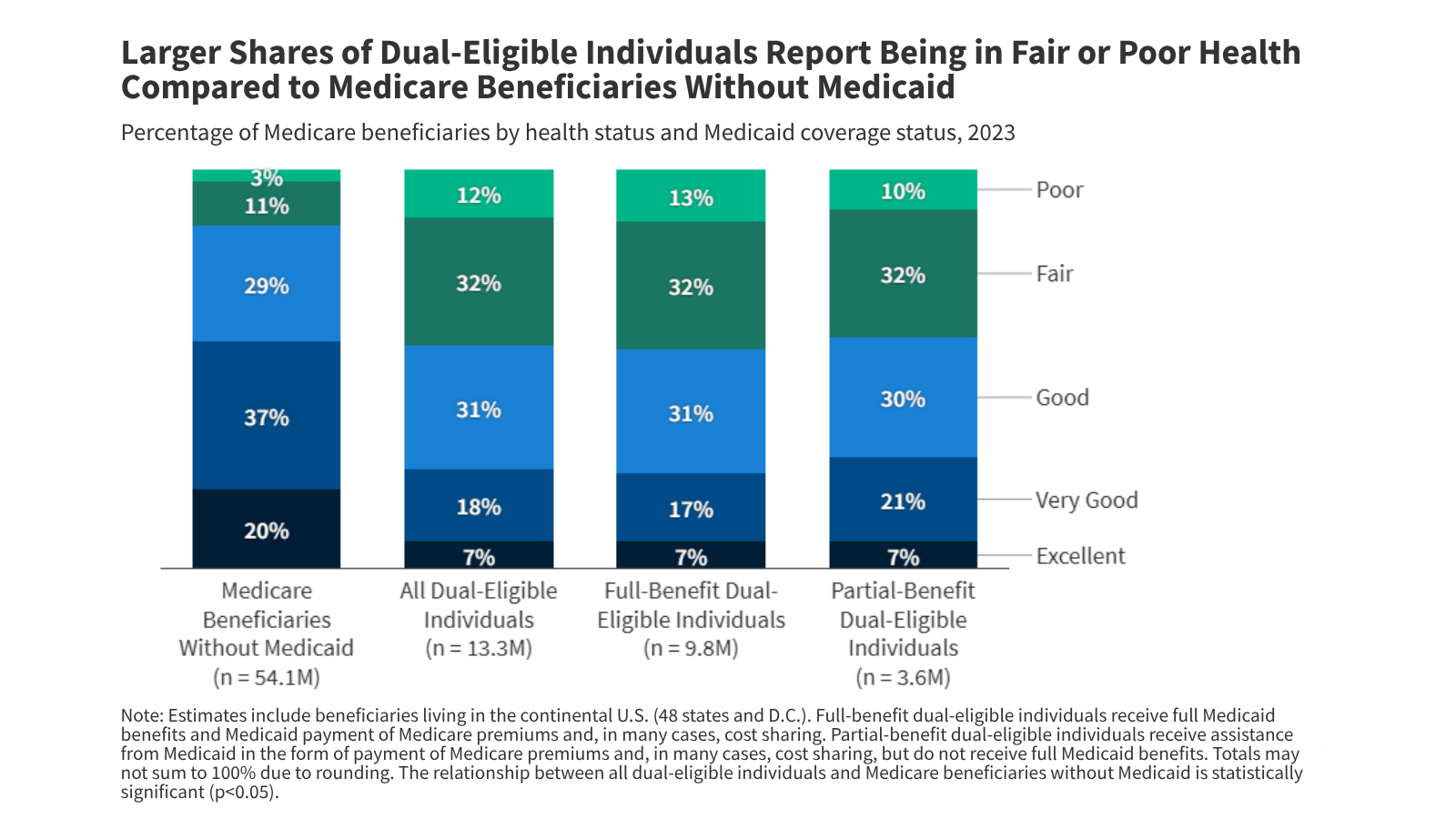
    On January 1, 2006, the six million Americans who are covered by both Medicare and Medicaid saw a change in how their prescription drugs are covered. The dual eligible population was transitioned from Medicaid into the Medicare prescription drug benefit. As a group, these beneficiaries are poorer and sicker than those on Medicare. Consequently, they have more extensive health and prescription drug needs than most Medicare beneficiaries.

  • Transitions 2005

    Video

    Transitions is a video that explores some of the issues and challenges “dual eligibles” may face during the transition from Medicaid drug coverage to Medicare.

  • Medicare and Medicaid at 40

    Video

    The Medicare and Medicaid health coverage programs were signed into law July 30, 1965. The Kaiser Family Foundation has some new resources that examine how Medicare and Medicaid came into existence and how they have evolved over the past 40 years. You will find new documentaries and extended interviews with key policymakers and government officials examining the origins of Medicare and Medicaid, new interactive historical timelines, a chart pack of key information and statistics, a webcast of a retrospective of the two programs with historian Robert Dallek and key government officials responsible for the programs over the past 40 years, and many other background resources on the two programs.

  • Medicaid at 40

    Video

    The Kaiser Family Foundation has produced three documentaries to mark the 40th anniversary of Medicare and Medicaid. The documentaries examine the social needs that led policymakers to create these programs, the expectations of what they would achieve and the reality of these programs today. Key policymakers, staff officials and members of Congress involved in the creation and implementation of Medicare and Medicaid are interviewed. Extensive use of historic video helps tell the story of these landmark social programs.

  • Health Reform Implementation Timeline

    Interactive

    The health reform implementation timeline is an interactive tool designed to explain how and when the provisions of the Affordable Care Act will be implemented over the next several years.

  • Health Affairs Article: Medicaid Expansion: Chronically Homeless Adults Will Need Targeted Enrollment and Access to a Broad Range of Services

    Issue Brief

    Homeless adults may gain access to health services under the Affordable Care Act’s Medicaid expansion, which takes effect in 2014. This study, published in Health Affairs, analyzed the health coverage, health status, and health services use of 725 chronically homeless adults with disabilities in eleven cities in the United States.