Medicaid

new and noteworthy

An Early Look at States’ Differing Approaches to Implementing Medicaid Work Requirements Amid Cost and Time Constraints and Uncertainty

A new KFF survey of state Medicaid officials and focus groups in eight states captures the different choices states are making about how to implement Medicaid work requirements, with seven states planning for a more restrictive approach to verifying work or exemption status or to implement work requirements early. These implementation plans are taking shape as states encounter time, cost, and other constraints as well as uncertainty about how to define and verify certain exemptions due to delayed federal guidance.

Medicaid Watch

Featuring policy research, polling and news about how Medicaid is changing, and the impact of those changes due to the tax and spending cuts law

Medicaid Work Requirements

Tracking Medicaid Work Requirements: u003cbru003eData and Policies

To implement Medicaid work requirements, states will need to make important policy and operational decisions, implement needed system upgrades or changes, develop new outreach and education strategies, and hire and train staff, all within a relatively short timeframe. The information tracked here can serve as a resource to understand Medicaid work requirements and state options, gauge readiness, and track implementation of the requirements.

understanding medicaid

Medicaid Financing

Medicaid represents $1 out of every $5 spent on health care in the U.S. and is the major source of financing for states to provide health coverage and long-term care. This brief examines key questions about Medicaid financing and how it works.

Medicaid and Provider Taxes

All states except Alaska cover some state Medicaid costs with taxes on health care providers. This brief uses data from KFF’s 2024-2025 survey of Medicaid directors to describe current practices and the federal rules governing them.

5 Facts: Medicaid and Hospitals

Absorbing reductions in Medicaid spending could be challenging for hospitals, particularly for those that are financially vulnerable. This brief provides data on the reach of Medicaid across hospitals, patients, and charity care.

Medicaid Home Care in 2025

This issue brief provides an overview of what Medicaid home care (also known as “home- and community-based services”) is, who is covered, and what services were available in 2025.

5 Facts: Medicaid Program Integrity

This brief explains what is known about improper payments and fraud and abuse in Medicaid and describes ongoing state and federal actions to address program integrity.

2025 Medicaid Home Care survey

Payment Rates Ahead of 2025 Reconciliation Law

This issue brief describes Medicaid payment rates for home care and other workforce supports that are in place in 2025, before the majority of the 2025 reconciliation law provisions start taking effect.

Home Care Support for Family Caregivers in 2025
number of responding states, including DC, that allow payments for family caregivers by type of home care program and type of caregiver.

This issue brief describes the availability of self-directed services and supports for family caregivers in Medicaid home care in 2025, before most provisions in the reconciliation law take effect.

States’ Management of Home Care Spending

This issue brief describes the mechanisms states are currently using to limit Medicaid spending on home care and their plans for adopting new mechanisms in state fiscal year (FY) 2026.

Waiting Lists for Medicaid Home Care, 2016 to 2025
A Look at Waiting Lists for Medicaid Home- and Community-Based Services from 2016 to 2025

This data note provides new information about waiting lists in Medicaid home care before many of the provisions in the 2025 reconciliation law go into effect.

Eligibility and coverage
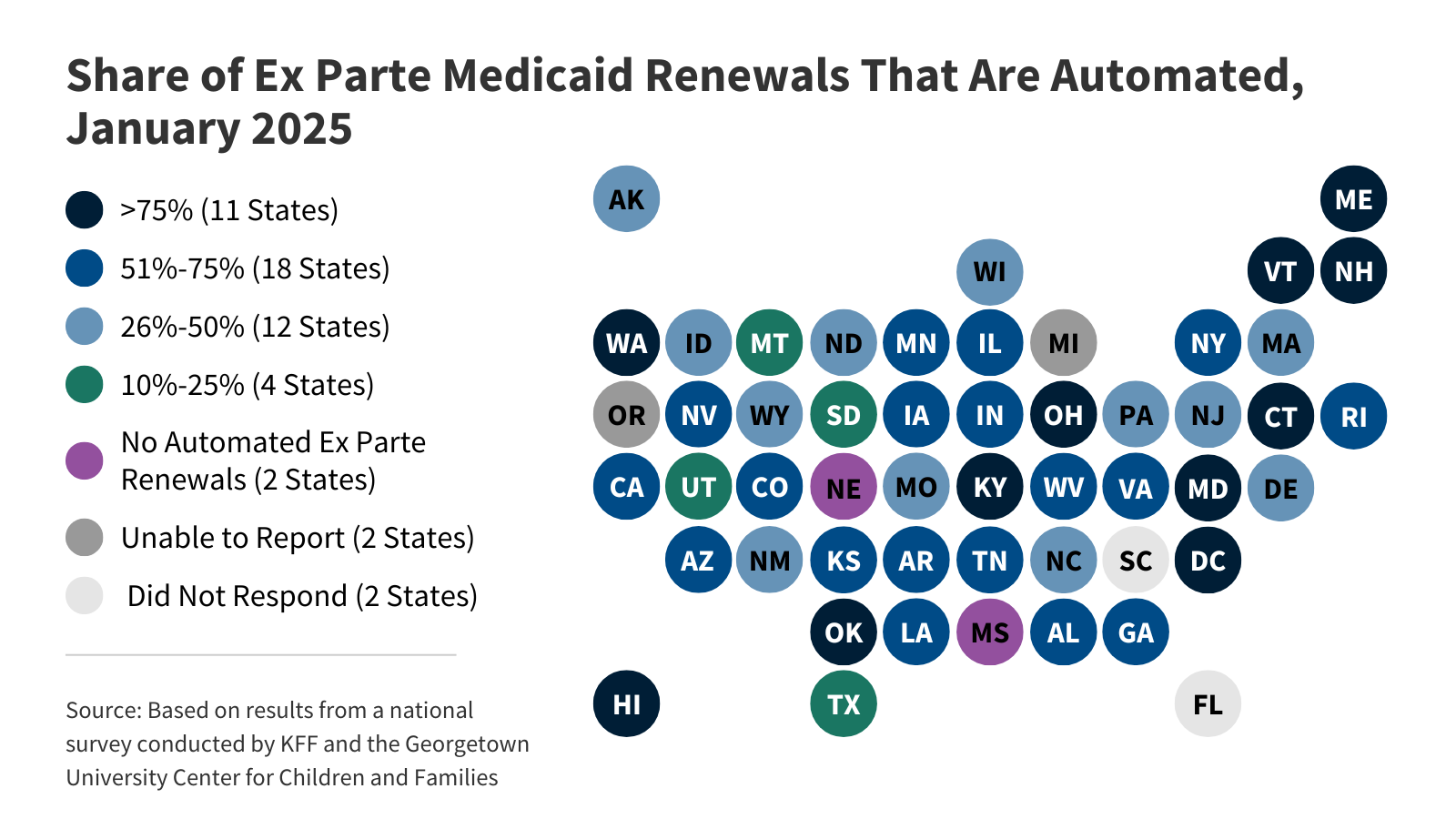
  • Eligibility, Enrollment, and Renewal Policies

    KFF's survey findings capture state actions that seek to improve the accuracy and efficiency of Medicaid and CHIP enrollment and renewal processes, as of January 2025.
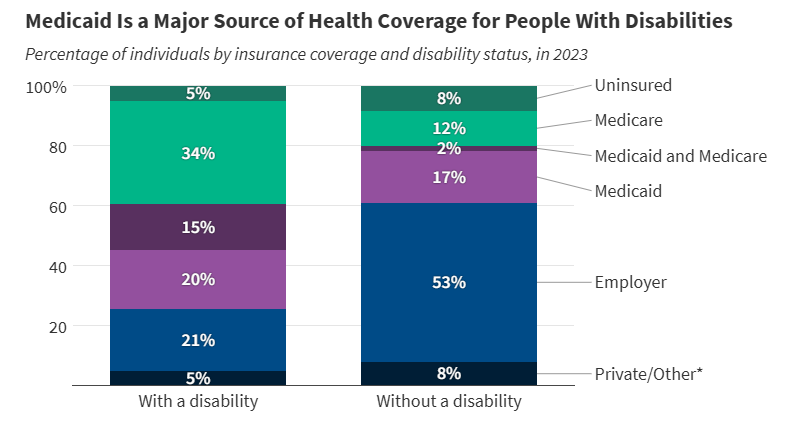
  • Seniors and People with Disabilities

    More than 1 in 3 people with disabilities (15 million) have Medicaid (35%). In comparison, only 19% of people without disabilities have Medicaid.
  • Children with Special Needs

    Amid debates about proposed cuts to federal Medicaid spending, this brief analyzes key characteristics of children with special health care needs and explores how Medicaid provides them with coverage.
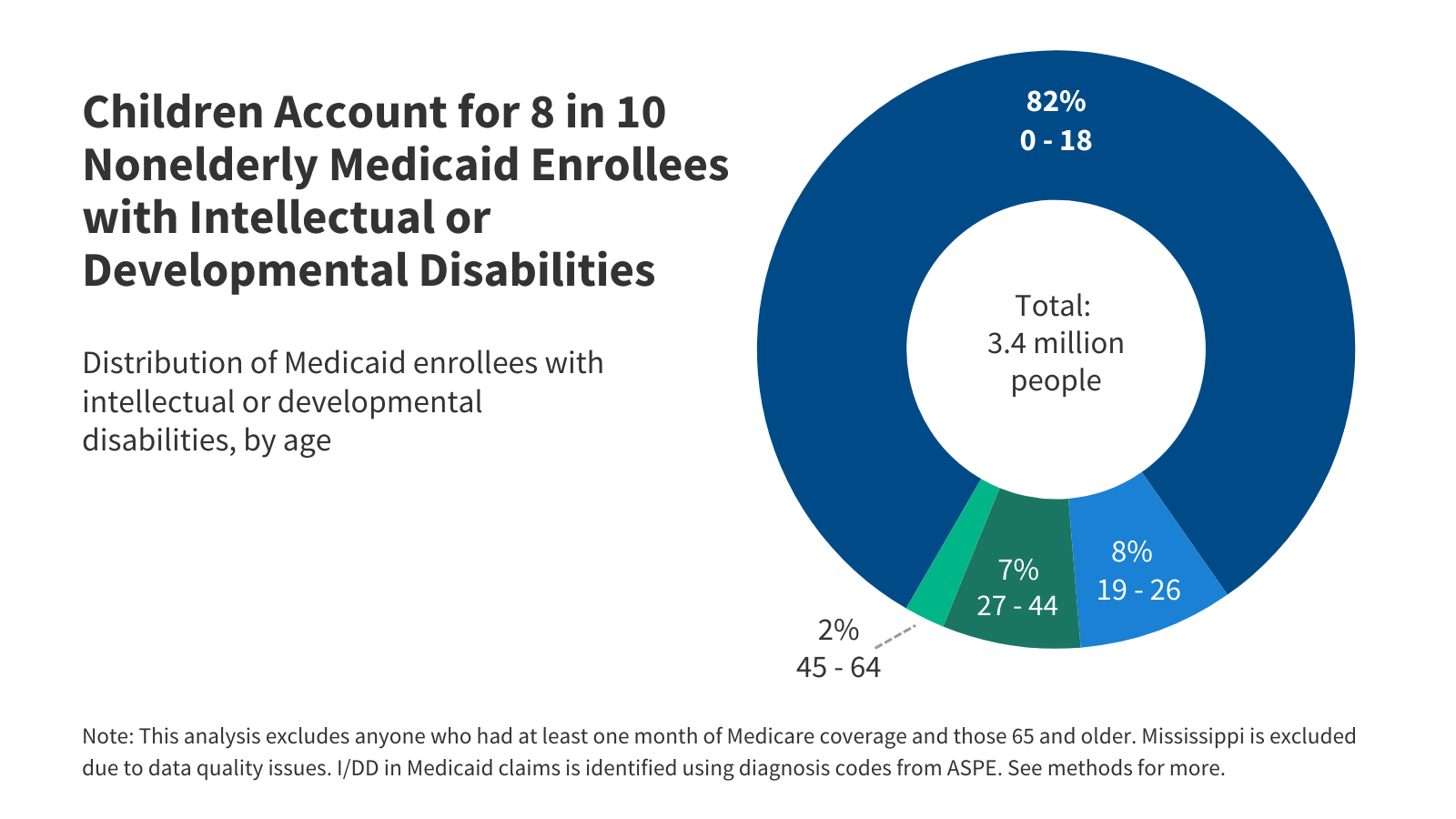
  • People With Intellectual and Developmental Disabilities

    Among the estimated 8 million people with intellectual and developmental disabilities (I/DD), over three million have Medicaid coverage.
  • Adults with Chronic Conditions

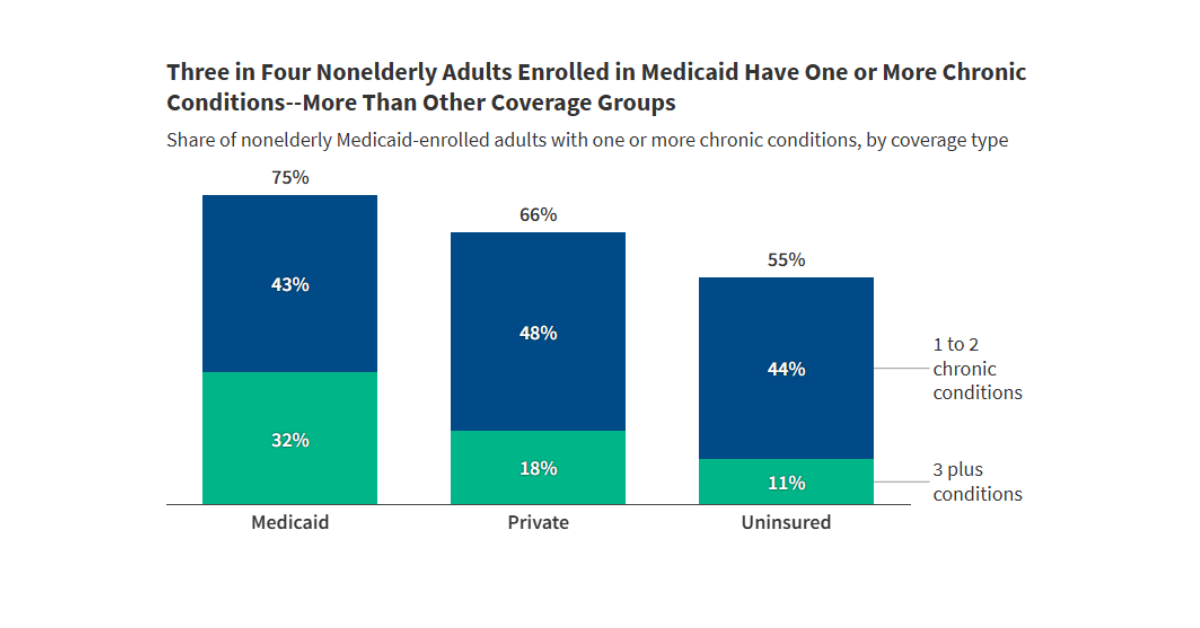
    Among working age adults enrolled in Medicaid, approximately three quarters have one or more chronic conditions, and nearly one-third have three or more.

Subscribe to KFF Emails

Choose which emails are best for you.
Sign up here

Filter

1,861 - 1,870 of 2,693 Results

  • CHIP TIPS: Children’s Oral Health Benefits

    Issue Brief

    This brief examines a new requirement under the Children's Health Insurance Program Reauthorization Act of 2009 that state CHIP programs cover comprehensive dental benefits. The reauthorization law also allows states with separate CHIP programs to offer a dental-only plan for children who have other health insurance but lack adequate dental benefits. Other oral health improvements in the law include education for new parents, better access to benefit and provider information and enhanced reporting on the…

  • Medicaid Financial Eligibility: Primary Pathways for the Elderly and People with Disabilities

    Issue Brief

    This issue brief details the various eligibility pathways by which individuals with disabilities and the elderly can qualify for Medicaid coverage. The program, which serves as a safety net for many of the nation’s poorest and sickest individuals, provides health coverage to nearly 60 million Americans, including 8.5 million with disabilities and 8.8 million low-income frail, elderly and disabled Medicare beneficiaries who rely on Medicaid to fill Medicare’s gaps.  Issue Brief (.pdf)

  • Resources Examine Medicaid Enrollment Growth And State Budget Pressures

    Fact Sheet

    This package of resources examines the substantial enrollment growth in Medicaid between June 2008 and June 2009 and provides a mid fiscal-year 2010 update on key state Medicaid issues, including the impacts of the economic downturn. News ReleaseWith the country in a deep recession, nearly 3.3 million more people were enrolled in state Medicaid programs in June 2009 compared to the previous June, according to a new analysis, Medicaid Enrollment: June 2009 Data Snapshot (updated for…

  • Kaiser Analysis Finds Record Medicaid Enrollment Growth in 2009

    News Release

    Largest Ever One-Year Increase Illustrates Medicaid’s Role In Covering People During Economic Downturns But Further Strains Tight State Budgets WASHINGTON, D.C.  – With the country mired in a deep recession, nearly 3.3 million more people were enrolled in state Medicaid programs in June 2009 compared to the previous June, according to a new analysis by the Kaiser Family Foundation’s Commission on Medicaid and the Uninsured.  It was the biggest ever one-year increase in terms of…

  • Pulling it Together: An Actuarial Rorschach Test

    Perspective

    Drew Altman, Larry Levitt, Gary Claxton My colleagues have worked on this column with me and I invited them to join me as authors. As with pretty much every other discussion of health care going back to the days of Roosevelt, the great reform debate of 2009 (and now 2010) has been distilled into an ideological battle over the role of government. A government-sponsored "public option" has been off the table for a while now,…

  • Medicaid’s Continuing Crunch In a Recession: A Mid-Year Update for State FY 2010 and Preview for FY 2011

    Report

    This report finds that 44 states and the District of Columbia are experiencing higher than expected program enrollment and spending for fiscal year 2010. At least 29 states say they are considering additional mid-year cuts in provider rates and program benefits. The recession and the scheduled end on Dec. 31, 2010 of enhanced federal matching money for Medicaid that was provided through the American Recovery and Reinvestment Act of 2009 will have a significant impact…

  • From Crunch to Crisis: State Budgets, Medicaid and the Economy

    Event Date:
    Event

    Medicaid programs are feeling the strain as enrollment grows while state revenues come in lower than projected. How are Medicaid directors coping? How is the recession affecting low-income individuals and families? This briefing, cosponsored by the Alliance for Health Reform and the Kaiser Commission on Medicaid and the Uninsured, addressed these and related questions. For more information, please visit the Alliance's event page. Full Video   Speakers for this session: The panel is co-moderated by…

  • Building an Express Lane Eligibility Initiative: A Roadmap of Key Decisions for States

    Issue Brief

    The Children's Health Insurance Program Reauthorization Act of 2009 (CHIPRA) provides states new options to reach and enroll the estimated 5 million eligible but uninsured low-income children into Medicaid and CHIP. One key tool provided to states by the law is Express Lane Eligibility (ELE), which allows state Medicaid and CHIP agencies to borrow and rely on eligibility findings from other need-based programs, such as Head Start and the National School Lunch Program, to determine…

  • Health Reform: How Will Medicaid Change? Tutorial

    Interactive

    This tutorial was produced for kaiserEDU.org, a Kaiser Family Foundation website that ceased production in September 2013. The kaiserEDU.org tutorials are no longer being updated but have been made available on kff.org due to demand by professors who are using the tutorials in class assignments. You may search for other tutorials to view on kff.org. To download this or other tutorials, visit the tutorials archive page.  Slides are available for download using the "Download Slides" link within the…

  • States Sustain and Expand Coverage For Low-Income Children and Families Despite Recession, But Gains Are Threatened By Impending End of Federal Assistance

    News Release

    New 50-State Survey Illustrates Key Role of CHIP Reauthorization and the Federal Stimulus Law in Safeguarding Coverage    WASHINGTON  – Despite the deep recession, most states have managed to safeguard and, in some cases, expand health coverage for children and parents in their Medicaid and Children's Health Insurance Programs in 2009, according to a new survey from the Kaiser Family Foundation's Commission on Medicaid and the Uninsured.  But the gains, which could serve as a…