Medicaid

new and noteworthy

An Early Look at States’ Differing Approaches to Implementing Medicaid Work Requirements Amid Cost and Time Constraints and Uncertainty

A new KFF survey of state Medicaid officials and focus groups in eight states captures the different choices states are making about how to implement Medicaid work requirements, with seven states planning for a more restrictive approach to verifying work or exemption status or to implement work requirements early. These implementation plans are taking shape as states encounter time, cost, and other constraints as well as uncertainty about how to define and verify certain exemptions due to delayed federal guidance.

Medicaid Watch

Featuring policy research, polling and news about how Medicaid is changing, and the impact of those changes due to the tax and spending cuts law

Medicaid Work Requirements

Tracking Medicaid Work Requirements: u003cbru003eData and Policies

To implement Medicaid work requirements, states will need to make important policy and operational decisions, implement needed system upgrades or changes, develop new outreach and education strategies, and hire and train staff, all within a relatively short timeframe. The information tracked here can serve as a resource to understand Medicaid work requirements and state options, gauge readiness, and track implementation of the requirements.

understanding medicaid

Medicaid Financing

Medicaid represents $1 out of every $5 spent on health care in the U.S. and is the major source of financing for states to provide health coverage and long-term care. This brief examines key questions about Medicaid financing and how it works.

Medicaid and Provider Taxes

All states except Alaska cover some state Medicaid costs with taxes on health care providers. This brief uses data from KFF’s 2024-2025 survey of Medicaid directors to describe current practices and the federal rules governing them.

5 Facts: Medicaid and Hospitals

Absorbing reductions in Medicaid spending could be challenging for hospitals, particularly for those that are financially vulnerable. This brief provides data on the reach of Medicaid across hospitals, patients, and charity care.

Medicaid Home Care in 2025

This issue brief provides an overview of what Medicaid home care (also known as “home- and community-based services”) is, who is covered, and what services were available in 2025.

5 Facts: Medicaid Program Integrity

This brief explains what is known about improper payments and fraud and abuse in Medicaid and describes ongoing state and federal actions to address program integrity.

2025 Medicaid Home Care survey

Payment Rates Ahead of 2025 Reconciliation Law

This issue brief describes Medicaid payment rates for home care and other workforce supports that are in place in 2025, before the majority of the 2025 reconciliation law provisions start taking effect.

Home Care Support for Family Caregivers in 2025
number of responding states, including DC, that allow payments for family caregivers by type of home care program and type of caregiver.

This issue brief describes the availability of self-directed services and supports for family caregivers in Medicaid home care in 2025, before most provisions in the reconciliation law take effect.

States’ Management of Home Care Spending

This issue brief describes the mechanisms states are currently using to limit Medicaid spending on home care and their plans for adopting new mechanisms in state fiscal year (FY) 2026.

Waiting Lists for Medicaid Home Care, 2016 to 2025
A Look at Waiting Lists for Medicaid Home- and Community-Based Services from 2016 to 2025

This data note provides new information about waiting lists in Medicaid home care before many of the provisions in the 2025 reconciliation law go into effect.

Eligibility and coverage
  • Eligibility, Enrollment, and Renewal Policies

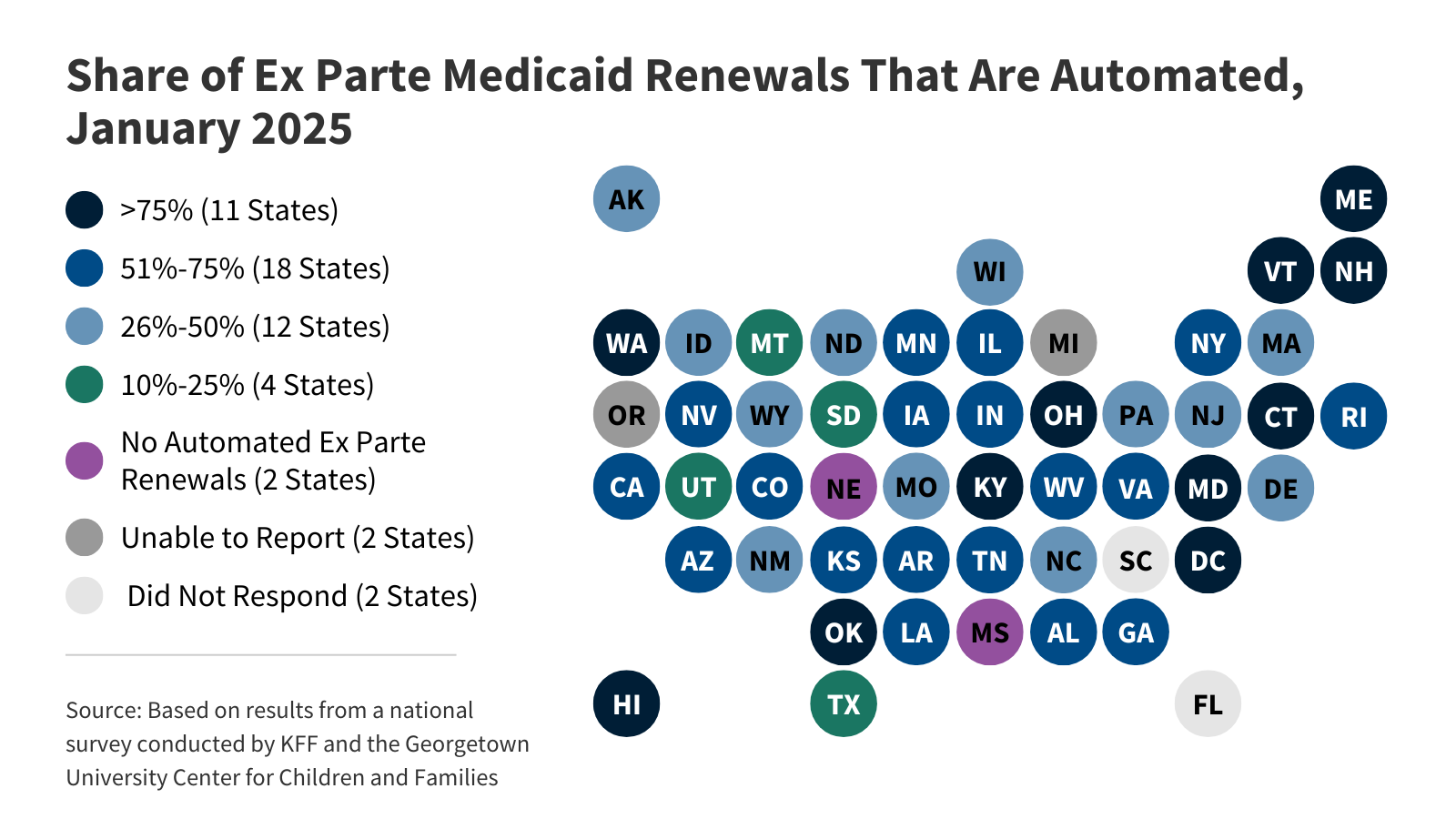
    KFF's survey findings capture state actions that seek to improve the accuracy and efficiency of Medicaid and CHIP enrollment and renewal processes, as of January 2025.
  • Seniors and People with Disabilities

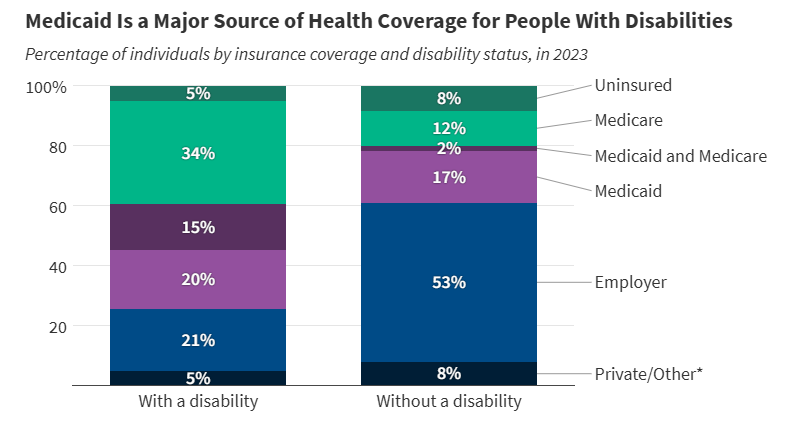
    More than 1 in 3 people with disabilities (15 million) have Medicaid (35%). In comparison, only 19% of people without disabilities have Medicaid.
  • Children with Special Needs

    Amid debates about proposed cuts to federal Medicaid spending, this brief analyzes key characteristics of children with special health care needs and explores how Medicaid provides them with coverage.
  • People With Intellectual and Developmental Disabilities

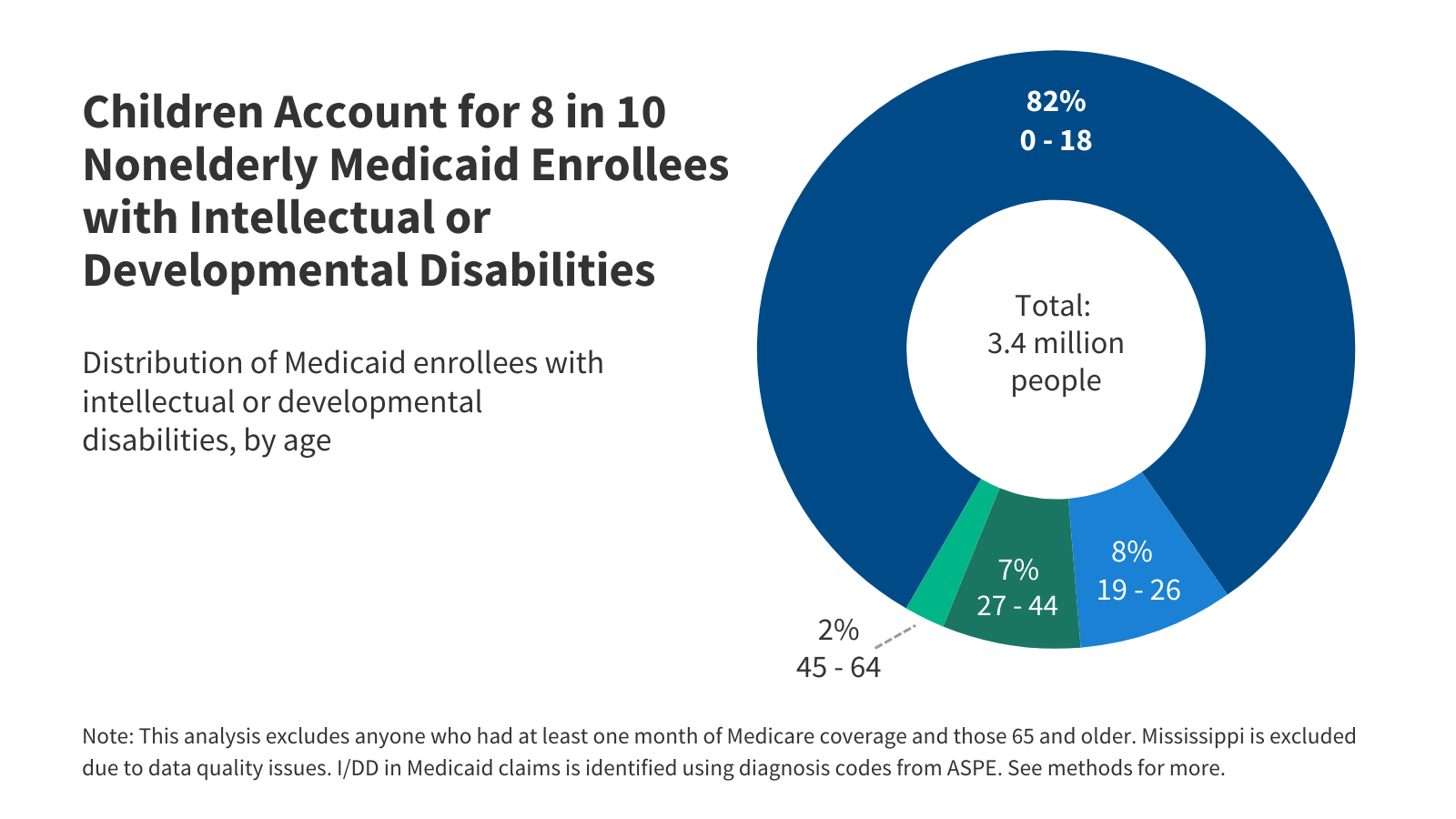
    Among the estimated 8 million people with intellectual and developmental disabilities (I/DD), over three million have Medicaid coverage.
  • Adults with Chronic Conditions

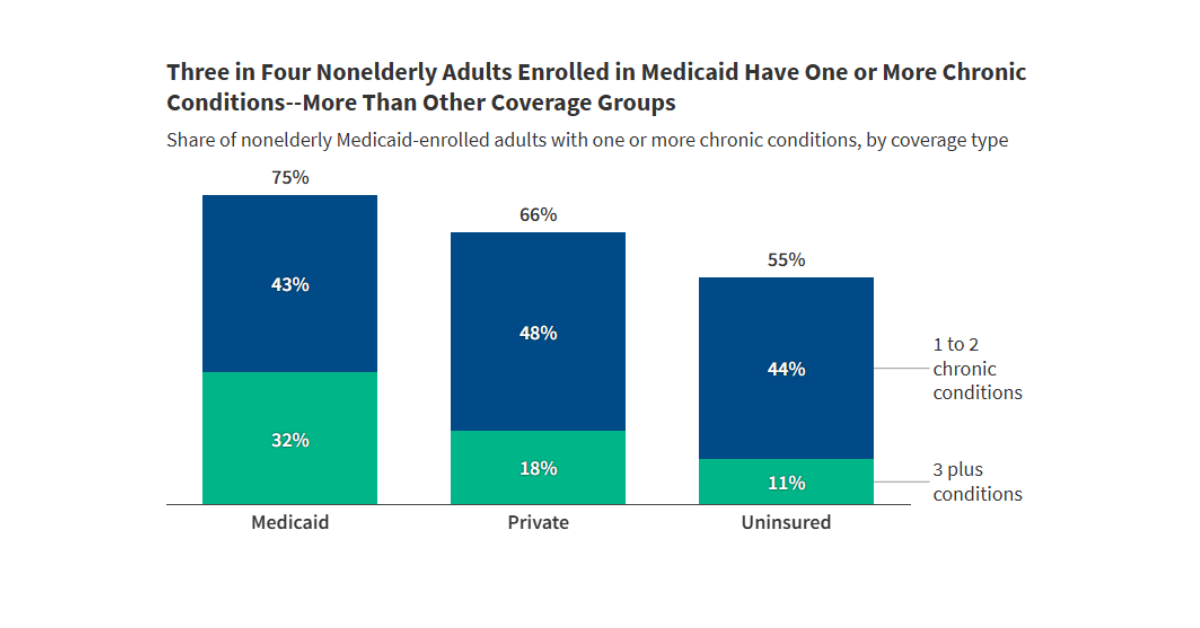
    Among working age adults enrolled in Medicaid, approximately three quarters have one or more chronic conditions, and nearly one-third have three or more.

Subscribe to KFF Emails

Choose which emails are best for you.
Sign up here

Filter

1,791 - 1,800 of 2,692 Results

  • Federal Core Requirements And State Options In Medicaid: Current Policies And Key Issues

    Fact Sheet

    Medicaid is a jointly financed partnership between the federal government and states. The federal-state financing and administrative structure of Medicaid provides a framework of federal core requirements along with broad state options for program design and administration. This issue brief presents an overview of the current Medicaid program framework, with a focus on eligibility, benefits and cost sharing, care delivery and provider payment, long-term services and supports, and dual eligibles, as well as key issues…

  • Medicaid Policy Options for Meeting the Needs of Adults with Mental Illness under the Affordable Care Act

    Issue Brief

    This paper examines the salient issues raised in a November 2010 roundtable discussion of national and state experts convened by the Kaiser Commission on Medicaid and the Uninsured, in partnership with the Bazelon Center for Mental Health Law, to discuss Medicaid policy options available under health reform to help meet the needs of adults with mental illness. The Patient Protection and Affordable Care Act will expand the Medicaid program, offering the opportunity to improve access…

  • Mental Health Financing in the United States: A Primer

    Report

    This primer provides an overview of behavioral health care, reviews the sources of financing for such care, assesses the interaction between different payers, and highlights recent policy debates in mental health. It also discusses the role of Medicaid, currently the largest source of financing for behavioral health services in the nation, covering a quarter of all expenditures. This comprehensive resource serves as a guide for those who want to understand the complex system of behavioral…

  • Implications Of A Federal Block Grant Program For Medicaid

    Issue Brief

    This issue brief examines the broad implications of converting Medicaid to block grant financing, one of several ideas that have been put forth to help reduce the federal deficit. The paper, which does not analyze any specific proposal, notes that switching to block grant financing would fundamentally alter the Medicaid program and could have significant implications for states, localities, beneficiaries and health care providers. Issue Brief (.pdf) Related Resources: Prior Analyses of Block Grant Proposals…

  • Comparison of Medicaid Provisions in Deficit-Reduction Proposals

    Issue Brief

    In response to mounting concern about the nation’s rising debt and deficit, and increasing apprehension about the federal budget, prominent leaders and various commissions have come forward with recommendations to strengthen the economy and bolster the nation’s fiscal health. These proposals include both tax increases and spending reductions in discretionary programs, including defense, and in mandatory programs, such as Social Security, Medicare, and Medicaid. This document provides a brief description of the key Medicaid changes…

  • Medicaid: A Primer on the Federal-State Partnership

    Event Date:
    Event

    This briefing provided an overview of the Medicaid program and its role in the health care system. Panelists discussed who is eligible for Medicaid, what benefits are covered, how the program is administered. Medicaid financing and the program’s role in health reform was also explained. More information on Medicaid from the Kaiser Family Foundation can be found in the related documents below. This March 4 briefing was cosponsored by the Kaiser Family Foundation and the…

  • Mobile Technology: Smart Tools to Increase Participation in Health Coverage

    Issue Brief

    As mobile technology advances and cell phone use continues to increase across demographic groups, there is significant potential to tap these technologies to facilitate enrollment in and retention of health coverage, in both the immediate term and as health reform is implemented. A brief produced in conjunction with The Children's Partnership examines how various tools and strategies, including text messages and smart phone apps, can be used to advance coverage goals. The report focuses especially…

  • Improving Access to Adult Primary Care in Medicaid: Exploring the Potential Role of Nurse Practitioners and Physician Assistants

    Issue Brief

    The inadequate supply of primary care providers is among the major challenges facing the U.S. health care system. Sixty-five million people live in areas designated by the federal government as having a shortage of primary care providers. Under the Patient Protection and Affordable Care Act (ACA), the pressures on access are certain to grow as millions of newly insured people enter the health care system. By 2020, the U.S. will face an estimated shortage of…

  • Medicaid Matters: Understanding Medicaid’s Role in Our Health Care System

    Fact Sheet

    This fact sheet provides key information about the Medicaid program and its role in our health care system and state economies. The nation’s public health insurance program for low-income people is counter-cyclical, expanding during the recent recession to assist millions of individuals and families affected by the loss of jobs and job-based health insurance. While the program has worked as intended, economic conditions have contributed to growing pressure on state budgets and Medicaid funding. This…

  • Determining Income for Adults Applying for Medicaid and Exchange Coverage Subsidies: How Income Measured With a Prior Tax Return Compares to Current Income at Enrollment

    Issue Brief

    A major goal of the Patient Protection and Affordable Care Act (ACA) is to significantly expand coverage and reduce the number of uninsured. Beginning in 2014, the ACA will establish a new continuum of coverage that will provide assistance to individuals with incomes up to 400% of poverty through a broad expansion in Medicaid and by making premium tax credits available to eligible individuals to purchase coverage through new Health Insurance Exchanges. The law standardizes…