Medicaid

new and noteworthy

An Early Look at States’ Differing Approaches to Implementing Medicaid Work Requirements Amid Cost and Time Constraints and Uncertainty

A new KFF survey of state Medicaid officials and focus groups in eight states captures the different choices states are making about how to implement Medicaid work requirements, with seven states planning for a more restrictive approach to verifying work or exemption status or to implement work requirements early. These implementation plans are taking shape as states encounter time, cost, and other constraints as well as uncertainty about how to define and verify certain exemptions due to delayed federal guidance.

Medicaid Watch

Featuring policy research, polling and news about how Medicaid is changing, and the impact of those changes due to the tax and spending cuts law

Medicaid Work Requirements

Tracking Medicaid Work Requirements: u003cbru003eData and Policies

To implement Medicaid work requirements, states will need to make important policy and operational decisions, implement needed system upgrades or changes, develop new outreach and education strategies, and hire and train staff, all within a relatively short timeframe. The information tracked here can serve as a resource to understand Medicaid work requirements and state options, gauge readiness, and track implementation of the requirements.

understanding medicaid

Medicaid Financing

Medicaid represents $1 out of every $5 spent on health care in the U.S. and is the major source of financing for states to provide health coverage and long-term care. This brief examines key questions about Medicaid financing and how it works.

Medicaid and Provider Taxes

All states except Alaska cover some state Medicaid costs with taxes on health care providers. This brief uses data from KFF’s 2024-2025 survey of Medicaid directors to describe current practices and the federal rules governing them.

5 Facts: Medicaid and Hospitals

Absorbing reductions in Medicaid spending could be challenging for hospitals, particularly for those that are financially vulnerable. This brief provides data on the reach of Medicaid across hospitals, patients, and charity care.

Medicaid Home Care in 2025

This issue brief provides an overview of what Medicaid home care (also known as “home- and community-based services”) is, who is covered, and what services were available in 2025.

5 Facts: Medicaid Program Integrity

This brief explains what is known about improper payments and fraud and abuse in Medicaid and describes ongoing state and federal actions to address program integrity.

2025 Medicaid Home Care survey

Payment Rates Ahead of 2025 Reconciliation Law

This issue brief describes Medicaid payment rates for home care and other workforce supports that are in place in 2025, before the majority of the 2025 reconciliation law provisions start taking effect.

Home Care Support for Family Caregivers in 2025
number of responding states, including DC, that allow payments for family caregivers by type of home care program and type of caregiver.

This issue brief describes the availability of self-directed services and supports for family caregivers in Medicaid home care in 2025, before most provisions in the reconciliation law take effect.

States’ Management of Home Care Spending

This issue brief describes the mechanisms states are currently using to limit Medicaid spending on home care and their plans for adopting new mechanisms in state fiscal year (FY) 2026.

Waiting Lists for Medicaid Home Care, 2016 to 2025
A Look at Waiting Lists for Medicaid Home- and Community-Based Services from 2016 to 2025

This data note provides new information about waiting lists in Medicaid home care before many of the provisions in the 2025 reconciliation law go into effect.

Eligibility and coverage
  • Eligibility, Enrollment, and Renewal Policies

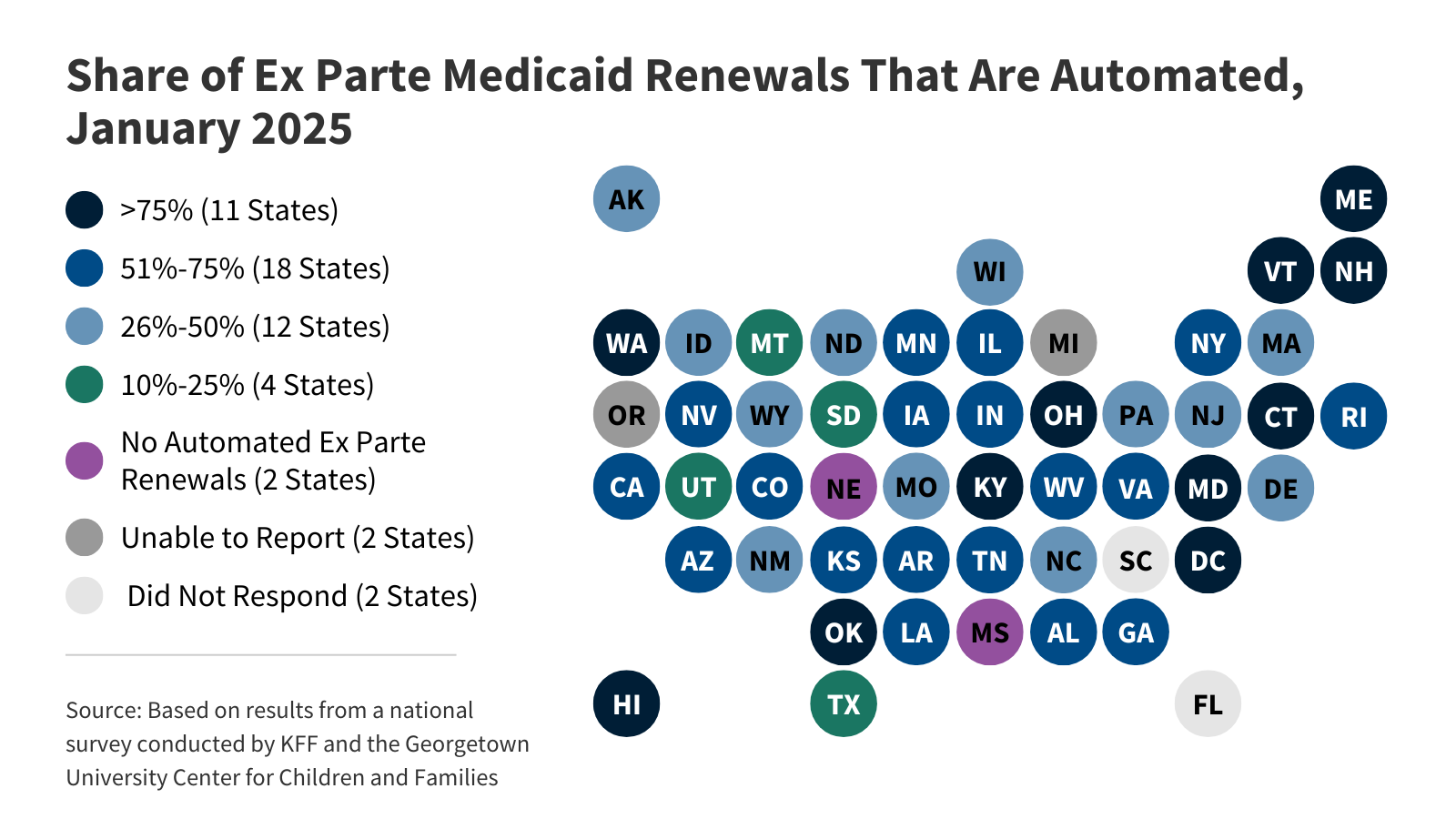
    KFF's survey findings capture state actions that seek to improve the accuracy and efficiency of Medicaid and CHIP enrollment and renewal processes, as of January 2025.
  • Seniors and People with Disabilities

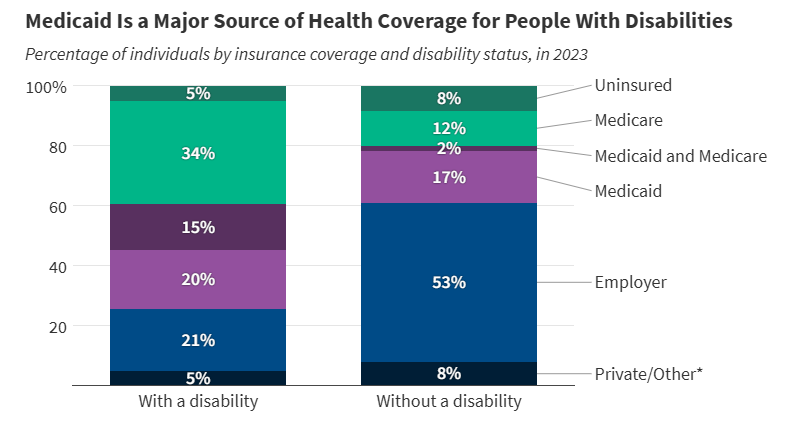
    More than 1 in 3 people with disabilities (15 million) have Medicaid (35%). In comparison, only 19% of people without disabilities have Medicaid.
  • Children with Special Needs

    Amid debates about proposed cuts to federal Medicaid spending, this brief analyzes key characteristics of children with special health care needs and explores how Medicaid provides them with coverage.
  • People With Intellectual and Developmental Disabilities

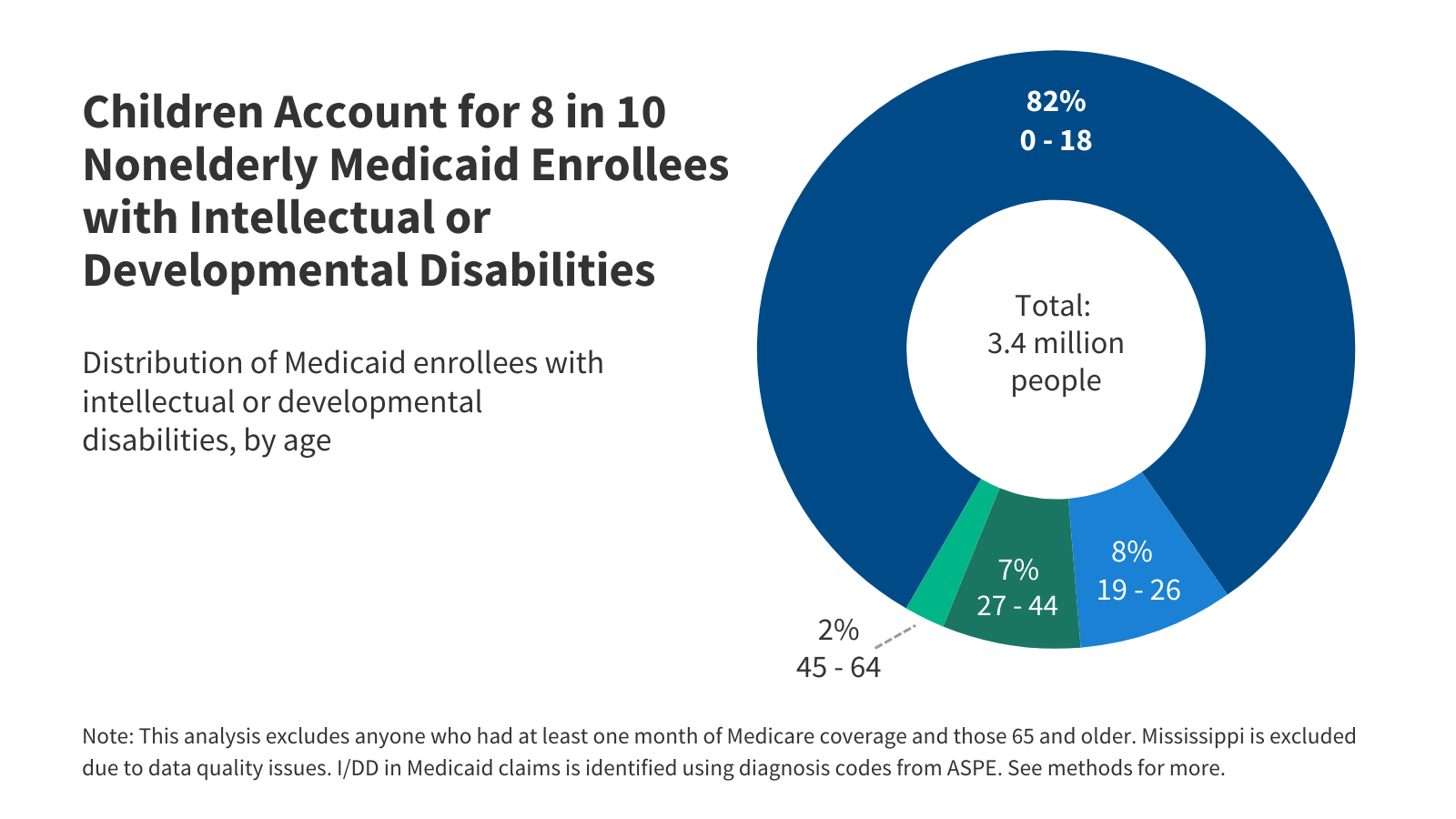
    Among the estimated 8 million people with intellectual and developmental disabilities (I/DD), over three million have Medicaid coverage.
  • Adults with Chronic Conditions

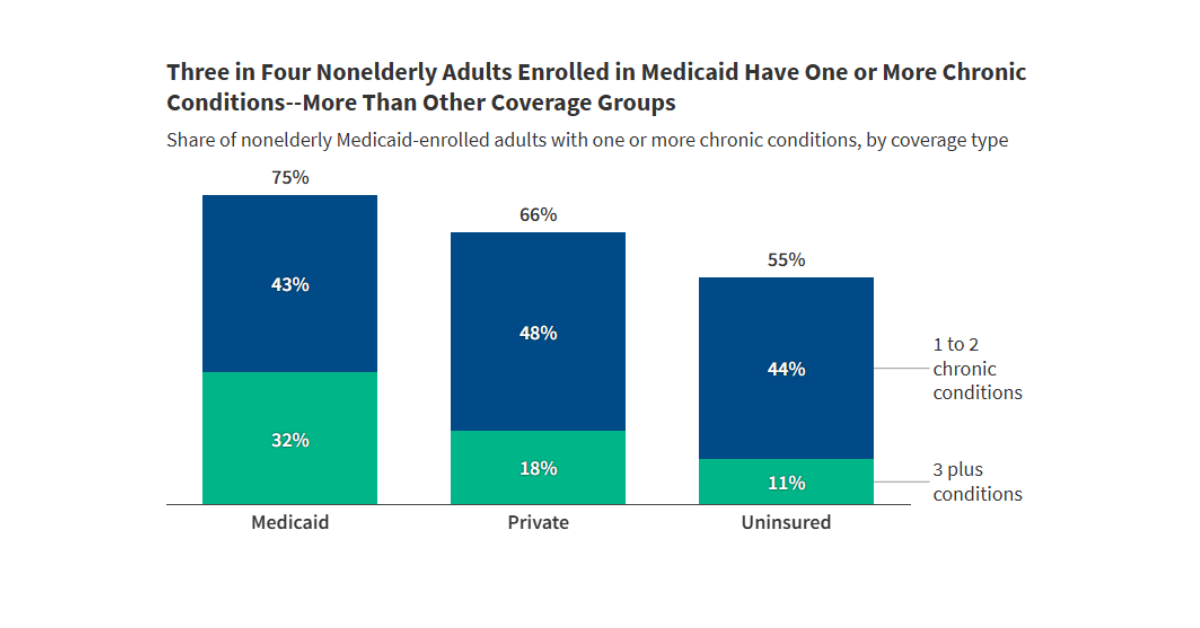
    Among working age adults enrolled in Medicaid, approximately three quarters have one or more chronic conditions, and nearly one-third have three or more.

Subscribe to KFF Emails

Choose which emails are best for you.
Sign up here

Filter

1,691 - 1,700 of 2,693 Results

  • An Overview of Recent Section 1115 Medicaid Demonstration Waiver Activity

    Issue Brief

    This brief summarizes and examines the implications of recent Section 1115 Medicaid waiver activity. Section 1115 waivers provide states flexibility to test new approaches in Medicaid that differ from federal program rules and can have significant impacts for beneficiaries, providers, and states. While recent waivers and waiver proposals vary in their specific goals and approaches, some key themes are emerging, including using Section 1115 waiver authority to get a jump start on the 2014 Medicaid…

  • Quick Take: Medicaid MCOs and Medical Loss Ratio (MLR) Requirements

    Fact Sheet

    One mechanism for ensuring that health insurance provides value to consumers for the premiums that they pay, or that others pay on their behalf, is to require insurers to meet a minimum “medical loss ratio” or MLR standard. The MLR is the share of premium revenues that an insurer or health plan spends on patient care and quality improvement activities, as opposed to administration and profits. In a recent 50-state survey on Medicaid managed care,…

  • Federal Funding Under the Affordable Care Act

    Fact Sheet

    This fact sheet provides highlights from an analysis tracking the flow of federal Affordable Care Act funds to states as reporter in the Department of Health and Human Services grant database as well as periodic reports from HHS and the Internal Revenue Service. The analysis distinguishes between funds awarded to state and local governments (including state and local health departments and school districts) and private entities (including private employers, health centers, universities, and other community-based…

  • Medicare’s Role for Dual Eligible Beneficiaries

    Issue Brief

    About 9 million low-income seniors and younger people with disabilities in the United States are covered by both Medicare and Medicaid. This brief examines the role of Medicare in providing health coverage for these beneficiaries. Medicare is the primary source of health insurance, while Medicaid provides supplemental coverage, helping with premiums and cost-sharing and paying for services not covered by Medicare. This brief examines overall and per capita Medicare spending for these beneficiaries, including variations…

  • States Getting a Jump Start on Health Reform’s Medicaid Expansion

    Issue Brief

    One of the primary goals of the Affordable Care Act (ACA) is to decrease the number of uninsured through a Medicaid expansion to nearly all individuals with incomes up to 133 percent of the federal poverty level (FPL) ($14,856 for an individual or $25,390 for a family of three in 2012) and the creation of new health insurance exchanges. These coverage expansions, which will take effect in 2014, will eventually cover about 32 million uninsured…

  • An Update on CMS’s Capitated Financial Alignment Demonstration Model For Medicare-Medicaid Enrollees

    Issue Brief

    Beginning in January, 2013, the Centers for Medicare and Medicaid Services (CMS) will implement a three year multi-state demonstration to test new service delivery and payment models for people dually eligible for Medicare and Medicaid. These demonstrations will enroll full dual eligibles in managed fee-for-service or capitated managed care plans that seek to integrate benefits and align financial incentives between the two programs. On January 25, 2012, CMS issued a memorandum providing additional guidance for…

  • The Diversity of Dual Eligible Beneficiaries: An Examination of Services and Spending for People Eligible for Both Medicaid and Medicare

    Issue Brief

    This issue brief analyzes linked Medicare and Medicaid data to examine dual eligibles' utilization and spending in both programs in 2007. As a group, dual eligibles are costly—with per capita Medicare and Medicaid spending over four times Medicare spending for other beneficiaries. However, a small share of dual eligibles account for most of the group's spending, and dual eligibles who are high cost to the Medicare program are generally not the same individuals who are…

  • Among Dual Eligibles, Identifying The Highest Cost Individuals Could Help In Crafting More Targeted And Effective Responses

    Report

    This Health Affairs article by researchers at the Urban Institute analyzes linked Medicare and Medicaid data to examine dual eligibles' utilization and spending in both programs in 2007. It finds that while the population of people dually eligible for Medicare and Medicaid is indeed costly, it is not monolithic. For instance, although 20 percent of dual eligibles accounted for more than 60 percent of combined Medicaid and Medicare spending, nearly 40 percent of dual eligibles…

  • Using Data and Technology to Drive Process Improvement in Medicaid and CHIP: Lessons From South Carolina

    Fact Sheet

    In the past year, there has been a notable trend of states increasingly utilizing data and technology to modernize, streamline, and gain efficiencies in their Medicaid and CHIP programs. The expanded use of data and technology is not only helping states deal with current budget pressures and decreased administrative resources, but also lays important groundwork for the coverage expansions and new coordinated, streamlined, and technology-driven enrollment process that will go into effect in 2014 under…

  • The Health Reform Law’s Medicaid Expansion: A Guide to the Supreme Court Arguments

    Issue Brief

    One significant element of the pending U.S. Supreme Court case challenging the Affordable Care Act is the constitutionality of the law's Medicaid expansion. This provision of the law requires states that choose to participate in the Medicaid program to cover nearly all adults under age 65 with household incomes at or below 133% of the federal poverty level as of January 2014. A ruling on the Medicaid expansion could have far-reaching impacts on the present…