Medicaid

new and noteworthy

An Early Look at States’ Differing Approaches to Implementing Medicaid Work Requirements Amid Cost and Time Constraints and Uncertainty

A new KFF survey of state Medicaid officials and focus groups in eight states captures the different choices states are making about how to implement Medicaid work requirements, with seven states planning for a more restrictive approach to verifying work or exemption status or to implement work requirements early. These implementation plans are taking shape as states encounter time, cost, and other constraints as well as uncertainty about how to define and verify certain exemptions due to delayed federal guidance.

Medicaid Watch

Featuring policy research, polling and news about how Medicaid is changing, and the impact of those changes due to the tax and spending cuts law

Medicaid Work Requirements

Tracking Medicaid Work Requirements: u003cbru003eData and Policies

To implement Medicaid work requirements, states will need to make important policy and operational decisions, implement needed system upgrades or changes, develop new outreach and education strategies, and hire and train staff, all within a relatively short timeframe. The information tracked here can serve as a resource to understand Medicaid work requirements and state options, gauge readiness, and track implementation of the requirements.

understanding medicaid

Medicaid Financing

Medicaid represents $1 out of every $5 spent on health care in the U.S. and is the major source of financing for states to provide health coverage and long-term care. This brief examines key questions about Medicaid financing and how it works.

Medicaid and Provider Taxes

All states except Alaska cover some state Medicaid costs with taxes on health care providers. This brief uses data from KFF’s 2024-2025 survey of Medicaid directors to describe current practices and the federal rules governing them.

5 Facts: Medicaid and Hospitals

Absorbing reductions in Medicaid spending could be challenging for hospitals, particularly for those that are financially vulnerable. This brief provides data on the reach of Medicaid across hospitals, patients, and charity care.

Medicaid Home Care in 2025

This issue brief provides an overview of what Medicaid home care (also known as “home- and community-based services”) is, who is covered, and what services were available in 2025.

5 Facts: Medicaid Program Integrity

This brief explains what is known about improper payments and fraud and abuse in Medicaid and describes ongoing state and federal actions to address program integrity.

2025 Medicaid Home Care survey

Payment Rates Ahead of 2025 Reconciliation Law

This issue brief describes Medicaid payment rates for home care and other workforce supports that are in place in 2025, before the majority of the 2025 reconciliation law provisions start taking effect.

Home Care Support for Family Caregivers in 2025
number of responding states, including DC, that allow payments for family caregivers by type of home care program and type of caregiver.

This issue brief describes the availability of self-directed services and supports for family caregivers in Medicaid home care in 2025, before most provisions in the reconciliation law take effect.

States’ Management of Home Care Spending

This issue brief describes the mechanisms states are currently using to limit Medicaid spending on home care and their plans for adopting new mechanisms in state fiscal year (FY) 2026.

Waiting Lists for Medicaid Home Care, 2016 to 2025
A Look at Waiting Lists for Medicaid Home- and Community-Based Services from 2016 to 2025

This data note provides new information about waiting lists in Medicaid home care before many of the provisions in the 2025 reconciliation law go into effect.

Eligibility and coverage
  • Eligibility, Enrollment, and Renewal Policies

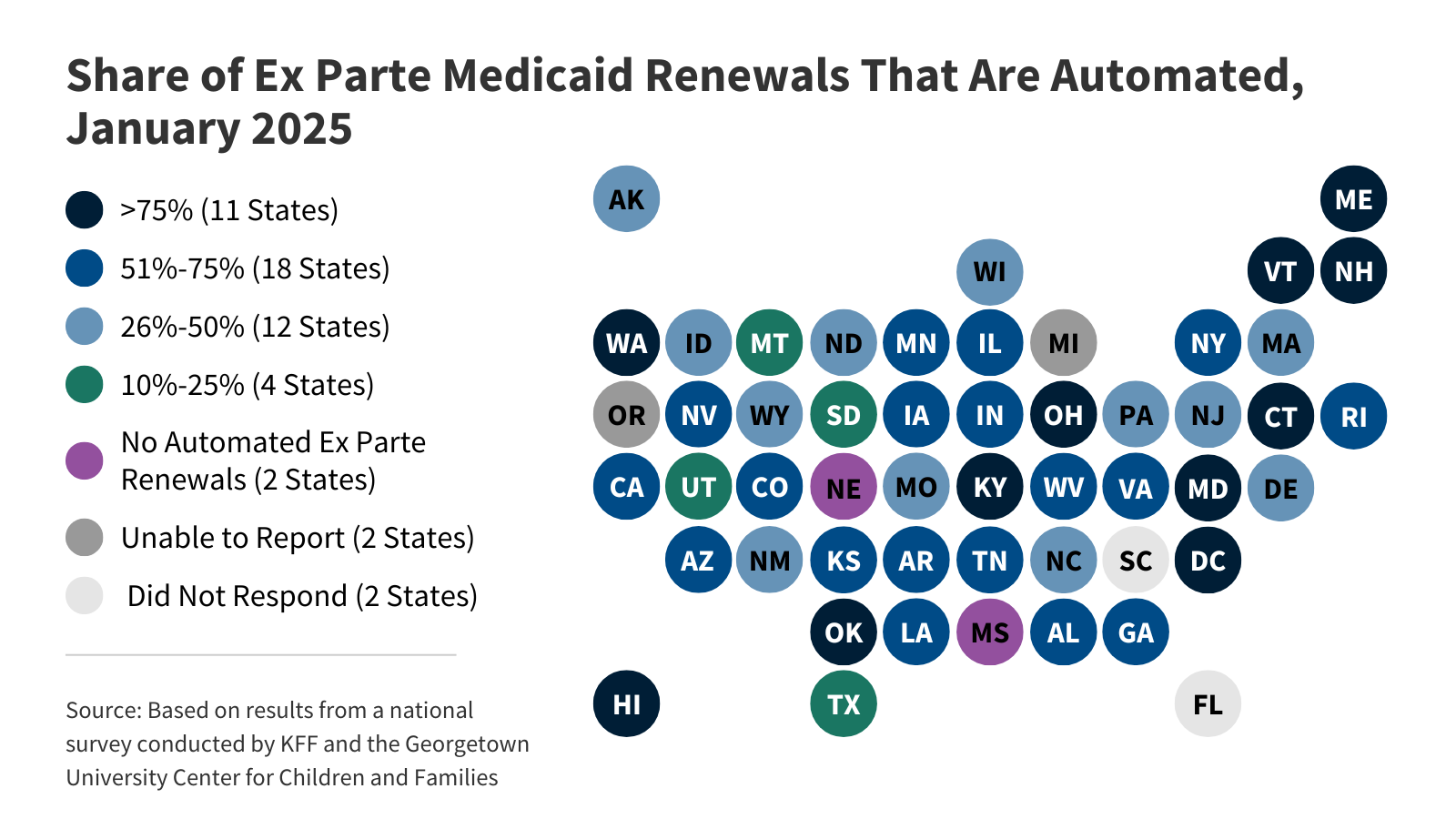
    KFF's survey findings capture state actions that seek to improve the accuracy and efficiency of Medicaid and CHIP enrollment and renewal processes, as of January 2025.
  • Seniors and People with Disabilities

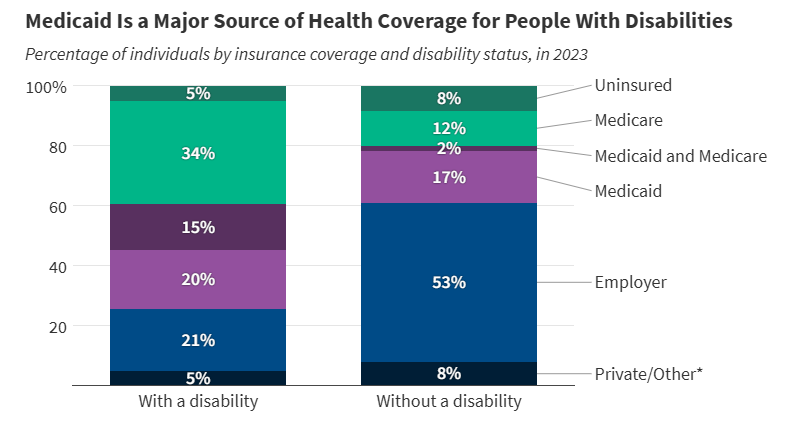
    More than 1 in 3 people with disabilities (15 million) have Medicaid (35%). In comparison, only 19% of people without disabilities have Medicaid.
  • Children with Special Needs

    Amid debates about proposed cuts to federal Medicaid spending, this brief analyzes key characteristics of children with special health care needs and explores how Medicaid provides them with coverage.
  • People With Intellectual and Developmental Disabilities

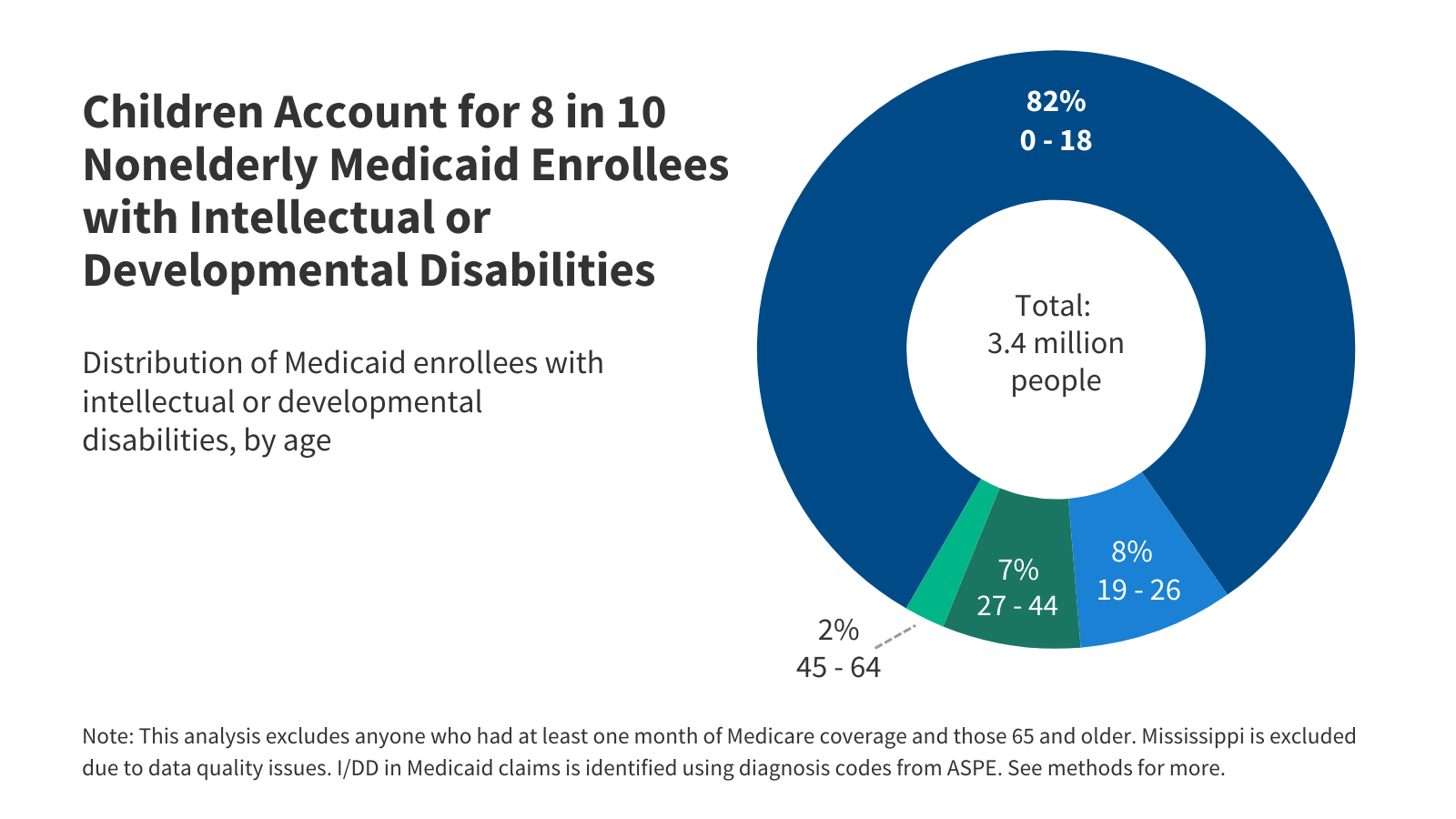
    Among the estimated 8 million people with intellectual and developmental disabilities (I/DD), over three million have Medicaid coverage.
  • Adults with Chronic Conditions

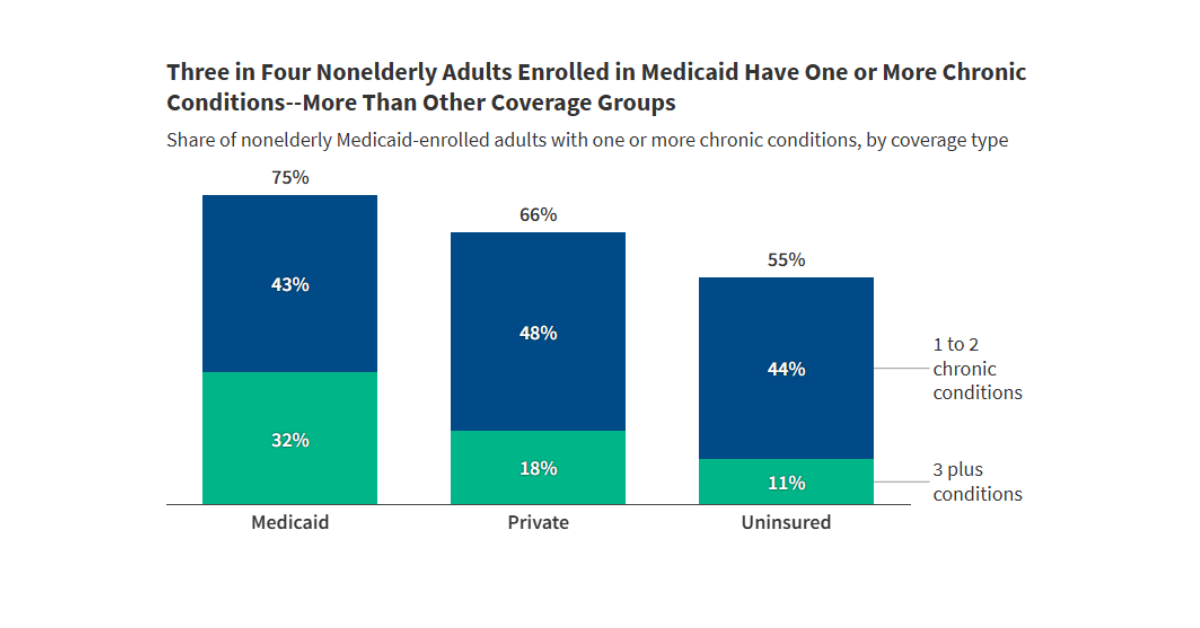
    Among working age adults enrolled in Medicaid, approximately three quarters have one or more chronic conditions, and nearly one-third have three or more.

Subscribe to KFF Emails

Choose which emails are best for you.
Sign up here

Filter

1,651 - 1,660 of 2,693 Results

  • Pulling it Together: How the ACA Can Help The Homeless

    From Drew Altman

    Estimates are that there are approximately 630,000 people who are homeless on any given night in the U.S. -- about two-thirds in shelters and one-third on the street or without real shelter. Several million people are estimated to experience homelessness over the course of a year. About two-thirds are individuals and the balance are in families. These numbers are virtually identical to national estimates we used when I worked intensively on the issue of homelessness in the…

  • How the ACA Changes Pathways to Insurance Coverage for People with HIV

    Perspective

    There are multiple sources of insurance coverage and care for people with HIV in the United States.  These include public programs, such as Medicaid and Medicare, and the Ryan White HIV/AIDS program, as well as private coverage through an employer or in the individual market. Medicaid, the nation's principal safety-net health insurance program for low-income Americans, is estimated to cover the largest share of people with HIV. Fewer are covered by Medicare, the federal health…

  • Current and Emerging Issues in Medicaid Risk-Based Managed Care: Insights from an Expert Roundtable

    Issue Brief

    Half of all Medicaid enrollees receive care through comprehensive risk-based managed care organizations (MCOs). Most Medicaid MCO enrollees today are low-income children and parents, but states are increasingly moving beneficiaries with more complex needs into MCOs. Managed care enrollment may grow more rapidly as states work with the Centers for Medicare & Medicare Services (CMS) to implement initiatives to better integrate Medicare and Medicaid benefits and care for dual eligibles. The Foundation’s Kaiser Commission on…

  • Coverage of Preventive Services for Adults in Medicaid

    Issue Brief

    This brief highlights data from a survey of coverage of 42 recommended preventive services for adults in Medicaid fee-for-service programs as of October 2010. Medicaid programs must cover preventive services for children as part of the Early Periodic Screening, Diagnosis and Treatment (EPSDT) benefit, but generally are not required to cover such services for adults. The Affordable Care Act (ACA) provides states the opportunity to earn a one percentage point increase in their federal matching…

  • Medicaid Coverage and Care for the Homeless Population: Key Lessons to Consider for the 2014 Medicaid Expansion

    Report

    Beginning in 2014, the Affordable Care Act ACA provides for a significant Medicaid expansion uninsured, low-income adults. Given their low incomes and high uninsured rate, individuals experiencing homelessness could significantly benefit from this expansion. However, it will be important to address the barriers they face to enrolling in coverage and accessing needed care. This report, based on eight focus group discussions with administrators and frontline workers serving the homeless population in four cities, identifies enrollment…

  • Visualizing Health Policy: Medicaid—Its Role Today and Under the Affordable Care Act

    Other Post

    The August 2012 Visualizing Health Policy infographic examines the role Medicaid plays in the lives of many Americans today, and how that role will change under the Affordable Care Act. See the full-size infographic at The Journal of the American Medical Association View the related Slideshow Visualizing Health Policy is a monthly infographic series produced in partnership with the Journal of the American Medical Association (JAMA). The infographics will be freely available on JAMA’s website and will be…

  • Medicaid Managed Long-Term Services and Supports: Are More Caution and Oversight Needed?

    Event Date:
    Event

    The Alliance for Health Reform and AARP sponsor an August 3rd briefing to discuss who is being served by Medicaid managed care, how enrollment is determined, and whether sufficient oversight of the programs exist. Speakers will explore such questions as: Does Medicaid managed care cover a full range of long-term services and supports, including home- and community-based services? Is Medicaid managed care as a strategy part of state plans for 2014, and the challenges and…

  • Health Homes for Medicaid Beneficiaries with Chronic Conditions

    Issue Brief

    This brief profiles four states that were the first to receive federal approval to take up a state option under the Affordable Care Act to implement health homes for Medicaid beneficiaries with chronic conditions. Almost half of the 9 million people who qualify for Medicaid on the basis of disability suffer from mental illness and 45 percent have three or more diagnosed chronic conditions. Health homes provide an important tool for states trying to manage…