Medicaid

Work Requirements

Challenges with Implementing Work Requirements

Many states are anticipating a variety of implementation challenges, including the need for complex system changes, a compressed implementation timeline, and limited staff capacity.

What is the Medicaid Hardship Exception?

The number of Medicaid expansion enrollees who ultimately qualify for the high unemployment hardship exception will depend on how the exception is implemented and how unemployment rates changes.

Tracking Implementation of the 2025 Reconciliation Law: Medicaid Work Requirements

KFF’s interactive tracks key data and policies that will affect how states implement Medicaid work requirements, which are required under the 2025 budget reconciliation law starting in January 2027. The tracker includes state-level data on Medicaid enrollment and renewal outcomes as well as current state enrollment and renewal policies.

Medicaid Budget Survey

Medicaid Home Care

Using data from the 23rd KFF survey of officials administering Medicaid home care programs, this issue brief describes the mechanisms states are currently using to limit Medicaid spending on home care and their plans for adopting new mechanisms in state fiscal year (FY) 2026.

A Look at Waiting Lists for Medicaid Home- and Community-Based Services from 2016 to 2025

This data note provides new information about waiting lists in Medicaid home care before many of the provisions in the 2025 reconciliation law go into effect. The data come from KFF’s 23rd survey on Medicaid home care programs in all 50 states and DC.

KFF regularly surveys states about their Medicaid home- and community-based services (HCBS) programs and their eligibility policies for people who are eligible for Medicaid on the basis of having a disability or being 65 and older.

states-are-most-likely-to-offer-home-care-to-eligible-people-with-intellectual-developmental-disabilities_FI_v2_7f7f71.png

This issue brief provides an overview of what Medicaid home care (also known as “home- and community-based services” or HCBS) is, who is covered, and what services were available in 2024.

Eligibility and coverage
  • Eligibility, Enrollment, and Renewal Policies

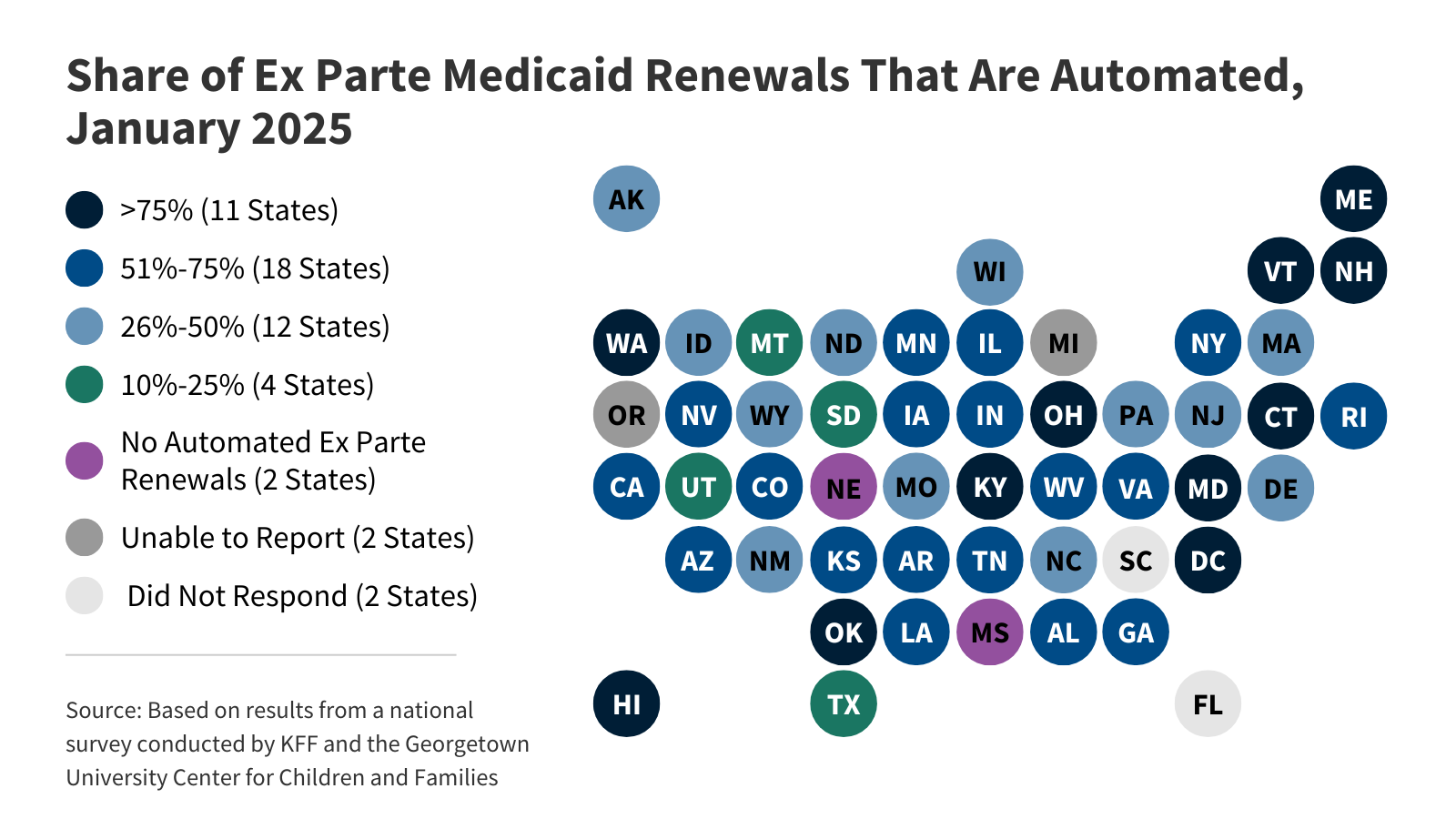
    KFF's survey findings capture state actions that seek to improve the accuracy and efficiency of Medicaid and CHIP enrollment and renewal processes, as of January 2025.
  • Seniors and People with Disabilities

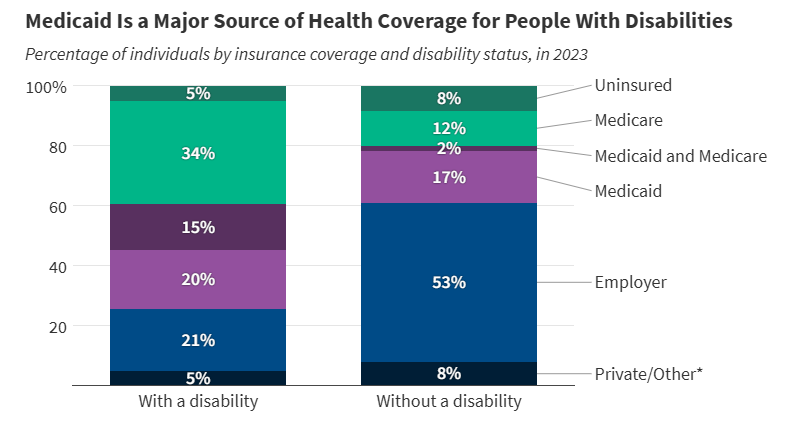
    More than 1 in 3 people with disabilities (15 million) have Medicaid (35%). In comparison, only 19% of people without disabilities have Medicaid.
  • Children with Special Needs

    Amid debates about proposed cuts to federal Medicaid spending, this brief analyzes key characteristics of children with special health care needs and explores how Medicaid provides them with coverage.
  • People With Intellectual and Developmental Disabilities

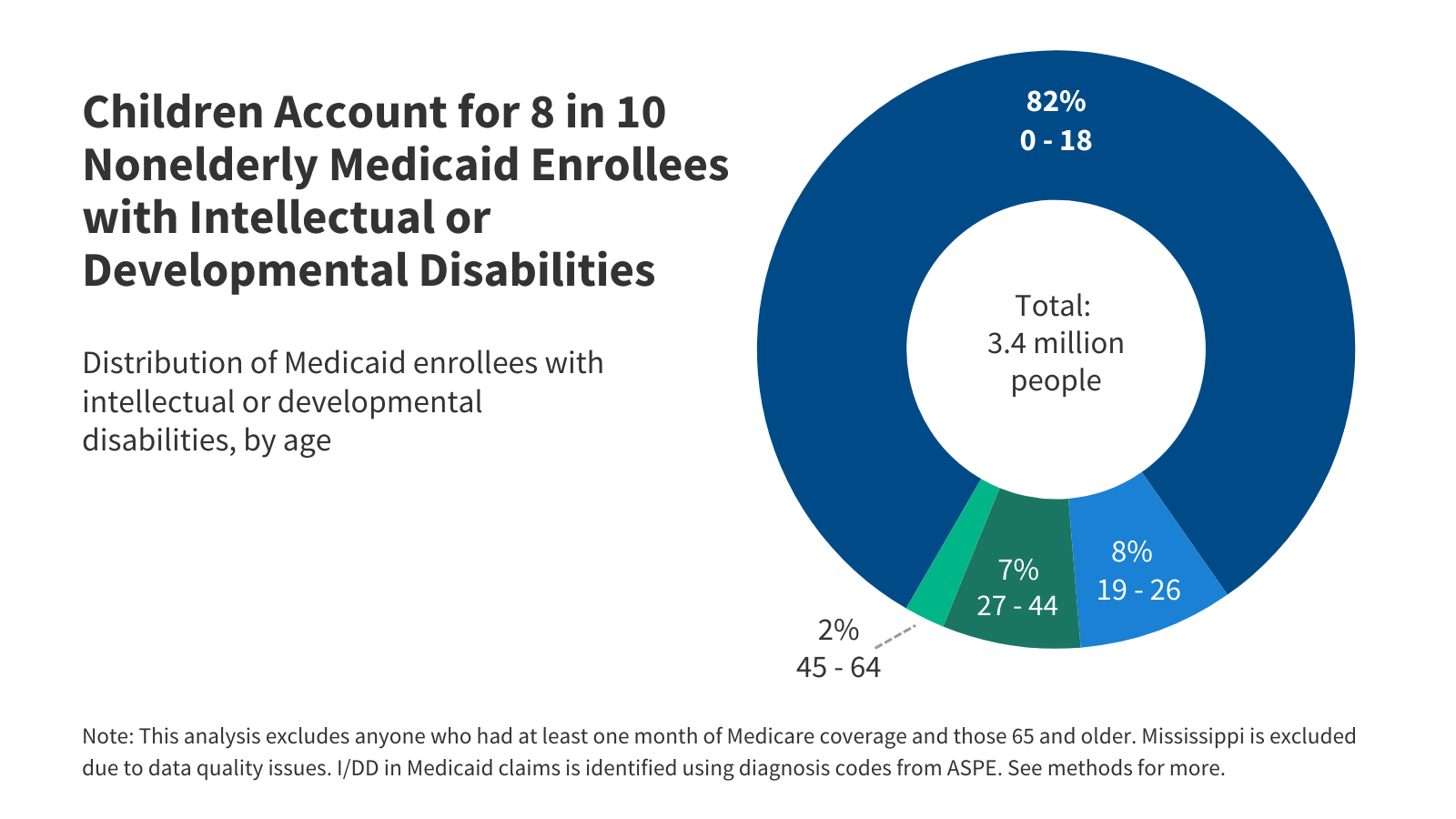
    Among the estimated 8 million people with intellectual and developmental disabilities (I/DD), over three million have Medicaid coverage.
  • Adults with Chronic Conditions

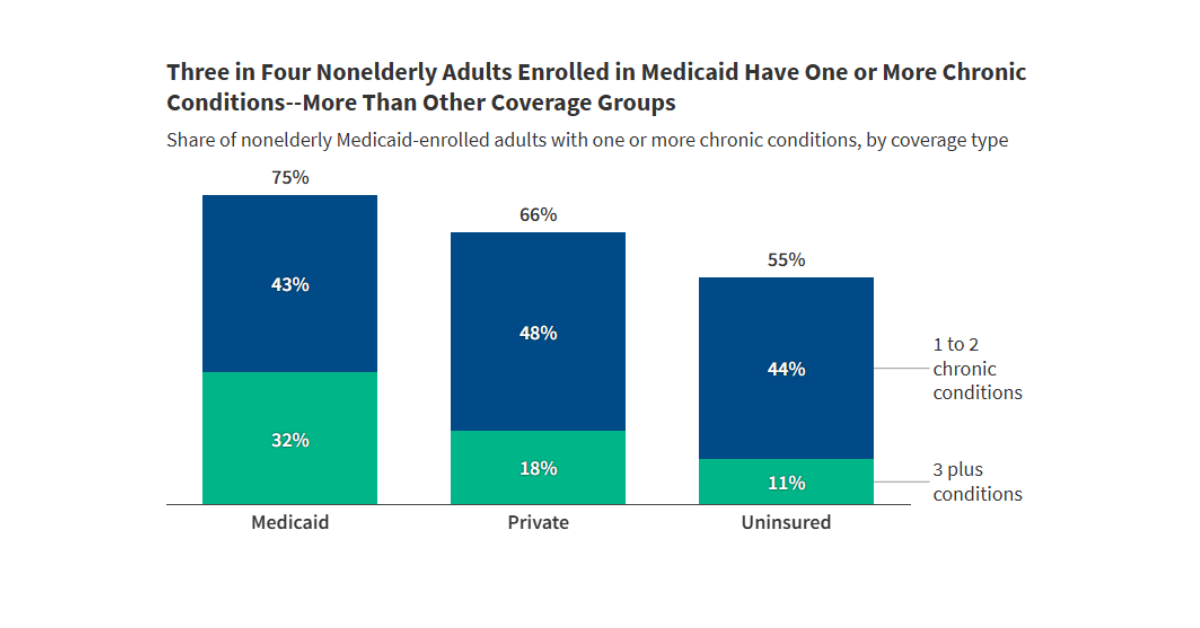
    Among working age adults enrolled in Medicaid, approximately three quarters have one or more chronic conditions, and nearly one-third have three or more.

The Essentials
  • 5 Facts: Immigrants and Medicaid

    This brief provides five key facts on Medicaid and immigrants as context for understanding the potential impacts of policy changes under the Trump administration.
  • 5 Facts: Medicaid and Hospitals

    This brief explains the role of Medicaid for hospitals, including how much spending on hospital care comes from Medicaid, the share of births covered by the program, and how Medicaid expansion has impacted hospital finances.
  • Medicaid Financing: The Basics

    Medicaid is a major source of financing for states to provide health coverage and long-term services and supports for low-income residents. This brief examines key questions about Medicaid financing and how it works.
  • 5 Facts: Medicaid’s Share of National Health Spending

    This brief explores how Medicaid spending contributes to national health spending and how different service areas contribute to Medicaid costs.
  • 5 Facts: Medicaid and Nursing Facilities

    The substantial Medicaid savings in the reconciliation bill could have major implications for nearly 15,000 federally certified nursing facilities and the 1.2 million people living in them.

Subscribe to KFF Emails

Choose which emails are best for you.
Sign up here

Filter

1,971 - 1,980 of 2,671 Results

  • Acceleration of Medicaid Spending Reflects Mounting Pressures

    Report

    This issue paper reveals that after three years of relatively slow spending growth, Medicaid spending accelerated in 1999 and 2000, and more rapid growth appears likely to continue. Medicaid spending grew by 7.1 percent ind FY 1999 and 8.6 percent in FY 2000.

  • Participation in Welfare and Medicaid Enrollment

    Report

    This paper examines Medicaid enrollment and its relation to the rise and fall of enrollment in Aid to Families with Dependent Children (AFDC) or Temporary Assistance to Needy Families (TANF) programs.

  • Summary of Findings: Privatization of Public Hospitals

    Poll Finding

    This Summary presents background, findings, and data from the Economic and Social Research Institute's (ESRI) full report, Privatization of Public Hospitals. Section I provides background about public hospital conversions, including the role of public hospitals, reasons for conversion, the mechanisms of conversion and new ownership entities, and analysis of national and regional public hospital data.

  • Medicaid Benefits: California

    Other Post

    Completed for the National Conference of State Legislatures and the Kaiser Commission on Medicaid and the Uninsured, by Health Management Associates. Compiled from Medicaid State Plans and Amendments approved by the Centers for Medicare and Medicaid Services, and from State websites, with verification by State and Territorial Medicaid officials in March 2003.

  • What Has Caused the Growth in Medicaid Spending in Recent Years?

    Event Date:
    Event

    A new study published in Health Affairs explains what caused Medicaid spending to rise from 2000-2003 and confirms the role Medicaid played in covering people during the recent economic downturn, and that Medicaid per enrollee spending grew at a slower rate than private insurance spending.

  • Key Facts: States Most Affected by Hurricane Katrina

    Fact Sheet

    Key Facts: States Most Affected by Hurricane Katrina A side-by-side comparison of key demographics and health coverage statistics of the states most affected by Hurricane Katrina. Fact Sheet (.

  • The Distribution of Assets in the Elderly Population Living in the Community

    Issue Brief

    Individuals cannot qualify for Medicaid nursing home care or home and community-based services unless they meet their state's asset eligibility standards. Currently, states are required to examine all transfers for less than fair market value that occurred within 36 months prior to an individual's application for Medicaid.