
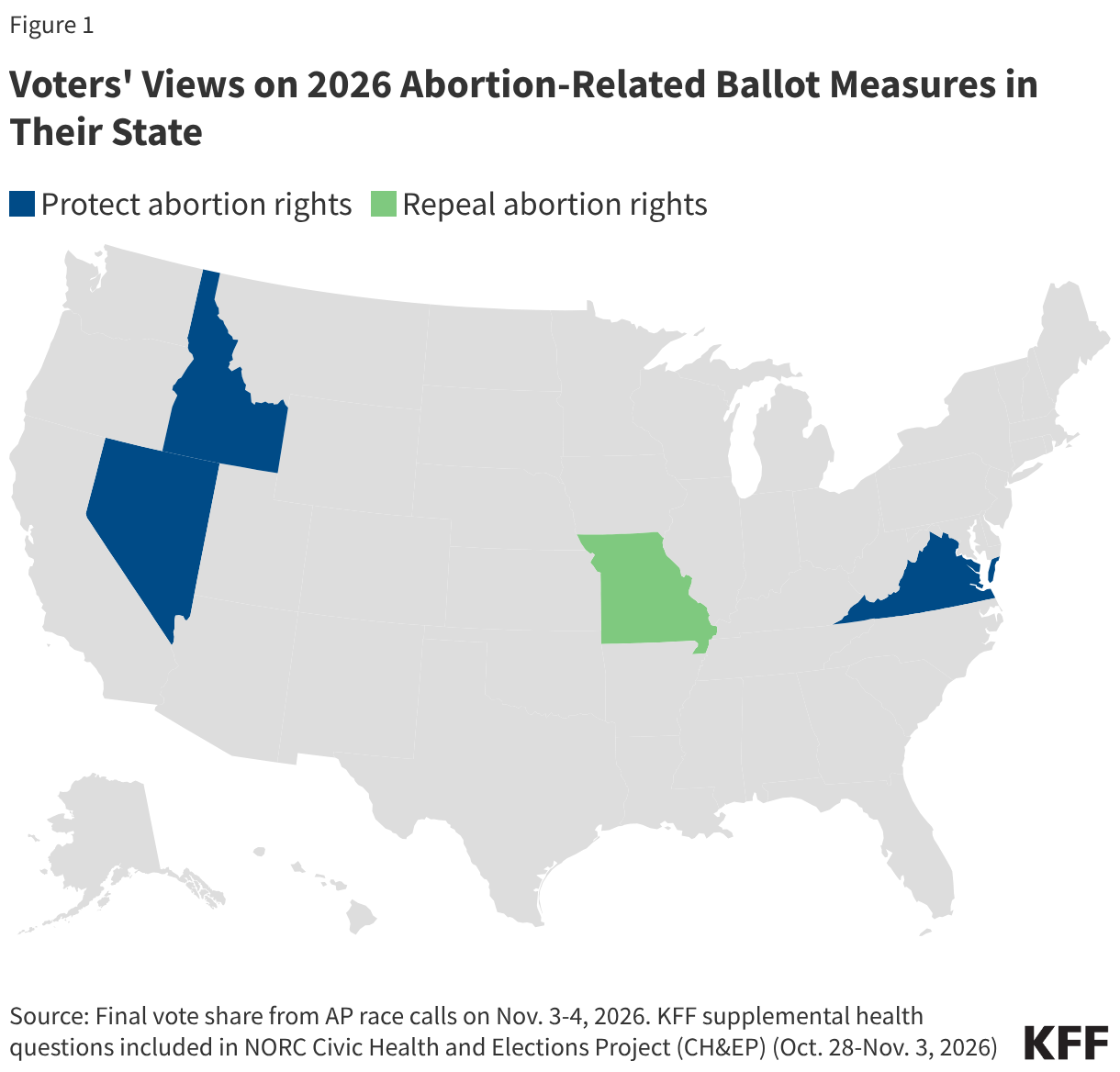
- Midterm voters voted to protect access to abortion in three of the four states that had abortion-related ballot measures. Ballot measures to protect abortion rights passed in Nevada and Virginia, enshrining the constitutional right to abortion. Missouri voters rejected Amendment 3, preserving the constitutional right to abortion. Idaho was the only state where voters rejected a proposition that would have expanded access to abortion, leaving the state with some of the most restrictive abortion laws.
- Missouri voters rejected Amendment 3, keeping in place the constitutional right to abortion voters approved in 2024. Placed on the ballot by Missouri’s Republican-led legislature, this measure asked voters to weigh in on abortion access alongside adding constitutional prohibitions on gender-affirming care for minors in the state, which are already largely banned. About six in ten voters in Missouri (58%) say they oppose repealing the right to abortion, while six in ten (62%) support prohibiting gender-affirming care for minors, the two issues at the center of this measure. However, voters were more than five times as likely to say “abortion policy” was a more important issue to them in this vote than the issue of gender-affirming care for minors (45% vs. 8%), and more than four in ten (45%) said both issues mattered equally. The rejection of this amendment keeps the constitutional right to abortion approved by voters in 2024 in place and leaves the laws prohibiting many gender-affirming treatments for minors already in place in the state for the time being.
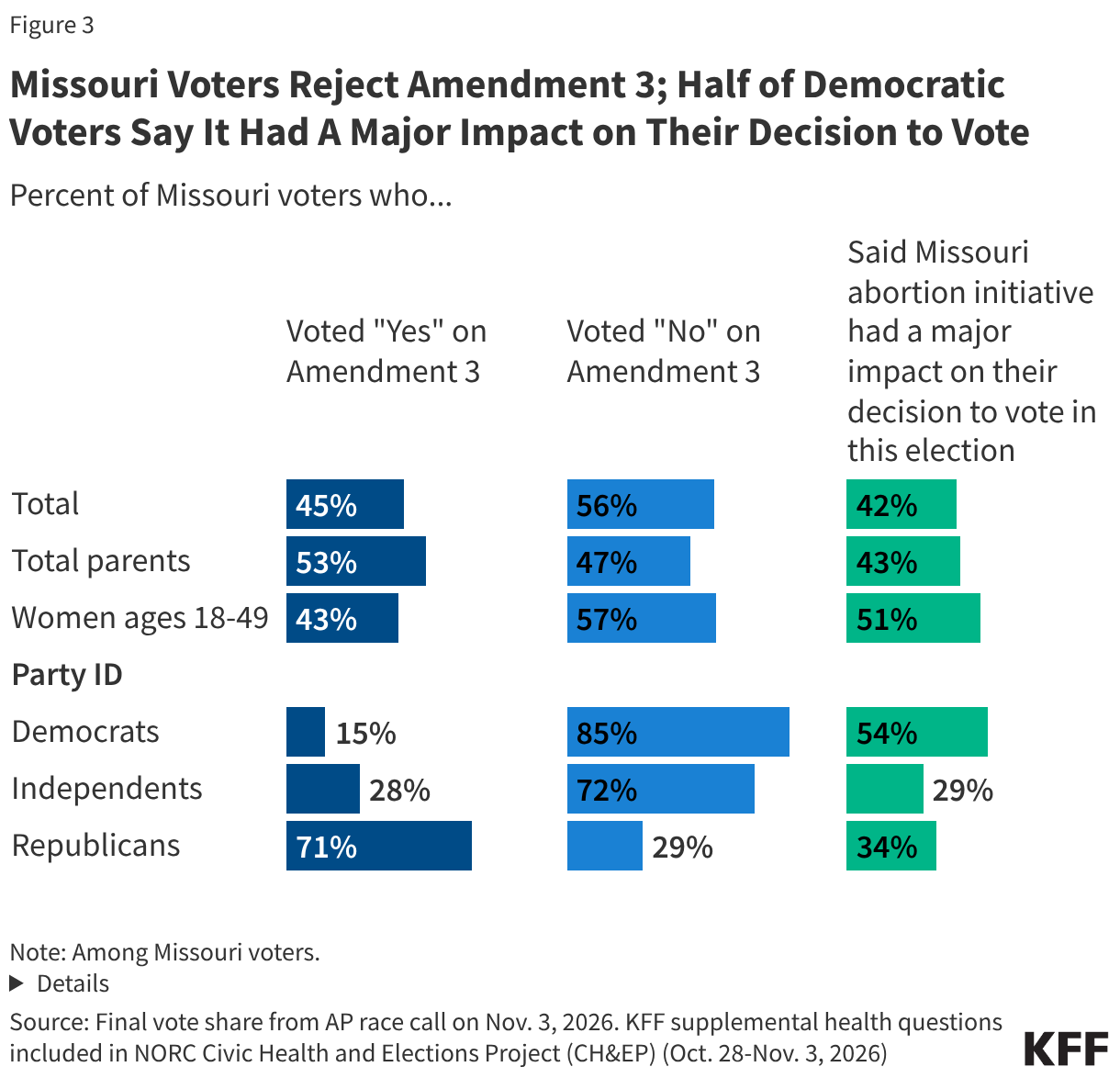
- About seven in ten Republicans (71%) voted in support of Missouri’s Amendment 3, while most Democrats (85%) and independents (72%) voted “no.” However, voter motivation was on the side of rejecting the amendment, as at least half of “no” voters say the measure had a major impact on their decision to vote in this election. This pattern is consistent with recent elections in which abortion motivated Democratic voters to turn out more so than Republicans.
- In Idaho, voters rejected Proposition 1, which would have established a right to abortion in one of the states with the most restrictive bans in the country. Democratic voters in the state overwhelmingly voted to pass the measure, including a vast majority of Democratic women. However, eight in ten Republican voters, including similar shares of Republican women, rejected the measure, and women of reproductive age were split with about half voting “yes” to expand abortion access and half voting “no.” Rejecting this measure leaves Idaho with its existing near-total abortion ban.
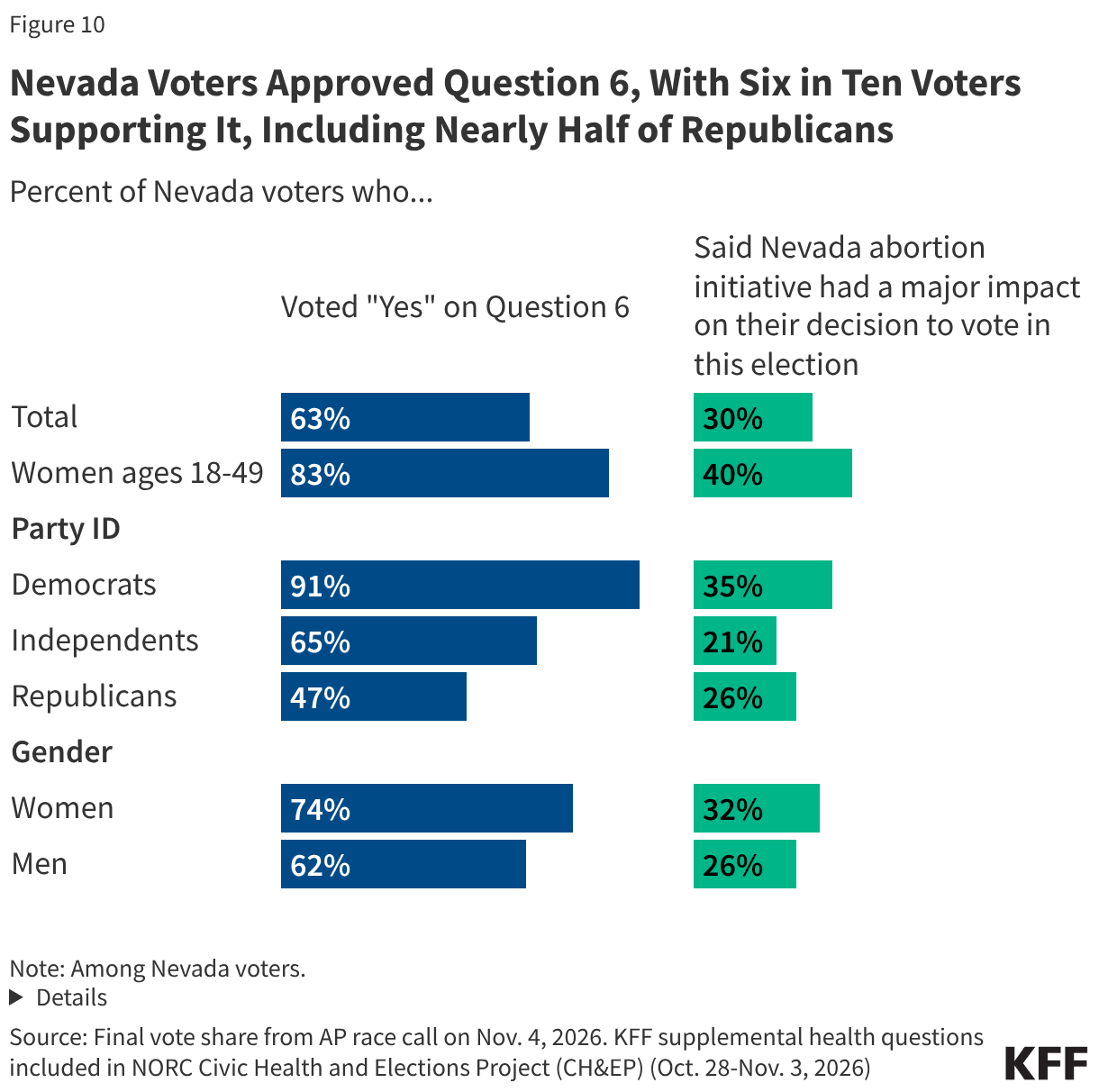
- In Virginia and Nevada, measures establishing a constitutional right to abortion passed with broad support across age and gender. Support extended beyond Democrats and independents, with about half of Republicans in Nevada (47%) and a third in Virginia (35%) voting “yes.” About four in ten Nevada voters (44%) who backed the Republican candidate for governor also supported the state’s abortion rights measure.
KFF Election Poll Analysis
Abortion on the Ballot in 2026: Polling Insights from Voters in Four States
This dashboard provides KFF’s analysis of the role abortion played in voters’ decisions in the 2026 midterm elections, with a focus on four states with abortion-related ballot measures: Idaho, Missouri, Nevada, and Virginia. For this analysis, KFF added supplemental questions to the NORC Civic Health and Elections Project, a survey of the 2026 midterm electorate conducted nationally and in all 50 states. It examines support for each of the measures across groups, including additional questions in Missouri, where voters were asked to weigh in on a ballot measure that combined questions of abortion access with restrictions on gender-affirming care.
For KFF’s analysis of the role of health care costs and other health policy issues in the midterms, see: Health Care in the 2026 Midterm Election
Last updated: November 4, 2026, 7:00PM ET
Table of Contents
Key Takeaways
Abortion Ballot Measures
In the 2026 election, four states voted on abortion-related ballot measures. Three of these measures would establish or protect abortion rights in Idaho, Nevada, and Virginia. In Missouri, the legislature put forward a measure to repeal the constitutional right to abortion approved by voters in 2024 and to add a constitutional prohibition on gender-affirming care for minors. Nevada voted on its measure for the second time, as the state requires constitutional amendments proposed by citizens to pass in two consecutive general elections, and the measure first passed in 2024. Voters in three of the four states voted to protect abortion access, while the measure in Idaho failed. More details about the different state ballot measures are available at this KFF brief.
Ballot measures to protect abortion rights passed in Nevada and Virginia, enshrining the constitutional right to abortion. Missouri voters rejected Amendment 3, preserving the constitutional right to abortion. Voters in Idaho rejected Proposition 1, which would have expanded access to abortion, leaving the state with some of the most restrictive abortion laws in the country.
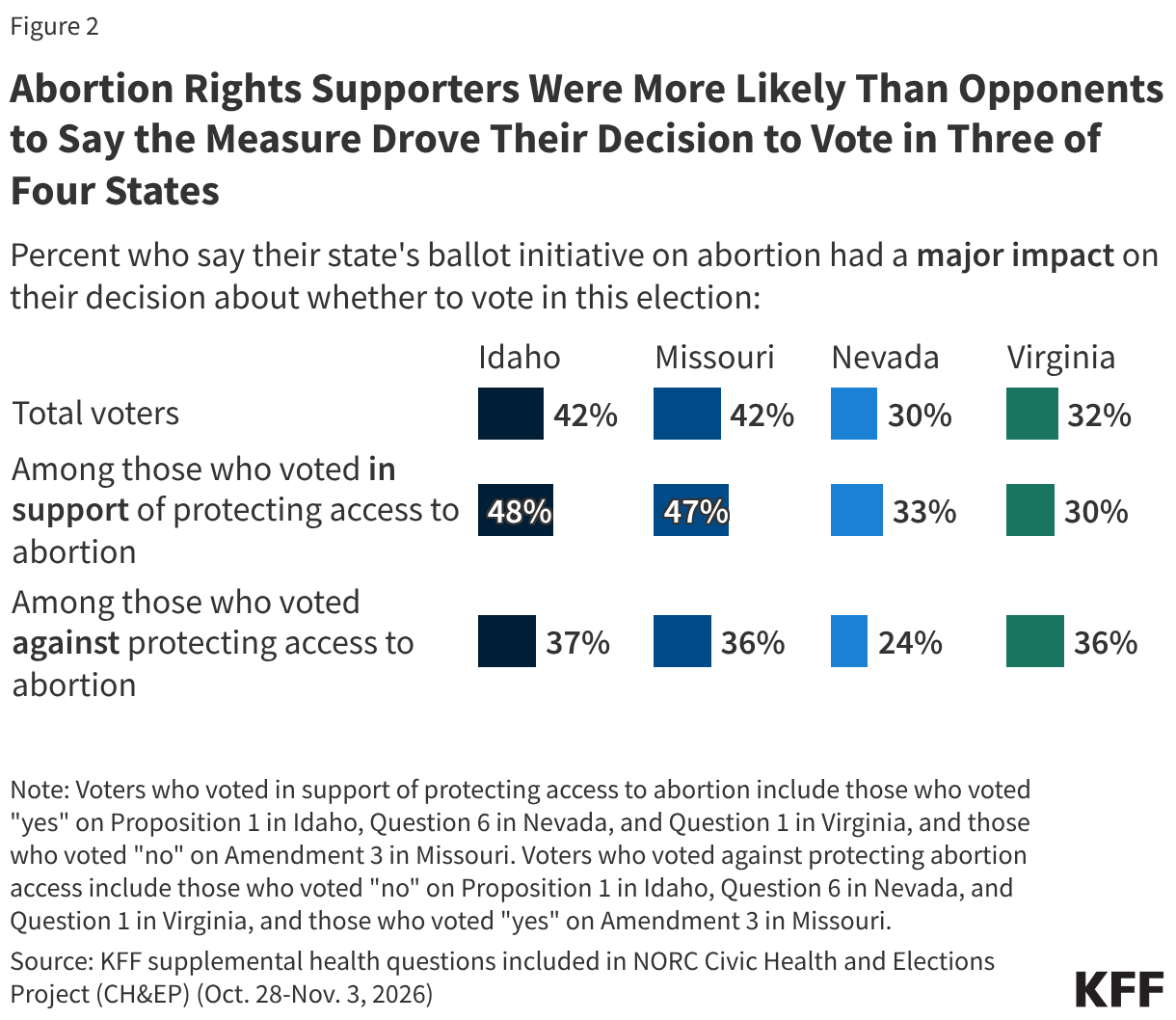
At least three in ten voters in each of these states said the abortion ballot measure in their state had a “major impact” on their decision to vote in this election. In Idaho, Missouri, and Nevada, proponents of abortion access (voting “yes” in Idaho and Nevada, and “no” in Missouri) were more likely than opponents to say the measure had a major impact on their decision to vote. In Virginia, however, those who oppose access to abortion were more likely than supporters of the measure to say it majorly impacted their decision to turn out.
Missouri Amendment 3
In Missouri, voters decided whether to repeal a constitutional right to abortion they adopted just two years earlier. In 2024, Missouri voters approved Amendment 3, a citizen-initiated measure that added a right to reproductive freedom, including abortion up to fetal viability, to the state constitution. The 2026 measure – also called Amendment 3 – was placed on the ballot by the Republican-majority legislature. If it had passed, this new measure would have repealed the 2024 constitutional amendment, banning abortion except in cases of medical emergency or fetal anomaly, or in cases of rape or incest up to 12 weeks of pregnancy. The measure would also have allowed the legislature to pass new abortion regulations, including some that a court has blocked after finding they violate the 2024 constitutional amendment protecting the right to abortion.
Additionally, the amendment would have written into the state constitution a prohibition on gender-affirming care for minors, specifically for surgery and prescribing hormones or puberty blockers. Missouri currently restricts this care for minors by statute, but the hormone and drug-related restrictions of that law are set to expire in August 2027.
Missouri voters rejected Amendment 3, with 56% voting “no,” keeping in place the constitutional right to abortion voters approved in 2024. About seven in ten Republicans (71%) supported the measure, while most Democrats (85%) and independents (72%) voted “no.” Fewer than half (43%) of women of reproductive age supported the measure that would have reinstated an abortion ban in Missouri.
About four in ten Missouri voters said the measure had a major impact on their decision to vote in this election, including about half of women of reproductive age (51%) and Democratic voters (54%).
Just over half of Missouri parents (53%) voted “yes” on the amendment that would have affected health care for minors in the state, and about four in ten (43%) said the measure had a major impact on their decision to turn out.
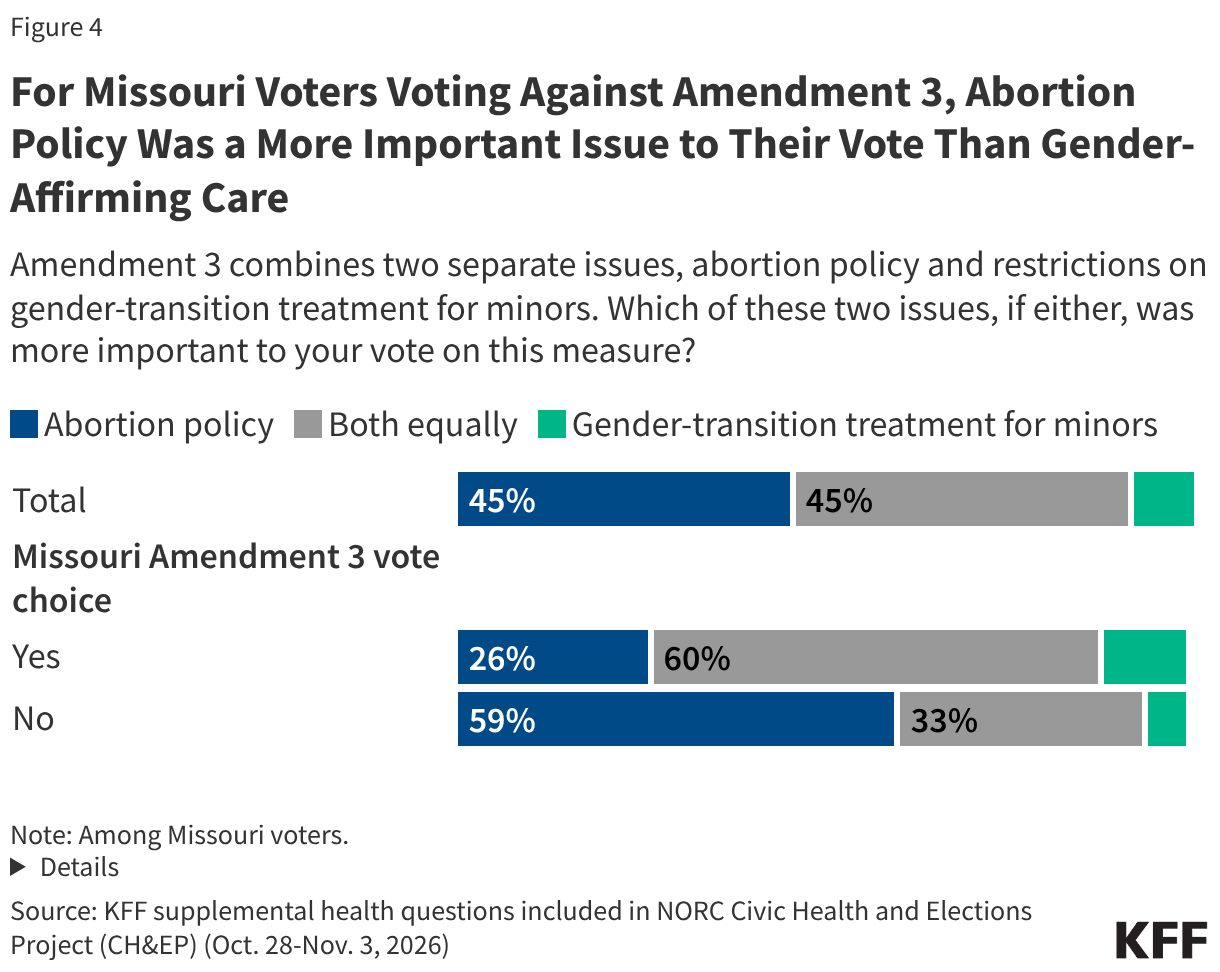
Because Amendment 3 paired the repeal of the 2024 abortion rights amendment with strengthened prohibitions on gender-affirming care for minors, described on the ballot as “gender-transition” treatment, voters had to weigh two separate issues in a single vote.
When asked which part of the amendment was more important to their vote, voters were more than five times as likely to say abortion policy (45%) was the more important issue than to say gender-affirming care for minors (8%). More than four in ten (45%) Missouri voters say both issues were equally important.
For opponents of the measure, abortion policy was a more salient issue than gender-affirming care. Six in ten (59%) voters who voted “no” on the measure said abortion policy was the more important issue to their vote. Six in ten Missouri voters who voted “yes” said both issues were equally important to their vote (60%).
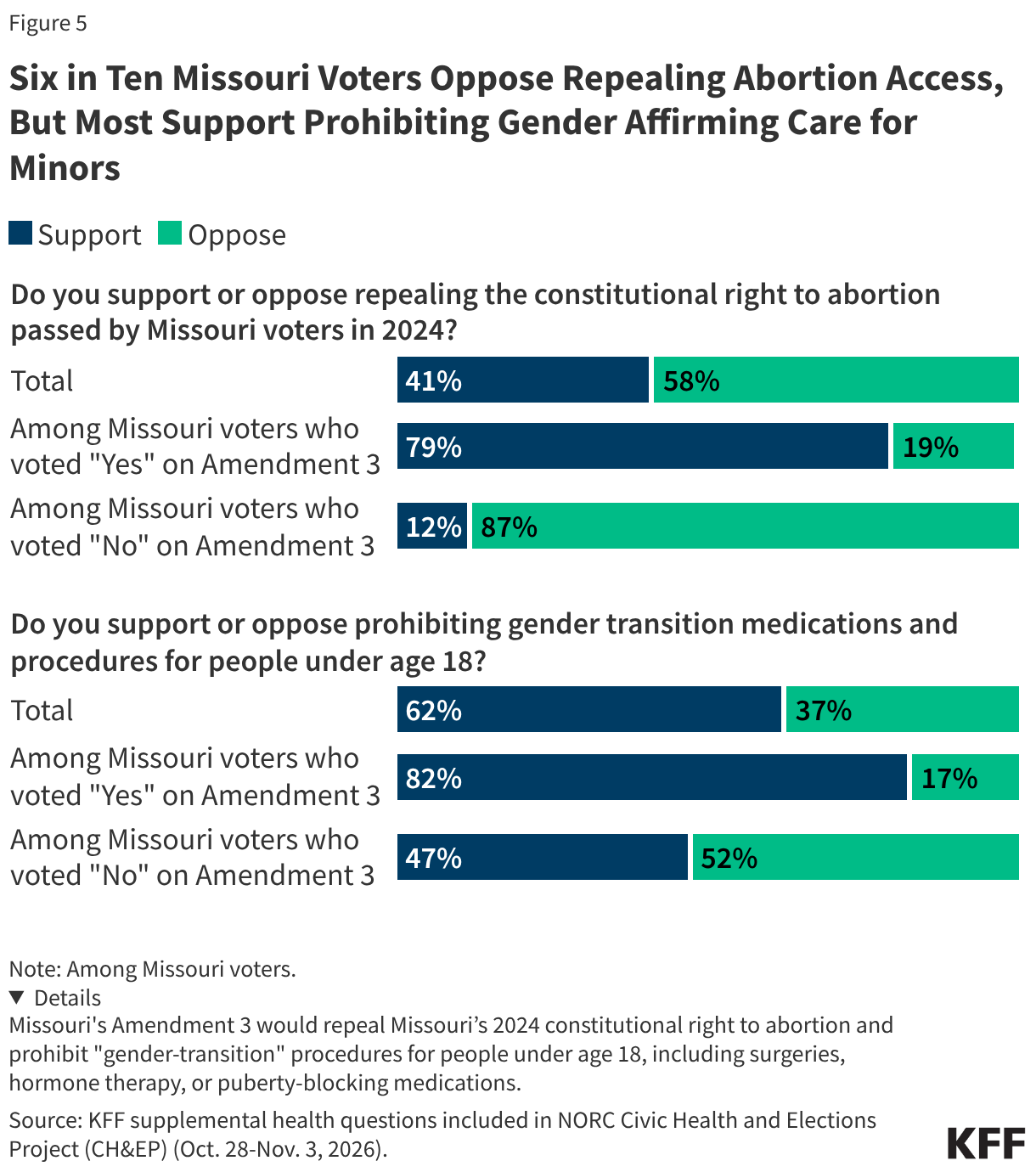
Asked about each part of Amendment 3 separately, a majority of Missouri voters (58%) oppose repealing the constitutional right to abortion passed by voters in 2024, while about six in ten (62%) support prohibiting gender-affirming care for minors, referred to by the ballot as “gender-transition” medications and procedures.
About eight in ten Missouri voters who voted “yes” on Amendment 3 support each of the provisions, while “no” voters are more divided. Few (12%) “no” voters support repealing the right to abortion, but about half (47%) support prohibiting gender-affirming care for minors.
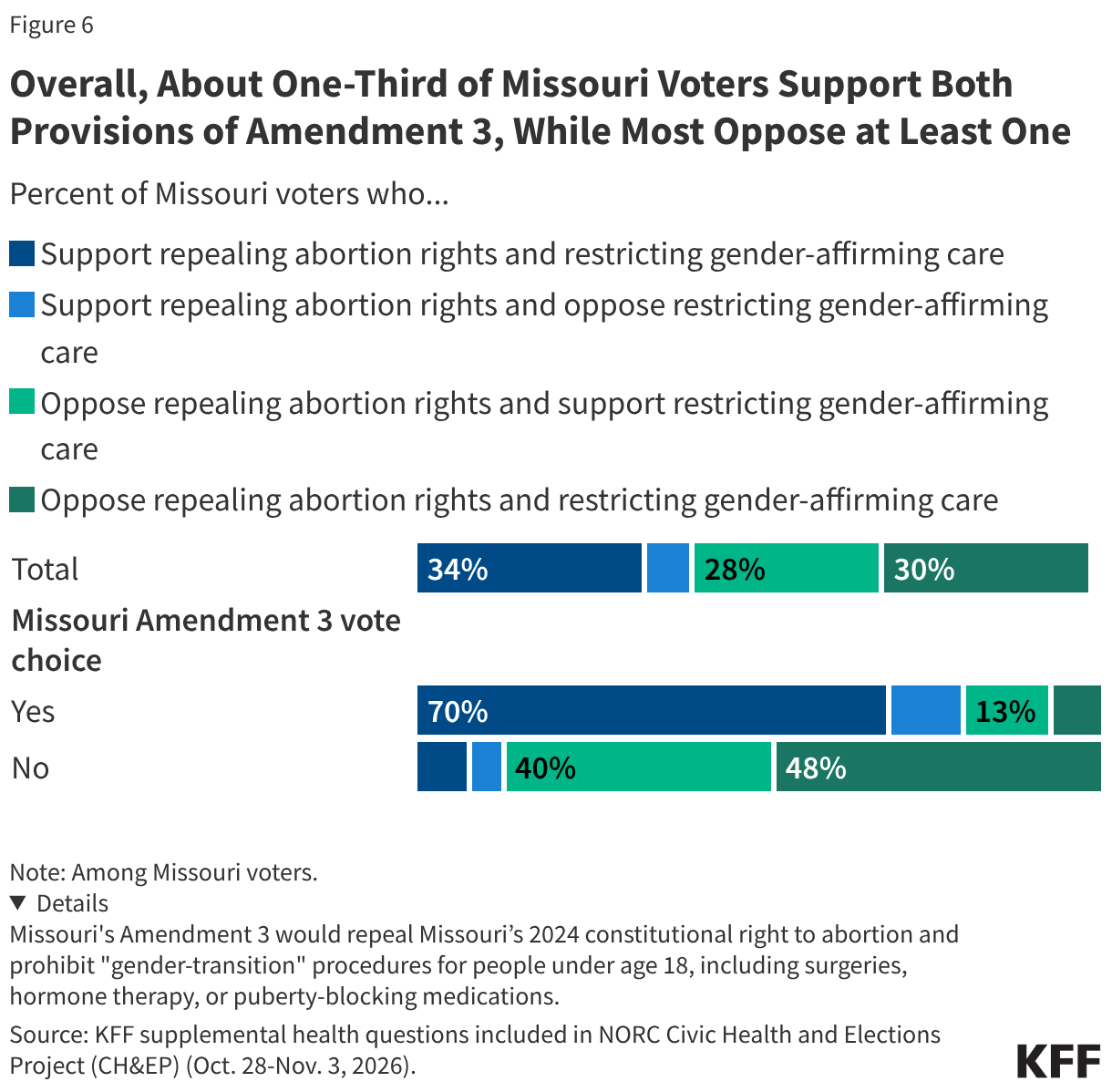
In fact, many Missouri voters held views that did not align with both ballot measure provisions. Nearly three in ten Missouri voters (28%) oppose repealing the right to abortion but support prohibiting gender-affirming care for minors, and 7% support repealing the right to abortion, but oppose prohibiting gender-affirming care for minors. About a third (34%) of voters support both provisions of the ballot measure, and three in ten oppose both provisions.
Among voters who supported the measure, seven in ten say they support both provisions, while about one in eight only support the prohibitions on gender-affirming care, and about one in ten only support repealing the right to abortion.
Among voters who rejected the measure, roughly half (48%) oppose both provisions of the measure, while four in ten oppose repealing abortion rights but support a ban on gender affirming care for minors, indicating that their views on abortion played a stronger role in their vote choice.
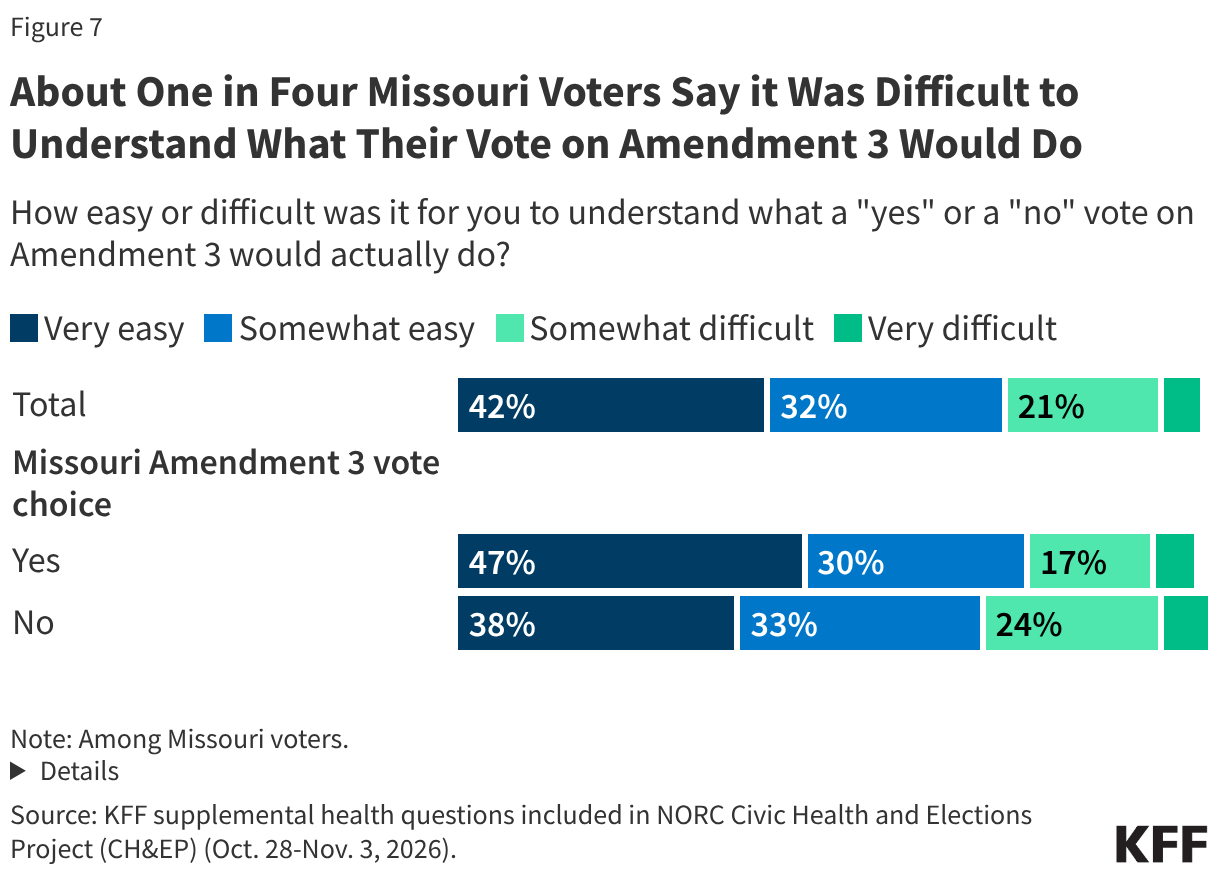
While most (74%) Missouri voters say it was “very” or “somewhat” easy to understand what a “yes” or “no” vote on Amendment 3 would do, about one in four say it was difficult.
About three in ten (29%) voters who voted “no” on the measure say it was difficult to understand what their vote on Amendment 3 would do, compared to about one in five (22%) who voted “yes.”
Idaho Proposition 1
Idaho, which currently has some of the most restrictive abortion laws in the U.S., voted on Proposition 1, the Reproductive Freedom and Privacy Act. This citizen-initiated statute would have established a right to reproductive freedom, including abortion before fetal viability and after viability in cases of medical emergency. The measure would also have protected reproductive freedom and privacy for contraception, fertility treatment, miscarriage care, and prenatal, pregnancy, childbirth, and postpartum care.
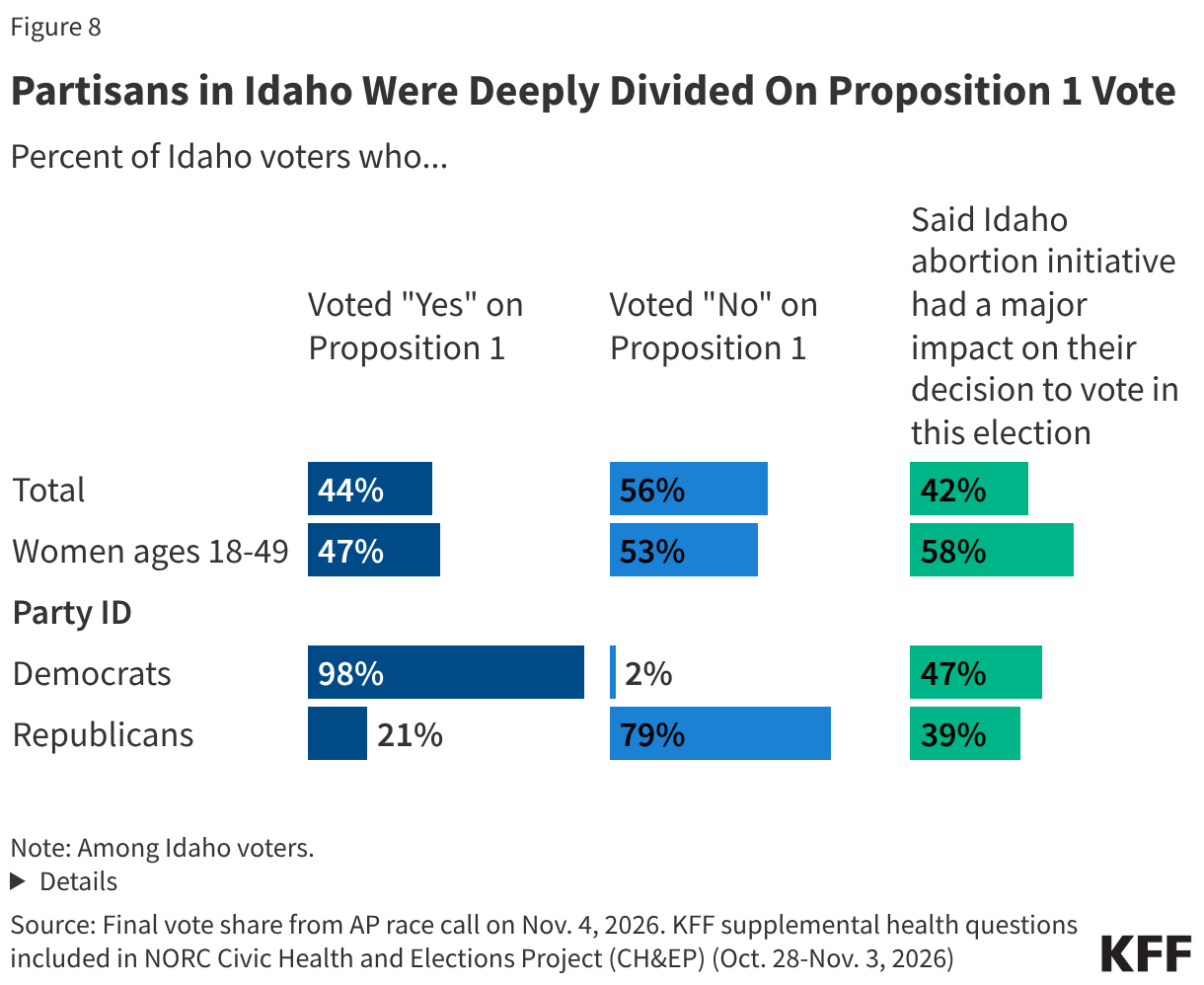
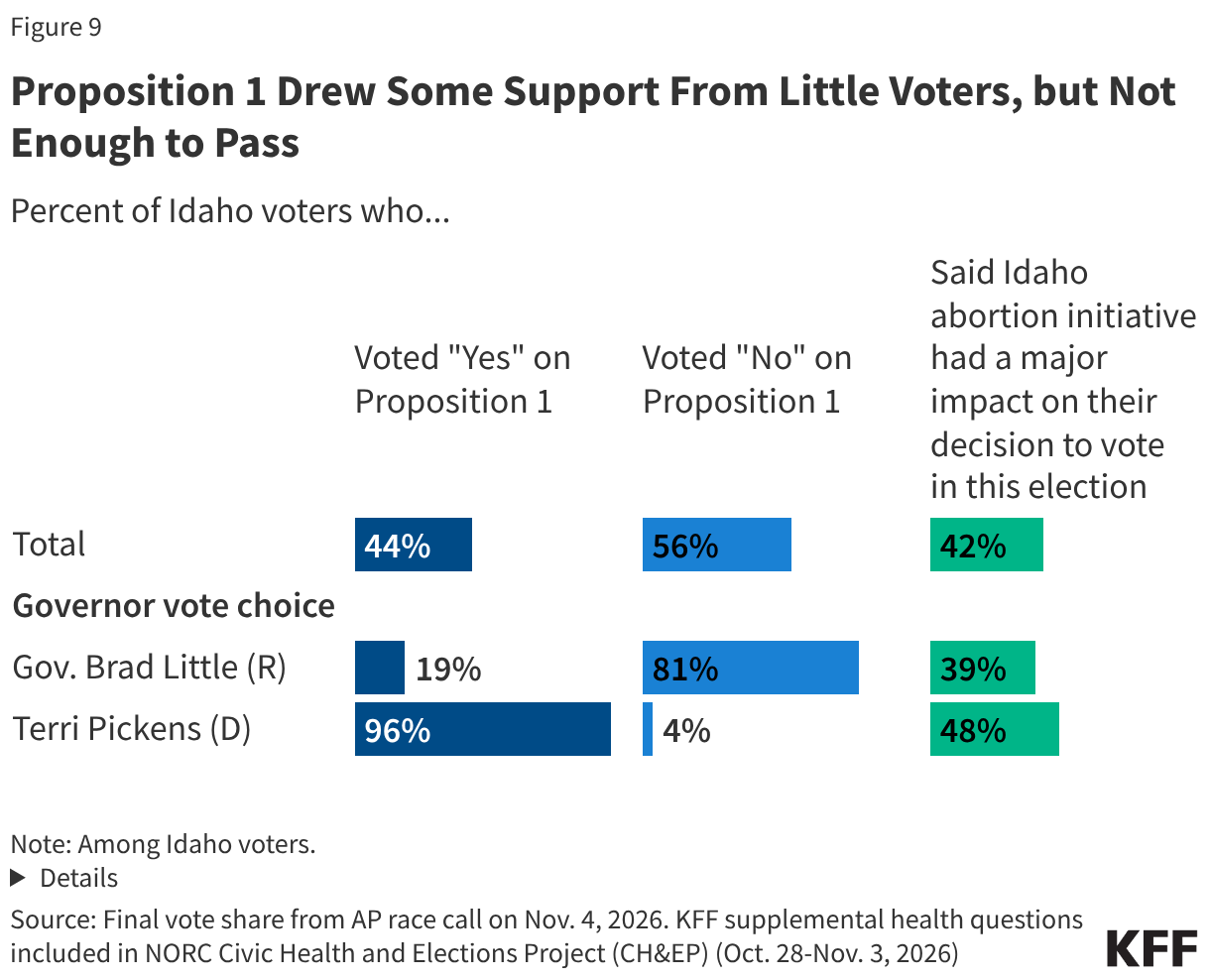
Voters in Idaho rejected Proposition 1, with 56% voting “no.” The measure received support from 98% of Idaho Democrats, though about eight in ten (79%) Republicans voted “no.” Women of reproductive age were more split, with about half voting to expand access to abortion in their state (47%) and about half rejecting the measure (53%).
About four in ten Idaho voters said the measure had a major impact on their decision to vote, rising to nearly six in ten women of reproductive age and about half of Democratic voters.
The leading candidates for governor in Idaho took opposing positions on Proposition 1. Democrat Terri Pickens said she supports the measure and would defend it if it passed. Republican Gov. Brad Little, who signed the state’s 2020 abortion ban into law, opposed the measure.
About one in five (19%) Idaho voters who voted for Gov. Little also voted “yes” on Proposition 1 to establish a right to reproductive freedom, and two in five (39%) said the initiative had a major impact on their decision to vote. Among those who voted for Pickens, the vast majority (96%) also voted “yes” on the measure, and nearly half (48%) said it had a major impact on their decision to vote.
Nevada Question 6
Nevada voters cast a second vote on Question 6, the Right to Abortion Initiative, which added a constitutional right to abortion up to fetal viability, and after viability when the pregnant person’s life or health is at risk. Nevada requires citizen-initiated constitutional amendments to pass in two consecutive general elections. Voters first approved the measure in 2024 with 64% support.
The measure passed with broad support, with 63% of Nevada’s voters voting “yes,” including nine in ten Democrats and nearly half of Republicans. Additionally, eight in ten (83%) women of reproductive age supported the initiative.
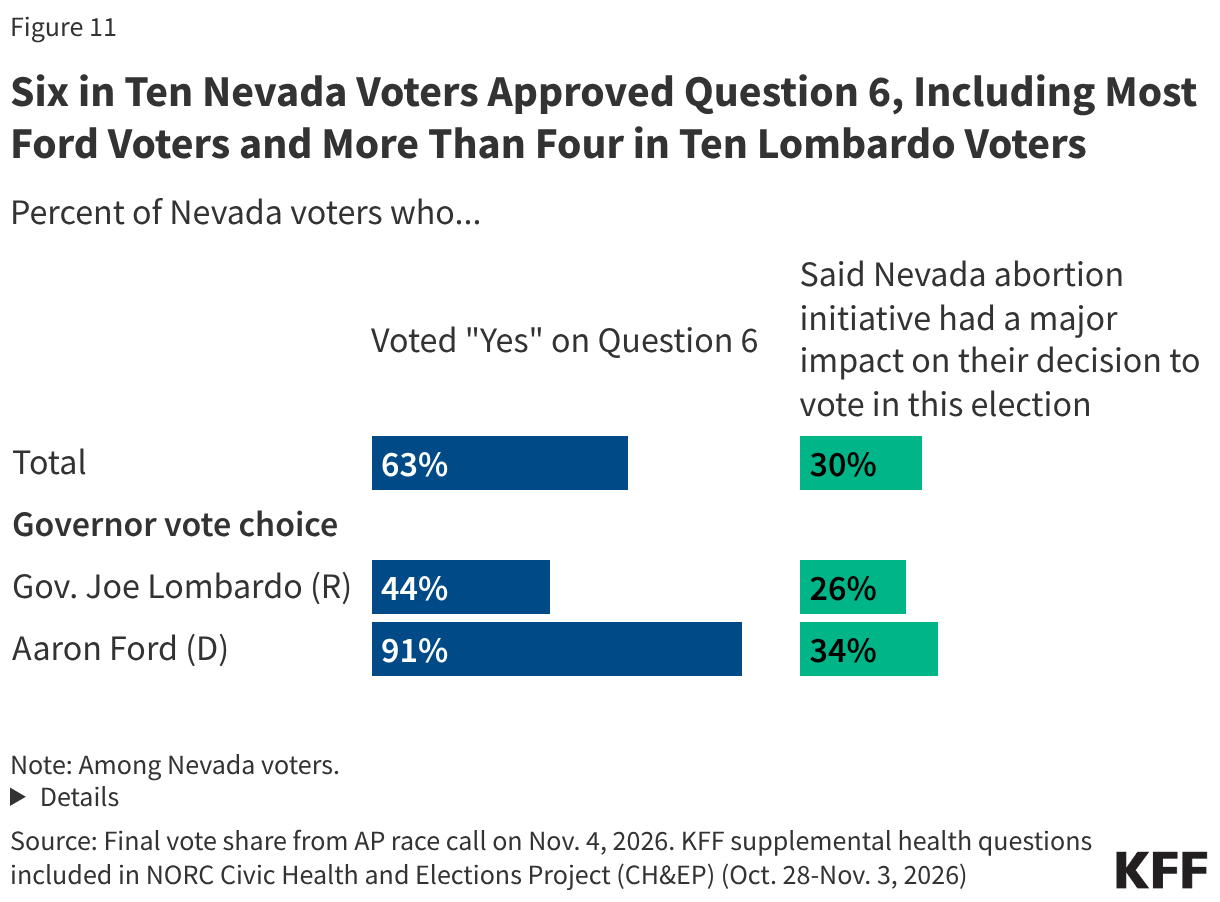
Along with Question 6, Nevada voters cast ballots in a competitive governor’s race. Democratic Attorney General Aaron Ford supports Question 6, while Republican Gov. Joe Lombardo has said abortion rights should be left to voters and in 2023 signed a law protecting out-of-state patients who travel to Nevada for abortion care.
Just under half (44%) of Nevada voters who voted for Gov. Lombardo also voted “yes” on Question 6, and a quarter (26%) said the initiative had a major impact on their decision to vote. Nine in ten (91%) Nevada voters who voted for Ford also voted “yes” on the measure, and around a third (34%) said it had a major impact on their decision to vote.
Virginia Question 1
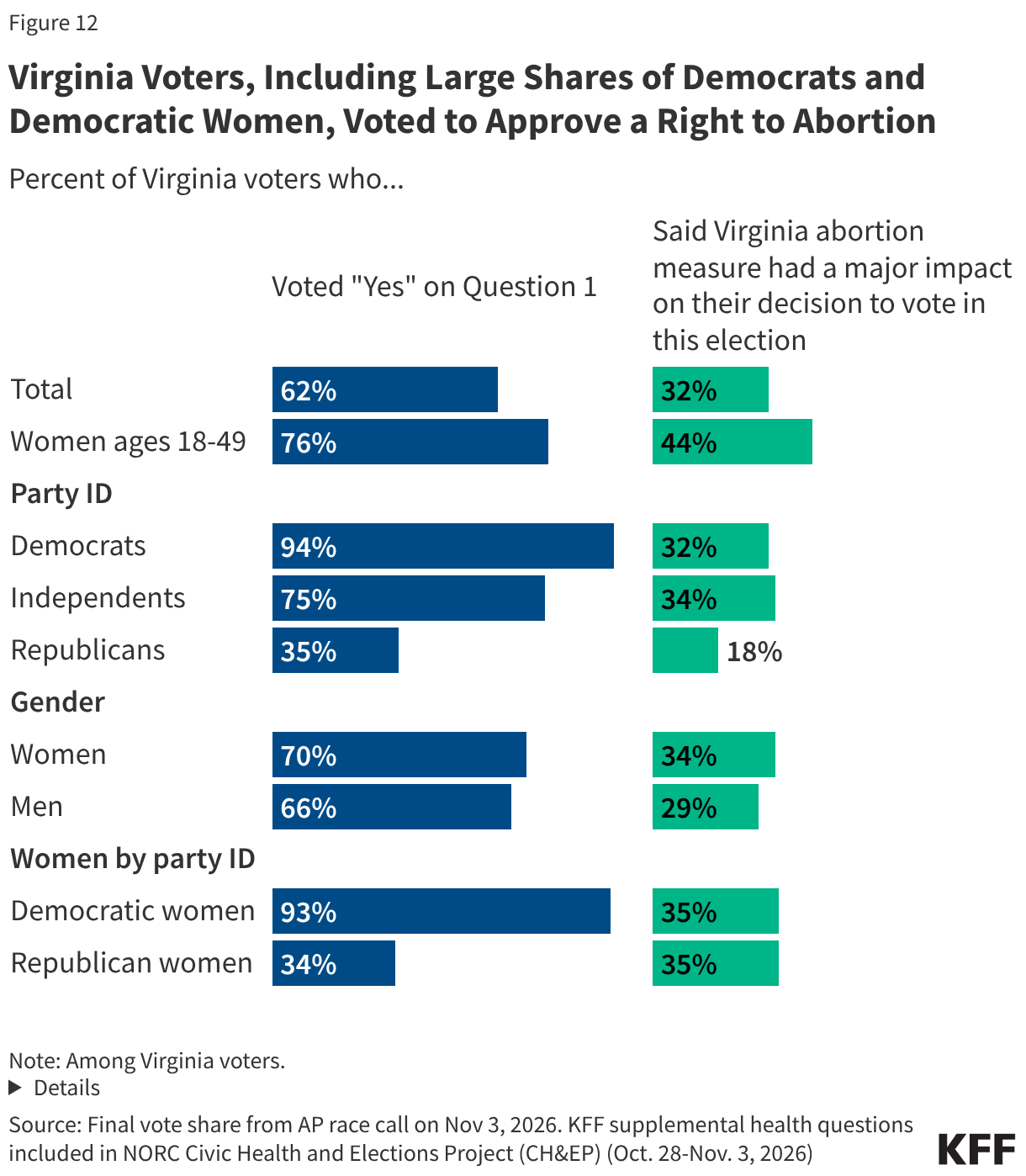
Virginia voters voted on Question 1, a constitutional amendment placed on the ballot by the General Assembly after passing it in two consecutive sessions. The amendment enshrines the right to reproductive freedom, including decisions about prenatal care, childbirth, postpartum care, contraception, abortion, miscarriage management, and fertility care. It allows the state to regulate abortion in the third trimester, except when necessary to protect the life or health of the pregnant person or when the fetus is not viable. Virginia currently allows abortion through the second trimester.
The measure passed, with 62% of Virginia’s voters supporting it, including more than nine in ten (94%) Democrats and about a third (35%) of Republicans. Three-quarters (76%) of women of reproductive age voted in favor of protecting abortion access.
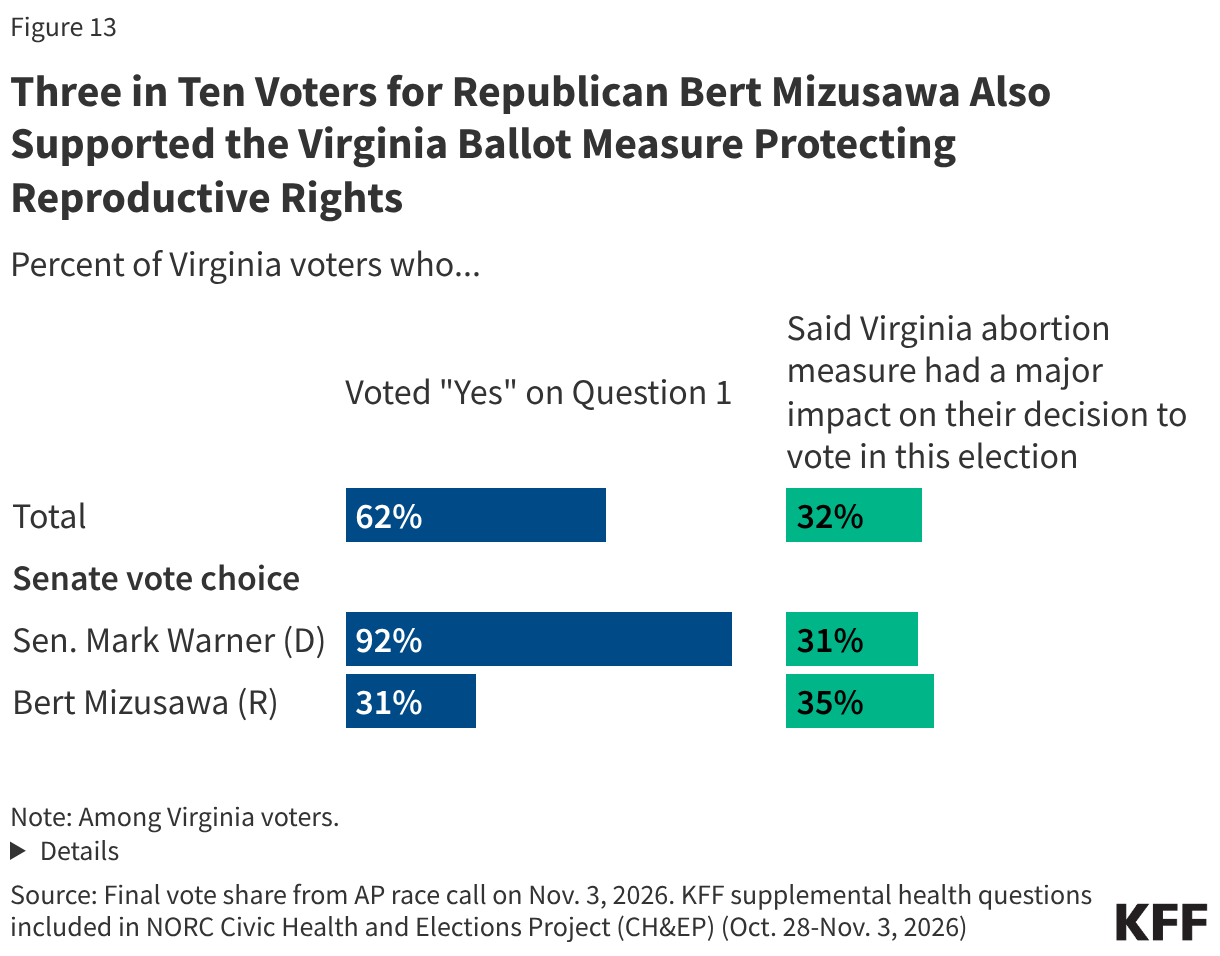
Along with Question 1, Virginia voters cast ballots in a U.S. Senate race, where Democratic Sen. Mark Warner sought a fourth term against Republican Bert Mizusawa.
About three in ten (31%) voters in Virginia who voted for Mizusawa also voted “yes” on Question 1, and a third (35%) said the measure had a major impact on their decision to vote. Nine in ten (92%) of those who voted for Sen. Warner also voted “yes” on the measure, and three in ten (31%) said it had a major impact on their decision to vote.
Methodology and additional resources
The Civic Health and Elections Project (CH&EP) is a survey of about 95,000 registered voters conducted nationally and in all 50 states by NORC at the University of Chicago, beginning on Oct. 28 and concluding as polls closed on Nov. 3, 2026. CH&EP conducts interviews with a random sample of registered voters drawn from state voter files and combines them with interviews from self-identified registered voters selected using nonprobability approaches. It also includes interviews with self-identified registered voters conducted using NORC’s probability-based AmeriSpeak panel, which is designed to be representative of the U.S. population. Interviews are conducted in English and Spanish. The study is funded by a group of sponsors including KFF; NORC made all final decisions on questionnaire content.
Note: Party labels include partisan-leaning independents.
Find more details about CH&EP’s methodology, including weighting, sample sizes, and question wording, at https://civichealth.norc.org/.
For media inquiries contact KFFMedia@kff.org