National Perspectives on Medicaid Managed Care
National Perspectives on Medicaid Managed Care
- Report: National Perspectives on Medicaid Managed Care
The independent source for health policy research, polling, and news.
National Perspectives on Medicaid Managed Care
New Survey Offers Insight Into Experiences of Managed Care Consumers
Majority of Sacramento Managed Care Consumers Report No Difficulty with Their Plan, But Over a Quarter Had Problems
For Immediate Release:Wednesday, November 19, 1997
Contacts:Heather Balas,Kaiser Family Foundation, (650) 854-9400
Katie Salvas,Sierra Health Foundation, (916) 922-4755
Magdalena Beltran-del Omo,The California Wellness Foundation, (818) 589-6600
Lauren Schaefer,Health Rights Hotline, (916) 551-2147
Medicaid Beneficiaries Report Highest Rate of Difficulty
Sacramento, California — Much national attention is currently focused on managed care issues, with a Presidential advisory commission considering a “bill of rights” for health care consumers and California policy-makers awaiting recommendations from a managed care task force. A new Survey of Consumer Experiences With Managed Care conducted in the Sacramento, California area – a region with one of the highest rates of managed care enrollment in the country – may help inform state and national debates about managed care regulation, offering new insight into difficulties people have with health plans and how they go about resolving them.
The survey finds that the majority of Sacramento managed care consumers cited no difficulties with their health insurance in the previous year, but that more than a quarter (27%) reported some problems. Of those managed care consumers experiencing problems, the most commonly reported difficulties included:
The report found that consumers did not appear to know of the availability of existing resources, particularly from state agencies. Of the 1,014 managed care consumers in the survey who reported difficulties – of whom many had major problems unresolved after over two months – only four individuals reported calling either the California Departments of Corporations or Insurance for assistance or to complain. A total of 2% of consumers with difficulties contacted any state or local agency.
Thirty-eight percent contacted their health plan and 37% contacted their doctor, while a quarter took no action. (32% used two or more resources.) Of those who took no action, 26% didn’t think it would do any good, 24% thought it was not worth the time, and 14% did not know what to do.
About the same number of consumers resolved their difficulty relatively quickly as those whose problem took two months or longer to settle. Over a third of consumers (36%) resolved their difficulty in less than a month, while 13% achieved resolution in one to two months. Another 13% took two months or longer to resolve their problem, and 35% had not resolved their problem at the time of the interviews. (Almost three-fourths of unresolved problems were at least two months old.)
The survey was conducted to provide baseline information for a multi-year evaluation of a pilot consumer assistance program, the Health Rights Hotline, funded by the Kaiser Family Foundation, Sierra Health Foundation, and The California Wellness Foundation with initial support of $1.6 million for the first two years of the project. The program is the largest test of an independent assistance program for consumers in managed care in the nation. Over the next three years, additional data on cases handled by the Health Rights Hotline and a full-scale evaluation of its effectiveness will be conducted.
Len McCandliss, president of Sierra Health Foundation, said, “With over 90% of privately insured Sacramentans enrolled in managed care, the community has long been considered an HMO ‘laboratory.’ We believe that very soon practically every community in the nation will resemble Sacramento in terms of managed care prevalence.”
Medicaid and Medicare
Low-income people enrolled in managed care through Medicaid (called Medi-Cal in California) experienced the highest rate of difficulty (42%). People insured through Medicare managed care (who account for 45% of all elderly and disabled Medicare beneficiaries in Sacramento county) experienced the lowest rate of difficulty (17%).
Reported Consequences of Difficulties
To provide information about the severity of the difficulties consumers experienced, the survey asked people several questions about the consequences they attributed to their difficulties (as opposed to the consequences of any underlying health condition). Of the 27% of people who reported a difficulty with their health plans:
“Quality health care has to work for patients,” said Gary Yates, president and CEO of The California Wellness Foundation. “These results show that while the majority of consumers reported no problems with their care, we must strive to make the system work for everyone. We see that even consumers with long-term continuity and familiarity with managed care have experienced difficulties.”
Consumer services
Most consumers said they would have used the services of an independent group to resolve their difficulty, had the option been available. The most popular requests were: a mechanism for lodging a complaint to prevent future problems for others (66%); information about consumer rights (62%); referral to other resources (60%); and assistance in understanding their health plan’s policies and procedures (54%).
“At a time when people across the country are complaining about managed care, this project is trying to find solutions,” said Drew Altman, president of the Kaiser Family Foundation, referring to the Health Rights Hotline. “It is the leading community-based effort in the nation giving people concrete help for their health plan problems.”
Methodology
The Survey of Consumer Experiences in Managed Care was developed and analyzed by the Lewin Group of Fairfax, Virginia. The survey was administered by Survey Methods Group, Inc., of San Francisco, California. Screening interviews were conducted in June and August, 1997 with representatives from 4,419 Sacramento households contacted at random by phone. Of these 3,768 were managed care consumers, upon whom survey results were based. For Medicare and Medicaid beneficiaries, managed care enrolles were identified based on the names of their plans. Since traditional fee-for-service coverage is virtually non-existent in the Sacramento area, all privately insured people were categorized as being in managed care. The margin of error is +/- 3% for most questions. These findings are preliminary; a final report will be released at a later date.
Additional information, including a complete copy of this preliminary report, can be obtained by calling the Kaiser Family Foundation’s toll-free publication request line at 800-656-4533 and requesting document #1344.
The Kaiser Family Foundation, based in Menlo Park, California, is a nonprofit, independent national health care philanthropy and is not associated with Kaiser Permanente or Kaiser Industries. Sierra Health Foundation, located in Sacramento, supports health and health-related activities in Northern California. Based in Woodland Hills, The California Wellness Foundation’s mission is to improve the health and wellness of the people of California.
Health Rights Hotline
The Survey of Consumer Experiences in Managed Care was conducted as part of a broader program to support and evaluate the Health Rights Hotline, a free, independent source of information and assistance for health care consumers in California’s El Dorado, Placer, Sacramento, and Yolo counties. The Health Rights Hotline, which began providing services in June 1997, is the first program of its kind in the nation to assist consumers regardless of the type of health plan they have and regardless who pays for care – whether an employer, individual, Medicare, Medi-Cal, or CHAMPUS. The Health Rights Hotline – a program of the Center for Health Care Rights in Los Angeles – is funded for a four-year pilot period to:
“The survey results point to the role that independent consumer assistance organizations like the Health Rights Hotline can play in helping consumers navigate an often confusing system,” noted Peter Lee, Health Rights Hotline Project Director.
The Health Rights Hotline is open 9 a.m. to 6 p.m., and can be reached toll-free by consumers in the four-county service area at (888) 354-4474 or (916) 551-2100.
In 1995, 17.5 million children — one-quarter of all children under age 18 — had Medicaid coverage for health care services. Medicaid, the federal/state health program for the poor, pays for a broad range of services for children including well-child care, immunizations, prescription drugs, doctor visits, and hospitalization, and a range of long-term care services for children with disabilities.
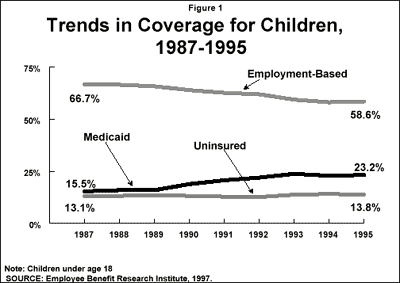
Medicaid plays a particularly strong role for low-income children, covering two-thirds (64%) of all poor children and a quarter( 27%) of children with incomes between 100% and 199% of the federal poverty level (FPL). While employer-based insurance coverage of children declined from 1987 to 1995, expansions in Medicaid have resulted in greater coverage of children in low-income families (Figure 1). During this same period, Medicaid enrollment grew from about 10 million — 15.5% of all children — to 17.5 million children (23.2%).
Despite the importance of Medicaid today, about 10 million children are uninsured. Lack of insurance is particularly high among low-income children. Seventy percent of uninsured children are in families with incomes below 200% of poverty. The new State Child Health Insurance Program, enacted as part of the Balanced Budget Act of 1997, is intended to provide coverage to this group.
Eligibility
Being poor does not automatically qualify a child for Medicaid. In the past 15 years, Medicaid eligibility for children has been broadened considerably through federal legislation and state optional expansions. Prior to 1986, Medicaid primarily served children who received AFDC cash assistance. Today, children qualify for Medicaid based on their age and income.
Medicaid coverage is especially prominent among young children, covering 33% of infants and 29% of children ages 1 to 5. Because recent expansions focused on young children, older children are less likely to qualify for Medicaid. Medicaid covers 22% of children between the ages of 6 to 12 years and 17% of teens between the ages of 13 to 18 years.
Medicaid Coverage of Children:
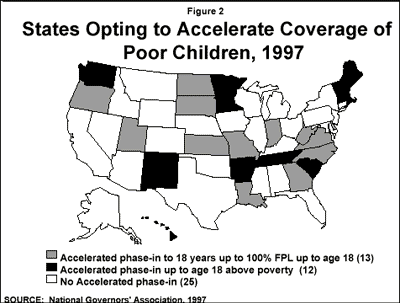
States are mandated to cover certain groups of children based on age and income criteria. By 2002, all states will be required to have phased-in coverage of children under age 19 with incomes below poverty. States can choose to expand Medicaid eligibility beyond federal minimum standards by raising age and income levels for children (Figure 2). They can also use Section 1115 research and demonstration waivers to broaden eligibility. In total, 41 states have expanded Medicaid coverage to children in one or more age or income levels. Federal coverage requirements for children are as follows:
Because states established varied Medicaid income eligibility levels for children, and because of state variations in per capita income there is considerable variation in Medicaid coverage, ranging from 13% of children in Colorado to 47% in West Virginia. Similarly, Medicaid pays for 39% of all births nationally, but coverage varies from 21% of births in Massachusetts to 61% in Georgia.
The Balanced Budget Act (BBA) of 1997 creates new options for states to strengthen and expand Medicaid coverage for children. The new State Children’s Health Insurance Program (CHIP) was enacted as part of the Balanced Budget Act (BBA) of 1997. This new capped federal program allocates $20.3 billion over five years in the form of a matched grant to states to expand coverage to uninsured low-income children through either a separate state program or by broadening Medicaid — or both. The funds became available on October 1, 1997 and are targeted to uninsured children under 19 with income below 200% of poverty who are not eligible for Medicaid or not covered by private insurance.
Provisions of the Balance Budget Act also included some important changes to Medicaid. It clarifies the state Medicaid option to accelerate the phase-in for children born before September 30, 1983. In addition, the new law gives states the option to extend presumptive eligibility to children, meaning that services provided to low-income uninsured children will be covered by Medicaid before the Medicaid eligibility determination process is complete. States can also offer 12 month continuous eligibility to children, regardless of any changes in family income during that period.
Services and Costs
Federal guidelines require that Medicaid cover a comprehensive set of services with nominal or no cost-sharing for children. Access to these services is important because poor children experience more health problems than more affluent children. Children with Medicaid are eligible to receive physician and outpatient services, prescription drugs, inpatient hospital care, and long-term care services.
Medicaid coverage also entitles children to early and periodic screening, diagnostic, and treatment (EPSDT) services including a comprehensive health and developmental history and physical exam, immunizations, laboratory tests including blood lead levels, and health education. Children found to have conditions requiring further attention are covered for needed treatment.
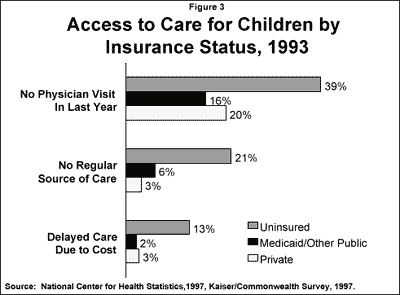
The importance of health insurance in securing access to health care services is well documented. Despite their complex health and social needs, children with Medicaid coverage have access to care that is similar to higher income privately insured children (Figure 3).
In 1995, Medicaid spent $25.4 billion on health care services for 17.5 million children in low-income families and about $7.1 billion for one million disabled children. The majority (93%) of the expenditures for non-disabled children are for acute care services, with one third for inpatient hospital care.
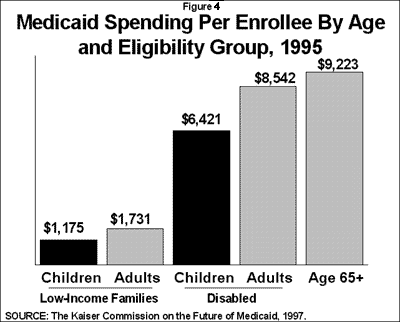
While low-income children represent half of the 35 million Medicaid beneficiaries, they account for only 16.7% of overall Medicaid spending. In 1995, Medicaid spent an average of $1,175 per low-income child enrolled in the program. On average, children cost less to care for than older Medicaid beneficiaries, but some disabled children have very costly health and long-term care needs. Medicaid spent an average of $6,421 per year per child qualifying on the basis of disability (Figure 4).
Issues and Challenges
Expanding Coverage.
To broaden coverage of low-income uninsured children, Congress enacted the new State Child Health Insurance Program and included provisions to allow states to facilitate enrollment and continuity of coverage under Medicaid. Key issues facing state Medicaid agencies include how the new children’s program will be structured, financed, and implemented, as well as how it will be integrated with or build on the state’s existing Medicaid program.
Participation.
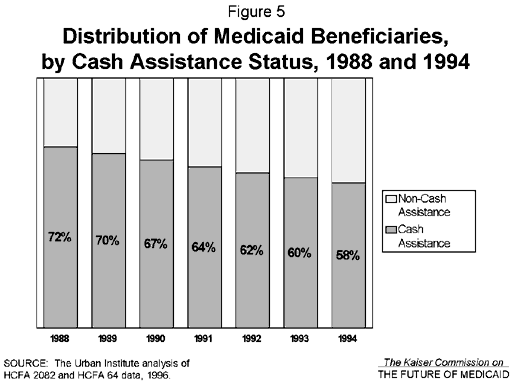
An estimated 3 million of the 9.8 million uninsured children are eligible for but not enrolled in Medicaid. This is largely due to enrollment barriers or lack of awareness of the program. States can streamline the eligibility process and facilitate enrollment. For example, 25 states allow mail-in eligibility applications and 29 states have dropped the asset test. Medicaid eligibility policy has also changed markedly as a result of the 1996 welfare law, which eliminated the automatic link between cash assistance and Medicaid. Ongoing and intensified outreach and educational efforts will be necessary to assure that all the children who are eligible for assistance under Medicaid are enrolled.
Managed Care.
In 1996, 40% of beneficiaries were enrolled in managed care, mostly low-income children and their parents. The BBA of 1997 expands state flexibility by allowing states to mandate Medicaid managed care enrollment without requiring states to obtain a Section 1115 or 1915(b) waiver. States will still need a waiver to mandatorily enroll special needs children, but will be able to enroll other non-disabled children. Managed care has the potential to improve access to preventive and primary care, but given the vulnerable nature of the Medicaid population, it requires careful implementation and monitoring to assure quality and access.
Is There A Managed Care “Backlash?”
Embargoed for release: 9:30 a.m. ET, Wednesday, November 5, 1997
For further information contact: Matt James or Tina Hoff
Most Americans Give Their Own Health Plan A Good Grade, But Have Concerns About Key Aspects Of Managed Care
Washington, DC — At a time of expanding enrollment and stricter federal and state regulation, how does the public feel about managed care? Most insured Americans — regardless of whether they have managed care or traditional coverage — give their own health plan a letter grade of “B” or higher. However, majorities of the public also say they are concerned about key aspects of managed health care. According to a new national survey by the Kaiser Family Foundation and Harvard University:
One area where managed care does come out on top is preventive care: nearly half (46%) of people say managed care has made it easier to get services such as immunizations, health screenings, and physical exams (31% say harder).
The survey also found that people seem to generalize from anecdotal reports in the news about problems with managed care. When asked about specific examples taken from news stories about the problems some people have reported to have had with managed care, the public’s perception is that these are fairly common occurrences. For example, two thirds of Americans believe that a Health Maintenance Organization (HMO) holding back on a child’s cancer treatment is something that happens “often” (26%) or “sometimes” (40%). Two out of five (39%) think newborn babies being sent home after just one day because of a managed care plan’s policy, in spite of mothers’ concerns, happens “often;” an additional third (34%) think this occurs at least “sometimes.”
“Managed care is winning in the health care marketplace, but it is in danger of losing the battle for public opinion,” said Drew E. Altman, Ph.D., President, Kaiser Family Foundation.
More people — 34 percent — think managed care health plans do a “good job” in serving health care consumers than think do a “bad job” (21%). However, overall, other health care groups are viewed far more favorably than managed care health plans: solid majorities of Americans think nurses (83%), doctors (69%), hospitals (61%), and pharmaceutical companies (62%) generally do a “good job.” For many people, though, the jury is simply still out: 32 percent have no opinion about the kind of job managed care health plans are doing.
Who Benefits from Managed Care Savings?
Many people perceive the cost savings from managed care as benefiting both employers (56%) and individuals (49%), but it is the health insurance companies themselves that most (72%) say reap the rewards in the form of greater profits. Few Americans believe the trend to managed care has had a significant impact on the overall cost of health care in this country, with most — 55 percent — saying they don’t see that it has made much of a difference; 28 percent say it has helped bring down costs.
Should Managed Care Be Regulated?
In recent weeks, the push for regulation of managed care has intensified with some industry leaders now calling for “legally enforceable national standards.” The President’s Advisory Committee on Consumer Protection and Quality in the Health Care Industry is also expected to soon release a “consumer bill of rights.” A slight majority of Americans — 52 percent — say the government should protect consumers of managed care; 40 percent say such intervention is not worth the increased costs that would result. When asked who they would “most like to see managed care plans regulated by,” the public is divided over whether the government — federal (19%) or state (18%) — or an independent organization (34%) should regulate the industry. Sixteen percent (16%) maintain that managed care plans should not be regulated at all.
Managed … What?
Few Americans are familiar with some of the key terms used in debates over health care policy. A sizeable percentage of people — 28 percent — have never heard of “managed care” (45% know what it means; 26% have heard of it but are not sure what it means). “Fee-for-service” is even less recognized: while 41 percent say they know what it means, 43 percent say they have never heard the term (15% have heard of it but are not sure what it means). HMOs are more familiar: 62 percent say they know what it means (24% have heard of but are not sure what it means, and 14% have never heard the term).
Comparing the Views of Managed Care Enrollees with People in Traditional Health Plans
People in managed care are more worried than those with traditional coverage when it comes to the perceived motivations of their health plans. Insured respondents under 65 in this survey were grouped into three categories based on their health care coverage: “heavy” managed care, reflecting the most restrictive arrangements; “light” managed care, reflecting less restrictive arrangements; and “traditional” fee-for-service plans. Three out of five people (61%) in “heavy” managed care say they would be at least “somewhat worried” that their health plan would be more concerned about saving money than providing the best treatment option if they were sick. Fifty-one percent (51%) of those in “light” managed care agree. By comparison, 34 percent of those with traditional coverage report a similar anxiety; 62 percent say they would not be overly worried that cost might affect medical care.
“People in managed care are much more anxious than those in traditional plans about whether or not their insurance plan will pay for what they need when they are sick,” said Robert J. Blendon, Sc.D., Professor of Health Policy at Harvard University. “Members appear satisfied with their plans today, but are concerned about what might happen to them in the future.”
While most insured Americans say they trust their health plan to do the right thing at least “most of the time,” those in traditional health plans have a greater degree of confidence than those in managed care that this is “just about always” the case (55% in traditional plans vs. 30% in “heavy” and 31% in “light” managed care).
Managed care enrollees are more likely to have cost concerns than those in traditional fee-for-service plans. While 69 percent of people in traditional health insurance say they think it would be “very likely” that their plan would cover most of the cost of serious illness, by comparison 44 percent of those in “heavy” and 54% in “light” managed care are equally sure their plan would pay. Similarly, three quarters (78%) of those with a traditional plan say it is “very likely” that a visit to the emergency room would be covered, while fewer of those in managed care (56% in “heavy” and 63% in “light”) are as confident their plan would pay.
While managed care enrollees appear more anxious about their health plan than those with traditional health care coverage, people with all types of insurance coverage grade their plans generally favorably. Twenty percent (20%) of those with “heavy” managed care give their plan a letter grade of “A,” 44 percent give a “B;” about the same percentages given by those with “light” managed care (“A” 24%, and “B” 44%). Slightly more people with traditional health insurance give an “A” (33%), and 43 percent give a “B.”
How Type of Health Care Coverage was Determined.
Because many people are unsure — or don’t know — what kind of health insurance they have, insured respondents under 65 in this survey (778 respondents) were asked a series of questions about their health plan to establish what kind of coverage they have. They were asked if they were required to do any of the following by their plan: choose doctors from a list and pay more for doctors not on the list; select a primary care doctor or medical group; and/or obtain a referral before seeing a medical specialist or a doctor outside of the plan. Respondents were listed as being in “heavy” managed care if they reported their plans had all of the characteristics described above (34% of the sample). Respondents were listed as being in “light” managed care if they reported their plans had some but not all of the characteristics listed above (45% of the sample). And, respondents were listed as having “traditional” insurance if they reported their plans as having none of the characteristics (21% of the sample).
Shaping Public Opinion: Personal Experience, Family, Friends, and the Media
People say that their feelings about managed care — favorable as well as unfavorable — are more likely to be based on personal experiences and what they have heard from family members and friends than on media coverage. Two thirds of those who say they think managed care plans generally do a “bad job” serving consumers report that the main reason they feel this way is their own experience (39%) or what they have heard from family or friends (32%). Similar percentages of people who think managed care is doing a “good job” say the same thing (35% say own experience, 32% say family or friends). About a quarter say media coverage of managed care has most influenced their views. Those with unfavorable impressions of managed care are again as likely to cite the media (22%) as those with more favorable opinions (24%).
Media coverage of HMOs or managed care is largely seen by the public as “fair” (54%) and as including a mix of favorable and unfavorable stories (57%). Most people — 56 percent — say they have personally seen at least “some” media coverage about managed care in the past year.
Methodology
The Kaiser/Harvard National Survey of Americans’ Views on Managed Care is a product of the Kaiser-Harvard Program on the Public and Health/Social Policy. It was designed and analyzed by researchers at the Kaiser Family Foundation and Harvard University. The survey was conducted by telephone by Princeton Survey Research Associates with 1,204 adults nationwide between August 22 and September 23, 1997. The margin of error is plus or minus 3 percent for the national sample.
The Kaiser Family Foundation, based in Menlo Park, California, is a non-profit, independent national health care philanthropy and is not associated with Kaiser Permanente or Kaiser Industries. The Foundation’s work is focused on four main areas: health policy, reproductive health, and HIV policy in the United States, and health and development in South Africa.
National Election Night Survey of VotersPress Release Survey Chart Pack
The November/December 1997 edition of the Kaiser Family Foundation/Harvard Health News Index includes questions about major health issues covered by news media, including questions about AIDS and the Health Care Bill of Rights. The survey was based on a national random sample of 1,201 Americans conducted December 4-9, 1997 which measures public knowledge of health stories covered in the news media the previous month. The Health News Index is designed to help the news media and people in the health field gain a better understanding of which health stories in the news Americans are following and what they understand about those health issues. Every two months, Kaiser/Harvard issues a new index report.
Note: This publication is not available on our website. However, the data from these surveys is still available through the Public Opinion and Media Research Group. Please email kaiserpolls@kff.org for more information.
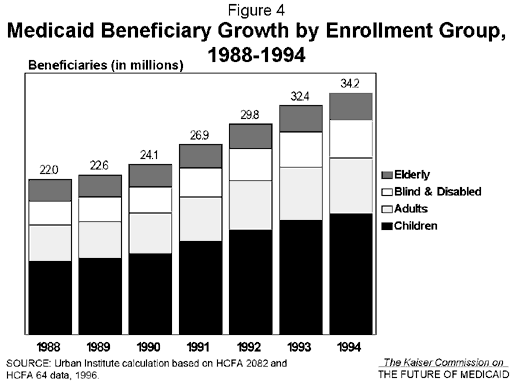
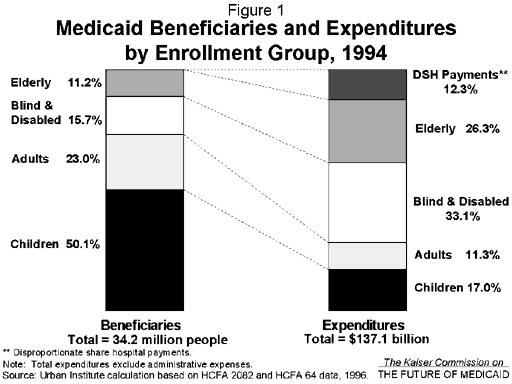
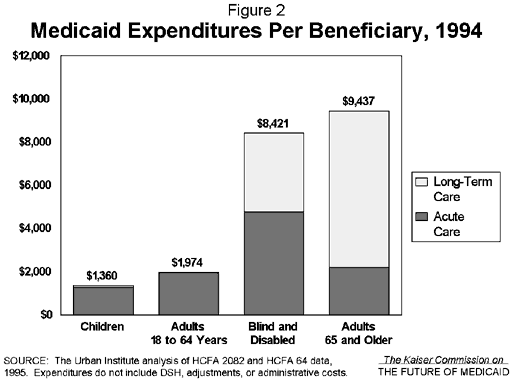
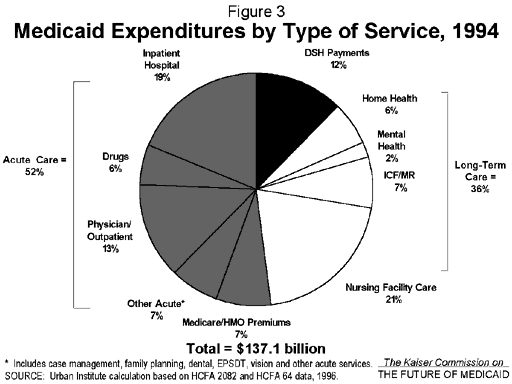
Medicaid Expenditures and Beneficiaries: 1994 Update
October 1998
Medicaid Expenditures and Beneficiaries:Policy Brief Tables Chart Pack