KFF designs, conducts and analyzes original public opinion and survey research on Americans’ attitudes, knowledge, and experiences with the health care system to help amplify the public’s voice in major national debates.
Americans Support Requiring Insurers To Cover Contraceptives, Even If Premiums Rise.
More Women and Men Say Contraceptives Should Be Covered Than Say Viagra
Embargoed for release until: 9:30 AM, ET, Friday, June 19, 1998
For further information contact: Tina Hoff or Matt James
Menlo Park, CA – Most Americans support requiring insurers to provide contraceptives as part of prescription coverage, even if premiums rise, according to a new national survey by the Kaiser Family Foundation. The public is also more likely to say contraceptives should be covered by insurers (75%) than Viagra, the new male impotence drug (49%).
Most Americans (62%) are not aware of proposals to require contraceptive coverage now before Congress. After learning that a “bill before Congress would require any health insurance plan with prescription coverage to pay for birth control methods just like any other prescription,” three quarters of Americans say they favor such a policy (45% “strongly favor” and 30% “somewhat favor” vs. 8% “strongly oppose” and 8% “somewhat oppose”). Both women and men (ages 18 and older) say contraceptives should be covered by insurers, though women (81%) are more likely to support such a policy than men (68%). Most (82%) who favor contraceptive coverage say all prescription methods currently on the market – oral contraceptives, IUDs or intra-uterine devices, Norplant implants, diaphragms, the injectable Depo-Provera, and cervical cap – should be paid for.
Support remains strong when people are told that contraceptive coverage could result in higher premiums. For example, when told that “the average cost individuals pay for health insurance could increase by $1-5 per month:” 43 percent “strongly favor” and 30 percent “somewhat favor,” vs. 12 percent “strongly oppose” and 8 percent “somewhat oppose.” Support drops somewhat, although a majority continues to favor contraceptive coverage, if premiums were to rise by larger amounts. For example, when asked their reaction if premiums were to rise by as much as $20 more per month: 30 percent “strongly favor” and 29 percent “somewhat favor,” vs. 19 percent “strongly oppose” and 13 percent “somewhat oppose.”
“Both men and women think comprehensive coverage for contraception makes sense; they think it should be part of prescription coverage, and they say they are willing to pay for it,” said Felicia H. Stewart, MD, Director of Reproductive Health Programs, Kaiser Family Foundation.
Americans More Mixed on Whether Viagra Should be Covered by Insurance
The new drug, Viagra, which sparked a recent debate over insurance coverage when it came on to the market earlier this Spring, draws more mixed views from Americans: 49 percent say the male impotence drug should be covered as part of prescription coverage; 40 percent say it should not be covered; and, 11 percent don’t know. Women (51%) are as likely to favor coverage of Viagra as men (47%).
Women of “Reproductive Age” and Privately Insured Supportive of Contraceptive Coverage
Women between the ages of 18-44, so-called “reproductive age,” are most supportive of legislation to require coverage of prescription contraceptives: almost nine out of ten favor such a policy (67% “strongly support” and 21% “somewhat support” vs. 4% “strongly oppose” and 5% “somewhat oppose”). There is no drop in support if the additional cost for providing this coverage falls in the low range ($1-5 per month) for an individual premium (87% support vs. 11% oppose); even at the higher range ($15-20 per month): 74 percent support (22% oppose). Women in this age range also are the most likely to say all methods should be covered (83%).
Three quarters of these women, who are most likely to use prescription contraceptives, say whether or not a certain method is covered by their insurance is something they would factor into their decision about what to use: 40 percent say coverage is “very” important, and 34 percent say “somewhat” in choosing birth control.
Family planning services, including contraceptives, are a required benefit under Medicaid, the public program that provides health coverage for low-income Americans. The contraceptive coverage proposal now before Congress applies to the privately insured population. Among this group, which would most directly benefit from the expanded coverage as well as potentially bear some of the additional costs if their insurer does not currently provide a full-range of contraceptive options, most support the policy. Eight out of ten privately-insured Americans, excluding those eligible for Medicare (65 and older), support contraceptive coverage (47% “strongly support” and 33% “somewhat support ” vs. 7% “strongly oppose” and 8% “somewhat oppose”). Even if their premiums were to go up, this group says they would still favor it ($1-5 per month: 78% support vs. 18% oppose; $15-20 per month: 64% support vs. 31% oppose). Women of reproductive age and the privately insured are no more likely than the average American to know that legislation has been proposed.
Methodology
The Kaiser Family Foundation 1998 National Survey on Insurance Coverage of Contraceptives is a random-sample telephone survey of 1,015 adults 18 and older living in the United States. It was designed by staff at the Foundation and Princeton Survey Research Associates (PSRA) and conducted by PSRA between May 22-26, 1998. The margin of sampling error is plus or minus 3 percent for the national sample; it may be higher for smaller sub-groups.
The Kaiser Family Foundation, based in Menlo Park, California, is an independent national health care philanthropy and is not associated with Kaiser Permanente or Kaiser Industries.
The questionnaire and top line from the survey are available by calling the Kaiser Family Foundation’s publication request line at 1-800-656-4533 (Ask for documents #1404). This release is also available on the Kaiser Family Foundation website at www.kff.org
The May/June 1998 edition of the Kaiser Family Foundation/Harvard Health News Index includes questions about major health stories covered in the news, including questions about Viagra and Social Security. The survey is based on a national random sample of 1,202 Americans conducted June 12-18, 1998 which measures the public’s knowledge of health stories covered in the news media during the previous month. The Health News Index is designed to help the news media and people in the health field gain a better understanding of which health stories in the news Americans are following and what they understand about those health issues. Every two months, Kaiser/Harvard issues a new index report.
Impact of Potential Changes to ERISA: Litigation and Appeals Experience of CalPERS, Other Large Public Employers and a Large California Health Plan – Report
The Employee Retirement Income Security Act (ERISA) currently preempts state law related to the wrongful denial or delay of health benefits to the extent that such laws relate to a health benefit plan sponsored by a private employer. This preemption of state law has protected private employers who sponsor health benefit plans from legal actions based on such laws; courts have found that the scope of preemption extends to lawsuits against insurers and HMOs as well. ERISA provides the exclusive avenue for remedies in such cases, which generally are limited to the value of the denied benefit and, in some cases, reasonable attorneys’ fees. ERISA does not allow claims for punitive damages or noneconomic damages.
In addition, ERISA governs the grievance and appeal procedures under private employee health benefit plans. Grievance and appeal processes provide an opportunity for individuals to resolve differences with their health plans before resorting to the court system. The Department of Labor, which administers ERISA, plans to issue regulations to require the grievance and appeal procedures of private sector employee health benefit plans to meet certain standards, including time frames for the resolution of appeals. Current greivance and appeal rules do not distinguish between types of claims for benefits (e.g., emergency vs. non-emergency services) and do not require external appeal procedures.
Legislative Proposals
Legislation before Congress includes proposals to narrow the scope of ERISA preemption, allowing individuals to bring suit under state law principles against employee health benefit plans and other parties involved in the administration of the health plan. Many bills also have been introduced to amend ERISA and mandate the use of specific grievance and appeal processes, such as imposing faster turnaround periods for claims related to emergency services, specifying the manner in which decisions are to be made in an internal grievance and appeal process, and requiring the opportunity for a third-party review of certain appeals.
The implications of requiring the use of specific grievance and appeal processes and of allowing individuals to sue managed care organizations and other parties involved in the administration of a private employee health benefit plan are difficult to quantify. However, the experience of state and local government employers, which are not covered by ERISA, may be illustrative. Because such plans have not been shielded from lawsuits based on state law, their grievance and appeal processes and the incidence of litigation experienced by their health benefit plans may be a source of useful information in estimating the frequency of litigation that might be experienced by employers and health plans in the private sector if the scope of ERISA were narrowed.
Approach
To gather information on the experience of state and local governmental employers, we utilized contacts within the industry and from previous projects to identify individuals responsible for administering the plans’ grievance and appeal processes and who had familiarity with and/or involvement in the litigation experiences of three large government entities that sponsor group health insurance coverage. The entities we identified are the California Public Employees Retirement System (CalPERS), the Los Angeles Unified School District (LAUSD) and the State of Colorado Employee Benefit Plan.
CalPERS provides health care coverage for approximately one million members. LAUSD covers about 70,000 members, and the State of Colorado Employee Benefit Plan covers about 30,000 members. CalPERS covers both active employees and retirees while LAUSD and the State of Colorado Employee Benefit Plan provide health care coverage for active employees only. Enrollment in managed care plans for each of these employers is 80% or higher, with CalPERS and the State of Colorado Employee Benefit Plan having 80% managed care enrollment and the LAUSD having 100% of its enrollees in HMOs or HMO-based Point of Service plans.
In gathering our information, we conducted multiple telephone interviews with individuals with extensive involvement in administrative appeals and litigation experience of health benefit issues for these government-sponsored health benefit programs. We sought information regarding the frequency, nature and costs associated with the appeals and litigation that these organizations have experienced. The individuals interviewed have had direct involvement in appeals and litigation for their organizations over an extended period of time, ranging from seven to fourteen years. In addition, for CalPERS we reviewed Evidence of Coverage booklets, internal procedures, legislation and regulations to obtain a more complete understanding of existing appeal procedures.
Findings
Each program has an internal grievance and appeals system established for individuals who disagree with a claims decision. The program grievance and appeal rules require that each step of the appeals process be exhausted prior to moving on to the next steps to resolve grievances. Under most state laws, including California and Colorado, an individual must exhaust available administrative procedures before bringing suit in state court. Therefore, a plan’s grievance and appeals system provides a forum in which many benefit disputes are resolved, avoiding the need to file suit against a health plan, administrator, or employer.
CalPERS Appeal Procedures
CalPERS has a formal multistage appeal structure. The legal and regulatory foundation of this program is Section 22815 of the California Government Code and Section 555.1 of the California Code of Regulations. CalPERS requires that the appeals procedure be included in the Evidence of Coverage booklets for each of the HMOs and PPOs that contract with CalPERS. In addition CalPERS has developed a General Procedures for Administrative Hearings brochure for its members to understand the appeal process. This brochure is particularly useful for those appeal situations where the member is representing himself or herself.
The multistage appeal process involves an internal appeal procedure of the health plan, administrator, or HMO, and a subsequent appeal to CalPERS. Each successive stage is available only after exhausting the preceding stage of the appeal procedure. Time limits are included for each stage of the process ranging from 30 to 60 days, although time limits are not specified for all of the steps in each stage. For example, an individual must file with the plan his or her initial objection within 30 days of the action that is being appealed.
An appeal to the health plan, administrator, or HMO typically involves two to four steps, depending on the plan through which the individual receives coverage. A four-step internal appeal procedure would include:
initial objection to the action;
request for reconsideration;
request for administrative review; and
final appeal to the health plan’s Consumer Appeals Department.
In 1995 California enacted additional requirements for the HMO appeal processes that established 30-day time limits at each stage of an appeal and an expedited appeal procedure in life threatening situations. These regulations became effective in April 1996 and January 1997 and included reporting requirements, penalties for non compliance and HMO-funded toll free access to the Department of Corporations (the HMO regulator in California). The health plan appeal process resulting from these reforms may take up to 60 days provided all information is correctly provided by the member and the member does not use the expedited appeal procedure. Prior to this legislation the appeal process could take up to 90 days.
Upon exhausting the plan’s internal appeal process, an individual may be able to appeal to CalPERS, which has a three-step appeal procedure:
an informal “consult and confer” process;
a formal hearing process before an Administrative Law Judge; and
a formal decision by the CalPERS Board of Administration.
If an appeal proceeds to litigation, California law protects CalPERS from punitive damage awards. This protection from punitive damages does not extend to the health plan.
The member is responsible for the legal costs of mounting an appeal, excluding any CalPERS staff costs. Although many California HMOs use binding arbitration, HMOs that contract with CalPERS must accept the CalPERS appeal process. Consequently, all CalPERS members have access to an external appeal process. CalPERS’s staff believe that members use CalPERS’s appeal process regardless of any binding arbitration requirements by an HMO that might otherwise apply.
The CalPERS appeal process is available for claims relating to the acts of and failure to act by contracting health plans, administrators and HMOs. For example, the process is available for appeals of decisions relating to improper payment for covered services, denial for coverage of services and eligibility determinations. The appeal process specifically excludes issues of medical malpractice, and CalPERS makes clear in its Evidence of Coverage brochure that appeals to CalPERS cannot be made related to medical malpractice.
CalPERS Appeal and Litigation Experience
For the seven-year period from 1991 through 1997, CalPERS indicated that there were approximately 60 appeals resolved at the administrative hearing stage of the appeal process (stage 2 of 3) as described above, for an annual rate of 0.9 appeals per 100,000 enrollees. The issues raised in these appeals generally involved denials of benefits and reimbursement disputes. The underlying medical conditions were generally not life threatening. The average internal cost to CalPERS for the preparation of a case before the administrative law judge was estimated by staff to be $10,000.
Over the same time period, between fifteen and twenty appeals reached the level of civil litigation, for a rate of 0.3 per 100,000 enrollees (i.e., the member was dissatisfied with the decisions resulting from the appeal process and proceeded to court. These civil litigation suits were brought against the health plans). Approximately twelve cases concerned denial of benefits and benefit exclusions. The medical conditions underlying these appeals were more serious and usually life threatening. The majority of these cases involved autologous bone marrow transplants for the treatment of breast cancer when this procedure was excluded based upon its experimental nature. Two or three cases involved eligibility issues. Two cases concerned coverage for twenty-four hour skilled nursing care, and one case involved coverage of rehabilitation services for an autistic child.
The majority of these cases were settled prior to trial; in many cases the complainant received at least partial payment for the requested services in the settlement. It is important to note that a significant number of the cases involved experimental procedures in a fast developing area of cancer treatment. It is very likely that similar incidents involving a cluster of lawsuits will occur in the future whenever advances in medicine result in experimental procedures that show promise of effectively treating a life-threatening disease.
Experience of Other Large Public Employers
We also interviewed administrators of the Los Angeles Unified School District (LAUSD) and the State of Colorado Employee Benefit Plan, both of which operate under rules that are largely similar to those used by CalPERS. Over the last fourteen years the staff of LAUSD could recall only three appeals that resulted in litigation. One of these cases involved autologous bone marrow transplant for breast cancer. The other two cases involved eligibility issues. Over the last seven years the State of Colorado Employee Benefit Plan had three appeals reach the litigation stage. One of these cases involved autologous bone marrow transplants for breast cancer.
Summary
All three programs reported very low rates of litigation ranging from 0.3 to 1.4 cases per 100,000 enrollees per year. The litigation rate per 100,000 enrollees decreased as the number of persons covered by the program increased. Grievances that reached the CalPERS administrative hearing stage numbered 0.9 per 100,000 enrollees per year. Assuming an average cost per case for litigation of $100,000 and the $10,000 estimate from CalPERS for the cost of an administrative hearing, the direct monthly cost per enrollee related to litigation ranged between $0.03 and $0.13.
The frequency of administrative appeals and litigation reflect the actual experience of CalPERS, LAUSD and the State of Colorado Employee Benefit Plan. This experience is most useful in estimating the administrative appeal and civil litigation exposure for plan sponsors. The specific features of the proposed modifications to ERISA will need to be compared to the CalPERS appeal process to determine any adjustments that may be needed to use these estimates to forecast the impact of the change. Among the factors that could affect the frequency and cost of any appeal process are the internal time limits, the availability of punitive or other damages, and any differences in appeals and litigation between government and non-government plan sponsors.
Impact on Health Insurers and HMOs
Because health insurers and HMOs are more actively involved in the administration of benefit plans and do not enjoy an employee/employer relationship with their members, they may be subject to greater appeal and litigation risks than plan sponsors. Whether health insurers and HMOs are vulnerable to punitive damages awards depends on the relevant state law. These health plans may be subject to federal rules governing appeal procedures, which would likely be enacted if liability reform is enacted.
We have identified two sources of data on the changes in the frequency of litigation for a large health insurer and HMO in California that provide some indication of the costs associated with a modification in the ERISA protection for health insurers and HMOs. These include:
the plan’s litigation experience prior to the 1987 decision in Pilot Life v. Dedeaux, in which the U.S. Supreme Court held that ERISA preempts a lawsuit based on state law against an insurance company for improper claims processing, including the manner in which decisions are made regarding the payment of claims; and
the plan’s litigation experience in the individual health insurance market.
Carrier’s Litigation Experience
It is noteworthy that the California carrier experienced a significant drop in the rate of litigation concerning improper claims processing for benefits and determination of covered benefits under an ERISA-covered plan after the Supreme Court’s 1987 decision in Pilot Life. From 1985 to 1988 this carrier reported an average of 3.2 litigation cases per 100,000 members, which largely reflects claims under group health plans, although this figure also reflects some claims related to individual plans. Our interviewee reported that lawyers for consumers typically attempted to bring a claim as a representative of a group rather than of an individual because there was perceived to be a greater probability of success.
Subsequent to the Supreme Court’s ruling that ERISA preempts cases concerning improper claims processing, litigation cases dropped to 2.4 per 100,000. (This number also includes both group and individual coverage cases.) This change in total litigation experience represents a decrease of 25%, although it is important to note that it is not possible to split the litigation experience between group and individual claims for these two time periods.
Individual Coverage
ERISA does not apply to individual health insurance coverage, and health plans active in the individual health insurance market have been subject to lawsuits under state law. Beginning in 1993 the health plan we examined began to track litigation related to individual insurance policies separately from litigation related to group health plans. The plan experienced 9.3 lawsuits per 100,000 members per year related to individual coverage for the period January 1993 through June 1996, compared to an average of 1.3 per 100,000 for members covered by groupinsurance.
This difference in litigation experience between individual and group coverage may be partially attributable to differences in ability to sue, the extent of internal and external appeal processes, and differences in the health care needs and circumstances of individuals with group versus individual plans. Those individuals who purchase insurance on their own may have greater health care needs, or may have a greater sense of ownership of the insurance benefit compared to those who receive coverage as an employee benefit. Additionally, many individual policies contain specific limitations on benefits (known as “riders”) that may lead to additional litigation if members attempt to obtain coverage for services that have been excluded from their benefit plan. Consequently, an exact extrapolation cannot be made of the difference in experience, although the data can be used to gain an understanding of the order of magnitude of potential changes in litigation rates.
General Cost Impact
An important consideration in evaluating the effect of potential changes in liability on health plan costs is the average cost per claim in either damages or settlement and the number of claimants. A litigation rate of 3.2 per 100,000 plan members with an average cost per claim of $100,000 translates to $0.27 per person per month. This amount represents approximately 0.25% of premium. If this rate were to double, health plan premiums related to litigation would increase to $0.54, or approximately 0.5% of premium. Note that the numbers provided here are for illustrative purposes only; we do not believe it would be valid to extrapolate the experience of one health plan to the entire managed care health insurance market.
The effect of a change in liability may be expected to vary for health plans that are currently active in the individual insurance market compared to those who sell health insurance only to groups. Those plans offering individual insurance may have greater experience with litigation related to medical malpractice and other benefit issues. Health plans that offer only group insurance coverage may see greater changes in their litigation experience and associated costs. Whether a health plan uses binding arbitration to settle cases may also affect its litigation experience; binding arbitration is likely to reduce the number of disagreements regarding health plan coverage that would reach the courts. Finally, the size of the health plan may impact these costs on a per member per month basis with per member per month costs decreasing as the enrollment of the health plan increases.
Conclusions
We interviewed three large public employers that are not protected by ERISA regarding their litigation experience. All three reported very low rates of litigation ranging from 0.3 to 1.4 cases per 100,000 enrollees per year. The litigation rate per 100,000 enrollees decreased as the number of persons covered by the program increased. Grievances that reached the CalPERS administrative hearing stage numbered 0.9 per 100,000 enrollees per year. The groups we interviewed have strong internal appeals procedures. In addition, other characteristics of the grievance process may have limited the number of cases reaching the civil litigation stage. These include:
Limited availability of punitive damages;
The employers in question were all public employers; it may be that public employees have a different propensity to sue than employees of private firms; and
The plan sponsors were specifically not responsible for medical necessity determinations.
We believe the information discussed here provides some guidance regarding potential changes in litigation rates that may result from a change in rules regarding ERISA protections. The net effect of this type of rule change is difficult to project, as behavior patterns may change with a change in law. An assessment of the effects of this legislative change should take into account the type of internal and external appeal processes that may be in place concurrent with the change in health plan liability. Changes in health plan behavior, including loosening or clarifying utilization review criteria may also occur. If health plans respond to a change in liability by loosening utilization review standards so as to avoid exposure to some litigation there may be an increase in health care costs resulting from increased utilization. If health plans respond by clarifying their standards and communicating those standards to providers and health plan members there may be little change in health plan costs, or perhaps decreases in costs, associated with changes in utilization.
The experience of one large health plan in California before and after clarification of the application of ERISA protection to health plans and HMOs also provides information on potential changes in litigation rates. For that health plan, litigation rates dropped by 25% when the ERISA protection was clarified. This rate may be expected to return to its pre-1988 level if liability rules were changed. Litigation costs for this health plan prior to theses changes represented approximately 0.25% of premium.
This report assesses the potential impact of selected recommendations of the Managed Health Care Improvement Task Force in the areas of access to care and specialists, information disclosure, and dispute resolution. The Managed Health Care Improvement Task Force was established in 1998 to inform state leaders about the health industry in California; the impact of managed care on quality, access, and cost of care; issues of special concern to consumers; and the appropriate role of government in relation to managed care.
Prepared for: The Henry J. Kaiser Family Foundation
The Henry J. Kaiser Family Foundation, based in Menlo Park, California, is an independentnational health philanthropy and is not associated with Kaiser Permanente or Kaiser Industries. Established in 1948 by industrialist Henry J. Kaiser and his wife Bess, the Foundation focusesits work on four main areas: health reform/health policy, reproductive health, HIV, and health anddevelopment in South Africa. The Foundation also maintains a special interest in health care inits home state of California.table of contents
Welfare reform, technically the Personal Responsibility and Work OpportunityReconciliation Act of 1996 (PRA), was signed into law on August 22, 1996. UnderPRA most legal immigrants arriving after August 22, 1996 will no longer be eligible forcash assistance and food stamps and are effectively barred from other services, including Medicaid, forat least a decade.1 Legal immigrants residing in the United States on August 22, 1996 will also losetheir entitlements unless they meet certain exemptions. A critical exemption enables legal immigrantswho have worked for forty quarters (10 years) in Social Security covered employment to retainbenefits. The various provisions concerning legal immigrants are complicated and the ensuing confusionhas already resulted in the denial of assistance to some qualified immigrants.
Relative to the federal budget, the reductions in welfare expenditures are modest. To theindividuals who depend on them they are of enormous importance. Most of the cuts come in the formof reduced benefits and time limits. The cuts for legal immigrants are especially severe: theCongressional Budget Office estimates that over the first six years the Personal Responsibility andWork Opportunity Reconciliation Act of 1996 will reduce federal spending by nearly $54.2 billion fromwhat would have been spent.2 About 44 percent of the total reductions ($23.8 billion) over the first sixyears, will be borne entirely by legal immigrants.
In 1995, there were an estimated 1.1 million legal immigrants age 65 or older. Elderly legalimmigrants are concentrated in a small number of states. In fact, more than one-half of the elderly legalimmigrant population lives in three states and 80 percent live in seven states. This suggests that thebroader economic consequences of these cuts will fall disproportionately on the citizens of communitieswith immigrant populations.
The portrait that emerges from the analysis suggests that the typical elderly legal immigrant didnot come to the United States because of its welfare programs. More than half of elderly legalimmigrants arrived in the United States over twenty years ago, and over three-quarters arrived prior totheir 65th birthday. Some elderly legal immigrants have served in the military, most have worked andpaid taxes, and more than three-quarters paid sufficient FICA taxes to earn Social Security andMedicare benefits. As a result, most elderly legal immigrants will not lose public assistance but the mostvulnerable those without Social Security and Medicare might lose some or all of their publicassistance. They are likely to lose SSI, food stamps, and other means-tested benefits. They could alsolose access to Medicaid, the principal source of nursing home care, depending on legislative andadministrative decisions made by each state.
Elderly legal imigrants are substantially more likely than elderly citizens to rely upon Medicaidbecause of their lower income levels. They are also more likely than elderly citizens to be uninsured. As a group, elderly legal immigrants were nearly twice as likely to live in households with incomesbelow the poverty level, and are more likely to be receiving some form of public assistance than elderlycitizens. The average family income among elderly legal immigrants is about half that of elderly citizens. Even among the working elderly, average monthly earnings for legal immigrants were about 66 percentless than elderly citizens. As a consequence, legal immigrants are nearly twice as likely to be poor aselderly citizens (24% versus 14%).
Elderly legal immigrants were found to be more likely than elderly citizens to have long-termcare needs. An estimated 80,000 to 90,000 nursing home residents in 1995 were elderly legalimmigrants; relying principally upon Medicaid to finance their care. The welfare reform law enacted lastyear permits states to discontinue Medicaid eligibility and coverage for legal immigrants, including thosein nursing homes. Those in nursing homes who lose Medicaid coverage have limited options. It isunlikely that the typical nursing home resident will have the physical and/or cognitive ability to become anaturalized citizen, in order to assure Medicaid coverage.Public assistance is critical for many elderly legal immigrants. Given the concentration of elderlylegal immigrants within families and specific communities, the implications of these changes go beyondthe elderly legal immigrant and their families, but will also affect the citizens in communities in which theylive.
Public assistance is critical for many elderly legal immigrants. Given the concentration of elderly legal immigrants within families and specific communities, the implications of these changes go beyond the elderly legal immigrant and their families, but will also affect the citizens in communities in which they live.
Introduction
Welfare reform, or technically the Personal Responsibility and Work OpportunityReconciliation Act of 1996 (PRA), was signed into law on August 22, 1996. This lawfundamentally changed the nature of federal public assistance by eliminating some federalentitlement programs and delegating to the states authority over who would be eligible to receive publicassistance. In addition, federal money provided to states and to beneficiaries for public assistance wasreduced. The Congressional Budget Office estimates that over the first six years the PersonalResponsibility and Work Opportunity Reconciliation Act of 1996 will reduce federal spending bynearly $54.2 billion.3 About 44 percent of the total reductions ($23.8 billion) over the first six years willbe borne entirely by legal immigrants. Eliminating legal immigrants from benefits reduces the federaldeficit annually by $5.1 billion when fully phased-in in 2002.4
Relative to the federal budget, these expenditure cuts are modest. However, to the individualswho depend on them they are of enormous importance. Elderly immigrants are particularly vulnerable,based on their service and their income needs. Analysis indicates that the majority of elderly legalimmigrants come to the U.S. long before they are elderly or in need of health or long-term care. Eliminating public support for these services especially for people already residing here impactsimmigrants, their extended families, and their communities, for circumstances beyond their control.
Elderly Immigrants and the Personal Responsibility and Work Opportunity Reconciliation Act
The Personal Responsibility and Work Opportunity Reconciliation Act (PRA) of 1996 eliminated theopen-ended federal entitlement program of Aid to Families with Dependent Children (AFDC) andreplaced it with Temporary Assistance to Needy Families (TANF), a block grant with a fixed amountof funding given to states to provide time-limited cash assistance to low-income families. The new lawalso fundamentally alters access to federal assistance for legal immigrants.
The PRA distinguishes between two classes of immigrants unqualified and qualified. Unqualified immigrants are effectively illegal immigrants and qualified are legal immigrants.5 Prior toPRA, illegal immigrants were not eligible for most federal means-tested benefits except for emergencymedical care, federally subsidized housing, and services related to the protection of life and safety. Illegal immigrants could, however, receive some forms of assistance by being categorized as”permanently residing under color of law” (PRUCOL). The new law eliminates this category, makingthem ineligible for benefits.
Under prior law, legal immigrants or those considered qualified in the PRA, could apply forpublic assistance.6 This too was changed under PRA. To understand these changes, one mustdifferentiate between legal immigrants who were receiving public assistance on August 22, 1996 andthose who were not. An overview of the changes in law are provided in Figure 1.
Figure 1Restrictions on Public Assistance to Immigrants Under the Personal Responsibility and Work Opportunity Reconciliation Act of 1996 Benefit Aliens permanently residing under color of law (PRUCOL)1 Legal Immigrants receiving benefits before August 22, 1996 Legal Immigrant that arrived before August 22, 1996, but not receiving benefits Legal immigrant arriving after August 22, 1996 Refugee Supplemental Security Income Immediate cut-off Cut off over the next year, unless in exempt category2 Ineligible until naturalization, unless in exempt category2 Ineligible until naturalization, unless in exempt category2 Eligible for first five years after entry, then denied until naturalization Food Stamps Immediate cut-off Cut off over the next year, unless in exempt category2 Ineligible until naturalization, unless in exempt category2 Ineligible until naturalization, unless in exempt category2 Eligible for first five years after entry, then denied until naturalization Medicaid Immediate cut-off State option to continue, unless in exempt category5 States have the option to bar coverage until naturalization5 Ineligible for first five years5 after entry, then subject to deeming.4 States have the option to bar coverage until naturalization.5 Eligible for first five years after entry, the state option to continue State and Local government assistance Immediate cut-off State option to continue, barring exemptions listed below State option to continue. State may require deeming State option to continue. State may require deeming4 Eligible for first five years after entry, then state option to continue1. Under prior law, certain illegal immigrants could be eligible for specific public benefits if they were considered to be “permanently residing under color of law” (PRUCOL). Under the new law, this category of immigrants has been eliminated, making this group like other illegal immigrants ineligible for benefits.
2. The following categories of immigrants are exempt from restrictions to SSI and Food Stamp programs during their first five years in the country: refugees, people seeking asylum, persons granted “withholding of deportation.” Also exempt are those legal immigrants who are active duty members of the U.S. armed forces or honorably discharged U.S. veterans and their spouses and unmarried dependent children. The law also exempts immigrants who have worked forty quarters (ten years) in the U.S.
3. Aliens exempt from the five-year bar include the same categories that were exempt from restrictions on SSI and Food Stamps. However, there is an additional exempt category of Cuban and Haitian entrants who are paroled into the U.S. for at least one year.
4. The same categories exempt from the five-year bar, except for veterans and their families, are also exempt from sponsor-to-alien deeming. Veterans are the only class of immigrants who are subject to deeming, but not to the five-year bar.
5. States must continue to provide Medicaid to legal immigrants who are veterans or on active military duty, refugees, and persons who have been granted asylum within the last five years, and those who have worked for at least ten years within the United States.
Current Legal Immigrants
The PRA would not change the eligibility for public assistance forlegal immigrants who meet specific exemptions. One of these exemptions is having worked for morethan forty quarters in Social Security covered employment. Since most elderly legal immigrants worked, they are more likely to be exempt. Legal immigrants whowere unable to work long-enough or who did not meet one of the other exemptions could lose benefitsor become ineligible to apply for benefits. If they were receiving benefits on August 22, 1996, benefitswill be terminated subsequent to a case-by-case review now underway to determine whether there isany basis for continued eligibility (for example, legal immigrants who served in the military or who havebeen in Social Security-covered employment for forty quarters).7 If they do not fall into one of thoseexempt categories and are not naturalized by the time their cases are reviewed, they will lose theirbenefits.8 Legal immigrants receiving Medicaid on August 22, 1996 continued to receive benefitsthrough January 1, 1997. After this date the State may decide whether to continue medical assistancethrough Medicaid for this group of immigrants (most states are expected to continue Medicaid for thisgroup). Elderly immigrants who arrived prior to the law s enactment (August 22, 1996), and who atthat time were not receiving assistance, immediately become ineligible for applying for food stamps andSSI, unless they, too meet one of the exemptions.9
Confusion over these provisions, however, has already resulted in nursing homes denyingaccess to legal immigrants with Medicaid coverage even when the state has made it clear that they willcontinue their Medicaid coverage.10 For current beneficiaries whose Medicaid was based on theirreceipt of SSI, however, the state will need to find another eligibility criterion (of which there areseveral) if they are no longer qualified for SSI.11 However, this process too could cause some elderlylegal immigrants to lose their access to Medicaid.
Future Legal Immigrants
Elderly legal immigrants arriving on or after August 22, 1996,are prohibited from receiving SSI or food stamps until they become naturalized citizens or fit one of theexemptions, such as working forty qualifying quarters (which takes a minimum of ten years).12 They arealso restricted from applying for Medicaid, Title XX-funded social services,13 Temporary Assistancefor Needy Families,14 and other federal means-tested benefits15 (other than SSI and food stamps), for aperiod of five years on entry into the U.S. as a legal immigrant (States have the option to extend thisrestriction until naturalization). After the five-year bar expires, legal immigrants must include thefinancial resources of their sponsor in their application for assistance.
This provision is called “deeming.”16 Given the low income and asset limits for means-tested programs such as Medicaid, “deeming,” is likely to keep most very poor legal immigrants from becoming eligible for assistance until they become citizens or fulfill some other criterion like working forty quarters in covered employment.17 Prior to PRA, legal immigrants were not barred from applying for assistance and although their sponsor s income was deemed, it was done for just the first three orfive years (depending on the public assistance sought).
The meaning of the PRA and the procedures needed to implement it are still subject to politicaldebate and judicial interpretation. The President and the Congress are revisiting some provisions inparticular, the elimination of benefits for current legal immigrants and the access to benefits for legalimmigrants here but not receiving benefits on August 22, 1996. The outcome is likely to impact currentelderly legal immigrants, but unlikely to change provisions for future elderly legal immigrants. To betterunderstand the consequences of this legislation, the following describes where and who elderly legalimmigrants are and their need for assistance.
A Profile of Elderly Legal Immigrants
The Size and Distribution of the Population
Nationally there are relatively few elderly legal immigrants. Census data suggest that in 1995 therewere about 1.1 million elderly legal immigrants.18 In 1995, elderly legal immigrants representedabout 3.2 percent of the country’s elderly population. Although elderly legal immigrants live in everystate, some states have a particularly high concentration. More than one-half of elderly legal immigrants(60.4 percent) lived in three states California, Florida, and New York. Adding Texas, New Jersey,Illinois and Massachusetts accounted for nearly 80 percent of elderly legal immigrants (see Table 1).
In most states, the elderly legal immigrant population constitutes less than 1 percent of theelderly population. However, in these seven states (see Table 1) and in nine others, whose numbers ofimmigrants are small, elderly legal immigrants are more than 3 percent of the state s elderlypopulation.19 For example, Hawaii has fewer than 14,000 elderly legal immigrants, but they constituteover 9 percent of the state s elderly population. Since the concentration of elderly legal immigrants isconsistent with that of legal and probably, illegal immigrants of all ages, the impact of the PRA on thecommunity is substantially larger than what just happens with elderly legal immigrants. Communitieswith a large proportion of people who need public assistance are less likely to have public and privateresources to assist those in need.
Table 1Distribution of Elderly Legal Immigrants Ranked by State, 1995. State Elderly Legal Immigrants Proportion of Elderly California 358,720 10.4% Florida 159,007 6.0% New York 157,778 6.5% Texas 74,466 3.9% New Jersey 49,416 4.5% Illinois 46,770 3.2% Massachusetts 34,145 4.0% All other States 237,254 1.2% Total 1,117,556 3.2%Source: National Academy on Aging estimates.
Demographic Characteristics
Table 2 provides a basic overview of the elderly legal immigrant population. Elderly legalimmigrants are primarily white, female, and between the ages of 65 and 74. About 61 percent ofelderly legal immigrants in 1993 were women and 68 percent were white. Compared to elderlycitizens, elderly legal immigrants are substantially more likely to be Asian or a Pacific Islander. Legalimmigrants are less likely to be married and living with their spouse, and are more likely than elderlycitizens to be widowed, divorced, separated, or never married.
Table 2Basic Demographics of Elderly Citizens and Legal Immigrants(Percentage Distribution) Race Legal Immigrants Citizens White 68.0 90.0 Black 2.5 8.5 Asian/Pacific Islander 29.4 1.3 Gender Legal Immigrants Citizens Male 39.0 42.0 Female 61.0 58.0 Age Legal Immigrants Citizens 65-74 60.0* 58.4* 75 and older 40.0* 41.6* Marital Status Legal Immigrants Citizens Married, spouse present 45.0 55.0 Widowed 37.0 33.0 Divorced, separated, or never married 14.8 11.1*The differences in age distributions were not statistically significant.Source: National Academy on Aging tabulations of the 1993 Survey of Income and Program Participation.
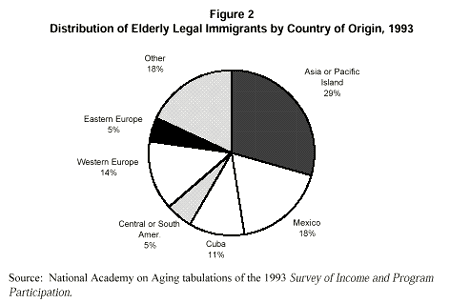
Figure 2 provides information on the country of origin of elderly legal immigrants. The largestnumber of elderly legal immigrants originated from Asia or a Pacific Island (29 percent), followed byEurope (19 percent), and then Mexico (18 percent). Another 11 percent were from Cuba, and lessthan 5 percent were from Central or South America.
When Did the Elderly Legal Immigrant Arrive in America?
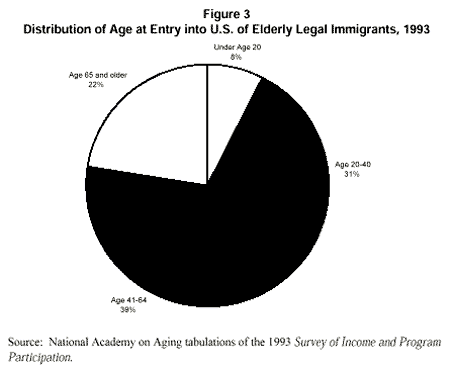
People have expressed concern that elderly legal immigrants enter the United States after havingretired from the work force of their own country. While this assumption could be true for some, itdoes not hold for the majority of elderly legal immigrants. More than half of elderly legal immigrantsarrived in the United States over twenty years ago, and over three-quarters arrived prior to their 65thbirthday (see Figure 3). About 22 percent did arrive after they were age 65.
The Employee Retirement Income Security Act (ERISA) currently preempts state law related to the wrongful denial or delay of health benefits to the extent that such laws relate to a health benefit plan sponsored by a private employer. This report examines the frequency, nature and costs associated with the appeals and litigation that state and local governmental employers have experienced. Information was gathered through multiple telephone interviews with individuals with extensive involvement in administrative appeals and litigation experience of health benefit issues for these government-sponsored health benefit programs.
Three reports examining how health issues are handled by the Latino-oriented media today and how Latinos use the media as an information source on health issues. The three new studies were released at the National Association of Hispanic Journalists (NAHJ) conference. The studies are also available separately: A National and Three Region Survey of Latinos on the Media and Health, conducted by Princeton Survey Research Associates (#1410), A Study of Health Coverage in Latino Newspapers, Television and Radio News, 1997-1998 (#1411), A Study of Sexual Health Coverage in Latino Magazines, 1997-1998 (#1412), Summary of the three reports (#1413).
conomic status, especially in old age, is often dependent on a lifetime of choices and opportunities. Retirement income is directly dependent on previous labor force experiences, savings, and thehealth and insurance coverage of family members. Good health and high educational attainment tend toresult in better employment opportunities, a greater likelihood of a pension, and increased prospects forsaving. Poor health, the death of a spouse, lack of education, or poor employment opportunities canmitigate the opportunity for a secure retirement income.
Table 3 provides a profile of the educational attainment of elderly citizens and legal immigrants. Over 30 percent of elderly legal immigrants had not gone past the sixth grade, compared to 7 percentof elderly citizens. Interestingly, more than 8 percent of elderly legal immigrants had earned a law,medical, dental, or doctorate degree. In contrast, less than 2 percent of elderly citizens had earnedprofessional or academic doctorate degrees.
Table 3Educational Attainment of Elderly Citizens and Legal Immigrants(Percentage Distribution) Educational Attainment Legal Immigrants Citizens 6th grade or less 30.6 7.2 Grades 7-11 11.6 29.9 High school graduate 40.8 35.7 Some college through a Masters degree 9.2 25.5 Professional degree (MD, DDS, JD) or Ph.D. level. 8.4 1.8 Source: National Academy on Aging tabulations of the 1993 Survey of Income and Program Participation.
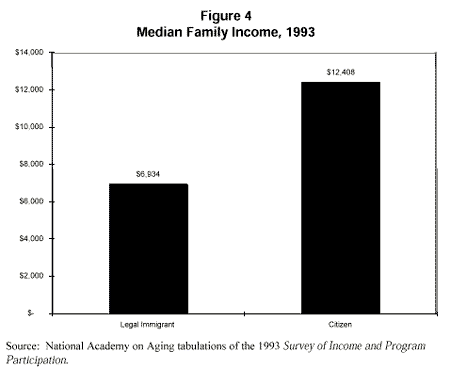
Consistent with educational attainment, elderly legal immigrants were more likely than elderlycitizens to be poor. Figure 4 shows that the average family income among elderly legal immigrants isabout half that of elderly citizens ($16,934/year for legal immigrants and $12,408 for citizens). Evenamong working elderly, average monthly earnings for legal immigrants were about 66 percent less thanelderly citizens (about $950 a month compared to $1,438, in 1993).20 As a consequence, legalimmigrants are nearly twice as likely to be poor as are elderly citizens (24 percent verses 14 percent). This is true even though elderly legal immigrants were more than three times as likely to be living withothers, including an adult child who may be working.21
Missing from this portrait are the employment histories of elderly legal immigrants. About 10percent of elderly legal immigrants in 1993 were working. Three-quarters (76 percent) of the elderlylegal immigrants had worked long enough under Social Security-covered employment to becomeentitled to Social Security benefits.22 This requires paying a minimum amount of FICA taxes in fortydifferent quarters (i.e., working at least for ten years). However, it should be noted that Social Securitybenefits alone do not necessarily provide income that is above the poverty threshold. A lifetime of low-paying jobs will result in Social Security benefits that are below poverty. In 1995, almost two-thirds(63 percent) of all elderly Supplemental Security Income (SSI) beneficiaries were also receiving SocialSecurity benefits.
The PRA did not change legal immigrant’s entitlement to earned benefits such as Social Securityand Medicare. By working enough years, like citizens, legal immigrants can collect SocialSecurity retirement benefits at age 62 and, hence, Medicare benefits at age 65. As already indicated,three-quarters of elderly legal immigrants had worked long enough in covered employment to beentitled to Medicare. Through the exemption, these elderly legal immigrants should be able to retainMedicaid or obtain Medicaid (as well as SSI and other benefits) in the same way as do citizens. However, for the 24 percent of the elderly legal immigrants who have not worked long enough to beentitled to Medicare, they may lose their access to Medicaid, depending on how states decide to treatlegal immigrants under their Medicaid program.
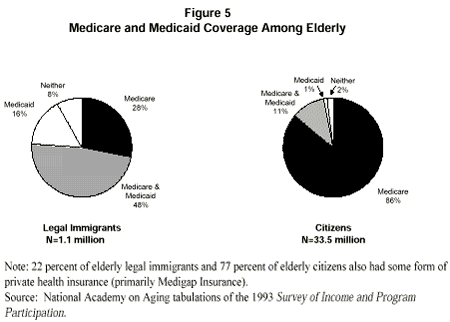
Figure 5 shows the distribution of Medicare and Medicaid coverage among elderly legalimmigrants and citizens. In 1993, virtually all (98 percent) elderly citizens were Medicare beneficiaries;by comparison, 76 percent of elderly legal immigrants were also beneficiaries. It should be noted thatMedicare beneficiaries also have private supplemental health insurance policies (Medigap) whichprimarily covers Medicare copayments and deductibles. About 22 percent of elderly legal immigrantsand 77 percent of elderly citizens had some form of private health insurance.23
Overall, Medicaid covered 64% of all elderly legal immigrants. By comparison, Medicaidcovered 12 percent of all elderly citizens. However, 16 percent of elderly legal immigrants relied onMedicaid alone compared to less than 1 percent of all elderly citizens. Moreover, 8 percent of elderlylegal immigrants and 2 percent of elderly citizens had neither Medicare nor Medicaid. It is these lattertwo groups, the 16 percent of elderly legal immigrants with Medicaid, but no Medicare and the 8percent with neither Medicare nor Medicaid who will no longer be eligible for cash assistance, foodstamps and other means-tested benefits.
Our analysis shows that most elderly legal immigrants did not come to the U.S. to gain accessto Medicaid benefits. As shown previously, more than three-quarters of elderly legal immigrantsarrived in this country before they were elderly. More importantly, legal immigrants who came to theUnited States after the age of 65 were not more likely than those who entered the United Statesbetween the ages of 40 and 64 to be receiving Medicaid benefits when they were elderly. Elderly legalimmigrants arriving between age 41 and 64 were 3.5 times more likely than those arriving before age40 and 2 times more likely than those arriving after age 65 to be Medicaid beneficiaries. Elderly legalimmigrants who arrived here when they were under 40 years old, however, were less likely than thosewho arrived after age 40 to be Medicaid beneficiaries (when elderly).
Preliminary analysis also suggests that, overall, elderly immigrants are more likely than elderlycitizens to need long-term care. Immigrants were twice as likely as citizens to need assistance withpersonal care.24 These findings are consistent with the educational attainment and income distribution ofelderly legal immigrants. Regardless of citizenship, people with less schooling generally have lessincome and poorer health.25 If an elderly legal immigrant with health care needs is not providedbenefits, their access to care will be seriously impeded. Although there are a few safety-net providerswho will provide acute care to the uninsured, without insurance or public coverage it is impossible toobtain a regular source of care. Having a regular source of care is necessary for chronic healthconditions. Without substantial resources or access to Medicaid, it is impossible to obtain long-termcare.
Unlike other types of health care, there is no last resort for long-term care generally and nursinghome care, in particular the nursing home is the last resort. Nursing homes routinely use ability to payto decide who to accept. They also can dismiss people who outlive their resources. Nursing homeresidents include some of the most frail and cognitively impaired people. The typical nursing homeresident is over age 85 and widowed. Nursing home residents are less likely to have any adult children,and if they do, their adult children are also likely to be elderly and have their own medical conditions.
Nursing home costs can easily exceed $3,000 a month, beyond the reach of most very oldpeople, and especially most legal immigrants. An estimated 80,000 to 90,000 nursing home residents in1995 were elderly legal immigrants.26 While this is less than 10 percent of all elderly nursing homeresidents, it does represent nearly $2.5 billion in revenues to nursing homes.
Elderly legal immigrants who have not worked long enough to become entitled to Medicare arelikely to lose cash assistance and food stamps and will be dependent on State action to ensure theiraccess to Medicaid. It is this population that is under discussion in the budget negotiations currentlyunderway in the U.S. Congress. In the non-binding budget agreement between the Congress and thePresident, it was agreed that PRA would be amended to restore SSI and Medicaid to legal immigrantswith disabilities. The agreement covered legal immigrants who were receiving SSI on August 22, 1996and who were legal immigrants on August 22, 1996, but not receiving SSI on that date but whosubsequently become disabled. In the bill that is now moving through Congress, the PRA would beamended to include just the first category-legal immigrants receiving SSI on August 22, 1996. Elderlypeople receiving SSI are also eligible for Medicaid. Even if both provisions under discussion weremade, legal immigrants arriving after August 22, 1996, regardless of their ensuing health care needs,could, depending on the State s actions, be denied access to Medicaid unless they had worked 40quarters or become naturalized prior to needing medical assistance.
This paper provides a portrait of the lives of elderly legal immigrants. Reflecting on their livesoffers a glimpse at the life ahead for younger immigrants arriving today. The findings in thispaper strongly suggest that the elderly legal immigrant did not come to the United Statesbecause of its welfare program. Most of them arrived here more than two decades earlierand before the age of 65. Some elderly legal immigrants served in the military,27 most worked, and, asa consequence, they paid taxes. Most raised children and because so many elderly legal immigrants areliving in households with children, they are probably helping to raise their grandchildren.
Elderly legal immigrants as of the day the PRA was enacted will retain access to publicassistance if they meet specific exemptions; those arriving after August 22, 1996 will face newprovisions that will effectively bar them from assistance for at least a decade if they are able to find andaccumulate forty quarters of Social Security covered employment during that time or until they becomenaturalized. Some immigrants will no longer be considered legal and are in the process of losing theirbenefits. These immigrants are receiving benefits due to special provisions under PRUCOL.
Legal immigrants receiving benefits are now having their cases reviewed and will be deniedcoverage unless they meet specific exemptions.28 One of those exemptions is having paid FICA taxesfor forty quarters. Because of this exemption, more than three-quarters of the elderly legal immigrantsare likely to remain entitled to their benefits. However, because of confusion about the law, some legalimmigrants entitled to benefits may think they are not entitled or may find that they are denied servicefrom providers concerned about being reimbursed.
About a quarter of current elderly beneficiaries, however, did not work long enough and theywill not only lose access to SSI and food stamps but they could, depending on what happens in thestate they live, lose access to Medicaid. Elderly legal immigrants seeking public assistance after August22, 1996 are barred from applying for Medicaid for 5 years, after which they must include theirsponsor’s resources in their application. They will also be ineligible for food stamps and cashassistance until they are naturalized or unless they are able to find Social Security covered employmentfor 40 quarters.
Despite having worked, elderly legal immigrants were more likely than elderly citizens to bepoor. Elderly legal immigrants have lower incomes because they have, on avergae, fewer years ofeducation and language and cultural differences may have hindered employment opportunities. Thissuggests that if legal immigrants found work, it was more likely to be low-paying and without benefits. Limited employment opportunities make it that much more difficult to maintain an adequate level ofretirement income once one has left the labor force.
In the future, the proportion of poor elderly immigrants not eligible for public assistancedepends on how legal immigrants respond to the law and on their ability to find and maintainemployment. Future legal immigrants will be barred from Medicaid for five years and will require theinclusion of their sponsor s resources when they apply thereafter. Deeming of their sponsor sresources is likely to keep many elderly legal immigrants ineligible for assistance. Alternatively they willhave to become a citizen before applying for public assistance. Citizenship requires five years of legalresidency, being able to read and write simple English, and being able to answer basic questions aboutU.S. history and the government.29 Clearly, some of the same factors that hinder employmentopportunities, such as reading and writing English, may be barriers to obtaining citizenship.
Barring access to benefits for the first five years, and then until naturalization or until they haveaccumulated forty quarters of work, leaves substantial periods in which people are vulnerable. Accidents and illness can occur at any time. People at any age can find themselves in need of acute orlong-term care. Without public or private coverage, this care is beyond the financial means of virtuallyeveryone.
The Personal Responsibility and Work Opportunity Reconciliation Act of 1996 fundamentallychanged the nature of public assistance. Although the cuts in federal spending on public assistancewere relatively small, a substantial portion of the cuts fall on legal immigrants and their extended families. As shown in this profile, this public assistance is absolutely critical for many elderly legal immigrants. Given the concentration of elderly legal immigrants within families and specific communities, theimplications of these changes go beyond the elderly legal immigrant and their families, but will also affectthe citizens in communities in which they live.
Footnotes
1. Technically, the bar from Medicaid is five years, but applicants must include the resources of their sponsor after the five-year bar, for as long as they remain legal immigrants, or until they have worked and paid FICA taxes for at least forty quarters, which takes at least ten years. Legal immigrants are barred from Food Stamps and SSI until they become citizens (which takes a minimum of five years) or until they have paid FICA taxes for at least forty quarters.
2.Federal Budgetary Implications of the Personal Responsibility and Work Opportunity Reconciliation Act of 1996, Congressional Budget Office, December 1996. Summary Tables 1 and 2.
3.Federal Budgetary Implications of the Personal Responsibility and Work Opportunity Reconciliation Act of 1996, Congressional Budget Office, December 1996. Summary Tables 1 and 2.
5. The category of “unqualified aliens” includes nonimmigrants, applicants for asylum, registry, cancellation or removal, or adjustment of status, aliens granted deferred action, family unity, temporary protected status or an order supervision, and aliens “permanently residing under the color of law (PRUCOL).” See Charles Wheeler and Josh Bernstein, New Laws Fundamentally Revise Immigrant Access to Government Programs, National Immigration Law Center, November 8, 1996, p. 7.
6. “Qualified aliens” are lawful permanent residents, refugees, persons granted asylum, withholding of deportation, or conditional entrant status; persons paroled into the United States for at least a year, and certain battered spouses and children [PRA Sec. 431(b)].
7. The categories of immigrants who are exempt from this provision during their first five years in the country include refugees, people seeking asylum, and persons granted “withholding of deportation.” Also exempt are those legal immigrants who are active duty members of the U.S. Armed Forces or honorably discharged U.S. veterans and their spouses and unmarried dependent children. The bill also exempts immigrants who have worked forty quarters (ten years) in the United States [PRA Sec. 402(a)(2)]. Also exempt are Cuban and Haitian entrants, as defined in Section 501(e)(2) of the Refugee Education Assistance Act of 1980, who are paroled into the United States for at least one year [PRA Sec. 403(b)(1) and Sec. 403(b)(2)].
8. It should be noted that while refugees and those seeking political asylum are exempt from the bar on benefits for five years, it takes at least seven for them to become naturalized citizens. As of June 10, 1997 the Budget Reconciliation bill now moving through Congress, includes a provision to change the five year exemption for refugees, asylees, and persons granted withholding of deportation, to seven years.
13. “Title XX of the Social Security Act provides block grants to the states that they use for a wide variety of purposes, including child care, in-home care for disabled persons, programs to combat domestic violence, programs for abused and neglected children, [etc.]” (Social Security Act, Title XX, 42 USC Sec. 303, et seq.).
14. Temporary Assistance for Needy Families or TANF replaced AFDC which provided cash assistance to low-income families with children. Most elderly, however, were not eligible for AFDC.
15. “The term ‘federal means-tested benefit’ is not defined in the final version of the legislation. The term was deleted from the bill because of a procedural rule that effectively prevents a budget bill from legislating on programs that do not involve direct spending. The term will likely be interpreted to include Medicaid and TANF services; other means-tested programs, such as food stamps and SSI, are barred to legal immigrants under separate provisions.” (Wheeler and Bernstein, Op. Cite., p. 15.)
16. Programs from which states are not allowed to deem a sponsor s income to the applicant’s income include emergency medical assistance; short-term, non-cash, in-kind emergency disaster relief; immunizations with respect to immunizable diseases and testing and treatment of symptoms of communicable diseases, whether or not such symptoms are caused by communicable disease; certain community-based programs, services, or assistance designated by the attorney general; school lunch and breakfast programs; and child nutrition programs [PRA Sec. 422(b)].
17. The same categories exempt from the five-year bar, except for veterans and their families, are also exempt from sponsor-to-alien deeming. Veterans are the only class of immigrants who are subject to deeming, but not to the five-year bar [PRA Sec. 421(a), Sec. 403(b)].
18. Projections for 1995 are based on data from the 1990 Census of Population and the 1993 Survey of Income and Program Participation (SIPP), and 1995 population estimates from the Current Population Survey.
19. In addition to the 7 states listed in Table 1, the following 9 states have elderly legal immigrants comprising more than 3 percent of their elderly population: Alaska, Arizona, Connecticut, District of Columbia, Hawaii, Maryland, Nevada, Rhode Island, and Washington.
20. In 1993, nearly 12 percent of elderly citizens and slightly less than 10 percent of elderly legal immigrants were in the paid labor force. National Academy on Aging tabulations of SIPP, 1993.
21. About 46 percent of legal immigrants and 14 percent of elderly citizens live in a household of three or more people. Elderly legal immigrants were more than twelve times as likely as elderly citizens to live in a household of five or more people. Over 25 percent of elderly legal immigrants lived in a household with a child, compared to less than 2 percent of elderly citizens. (National Academy on Aging tabulations of SIPP 1993.)
22. National Academy on Aging tabulations of SIPP, 1993.
23. National Academy on Aging tabulations of SIPP, 1993.
24. In 1990, 17 percent of elderly citizens and 36 percent of elderly legal immigrants indicated that they needed assistance with personal care. National Academy on Aging Tabulations of the 1990 Census Public Use Micro Data Sample.
25. See for example, Victor R. Fuchs, How We Live, (Cambridge, MA: Harvard University Press, 1983), or Michael Grossman, The Correlation Between Health and Schooling, in Household Production and Consumption, ed. Nestor E. Terleckyj, (New York: Columbia University Press, 1976), or Linda K. George, Social Factors and Illness, in Handbook of Aging and the Social Sciences, ed. Robert H. Binstock and Linda K. George, (New York: Academic Press, 1996).
26. National nursing home surveys in the past have not asked about the citizenship status of residents and most population-based surveys exclude the nursing home population. The 1990 census does note where people live. People living in a nursing home are designated as living in an institution. Unfortunately, the data does not distinguish a nursing home from any other type of institution (prison, hospital, assisted-living facility, or life care community, for example). Applying the proportion of the elderly legal immigrants living in institutions from the 1990 census data to the elderly nursing home population suggests that as many as 114,000 elderly nursing home residents during 1995 were legal immigrants. Adjusting for the likelihood that not all institutionalized people were only in nursing homes, however, suggests that the number of elderly legal immigrants in nursing homes was probably closer to 80,000.
27. In 1993, about 20,000 elderly legal immigrants were receiving veterans benefits from having served in the Military. (Academy tabulations of SIPP).
29. Throughout this paper the term “legal immigrant” has been used to describe people here in the United States legally, but under different visas. Technically, the holding of some visas do not count toward the five years of residency and hence some people must change their visa status and hold that status for five years. There are exemptions to the five-year residency requirement, however. For example, the time period is three years if married to an American citizen, or none in either the case of having served three years in the U.S. military, or having been discharged honorably after less than three years during specifically defined war actions. There are also some people exempt from the English language test, but not the exam of the basic understanding of U.S. history and government. The English language test is waived for persons over age 50 who have been a legal permanent resident alien for twenty years, or for persons age 55 or older if they have been a legal permanent resident alien for fifteen years, or for persons age 55 or older who cannot understand English because of a disability, such as deafness.
References
American Association for Homes and Services for the Aging. Issue Brief: Welfare Reform Act. 1996.
Committee on Ways and Means, U.S. House of Representatives. 1996 Green Book. Washington, DC: Government Printing Office, 1996.
Congressional Budget Office. Federal Budgetary Implications of the Personal Responsibility and Work Opportunity Reconciliation Act of 1996. Washington, DC: Congressional Budget Office, 1996.
Cox, Carole. Block Grants: Where We’ve Been and Where We’re Going. Washington, D.C.: National Academy on Aging, July 1995.
Fuchs, Victor R. How We Live. Cambridge, MA: Harvard University Press, 1983.
George, Linda K. “Social Factors and Illness,” in Handbook of Aging and the Social Sciences, Robert H. Binstock and Linda K. George, eds. New York: Academic Press, 1996.
Grossman, Michael. “The Correlation Between Health and Schooling,” in Household Production and Consumption, Nestor E. Terleckyj, ed. New York: Columbia University Press, 1976.
Moon, Marilyn, Crystal Kuntz, and Laurie Pounder. Protecting Low-Income Medicare Beneficiaries. The Commonwealth Fund, November 1996.
Social Security Act, Title XX, 42 USC, Sec. 303, et seq.
Swarns, Rachel L. “Confused by Law, Nursing Homes Bar Legal Immigrants.” New York Times. April 20, 1997, A1.
U.S. House of Representatives. Personal Responsibility and Work Opportunity Reconciliation Act of 1996. Washington, DC: Government Printing Office, 1996.
Peterson, George. “A Block Grant Approach to Welfare Reform.” In Welfare Reform: An Analysis of the Issues. The Urban Institute, 1995.
Super, David A., Sharon Parrott, Susan Steinmetz, and Cindy Mann. The New Welfare Law. Center on Budget and Policy Priorities, August 14, 1996.
Wheeler, Charles, and Josh Bernstein. New Laws Fundamentally Revise Immigrant Access to Government Programs. Washington, D.C.: National Immigration Law Center, November 8, 1996.
This report presents the findings of researchers at the National Academy on Aging on welfare reform and elderly legal imigrants. The Personal Responsibility and Work Opportunity Reconciliation Actof 1996 included an array of structural reforms affecting access to cash assistance programs such as AFDC and SSI as well as Medicaid. This study profiles elderly legal immigrants in the United States and explores the implications of welfare reform for this population.