KFF designs, conducts and analyzes original public opinion and survey research on Americans’ attitudes, knowledge, and experiences with the health care system to help amplify the public’s voice in major national debates.
Medicare Beneficiaries & HMO’s: A Case Study of the Portland, OR Market
Note: This publication is no longer in circulation. However, a few copies may still exist in the Foundation’s internal library that could be xeroxed. Please email order@kff.org if you would like to pursue this option
HIV Prevention for Injection Drug Users, Special Supplement to JAIDS
This special supplement from the Journal of Acquired Immune Deficiency Syndromes and Human Retrovirology represents a compilation of selected presentations from the 1995 workshop sponsored by the Kaiser Family Foundation in conjunction with the Centers for Disease Control and Prevention, the Center of Substance Abuse Treatment, and the National Institute on Drug Abuse entitled “Sterile Needles and Syringes for Drug Users Who Continue Injecting”. Other related papers prepared by leading experts inthe field offer important insights into strategies for developing effective HIV intervention programs among injection drug users.
Note: This publication is no longer in circulation. However, a few copies may still exist in the Foundation’s internal library that could be xeroxed. Please email order@kff.org if you would like to pursue this option.”
This case study of the evolution of Medicare managed care in Portland, Oregon, is part of a series of four case studies being prepared for the Kaiser Family Foundation to learn more about the factors influencing, and consequences of, the growth of Medicare managed care. Portland was one of the first markets to implement a Medicare managed care program, with the Kaiser Foundation Health Plan beginning its Medicare HMO in 1978 and all four of Portland’s current Medicare risk contractors serving the Medicare population by the late 1980s.
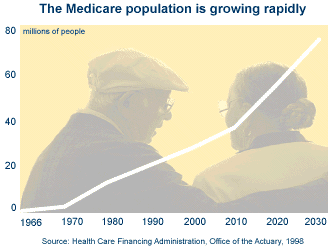
Que Es El Medicare Y Como Se Financia? Medicare es un programa de seguro medico nacional que atiende a 39 millones de ancianos y discapacitados. Antes de la existencia del Medicare, menos de la mitad de todos los norteamericanos de edad avanzada contaban con un seguro medico. Hoy en dia, practicamente todos los adultos de 65 anos de edad mayores se encuentran asegurados bajo Medicare. Medicare cubre a 34 millones de beneficiarios ancianos y a 5 millones de discapacitados. La cantidad de beneficiarios del Medicare se ha duplicado desde la concepcion del programa en 1965 y se estima que se volvera a duplicar en las siguientes tres decadas hasta alcanzar una cifra de 72 millones.
Americans Support Requiring Insurers To Cover Contraceptives, Even If Premiums Rise.
More Women and Men Say Contraceptives Should Be Covered Than Say Viagra
Embargoed for release until: 9:30 AM, ET, Friday, June 19, 1998
For further information contact: Tina Hoff or Matt James
Menlo Park, CA – Most Americans support requiring insurers to provide contraceptives as part of prescription coverage, even if premiums rise, according to a new national survey by the Kaiser Family Foundation. The public is also more likely to say contraceptives should be covered by insurers (75%) than Viagra, the new male impotence drug (49%).
Most Americans (62%) are not aware of proposals to require contraceptive coverage now before Congress. After learning that a “bill before Congress would require any health insurance plan with prescription coverage to pay for birth control methods just like any other prescription,” three quarters of Americans say they favor such a policy (45% “strongly favor” and 30% “somewhat favor” vs. 8% “strongly oppose” and 8% “somewhat oppose”). Both women and men (ages 18 and older) say contraceptives should be covered by insurers, though women (81%) are more likely to support such a policy than men (68%). Most (82%) who favor contraceptive coverage say all prescription methods currently on the market – oral contraceptives, IUDs or intra-uterine devices, Norplant implants, diaphragms, the injectable Depo-Provera, and cervical cap – should be paid for.
Support remains strong when people are told that contraceptive coverage could result in higher premiums. For example, when told that “the average cost individuals pay for health insurance could increase by $1-5 per month:” 43 percent “strongly favor” and 30 percent “somewhat favor,” vs. 12 percent “strongly oppose” and 8 percent “somewhat oppose.” Support drops somewhat, although a majority continues to favor contraceptive coverage, if premiums were to rise by larger amounts. For example, when asked their reaction if premiums were to rise by as much as $20 more per month: 30 percent “strongly favor” and 29 percent “somewhat favor,” vs. 19 percent “strongly oppose” and 13 percent “somewhat oppose.”
“Both men and women think comprehensive coverage for contraception makes sense; they think it should be part of prescription coverage, and they say they are willing to pay for it,” said Felicia H. Stewart, MD, Director of Reproductive Health Programs, Kaiser Family Foundation.
Americans More Mixed on Whether Viagra Should be Covered by Insurance
The new drug, Viagra, which sparked a recent debate over insurance coverage when it came on to the market earlier this Spring, draws more mixed views from Americans: 49 percent say the male impotence drug should be covered as part of prescription coverage; 40 percent say it should not be covered; and, 11 percent don’t know. Women (51%) are as likely to favor coverage of Viagra as men (47%).
Women of “Reproductive Age” and Privately Insured Supportive of Contraceptive Coverage
Women between the ages of 18-44, so-called “reproductive age,” are most supportive of legislation to require coverage of prescription contraceptives: almost nine out of ten favor such a policy (67% “strongly support” and 21% “somewhat support” vs. 4% “strongly oppose” and 5% “somewhat oppose”). There is no drop in support if the additional cost for providing this coverage falls in the low range ($1-5 per month) for an individual premium (87% support vs. 11% oppose); even at the higher range ($15-20 per month): 74 percent support (22% oppose). Women in this age range also are the most likely to say all methods should be covered (83%).
Three quarters of these women, who are most likely to use prescription contraceptives, say whether or not a certain method is covered by their insurance is something they would factor into their decision about what to use: 40 percent say coverage is “very” important, and 34 percent say “somewhat” in choosing birth control.
Family planning services, including contraceptives, are a required benefit under Medicaid, the public program that provides health coverage for low-income Americans. The contraceptive coverage proposal now before Congress applies to the privately insured population. Among this group, which would most directly benefit from the expanded coverage as well as potentially bear some of the additional costs if their insurer does not currently provide a full-range of contraceptive options, most support the policy. Eight out of ten privately-insured Americans, excluding those eligible for Medicare (65 and older), support contraceptive coverage (47% “strongly support” and 33% “somewhat support ” vs. 7% “strongly oppose” and 8% “somewhat oppose”). Even if their premiums were to go up, this group says they would still favor it ($1-5 per month: 78% support vs. 18% oppose; $15-20 per month: 64% support vs. 31% oppose). Women of reproductive age and the privately insured are no more likely than the average American to know that legislation has been proposed.
Methodology
The Kaiser Family Foundation 1998 National Survey on Insurance Coverage of Contraceptives is a random-sample telephone survey of 1,015 adults 18 and older living in the United States. It was designed by staff at the Foundation and Princeton Survey Research Associates (PSRA) and conducted by PSRA between May 22-26, 1998. The margin of sampling error is plus or minus 3 percent for the national sample; it may be higher for smaller sub-groups.
The Kaiser Family Foundation, based in Menlo Park, California, is an independent national health care philanthropy and is not associated with Kaiser Permanente or Kaiser Industries.
The questionnaire and top line from the survey are available by calling the Kaiser Family Foundation’s publication request line at 1-800-656-4533 (Ask for documents #1404). This release is also available on the Kaiser Family Foundation website at www.kff.org
The Employee Retirement Income Security Act (ERISA) currently preempts state law related to the wrongful denial or delay of health benefits to the extent that such laws relate to a health benefit plan sponsored by a private employer. This report examines the frequency, nature and costs associated with the appeals and litigation that state and local governmental employers have experienced. Information was gathered through multiple telephone interviews with individuals with extensive involvement in administrative appeals and litigation experience of health benefit issues for these government-sponsored health benefit programs.
The May/June 1998 edition of the Kaiser Family Foundation/Harvard Health News Index includes questions about major health stories covered in the news, including questions about Viagra and Social Security. The survey is based on a national random sample of 1,202 Americans conducted June 12-18, 1998 which measures the public’s knowledge of health stories covered in the news media during the previous month. The Health News Index is designed to help the news media and people in the health field gain a better understanding of which health stories in the news Americans are following and what they understand about those health issues. Every two months, Kaiser/Harvard issues a new index report.
Prepared for: The Henry J. Kaiser Family Foundation
The Henry J. Kaiser Family Foundation, based in Menlo Park, California, is an independentnational health philanthropy and is not associated with Kaiser Permanente or Kaiser Industries. Established in 1948 by industrialist Henry J. Kaiser and his wife Bess, the Foundation focusesits work on four main areas: health reform/health policy, reproductive health, HIV, and health anddevelopment in South Africa. The Foundation also maintains a special interest in health care inits home state of California.table of contents
Welfare reform, technically the Personal Responsibility and Work OpportunityReconciliation Act of 1996 (PRA), was signed into law on August 22, 1996. UnderPRA most legal immigrants arriving after August 22, 1996 will no longer be eligible forcash assistance and food stamps and are effectively barred from other services, including Medicaid, forat least a decade.1 Legal immigrants residing in the United States on August 22, 1996 will also losetheir entitlements unless they meet certain exemptions. A critical exemption enables legal immigrantswho have worked for forty quarters (10 years) in Social Security covered employment to retainbenefits. The various provisions concerning legal immigrants are complicated and the ensuing confusionhas already resulted in the denial of assistance to some qualified immigrants.
Relative to the federal budget, the reductions in welfare expenditures are modest. To theindividuals who depend on them they are of enormous importance. Most of the cuts come in the formof reduced benefits and time limits. The cuts for legal immigrants are especially severe: theCongressional Budget Office estimates that over the first six years the Personal Responsibility andWork Opportunity Reconciliation Act of 1996 will reduce federal spending by nearly $54.2 billion fromwhat would have been spent.2 About 44 percent of the total reductions ($23.8 billion) over the first sixyears, will be borne entirely by legal immigrants.
In 1995, there were an estimated 1.1 million legal immigrants age 65 or older. Elderly legalimmigrants are concentrated in a small number of states. In fact, more than one-half of the elderly legalimmigrant population lives in three states and 80 percent live in seven states. This suggests that thebroader economic consequences of these cuts will fall disproportionately on the citizens of communitieswith immigrant populations.
The portrait that emerges from the analysis suggests that the typical elderly legal immigrant didnot come to the United States because of its welfare programs. More than half of elderly legalimmigrants arrived in the United States over twenty years ago, and over three-quarters arrived prior totheir 65th birthday. Some elderly legal immigrants have served in the military, most have worked andpaid taxes, and more than three-quarters paid sufficient FICA taxes to earn Social Security andMedicare benefits. As a result, most elderly legal immigrants will not lose public assistance but the mostvulnerable those without Social Security and Medicare might lose some or all of their publicassistance. They are likely to lose SSI, food stamps, and other means-tested benefits. They could alsolose access to Medicaid, the principal source of nursing home care, depending on legislative andadministrative decisions made by each state.
Elderly legal imigrants are substantially more likely than elderly citizens to rely upon Medicaidbecause of their lower income levels. They are also more likely than elderly citizens to be uninsured. As a group, elderly legal immigrants were nearly twice as likely to live in households with incomesbelow the poverty level, and are more likely to be receiving some form of public assistance than elderlycitizens. The average family income among elderly legal immigrants is about half that of elderly citizens. Even among the working elderly, average monthly earnings for legal immigrants were about 66 percentless than elderly citizens. As a consequence, legal immigrants are nearly twice as likely to be poor aselderly citizens (24% versus 14%).
Elderly legal immigrants were found to be more likely than elderly citizens to have long-termcare needs. An estimated 80,000 to 90,000 nursing home residents in 1995 were elderly legalimmigrants; relying principally upon Medicaid to finance their care. The welfare reform law enacted lastyear permits states to discontinue Medicaid eligibility and coverage for legal immigrants, including thosein nursing homes. Those in nursing homes who lose Medicaid coverage have limited options. It isunlikely that the typical nursing home resident will have the physical and/or cognitive ability to become anaturalized citizen, in order to assure Medicaid coverage.Public assistance is critical for many elderly legal immigrants. Given the concentration of elderlylegal immigrants within families and specific communities, the implications of these changes go beyondthe elderly legal immigrant and their families, but will also affect the citizens in communities in which theylive.
Public assistance is critical for many elderly legal immigrants. Given the concentration of elderly legal immigrants within families and specific communities, the implications of these changes go beyond the elderly legal immigrant and their families, but will also affect the citizens in communities in which they live.
Introduction
Welfare reform, or technically the Personal Responsibility and Work OpportunityReconciliation Act of 1996 (PRA), was signed into law on August 22, 1996. This lawfundamentally changed the nature of federal public assistance by eliminating some federalentitlement programs and delegating to the states authority over who would be eligible to receive publicassistance. In addition, federal money provided to states and to beneficiaries for public assistance wasreduced. The Congressional Budget Office estimates that over the first six years the PersonalResponsibility and Work Opportunity Reconciliation Act of 1996 will reduce federal spending bynearly $54.2 billion.3 About 44 percent of the total reductions ($23.8 billion) over the first six years willbe borne entirely by legal immigrants. Eliminating legal immigrants from benefits reduces the federaldeficit annually by $5.1 billion when fully phased-in in 2002.4
Relative to the federal budget, these expenditure cuts are modest. However, to the individualswho depend on them they are of enormous importance. Elderly immigrants are particularly vulnerable,based on their service and their income needs. Analysis indicates that the majority of elderly legalimmigrants come to the U.S. long before they are elderly or in need of health or long-term care. Eliminating public support for these services especially for people already residing here impactsimmigrants, their extended families, and their communities, for circumstances beyond their control.
Elderly Immigrants and the Personal Responsibility and Work Opportunity Reconciliation Act
The Personal Responsibility and Work Opportunity Reconciliation Act (PRA) of 1996 eliminated theopen-ended federal entitlement program of Aid to Families with Dependent Children (AFDC) andreplaced it with Temporary Assistance to Needy Families (TANF), a block grant with a fixed amountof funding given to states to provide time-limited cash assistance to low-income families. The new lawalso fundamentally alters access to federal assistance for legal immigrants.
The PRA distinguishes between two classes of immigrants unqualified and qualified. Unqualified immigrants are effectively illegal immigrants and qualified are legal immigrants.5 Prior toPRA, illegal immigrants were not eligible for most federal means-tested benefits except for emergencymedical care, federally subsidized housing, and services related to the protection of life and safety. Illegal immigrants could, however, receive some forms of assistance by being categorized as”permanently residing under color of law” (PRUCOL). The new law eliminates this category, makingthem ineligible for benefits.
Under prior law, legal immigrants or those considered qualified in the PRA, could apply forpublic assistance.6 This too was changed under PRA. To understand these changes, one mustdifferentiate between legal immigrants who were receiving public assistance on August 22, 1996 andthose who were not. An overview of the changes in law are provided in Figure 1.
Figure 1Restrictions on Public Assistance to Immigrants Under the Personal Responsibility and Work Opportunity Reconciliation Act of 1996 Benefit Aliens permanently residing under color of law (PRUCOL)1 Legal Immigrants receiving benefits before August 22, 1996 Legal Immigrant that arrived before August 22, 1996, but not receiving benefits Legal immigrant arriving after August 22, 1996 Refugee Supplemental Security Income Immediate cut-off Cut off over the next year, unless in exempt category2 Ineligible until naturalization, unless in exempt category2 Ineligible until naturalization, unless in exempt category2 Eligible for first five years after entry, then denied until naturalization Food Stamps Immediate cut-off Cut off over the next year, unless in exempt category2 Ineligible until naturalization, unless in exempt category2 Ineligible until naturalization, unless in exempt category2 Eligible for first five years after entry, then denied until naturalization Medicaid Immediate cut-off State option to continue, unless in exempt category5 States have the option to bar coverage until naturalization5 Ineligible for first five years5 after entry, then subject to deeming.4 States have the option to bar coverage until naturalization.5 Eligible for first five years after entry, the state option to continue State and Local government assistance Immediate cut-off State option to continue, barring exemptions listed below State option to continue. State may require deeming State option to continue. State may require deeming4 Eligible for first five years after entry, then state option to continue1. Under prior law, certain illegal immigrants could be eligible for specific public benefits if they were considered to be “permanently residing under color of law” (PRUCOL). Under the new law, this category of immigrants has been eliminated, making this group like other illegal immigrants ineligible for benefits.
2. The following categories of immigrants are exempt from restrictions to SSI and Food Stamp programs during their first five years in the country: refugees, people seeking asylum, persons granted “withholding of deportation.” Also exempt are those legal immigrants who are active duty members of the U.S. armed forces or honorably discharged U.S. veterans and their spouses and unmarried dependent children. The law also exempts immigrants who have worked forty quarters (ten years) in the U.S.
3. Aliens exempt from the five-year bar include the same categories that were exempt from restrictions on SSI and Food Stamps. However, there is an additional exempt category of Cuban and Haitian entrants who are paroled into the U.S. for at least one year.
4. The same categories exempt from the five-year bar, except for veterans and their families, are also exempt from sponsor-to-alien deeming. Veterans are the only class of immigrants who are subject to deeming, but not to the five-year bar.
5. States must continue to provide Medicaid to legal immigrants who are veterans or on active military duty, refugees, and persons who have been granted asylum within the last five years, and those who have worked for at least ten years within the United States.
Current Legal Immigrants
The PRA would not change the eligibility for public assistance forlegal immigrants who meet specific exemptions. One of these exemptions is having worked for morethan forty quarters in Social Security covered employment. Since most elderly legal immigrants worked, they are more likely to be exempt. Legal immigrants whowere unable to work long-enough or who did not meet one of the other exemptions could lose benefitsor become ineligible to apply for benefits. If they were receiving benefits on August 22, 1996, benefitswill be terminated subsequent to a case-by-case review now underway to determine whether there isany basis for continued eligibility (for example, legal immigrants who served in the military or who havebeen in Social Security-covered employment for forty quarters).7 If they do not fall into one of thoseexempt categories and are not naturalized by the time their cases are reviewed, they will lose theirbenefits.8 Legal immigrants receiving Medicaid on August 22, 1996 continued to receive benefitsthrough January 1, 1997. After this date the State may decide whether to continue medical assistancethrough Medicaid for this group of immigrants (most states are expected to continue Medicaid for thisgroup). Elderly immigrants who arrived prior to the law s enactment (August 22, 1996), and who atthat time were not receiving assistance, immediately become ineligible for applying for food stamps andSSI, unless they, too meet one of the exemptions.9
Confusion over these provisions, however, has already resulted in nursing homes denyingaccess to legal immigrants with Medicaid coverage even when the state has made it clear that they willcontinue their Medicaid coverage.10 For current beneficiaries whose Medicaid was based on theirreceipt of SSI, however, the state will need to find another eligibility criterion (of which there areseveral) if they are no longer qualified for SSI.11 However, this process too could cause some elderlylegal immigrants to lose their access to Medicaid.
Future Legal Immigrants
Elderly legal immigrants arriving on or after August 22, 1996,are prohibited from receiving SSI or food stamps until they become naturalized citizens or fit one of theexemptions, such as working forty qualifying quarters (which takes a minimum of ten years).12 They arealso restricted from applying for Medicaid, Title XX-funded social services,13 Temporary Assistancefor Needy Families,14 and other federal means-tested benefits15 (other than SSI and food stamps), for aperiod of five years on entry into the U.S. as a legal immigrant (States have the option to extend thisrestriction until naturalization). After the five-year bar expires, legal immigrants must include thefinancial resources of their sponsor in their application for assistance.
This provision is called “deeming.”16 Given the low income and asset limits for means-tested programs such as Medicaid, “deeming,” is likely to keep most very poor legal immigrants from becoming eligible for assistance until they become citizens or fulfill some other criterion like working forty quarters in covered employment.17 Prior to PRA, legal immigrants were not barred from applying for assistance and although their sponsor s income was deemed, it was done for just the first three orfive years (depending on the public assistance sought).
The meaning of the PRA and the procedures needed to implement it are still subject to politicaldebate and judicial interpretation. The President and the Congress are revisiting some provisions inparticular, the elimination of benefits for current legal immigrants and the access to benefits for legalimmigrants here but not receiving benefits on August 22, 1996. The outcome is likely to impact currentelderly legal immigrants, but unlikely to change provisions for future elderly legal immigrants. To betterunderstand the consequences of this legislation, the following describes where and who elderly legalimmigrants are and their need for assistance.
A Profile of Elderly Legal Immigrants
The Size and Distribution of the Population
Nationally there are relatively few elderly legal immigrants. Census data suggest that in 1995 therewere about 1.1 million elderly legal immigrants.18 In 1995, elderly legal immigrants representedabout 3.2 percent of the country’s elderly population. Although elderly legal immigrants live in everystate, some states have a particularly high concentration. More than one-half of elderly legal immigrants(60.4 percent) lived in three states California, Florida, and New York. Adding Texas, New Jersey,Illinois and Massachusetts accounted for nearly 80 percent of elderly legal immigrants (see Table 1).
In most states, the elderly legal immigrant population constitutes less than 1 percent of theelderly population. However, in these seven states (see Table 1) and in nine others, whose numbers ofimmigrants are small, elderly legal immigrants are more than 3 percent of the state s elderlypopulation.19 For example, Hawaii has fewer than 14,000 elderly legal immigrants, but they constituteover 9 percent of the state s elderly population. Since the concentration of elderly legal immigrants isconsistent with that of legal and probably, illegal immigrants of all ages, the impact of the PRA on thecommunity is substantially larger than what just happens with elderly legal immigrants. Communitieswith a large proportion of people who need public assistance are less likely to have public and privateresources to assist those in need.
Table 1Distribution of Elderly Legal Immigrants Ranked by State, 1995. State Elderly Legal Immigrants Proportion of Elderly California 358,720 10.4% Florida 159,007 6.0% New York 157,778 6.5% Texas 74,466 3.9% New Jersey 49,416 4.5% Illinois 46,770 3.2% Massachusetts 34,145 4.0% All other States 237,254 1.2% Total 1,117,556 3.2%Source: National Academy on Aging estimates.
Demographic Characteristics
Table 2 provides a basic overview of the elderly legal immigrant population. Elderly legalimmigrants are primarily white, female, and between the ages of 65 and 74. About 61 percent ofelderly legal immigrants in 1993 were women and 68 percent were white. Compared to elderlycitizens, elderly legal immigrants are substantially more likely to be Asian or a Pacific Islander. Legalimmigrants are less likely to be married and living with their spouse, and are more likely than elderlycitizens to be widowed, divorced, separated, or never married.
Table 2Basic Demographics of Elderly Citizens and Legal Immigrants(Percentage Distribution) Race Legal Immigrants Citizens White 68.0 90.0 Black 2.5 8.5 Asian/Pacific Islander 29.4 1.3 Gender Legal Immigrants Citizens Male 39.0 42.0 Female 61.0 58.0 Age Legal Immigrants Citizens 65-74 60.0* 58.4* 75 and older 40.0* 41.6* Marital Status Legal Immigrants Citizens Married, spouse present 45.0 55.0 Widowed 37.0 33.0 Divorced, separated, or never married 14.8 11.1*The differences in age distributions were not statistically significant.Source: National Academy on Aging tabulations of the 1993 Survey of Income and Program Participation.
Figure 2 provides information on the country of origin of elderly legal immigrants. The largestnumber of elderly legal immigrants originated from Asia or a Pacific Island (29 percent), followed byEurope (19 percent), and then Mexico (18 percent). Another 11 percent were from Cuba, and lessthan 5 percent were from Central or South America.
When Did the Elderly Legal Immigrant Arrive in America?
People have expressed concern that elderly legal immigrants enter the United States after havingretired from the work force of their own country. While this assumption could be true for some, itdoes not hold for the majority of elderly legal immigrants. More than half of elderly legal immigrantsarrived in the United States over twenty years ago, and over three-quarters arrived prior to their 65thbirthday (see Figure 3). About 22 percent did arrive after they were age 65.