The Role of Employer-Sponsored Health Coverage for Immigrants: A Primer

Published: Jul 1, 2006

Access to employer-sponsored health insurance is declining for all families living in the United States, and this problem is especially acute for immigrant families. Employer-sponsored coverage is a particularly important source of insurance for immigrant families since their eligibility for public coverage through Medicaid and the State Children’s Health Insurance Program (SCHIP) is restricted. This primer examines the role of employer-based coverage for immigrants and the specific hurdles they face in obtaining this coverage.

Issue Brief – English language (.pdf)

Issue Brief – Spanish language (.pdf)

It’s Child’s Play: Advergaming and the Online Marketing of Food to Children — Report

Published: Jun 30, 2006

Concerned about the high rates of childhood obesity in the U.S., policymakers in Congress, the Federal Trade Commission and agencies such as the Institute of Medicine have explored a variety of potential contributing factors, including the marketing and advertising of food products to children. One area where policymakers have expressed interest, but have also noted a lack of publicly available data, is in the realm of online food marketing to children.

The Kaiser Family Foundation released the first comprehensive analysis of the nature and scope of online food advertising to children to help inform the decision making process for policymakers, advocates and industry experts. The report, It’s Child’s Play: Advergaming and the Online Marketing of Food to Children, found that more than eight out of ten (85%) of the top food brands that target children through TV advertising also use branded websites to market to children online.

Report (.pdf)

Key Issues and Opportunities: Implementing the New Medicaid Integrity Program

Published: Jun 30, 2006

The Deficit Reduction Act of 2005 created a new Medicaid Integrity Program to increase the government’s capacity to prevent, detect and address fraud and abuse in the Medicaid program. The new initiative represents the most significant single, dedicated investment the federal government has made in ensuring the integrity of the Medicaid program and offers an opportunity to ensure the efficient administration of the program and promote sound stewardship of state and federal resources.

The Kaiser Commission on Medicaid and the Uninsured convened a meeting of experts in early May to discuss issues and opportunities created by the new integrity initiative. This new report discusses six key issues identified by the group of experts as facing the federal government and states as development and implementation of the Medicaid Integrity Program begins.

Report (.pdf)

It’s Child’s Play: Advergaming and the Online Marketing of Food to Children — Executive Summary

Published: Jun 30, 2006

Concerned about the high rates of childhood obesity in the U.S., policymakers in Congress, the Federal Trade Commission, and agencies such as the Institute of Medicine have explored a variety of potential contributing factors, including the marketing and advertising of food products to children. One area where policymakers have expressed interest, but have also noted a lack of publicly available data, is in the realm of online food marketing to children.

The Kaiser Family Foundation released the first comprehensive analysis of the nature and scope of online food advertising to children to help inform the decision making process for policymakers, advocates, and industry experts. The report, It’s Child’s Play: Advergaming and the Online Marketing of Food to Children, found that more than eight out of ten (85%) of the top food brands that target children through TV advertising also use branded websites to market to children online.

Executive Summary (.pdf)

Fact Sheet: Young African American Men in the United States

Published: Jun 30, 2006

This fact sheet highlights key information about the education, health and overall status of young African American men, including comparisons to other groups. It was released at a July 2006 event, “Paths to Success: A Forum on Young African American Men.”

Fact Sheet (.pdf)

International Assistance for HIV/AIDS in the Developing World: Taking Stock of the G8, Other Donor Governments and the European Commission

Published: Jun 30, 2006

A new report from the Kaiser Family Foundation, , provides a detailed overview of how donors finance the international response to HIV/AIDS and presents the latest data on G8 and EC funding commitments and disbursements. The report also discusses the concept of “fair share” and examines different methodologies for assessing fair share among donors.

Data for the report were collected through a collaborative effort among UNAIDS, the Kaiser Family Foundation and the Center for Strategic and International Studies.

Report (.pdf)

icon_charts_data.gif

Chartpack

Previous versions:

July 2005 Report (.pdf)

Poll Finding

Survey Snapshot: Views and Experiences of Young Black Men

Published: Jun 30, 2006

The snapshot highlights data on young, black men from a Washington Post/Kaiser Family Foundation/Harvard University survey on African American men. It was released at a July 2006 event, “Paths to Success: A Forum on Young African American Men.”

Survey Snapshot (.pdf)

Poll Finding

Paths to Success: A Forum on Young African-American Men

Published: Jun 29, 2006
pts_banner.jpg

Webcast:

icon_video_audio.gif

High Speed

icon_video_audio.gif

Low Speed

icon_reports_studies.gif

Transcript

The Kaiser Family Foundation and The Washington Post on July 18 hosted a forum in the Foundation’s Barbara Jordan Conference Center featuring Bill Cosby and a panel of national leaders examining the experiences of young black men in America.

The forum, Paths to Success: A Forum on Young African-American Men, addressed the results of a major new national survey conducted by The Washington Post, the Kaiser Family Foundation and Harvard University. The discussion focused on strategies to enable young black men to succeed in America today and built on themes presented in the Post‘s series, “Being a Black Man.”

The forum began with a conversation with Bill Cosby and was followed by a panel discussion among national leaders and young people. Harvard Law School Professor and Foundation Trustee Charles J. Ogletree, Jr. moderated the forum. Foundation CEO and former New Jersey Human Services Commissioner Drew Altman gave the opening remarks and highlighted key findings from the survey.

Panelists include:

  • Marcellus (Bishop) Allen, president of Saving OurSelves (S.O.S.), an organization aimed at preventing gang violence
  • Ras Baraka, high school vice principal and leader in gang intervention and prevention
  • Joy Angela DeGruy-Leary, author of Post Traumatic Slave Syndrome: America’s Legacy of Enduring Injury and Healing
  • Oakland Mayor-Elect Ronald Dellums, a former Congressman and chair of the Joint Center for Political and Economic Studies’ Dellum Commission on young men of color
  • James Forman, Jr., professor of Law at Georgetown University
  • Steven Holmes of The Washington Post
  • Rev. Donald Isaac, executive director of the East of the River Clergy-Police-Community Partnership
  • Jachin Leatherman, Ballou High School valedictorian
  • Dr. Joshua W. Murfree Jr., vice president and national/international mentoring chairman of 100 Black Men, which leads efforts to train black men to serve as mentors, advocates and role models for black children and youth in their communities
  • Wayne Nesbit, Ballou High School salutatorian
  • U.S. Congresswoman Eleanor Holmes Norton
  • Dr. Alvin Poussaint, a Harvard Medical School psychiatrist and director of the Media Center of the Judge Baker Children’s Center in Boston
  • Eva Rousseau, former principal of Dunbar Senior High School in Washington, D.C.
  • Faye Wattleton, president of the Center for the Advancement of Women
  • James C. (Loose) White, III, one of the founders of Saving OurSelves (S.O.S.)
  • Corey Wiggins, doctoral student at the University of Alabama at Birmingham and 2004 Barbara Jordan Health Policy Scholar
cosby-ballouscholars_web_8.jpg
altman_web_2.jpg
ogletreemoderating_web_2.jpg

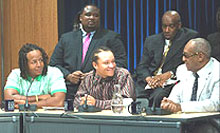
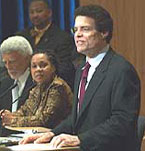
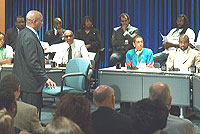
Ballou Public High School graduates Wayne Nesbit (l) and Jachin Leatherman talk to Bill Cosby. In the background, doctoral student Corey Wiggins and the Rev. Donald L. Isaac look on. (Photo by Richard Bloom) Kaiser Family Foundation President and CEO Drew Altman addresses the audience, as Oakland Mayor-Elect Ronald V. Dellums and Dr. Joy Angela DeGruy-Leary look on. (Photo by Richard Bloom) Harvard Law Professor Charles Ogletree, a Foundation trustee, moderates the panel discussion in the Barbara Jordan Conference Center. (Photo by Richard Bloom)

icon_reports_studies.gif

Survey Snapshot: Views and Experiences of Young Black Men

icon_reports_studies.gif

Young African American Men in the United States — Fact Sheet

Washington Post/Kaiser Family Foundation/Harvard Survey of African-American Men

icon_reports_studies.gif

June 4, 2006, Washington Post article about the survey results

icon_reports_studies.gif

The Washington Post‘s complete “Being a Black Man” series, including interactive features, videos and photo galleries

Webcast Materials:

icon_reports_studies.gif

Agenda (.pdf)

icon_reports_studies.gif

Speaker Biographies (.pdf)

Washington Post Radio /Kaiser Interview Series

Published: Jun 22, 2006

Kaiser Family Foundation Interviews on Washington Post Radio

About the Collaboration:

The Kaiser Family Foundation and Washington Post Radio collaborate to provide listeners of the new station in Washington, D.C. with information and analysis about current health care issues.

Kaiser experts have in-depth conversations with WTWP anchors about topics in the news, explaining what’s behind current health policy issues and helping consumers navigate the health care system. The segments are frequently broadcast from the Kaiser Family Foundation’s broadcast studio in Washington, D.C.

More information about Washington Post Radio ( WTWP Radio 107.7fm 1500am ) can be found at http://www.washingtonpost.com/wp-srv/wtwpradio.

clear.gif

Entertainment Media

Published: Jun 21, 2006

Media and Health

The Foundation enters into partnerships with major media companies to create public education campaigns on important health issues, and also studies the impact of the media on health.

Entertainment Media Partnerships

The Foundation partners with media organizations to develop multi-faceted public education campaigns on important health issues. A particular focus of our Entertainment Media Partnerships is on reaching young people with information about HIV and other sexually transmitted diseases.

Our partnerships combine targeted public service messages with longer-form special programming or editorial and other forms of outreach. We provide complementary free resources through toll-free hotlines and/or websites that reach millions of young people. The Foundation works collaboratively with its media partners providing both expert substantive guidance and participating in production and operations.

Among the Foundation’s other current or recent media partners are: the global cross-platform KNOW HIV/AIDS partnership with Viacom; the Emmy-award winning Fight for Your Rights: Protect Yourself campaign with MTV U.S. and Staying Alive with MTV International; Rap it Up with BET; and Enterate/Protegate with Univision.

The Global Media AIDS Initiative (GMAI) was conceived of and organized by the Joint United Nations Programme on HIV/AIDS (UNAIDS) and the Kaiser Family Foundation.

More Information on Individual Entertainment Media Partnerships

Program for the Study of Media and Health

The Foundation conducts research, evaluations, and analysis on the impact of media on the public’s health. The purpose of the research is to help inform policymakers, journalists, healthcare providers, and the public. A particular focus is on the exposure to and the impact of media on young people, as well as the public policies effecting access to media.

Major research projects include such topics as how teens use the Internet for health information; the amount of time children of all ages spend watching TV, playing video games, using computers, and reading; sexual messages on television; how health policy issues are portrayed on TV’s medical dramas; what viewers learn from health information in entertainment shows; and the impact of media-based public health campaigns. The Foundation also studies public policies on related media topics, including public service advertising on television, TV ratings, the V-Chip, and the impact of Internet filtering. In addition, the Foundation publishes the Teen Media Monitor, a marketing guide to youth media trends, available only to non-profits conducting public education campaigns among young people. Finally, the Program publishes a series of Fact Sheets on children and media, including such topics as children and video games, TV violence, children and the news media, parents and media, and teens and the Internet.

More information on the Program for the Study of Media and Health