Pulling It Together: America Has Gone Quiet on HIV/AIDS

Published: Apr 1, 2009

Kaiser has had a focus on HIV/AIDS since we remade the Foundation in the early nineties. It cuts across all of our program activities, from policy analysis, to our large scale media campaigns in the U.S. and around the world, to our web initiatives, to our public opinion research program. We have just completed a major survey of the American people on HIV/AIDS and global health. As new health priorities take shape in Washington, one set of findings deserves early attention while we continue to analyze the overall survey for release.

We found that the percentage of the American people who say that they have seen, heard or read a lot about HIV/AIDS in the U.S. has fallen from 34% five years ago to just 14% today.  The percentage of African Americans reporting this has fallen from 62% to 33%.  
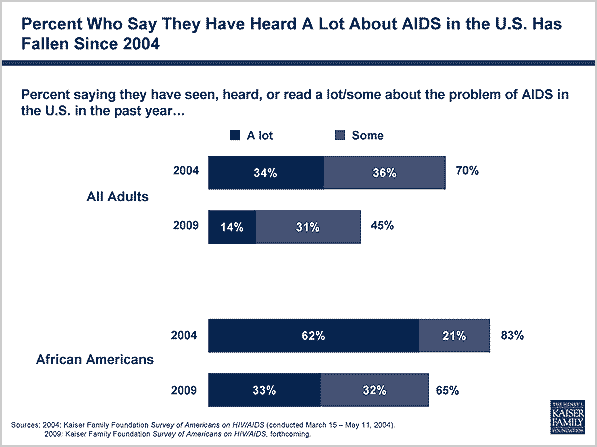
PIT0409slide1_4.gif

The dropoff in attention to HIV/AIDS could partly be a response to the current focus on the economy, but related findings suggest it’s a longer term trend.  As this next chart shows, the percentage of the overall public and of African Americans naming HIV/AIDS the most urgent health problem facing the nation has declined steadily and has fallen precipitously since 1995.
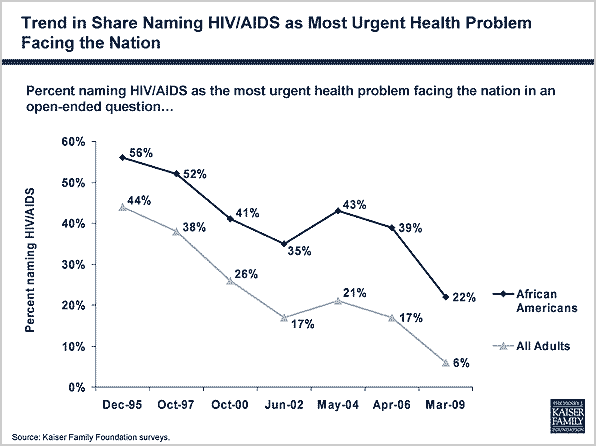
PIT0409slide2_1.gif

Today’s relative state of quiet and apparent lessened concern about HIV/AIDS has occurred despite the fact that in August 2008, the CDC announced that the number of new HIV infections each year in the U.S. is 40% higher than we previously thought. The CDC also underscored that our epidemic continues to be concentrated in familiar higher risk communities and groups: gay and bisexual men, African Americans, and teens and young adults.

The media, and in particular the news media, clearly has a role to play in bringing greater attention to the U.S.’s continuing HIV/AIDS epidemic. In our survey 62% of the American people named media as their main source of information on HIV/AIDS. However, while the news media can do more to cover HIV/AIDS, the media, appropriately, follows more than leads when it comes to agenda setting. Its primary job is to report the news, not to set the agenda.  The main message here is simple: the CDC says we have a much bigger epidemic than we thought we had at exactly the time when the public is hearing much less about it and seems less concerned. It’s time for renewed national, state, and community leadership if the domestic HIV/AIDS epidemic is to get back on the public agenda.
HIV Animation

Published: Apr 1, 2009

This broadcast-quality animation commissioned by the Kaiser Family Foundation illustrates how HIV infects a cell and how antiretroviral treatments combat the virus. It is being provided on a rights-free basis

CHIP TIPS Series Focuses On New Opportunities For Covering Children Under Medicaid and CHIP

Published: Mar 30, 2009

This series of implementation briefs called “CHIP Tips” examines new opportunities for covering children following the reauthorization and expansion of CHIP in February 2009. Together Medicaid and CHIP provide coverage for more than one in four children in the U.S., yet many others remain eligible but uninsured.

The series, which explores a range of topics, is jointly produced by the Kaiser Family Foundation’s Commission on Medicaid and the Uninsured and the Center for Children and Families at the Georgetown University Health Policy Institute.

CHIP TIPS: Medicaid Performance Bonus

CHIP TIPS: Medicaid Performance Bonus “5 of 8” Requirements

CHIP TIPS: Citizenship Documentation Changes

CHIP TIPS: Children’s Oral Health Benefits

CHIP TIPS: CHIP Financing Structure

CHIP TIPS: New Federal Funding Available To Cover Immigrant Children and Pregnant Women

CHIP TIPS: Medicaid Performance Bonus “5 of 8” Requirements

Published: Mar 30, 2009

This brief, the second in a series, examines the requirements that states must meet to be eligible for the new “performance bonus” available to states that do an especially good job of signing up eligible children for Medicaid. The bonus, created by a provision in the Children’s Health Insurance Program Reauthorization Act of 2009, is designed to help states cover the added costs that result when states are very successful in enrolling eligible children in Medicaid above target levels specified in the law. It reflects an understanding that aggressive state outreach efforts for CHIP tend also to drive up enrollment in state Medicaid programs.

Brief (.pdf)

National ADAP Monitoring Project Annual Report, April 2009

Published: Mar 30, 2009

This report provides the latest data on state AIDS Drug Assistance Programs (ADAPs). It is 13th in a series of National ADAP Monitoring Project Reports authored jointly by the Kaiser Family Foundation and the National Alliance of State and Territorial AIDS Directors.

Summary and Highlights (.pdf)

Full Report (.pdf)

ADAP Formularies by State (.pdf)

CHIP TIPS: Medicaid Performance Bonus

Published: Mar 30, 2009

This brief, the first in a series, examines the new federal “performance bonus” available to states that do an especially good job of signing up eligible children for Medicaid. The bonus, created by a provision in the Children’s Health Insurance Program Reauthorization Act of 2009, is designed to help states cover the added costs that result when states are very successful in enrolling eligible children in Medicaid above target levels specified in the law. It reflects an understanding that aggressive state outreach efforts for CHIP tend also to drive up enrollment in state Medicaid programs.

Brief (.pdf)

Public Education Partnerships: MTV: Get Yourself Tested: PSAs

Published: Mar 20, 2009
GYT-Get-Yourself-Tested-GYTNOW-org.jpg
clear.gif

Public Service Announcements

2011/12 PSAs

2010/11 PSAs

2009/10 PSAs

Trends in Health Care Costs and Spending

Published: Mar 19, 2009

This fact sheet on health care costs presents key statistics about the growth, level and impact of rising U.S. health care costs. It covers spending on various medical services, sources of health spending, employer-sponsored health coverage and the impact on businesses and people.

Fact Sheet (.pdf)

News Release

William H. Frist and Gerald Rosberg Appointed to Kaiser Family Foundation Board of Trustees

Published: Mar 17, 2009

Menlo Park, Calif. – The Kaiser Family Foundation announced today that former U.S. Senate Majority Leader William H. Frist, M.D. and Gerald Rosberg, J.D. have been appointed as members of its Board of Trustees.

William H. Frist, M.D., is a licensed and board certified heart and lung transplant surgeon. Frist is a Vanderbilt University Distinguished Professor of Medicine and Business and teaches a health policy course at Princeton University. He also serves as the chairman of the nonprofit charitable foundation Hope Through Healing Hands, which promotes quality of life for citizens and communities around the world using health as a currency for peace. Frist served as a U.S. Senator from 1995 to 2007 and as Senate Majority Leader from 2003 to 2007.

Gerald Rosberg, J.D. is a senior vice president of planning and development for The Washington Post Company. Rosberg previously served as a member of the Foundation’s Board of Trustees from 1997 to 2005 and as the chair from 2001 to 2005. He also served as the Foundation’s counsel from 1987 to 1997. Rosberg has previously served as counselor on international law in the Office of the Legal Adviser of the U.S. Department of State. He was a clerk to Chief Judge David L. Bazelon of the U.S. Court of Appeals for the District of Columbia Circuit and then to Justice William J. Brennan, Jr. of the U.S. Supreme Court.

The Kaiser Family Foundation is a non-profit private operating foundation, based in Menlo Park, California, dedicated to producing and communicating the best possible information, research and analysis on health issues. More information about the Foundation and its Trustees is available at www.kff.org/about.

# # #

Pulling It Together: Jobs, A Reason to Fast Track Coverage

Published: Mar 13, 2009

The two big topics in Washington right now are the economy and health care.  I’ve written before about how the two are linked, and in particular about how among the everyday economic problems people are having, paying for health care is a big one.

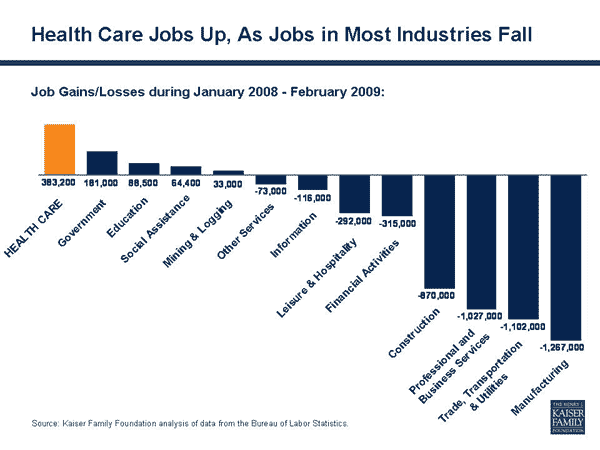
But the latest numbers out from the Bureau of Labor Statistics show there is another link: Health care is one of the few relatively healthy parts of our unhealthy economy right now. Since January 2008, the economy has lost 4.3 million non-farm jobs. Virtually all major industries have shed jobs. What went up? Well, mining and logging companies added modestly to their payrolls. Government and education employment is up somewhat, along with social assistance (not too surprising given our economic circumstances). But where did employment go up the most since January of last year? You guessed it: Health care, which added 383,200 jobs.

pti031709_2.gif

These numbers underscore a similar point made recently by my friend Uwe Reinhardt. Cutting back on health care spending is tricky right now because health care is one of the few things fueling our economy, which desperately needs a boost.

At the same time, we can’t forget that more health care jobs generally mean higher health care costs. In fact, the actuaries at Centers for Medicare and Medicaid Services just released projections showing that in 2009 health care as a share of the economy will grow faster than it ever has, with health spending growing by 5.5% as GDP shrinks. Over the next decade, they forecast that annual increases in health care spending will eclipse GDP by 2.1 percentage points.

This presents a bit of a conundrum. As our surveys continue to document, people are struggling with health care bills.  And, as the Obama Administration has emphasized recently, a primary aim of health care reform is to slow the growth in health costs in the future. Virtually everyone agrees health care costs pose a serious problem we need to confront, but for the next year or two, the country needs those health sector jobs even more than it needs to control health care costs.

A way out may be to think differently about the long run and the short run. Over the long term, it is certainly the case that we need to weed out unnecessary care, get the best value we can for our health care dollar, and rein in the rate of increase in health spending. In the short term, if policymakers can act quickly to expand coverage and assist families with their health care expenses, they can both provide immediate help to people and stimulate the economy with added jobs.

We need to do both coverage and cost containment in health reform, but what the job numbers suggest is that the coverage elements in health reform should kick in as rapidly as possible — to create more jobs, free up other money in family budgets people can put back into the economy, and help fuel the recovery.