Kaiser Health News

Contact Information:
For more information, please contact us.
The independent source for health policy research, polling, and news.
Contact Information:
For more information, please contact us.
On March 23, 2010, President Obama signed into law the Patient Protection and Affordable Care Act, and a week later, signed into law the Health Care and Education Reconciliation Act of 2010, which made some changes to the comprehensive health reform law.
Summary of Final Health Care Reform Law (.pdf)
Download a printable version of the three Congressional authorizing committee proposals (.pdf)
Download a printable side-by-side comparison of all proposals and topics (.pdf)
These reports provide in-depth analysis related to the health reform debate. Additional reports will be added as they become available.
Medicaid Expansion in Health Reform: National and State Estimates of Coverage and CostsThis analysis and public briefing examine the potential national and state-by-state impacts on Medicaid enrollment and spending of the expansion of coverage for low-income adults under the health reform law.
Reform Calculator Estimates Premiums and Subsidies Available In 2014The Foundation’s interactive health reform calculator has been updated to illustrate how government assistance for insurance premiums could work under the health reform law enacted this year.
2010 Kaiser/HRET Employer Health Benefits SurveyThis annual survey of employers provides a detailed look at trends in employer-sponsored health coverage, including changes in premiums, employee contributions, cost-sharing policies and other relevant information.
Side-by-Side Comparison of Major Health Care Reform ProposalsThe Foundation’s interactive side-by-side health reform comparison tool reflects provisions of the final health reform law, as well as earlier versions of the legislation considered by Congress and other comprehensive reform proposals put forwarded during the debate.
Survey of People Who Purchase Their Own InsuranceThis survey examines the premiums, rate increases and deductibles for people who buy health insurance on their own currently in the non-group market.
Alternatives for Financing Medicaid Expansions in Health ReformThis report examines alternative ways of financing Medicaid expansions that potentially would be more equitable and less complicated than those included in leading health reform legislation under consideration in Congress.
Health Reform Lessons From MassachusettsTwo reports and an updated fact sheet examine state-level health reform in Massachusetts and the lessons it offers for policymakers in Washington.
Health Care and the Middle Class: More Costs and Less CoverageThis issue brief examines the availability, affordability and stability of the health insurance coverage of the American middle class, defined as those with incomes of $44,000 to $88,000 for a family of four.
The Coverage and Cost Impacts of Expanding MedicaidThis paper quantifies the impacts on coverage and cost of expanding Medicaid to cover more of the low-income uninsured, including adults, at various income levels and with improved participation rates.
Rising Unemployment, Medicaid and the UninsuredThis report analyzes the relationship between increases in the unemployment rate and changes in the number of people covered by employer-sponsored health insurance, Medicaid, the Children’s Health Insurance Program and non-group insurance policies, as well as the financial implications for government budgets.
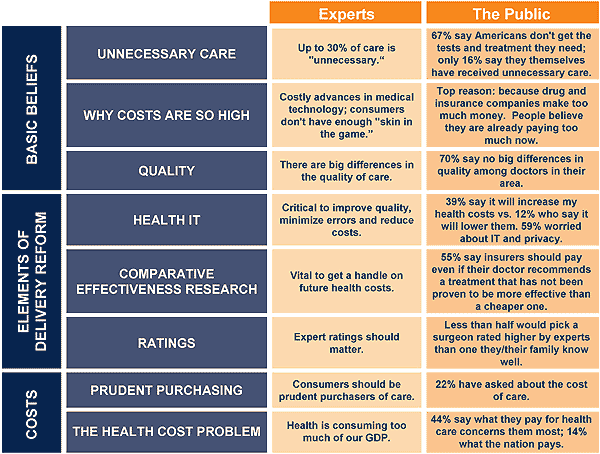
In repeated Kaiser polls, we see a divide between what experts believe and what the public believes about some of the key issues in health reform. They don’t disagree on everything; far from it. But there is a wide gulf on basic beliefs about what is behind the problems in the health care system and key elements of reform, especially delivery reform.
Experts believe the health care system is full of unnecessary care and troubling variations in care, and are committed to the long-term reform of the health care delivery system to make it more efficient, smooth out variations and produce greater value for the health care dollar. In this they (we) are of course right; it will not make sense over the long run to put more money into such an inefficient health care system. The public has a very different world view: People think that underservice is a bigger problem than overservice. They want relief from the problems they are having now paying for health care and health insurance in very tough economic times. Under no circumstances do they want to pay more for their care. And many are worried that they will not be able to afford their health insurance in the future or may lose it altogether.
People are likely to be perplexed when they hear experts say controlling health care costs may mean difficult tradeoffs in the high tech care they get or how much they have to pay out of pocket, because they don’t see the need for tradeoffs; more than anything else they blame waste and fraud and high profits made by insurance and drug companies for high health care costs. They don’t relate well to delivery reform because they don’t see problems in health care as systems failures as experts do and can’t easily see how delivery reform will help them with their day-to-day problems paying for care.
This chart shows a few of the areas where the experts and the public are at odds on basic beliefs about underlying problems, delivery reform, and health care costs.
These differences between experts and the public matter because key elements of health reform which elected officials expect to resonate with the public could get a decidedly less enthusiastic reception than expected if more is not done to close the gap in basic premises and beliefs between experts and the public. Most fundamentally, the challenge is to educate the public about why health costs are rising as fast as they are in the U.S. As long as people think we can solve the problem of rising health care costs simply by eliminating waste, fraud and profiteering, the hard choices they hear experts and leaders talking about will not make much sense to them. But it’s a lot easier to rail against the latest rip-off in the health care system if you are a politician or do another news story on Medicare fraud if you are a journalist than it is to talk about why medical technologies people want cost us so much. Perhaps we need Ross Perot back with his charts and graphs, this time with basic facts about why we have the problems we do in the health care system.
Another challenge is to explain how IT, and comparative effectiveness research, and pay for performance and the whole panoply of health systems changes that need to be made will help address the everyday problems of cost and access people care about most. Taking this communications challenge seriously is a necessary first step towards closing some of the gaps between experts and the public on health reform. Otherwise, key elements of reform will be susceptible to demagoguery and may not have the public support they deserve.
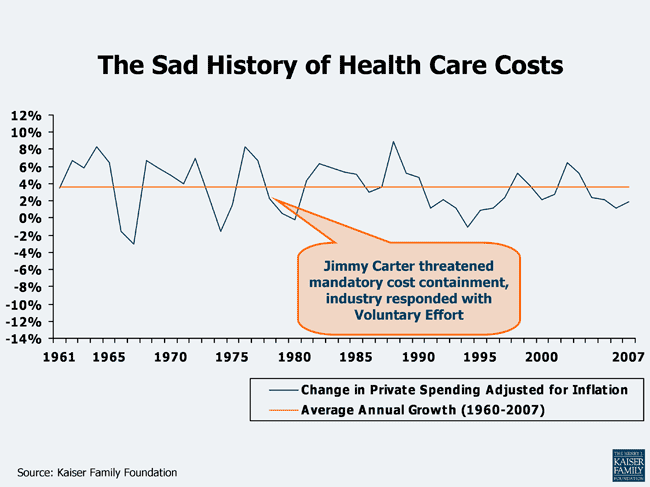
The announcement that health care industry groups plan to put on the table voluntarily a package of proposals to shave $2 trillion off the rate of increase in health spending over the next ten years immediately conjures up the image of the Voluntary Effort or VE launched with similar fanfare in the Carter administration. Back then the industry used the VE to fend off Jimmy Carter’s efforts to aggressively control the costs of hospital care by offering to do it themselves on a voluntary basis. The VE helped defeat Carter’s plan and actually worked for a few years. As the chart shows, the rate of increase in health care costs fell for a few years, but then spiked again, and resumed its upward trajectory. This has been the history of efforts to control health costs; we sometimes achieve temporary successes, but higher rates of increases, at least in the past, have always returned.
Ever since the Carter years (I worked for Jimmy Carter in what was then the Health Care Financing Administration) the VE has been viewed in health policy circles as something of a farce; a president diverted by an industry trying to fend off cost containment actions it saw as more harmful to its bottom line by promising to regulate itself. While today’s voluntary actions by health care groups are not intended to block action on health reform legislation like the earlier VE was—far from it, the industry is at the table in an unprecedented way—they do underscore how the prospect of broader action by a president and congress, including specific ideas industry groups don’t like such as a public plan option, can sometimes motivate an industry to do more on its own than it would otherwise do.
But the new announcement need not be viewed cynically. The President was very clear in his remarks that the private effort is a parallel one, not to be confused with the challenge of designing and paying for health reform legislation, scored by the CBO, on Capitol Hill. The new move by the health care industry groups also reflects a very public recognition on their part that the rate of growth in health spending needs to be reduced, even if the goals they announced may not prove fully achievable, either because national associations cannot deliver their members or expected savings do not materialize. The recognition by the industry itself that current rates of increase in health spending are unsustainable is a good thing and will provide cover for other efforts to reduce health spending not just this one.
The bigger test will come soon: once there is health reform legislation on the table will the industry remain supportive or will they revert to form and protect their bottom line? At that point, the health reform debate will enter a new and critical phase. If the industry is still at the table then, that could truly be a game changer.
A key element in any comprehensive health reform plan is defining what health insurance is and the amount of insurance coverage people will have. There are two components to that coverage: the types of services covered (e.g., physician care, hospitalization, prescription drugs, etc.), and the cost sharing required of enrollees (e.g., the annual deductible, the copayments or coinsurance, and the maximum out-of-pocket costs for a year).
The overall approach to reform drives the kinds of policy decisions that must be made concerning the level of coverage people will have. This brief explains the ways in which coverage might be defined under a health reform plan, and some of the policy issues raised by those determinations.
It is part of a series of briefs providing an overview of key issues and concepts related to health reform.
Brief (.pdf)
Issue Briefs Related to Health Reform
This collection of some of our most recent and relevant issue briefs go beyond the basics to provide concise discussions and analyses of key policy topics related to health reform. For a more complete collection of all the Foundation’s health reform resources, click here.Health Reform Roundtables: Charting A Course Forward Health Reform Roundtables: Charting A Course Forward is a series of discussions among federal officials, state officials and outside experts that provides a forum to share insights and explores key issues related to implementing a significant expansion of the Medicaid program as part of the new health reform law and coordinating that expansion with the creation of new state-based insurance Exchanges.
Community Health Centers: Opportunities and Challenges of Health ReformThis issue brief examines the role that community health centers will play in implementing health reform and providing access to care for millions of Americans who will gain insurance coverage under the new law.
Health Reform Issues: Key Issues About State Financing and Medicaid This updated issue brief examines key issues related to state financing and the expansion of the Medicaid program under the new health reform law.
Optimizing Medicaid Enrollment: Perspectives on Strengthening Medicaid’s Reach Under Health ReformThis brief summarizes the views of Medicaid program directors and other experts about the opportunities that health reform presents to optimize Medicaid by strengthening its enrollment and renewal operations and recasting it as an affordable health coverage program for working people and families.Expanding Medicaid to Low-Income Childless Adults Under Health Reform: Key Lessons From State ExperiencesThe health reform law will expand Medicaid to millions of low-income adults, including many childless adults who have historically been ineligible for the program, necessitating one of the largest enrollment efforts in the program’s history. This report examines lessons learned to help inform the expansion effort based on past state experience covering childless adults through waiver and state-funded programs.Medicaid Long-Term Services and Supports: Key Changes in the Health Reform LawThis brief examines new opportunities under the health reform law for states to balance their Medicaid long-term care delivery systems by expanding access to Medicaid home and community-based services (HCBS) programs.
Health Reform and the CLASS ActThis issue brief examines the Community Living Assistance Services and Supports (CLASS) program, a component of health reform that establishes a national, voluntary insurance program for purchasing community living services and supports that is designed to expand options for people who become functionally disabled and require long-term help.
State High-Risk Pools: An OverviewThis issue brief provides an overview of the primary components of state high-risk pools, discusses their benefits and challenges, and concludes with a discussion of high-risk pools in national health reform.
Uninsured and Untreated: A Look at Uninsured Adults Who Received No Medical Care for Two YearsThis brief profiles uninsured adults with incomes at or below 133 percent of the poverty level who, because of health reform, will be eligible for Medicaid in 2014 based on income. It focuses on those who received no medical care over a two-year period to help assess unmet need.
Financing New Medicaid Coverage Under Health Reform: The Role of the Federal Government and StatesThis brief examines how the federal government and the states are expected to split responsibility for financing expanded Medicaid coverage under the health reform law.Issues for Structuring Interim High Risk PoolsThis brief examines the role of high-risk pools as a coverage safety net today and reviews key issues involved in implementing a national high risk pool, which would be one of the first provisions to be implemented under pending health reform legislation.How Will Health Reform Impact Young Adults?This paper explains the key ways in which the new law will impact young adults ages 19 to 29, and provides a brief overview of current health coverage for this population.Health Reform and Access to Abortion CoverageThe brief discusses the treatment of coverage for abortion services under the major health reform bills and explores the possible impact of the House- and Senate-passed legislation on public and private coverage for abortion services.
Where Are States Today?: Medicaid and State-Funded Coverage Eligibility Levels for Low-Income AdultsThis fact sheet provides a brief overview of low-income adults’ current eligibility for Medicaid and other state-funded coverage programs and a discussion of how this coverage may be impacted by health reform.
Medicaid Beneficiaries and Access to CareThis fact sheet summarizes Medicaid beneficiaries’ experience in obtaining access to care, finding Medicaid compares favorably with private coverage in connecting low-income children and adults with primary and preventive care.
Immigrants’ Health Coverage and Health ReformThis issue brief discusses key questions related to immigrants’ health coverage and health reform, addressing subjects such as how many of the uninsured are non-citizen immigrants and what would happen to coverage for them under current health reform proposals.
Health Reform: Implications for Women’s Access to Coverage and CareThis issue brief highlights key issues for women that arise in the context of health reform, including access to health insurance coverage, health care affordability, scope of benefits, reproductive health and long-term care.
Health Reform and Communities of Color: How might it Affect Racial and Ethnic Health Disparities?This brief examines some of the key provisions of health reform legislation that are likely to have a significant impact on people of color and also highlights the specific provisions that focus on health disparities.
To broaden coverage, some health reform proposals would require employers to offer coverage or pay to help finance subsidies for those without access to affordable coverage. These types of reforms are often referred to as “pay-or-play” policies.
The brief explains the concept and policy implications of employer pay-or-play proposals, which can vary in terms of the level of coverage required for compliance, the cost of the penalty to employers who do not offer, and whether small firms are exempt from the requirements.
It is part of a series of briefs providing an overview of key issues and concepts related to health reform.
Brief (.pdf)
There is lots of apocalyptic talk these days about the collapse of the newspaper industry and the challenges facing news organizations. There is even talk of the unimaginable, my hometown paper The Boston Globe shutting down. Surely they know that Red Sox Nation cannot exist without the Globe Sports pages.
All kinds of solutions have been proposed, from micro-payments for news stories like songs on iTunes to foundation-endowed daily newspapers. There is growing talk of newspapers charging for their content on the web. Health journalists are worried too, as our recent survey of health journalists and forum on this topic showed.
Against this background, Kaiser is launching a new nonprofit health policy news service this June, Kaiser Health News (KHN), with the mission of providing in-depth coverage of today’s ever more complex health issues and developments.
Will KHN improve coverage of complex health policy issues and give policymakers, business and health leaders, and the public better access to information about what’s happening in Washington and around the country? That is our goal so I certainly hope so. In the midst of the biggest U.S. debate about health care in 15 years — if not ever — insightful coverage will be critical to an informed debate and good policy.
Will KHN be the model for nonprofit journalism? I’m not so sure. That’s not our goal, and that in fact is the wrong question, from our perspective at Kaiser.
To appreciate our motivation for creating KHN, it’s important to understand our longstanding commitment to health journalism, our role as an operating foundation and our mission as an information organization. In fact, KHN itself has been long in development; I first brought the idea to our board and made it our top priority for new program development in March 2007, and only then after about a year of internal development.
One of the first operating programs we started after I arrived at Kaiser in 1990 and began remaking the organization was our media fellows program . Run by Penny Duckham from our Menlo Park headquarters, the program provides journalists with the time and resources to delve into complicated health policy issues, access to experts, and an understanding of what’s happening on the ground in the health system through regular site visits. Over the last 15 years, many of the nation’s top health policy reporters have come through the program. We followed the fellows program up with internships for young journalists interested in covering health issues affecting diverse communities. And we’ve provided similar opportunities for journalists covering global health issues.
But that is hardly our only involvement with journalists and news organizations. Through our in-house polling operation, we have entered into formal partnerships with many of the nation’s top news organizations, including The Washington Post, NPR, USA Today, and ABC News. These partnerships are based on surveys and stories resulting from them that go beyond the usual who’s up/who’s down polls and have produced some extraordinary analysis and journalism. Take a look, for example, at the Being a Black Man series we did with the Washington Post and the Harvard School of Public Health. We have now done eighteen surveys with the Post and Harvard. We pick the topics and analyze the results together (with Molly Brodie’s public opinion research team at Kaiser playing a lead analytic role) and, of course, the Post or our other news partners have final say over what they publish or broadcast.
I’ve always believed that good journalism is a key to informed debate and good public policy, since it’s through news coverage that most people understand policy. And frankly, as an ex-public official, I have a keen sense of how news coverage influences the public agenda and public officials — almost like a daily umpire of a never ending game — much as we like to deny it when we are in office.
But, to fully understand the genesis of KHN, you have to see it as part of our larger role as an information organization. People see the word “Foundation” in our name and they think we give out grants. But that’s not what we do. We are a nonprofit, private operating foundation whose product is information — from the most sophisticated policy analysis, to basic facts and numbers, to daily summaries of developments in the news, to up-to-the-minute expert commentary and analysis from our broadcast studio, to information young people can use to improve their health or elderly people can use to understand their Medicare benefits. One Kaiser audience knows us mainly for our policy work and knows little if anything about the Emmy and Peabody award-winning media campaigns we operate in partnership with media companies on issues like HIV in the U.S. and around the world. On the other hand, our more than one hundred media partners across Africa and the Caribbean, or the many partners we have worked with so closely in South Africa since before apartheid fell, probably don’t even know we work on Medicare and Medicaid or health reform in the U.S., much less have a substantial Washington D.C. building and conference center. But it’s all tied together by a commitment to producing the best possible information, whether for policy or people.
The in-depth news coverage that KHN will provide — along with the kind of daily news summaries, interviews, and webcasts previously produced by kaisernetwork.org that will now be integrated into KHN — is one part of a spectrum of all that we do to better inform the health community and mainstream news coverage, and to equip the public to participate in the policymaking process. We hope that KHN will help explain the complex policy issues being debated inside the beltway to audiences outside Washington. As important are the time and resources KHN journalists will have to cover stories where they are happening in the marketplace, the delivery system and in the states, to report on and explain what is happening in health care in the country.
A few specific aspects of KHN are important to mention. KHN will have editorial independence, with control over news content resting with our outstanding executive editors — Laurie McGinley, who came from the Wall Street Journal, and Peggy Girshman, formerly of CQ and NPR, and the Foundation acting as publisher. Our longtime Senior VP who oversees all our media initiatives, Matt James, will oversee KHN. KHN will also enable us to build upon our partnerships with news organizations. We have no desire to supplant what news organizations do; our goal is to support them by producing high-quality, in-depth news reports about health issues that newspapers and other media organizations can use and often don’t have the resources now to produce themselves. KHN content will appear on a new website we are developing and will be published or broadcast by other news organizations with whom KHN enters into partnership arrangements. (KHN has already published stories in the Washington Post and Philadelphia Inquirer and in its “soft launch phase.”)
Fundamental to our underlying philanthropic purpose, all KHN content will be made available for free. And much of the content previously provided by kaisernetwork.org is being integrated into KHN, from our daily reports to our studio programming and more, with many improvements made. By integrating kaisernetwork into KHN, we hope to produce a unique home for health news information ranging from original in depth journalism to news synthesis reports to newsmaker interviews and original studio programming.
KHN is in the process of building out its fulltime reporting staff. In addition to Laurie McGinley and Peggy Girshman we have been fortunate enough to have been able to attract a number of outstanding journalists: John Fairhall, formerly of the Baltimore Sun; Julie Appleby, formerly of USA Today; Mary Agnes Carey, formerly of CQ; Jordan Rau, most recently with the LA Times Sacramento Bureau, with more to come. But KHN will also make wide use of independent journalists, to provide a resource and distribution vehicle for freelance journalists and the many excellent journalists who have lost their jobs in recent downsizings and reorganizations.
To be honest, we are in some ways going against the grain here. Our aim is not investigative reports, snarky opinion or blogs, or breaking news headlines that can fit on a cable news ticker or Twitter feed, though we have no problem if KHN sometimes “breaks news.” Nor do we want to cover regular daily health news, a job which will get done without us. Unlike some others, we do not seek to achieve policy change; indeed, I view that as antithetical to our purpose — excellent in-depth news coverage. Nor are we putting ourselves forward as a model for the future of nonprofit journalism. Indeed it is what is most different and un-replicable about us that is probably most striking.
KHN’s objective is simply to report, inform and explain. And unlike other nonprofit “models,” we are not dependent on the largesse of outside benefactors whose interests may change over time, if for no other reason than a leadership change at the funding organization. KHN’s core costs are built into our ongoing operating budget funded from our own endowment and KHN itself is integral to our long-term strategic plan as an information organization.
Despite our differences, what is common to all nonprofit models is that we have the luxury to fill a need — in our case for in-depth health policy journalism — in creative and effective ways without needing to worry about ad revenue, rating points, or how our stock is faring on Wall Street. If we follow that opportunity — our essential difference from the commercial news media and comparative advantage — there is a chance to make a tremendous difference for journalism and the public.
The Washington Post published an op-ed authored by Foundation President and CEO Drew Altman which examines how the health industry’s voluntary commitment to curb health care spending is similar and different from past efforts.