Explaining Health Care Reform: What is Comparative Effectiveness Research?

Published: Sep 29, 2009

The brief examines current funding for comparative effectiveness research, the provisions included in the current health reform legislation, and issues related to which treatments that might be studied, whether and how to weigh costs of care, and how such findings will be used and shared with health-care practitioners and the public. It is part of the Foundation’s series of Explaining Health Reform briefs on key concepts in health reform.

Brief (.pdf)

Pulling it Together: The Media’s Challenge In Health Reform

Published: Sep 28, 2009

For many years now the news media has served as the public’s number one source of information on important issues like health reform. People rely on the news media to help them wade through claims and counter claims, understand how policy options will affect them and come to judgment on complex issues. In some cases the broader news media has performed admirably in explaining the sometimes overwhelming complexities of health reform, particularly in recent weeks as many journalists and news organizations have worked hard to disentangle the debate about health reform legislation for the American people as it wends its way through Congress. We policy experts particularly admire how good journalists can explain complex issues simply, which as a field we struggle to do.

But the rise of 24-hour cable TV news, the almost instant news cycle and cable’s many entertaining but ideologically left- or right-leaning shows (I watch them all), as well as cutbacks in traditional newsrooms, and the continuing limitations of local TV news have left the news industry poorly structured to play the vital role the country needs it to play. Too often when the news media should stand apart from the political process it has become just another part of it. There was no better example of this than news media coverage – and especially cable TV and local TV news coverage – of health reform town halls in August which sidetracked the health reform debate. Consider these poll findings:

  • Eight in ten people said in a recent poll that they saw or heard news coverage of protests against health reform legislation at town hall meetings. We don’t see that level of public exposure often; not even the health reform ads which run endlessly on cable TV have achieved anything close to that level of penetration.
  • Fully half of the American people say in our tracking poll out this week that media coverage of health reform is mostly about politics and controversy.
  • As of late September only about a quarter of the public can say that they have figured out how health reform will affect them or their families and almost half say they are simply confused.

Sure the media was just covering real events and bringing people the news when it covered the town hall meetings. And much time was devoted to fact checking claims that were made at the town halls. But the disproportionate coverage of the often wild claims made and of the most extreme elements attending the town halls, even when fact checking them, shifted the entire discussion to the activists agendas on both sides and made it more difficult for average people to answer the basic question they have about health reform: will this help me and my family?

The focus on death panels, abortion, and the threat of rationing and a supposed government takeover of the health system also made people more anxious, even when careful attention was devoted to both sides of the claims being made. It was the health reform equivalent of the old adage about sensationalism and local TV news: “if it bleeds it leads.” The biggest losers were the average citizens activated by the debate who attended the town halls because they wanted to learn or be heard; their views got much less attention. Not enough attention was paid to who was orchestrating the meetings or, since the point was to attract coverage, whether these were real news at all. Too many media organizations, particularly on cable TV and local news where town halls were held, followed staged events designed to attract their coverage or chose on their own to put more juicy stories on air about angry town halls and symbolic side issues. According to one study, cable TV and radio were seven times more likely to cover angry town halls and polarizing issues than major newspapers.

Extensive coverage of the public option, a threshold issue for the left, was more legitimate because the public option is an important issue, but it was disproportionately covered because of its larger ideological symbolism to the right and the left. Excessive coverage of the public option diverted attention from the insurance market reforms and coverage expansions and subsidies, which are the elements of the legislation that will provide the most immediate and tangible help to people. As a result, the critical issue of affordability is only now belatedly emerging. I watched a long segment of Larry King Live devoted to health reform in which Elizabeth Edwards and Tommy Thompson debated the public option as if it was the only issue in health reform. As a result the discussion became entirely about whether health reform was or was not a government takeover of the health care system.

As the Congress winnows the process down from five bills to two bills in the House and the Senate and then one final bill that can be put under a public microscope, there is a new opportunity for the media and a big public information role that only the news media can fill. Our polls show that a third of college graduates, one third of all women, thirty eight percent of blacks, a third of all sick people, and a third of all political independents say they can’t figure out how health reform legislation will affect them. More of the American people currently support action on health reform than oppose it, but public opinion is fluid and the public may still decide that proposed fixes are wrong headed, too expensive or just won’t work. That’s always acceptable in a democracy as long as the debate is about the real issues.

How the media covers health reform as the debate moves into the final stages will be critical in determining whether the public’s final judgments are based on a real understanding of how the proposed plan will affect them and the country or based instead on hot button side issues and public relations tactics used by political operatives to lure media coverage. The media can’t wave a magic wand and change how politics works today, but it is the one great balancer in the system and when it becomes part of the political process and no longer stands apart from it we lose a lot. With so much of the media now configured for instant news and the relentless pursuit of controversy, stoked by spin and manufactured news by partisans on both sides, the many great journalists in the news business working hard to inform the public face a big challenge in explaining the complex issues in health reform.
Pulling it Together: Simple Arithmetic

Published: Sep 10, 2009

This week we put out our annual benchmark survey of employer health coverage and costs. Two numbers jumped off the pages.

The first number was the average cost of a family health insurance policy in 2009: $13,375. To put that number in context, if you are an employer, you can hire an employee at the minimum wage for about $15,000 per year. If you are a consumer, you can rent an average two-bedroom apartment nationwide for $11,136 per year (though it is quite a bit more here in Menlo Park, California where our Foundation is based). You can also buy a new Chevy Aveo for $12,000, and it gets 35 miles per gallon on the highway.

The other result that jumped off the page was the stark contrast between increases in health insurance premiums and overall inflation in the general economy. Premiums went up 5% and prices overall fell 0.7% (mainly driven by a big drop-off in energy prices).

The 5% increase we found in premiums is moderate by long-term historical standards. For example, two different times during the last decade premiums increased by 13% a year, in 2002 and 2003. This year’s increase continues a multi-year period of relative moderation in premium increases. Still, over the last ten years premiums have increased by 131%, while wages have grown 38% and inflation has grown 28%. Consider this: If people (and businesses) are as concerned as they are now about rising health care costs in a period when they are actually moderating, how much more concerned will they be when rates of increase return to historic averages?

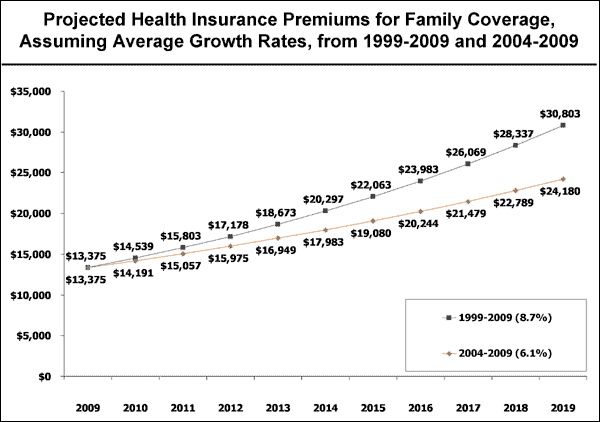
Let’s do some very simple arithmetic. Start with a fairly conservative assumption: If we assume that premium increases over the next ten years will average what they did over the last five (about 6.1% per year), the average premium for a family policy in 2019 will be $24,180. That’s a big number. On the other hand, if we assume increases revert to the average of the last ten years—an average annual increase of about 8.7% and a very plausible scenario—premiums in 2019 will average a whopping $30,803, a very scary number (Figure 1).

Figure 1

091509pitgif_2.gif

Note: Health insurance premiums projected for 2010-2019 assuming (1) that the average growth in premiums between 1999 and 2009 (8.7%) continues or (2) that the average growth in premiums between 2004 and 2009 (6.1%) continues. Source: Kaiser Family Foundations projections based on data from Kaiser/HRET Survey of Employer-Sponsored Health Benefits, 1999-2009.

One obvious implication is that we need to get more serious about reaching agreement on ways to slow the rate of increase in health care costs.  But consensus on measures that would put a real dent in the health cost trajectory has been hard to achieve. Even simple first steps, such as comparative effectiveness research to collect data on what works and what does not in medical practice, have proven controversial, requiring language in draft legislation disavowing that they will ever be linked to payment. And when the public can be so readily scared that these efforts will lead to rationing, it’s a signal that the obstacles to reining in health costs are more fundamental than interest group opposition and health reform politics. Our polls show that we are far from the level of public understanding needed to meaningfully take on health care costs.

Even under the most optimistic scenarios, reducing the rate of increase in health costs will take time. This is why decisions about who gets subsidies and how generous subsidies will be in the health reform legislation now being drafted on Capitol Hill are so important. These decisions will determine how many people get help with their health care costs as insurance premiums and cost sharing become ever more unaffordable for average Americans. Projecting a family premium of more than $30,000 in ten years is simple arithmetic, but the implications for people and employers are real. Low and moderate income people are going to need some help paying for health care and health insurance as we learn which delivery and payment reforms work best and cost containment efforts ramp up.

Oral Histories: Report from a Dental Fair

Published: Sep 9, 2009

This video profiles patients attending a dental fair in rural Virginia and highlights the impact of lack of coverage for oral health services. Uninsured adults have vast oral care needs, and untreated dental problems can have serious health, employment and social consequences.

Poll Finding

Survey on the Role of Health Care Interest Groups–Summary and Charts

Published: Sep 2, 2009

This summary and chartpack are from a survey conducted jointly by NPR, the Kaiser Family Foundation, and the Harvard School of Public Health examines the public’s views and opinions of the role of health care interest groups in the ongoing federal health care debate. The survey examines whether people feel their views are represented in the ongoing legislative process and their level of trust in different groups.

The survey is part of a series of projects about health-related issues by NPR, the Henry J. Kaiser Family Foundation, and the Harvard School of Public Health. Representatives of the three organizations worked together to develop the survey questionnaire and to analyze the results, with NPR maintaining editorial control over its broadcasts on the surveys

The survey was conducted in the midst of the federal health care debate from August 27 through September 13, 2009. A nationally representative sample of 1,278 adults were interviewed by landline (858) and cell phone (420, including 154 who had no landline telephone). The margin of sampling error is plus or minus 3 percentage points.

Summary and Chartpack (.pdf)

Poll Finding

Survey on the Role of Health Care Interest Groups –Toplines

Published: Sep 2, 2009

These toplines are of a survey conducted jointly by NPR, the Kaiser Family Foundation, and the Harvard School of Public Health examines the public’s views and opinions of the role of health care interest groups in the ongoing federal health care debate. The survey examines whether people feel their views are represented in the ongoing legislative process and their level of trust in different groups.

The survey is part of a series of projects about health-related issues by NPR, the Henry J. Kaiser Family Foundation, and the Harvard School of Public Health. Representatives of the three organizations worked together to develop the survey questionnaire and to analyze the results, with NPR maintaining editorial control over its broadcasts on the surveys.

The survey was conducted in the midst of the federal health care debate from August 27 through September 13, 2009. A nationally representative sample of 1,278 adults were interviewed by landline (858) and cell phone (420, including 154 who had no landline telephone). The margin of sampling error is plus or minus 3percentage points.

Toplines (.pdf)

Poll Finding

New NPR/Kaiser/Harvard Poll Examines Public’s Views of the Role of Health Care Interest Groups in the Health Care Debate

Published: Sep 2, 2009

This survey conducted jointly by NPR, the Kaiser Family Foundation, and the Harvard School of Public Health examines the public’s views and opinions of the role of health care interest groups in the ongoing federal health care debate. The survey examines whether people feel their views are represented in the ongoing legislative process and their level of trust in different groups.

The survey is part of a series of projects about health-related issues by NPR, the Henry J. Kaiser Family Foundation, and the Harvard School of Public Health. Representatives of the three organizations worked together to develop the survey questionnaire and to analyze the results, with NPR maintaining editorial control over its broadcasts on the surveys.

The survey was conducted in the midst of the federal health care debate from August 27 through September 13, 2009. A nationally representative sample of 1,278 adults were interviewed by landline (858) and cell phone (420, including 154 who had no landline telephone). The margin of sampling error is plus or minus 3 percentage points.

Summary and Charts

Toplines

The Crunch Continues: Medicaid Spending, Coverage and Policy in the Midst of a Recession

Published: Sep 2, 2009

This annual 50-state survey finds that number of people on Medicaid and state spending on the program are climbing sharply as a result of the recession, straining state budgets and pressuring officials to curb costs despite increased financial help from the federal government through the American Recovery and Reinvestment Act (ARRA).

The survey finds that these trends are expected to continue well into the 2010 fiscal year, with the slumping economy contributing to the loss of jobs, private health coverage and state tax revenue at a time when more people are seeking help from public programs.

Across the country, states estimate Medicaid enrollment grew by an average of 5.4 percent in state fiscal 2009, the highest rate in six years, surpassing the projected 3.6 percent increase at the start of the year. Similarly, total Medicaid spending growth averaged 7.9 percent in FY 2009, the highest rate in five years, well above the 5.8 percent projected growth. For FY 2010, states estimate Medicaid enrollment will grow by 6.6 percent over FY 2009 levels.

The survey finds that, based on initial legislative appropriations, Medicaid spending across states is expected to grow by an average of at least 6.3 percent in fiscal 2010. But officials in three-fourths of the states are concerned that those appropriations will not be enough, leading to more budget shortfalls and more pressures to trim services and spending.

Executive Summary (.pdf)

Full Report (.pdf)

Event Page

Poll Finding

Key Findings: Kaiser Health Tracking Poll — September 2009

Published: Sep 1, 2009

This document contains the key findings from the September Health Tracking Poll. The survey was designed and analyzed by public opinion researchers at the Kaiser Family Foundation and was conducted September 11 through September 18, 2009, among a nationally representative random sample of 1,203 adults ages 18 and older. Telephone interviews conducted by landline (801) and cell phone (402, including 147 who had no landline telephone) were carried out in English and Spanish. The margin of sampling error for the total sample is plus or minus 3 percentage points. For results based on subgroups, the margin of sampling error is higher.

Key Findings (.pdf)

Poll Finding

Kaiser Health Tracking Poll — September 2009

Published: Sep 1, 2009

The September Kaiser Health Tracking Poll finds that public support for health reform ended its summer slide, reversed course and moved modestly upwards in September. The survey also finds initial majority support for taxing expensive health plans and imposing fees on insurers to pay for reform.

Fifty-seven percent of Americans now believe that tackling health care reform is more important than ever—up from 53 percent in August. The proportion of Americans who think their families would be better off if health reform passes is up six percentage points (42% versus 36% in August), and the percentage who think that the country would be better off is up eight points (to 53% from 45% in August).

Substantial majorities of Americans continue to say they back individual reform components designed to expand coverage, including an individual mandate (68%), an employer mandate (67%) and an expansion of state programs such as Medicaid and the Children’s Health Insurance Program (82%).

When it comes to paying for reform, two ideas now under discussion among policymakers garner initial majority support. Fifty-seven percent of the public say they would support “having health insurance companies pay a fee based on how much business they have” and 59 percent would support “having health insurance companies pay a tax for offering very expensive policies.” In both cases, Republicans are evenly divided while Democrats and political independents tilt in favor.

The September poll, the sixth in a series designed and analyzed by the Foundation’s public opinion survey research team, examines voters’ specific health care issue interests and experiences and perceptions about health care reform.

Key Findings

Chartpack

Summary of Recent Results of Public Opinion on Medicare Expansion (.pdf)

Toplines