Poll Finding

Survey of People Who Purchase Their Own Insurance

Published: Jun 1, 2010

While most people in the U.S. get health insurance through their employer, about 14 million people under age 65 have coverage through the non-group or individual market, which has faced scrutiny recently in news reports about some insurers’ steep rate increases and in the market reforms in the new health reform law that will take effect in 2014.

This survey provides insight into the current state of the non-group market and finds policyholders report that their insurers most recently requested premium increases averaging 20 percent. Most say they paid the increase, but some say they switched plans, either buying a less expensive policy from their current insurer or switching companies altogether.

The survey also provides national data on the average premiums and deductibles reported by people who buy their own coverage in the non-group market. It examines policyholders’ views and experiences with non-group coverage and a focused look at the issues facing policyholders with pre-existing conditions.

The survey involved a nationally representative random sample of 1,038 people ages 18-64 who purchase their own health coverage, conducted between March 19 and April 2, 2010.

News Release

Report (.pdf)

Toplines (.pdf)

Changes in Health Insurance Status over a Two-Year Period

Published: May 29, 2010

The ability to maintain health insurance in the face of rising costs and an uncertain economy is a key concern for families and featured prominently in the health reform debate. While the percentage of the population without coverage at any one time changes by only a relatively small amount over a one- or two-year period, the percentage of people who start out with coverage and lose it for a meaningful amount of time during the same period can be much larger. Lapses in coverage affect millions of Americans and contribute to the worries that many have about their financial and health security.

This brief by Kaiser Family Foundation researchers presents information about changes in health insurance status for adults age 18 to 64 with coverage in January 2006 and shows their health insurance status through December 2007. It also presents the alternative, examining gains in coverage over the two-year period among those that began the period uninsured.

Issue Brief (.pdf)

kaiserslidesicon.gif

Slides

Health Reform Issues: Key Issues About State Financing and Medicaid

Published: May 28, 2010

This updated issue brief from the Kaiser Commission on Medicaid and the Uninsured examines key issues related to state financing and the expansion of the Medicaid program under the new health reform law.

Issue Brief (.pdf)

News Release

12 Selected as 2010 Barbara Jordan Health Policy Scholars

Published: May 27, 2010

Washington, D.C. — The Henry J. Kaiser Family Foundation has selected 12 individuals as the 2010 Barbara Jordan Health Policy Scholars.  The Scholars have an opportunity to learn first-hand about health policy and the policymaking process during a nine-week position as staff to a congressional office.

The Foundation established the Barbara Jordan Scholars Program in memory of former U.S. Congresswoman Barbara Jordan — the first African American woman elected to Congress from Texas and a deeply respected member of the Foundation’s board of trustees.

“This year’s group of bright young Scholars will have a unique opportunity to delve into health policy during the early implementation of comprehensive national health reform,” Foundation President and CEO Drew Altman said. “The experience and insights that they gain will help prepare these students to be future leaders in our country, which is a fitting legacy for Barbara Jordan.”

The program is designed to introduce recent college graduates with an interest in issues affecting racial and ethnic minority and underserved communities to the federal legislative process and current issues in health policy.  In addition to working on Capitol Hill, Scholars participate in seminars and site visits organized by the Foundation to broaden their knowledge of health policy issues.  Under the guidance of the Foundation’s staff, the Scholars also complete an in-depth analysis of a health policy issue and produce a policy memo.

This year’s Scholars were chosen from more than 250 applicants.  Cara James, Ph.D., is the director of the Barbara Jordan Scholars Program at the Foundation.  The program operates in partnership with Howard University.

More information about the Barbara Jordan Health Policy Scholars Program is available online.

The 12 Barbara Jordan Health Policy Scholars for 2010 are:

Randall BaldassarreHometown: San Mateo, CASchool: Rice UniversityMajor: Hispanic Studies and Biochemistry & Cell BiologyPlacement: House Energy and Commerce (Minority Staff)

Ashley CastilloHometown: Mesa, AZSchool: Arizona State UniversityMajor: MicrobiologyPlacement: Rep. John Lewis (D-GA)

Trenell DarbyHometown: Kenosha,WISchool: University of Wisconsin-MadisonMajor: NursingPlacement: Sen. Tom Harkin (D-IA)

Alexandra FergusonHometown: Seattle, WASchool: Brown UniversityMajor: Political SciencePlacement: Senate Committee on Health, Education, Labor and Pensions (Majority Staff)

Yvette GonzalezHometown: Salt Lake City, UTSchool: University of UtahMajor: Social Justice Education & Community Based ResearchPlacement: Rep. Charles Rangel (D-NY)

Mariah JonesHometown: Broken Arrow, OKSchool: Howard UniversityMajor: BiologyPlacement: Rep. Donna Christian-Christensen (D-VI)

Elizabeth LamosteHometown: Troy, MISchool: Columbia UniversityMajor: Sociology and Political SciencePlacement: Sen. Olympia Snowe (R-ME)

Victoria MaciasHometown: Santa Fe, NMSchool: Colorado State UniversityMajor: Natural Sciences and SpanishPlacement: Sen. Thomas Udall (D-NM)

Elieth MartinezHometown: Los Angeles, CASchool: University of California San DiegoMajor: Human BiologyPlacement: Rep. Lucille Roybal-Allard (D-CA)

Ryan O’QuinnHometown: Miami, FLSchool: University of PittsburghMajor: Neuroscience and EconomicsPlacement: Rep. Sheila Jackson Lee (D-TX)

Nitrecus SimmonsHometown: Atlanta, GASchool: Bennett College for WomenMajor: BiologyPlacement: Rep. Jesse Jackson, Jr. (D-IL)

Rebecca SnidermanHometown: Barrington, RISchool: Brandeis UniversityMajor: Sociology and PhilosophyPlacement: Rep. Eleanor Holmes Norton (D-DC)

The Kaiser Family Foundation is a non-profit private operating foundation, based in Menlo Park, California, dedicated to producing and communicating the best possible information, research and analysis on health issues.

News Release

New Report Provides State-Level Data on Coverage Gains and Costs of the Medicaid Expansion in Health Reform

Published: May 26, 2010

Analysis Projects Steep Decreases in Uninsured, With Federal Government Covering Vast Majority of CostsWASHINGTON — The expansion of Medicaid under the new health reform law will significantly increase the number of people covered by the program and markedly reduce the uninsured in states across the country, with the federal government picking up the overwhelming majority of the cost, according to a state-by-state analysis released today by the Kaiser Family Foundation’s Commission on Medicaid and the Uninsured (KCMU).

The analysis, performed by John Holahan and Irene Headen of the Urban Institute for the Foundation, is among the first to show for all 50 states and the District of Columbia the distribution of new Medicaid enrollees and costs, as well as the impact on the uninsured.  Health reform will offer Medicaid coverage to millions of low-income adults for the first time and help establish a national floor for Medicaid eligibility that contrasts sharply with the wide variation in eligibility across state Medicaid programs today.

States with large uninsured populations today are expected to see the biggest increases in the numbers of people who obtain health coverage through Medicaid.  California and Texas, for example, two states with considerable numbers of uninsured residents, are each projected to see 1.4 million fewer uninsured adults in 2019 due to the Medicaid expansion, with the federal government covering 95 percent of the cost in Texas and 94 percent in California.

“For a relatively small investment of state dollars, states could see huge returns in terms of additional coverage for their lowest income residents — with federal dollars covering the bulk of the bill,” said Diane Rowland, executive vice president of the Foundation and executive director of the KCMU.

Nationally, the analysis projects that Medicaid enrollment will climb by 15.9 million more people by 2019 than it otherwise would have, and the number of uninsured will fall by more than 11 million.  The cost of the Medicaid expansion between 2014 and 2019 would be jointly financed with the federal government paying $443.5 billion (or 95.4 % of the total cost) and the states contributing $21.2 billion.MethodsIt is difficult to predict the impact of the new Medicaid outreach and enrollment efforts under health reform, as well has how states will respond.  So the analysis contemplates two scenarios and applies a uniform rate of enrollment (participation rate) among those eligible for Medicaid.

The “Standard Scenario” approximates participation rates used by the Congressional Budget Office to achieve the 16 million-person increase in Medicaid enrollment by 2019.  The “Enhanced Scenario” examines the potential impact of more aggressive outreach efforts by federal and state governments, community based organizations and providers combined with the influence of the new individual mandate that everyone obtain health coverage.  It demonstrates the higher level of enrollment (and costs) that might be achieved if newly eligible people were to enroll at much higher rates than are seen among already eligible populations today. Of course, due to fiscal, political and administrative pressures, it is possible that some states may not achieve the expected enrollment gains contemplated under either scenario, leading to smaller increases in coverage and costs.

Both scenarios examine the coverage and cost impact of the Medicaid expansion for adults with annual incomes at or below 133% of the federal poverty level, which is $14,404 for an individual under current poverty guidelines.  The scenarios do not account for the impact of reform for children or state savings related to reductions in uncompensated care costs or reductions in Medicaid coverage for adults currently covered above 133% FPL.  Nor do they factor in other changes in Medicaid in health reform related to provider payment rates, changes to the drug rebates or new options related to payment reform.

For more data on how individual states are expected to be affected, see Table 1 in the executive summary of the report.The Kaiser Family Foundation is a non-profit private operating foundation, based in Menlo Park, California, dedicated to producing and communicating the best possible information and analysis on health issues.

The Kaiser Commission on Medicaid and the Uninsured provides information and analysis on health care coverage and access for the low-income population, with a special focus on Medicaid’s role and coverage of the uninsured. Begun in 1991 and based in the Kaiser Family Foundation’s Washington, D.C. office, the Commission is the largest operating program of the Foundation. The Commission’s work is conducted by Foundation staff under the guidance of a bipartisan group of national leaders and experts in health care and public policy.

# # #

Pulling it Together: REPOR(t)

Published: May 26, 2010

In today’s column I investigate a somewhat lighter topic than my last column on micro-simulation modeling: What was the impact of shows like Jon Stewart’s The Daily Show and Stephen Colbert’s The Colbert Report on the health reform debate?  Who among us has not wondered about the answer to this question?  Please don’t answer that.

I should start by acknowledging that I am a frequent but not religious viewer of these shows, and believe that whatever else they do they perform a deeper public service by helping us take a semi-comical/semi-serious look at the less functional aspects of our democracy.  That made health reform—especially the political and legislative process—a prime topic for both shows over the last year.

In our May tracking poll, 12% of the American people said they got information on health reform from shows like The Daily Show and The Colbert Report (or their websites).  The numbers were higher for college graduates (16%); higher still for 18-29 year olds (19%); and self-reported liberals (20% vs. 9% for conservatives).

We also asked people what their “most important” source of information was on health reform.  Cable TV news and their related websites topped the list, picked by 30%, followed by newspapers and their websites and friends and family at 12% and 11% respectively.  (Note: some respected bloggers questioned whether this could be so given TV ratings data showing far fewer people tuned in to cable than, say, network news, but how frequently people view a news show and what they cite as their “most important” source of information on an issue can be very different things.)  In any event, shows like The Daily Show and The Colbert Report were picked by a tiny 1% as people’s “most important” source of information.  If that sounds very low, by comparison “your doctor or another health care professional” was picked by 3% (19% said they got some information on health reform from their doctor or a health professional).

We also know from an earlier Time magazine poll conducted in October of 2008 that 11% of likely voters cited Stewart/Colbert as a ”major source” of news about politics and current events, 25% as a “minor source”, and 63% as “not a source”.

So what do numbers like these mean?   I suspect the 12% who cite Stewart and Colbert as a “source of information about health reform” is a real undercount; respondents may not think of these shows as providing “information” even if they get them to “think” about a subject like health reform or about government or politics.  These shows are primarily viewed by people as entertainment.  Also, the data should be viewed in the context of the changing information consumption habits of many Americans, especially younger people.  They are fast becoming one-person-news-aggregators, pulling together what they see and learn from multiple websites and shows to form their own overall picture of issues and events (even if they seldom pick up a newspaper or watch broadcast news).  For viewers what they see or learn on The Daily Show is a piece of a “daily” puzzle they assemble themselves. An unknown and I suspect very small percentage of people get their only exposure to information about current events from shows like The Colbert Report, or The Daily Show, or Real Time with Bill Maher, or the other late night shows. The shows engage this group in public affairs when they otherwise might not be engaged but may also fuel skepticism about government and our ability to solve problems as a country which polling suggests seems to be growing.

Another way these shows have impact is that people often forward show segments to their friends, especially young people.  For example, I am forwarding this Jon Stewart interview about “death panels” to you now, one of his interviews that was flipped widely around the internet during the health reform debate.  Lastly, episodes of these shows often create buzz that influences mainstream media, makes news itself, and becomes part of the ever intensifying news cycle.  The impact of a “hot” segment or interview on a show like The Daily Show or The Colbert Report is not told simply through the number of viewers alone or the number of respondents who tell us they got information on an issue from the show in a poll.

One question is how much these shows will continue to pay attention to health reform as we move from a hot political debate to behind-the-scenes implementation issues that are not often grist for riveting television.  It is hard to imagine a Samantha Bee report on medical loss ratio regulations (although not impossible). It would be a good thing for Stewart and Colbert to continue following health reform because it would help keep the public engaged, especially younger people who watch these shows. But it also might be a sign that implementation is not going well if it becomes the focus of shows that capitalize on absurdities and gaffes. That’s the Repor(t).

Confusion Declines, but Remains Widespread in KFF May Tracking Poll

Published: May 16, 2010

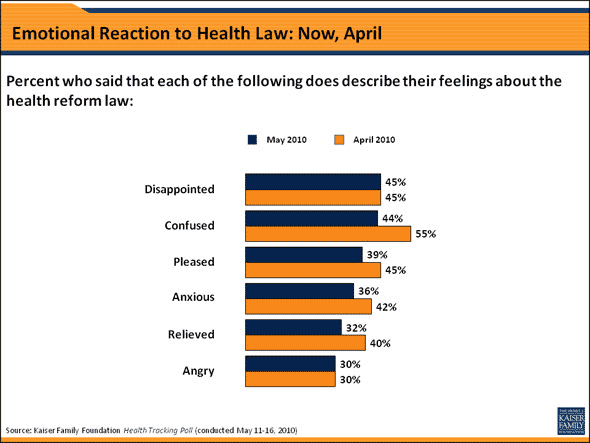
Confusion over the new health reform law declined but remains widespread, with 44 percent of the public saying they were confused in May, compared to 55 percent in April. Moreover, more than a third of Americans (35%) say they do not understand what the impact of the law will be on themselves and their families, while 61 percent report feeling they do understand what that impact will be. Americans continue to report getting information about health reform from a wide variety of sources, including the news media, friends and medical professionals. More than half report having gotten information from friends and family (68%), or from cable (63%) or broadcast news programs (55%). Further breaking down those getting health reform information from cable news, 25 percent of Americans indicated their main cable source on this topic was FOX News, 22 percent named CNN and 6 percent MSNBC.”

Policy-insights-emotionalreactiontohealthlawnowapril

Americans continue to report getting information about health reform from a wide variety of sources, including the news media, friends and medical professionals. More than half report having gotten information from friends and family (68%), or from cable (63%) or broadcast news programs (55%). Further breaking down those getting health reform information from cable news, 25 percent of Americans indicated their main cable source on this topic was FOX News, 22 percent named CNN and 6 percent MSNBC.

How Will Health Reform Impact Young Adults?

Published: May 13, 2010

Adults ages 19 to 29 have the highest uninsured rate of any age group in the United States. The 13.7 million uninsured people in this age group comprise nearly a third of the overall uninsured population.  Most provisions in health reform do not specifically target young adults, but because of their high uninsured rate they will be one of the groups that is most affected by the new law. This paper explains the key ways in which the new law will impact young adults, and provides a brief overview of current health coverage for this population.

Issue Brief

Explaining Health Care Reform: Questions About the Extension of Dependent Coverage to Age 26

Published: May 5, 2010

The new health reform law requires private health insurers that offer dependent coverage to children to allow young adults up to age 26 to remain on their parent’s insurance plan. This provision is among the first in the reform law to take effect, and it increases the availability of insurance to a population that currently has a high uninsured rate.

This short summary answers basic questions about the dependent coverage expansion and explains how the new law will interact with current state laws.

Brief (.pdf)

Pulling It Together: Predicting the Future

Published: May 4, 2010

A fair amount of attention was given recently to projections made by the Chief Actuary of the Centers for Medicare and Medicaid Services (CMS) about the new health reform law, and how they compare to previous estimates by the Congressional Budget Office (CBO). No doubt the various projections will be grist for claims made in the upcoming political season, so it is important to be clear about the differences between the two estimates and to keep in mind what this kind of statistical modeling does and does not do.

The CMS Actuary’s statement that national health spending will go up under reform has attracted the most attention. It should be no surprise that spending will go up. The law will significantly increase the number of people who have health coverage — by 32 million according to the CBO, and 34 million by the Actuary’s reckoning. These are people who would not have had coverage otherwise, and will use more health services as a result. The Actuary projects that net national health spending will go up by an average of less than one percent per year over the next ten years, a small increase in the context of overall health spending and an amount that could be lost in the shuffle of the next update of national health spending projections.

From the perspective of the federal budget, the law was designed so that revenues and savings will offset new spending. Critics dispute the estimates, and some don’t like the specific revenue and savings measures contained in the legislation. But, the CBO says that the revenue and savings measures in the law will more than offset its costs, leading to a reduction in the federal budget deficit over time. (Technically, the CBO takes its revenue estimates from the Joint Committee on Taxation and incorporates them into its model.)

Unlike the CBO, however, the CMS Actuary does not include estimates of revenues, and thus he reaches no conclusion about the impact on the deficit. Conversely, the CBO does not estimate the effect on national health spending. In other words, the CBO and the Actuary do not estimate the same things. Essentially, when you put the two analyses together, they are saying that the law covers 32-34 million additional people, and it does so with essentially the same amount we would spend anyway as a nation and in the federal budget, after taking into account its revenue and cost saving measures.

These specific projections were the focus of recent attention, but how should we think about the role of modeling in health reform more generally? In the health reform debate “micro-simulation models” were used to project the impact of legislation relative to the status quo. Based on existing studies and economic logic, assumptions are made to predict how people and employers will react to all the various changes in the law — from expanded Medicaid eligibility, to tax credits to help pay for private insurance, to the insurance reform and the individual and employer mandates. These changes in behavior are then aggregated to predict the overall impact of the law.

The most fundamental assumption the CBO and the Actuary must make when they do their projections is that the law will be implemented as it was written. Particularly in the context in which they are doing their estimates, this seems reasonable enough, as they have no way of predicting how the law might morph or change in the future. It is, however, a basic constraint the rest of us should be aware of in interpreting official projections. A complex law like this could change substantially in implementation and initial modeling assumptions could change depending on how governors and states react and handle their responsibilities (no doubt there will be great variation), how the private sector reacts, what health care providers do, and most of all how the public responds once the law is implemented. Of course the law itself could also be modified in the future.

Certainly, with all its moving parts affecting so many aspects of the health care system and the economy, simulating the effects of the health reform law is infinitely more complex than modeling the likely impact of, say, the last big change in health policy, the Medicare prescription drug law. That was complex enough, but involved a single change in one program affecting only Medicare beneficiaries. As it turned out, Medicare spending under the prescription drug law was significantly lower than originally projected by the CBO.  There are many who believe that the CBO is decidedly conservative when it comes to scoring the potential savings that will come from the delivery and payment reforms in the health reform law, as well as its prevention components. Where there is no research or experience to base savings on, a conservative approach is reasonable given the CBO’s vital role in the legislative process. But, it also makes it difficult to project and count on savings for things which have not been tried before or have been tried on a small scale in the private sector but not evaluated, such as some of those delivery and payment reforms.

Critics of the law, of course, are more pessimistic and take the view that cost savings will not materialize as envisioned and that some elements of the law scored as reducing costs, such as the Cadillac plan tax, are unlikely to even be implemented. What seems likely in the real world is that some elements of the law will work better than envisioned and some not as well, and when that happens there will be pressure to make adjustments and improvements. That is the lesson from Massachusetts, which led with coverage and then turned to the need to deal with problems such as cost containment and primary care supply as those issues emerged in implementation. But the kind of process which has played out in Massachusetts, one in which policymakers learn and adapt based on real world experience, is not easily modeled in advance.

Also important are the assumptions that modelers must make to ultimately arrive at their predictions. For example, the CBO predicts that 3.9 million people will ultimately pay penalties under the law rather than buy insurance. That estimate, presumably, is based on an analysis of the costs and benefits of buying a policy versus paying the penalty. But can that number really be known or estimated with precision? How dependent are the projections on how the economy is doing at the time and how rapidly people’s wages are rising and what they can afford? To what extent do people value insurance protection for their families in ways that are difficult to quantify?  If policies end up being unaffordable for many people in the real world, will the penalty be relaxed? Or the subsidies improved? Or more people exempted from the mandate to buy insurance? All kinds of reasonable scenarios are possible. There are many examples in the models where reasonable and informed assumptions are made based on published and unpublished studies (or economic logic). But the evidence is not always ironclad, and other assumptions might have been made instead, especially if you expect, as modelers cannot, that other more real world variables will enter the equation.

There is also a lot the CBO and the Actuary do not attempt to estimate, because their models are designed to address specific questions about the impact of federal legislation on the federal budget or national health spending. For example, they do not estimate the impact of the legislation on individual states, which is information in high demand right now as states gear up to take on their substantial implementation responsibilities. And they do not estimate the impact of the legislation on particular population groups, whether it’s the chronically ill or the middle class or minorities or people in rural areas. These things can be modeled but are outside of the purview of the analyses the CBO and the Actuary take on.

In the end the policymaking process is much better off because of the presence of honest brokers trying to use the best economic tools available to make projections about what policy changes will mean. The benefit is not only that it introduces budget discipline into the policymaking process on Capitol Hill — which would otherwise be entirely about differences in policy and about politics and ideology — but also that it introduces facts, data and objectivity into a process that is often about other things. However, in a partisan and conflict-oriented process that elevates modeling from an analytic tool to the status of a referee, it will be important in the coming political season to watch out for statements that take estimates from the CBO and the Actuary out of context or that imbue them with a precision and clairvoyance modeling does not have.