How Has Projected Medicaid Spending and Enrollment Changed Since Passage of the 2025 Reconciliation Law?
The Congressional Budget Office (CBO), known as Congress’s “scorekeeper,” projects federal spending and revenues over the next decade and cost estimates of proposed legislation are measured against those projections. Those projections include spending on major federal programs, such as Medicaid. CBO also typically releases a detailed baseline for federal spending on Medicaid that includes estimates of enrollment by eligibility group and spending by service category. The 2025 reconciliation law, signed into law by President Trump on July 4, 2025, made major changes to federal revenues and spending, with CBO estimating the new law would reduce federal spending on Medicaid by $911 billion over the 2025-2034 period, relative to its January 2025 baseline projections of Medicaid spending under the law and regulations at the time.
CBO’s latest projections of Medicaid spending and enrollment from February 2026 show how enrollment and spending are expected to change over the next decade, accounting for the historic policy changes and their expected reductions in future federal Medicaid spending as well as other economic and technical changes. This policy watch compares CBO’s February 2026 projections of Medicaid spending and enrollment to earlier CBO projections. Projections of spending are compared to those from January 2025 (the baseline used to score the 2025 reconciliation law), but the most recent prior Medicaid enrollment projections are from June 2024. CBO’s newest projections show that enrollment is estimated to be 13% lower and spending 8% lower at the end of the budget windows, highlighting a significant shift in baselines stemming from Medicaid cuts in the 2025 reconciliation law. However, those changes understate the true effects of the 2025 reconciliation law because other factors caused Medicaid baseline spending to increase.
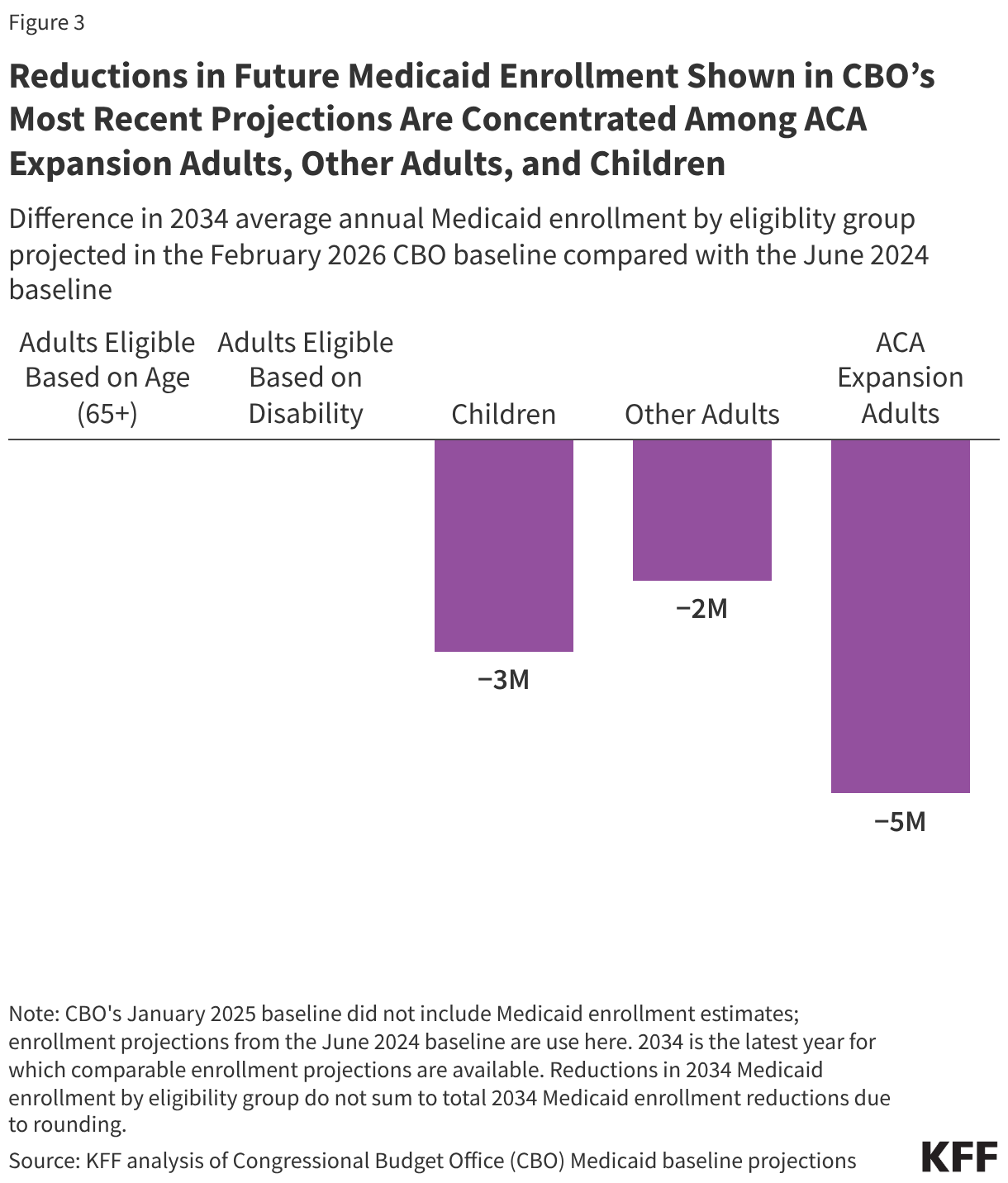
CBO’s most recent Medicaid projections highlight the effects of the 2025 reconciliation law in reducing future Medicaid spending. The most recently released detailed CBO baseline shows that, following passage of the Medicaid changes in the reconciliation law, Medicaid spending is now expected to grow more slowly over time relative to earlier projections. As a result, 2035 spending is projected to be 8% lower than it was in the January 2025 baseline ($941 billion instead of $1.03 trillion, Figure 1). Over the entire 2025-2035 period, federal Medicaid spending in CBO’s latest baseline is projected to be $503 billion lower than estimated in the January 2025 baseline, before the passage of the 2025 reconciliation law. The reconciliation law included major changes to Medicaid eligibility, including the implementation of new Medicaid work requirements, and substantial changes to Medicaid financing, which together contribute to Medicaid’s lower baseline compared with prior years. CBO projects that federal Medicaid spending will still grow but more slowly because of the reductions in the reconciliation law. As a result, fewer people will be covered, and aggregate federal Medicaid spending will likely not keep pace with the increase in health care costs.
CBO’s latest spending projections also account for economic and technical changes that increased Medicaid spending relative to the January 2025 baseline, so comparing baselines may understate the effects of Medicaid cuts in the 2025 reconciliation law. One of the biggest reasons for increased spending was higher-than-expected per enrollee spending in 2025. CBO reports that costs per enrollee grew by 16% in that year, primarily because of declining health status after the COVID-19 continuous enrollment period ended. Those higher 2025 costs per enrollee compound over time due to inflation and rising health care costs. If the most recent baseline projections did not account for those 2025 cost increases, the differences between January 2025 and February 2026 Medicaid spending projections, driven by the Medicaid policy changes in the reconciliation law, would be larger.
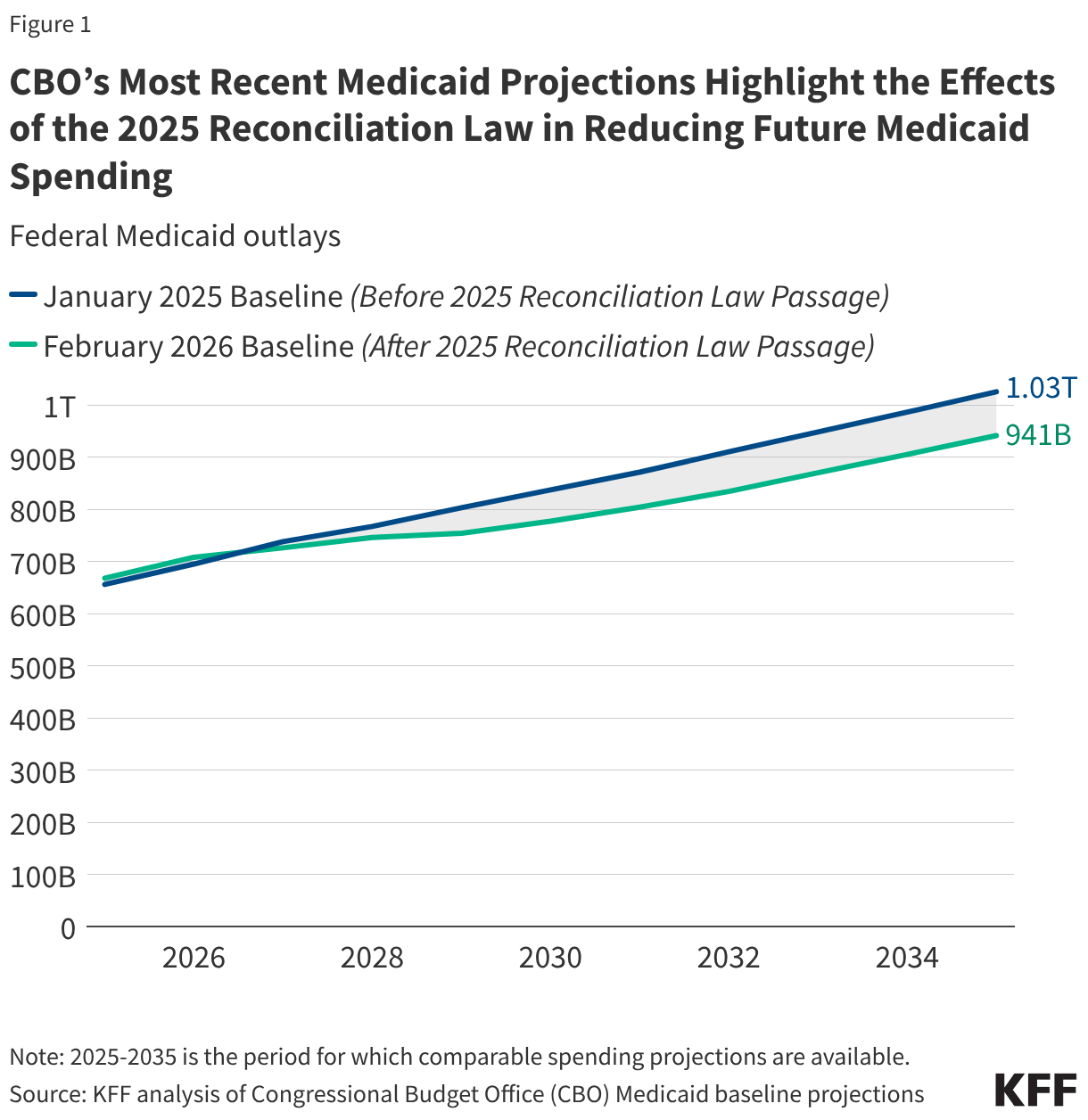
CBO’s latest Medicaid projections also show the impact of the 2025 reconciliation law on reducing future Medicaid enrollment. The latest baseline shows that total average annual Medicaid enrollment is expected to decline, falling to 74 million enrollees by 2034 (a 13% reduction) compared with 85 million projected in the detailed baseline released before the new law’s passage. Many individuals who lose Medicaid coverage do not have another source of affordable health coverage and will become uninsured. CBO’s earlier estimates of the Medicaid policy changes in the reconciliation law found the new law will reduce Medicaid enrollment by more than 11 million and increase the number of people without insurance by 7.5 million in 2034, though these estimates do not account for recently released rules related to work requirements that could affect enrollment projections. CBO may release updated coverage estimates in the coming months. Data show that being uninsured has implications for access to care, financial stability, and health outcomes.
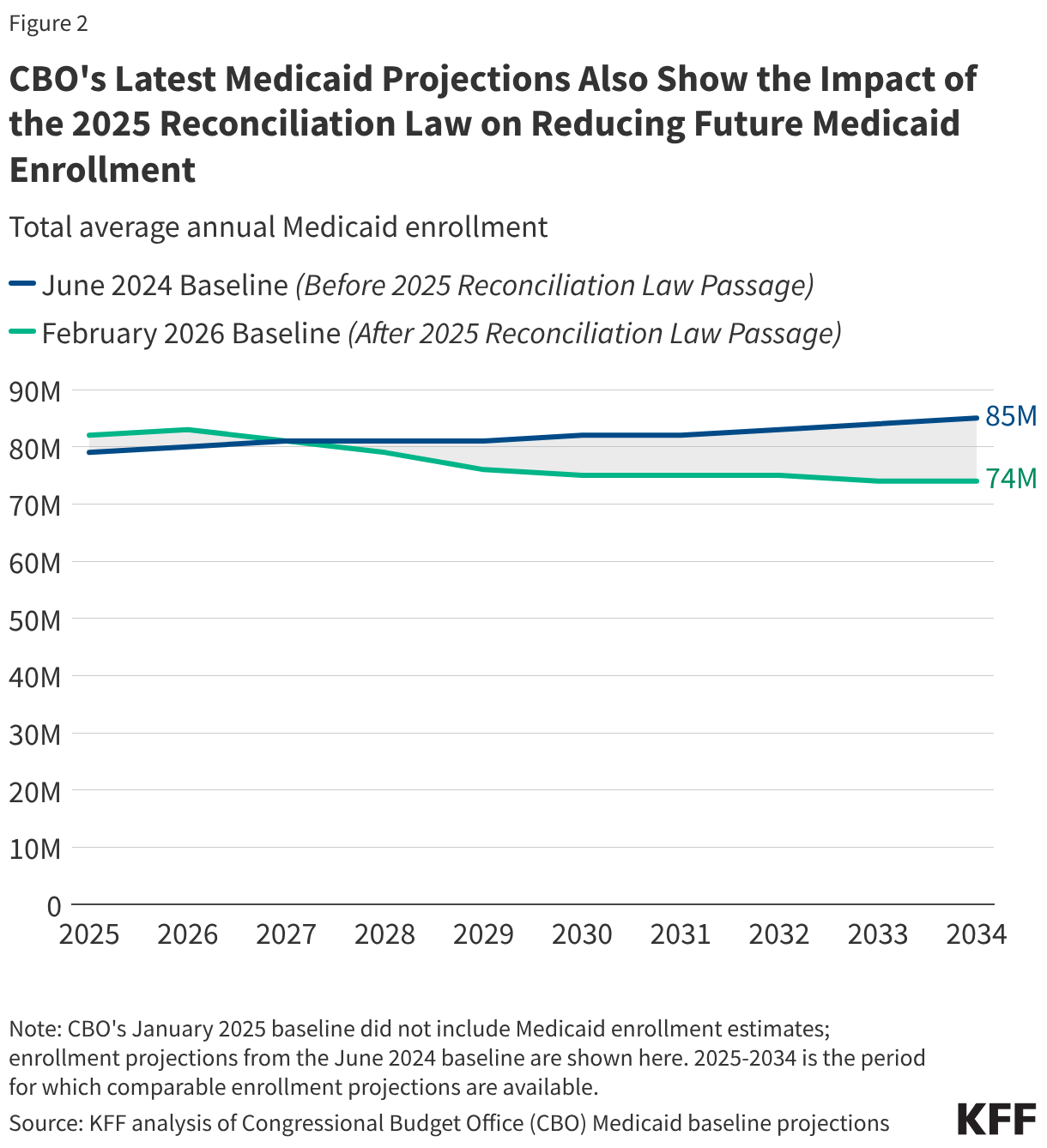
Reductions in future Medicaid enrollment shown in CBO’s most recent projections are concentrated among ACA expansion adults, other adults, and children. The eligibility changes in the 2025 reconciliation law primarily affect adults in the ACA Medicaid expansion group (including new work requirements and more frequent eligibility determinations). Comparing CBO’s projections with those prior to passage of the reconciliation law shows the largest change in enrollment among the ACA Medicaid expansion group (5 million fewer expansion enrollees in 2034). The latest detailed baseline also shows 3 million fewer children and 2 million fewer other adult enrollees than the previous detailed baseline, likely due to provisions that affect groups beyond the expansion group and research showing that coverage loss among parents may reduce enrollment among children.