State Marketplace Profiles: Washington

Published: Oct 17, 2011
Washington

Final update made on November 22, 2013 (no further updates will be made)

Establishing the Marketplace

On May 11, 2011, Governor Christine Gregoire (D) signed SB 5445 into law establishing the Washington Health Benefit Exchange (HBE).1  Additional legislation signed by the Governor in March 2012, removed limitations on the Board’s governing authority over the Marketplace (HB 2319).2  In October 2012, the state announced that the online Marketplace would be called Washington Healthplanfinder.

Structure: The legislation defines Washington’s Marketplace as a quasi-governmental organization, specifically a “self-sustaining public-private partnership separate and distinct from the state.”

Governance: The Marketplace is governed by an 11-member board, including two non-voting, ex officio members (or their designees): the Insurance Commissioner and the Administrator of the Health Care Authority. The Governor appoints eight voting board members from lists of nominees created by the two largest caucuses in the House and Senate. The legislation specifies that appointees must include at least one employee benefits specialist, one health economist or actuary, one representative of small business, and one health consumer advocate. The remaining voting members should possess related expertise in areas such as individual or small employer health care coverage, health benefit plan administration, or health care finance. The Governor appoints a ninth member to the Board who will serve as chair and vote only when needed in case of a tie. Voting board members cannot be legislators or employees of the state or its political subdivisions. The Governor cannot appoint members whose participation in Board decisions would benefit their own financial interests or those they represent. Members developing these conflicts of interest should resign or be removed from the Board.

Current appointed Board members are:

  • Margaret Stanley (Chair), formerly with Puget Sound Health Alliance and Regence Blue Shield
  • Steve Appel, farmer and formerly with Washington Farm Bureau
  • Bill Baldwin, The Partners Group
  • Don Conant, Valley Nut and Bolt and School of Business at St. Martin’s University
  • Doug Conrad, University of Washington School of Public Health
  • Melanie Curtice, Stoel Rives LLP
  • Ben Danielson, MD, Odessa Brown Children’s Clinic
  • Phil Dyer, Kibble & Prentice/USI and former state legislator
  • Teresa Mosqueda, Washington State Labor Council and Healthy Washington Coalition

The Board held their first meeting in early January and assumed governing authority over the Marketplace on March 15, 2012. A few months later the Board hired a CEO.

Marketplace legislation specifies the Board should establish advisory committees to represent the views of the health care industry and other stakeholders, and may also establish technical advisory committees or seek advice of technical experts. In addition, it requires the Marketplace to consult with the American Indian Health Commission. In May 2012, the Board selected 17 Advisory Committee members to provide expertise and experience on various issues. Members include carriers, brokers, small employers, consumer advocates, a Tribal representative, and providers.3 

Contracting with Plans: In February 2013, HBE released guidance that detailed requirements for Qualified Health Plan (QHP) participation in Healthplanfinder.4  The Marketplace allows all QHPs meeting the minimum standards to participate on Healthplanfinder in 2014. HB 2319 created new insurance market rules for plans sold inside and outside Healthplanfinder. If an insurer offers a Bronze plan in the individual or small group markets outside the Marketplace, it must also offer plans in the Silver and Gold levels for that same market. Catastrophic plans may only be sold on Healthplanfinder. Issuers may participate in Healthplanfinder’s individual market, SHOP market, or both and are not required to participate in the same markets inside and outside of the Marketplace. Federal requirements specify that issuers must offer at least one QHP at the silver level and one QHP at the gold level in order to participate in Healthplanfinder. Issuers are also required to offer a child-only plan at the same level of coverage as any QHP offered through Healthplanfinder. The Office of the Insurance Commissioner (OIC) requires issuers to offer contracts to all Indian Health centers in their service area, and issuers must notify HBE of all such contracts. There are five geographic rating areas in the state.5 

In September 2013, the OIC and the Board certified eight health insurance carriers to offer 38 QHPs for individuals through Washington Healthplanfinder. Eight multi-state plans will also be available. One carrier will offer five plans in the SHOP Marketplace, and SHOP plans will only be available in two counties.6  No platinum level plans are offered in either market. The Board will certify QHPs annually and issuers will offer QHPs for a term of one year.7  Information on plan rates for 2014 is available on the Marketplace website. HBE will aggregate subscriber premiums and send the aggregated payments to the appropriate issuer. Subscribers enrolled in the individual market will also be allowed to pay premiums directly to the issuer.

HB 2319 required that by the end of 2012, the Board establish a rating system for qualified health plans to assist consumers in evaluating plan choices.  In September 2012, the Board approved nine consumer rating factors and the use of specific corresponding data sources including the Consumer Assessment of Healthcare Providers and Systems (CAHPS) data for enrollee satisfaction and Healthcare Effectiveness Data and Information Set (HEDIS) data for provider reimbursement and promotion of primary care.8  QHP issuers must also document implementation of quality improvement strategies outlined by the Affordable Care Act (ACA), and submitted strategies will be posted online for consumers to review.

Issuers must ensure that each QHP’s network is sufficient in the number and type of providers, including mental health and substance abuse specialists. The network must also satisfy the essential community providers standard outlined by the ACA and comply with the provisions set forth by the Public Health Service Act and Washington Administrative Code 284-43-200. QHP issuers may only contract with hospitals with more than 50 beds if the hospital has a patient safety evaluation system in place. The OIC will monitor compliance of network adequacy requirements and HBE will decertify QHPs of issuers that do not adhere to the standards. Issuers must also submit health care provider data to HBE for a network directory.

Dental and Vision Benefits: In March 2013, HBE issued final guidance for participation of stand-alone pediatric dental plans in Healthplanfinder. The Board performed final certification of Qualified Dental Plans (QDPs) in September.9  Four dental issuers each offer one stand-alone pediatric dental plan through Healthplanfinder. All plans have low actuarial value (70%).

Risk adjustment, Reinsurance, and Risk corridors (RRR): In a presentation to the Board in September 2012, the Office of the Insurance Commissioner’s Workgroup on RRR expressed a preference for state operated risk adjustment programs.10  The OIC will monitor issuer compliance with the risk adjustment program; if the OIC determines that an issuer is not in compliance with program requirements, HBE will decertify all of the issuer’s QHPs.

Consumer Assistance and Outreach: In June 2013, the Marketplace awarded $6 million in grant funding to ten entities to serve as Lead Organizations for the state’s In-person Assistance program. Lead Organizations are responsible for building, training, and managing a network of partners in their region to conduct in-person educational activities and enrollment assistance. Lead Organizations are partnering with almost 100 community organizations across the state and, as of early October, had trained 800 individual in-person assisters (IPAs) to perform outreach and facilitate enrollment through Healthplanfinder. The Marketplace also awarded $420,000 in grant funding to five tribal organizations to support outreach and enrollment activities for members of tribal communities.11  The Washington Healthplanfinder website features a tool that allows consumers to search for in-person assistance according to zip code and service language.

Licensed producers that complete a four to six hour training course and register with the Marketplace are authorized to sell coverage to individuals and small businesses through Healthplanfinder. Producers must be appointed by carriers to sell QHPs and will continue to receive compensation from carriers.12  Training sessions began in mid-August and will be offered through November.13  As of early October, there were over 2,000 trained producers selling plans through the Marketplace statewide. Consumers may search for a broker by zip code and service language on the Marketplace website.

In September 2013, HBE launched the Customer Support Program, which includes a toll-free call line and email inquiry system. The center is open from 7:30am through 8:00pm and will be staffed by 80 full-time trained Customer Support Center representatives. A translation service is available to provide interpretation for approximately 175 languages and all representatives are trained on how to route calls to other agencies.14 

HBE’s consumer education campaign includes advertising, grassroots activities, social media, business outreach, and partnerships with media outlets and community organizations.  In August 2013, HBE began an online advertising campaign to build Healthplanfinder brand awareness and in September launched a comprehensive advertising campaign that emphasizes how consumers may use the online portal to compare plans and enroll into coverage. Healthplanfinder advertisements appear on television, radio, print, billboards, buses, and in other public areas.15  HBE also produced an eight-part “Countdown to Coverage” webinar series to educate consumers on the Affordable Care Act, how Healthplanfinder works, and the coverage options that will be available in 2014. In April 2013, HBE launched the Washington Healthplanfinder website, including a cost-estimate calculator.

The Marketplace has established key partnerships with entities such as business associations, libraries, hospitals, clinics, community-based alliances, and faith-based organizations, to help spread awareness of the Healthplanfinder and facilitate enrollment statewide. The Marketplace has a series of outreach and enrollment events planned throughout the open enrollment period, including a mobile enrollment tour featuring a customized Washington Healthplanfinder bus. The bus will make stops at nine mobile enrollment event locations throughout the state, and IPAs will use laptops to enroll consumers on-site.16  The Marketplace is also partnering with a nonprofit to develop a smartphone application targeted towards young adults.

Small Business Health Options Program (SHOP) Marketplace: The Washington SHOP Marketplace has experienced significant challenges in recruiting insurers to participate. While seven carriers initially submitted letters of intent to participate in the SHOP, all but one have since withdrawn due to concerns about operational readiness and risk. Despite the limited carrier participation, in May 2013, the Board voted to launch the SHOP on October 1, 2013.17  For 2014, the one participating issuer will offer five QHPS in two counties.

Employers may offer a single health plan or a choice of health plans at a single metal level to employees, and employer premium contribution must be at least 50% for employees. HBE requires 100% employee participation for employer groups with three or fewer employees and employee participation of 75% for employer groups with more than three employees. HBE will collect and aggregate employer premium payments.18 

Financing: In July 2013, the Legislature passed SHB 1947 to ensure self-sustainability for the Marketplace beyond 2014. The bill funds the Marketplace using two mechanisms. First, HMOs, health care service contractors, and self-funded employers must pay a 2% tax on premiums collected during the preceding calendar year.  Taxes on premiums collected through QHPs offered on the Marketplace and on premiums collected through Medicaid plans for the expansion population will be allocated for Marketplace operations rather than deposited into the general fund. If premium taxes for the current year are insufficient to fund Marketplace operations for the upcoming year, assessments on carriers offering QHPs through Healthplanfinder may be used to generate the necessary funds. Assessments will be collected by the Marketplace on a quarterly basis. The legislation also orders the state auditor to conduct an evaluation of Marketplace costs in 2016 and to make a recommendation to the Board and the Legislature about how best to proceed with financing the Marketplace.19 

Basic Health Program (BHP) Option: Washington has considered establishing an optional coverage program available through the Affordable Care Act (ACA) which allows states to use federal funding to offer subsidized health insurance to adults with incomes between 139 and 200% of the federal poverty level (FPL) who would otherwise be eligible to purchase subsidized coverage through the Marketplace. The state released a proposal in June 2012 to operationalize a BHP, but awaits final approval from the federal government.20  Washington already operates the Washington Basic Health program, a state-sponsored program that provides low-income residents below 200% FPL with health care coverage through private health plans; however, this program would have to be modified to meet federal criteria for a BHP.21 

Essential Health Benefits (EHB): The ACA requires that all non-grandfathered individual and small-group plans sold in a state, including those offered through the Marketplace, cover certain defined health benefits. States must decide whether to benchmark their EHB plan to one of ten plans operating in the state or default to the largest small-group plan in the state. The state recommended the EHB benchmark be Blue Shield- Regence Innova Plan PPO.22  In addition, the Children’s Health Insurance Program (CHIP) will serve as the pediatric dental supplement, and the Federal Employee Vision Plan (FEDVIP) as the pediatric vision supplement. The Insurance Commissioner is required to submit annually to the Legislature a list of state-mandated benefits, the costs of which will be borne by the state.

Marketplace Funding

The Washington Health Care Authority has received two federal grants: an Exchange Planning grant of almost $1 million and a Level One Establishment grant of approximately $23 million to be used for operational planning and to develop an information technology system for critical Marketplace functions related to eligibility, enrollment and information exchange. In May 2012, the state was awarded a $127.8 million Level Two Establishment grant to fund Marketplace development through December 2014.23 

Next Steps

On December 7, 2012, Washington received conditional approval from the U.S. Department of Health and Human Services (HHS) to establish a State-based Marketplace.24  The Washington Healthplanfinder portal became operational on October 1 and began enrolling qualified individuals, families, and small businesses into coverage.

Additional information about the Washington Health Benefit Exchange and Washington Healthplanfinder can be found at: http://wahbexchange.org/ and https://www.wahealthplanfinder.org/.

  1. SB 5445, Washington’s 2011 Health Benefit Exchange act.  ↩︎
  2. HB 2319. An Act furthering state implementation of the health benefit exchange. 2012 Regular Session.  ↩︎
  3. See Advisory Committee Members. ↩︎
  4. Washington Health Benefit Exchange. Guidance for Participation in the Washington Health Benefit Exchange. February 1, 2013.  ↩︎
  5. Washington Healthplanfinder Individual Market 2014 Qualified Health Plan and Qualified Dental Plan Certification Requests. August 21, 2013.  ↩︎
  6. Washington Health Benefit Exchange Certifies New Health Plan Options Available This Fall.” September 4, 2013.  ↩︎
  7. Washington Health Benefit Exchange. Guidance for Participation in the Washington Health Benefit Exchange. February 1, 2013.  ↩︎
  8. Consumer Rating System. Health Benefit Exchange Board Meeting. September 19, 2012.  ↩︎
  9. Washington Health Benefit Exchange. Final Guidance for Participation of Dental Plans. March 7, 2013.  ↩︎
  10. Office of the Insurance Commissioner. Reinsurance and Risk Adjustment Workgroup. Exchange Board Presentation. September 19, 2012.  ↩︎
  11. Washington Healthplanfinder Opens Customer Support Program for New Health Plan Options.” September 3, 2013. ↩︎
  12. Washington Healthplanfinder Broker Fact Sheet↩︎
  13. Washington Health Benefit Exchange. Producer Training and Registration↩︎
  14. Washington Healthplanfinder Opens Customer Support Program for New Health Plan Options.” September 3, 2013. ↩︎
  15. Washington Healthplanfinder Expands Ad Campaign to Educate Consumers about New Way to Find Health Insurance.” September 17, 2013. ↩︎
  16. Washington Healthplanfinder Mobile Enrollment Tour Kicks Off in Spokane.” October 16, 2013. ↩︎
  17. Washington Healthplanfinder Sees Competitive Health Plan Options for Consumers.” May 16, 2013. ↩︎
  18. Washington Healthplanfinder Sees Competitive Health Plan Options for Consumers.” May 16, 2013. ↩︎
  19. State of Washington 63rd Legislature. Substitute House Bill 1947↩︎
  20. Washington State Proposal for a Federal Basic Health Option. June 18, 2012. Washington State Health Care Authority.  ↩︎
  21. See Washington Basic Health Program  ↩︎
  22. Essential Health Benefits Benchmark Plan Selection- Revised. February 13, 2012. Milliman.  ↩︎
  23. Washington Health Insurance Marketplace Grants Awards List. ↩︎
  24. Letter from HHS to Governor Gregoire. December 7, 2012.  ↩︎

State Exchange Profiles: Pennsylvania

Published: Oct 17, 2011
Pennsylvania

Final update made on December 12, 2012 (no further updates will be made)

Establishing the Exchange

On December 12, 2012, Governor Tom Corbett (R) notified federal officials that Pennsylvania would default to a federally-facilitated health insurance exchange.1

Prior to the announcement, the Pennsylvania Insurance Department had taken the lead with exchange planning. The Insurance Department, released an extensive report in November 2011 that suggested broad support for a state-run exchange.2 In January 2012, the Department released a conceptual draft for proposed legislation which would establish multiple private exchanges overseen by the Department.3 Consumer representatives expressed concern over the proposed model, citing such an approach would be inconsistent with the exchange requirements under the Affordable Care Act (ACA).4 In May 2012, the Department had begun soliciting for a subcontractor to provide guidance and consultation on exchange planning.5

Essential Health Benefits (EHB): The ACA requires that all non-grandfathered individual and small-group plans sold in a state, including those offered through the Exchange, cover certain defined health benefits. Since Pennsylvania has not put forward a recommendation, the state’s benchmark EHB plan will default to the largest small-group plan in the state, Aetna POS.

Exchange Funding

In September 2010, the Pennsylvania Insurance Department was awarded a $1 million federal Exchange Planning grant. In February 2012, the Department was awarded a $33.8 million federal Level One Establishment grant to continue with exchange planning and the procurement of technical expertise.6

Next Steps

The federal government will assume full responsibility for running a health insurance exchange in Pennsylvania beginning in 2014.


1. Press Release PA Insurance Department. Governor Corbett Announces State-based Insurance Exchange Decision. December 12, 2012.2. Commonwealth of Pennsylvania, Pennsylvania Insurance Department. Insurance Exchange Planning. November 21, 2011. KPMG.http://www.portal.state.pa.us/portal/server.pt/community/health_insurance/9189/health_insurance_exchange_-_archived_exchange_information/10754043. Commonwealth Health Insurance Marketplace and Exchange Access Act. Conceptual Draft. January 30, 2012. http://www.phlp.org/wp-content/uploads/2012/03/Draft-exchange-bill-1-31-12.pdf4. Comments on the Conceptual Draft of the Commonwealth Health Insurance Marketplace and Exchange Access Act. Community Legal Services and Pennsylvania Health Law Project. February 14, 2012. http://www.phlp.org/wp-content/uploads/2012/03/CLS-PHLP-Comments-to-PID-Exchange-Legislation-Conceptual-Draft.pdf5. Pennsylvania Insurance Department. Request for Quotations for Pennsylvania Insurance Exchange Planning. May 2, 2012. http://www.emarketplace.state.pa.us/FileDownload.aspx?file=6100022192/Solicitation_0.pdf6. Level One Exchange Establishment Grant application. Submitted December 28, 2011.http://www.portal.state.pa.us/portal/server.pt/community/health_insurance/9189/health_insurance_exchange/1064758

State Exchange Profiles: Texas

Published: Oct 17, 2011
Texas

Final update made on December 11, 2012 (no further updates will be made)

Establishing the Exchange

On July 9, 2012, Governor Rick Perry (R) announced that Texas would not establish an exchange.1 Prior to this announcement, the Department of Insurance and the Health and Human Services Commission had partnered to explore exchange implementation plans.2 Using federal grant funding they identified subcontractors to assist with the exchange planning process, to collect stakeholder feedback, and to investigate the state’s policy options. In addition, Texas held a public exchange planning symposium and solicited public comments in early 2011.3

Essential Health Benefits (EHB): The ACA requires that all non-grandfathered individual and small-group plans sold in a state, including those offered through the Exchange, cover certain defined health benefits. In August 2012, the Texas Department of Insurance held a public forum to discuss stakeholder feedback on the possible EHB benchmark plans.4 Texas did not put forward a recommendation and the state’s benchmark EHB plan will default to the largest small-group plan in the state, Blue Cross Blue Shield of Texas- BestChoice PPO.

Exchange Funding

The Texas Department of Insurance received a federal Exchange Planning grant of $1 million in 2010, though the state has since returned $900,000 of this grant to the federal government.5

Next Steps

The federal government will assume full responsibility for running a health insurance exchange in Texas beginning in 2014.


1. Press Release from Governor Rick Perry. “Gov. Perry: Texas Will Not Expand Medicaid or Implement Health Benefit Exchange.” July 9, 2012. http://governor.state.tx.us/news/press-release/17408/2.Ramshaw E. “Perry Rejects ‘Obamacare,’ But State Agency Pushes On.” The Texas Tribune. June 20, 2011.http://www.texastribune.org/texas-health-resources/health-reform-and-texas/perry-rejects-obamacare-but-state-agency-pushes-on/3. “Federal Healthcare Reform- Exchange Planning Symposium. Background Information and Requested Stakeholder Input.” February 14, 2011. http://www.tdi.texas.gov/health/documents/background.pdf  (Access August 15, 2011)4. Texas Department of Insurance. “Essential Health Benefits.” (Accessed September 5, 2012).http://www.tdi.texas.gov/health/documents/ehbsummary.pdf5. Tan, Thanh. “Health Leaders Say They’re Ready for Federal Reforms.” The Texas Tribune. February 27, 2012.http://www.texastribune.org/texas-state-agencies/health-and-human-services-commission/will-texas-implement-federal-health-care-reforms/

State Marketplace Profiles: Idaho

Published: Oct 17, 2011
Idaho

Final update made on October 3, 2013 (no further updates will be made)

Establishing the Marketplace

On December 11, 2012, Governor C.L. Otter (R) announced Idaho’s commitment to the establishment of a State-based health insurance Marketplace and on March 28, 2013 signed into law legislation (HB248) creating the Idaho Health Insurance Exchange.1 2  In August 2013, the state announced that the online marketplace would be called Your Health Idaho.3 

While the Governor had previously signed an Executive Order blocking the implementation of health reform in Idaho, he remained favorable towards exploring the creation of a state-run health insurance Marketplace.4 5  Following the Supreme Court’s decision to uphold the Affordable Care Act (ACA) in June 2012, Governor Otter stated that Idaho would work towards a market-based solution and research whether and how to implement a Marketplace. He announced the creation of new work groups to collect data on the Marketplace and Medicaid expansion.6   The Exchange workgroup was be led by the Idaho Insurance Department and representatives of key stakeholders have been appointed by the Governor including: insurers, physicians, brokers, business owners, advocacy groups, researchers and a trade association.7  In October 2012, the work group issued findings recommending the state pursue a State-based Marketplace.8 

Throughout 2011, the Idaho Department of Insurance and the Department of Health and Welfare moved forward with Marketplace planning, creating the Idaho Health Insurance Exchange Project. The Exchange Project organized various work groups as well as stakeholder meetings with business owners, medical providers, insurers, Idaho Tribes, consumer advocates and the general public. The Governance work group was responsible for the initial drafting of the establishment legislation presented to the Health Care Task Force.9  The work group passed a motion in June 2011, to implement a state-run Marketplace over a federally-run one and approved seeking additional federal funding for Marketplace implementation in the state; however, the Exchange Project suspended its website in early 2012.

In April 2011, the Governor signed into law a measure prohibiting abortion coverage in the state’s health insurance exchange except in cases of life endangerment of the pregnant woman, rape or incest (SB 1115).10 

Structure: The legislation defines Idaho’s Exchange as a quasi-governmental organization, specifically an “independent body corporate and politic.”

Governance: Your Health Idaho is governed by a nineteen-member board, including two non-voting ex officio members (or their designees): the Director of the Department of Insurance and the Director of the Department of Health and Welfare. The Governor appoints fourteen members of the board, the Speaker of the House appoints a member of the House of Representatives, the President pro tempore appoints a member of the Senate, and minority leadership appoints a member of the legislature representing the minority party. Members appointed by the Governor serve four-year terms. The legislation specifies that the Board should collectively offer expertise in health benefits administration, health care finance, health plan purchasing, health care delivery system administration, public health, and health policy issues related to small business and individual markets and the uninsured. A majority of the board may not collectively represent health carriers and producers.

Members of the Board, persons within the member’s household, or any entity with which the member is associated cannot benefit financially from any action taken by the Board. Members must fully disclose conflicts of interest and abstain from voting on issues in which there is a conflict of interest.

Current appointed Board members are:

  • Stephen Weeg, formerly of Health West
  • Mark Estess, AARP
  • Karen Vauk, Idaho Food Bank
  • Dave Self, Pacific Source
  • Scott Kreiling, Regence Blue Shield of Idaho
  • Zelda Geyer-Sylvia, Blue Cross of Idaho
  • B. Hyatt Erstad, Erstad and Co.
  • Tom Shores, Shores Insurance
  • Frank Chan, Applied Computing
  • Jeff Agenbroad, Since 86, Inc.
  • Kevin Settles, Bardenay Restaurant and Distillery
  • Fernando Veloz, MS Administrative Services
  • John Livingston, M.D.
  • Margaret Henbest, R.N., Idaho Alliance of Leaders in Nursing
  • Senator Jim Rice
  • Representative Kelley Packer
  • Representative John Rusche

The Board first met in April 2013 and established six subcommittees: information technology, finance, governance, operations, outreach and education, and the Small Business Health Options Program (SHOP) Marketplace.  Also in April 2013, the Board hired an Executive Director.

Contracting with Plans: The legislation specifies that the Exchange will function as a clearinghouse; all carriers, health benefit plans, and stand-alone dental plans will be allowed to participate in the Exchange as long as they are in compliance with state and Exchange law.

In March 2013, the Department of Insurance (DOI) established a process for reviewing and accepting submissions of Qualified Health Plans (QHPs) to be sold through Your Health Idaho.11  Carriers are required to offer at least one silver and one gold plan in each market in which they want to participate. They must also offer a silver metal level plan that reflects cost-sharing reductions and two plans for Native Americans at all metal levels.12  Eight carriers were certified to offer coverage through Your Health Idaho; however, one carrier withdrew. A total of 146 plans will be offered on the Marketplace, including 61 individual plans, 55 small group plans, 13 individual dental plans, and 17 small group dental plans.13 

The DOI received approval from the Centers for Medicare and Medicaid Services (CMS) to define Idaho’s geographic rating areas based on three-digit zip codes rather than the federal default. As a result, Idaho will be divided into seven geographic rating areas. Idaho’s age and tobacco rating ratios will comply with the federal default. The DOI plans to use network adequacy standards similar to the standards established by the Department of Health and Human Services for Federally-facilitated Marketplaces.14 

Consumer Assistance and Outreach: In August 2013, Your Health Idaho awarded a total of $1.7 million in grants to eight In-Person Assister (IPA) organizations to provide education and enrollment assistance to consumers seeking to enroll into coverage through the Marketplace. IPAs will focus on providing education and eligibility assistance, and their services will be available at 150 locations statewide. IPAs will complete a 20 hour training course and must pass a test and a background check in order to become certified. The Marketplace intends to establish a Navigator program in 2014.15 

IPAs and agents/brokers together are known as Consumer Connectors. Agents/brokers are expected to play a major role in enrolling individuals, small employers, and employees into coverage through Your Health Idaho. IPAs and call center staff are strongly encouraged to refer consumers to agents/brokers to select a plan and complete the enrollment process. Agents/brokers must complete the federal training course in order to participate on the Your Health Idaho Marketplace.

In July 2013, the state awarded a contract to develop the Marketplace’s branding, establish a communications strategy, develop educational materials, and manage media relations.16  Your Health Idaho plans to launch a $3.5 million marketing campaign, including television, radio, internet, and newspaper advertisements, in late October.17  In August 2013, the Marketplace launched a consumer-facing website, including a subsidy calculator. The website also features a Consumer Connector Locator that consumers may use to search for an IPA or an agent/broker in their zip code. In September 2013, the Your Health Idaho consumer resource center opened. Call center services are available in English and Spanish, and staff have been trained to refer consumers to an agent/broker for assistance in selecting a plan.18 

Small Business Health Options Program (SHOP) Marketplace: The DOI will not merge the small group and individual markets into a single risk pool, and enrollment in the SHOP Marketplace will be limited to small employers with up to 50 employees. The Board has the authority to set a minimum participation requirement but has not yet established such a requirement.19 

Essential Health Benefits (EHB): The ACA requires that all non-grandfathered individual and small-group plans sold in a state, including those offered through the Marketplace, cover certain defined health benefits. Since Idaho has not put forward a recommendation, the state’s benchmark EHB plan will default to the largest small-group plan in the state, Blue Cross Blue Shield of Idaho- Preferred Blue PPO.

Marketplace Funding

The Idaho Department of Insurance received a $1 million federal Exchange Planning grant in September 2010. In November 2011, the Department of Health and Welfare, in collaboration with the Department of Insurance, received a $20.3 million federal Level One Establishment grant for the procurement and development of Marketplace and Medicaid information technology systems.20  In August 2013, Your Health Idaho applied for a $70 million Level One Establishment grant to fund Marketplace functions through 2014.21 

Next Steps

On January 3, 2013, Idaho received conditional approval from the U.S Department of Health and Human Services (HHS) to establish a State-based Marketplace.22  As of October 1, 2013, individuals, families, and small businesses are able to enroll into coverage through the Marketplace; however, Your Health Idaho is using the federal government’s online eligibility and enrollment system for both the SHOP and individual Marketplaces until its IT platform is fully developed. The Your Health Idaho Marketplace IT system is expected to be operational in early 2014.23 

For additional information on Idaho’s Marketplace see http://gov.idaho.gov/priorities/Exchange.html and http://www.yourhealthidaho.org/

  1. News Release Governor Otter. “Governor Opts for State-based Exchange” December 11, 2012.  ↩︎
  2. Legislature of the State of Idaho. House Bill No. 248↩︎
  3. Your Health Idaho Unveils New Logo and Launches Web site, Outreach Efforts.” August 20, 2013.  ↩︎
  4. Executive Order No. 2011-03. April 20, 2011.  ↩︎
  5. Governor’s News Release. Governor Opts to Seek Federal Funding for Implementing State-based Health Exchange. September 19, 2011.  ↩︎
  6. Governor’s News Release. Idaho’s Next Steps on Obamacare Require Further Study, Careful Consideration. July 10, 2012.  ↩︎
  7. Saunders, Emilie. NPR. “Gov. Otter Appoints Public and Private Stakeholders to study Medicaid Expansion, Insurance Exchange.” July 13, 2012.  ↩︎
  8. Health Insurance Exchange Working group findings. DOI. October 30, 2012.  ↩︎
  9. An Act Relating to the Health Insurance Exchange. Proposed legislation presented November 17, 2011 to the Health Care Task Force.  ↩︎
  10. Senate Bill 1115. Signed into law April 1, 2011.  ↩︎
  11. State of Idaho Department of Insurance. Notice RE: Submission and Review of Rate/Form Filings. March 26, 2013.  ↩︎
  12. State of Idaho Department of Insurance. Idaho Carrier Questions and Answers. May 3, 2013.  ↩︎
  13. UPDATE: Idahoans to Have Robust Choice of Health Plans on Your Health.” September 18, 2013.  ↩︎
  14. State of Idaho Department of Insurance. Bulletin NO. 13-02. March 29, 2013.  ↩︎
  15. Idaho Health Insurance Exchange. Consumer Connector Program. August 13, 2013.  ↩︎
  16. Idaho insurance exchange awards first contract, for outreach, communications.” July 15, 2013. ↩︎
  17. For Idaho uninsured, exchange starts Tuesday.” September 30, 2013.  ↩︎
  18. Your Health Idaho Opens Consumer Resource Center.” September 25, 2013.  ↩︎
  19. State of Idaho Department of Insurance. Idaho Carrier Questions and Answers. May 3, 2013.  ↩︎
  20. Idaho Affordable Insurance Exchange Grants Awards List↩︎
  21. Idaho Health Insurance Exchange. Second Level 1 Grant Funding Request. August 13, 2013.  ↩︎
  22. Letter from HHS to Governor Otter. January 3, 2013.  ↩︎
  23. Otter, Idaho exchange officials defend exchange, say feds won’t run it.” May 23, 2013.  ↩︎

State Exchange Profiles: Missouri

Published: Oct 17, 2011
Missouri

Final update made on December 13, 2012 (no further updates will be made) 

Establishing the Exchange

On November 6, 2012, Missouri voters passed a ballot measure blocking Governor Jay Nixon (D) from establishing an exchange via Executive Order.1 Legislation establishing a state-based health insurance exchange failed in both the 2012 and 2011 legislative sessions. While the Governor initially supported running a state-based exchange, he announced the state would default to a federal exchange in 2014.

Prior to the announcement, the Governor established Missouri’s Health Insurance Exchange Coordinating Council to coordinate the state’s response to federal health reform.2 The Council included executive leadership from multiple state agencies and established four work groups to address exchange components including, Operations; Finance and Coverage; Communications; and Cost-containment and Quality.3 The Council identified a number of consultants to provide background research and insurance market analysis to inform decision-making in the state. In June 2011, the Senate had also created the Senate Interim Committee on Health Insurance Exchanges to explore Missouri’s options to establish a state-based exchange.4

In August 2011, the Missouri Health Insurance Pool Board released a Request for Information for general exchange information technology component solutions and services; however the contract was never awarded.5 Missouri was also participating in the “Enroll UX 2014” project, which is a public-private partnership creating design standards for exchanges that all states can use.6

In August 2010, Governor Nixon allowed a law prohibiting health insurance exchanges established in Missouri from offering insurance policies or riders that provide abortion coverage except in cases of life endangerment of the pregnant woman to become law without his signature (SB 793).7

Essential Health Benefits (EHB): The ACA requires that all non-grandfathered individual and small-group plans sold in a state, including those offered through the Exchange, cover certain defined health benefits. Since Missouri has not put forward a recommendation, the state’s benchmark EHB plan will default to the largest small-group plan in the state, Healthy Alliance (Blue Cross Blue Shield)- Blue Access Choice PPO.

Exchange Funding

In September 2010, the Missouri Department of Insurance received a federal Exchange Planning grant of $1 million. The Missouri Health Insurance Pool, a quasi-governmental, non-profit insurer that expanded to operate the federal high risk-pool in the state, received a $20.8 million federal Level One Establishment grant in August 2011, to build a coordinated information technology infrastructure with a single portal eligibility and enrollment system.However, the Senate Interim Committee, which has been critical of the state’s decision to apply for federal grant money without explicit approval from the legislature, has yet to approve spending the funds. In April 2012, the Missouri legislature rejected a $50 million federal grant to upgrade the state’s Medicaid information technology system because lawmakers saw it as a possible framework for building an exchange.9

Next Steps

The federal government will assume full responsibility for running a health insurance exchange in Missouri beginning in 2014.


1. Associated Press. “Nixon: Missouri won’t run health insurance exchange by 2014.” November 8, 2012. Kansas City Star. http://www.kansascity.com/2012/11/08/3907070/nixon-missouri-wont-run-health.html2. The Health Insurance Exchange Coordinating Council was formerly the Health Care Cabinet3. Missouri Level One Establishment Grant application:http://www.mhip.org/Documents/Grant/Establishment%20Grant%20Project%20Narrative.pdf4. Senate Interim Committee on Health Insurance Exchanges.http://www.senate.mo.gov/11info/comm/interim/sihi.htm (Accessed September 16, 2011)5. Missouri Health Insurance Pool. Request for Information for Health Insurance Exchange Component Solutions and Services. RFI# 2011-001. August 19, 2011.6. Enroll UX 2014 website. http://www.ux2014.org/7. Senate Bill 793. Modifies provisions relating to abortion. Delivered to Governor May 25, 2010.http://www.senate.mo.gov/10info/bts_web/bill.aspx?BillID=3187166&SessionType=R8. HealthCare.gov. “Creating a New Competitive Marketplace: Affordable Insurance Exchange Establishment Grant Awards List.”http://www.healthcare.gov/news/factsheets/exchanges05232011a.html (Accessed August 18, 2011)9. Nelson, J. “Bill gives Missouri voters say on health exchanges.” May 19, 2012. News-Leader.http://www.news-leader.com/article/20120519/NEWS06/305190025/health-exchanges-missouri-legislature?gcheck=1&nclick_check=1

Pulling it Together: Business and Health Care Costs

Published: Oct 11, 2011

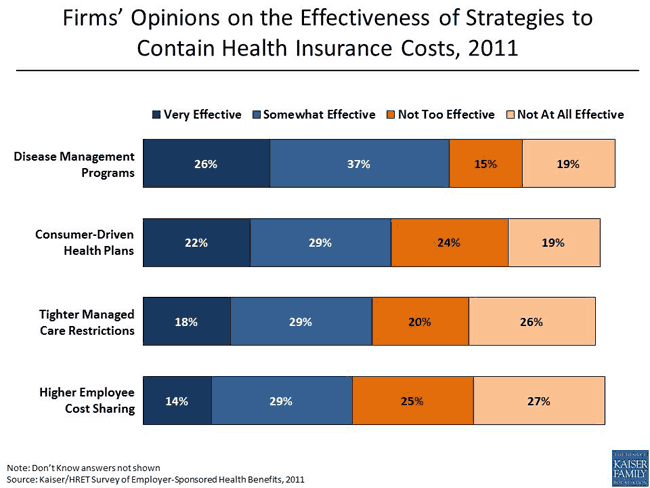
Hidden away on page 218 of our annual Employer Health Benefits Survey is a table that shows what employers think of the main strategies they have to control health care costs.  More specifically, the table shows what the person in the firm responsible for its health benefits thinks, which is whom we survey.  The short answer is, employer confidence in their own ability to control costs is not high.

Not more than about a quarter of employers felt any one strategy was “very effective,” and they were divided on virtually every cost-containment strategy they were asked about.  For example, 22% said consumer-driven health plans were “very effective,” and 19% said they were “not at all effective.”  Similarly, 18% said tighter managed care restrictions were “very effective,” while 26% said they were “not at all effective.”  The “winner” this year seems to be disease management, garnering the most employer confidence, with 26% calling it “very effective” and 19% calling it “not at all effective.”  The not very enthusiastic “somewhat effective” was the description often chosen by employers to characterize the cost-containment strategies available to them.  Interestingly, many firms said they don’t have a lot of confidence in increasing employee cost-sharing as a way to decrease costs.  Many firms also offer wellness programs, and in an answer to a different question, slightly more than half think those programs help to lower costs to some degree.  You can see the results in this chart.

PIT1013_1.gif

With no single magic bullet strategy they have confidence in, employers tend to try multiple strategies at once in the hope that cumulatively they will have a measurable impact.  Large employers have more weapons at their disposal than smaller ones, who, for example, are more likely to offer only one type of health plan (85% of small firms vs. 58% of larger ones).  Simply switching plans is often the cost-control strategy of last resort for many firms.  About six in ten firms shop for a new plan or new insurer each year, and among those, almost half switch carriers and/or change the type of plan they offer.  This produces a remarkable amount of churning in the insurance system.  This has been our own experience at the Foundation.  Premiums for our main PPO rise to unaffordable levels, we make the changes we can to hold on until premiums rise once more to prohibitive levels, we are told our premiums are up because our cost experience is too high, and then we are forced to switch again.Many years ago, before my time in government and foundations, I did a study of corporate attitudes toward health care costs with colleagues at MIT.  We did the study because there was a view at the time that corporations were awakening to health costs in a new way and would become willing allies with government in new efforts to take on this growing problem.

To assess that contention, which was gaining momentum at the time, we interviewed CEOs and corporate health benefits officers at 69 companies, including some of the largest corporations in America.  We found that the CEOs, in particular, did not have a great deal of faith in the tools they had to control health care costs (their views were often quite different from those of their health benefits managers).  They had little confidence in the ability of businesses and their insurance companies, acting on their own to control costs and they believed the answer (whether market-driven solutions or regulation) had to come from the government, feeling that only government could act on a system-wide scale.  Logically then, they would lend their support and considerable clout to back government efforts to control health care costs?  Not really.

To the contrary, on a personal level, many of the CEOs we spoke to were opposed to a larger role for government generally, and in the other areas of their businesses that they were more familiar with than health care they were no friends of government regulation.  These CEOs were trapped between their frustration and concern over rising health costs and their personal, and sometimes ideological, aversion to government intervention.  When it came time to support federal legislation, more times than not, business would stand on the sidelines if not oppose.  Of course there were exceptions.  A few CEOs became heavily involved in the health cost issue on the national stage, at least for a time, such as the late Walter Wriston from what was then Citicorp, and, more recently, Howard Schultz from Starbucks.

The following was our main conclusion in 1981, which incidentally was a year when health premiums soared by double digits: “Major corporations are under no illusion that they can do much individually to alter their health benefit costs…  To be sure, firms are no longer totally passive about rising health care costs and continual increases could provoke stronger action than we have observed…  However, firms are not, nor are they likely to be the force for systems reform that some have imagined.”

In our employer survey this year, when we asked employers to assess major approaches to controlling health costs and got such lukewarm responses, I think back to that 1981 study, and how little seems to have changed.

Poll Finding

Kaiser Health Tracking Poll — October 2011

Published: Oct 1, 2011

The October health tracking poll finds a more negative overall public mood about the health reform law, driven largely by changes in support for the law among Democrats. The poll also asked the public’s impressions of the Massachusetts health reform law enacted under then- Gov. Mitt Romney, who is now a candidate for the Republican presidential nomination. Findings from the poll include:

  • After remaining roughly evenly split for most of the last year and a half, this month’s tracking poll found more of the public expressing negative views towards the law. In October, about half (51%) say they have an unfavorable view of the Patient Protection and Affordable Care Act (ACA), while 34 percent have a favorable view, a low point in Kaiser polls since the law was passed. While Democrats continue to be substantially more supportive of the law than independents or Republicans, the change in favorability this month was driven by waning enthusiasm for the law among Democrats, among whom the share with a favorable view dropped from nearly two-thirds in September to just over half (52%) in October.
  • Americans are more than twice as likely this month to say the law won’t make much difference for them and their families as they are to say they’ll be better off under the law. Forty-four percent say health reform won’t make much difference to them personally, up from 34 percent in September. Meanwhile 18 percent say they and their families will be better off, down from 27 percent last month. (The share who thinks they’ll be worse off personally held steady at roughly three in ten, where it has been since the law passed in 2010.) Here, too, changes in views among Democrats helped shape the overall change.
  • The survey finds that nearly three quarters of the public, including seven in ten likely Republican presidential primary voters, say they don’t know enough about the Massachusetts law to have either a favorable or unfavorable opinion of it. A similar share of the public (71%) cannot say whether the law is similar to, or different from, the national health reform law.

The October poll is the latest in a series designed and analyzed by the Foundation’s public opinion research team.

Findings (.pdf)

Toplines (.pdf)

Moving Ahead Amid Fiscal Challenges: A Look at Medicaid Spending, Coverage and Policy Trends Results from a 50-State Medicaid Budget Survey for State Fiscal Years 2011 and 2012

Published: Oct 1, 2011

The 11th annual 50-State Medicaid budget survey from the Kaiser Family Foundation’s Commission on Medicaid and the Uninsured finds that Medicaid officials in virtually every state are enacting a variety of cost cutting measures as states’ spending for Medicaid is projected to increase 28.7 percent in fiscal year 2012 to make up for the loss of federal stimulus money.

The temporary increase in the federal share of Medicaid spending under the American Recovery and Reinvestment Act (ARRA) brought about the only declines in state spending on Medicaid in the program’s history, even as the recession increased Medicaid enrollment and overall Medicaid spending. With that money having expired in June 2011, however, states must ramp up their own spending to replace the lost funds, even though states project total spending in the Medicaid program – which is jointly financed by the federal government and the states — to increase on average by 2.2 percent in FY 2012.

The survey finds cost containment actions ranging from restrictions on payments to providers and benefits, to new copayments for beneficiaries and additional efforts to contain the costs of prescription drugs. States also are trying to make their programs more efficient by increasing their reliance on Medicaid managed care, moving long-term care toward community-based care models, and streamlining enrollment procedures.

The state focus on cutting costs occurs as deficit reduction efforts in Washington could reduce federal support for Medicaid and shift costs to states and at a time when states, still coping with a weak economy, also must prepare for the expansion of Medicaid under the health reform.

icon_news_release.gif

Press Release

Executive Summary (.pdf)

Full Report (.pdf)

Mid-Year Update Report for FY 2012

Related Reports:

June 2012 Report: A Focus Group with Medicaid Directors: As FY 2012 Ends, Looking Toward FY 2013

Update: State Budgets in Recession and Recovery

Impact of the Medicaid Fiscal Relief Provisions in the American Recovery and Reinvestment Act (ARRA)

Connecting Eligible Immigrant Families to Health Coverage and Care: Key Lessons from Outreach and Enrollment Workers

Published: Oct 1, 2011

Beginning in 2014, health coverage options will significantly expand under health reform through an expansion in Medicaid eligibility and by making tax credits available to help individuals purchase coverage through new Health Benefit Exchanges. Given their high uninsured rate and limited access to private and public coverage, one group who could significantly benefit from this coverage expansion is lawfully residing immigrant families. However, it will be important to address barriers eligible immigrant families often face to enrolling in coverage and accessing needed care.

Based on findings from focus groups conducted with outreach and enrollment workers who serve immigrant communities, this report identifies the role of Medicaid and CHIP for immigrant families; key barriers eligible, lawfully residing immigrant families face to enrolling in coverage and accessing care; successful strategies to overcome these barriers; and considerations for implementing the coverage expansion under health reform.

Executive Summary (.pdf)

Full Report (.pdf)

Impact of the Medicaid Fiscal Relief Provisions in the American Recovery and Reinvestment Act (ARRA)

Published: Oct 1, 2011

The American Recovery and Reinvestment Act (ARRA), enacted in February 2009, has provided $103 billion in federal fiscal relief to state Medicaid programs over a period of two-and-a-half years to help them address the effects of the 2007-2009 recession. During a recession, unemployment increases and state revenues decline, making it difficult for states to meet the increased demand for Medicaid coverage among the newly unemployed. This brief reviews the ARRA Medicaid fiscal relief provisions—how they were structured and what impact they had on state Medicaid finances during the recession.

Issue Brief (.pdf)