Federal Funding Under the Affordable Care Act

Published: Apr 12, 2012

This fact sheet provides highlights from an analysis tracking the flow of federal Affordable Care Act funds to states as reporter in the Department of Health and Human Services grant database as well as periodic reports from HHS and the Internal Revenue Service. The analysis distinguishes between funds awarded to state and local governments (including state and local health departments and school districts) and private entities (including private employers, health centers, universities, and other community-based organizations).

Fact Sheet (.pdf)

Pulling It Together: The Falloff in Utilization: “There’s Something Happening, Here, What It Is Ain’t Exactly Clear”

Published: Apr 10, 2012

For as long as I have been in the field, we have seen cycles in health care costs. Per capita health spending would rise, then moderate, then rise gain. My colleague Larry Levitt and I documented this in The Sad History of Health Care Costs and my friend Dr. Jim Mongan called it “the peaks and valleys” of health care costs. We have never been sure whether the “valleys” were the result of government actions, such as wage and price controls, the threat of health reform in earlier eras, recessions, or other factors we just could not identify, but they were clearly observable in the data. Even as health spending per capita rose and fell, overall health spending has continued to rise faster than GDP and gobble up a growing share of the economy. When we saw a valley in per capita health spending or in health insurance premiums, we always knew there would be another peak, because as a nation we had done little or nothing to deal with the underlying drivers behind rising health care costs. Has something changed?

When the historic recession started to bite in 2008, people began to put off elective health services: they went to the doctor less, had fewer procedures, and purchased fewer drugs. Even hospital days fell. But utilization continued downward even after the recession technically ended in June of 2009 and the economy started to slowly recover. Current data on medical use in the private sector are sparse, but from what we can tell from the data we have and from anecdotal reports from health insurers, utilization has not picked back up, at least not yet. Seniors too appear to be cutting back on prescription drugs, according to a recent study from IMS Health.

These trends are consistent with recent patterns in health premiums we have observed in our annual employer survey. We saw historically very modest increases of between 6% and 3% from 2006 and 2010, the longest period of moderation on record. Premiums jumped 9% in 2011, but we believe that was because insurers expected a return to higher utilization levels in the economic recovery, which did not in fact occur.

Are we witnessing another temporary valley in health care costs, albeit a very long one due to the historic nature of the recession and its lingering effects on consumer spending? Or, are we seeing a real change in health care utilization patterns? If it is the latter, what is driving it? Are doctors all of a sudden ordering fewer tests, drugs, procedures and hospitalizations for their patients? That’s hard to believe, at least in the absence of fundamental payment reform. Could there be fewer new medical technologies coming online? That would not seem to be the case; last year was a big year for new drugs.

If we are witnessing something other than the lingering effects of a weak recovery, then a likely explanation is the growth we have seen in cost-sharing and high-deductible plans. The share of workers in a plan with a deductible of $1,000 or more grew from 18% in 2008 to 31% in 2011, and from 35% to 50% in smaller firms. The Affordable Care Act (ACA) will not arrest, and could accelerate, these trends. The individual deductible for a bronze plan in the new insurance exchanges could easily exceed $4,000, and the family deductible is about double that amount. In other words, to reference a different debate currently in the news, what is actually “mandated” for about 30 million people under the ACA is basically catastrophic coverage. As insurance begins to look more like catastrophic coverage and less like comprehensive coverage, there is an impact on utilization. Of course, in some cases people may be cutting back on unnecessary care and in some cases they may skimp on needed care, which could lead to higher costs down the road. Much more research is needed on this issue.

Increases in cost sharing are not a new phenomenon. Economists will be quick to point out that out-of-pocket spending has not gone up as a share of overall health spending. But it has risen dramatically relative to wages which have been flat for over a decade. And it is plausible, if not likely, that the combination of a deep and lingering recession and higher deductibles, in some cases spurred by tax changes that make high-deductible plans attractive in combination with savings accounts, has triggered a tipping point of sorts that is causing people to use less health care.

If we are seeing a shift downward in utilization patterns it would constitute a one-time reduction in the level of health spending but not necessarily affect the longer-term rate of growth, which most agree is driven by new medical technologies. People get sick and sometimes very sick, and there are, in the end, only so many doctor visits, procedures, elective hospital stays and drugs that people can delay or forgo. But if increased cost sharing is a major factor driving lower use, we may not have seen the full effect yet, as the trend toward high-deductible plans shows no signs of arresting soon. It will take a few more years of monitoring utilization patterns to know if we are seeing a recession-effect or a real change in patterns of use, what may be driving them, and how deep this one-time adjustment in patterns of use may go.

We have a new phenomenon to watch with important implications for people and costs. In the words of the old Buffalo Springfield song:

“There’s something happening here,What it is ain’t exactly clear.”

Poll Finding

The Role of High-Income Seniors in Medicare Reforms: The Public’s Perspective

Published: Apr 9, 2012

Medicare remains in the spotlight as policymakers and presidential candidates look for ways to rein in Medicare spending. One facet of the debate has centered on whether seniors with higher incomes should pay more for their coverage under Medicare. Based on data from the February 2012 Health Tracking Poll, this data note examines at what income level the public sees seniors as ‘wealthy,’ and finds that the answer has a lot to do with how the question is asked.

Data Note (.pdf)

News Release

National Campaign Encourages Young People to “Get Yourself Tested” for STDs, Including HIV

Published: Apr 9, 2012

NEWS RELEASEApril 9, 2012

NEW YORK, N.Y. — The fourth annual GYT: Get Yourself Tested campaign kicks off National STD Awareness Month (April) with new initiatives on-air, online, and on the ground at college campuses and in more than 5,000 health centers across the nation. GYT is an ongoing national campaign launched in 2009 as an extension of a longstanding public information partnership between MTV and the Kaiser Family Foundation to address the high rates of STDs among those under 25. It is supported by a broad range of organizations including the U.S. Centers for Disease Control and Prevention (CDC) and Planned Parenthood Federation of America, which reinforce the on-air campaign with on-the-ground promotions conducted with health centers and community organizations across the nation.

“MTV has made a sustained commitment to challenging the stigma that prevents countless young people from getting tested for STDs and HIV,” said Jason Rzepka, Vice President of MTV Public Affairs. “We’re proud that GYT has helped drive notable increases in STD testing, but there’s no finish line in this race, and we will continue to do all we can to help our audience make responsible decisions about their sexual health.”

GYT is a youthful, empowering campaign aimed at reducing the spread of STDs among young people through information; open communication with partners, health care providers, and peers; and testing and treatment as needed. GYT offers a short-hand reference for young people to open up dialogue about STDs and, in particular, the importance of testing. According to CDC, young people ages 15-24 represent nearly half of all new STDs occurring in the U.S., while representing just 25 percent of the population. Rates of chlamydia, a preventable and treatable STD, are particularly high. Chlamydia often has no symptoms, and when left undiagnosed and untreated can cause serious health consequences, including infertility in women. As a result, CDC recommends annual screening for all sexually active women aged 25 and younger.

“We’re proud to be a part of GYT because of the positive difference it has made on the lives of so many young Americans,” said Gail Bolan, MD, director of CDC’s Division of STD Prevention. “The facts are clear – STDs are common, and the life-long impact of an untreated STD is real. But, these don’t have to be accepted parts of life. GYT provides the tools young people need to be proactive about their health.”

GYT public service messages air throughout the year on MTV channels with cross promotions with health centers and community organizations. Extensive information resources – including a dedicated website (www.gytnow.org), which provides basic information about common STDs, talking tips and a zip code locator to find local testing locations – as well as mobile testing locator, GYTNOW (498669) – provide the audience with more information. During April, the campaign scales up its presence by introducing new messaging and outreach. Some elements of this year’s national GYT campaign include:

    • “Team GYT” — Celebrities recognizable to the GYT audience help carry the GYT message as part of “Team GYT.” Coming from an array of backgrounds, these celebrities are hand-picked to offer a sense of inspiration and personal empowerment. This year, the campaign is pleased to welcome Litefoot, a Native American rap artist, actor and entrepreneur. Litefoot, a member of the Cherokee Nation of Oklahoma, also operates the “Reach the Rez Tour”, an outreach program that promotes positive change among American Indian youth. Litefoot joins the ranks of the existing members of Team GYT including: The Jersey Shore’s Vinny, rap visionary Talib Kweli, celebrity gossip blogger Perez Hilton, America’s Best Dance Crew’s Jungle Boogie, professional street skateboarder Stevie Williams, head of Thehundreds.com Bobby Hundreds, Paper Twins’ artists Nica and Edgar A. English, aspiring fashion-conscious entrepreneur Allie Bashuk, surf-loving San Franpsycho, San Francisco designer/painter/artist Ube Urban, Levi Maestro of the online show “Maestro Knows,” Buff Monster, designer Han Cholo, and DJ A-Trak. Team GYT will continue to grow throughout the year as new faces are added to the campaign. All will carry the GYT brand out into various aspects of youth culture, encouraging their fans and followers to know their status.
  • GYT “Party” — GYT has created a new online interactive video experience to encourage conversations about STDs and testing with partners, peers, and health care providers. The video, a simulation of a party scene, includes five conversations among couples, peers and friends, about STDs and testing and is found at http://www.itsyoursexlife.com/gyt/talk/party. The GYT Party is filled with talking tips, an interactive quiz, key information for starting a conversation about STDs and testing and other bonus features.
  • GYT Nation — GYT is also supported by an extensive on-the-ground outreach effort is taking GYT to communities across the country. GYT promotional and informational materials, including T-shirts, posters, buttons, brochures, and stickers are being distributed to more than 5,000 health centers and organizations nationwide, including Planned Parenthood’s network of nearly 800 health centers and additional public and private clinics identified by CDC. GYT is also working with state and local health departments the National Coalition of STD Directors, the American Academy of Pediatrics, the Society for Adolescent Health and Medicine and the National Assembly of School-Based Health Centers to provide young people with information about the campaign. And, the American College Health Association (ACHA) works with GYT to distribute materials through college health centers.

“When it comes to STDs, many of those at risk don’t know it or assume they would know if they had one,” said Tina Hoff, Senior Vice President and Director of the Kaiser Family Foundation’s Health Communication & Media Partnerships Program. “Through a combination of on-air, online, and on-the-ground messages, GYT is working to increase knowledge and remove the stigma of STD testing”.

During last year’s GYT campaign, Planned Parenthood health centers tested almost 125,000 men and women in April, and Planned Parenthood affiliates held 240 events with 1,250 youth volunteers, reaching 67,000 people. Data collected from 10 Planned Parenthood affiliates show that STD testing has increased significantly since the launch of GYT in 2009. Among the 10 affiliates, there was a 51 percent increase in patients getting tested in April 2011 as compared to the same time in 2008, prior to the launch of the campaign – suggesting that the campaign helped drive an increase in STD tests. Nationally, Planned Parenthood reported significant increases in the populations most affected by STDs, including African Americans and people living at or below 150 percent of the federal poverty level. Data is not available for all 80 PPFA affiliates and more than 1000 clinics, colleges and universities, and other partners that also supported the campaign in 2011.

“At Planned Parenthood, we know that affordable testing and treatment, along with education, are the best ways to ensure that young people stay healthy and safe,” said PPFA President Cecile Richards. “For almost a century, Planned Parenthood has been providing health care information and resources aimed at preventing STDs, and our doors are open to everyone. Getting tested is simply a basic part of staying healthy, and we’re thrilled that the GYT campaign is getting that message out to teens and young people.”

###

GYT launched in 2009 as an extension of a longstanding public information partnership between MTV and the Kaiser Family Foundation. It is supported by a broad range of organizations including Planned Parenthood Federation of America, the National Coalition of STD Directors (NCSD), American College Health Association (ACHA), American Social Health Association (ASHA), the National Chlamydia Coalition (NCC), CDC, and various state and local health departments, colleges and universities, and other community groups and non-profits. Gilead Sciences, Inc. provides support and resources for select elements of the campaign. CDC provided assistance to ensure scientific accuracy of GYT health information. Comprehensive informational resources — designed for web and mobile applications — provide facts and referrals to local health centers. For more information, visit www.GYTNOW.org.

MTV is the world’s premier youth entertainment brand. With a global reach of more than a half-billion households, MTV is the cultural home of the millennial generation, music fans and artists, and a pioneer in creating innovative programming for young people. MTV reflects and creates pop culture with its Emmy
How Does the Benefit Value of Medicare Compare to the Benefit Value of Typical Large Employer Plans?: A 2012 Update

Published: Apr 4, 2012

This study compares the value of Medicare’s fee-for-service benefits last year with the value of benefits in two large employer health plans — a large health plan serving federal employees and a typical large employer Preferred Provider Organization (PPO) plan.

For individuals ages 65 and older, the study finds that Medicare remains less generous on average than typical large employer health plans, even after recent improvements in the program’s drug coverage.

Overall, Medicare would cover $11,930 on average of the $14,890 in estimated annual spending for an individual age 65 and older, less than would be covered under either the federal employee plan ($12,260) or the typical PPO comparison plan ($12,800) for an individual age 65 and older. The gap was narrower in 2011 than it was in 2007, largely due to provisions in the Affordable Care Act that provide discounts on brand-name drugs purchased in the Medicare drug benefit’s coverage gap, or “doughnut hole.”

The study is authored by researchers at the Kaiser Family Foundation and Aon Hewitt.

Issue Brief (.pdf)

Medicare’s Role for Dual Eligible Beneficiaries

Published: Apr 4, 2012

About 9 million low-income seniors and younger people with disabilities in the United States are covered by both Medicare and Medicaid.

This brief examines the role of Medicare in providing health coverage for these beneficiaries. Medicare is the primary source of health insurance, while Medicaid provides supplemental coverage, helping with premiums and cost-sharing and paying for services not covered by Medicare.

This brief examines overall and per capita Medicare spending for these beneficiaries, including variations reflecting their diverse circumstances. It describes the characteristics of those with the relatively high and low Medicare costs and includes state-specific data on the share of Medicare beneficiaries who are also Medicaid-eligible.

Issue Brief (.pdf)

States Getting a Jump Start on Health Reform’s Medicaid Expansion

Published: Apr 2, 2012

One of the primary goals of the Affordable Care Act (ACA) is to decrease the number of uninsured through a Medicaid expansion to nearly all individuals with incomes up to 133 percent of the federal poverty level (FPL) ($14,856 for an individual or $25,390 for a family of three in 2012) and the creation of new health insurance exchanges. These coverage expansions, which will take effect in 2014, will eventually cover about 32 million uninsured people. The ACA also provided states flexibility to get an early start on the Medicaid expansion. As of March 2012, six states have moved early to expand Medicaid to adults to help prepare for and transition to 2014.

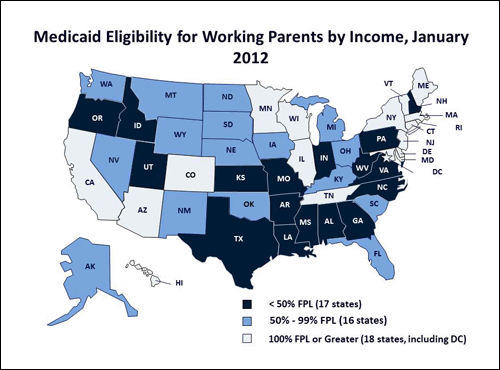
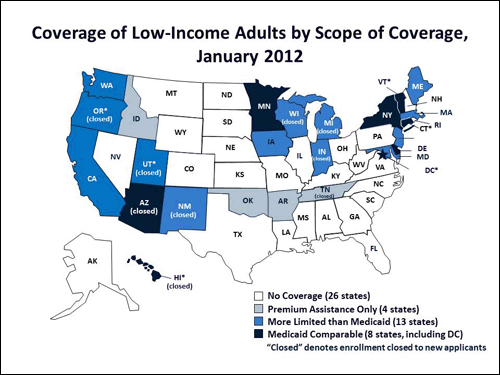
Survey data show that, to date, states have achieved significant success expanding Medicaid and CHIP coverage for children, but poor parents and other adults in many states remain ineligible for Medicaid (Figures 1 and 2). This reflects the fact that federal minimum Medicaid eligibility levels for parents are very low, and, prior to the ACA, states could not receive federal Medicaid matching funds to cover non-disabled adults without dependent children, regardless of their income.

Figure 1

8299_JumpStart_01_1.gif

NOTE: The federal poverty line (FPL) for a family of three in 2012 is $19,090 per year. Several states also offer coverage with a benefit package that is more limited than Medicaid to parents at higher income levels through waiver or state-funded coverage.SOURCE: Based on the results of a national survey conducted by the Kaiser Commission on Medicaid and the Uninsured and the Georgetown University Center for Children and Families, 2012.

Figure 2

8299_JumpStart_02_final.gif

NOTE: Map identifies the broadest scope of coverage in the state.  CT, DC, HI, & VT also offer coverage “more limited than Medicaid.” OR and UT also offer “premium assistance” with open enrollment.SOURCE: Based on the results of a national survey conducted by the Kaiser Commission on Medicaid and the Uninsured and the Georgetown University Center for Children and Families, 2012.

Because of their historic exclusion from Medicaid, states could only cover low-income adults by receiving a Section 1115 waiver of federal Medicaid rules or through a solely state-funded program. Moreover, if a state obtained a Section 1115 waiver to cover these adults, it could not receive additional federal Medicaid funds for this coverage—instead, it needed to redirect existing federal Medicaid funds or create program savings to offset the cost of the coverage expansion. Some states have expanded coverage through these avenues, but they often provide coverage that is more limited than Medicaid.

The ACA provided states a new option, effective April 2010, to receive federal Medicaid matching funds to cover adults with incomes up to 133% of the FPL to get an early start on the 2014 Medicaid expansion. States that expand coverage through the option must meet federal benefit and cost sharing requirements and cannot cap enrollment for eligible individuals. In addition, subject to federal approval, states may still expand coverage to adults through a Section 1115 waiver and are no longer restricted from receiving additional federal Medicaid funds for this coverage. A state might seek to expand coverage through a Section 1115 waiver instead of the ACA option to provide the coverage in ways that do meet other federal Medicaid rules, for example, by covering adults above 133% of the FPL, providing a more limited benefit package than otherwise allowed, or capping enrollment.

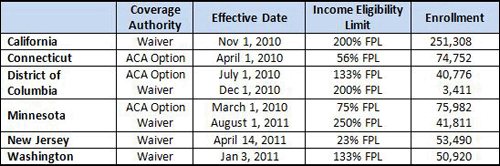
Since April 2010, six states (CA, CT, DC, MN, NJ, and WA) have expanded Medicaid to low-income adults through the new ACA option and/or Section 1115 waiver authority to help prepare for 2014 (Table 1). Together, these expansions cover nearly 600,000 adults. All six early expansion states previously covered some low-income adults through solely state- or county-funded programs. By moving this coverage to Medicaid and securing federal financing, these states were able to preserve and, in some cases, expand and strengthen coverage for low-income adults. In addition, these states are gaining key experience reaching, enrolling, and providing care to low-income adults that will help them prepare their outreach and enrollment processes and systems for 2014.

Table 1States Getting an Early Start on the Medicaid Expansion:Adult Expansions Between April 2010-March 2012

8299_JumpStart_03_larger.gif

Enrollment data notes/sources:CA: LIHP December 2011 Monthly Enrollment, www.dhcs.ca.gov/provgovpart/Documents/LIHP/Reports/EnrollmtLIHPDec11.pdfAll other data are based on communications with state officials. CT and DC data are as of Jan. 2012; MN and NJ data are as of Dec. 2011; WA includes data for Basic Health transition eligible enrollees as of January 2012 and Medical Care Services transition eligible enrollees as of November 2011, see http://www.hca.wa.gov/hcr/waiver.html

This recent action to expand Medicaid for low-income adults begins to build on the existing base of coverage for low-income parents and other adults. However, because this base remains limited in most states, the 2014 Medicaid expansion will be key for providing a coverage option for millions of uninsured adults who currently lack access to affordable coverage and to reduce disparities in coverage across states. States that are getting an early start on the expansion are not only strengthening coverage options for low-income adults today, but also are gaining key experience enrolling and providing care to these low-income adults that will help inform their and other states’ efforts to prepare for 2014.


An Update on CMS’s Capitated Financial Alignment Demonstration Model For Medicare-Medicaid Enrollees

Published: Apr 1, 2012

Beginning in January, 2013, the Centers for Medicare and Medicaid Services (CMS) will implement a three year multi-state demonstration to test new service delivery and payment models for people dually eligible for Medicare and Medicaid. These demonstrations will enroll full dual eligibles in managed fee-for-service or capitated managed care plans that seek to integrate benefits and align financial incentives between the two programs. On January 25, 2012, CMS issued a memorandum providing additional guidance for organizations interested in offering health plans in the capitated financial alignment demonstration. The guidance details the state demonstration approval and plan selection processes, compares existing Medicare and Medicaid managed care plan requirements, and sets out CMS’s preferred standards for the capitated financial alignment demonstration model.

This policy brief describes significant characteristics of CMS’s capitated financial alignment model, including information provided in the new guidance concerning financing, enrollment, provider network adequacy, medical necessity determinations, appeals, and quality and oversight. It also summarizes key dates in the state demonstration approval and plan selection processes, and an appendix describes CMS’s standards and conditions for the state demonstrations.

Policy Brief (.pdf)

Poll Finding

Kaiser Health Tracking Poll — April 2012

Published: Apr 1, 2012

The April poll gauged Americans’ opinions of the Affordable Care Act (ACA) in the wake of the Supreme Court oral arguments in the legal challenges to the health reform law in March.

The increased public attention to the Affordable Care Act generated by the Supreme Court’s consideration of the law did not meaningfully change the public’s opinion of the law overall or of the specific provision at the heart of critics’ legal case against it, the requirement that nearly everyone obtain health insurance. Forty-two percent say they have a favorable opinion of the law this month and 43 percent have an unfavorable one, a division virtually unchanged from March. Similarly, the individual mandate is as unpopular as it was in March, but not more so. Seven in ten Americans oppose this provision, including 53 percent of the public who say they hold “very unfavorable” views of it. Overall, half of Americans (51%) believe the court should rule the mandate unconstitutional, identical to March.

The Supreme Court challenge did appear to have an impact on Americans’ sense of familiarity with the ACA, however. In April three in four Americans (74%) report they are aware that the individual mandate is part of the health care law, up from 64 percent before the Court heard oral arguments last month. And the proportion who feels they understand how the law will impact them jumped to 51 percent, up 12 percentage points from March. Overall, half the public reported following news about the Court challenge at least fairly closely in April, up from 37 percent last March.

Although most Americans (63%) don’t expect to have to change anything about their health coverage when the mandate takes effect in 2014, nearly three in ten (28%) do believe they will have to make some change to their current insurance arrangements. Among the latter group, three times as many say they will be worse off (20%) as say they will be better off (6%) after making that change.

The proportion of the public expressing a high degree of confidence in the Supreme Court rose from 23 percent to 31 percent in the last month, driven by a big boost among Republicans, who overwhelmingly disapprove of the ACA and perhaps are responding to the tough questioning about the law by some of the justices.

There was a noticeable jump in the proportion of Americans saying that the justices’ analysis and interpretation of the law would play the most important role in their decision in the case: 30 percent say so in April, compared to 19 percent who said so last month. This vaulted this factor to the top of the list, above “whether the justices’ themselves hold liberal or conservative views,” which now ranks second, at 21 percent. Here, too, the change was driven primarily by Republicans.

The April poll is the latest in a series designed and analyzed by the Foundation’s public opinion research team.

Findings (.pdf)

Chartpack (.pdf)

Toplines (.pdf)

The Diversity of Dual Eligible Beneficiaries: An Examination of Services and Spending for People Eligible for Both Medicaid and Medicare

Published: Apr 1, 2012

This issue brief analyzes linked Medicare and Medicaid data to examine dual eligibles’ utilization and spending in both programs in 2007. As a group, dual eligibles are costly—with per capita Medicare and Medicaid spending over four times Medicare spending for other beneficiaries. However, a small share of dual eligibles account for most of the group’s spending, and dual eligibles who are high cost to the Medicare program are generally not the same individuals who are high cost to the Medicaid program. The new analysis has important implications for efforts to integrate benefits and align financing for dual eligibles.

Issue Brief (.pdf)

A shorter version of this analysis was published in Health Affairs.

Previous version:

April 2009 (.pdf)