Visualizing Health Policy: Medicare’s Role and Future Challenges

Published: Nov 28, 2012

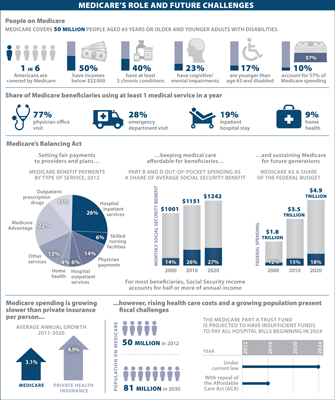
November 2012 infographic in the Visualizing Health Policy series takes a look at Medicare—who it covers; the services its beneficiaries use; and the balance policymakers must strike between setting fair payments, keeping care affordable, and sustaining the program for future generations.

VHP_Medicare_Thumbnail

See the full-size infographic at The Journal of the American Medical Association

View the related Slideshow

Visualizing Health Policy is a monthly infographic series produced in partnership with the Journal of the American Medical Association (JAMA). Each month’s infographic is freely available on JAMA’s website and is published in the print edition of the journal.

JAMA Forum: Key Decisions Loom for States About the Health Care Law

Published: Nov 28, 2012

“Key Decisions Loom for States About the Health Care Law,” Larry Levitt’s November 2012 post for The JAMA Forum, is now available online.

News Release

AIDS Is a Deeply Personal As Well As Societal Concern for Young Americans of Color

Published: Nov 27, 2012

Survey finds Black and Latino Youth “Very Concerned” about Impact of HIV on Themselves and Others Their Age; Black Youth Most Likely to be Offered and to Get a Test for HIV

Menlo Park, Calif. – Nearly three times as many Black teens and young adults, and twice as many Latino youth, say HIV/AIDS is an issue that concerns them personally as compared to whites the same age, according to a new Kaiser Family Foundation survey of 15-24 year olds in the United States.

One in two (49%) Black youth say they are “very concerned” personally about HIV/AIDS today, another 21 percent say they are at least “somewhat concerned;” by comparison, only a third of whites express any personal concern (17% “very” and 18% “somewhat”). Latinos of the same age fall in the middle with 32 percent saying they are “very concerned” personally, and another 16 percent, “somewhat concerned.”

Three in four youth today say HIV/AIDS is a serious issue for their generation (44% “very” and 34% “somewhat”). As with personal concern, young people of color – those from communities that have been disproportionately affected by the disease – are more likely to see HIV/AIDS as a significant issue for others their age. Twice as many Black (62%) and Latino youth (61%) say HIV/AIDS is “very serious” issue for their generation, as compared with whites of the same age (32%).

These differences correspond with the disproportionate affect HIV/AIDS has had on minorities, especially Black Americans, who account for nearly half of new infections in the U.S. today, while representing just 13 percent of the population. Latinos, in particular young gay men, are also among those at greatest risk.

“For many young Americans, especially youth of color, HIV/AIDS is not just a societal issue, but also a deeply personal one,” said Tina Hoff, Senior Vice President and Director, Health Communication & Media Partnerships, Kaiser Family Foundation. “The survey provides hope that young Americans can be engaged, finding that over half say they see themselves as having a role in ending HIV/AIDS.”

While young people are concerned about HIV/AIDS and its effect both on themselves personally as well as for their generation, most appear to have a generally realistic understanding of HIV/AIDS today. Most agree – 25 percent “strongly” and 54 percent “somewhat” – that “it is possible for people with HIV to live healthy, productive lives.”

Stigma Persists as Barrier to Overcome

More than 30 years since the first case of AIDS was diagnosed, one in three (33%) young people say there is still “a lot” of stigma around HIV/AIDS in the U.S., and another 51 percent say there is at least “some.” When asked about their own feelings about HIV, a majority say they would be “comfortable” having a close friend who is HIV-positive (58%) or working with someone who is positive (54%), yet 62 percent say they would be uncomfortable having a roommate who is positive and 86 percent say they would be uncomfortable being in a relationship with someone who is positive.

Acknowledging the gaps in their knowledge and understanding of the disease, many young people say there is more they need to know about HIV/AIDS, including even the most basic facts. A third (36%) say they would like more information about “how to prevent the spread of STDs, including HIV,” about as many as say they would like to know more about who should get tested (35%) and how to talk about testing (34%) and protection (27%) with a partner. Young people of color (54% of Blacks and 61% of Latinos) are more likely than whites (34%) to say that they would like to know more about any of the topics asked about. Younger teens, those ages 15-17 (53%), are more likely than young adults, ages 18-24 (40%), to say they want more information.

Black Youth More Likely to be Offered and to Get Tested

One in three (34%) sexually active young people – and 20 percent of all 15-24 year olds – say they have been tested for HIV. Black youth are twice as likely to report having been tested than whites (50% vs. 25% among those who report having had sex). A third (36%) of Latinos the same age who report having had sex say they’ve been tested. At least some of the young people who say they’ve been tested may be mistaken, as 24 percent said they did not actually discuss it, but rather just assumed it was included with other tests or was a routine part of the exam. Most (65%) of those who say they have been tested for HIV indicate it was part of another health visit; 21 percent say they went specifically to get tested.

For about half (48%) of those who report being tested for HIV, having their health care provider recommend they do so was a motivator in their decision. Yet few health care providers seem to be suggesting testing to their younger patients. Only 21 percent of sexually-active young people – and 13 percent of youth overall – say a health care provider has ever suggested they be tested for HIV. Black sexually active youth are significantly more likely to report having had a test suggested by a health care provider (48%) than whites (13%) or Latinos (21%). For those who report being sexually active but say they have not been tested, the most often cited reason is not believing themselves to be at risk (64%). The next most common response was because their doctor had not suggested it (41%), reinforcing the role of health care providers in testing decisions.

View of the Future and Their Role in It

At a time when many experts are saying an AIDS free future is within reach scientifically, most young people – 74 percent –say they are not overly optimistic about the prospects of seeing the end of AIDS in their lifetime. But, there is hope they can be engaged.

When asked what, if any, role they might play in realizing this potential, most say they see at least some role for themselves with 14 percent saying they see themselves having “a big role” and another 45 percent saying they have “a small role” in helping to end AIDS. Black youth are more likely to see an opportunity to make a difference. One in four (25%) Black young people say they have “a big role” to play in achieving this goal, and another 45 percent see at least some role.

On World AIDS Day – December 1st – I’m Positive, a new documentary special developed with the Kaiser Family Foundation that explores what it means to be young and HIV positive in America today, will debut on MTV (7 p.m. ET/6 p.m. CT). Produced by Lauren Dolgen, the award-winning creator of MTV’s 16 & Pregnant and Teen Mom, together with Dr. Drew Pinsky, the one-hour show follows the lives of Kelly, Otis and Stephanie, three young Americans living with HIV in 2012. From the challenges they face to their hopes for the future, the show provides an up-close and personal look at HIV/AIDS.

I’m Positive is presented by GYT: Get Yourself Tested, a campaign to encourage testing for STDs, including HIV. GYT is produced as part of a 15-year public information partnership between the Kaiser Family Foundation and MTV to address sexual health issues facing young people. Gilead Sciences provided funding for the production.

Whether positive or negative, the show encourages all young people to consider their role in ending AIDS. For more information visit: gytnow.org

Methodology

The poll, designed and analyzed by public opinion researchers at the Kaiser Family Foundation, was conducted Sep. 21 ‐ Oct. 1, 2012 among a nationally representative online sample of 1,437 youth ages 15-24 living in the United States. The margin of sampling error for the full sample is plus or minus 4 percentage points. For results based on subgroups, the margin of sampling error may be higher.

The National Survey of Teens and Young Adults on HIV/AIDS, including a chart pack and the full question wording and methodology of the poll, can be viewed online.

The Kaiser Family Foundation, a leader in health policy analysis, health journalism and communication, is dedicated to filling the need for trusted, independent information on the major health issues facing our nation and its people. The Foundation is a non-profit private operating foundation, based in Menlo Park, California.

###

News Release

Report Finds State Costs of Implementing The Affordable Care Act’s Medicaid Expansion Would Be Modest Compared to Increases in Federal Funds, and Some States Would See Net Savings

Published: Nov 26, 2012

Washington, D.C. – A new report released today by the Kaiser Family Foundation shows modest state costs for implementing the Medicaid expansion under the Affordable Care Act compared to significant increases in federal funds, allowing some states to see net budget savings even as millions of low-income uninsured Americans gain health coverage.

The new, updated analysis, conducted by John Holahan, Matt Buettgens, Caitlin Carroll and Stan Dorn at the Urban Institute for the Foundation’s Commission on Medicaid and the Uninsured, shows that if all states were to expand their programs, state Medicaid spending nationally would rise by $76 billion from 2013 to 2022, an increase of less than 3 percent, while federal Medicaid spending would increase by $952 billion, or 26 percent. As a result, an additional 21.3 million individuals could gain Medicaid coverage by 2022 and, together with other coverage provisions of the ACA, that would cut the uninsured by almost half (48%).

“States are deciding whether to expand the Medicaid program, and they clearly will be balancing improvements in coverage against new costs for states,” said Diane Rowland, executive vice president of the Foundation and executive director of the Kaiser Commission on Medicaid and the Uninsured. “While some states will see net savings, others will need to weigh the trade-offs between small increases in state spending in return for large gains in coverage supported by mostly federal dollars.”

As with all of Medicaid, the coverage and budget impacts of the Medicaid expansion would vary across states. States that had already expanded coverage to adults – such as Vermont, Massachusetts, New York, Maine, and Maryland – may see savings under the ACA due primarily to higher matching rates for already covered populations. Meanwhile states with relatively large uninsured populations prior to any coverage expansions – including Nevada, Florida and Mississippi – are likely to see higher increases in state costs, but these increases are expected to be small relative to decreases in the uninsured and increases in federal matching funds.

The report provides key data for state officials to consider in light of the June Supreme Court ruling that effectively made the ACA’s expansion of Medicaid eligibility a state option. The ACA set a national floor for Medicaid eligibility for adults with annual incomes at or below 138 percent of the federal poverty level, which is $15,415 for an individual in 2012. The analysis also points out that Medicaid enrollment and spending is expected to rise even in states that elect not to expand coverage. That is because other ACA provisions, including the requirement to simplify enrollment and the implementation of the exchanges, are expected to increase Medicaid enrollment of some adults and especially many children who are already eligible for the program but not yet enrolled. States may want to factor the costs of the currently eligible population into their calculations as they weigh the costs and benefits of undertaking the Medicaid expansion to newly eligible individuals. For states that do adopt the expansion, they will see significant increases in coverage with limited incremental state costs and will see large increases in additional federal funds.

If coverage is expanded, states can expect to see declines in uncompensated care costs tied to spending on hospital care for people without insurance. If all states adopted the Medicaid expansion, it is estimated that states could save $18 billion from 2013-2022. That would help to further mitigate the incremental costs of implementing the Medicaid expansion, particularly for states in the South, which tend to spend more on uncompensated care relative to their current spending on Medicaid than do states in other regions.

We limited this analysis to data available for all 50 states and the District of Columbia, so we were unable to estimate several potential sources of state fiscal gain from the Medicaid expansion including increased federal matching rates for current-law beneficiaries other than those covered through 1115 waivers or limited benefit programs; reduced state spending on non-Medicaid health care previously for uninsured populations (like mental health and substance abuse services), as well as additional revenue state revenues tied to economic activity that would result from increased federal Medicaid dollars being spent within the state. If these factors were taken into account, more states could realize net fiscal gains.

More data on how individual states are expected to be affected by the ACA’s Medicaid expansion, as well as a discussion of the methods underlying this analysis, can be found in the full report online.

The Kaiser Family Foundation, a leader in health policy analysis, health journalism and communication, is dedicated to filling the need for trusted, independent information on the major health issues facing our nation and its people. The Foundation is a non-profit private operating foundation, based in Menlo Park, California.

The Kaiser Commission on Medicaid and the Uninsured provides information and analysis on health care coverage and access for the low-income population, with a special focus on Medicaid’s role and coverage of the uninsured. Begun in 1991 and based in the Kaiser Family Foundation’s Washington, D.C. office, the Commission is the largest operating program of the Foundation. The Commission’s work is conducted by Foundation staff under the guidance of a bipartisan group of national leaders and experts in health care and public policy.

News Release

MTV and Dr. Drew Team Up To Document The Lives of Three HIV Positive Young People In “I’m Positive” Premiering On World AIDS Day

Published: Nov 20, 2012

60-Minute Special Spotlights the Reality of Living with HIV as Part of MTV’s 15-Year Public Information Partnership with the Kaiser Family Foundation; Dr. Drew to Host After-Show Discussion with Cast on MTV.com Tweet It: New special from @MTV, @DrDrew, @LoBosworth and @OctagonEnt to air on World AIDS Day at 7pm ET/PT, focus on young adults with HIV

New York, N.Y.MTV today announced that the network will air “I’m Positive,” a 60-minute special produced by DrDrew Productions and Octagon Entertainment on World AIDS Day, December 1, 2012 at 7:00 p.m. ET/PT, with a simulcast on MTV Tr3s. “I’m Positive” goes inside the lives of three young people from around the country who are HIV positive. Although each faces struggles that are part of living with this virus, they all work to maintain a positive outlook on life, while taking steps to remain healthy and to stop the spread of HIV. Click here to watch a sneak peek scene of the special.

Presented under the “GYT: Get Yourself Tested” campaign, which is part of MTV’s 15-year public information partnership with the Kaiser Family Foundation, ”I’m Positive” dispels common myths and stereotypes associated with HIV.

“I’m honored to team with MTV to shine a spotlight on the important topic of young people living with HIV/AIDS,” said Dr. Drew. “Through accurate portrayals and powerful storytelling, ‘I’m Positive’ will raise awareness, decrease stigma and hopefully enhance healthy behaviors.”

”If an AIDS free future is to be achieved, as many experts now say is possible, this generation of young people must be involved,” said Tina Hoff, Senior Vice President and Director, Health Communication & Media Partnerships, Kaiser Family Foundation. “’I’m Positive’ builds on our partnership with MTV to engage and inform young people on the critical issues in their lives, which includes preventing the spread of HIV/AIDS.”

“I’m Positive” will document the powerful stories of Kelly from California, Otis from Texas and Stephanie from North Carolina:

Kelly is a true California girl – she’s laid-back, funny, artsy, and loves hanging out with her friends. Kelly is also HIV positive. For six months now, she’s been dating Aaron, who is HIV negative. Their relationship moved fast, and has been increasingly rocky. They are now trying to figure out the next step – whether that’s breaking up or staying together.

Stephanie is a confident, single Southern belle who found out that she was HIV positive when she was just 19 years old. She contracted the virus after having unprotected sex just once with a partner. While HIV is a part of her daily life, it doesn’t define who she is – she still struggles with the everyday challenges of relationships with family and friends.

As the oldest child in a large, close-knit family, Otis feels like he has to set an example for his younger siblings. That’s why it was hard for him to tell his family he is HIV positive, after having just come out as gay the year before. Currently, Otis is in a serious relationship with his boyfriend, Kanjhe, and they are both committed to making sure that he stays HIV negative.

“I’m Positive” will be followed by an After-Show special hosted by Dr. Drew, which will air exclusively on MTV.com. In the special, Dr. Drew will sit down with Kelly, Otis and Stephanie in front of a small studio audience to discuss their experiences living with HIV and dive deeper into how young people can protect themselves.

Two in five new HIV infections occurring in the U.S. each year are among people ages 13-29. Of the more than 1.1 million Americans living with HIV today, one in five is unaware that they are infected. The U.S. Centers for Disease Control also reports that only one in four of those who are positive in the U.S. has their virus “under control.” Early diagnosis and treatment saves lives and helps to prevent the spread of HIV. To take action, young people can head to GYTNOW.org or text their zip code to GYTNOW (498669) to locate a local testing center near them.

“I’m Positive” encourages all young people – whether HIV positive or HIV negative – to consider their role in ending HIV in the U.S. An extensive complementary social media campaign from MTV and its partners in the lead up to and during the show encourages young people to consider what they can do to promote change in their lives, specifically emphasizing five core actions: being informed; speaking out; using protection; getting tested; and getting into care and staying on treatment for those who are positive. Throughout the special, MTV will continue the conversation by promoting the hashtag “#positivetalk,” which is meant to ignite a dialogue around the role that young people can play in an AIDS free future. “I’m Positive” will be promoted on MTV’s Twitter, tumblr and Instagram pages.

GYT was launched in April 2009 as part of a longstanding partnership between MTV and the Kaiser Family Foundation on sexual health issues, “It’s Your (Sex) Life,” which was created in response to the staggering rate of sexually transmitted diseases (STDs) among young people in the U.S. Through a cross-platform national media campaign and community outreach, GYT seeks to reduce the spread of STD’s among those under 25 by providing information, encouraging more open communication, and promoting testing and treatment as needed. GYT is conducted together with the U.S. Centers for Disease Control and Prevention and Planned Parenthood Federation of America. Gilead Sciences, Inc. provides additional financial support.

For more on “I’m Positive,” as well as information about HIV/AIDS, and to find local testing services, go to ImPositive.mtv.com. The show and a complementary viewing guide, in addition to other resources, will be made available after air for educational use.

Additionally, “I’m Positive” will feature the song “Can’t Hold Us” by Macklemore & Ryan Lewis. The duo’s music is distinct for channeling cultural moments and refreshingly self-aware testimony through candid lyricism and expertly crafted production. Their work has captivated listeners around the world, with a combined total of 20 million views on YouTube and a passionate fan following on social media.

“I’m Positive,” is executive produced by Dr. Drew Pinsky, Howard Lapides, David Stanley, John Ferriter Siobhan Walshe and Lauren Bosworth. Lauren Dolgen, James DeSimas and Jennifer Russakoff are the MTV executives in charge. The concept is by Lauren Bosworth, John Ferriter and David Stanley.

The Kaiser Family Foundation provided substantive guidance. Funding for “I’m Positive” and related elements is provided by Gilead Sciences, Inc.

About MTV:MTV is the world’s premier youth entertainment brand. With a global reach of more than a half-billion households, MTV is the cultural home of the millennial generation, music fans and artists, and a pioneer in creating innovative programming for young people. MTV reflects and creates pop culture with its Emmy®, Grammy® and Peabody® award-winning content built around compelling storytelling, music discovery and activism across TV, online and mobile. MTV’s sibling networks MTV2 and mtvU each deliver unparalleled customized content for young males, music fans and college students, and its online hub MTV.com is a leading destination for music, news and pop culture. MTV is a unit of Viacom Inc. (NASDAQ: VIA, VIAB), one of the world’s leading creators of programming and content across all media platforms. For more information, go to www.mtvpress.com.

About The Kaiser Family Foundation: The Kaiser Family Foundation, a leader in health policy analysis, health journalism and communication, is dedicated to filling the need for trusted, independent information on the major health issues facing our nation and its people. The Foundation is a non-profit private operating foundation, based in Menlo Park, California.

About Octagon Entertainment:With over 60 combined years of major Hollywood talent agency experience, the Octagon Entertainment team has been responsible for the packaging and representation of more than 150 television series and specials, as well as major film and radio work. Together with its history of directing the careers of some of the world’s biggest hosts, presenters, talent, and comedians, Octagon Entertainment has become one of the true 360° entertainment companies in the industry.

About DrDrew Productions: DrDrew Productions is a Los Angeles–based joint venture between Dr. Drew Pinsky and his longtime manager and production partner Howard Lapides, focusing on high-quality reality television projects and expanding the Dr. Drew brand of “always making a difference.” Following closely on the heels of VH1 pilot “Estranged with Dr. Drew” and “Lifechangers with Dr. Drew,” I’m Positive” is the first DrDrew Production in association with Octagon Entertainment Productions, reuniting several members of the creative team responsible for the long- running MTV hit series “Loveline.”

###
Medicare Part D Prescription Drug Plan Availability in 2013

Published: Nov 19, 2012

This fact sheet contains 2013 state-specific summary data about available Medicare drug benefit options, including premium ranges and the number of plans available at no cost to qualifying beneficiaries.

Fact Sheet (.pdf)

The Role of Medicaid for Adults With Chronic Illnesses

Published: Nov 16, 2012

This report and related fact sheets provide data on spending, utilization, and access to care among low-income nonelderly adult Medicaid beneficiaries with chronic illnesses. Four fact sheets provide detail for beneficiaries with diabetes, respiratory disease, cardiovascular disease, and behavioral health conditions

The reports show that, despite relatively high prevalence of chronic conditions and, correspondingly, relatively high spending and utilization rates, Medicaid beneficiaries with chronic illness report better access to care than their uninsured counterparts, many of whom may become eligible for Medicaid under the Affordable Care Act. Understanding the current and future role of Medicaid for adults with chronic illness can aid policymakers in designing programs to efficiently and effectively meet the needs of enrollees.

Overview: The Role of Medicaid for Adults with Chronic Illnesses (.pdf)

Fact Sheets:

The Role of Medicaid for People with Diabetes (.pdf)

The Role of Medicaid for People with Respiratory Disease (.pdf)

The Role of Medicaid for People with Cardiovascular Diseases (.pdf)

The Role of Medicaid for People with Behavioral Health Conditions (.pdf)

The Budget Control Act of 2011: Implications for Medicare

Published: Nov 13, 2012

Beginning January 2013, Medicare spending will be subject to automatic, across-the-board reductions, known as “sequestration,” which is slated to reduce Medicare payments to plans and providers by up to 2 percent. This sequestration results from provisions in the Budget Control Act of 2011, which raised the debt ceiling and will reduce net federal spending by $2.1 trillion over ten years. The Act was a bipartisan compromise negotiated between the Administration and Congressional leaders, just before the nation was to breach the debt ceiling.

The Budget Control Act set forth a process to reduce federal spending and established a Joint Select Committee on Deficit Reduction, known as the “Super Committee”, which failed to reach a bipartisan agreement. As a result, the Act required automatic reductions in spending, beginning in 2013. This sequestration is projected to reduce Medicare spending by $11 billion in Fiscal Year 2013.

This updated brief provides an overview of the Budget Control Act and describes the timeline and process for raising the debt ceiling and lowering the federal deficit. It also describes the role of the Joint Select Committee on Deficit Reduction, how Medicare spending could have been affected by changes proposed by the Committee, and how it could be affected by sequestration.

The brief is a product of the Kaiser Project on Medicare’s Future, which focuses on producing timely analysis of leading reforms affecting people on Medicare.

Issue Brief (.pdf)