KFF designs, conducts and analyzes original public opinion and survey research on Americans’ attitudes, knowledge, and experiences with the health care system to help amplify the public’s voice in major national debates.
If you or someone in your family has a pre-existing health condition – such as heart disease, asthma, or even a pregnancy – you will find it much easier to obtain coverage or change plans starting in 2014. Obamacare bars insurers from denying coverage to people with pre-existing conditions, or physical or mental illnesses or conditions that existed before coverage began. Insurers also can no longer refuse to pay for otherwise-covered medical care and services due to a pre-existing condition or charge you more because of a pre-existing condition in the family.
What’s Covered
If you don’t have insurance or want to change plans, you can shop for a new plan in the individual insurance market or on your state’s new health insurance marketplace (or exchange). These plans will cover doctor visits, hospitalization, prescription drugs and maternity care without any restrictions for pre-existing conditions. They will cover preventive services like immunizations, screenings and contraception at no expense to you. You will not have to give your detailed health or medical history to apply. The marketplaces will allow you to compare plans and prices. The open enrollment period for your state’s marketplace will run from Oct. 1 through March 31. Coverage begins on Jan. 1, 2014.
Types of Plans
Plans both in and out of the marketplace will come in four levels – bronze, silver, gold and platinum – that will vary in what they cover, what they charge in premiums and what deductibles and other out-of-pocket costs they require. But these plans cannot charge you more based on your medical history. Insurers can only vary their premiums based on your age, the number of people in your family covered by the policy and whether you use tobacco.
Help with Premiums
If you buy a policy through your state’s marketplace, you may also be eligible for financial assistance to help cover the cost. In general, you may be eligible if you are a single person with an annual income in the range of $11,500 to $46,000, or if your household income is in the range of $19,500 to $78,000 for a family of three. The range will differ for families of different sizes. Use the Kaiser Family Foundation’s online calculator to get a rough estimate of the premiums and subsidies available to you. People with lower incomes who buy coverage through the marketplaces also may have their deductibles and other out-of-pocket costs reduced. If your income is lower, you may be eligible for coverage through Medicaid.
Other Options
Obamacare established a temporary program in 2010 to offer coverage to people with pre-existing conditions. If you have coverage through the Pre-existing Condition Insurance Plan in your state, you can remain enrolled through the end of January 2014, but are encouraged to get coverage in your marketplace as soon as possible.
If you currently have insurance you purchased on your own (and not through an employer), then the plan may be exempted from the law’s requirements about pre-existing conditions. However, you can still drop that coverage and buy one under the new rules.
Questions
The federal government has set up a toll-free 24-hour hotline – 1-800-318-2596 – to answer consumers’ questions. To find out more about Obamacare visit www.healthcare.gov.
This fact sheet is also available in Spanish: en español.
If you are now covered by job-based health benefits through your (or a family member’s) employer, then you likely can keep that coverage and will not have to make any changes. In most cases, your employer coverage will satisfy the law’s requirement that you obtain insurance.
Changes to Employer Coverage
Some features of your employer coverage may already have changed as a result of the law. For example, if you are a parent, your children may now stay on your policy until they reach age 26.
Your plan also now likely covers preventive services like immunizations and screenings at no cost to you, though some employer plans in place in 2010 are exempted from this requirement.
Beginning in 2014, your plan cannot set an annual dollar limit on your benefits that could leave you without coverage if you get seriously ill. Your plan also can no longer limit anyone’s coverage for pre-existing conditions. Your plan also can no longer limit the total dollar amount of benefits you may receive over your lifetime. Employer plans are also required to limit the amount of cost sharing (such as deductibles and co-pays) that you are required to pay for covered services to $6,350 per person per year. This provision will take full effect in 2015.
In some cases, your employer may need to change your health benefits to meet the law’s requirements. For instance, if you currently get only bare-bones coverage through your employer — such as help paying for routine doctor visits, with little or no coverage for hospitalization of other serious illnesses — that coverage can no longer be offered in 2014. Your employer may decide to offer more comprehensive coverage, as most employers already do, or your employer may decide not to offer any coverage to its workers.
Employer Mandate
The law encourages employers to offer health insurance. Large employers — those with at least 50 full-time workers (or the equivalent in part-time workers) may face penalties if they do not offer affordable coverage to full-time workers. These penalties will begin in 2015, a year later than originally called for in the law. Smaller employers — those with 50 or fewer full-time workers — are not required to offer coverage, but may get tax credits if they do.
If your employer offers coverage that is too costly for you to afford based on your income, you may want to buy coverage through the new health insurance marketplace (or exchange) in your state instead. The marketplaces are like an online store for people buying their own health insurance and would allow you to compare plans based on price and other factors. You may qualify for tax credits to purchase this coverage if your employer does not offer you coverage that meets the law’s requirements and your household income falls below a certain level — about $46,000 for an individual or $78,000 for a family of three. If your income is very low (less than about $16,000 for a single individual) you might also qualify for coverage under Medicaid.
Questions
The federal government has set up a toll-free 24-hour hotline – 1-800-318-2596 – to answer consumers’ questions. To find out more about Obamacare, visit www.healthcare.gov.
This fact sheet is also available in Spanish: en español.
Obamacare and You is a series of one-page papers explaining how the Affordable Care Act, also known as “Obamacare,” will affect different groups of people. Click on the links below to learn more:
The Kaiser Family Foundation partnered with NBC News to ask several survey questions of the U.S. public about their feelings towards the 2010 health care law, as well as their worries about affording health care more generally. These questions were asked as part of the September 2013 Kaiser Health Tracking Poll.
As the clock counts down on open enrollment and the rollout of the major provisions of the Affordable Care Act (ACA), in the latest Kaiser Health Tracking Poll we asked people who say they don’t have enough information about the law (51 percent of the public overall) what their top questions are about the ACA. Their top two answers: they want more information about how much the law will cost them and how it is paid for; and they want an easily digestible summary of what the law is and how it works. At the same time that they report the need for basic information, most people say news coverage of the law is focused on politics and controversies rather than the impact on people, and more report seeing advertising that makes arguments in favor or against the ACA rather than providing practical information about the law and how to get coverage. Views of the law overall remain split, tilting negative, and those with an unfavorable view mostly want opponents to continue their efforts to repeal the law or stop it from being implemented, though a few say it’s time to accept that it’s the law and move on. At the same time, a majority of the public continues to disapprove of cutting off funding as a way to stop the law’s implementation. Views continue to divide sharply along partisan lines, and the share of Democrats with a positive view – which had been slightly lower throughout 2013 – has rebounded by 8 percentage points this month to two-thirds, closer to levels seen in 2011 and 2012. Among Republicans, those who identify with the Tea Party are much more likely than those who don’t to feel “very unfavorable” about the law, support defunding, and say opponents should continue their efforts to block it.
While policy watchers have been counting down the days until open enrollment in the ACA’s new health insurance marketplaces, just one in eight of the uninsured know that the exchanges open for business on October 1. Public awareness of many of the law’s key provisions has not increased since 2010, and some stubborn misperceptions persist. Finally, as rollout of many of the ACA’s major provisions begins, eight in ten of the uninsured, as well as over half of those with insurance, say they have skipped or postponed some type of health care in the past year due to cost. About half of those with insurance also report experiencing a variety of problems with their current insurance, such as misunderstandings about coverage, problems with billing, and delays or denial of treatment.
Public’s Biggest Questions About ACA Center On Costs and the Need for Basic Information
As has been true since the ACA was passed, the latest Kaiser Health Tracking Poll finds that about half the public (51 percent), and two-thirds of the uninsured (67 percent) continue to say they don’t have enough information about the law to know how it will impact their families. When those who say they don’t have enough information are asked what one question they would like to have answered about the law, the most common responses have to do with costs and what people will have to pay (mentioned by 19 percent of those who say they don’t have enough information) – followed by the need for basic information about what the law is and how it works (18 percent). Other common questions have to do with how the law will improve the health care system (7 percent), the impact on specific groups such as the uninsured or young people (6 percent), general questions about how people will personally be impacted (5 percent), and questions about coverage and benefits (5 percent). Among the uninsured, the mix of questions is similar to those among the public generally.
FIGURE 1: IN THEIR OWN WORDS
Among the 51% who say they don’t have enough information about the law to understand how it will impact their families: What ONE question would you most like to have answered to help you understand how the health care law will impact you and your family? (Open-ended)
Questions about cost/How much will I have to pay/How is the law paid for? – 19%
“How am I supposed to afford this financially?”
“I am having a problem with medication costs. How would this new law help?”
“Will the medical insurance be free or will I have to pay?”
“Is it going to lower the cost for the average person in the long run?”
“How is it going to be sustainable?”
“Who is paying for the health care program?”
“How is the cost of insurance going to be regulated so that I would only pay what I could afford?”
“Why is my company stating that our insurance rate will go up?”
Need a general, easy summary, what is it and what will it do/How does it work? – 18%
“Better clarify what it will really means to each American.”
“Can you just put it in plain laymen language so we can understand what you’re doing for us?”
“I would like to have a non-partisan generated package. I’d like to have the facts rather than a politicized editorial.”
“I would like to know more specifics about the law, [such as] where to go to read the law.”
How will the law make the health care system better/Who benefits (most)? – 7%
“What does it make better and how is it better than the old law?”
“Who really benefits from it?”
What impact will it have on a specific group (uninsured, young people, undocumented, Seniors) – 6%
“How will it affect the middle class working people? Will we be better off or worse off?”
“How will it affect those already retired?”
“What will happen to all of us who don’t have papers in this country?”
How will it impact me/my family? – 5%
“Am I going to get better services?”
“How is my care going to change?”
“How it would impact me being age 21 personally?”
Questions about benefits, coverage, or available plans – 5%
“Does it take care of major illnesses?”
“I do not understand the limits on benefits. What does it cover?”
How will the law impact my current insurance arrangements? – 4%
“How is it going to change my health insurance that my employment pays for? Am I going to have to pay for insurance?”
“I would like to know if I can maintain my health care insurance exactly as it is now.”
Other
“What happens if we’re unable to afford it? I’ve heard we can go to jail.”
“Who is eligible for health care under the health care law, specifically if they [do] not have a source of income?”
“Will it change my Medicare?”
“If it is so good why is Congress not subject to this law?”
“How is this constitutional?”
“How does it affect business owners? Do we have to buy or provide [insurance] for employees?”
“Are the end of life panels included in the health care law and what is their purpose?”
Public Says Media Coverage And Ads More About Politics Than Practical Info Or Impact On People
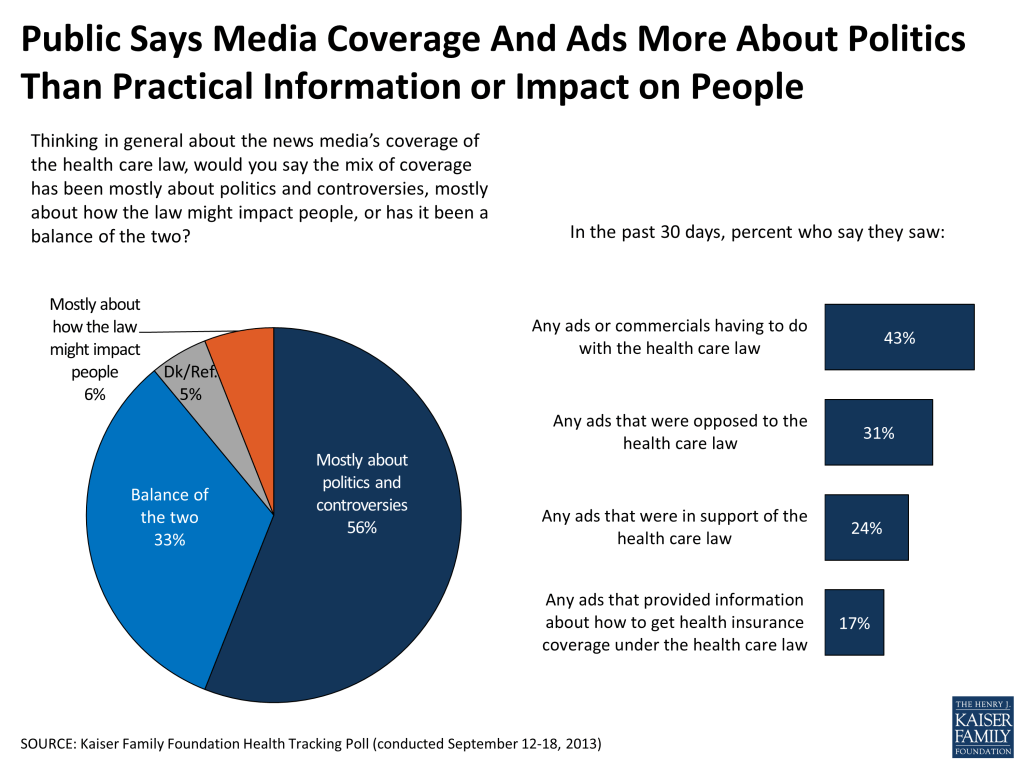
At the same time that much of the public reports a need for basic information on the ACA, a majority (56 percent) say the news media’s coverage of the law has been focused on politics and controversies, while very few (6 percent) say coverage has been mostly about how the law will impact people. A third say it’s been a balance of the practical and the political. Similarly, when it comes to advertising about the law, people are more likely to report seeing ads that are opposed to the law (31 percent) or in favor of it (24 percent), rather than those that provide information about how to get coverage (17 percent).
Figure 2
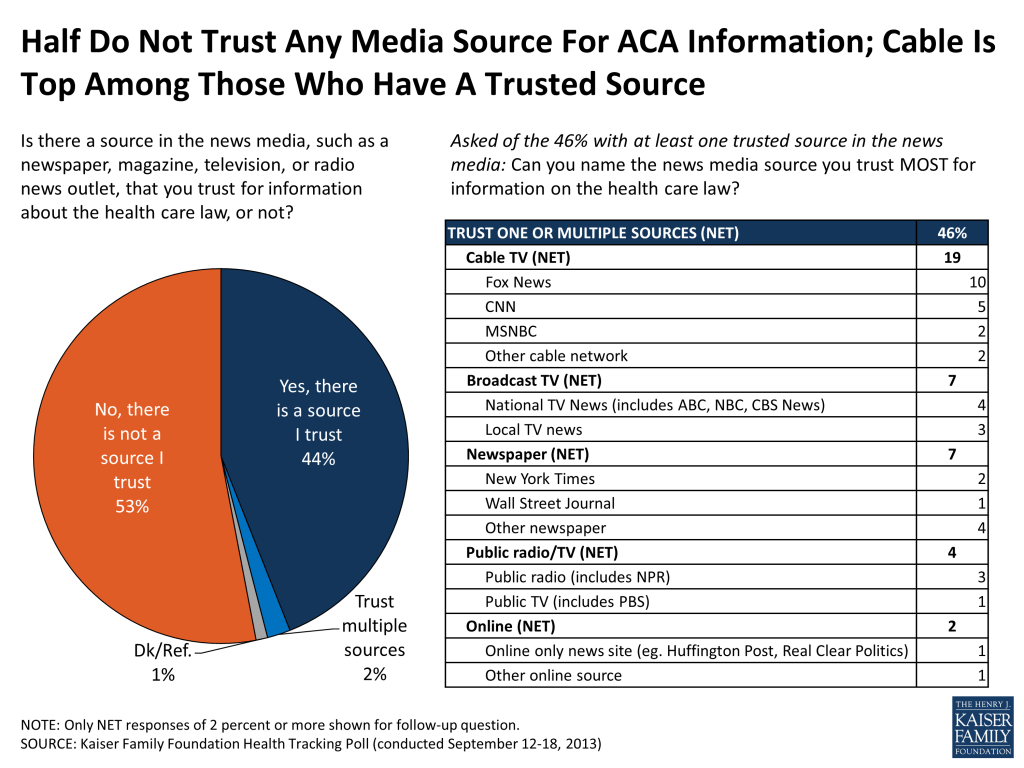
When asked to name a source in the news media that they trust for information about the health care law, more than half (53 percent) say they don’t trust any source, while 46 percent say there is at least one news media source they find trustworthy. Cable TV networks top the list of trusted sources (including 10 percent who name Fox News and 5 percent who name CNN), followed by broadcast TV news (7 percent) and newspapers (7 percent).
Figure 3
Overall Opinion on the Law Remains Divided, Tilting Negative, but a Majority Disapprove of Defunding
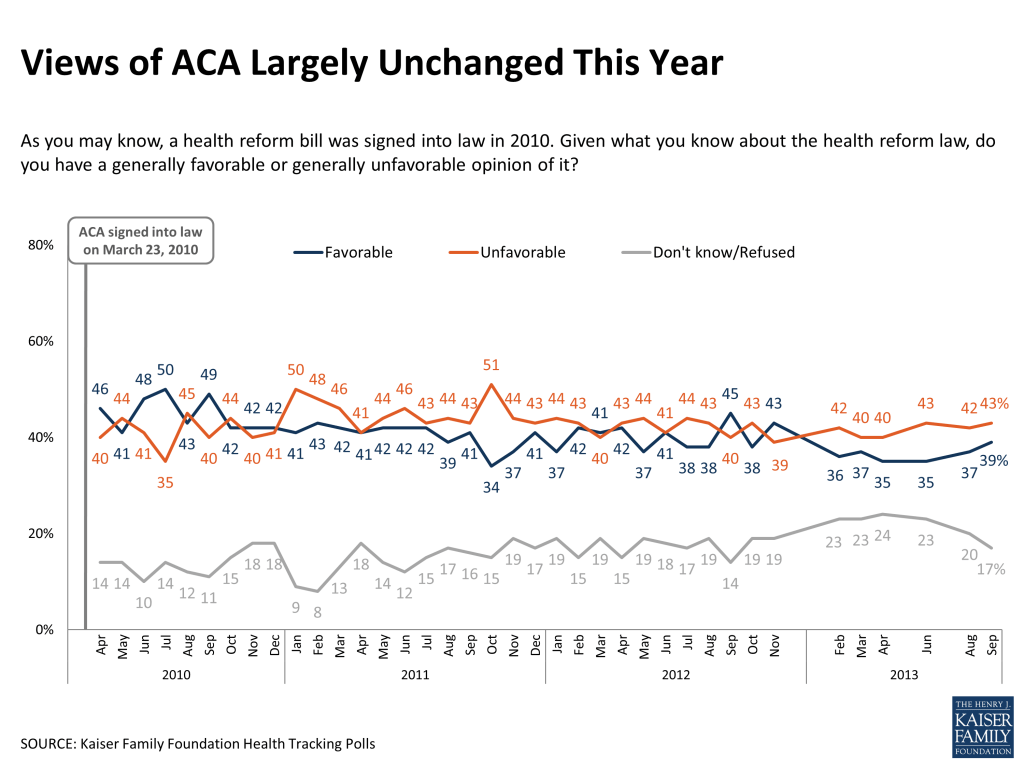
The public’s overall view of the ACA in September looks much like it has throughout 2013, with 43 percent expressing an unfavorable view of the law, 39 percent holding a favorable view, and 17 percent declining to offer an opinion.
Figure 4
Among those with an unfavorable view of the law, the large majority (representing 35 percent of the public overall) say opponents should continue their efforts to either repeal it or stop it from being implemented. A small share (7 percent of the public overall) say opponents should accept that it’s the law of the land and move on to other things.
Figure 5
Still, a majority (56 percent) of the public continues to disapprove of cutting off funding as a strategy for stopping the law from being implemented, including about a third of Republicans (34 percent) and a similar share of those with an unfavorable view of the law overall (31 percent). The survey was in the field from September 12-18, before the House voted to approve a spending bill that stripped all funding for the ACA on September 20.
Partisanship: Democrats Look Slightly More Positive This Month; Divisions Among Republicans by Tea Party Identification
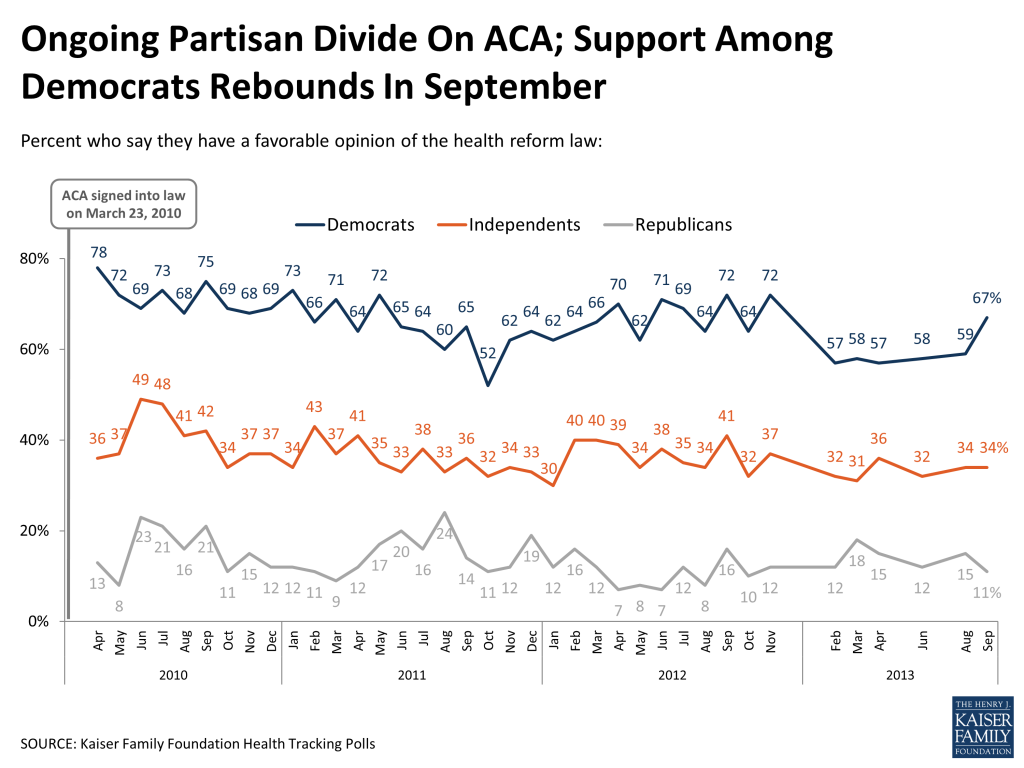
As it has since it was passed, the ACA continues to split the country on partisan lines, with a solid majority of Democrats expressing a favorable view and a large share of Republicans viewing it unfavorably. The share of Democrats who say they like the law – which dropped somewhat following the 2012 election and has hovered just below six in ten for most of this year – appears to have rebounded this month. Currently, two-thirds (67 percent) of Democrats say they have a favorable view of the law, up from 59 percent last month, and closer to levels measured in 2011 and 2012.
Figure 6
Deep partisan divides on the ACA are nothing new, but this month’s tracking poll also illuminates some differences in intensity of opinion between Republicans who identify with the Tea Party and those who don’t. For example, seven in ten Tea Party Republicans say they feel “very unfavorable” about the law, compared with half of Republicans who don’t consider themselves part of the Tea Party. Similarly, over three-quarters (77 percent) of Tea Party Republicans say they don’t like the law and want opponents to keep up their efforts to repeal it or stop it from being implemented, compared with just over half (55 percent) of non-Tea Party Republicans. Finally, while a large majority (78 percent) of Tea Party Republicans say they approve of defunding as a strategy to stop the law from being implemented, Republicans who don’t identify with the Tea Party are more divided (51 percent approve, 44 percent disapprove).
FIGURE 7: INTENSITY GAP AMONG REPUBLICANS BY TEA PARTY IDENTIFICATION
All Republicans
Republicans who identify with Tea Party
Republicans who don’t identify with Tea Party
Percent who say they have a “very unfavorable” opinion of the health care law
57%
70%
50%
Percent who say they have an unfavorable opinion of the health care law and think opponents should continue their efforts to either repeal the law or stop it from being implemented
62
77
55
Percent who say they APPROVE of cutting off funding as a way to stop all or some of the law from being put into place
60
78
51
Percent who say they DISAPPROVE of cutting off funding as a way to stop all or some of the law from being put into place
34
21
44
Most Uninsured Don’t Know Insurance Exchanges Are Opening In October, and Overall Awareness of Provisions Has Not Increased Since 2010
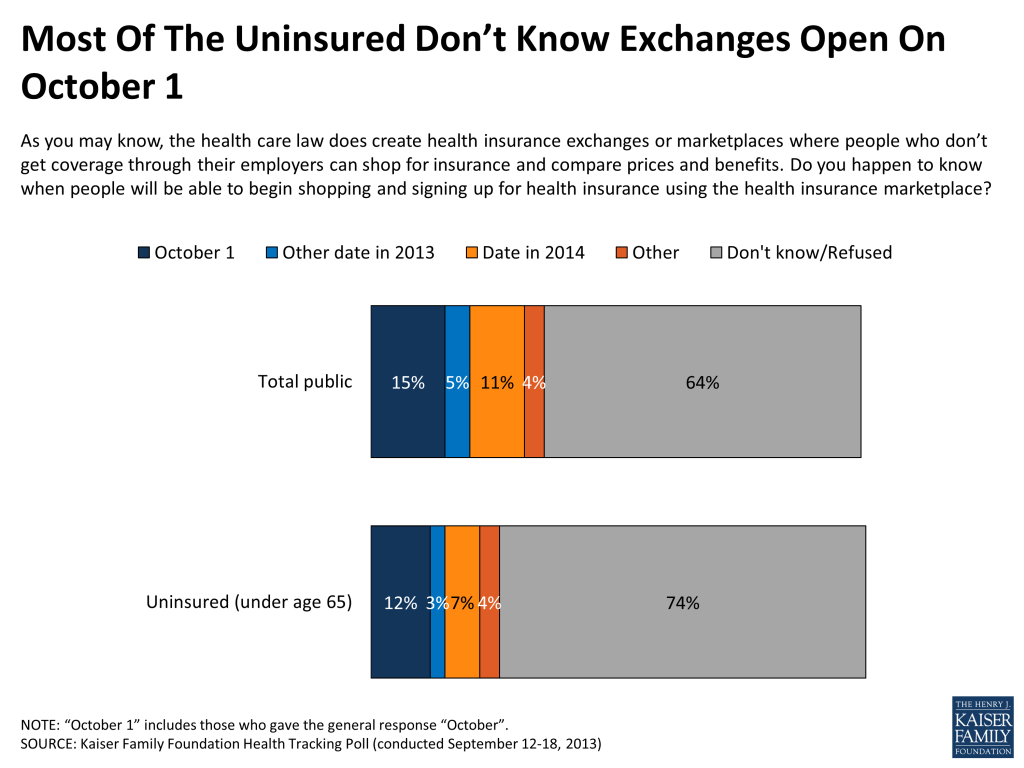
With open enrollment in the ACA’s health exchanges just around the corner, nearly two-thirds of the public – including almost three-quarters of the uninsured – say they don’t know when people will be able to begin shopping for health insurance using the new marketplaces. While about a third are willing to guess, just 15 percent of the public overall – and 12 percent of the uninsured – are able to correctly answer that the marketplaces will open in October.
Figure 8
More broadly, the public’s level of awareness about exactly which provisions are – and are not – included in the health care law has generally not increased in the three and a half years since the law was passed. Of the provisions asked about, only one – the individual mandate – is recognized by a larger share now than in 2010 as being part of the law (79 percent now, up from 71 percent). Levels of awareness of other key provisions have either remained stable or declined over time. For example, the shares who are aware of the law’s subsidies, Medicaid expansion, and closing of the Medicare prescription drug “doughnut hole” have all decreased since right after the law’s passage in 2010 (by 12 percentage points, 6 percentage points, and 7 percentage points, respectively). This leaves substantial shares unaware that the law includes each of these key provisions. Among the uninsured, nearly half are unaware that the law expands Medicaid in some states and provides financial help to lower-income people to help them purchase insurance, and more than one in three are unaware that it creates health insurance marketplaces where people can shop for coverage.
FIGURE 9: AWARENESS OF PROVISIONS INCLUDED IN THE ACA
Right after ACA passage (2010)*
Now (Sept. 2013)
Percent who are aware that the law does each of the following:
Total public
Total public
Uninsured, age<65
Individual mandate/penalty
71%
79%
77%
Health insurance exchanges
62
65
64
Subsidy assistance to individuals
75
63
54
Guaranteed issue
64
59
55
Medicaid expansion
64
58
53
Close Medicare “doughnut hole”
49
42
50
*Results are from April 2010, except for “doughnut hole” question, which is from July 2010. Note: Question wording abbreviated. For full question wording, see topline document.
At the same time, many misperceptions about the law stubbornly persist. More than half the public (52 percent) think the law creates a government-run insurance plan to compete with private plans (the so-called “public option” which was debated but ultimately not included in the final package), and another 16 percent are unsure if it does. About four in ten believe the law allows undocumented immigrants to receive government help in purchasing insurance, establishes a government panel to make end-of-life decisions for people on Medicare, or cuts benefits for people in the traditional Medicare program, with another two in ten saying they don’t know whether the law does each of these things.
FIGURE 10: MISPERCEPTIONS ABOUT PROVISIONS NOT INCLUDED IN THE ACA
CORRECT
INCORRECT
To the best of your knowledge, would you say the health reform law does or does not do each of the following?
No, the law does not do this
Yes, the law does this
Don’t know
Create a new government run insurance plan to be offered along with private plans
32%
52%
16%
Allow undocumented immigrants to receive financial help from the government to buy health insurance
35
43
21
Establish a government panel to make decisions about end-of-life care for people on Medicare
38
42
20
Cut benefits for people in the traditional Medicare program
40
42
18
Those With and Without Insurance Report Problems Putting Off Care Due to Cost
As coverage expansions under the ACA get set to be implemented, the survey highlights some of the problems people continue to have accessing care and dealing with their insurance companies. Overall, just over half the public (57 percent) reports putting off or skipping some sort of health care in the past year because of the cost. Most common among these are skipping dental care (37 percent), relying on home remedies or over-the-counter drugs instead of going to the doctor (35 percent), and putting off or postponing needed care (34 percent).
Reports of skipping or delaying care due to cost are more common among the uninsured (83 percent), those in fair or poor health (80 percent), and those with lower incomes (70 percent of those living in households making less than $40,000 a year). Women (64 percent) are also somewhat more likely than men (49 percent) to report postponing or forgoing some sort of needed care because they couldn’t afford it.
FIGURE 11: OVER HALF REPORT SKIPPING OR DELAYING SOME TYPE OF CARE IN THE PAST YEAR BECAUSE OF THE COST
By Insurance Status
By Household Income
By Health Status
By Gender
Total
Insured (ages 18-64)
Uninsured (ages 18-64)
<$40,000
$40,000-<$90,000
$90,000+
Excellent/ very good/ Good
Fair/ poor
Men
Women
Percent who say in the past 12 months, they or another family member living in their household have done each because of the cost
Skipped dental care or checkups
37%
33%
65%
51%
34%
16%
32%
62%
30%
44%
Relied on home remedies or over the counter drugs instead of going to see a doctor
35
32
62
49
31
17
30
57
29
42
Put off or postponed getting health care you needed
34
30
63
46
29
19
29
53
27
40
Not filled a prescription for a medicine
27
23
48
39
21
14
20
54
22
32
Skipped a recommended medical test or treatment
26
24
49
37
22
13
22
47
20
33
Cut pills in half or skipped doses of medicine
19
16
35
29
16
6
13
46
15
23
Had problems getting mental health care
12
11
23
19
8
5
8
28
10
14
Yes to any above
57
54
83
70
54
37
51
80
49
64
While putting off care due to cost is more common among the uninsured, those with insurance are not immune to these types of problems. In fact, over half (54 percent) of those with coverage say they have delayed or gone without some type of health care in the past year because they couldn’t afford it.
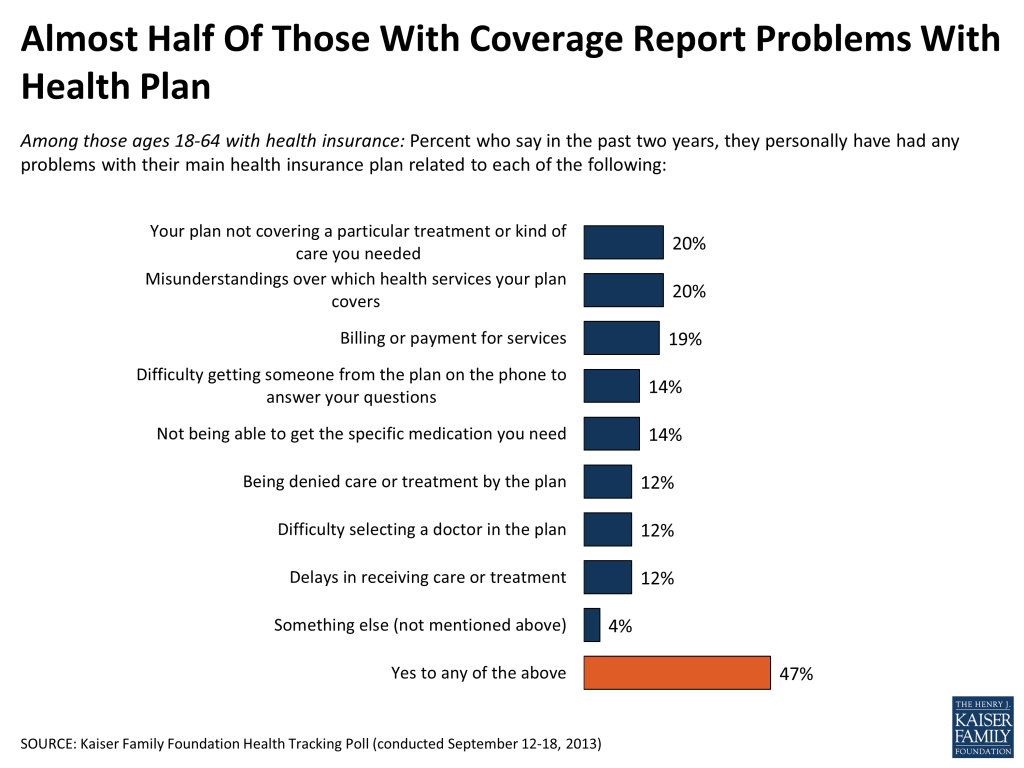
Those with coverage also report experiencing a variety of problems with their health plans. Most common among these are misunderstandings over which services the plan covers (20 percent say this has happened in the past two years), the plan not covering a needed service or treatment (20 percent), and problems related to billing or payment (19 percent). Somewhat fewer report problems getting needed medication (14 percent), difficulty reaching someone to answer questions (14 percent), treatment delays (12 percent) or denials (12 percent), and difficulty selecting a doctor (12 percent). All told, nearly half (47 percent) of those with insurance say they’ve had at least one of these problems in the past two years.
Figure 12
This Kaiser Health Tracking Poll was designed and analyzed by public opinion researchers at the Kaiser Family Foundation (KFF) led by Mollyann Brodie, Ph.D., including Liz Hamel, Claudia Deane, and Sarah Cho. The survey was conducted September 12-18, 2013, among a nationally representative random digit dial telephone sample of 1,503 adults ages 18 and older, living in the United States, including Alaska and Hawaii (note: persons without a telephone could not be included in the random selection process). Computer-assisted telephone interviews conducted by landline (752) and cell phone (751, including 410 who had no landline telephone) were carried out in English and Spanish by Princeton Data Source under the direction of Princeton Survey Research Associates International (PSRAI). Both the random digit dial landline and cell phone samples were provided by Survey Sampling International, LLC. For the landline sample, respondents were selected by asking for the youngest adult male or female currently at home based on a random rotation. If no one of that gender was available, interviewers asked to speak with the youngest adult of the opposite gender. For the cell phone sample, interviews were conducted with the person who answered the phone. KFF paid for all costs associated with the survey.
The combined landline and cell phone sample was weighted to balance the sample demographics to match estimates for the national population using data from the Census Bureau’s 2011 American Community Survey (ACS) on sex, age, education, race, Hispanic origin, nativity (for Hispanics only), and region along with data from the 2010 Census on population density. The sample was also weighted to match current patterns of telephone use using data from the July-December 2012 National Health Interview Survey. The weight takes into account the fact that respondents with both a landline and cell phone have a higher probability of selection in the combined sample and also adjusts for the household size for the landline sample. All statistical tests of significance account for the effect of weighting.
The margin of sampling error including the design effect for the full sample is plus or minus 3 percentage points. Numbers of respondents and margin of sampling error for key subgroups are shown in the table below. For results based on other subgroups, the margin of sampling error may be higher. Sample sizes and margin of sampling errors for other subgroups are available by request. Note that sampling error is only one of many potential sources of error in this or any other public opinion poll.
California’s Uninsured Struggle With Costs and Access And Say They Want Insurance, But Most Have Heard Little About The Affordable Care Act, And Many Who Are Likely To Be Eligible For Medi-Cal or Exchange Subsidies Don’t Know It
Many Undocumented Immigrants in CA Think They Will Get Coverage Through the ACA But Won’t
Menlo Park, Calif. – California’s uninsured are skipping medical care, struggling with costs and want coverage, but many report knowing little about the Affordable Care Act’s new coverage options. The majority who are likely to be eligible for subsidies in the state’s new insurance marketplace don’t realize it, and almost half who are likely to be eligible for Medi-Cal are similarly unaware, according to the first wave of a comprehensive panel survey which will follow the same 2,000 randomly selected uninsured Californians as they and their families experience Obamacare over the next two years.
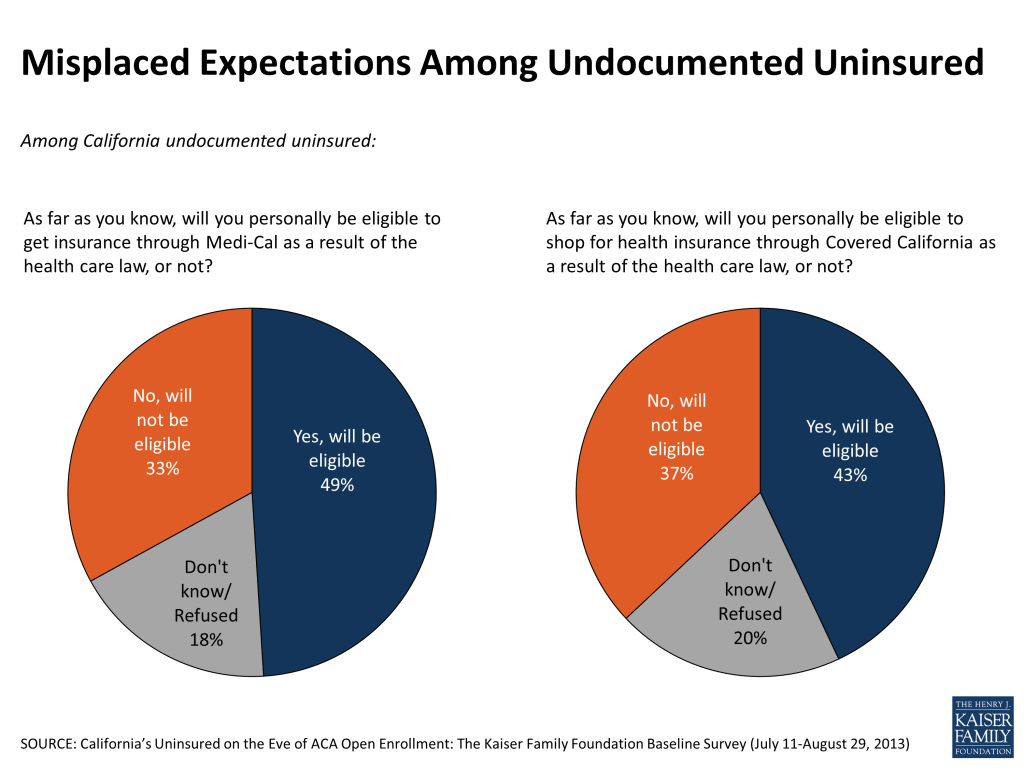
Many undocumented immigrants among the uninsured have the reverse problem. Almost half believe they will be eligible for either Medi-Cal coverage or exchange subsidies under the law although they won’t be.
The first wave of the Kaiser Family Foundation’s panel survey project was in the field July 11 to August 29 to gauge the circumstances of uninsured people in California before open enrollment for the ACA begins Oct. 1, as well as their familiarity with the law and the ways it will affect them.
Each wave of the survey will produce data at a different point in the implementation process. Drawing on the individuals in the survey panel, the Foundation will also produce representative profiles of the uninsured and their families and how they are affected by the changes brought about by the law. The uninsured people in the panel who have volunteered to do so can be made available to news organizations interested in profiling them as they cover the implementation of Obamacare. The Foundation’s news service, Kaiser Health News, will also be undertaking a special reporting project based on the panel survey.
“As we follow these randomly selected 2,000 uninsured residents of our home state through their experiences with the ACA, we will have an unprecedented opportunity to assess the impact of the law on people’s lives as well as give them a voice in the public verdict about the law,” said Drew Altman, president of the Foundation, which is based in Menlo Park, Calif.
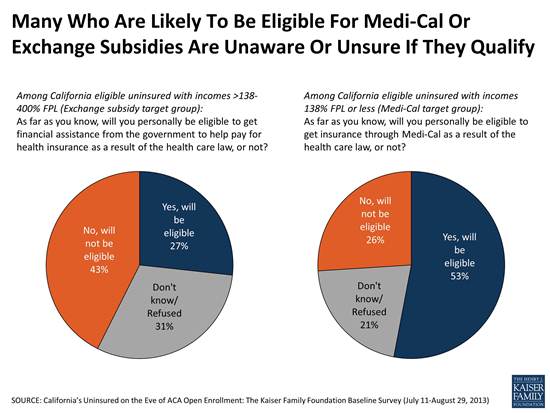
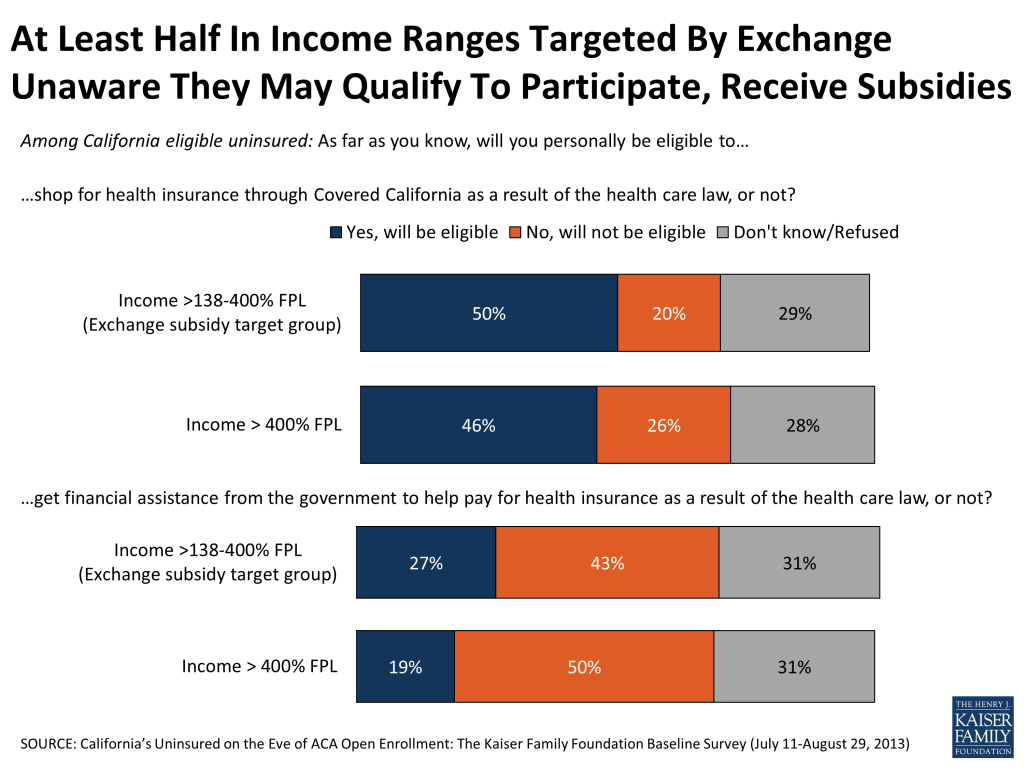
The first survey finds that nearly three-quarters of uninsured people whose income would put them in line to receive subsidies in the state’s marketplace, Covered California, either said they do not know if they are eligible to get financial assistance to help pay for health insurance (31%) or think they will not be eligible for assistance (43%). And 47 percent of the uninsured with incomes that would make them eligible for Medi-Cal either don’t know if they will qualify (21%) or believe they will not (26%).
California’s Uninsured
About two-thirds of the eligible uninsured — U.S. citizens or legal permanent residents who would be eligible to take up the new coverage options in the ACA — have gone without coverage for two years or more, and roughly one in five have never had health insurance. Cost is the reason they cite most, followed by job loss.
Although the majority are employed, most of California’s uninsured (57%) describe themselves as financially insecure, with 84 percent saying their family finds it difficult to afford health care. Nearly two-thirds (64%) say they’ve gone without needed health care because of cost. Half have skipped a recommended medical test or treatment, and four in 10 have not filled a prescription, cut pills in half or skipped doses of medicine.
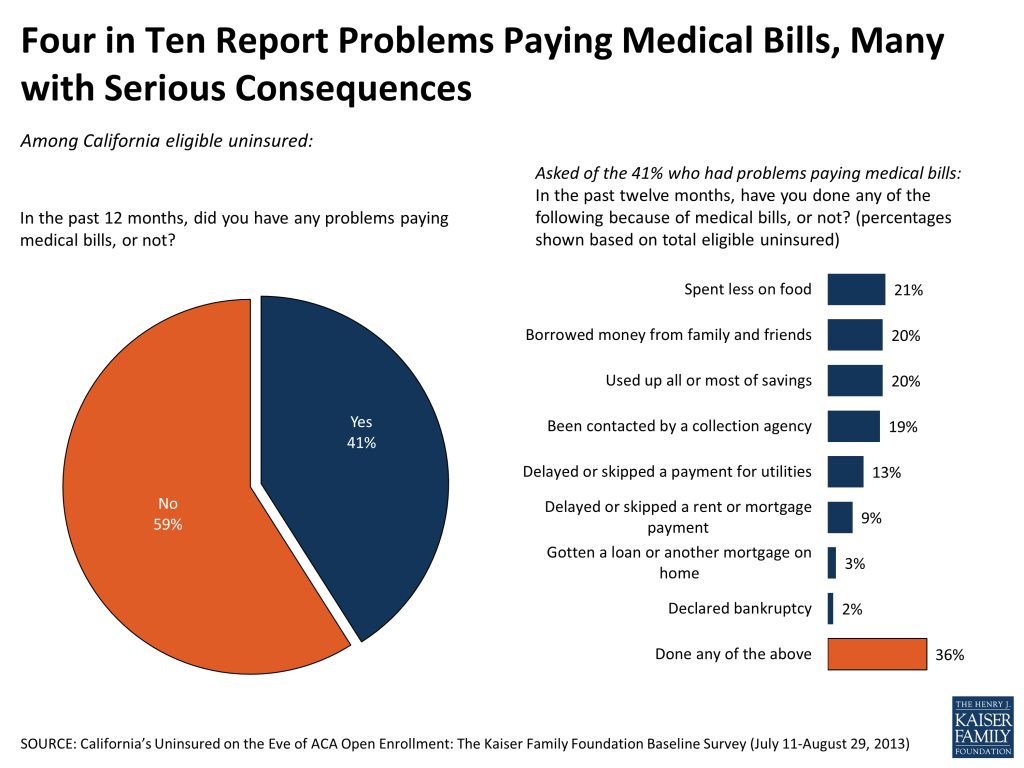
Four in 10 say they have had trouble paying the medical bills they did incur. And three-quarters say they are “very worried” about being unable to pay medical bills if they were in an accident or had a serious illness.
“The health cost burdens and access barriers California’s uninsured report to us in this pre-enrollment survey are striking. Whether you favor or oppose Obamacare, there should be no question about their need for coverage,” Altman said.
Views and Awareness of ACA
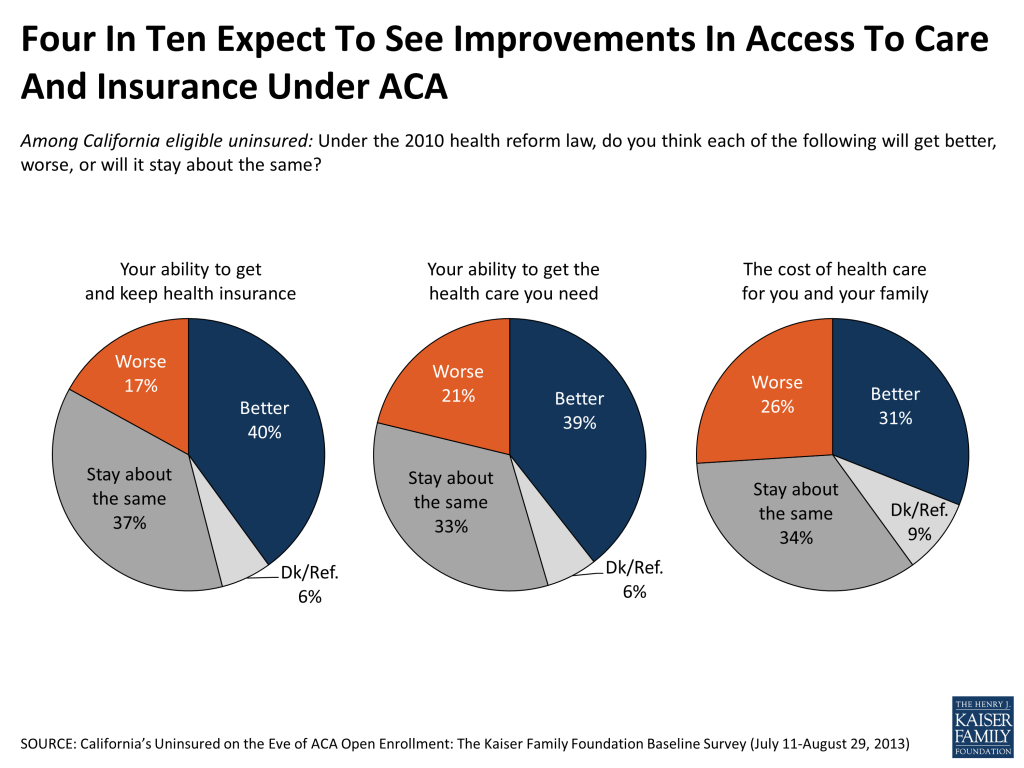
Overall, California’s eligible uninsured are more likely to hold a favorable view of the ACA (48% view it favorably vs. 30% unfavorably) than are the uninsured nationally (36% favorable, 38% unfavorable, according to the August Kaiser Health Tracking Poll). Moreover, more than twice as many of California’s eligible uninsured believe the law will improve their ability to get and keep health insurance (40%) as believe it will make getting insurance more difficult (17%). A little more than a third (37%) don’t expect the law to make a difference either way.
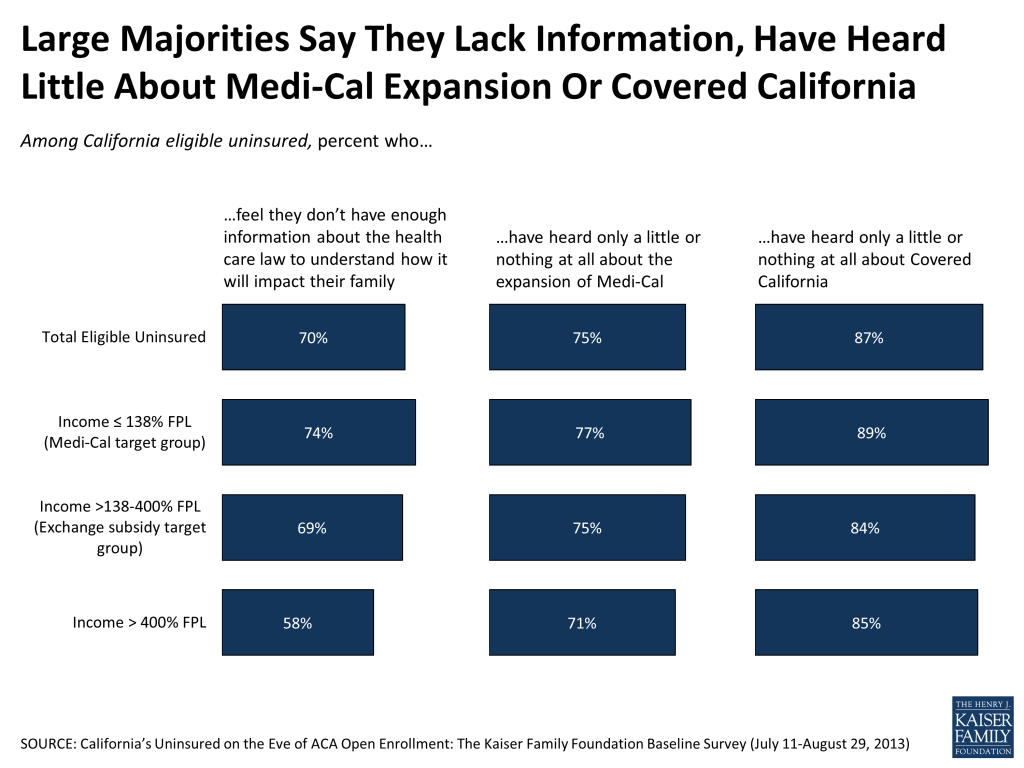
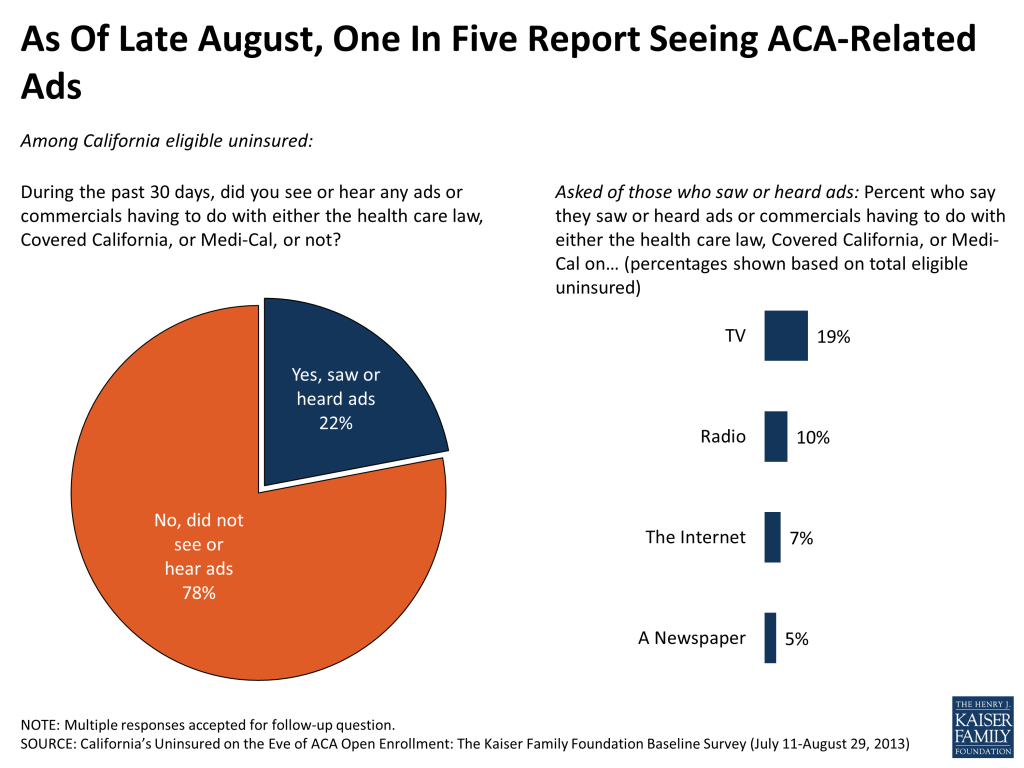
As of the end of August, about one in five eligible uninsured (22%) reported seeing an ACA-related ad, with TV the most frequently named medium, followed by radio. Overall, six percent of the uninsured say such advertising had prompted them to seek more information about the law. Seventy percent of the uninsured said they lack enough information to understand how the ACA will affect their family.
“The uninsured face a steep learning curve,” said Mollyann Brodie, a Kaiser Senior Vice President and head of the Foundation’s Public Opinion and Survey Research team. “The outreach and enrollment campaigns have intensified since we completed this first wave survey, and this group really needs that information and assistance to understand their options under the ACA.”
California’s uninsured want coverage
The uninsured say they need coverage, and the survey finds they would want to sign up for it if their confusion over their eligibility can be cleared up. Eight in 10 uninsured Californians eligible for coverage in the expanded Medi-Cal program or through Covered California say they do feel they need to have health insurance coverage. That includes 72 percent of those ages 19 to 25, a group considered important to the success of the new insurance marketplaces.
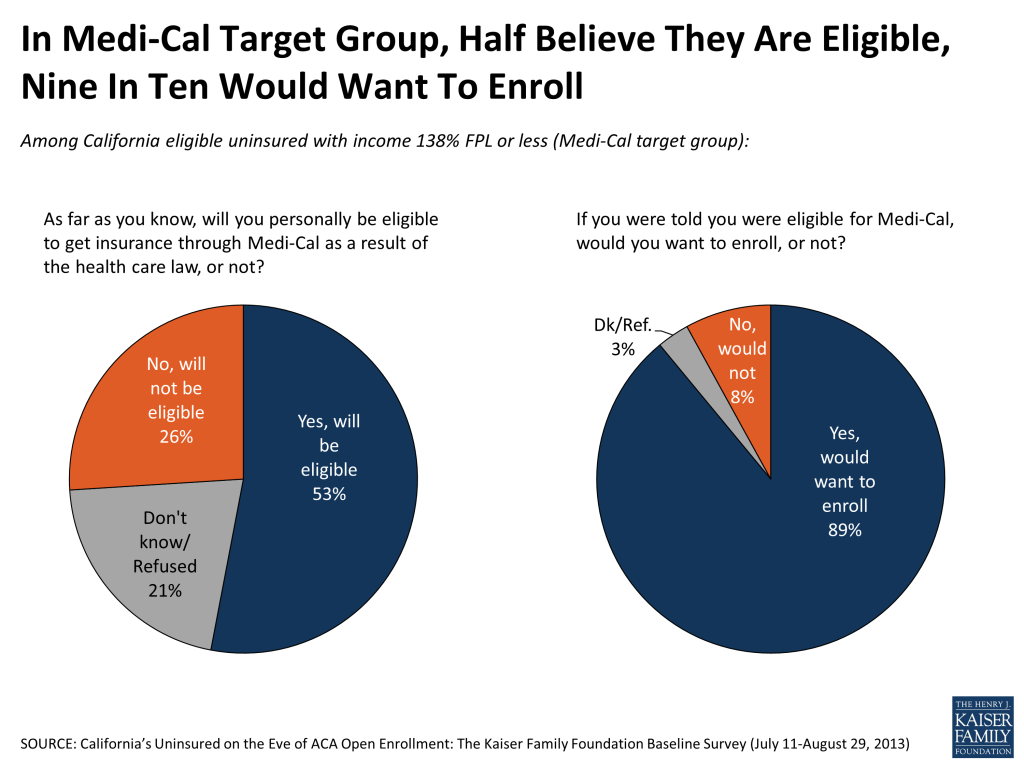
Nine in 10 (89%) in the Medi-Cal eligible income group say that if told they qualified for the program they would want to enroll. More than six in 10 uninsured Californians have a favorable view of Medi-Cal, with many saying they have been on Medi-Cal at some point or know someone who has participated in the program.
Forty-three percent of the eligible uninsured are not aware the ACA contains an individual mandate. When told of the requirement to have health coverage, about half of California’s eligible uninsured say they plan to get it (54%). The other half say either they won’t get coverage (32%), that it will depend on the cost (8%) or that they simply don’t know what they will do (7%).
Undocumented and uninsured
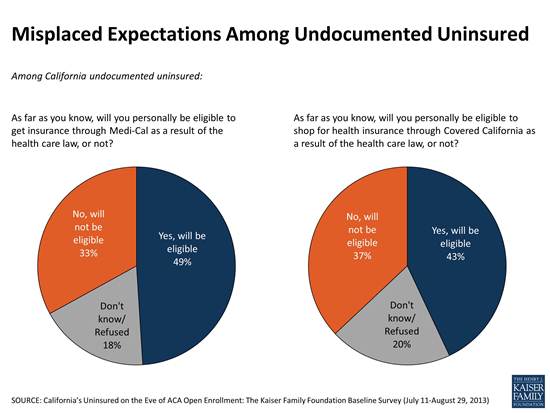
The first wave survey finds that many of California’s uninsured undocumented immigrants, 63 percent of whom have a favorable view of the ACA, have misplaced expectations of the help they will get from the law. About half (49%) say they believe they will personally be eligible to get insurance through Medi-Cal as a result of the health law. And 43 percent believe they will be eligible to shop for health insurance in Covered California as a result of the law.
“The confusion over eligibility cuts both ways,” said Claudia Deane, an Associate Director for Public Opinion & Survey Research at the Foundation. “Some uninsured people are in for a pleasant surprise when they learn they may qualify for help. Still others who think they are on track to receive assistance, including many undocumented immigrants, may be disappointed to learn they are not eligible.”
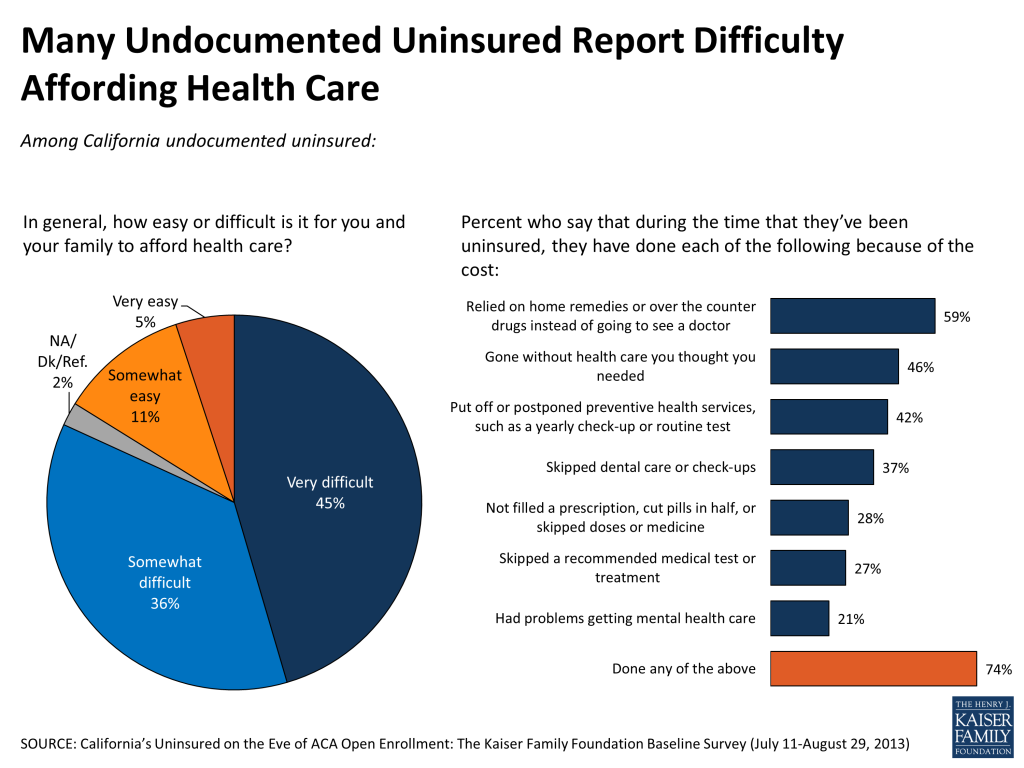
A very high percentage of the undocumented uninsured (81%) report difficulty affording health care, and 46 percent say they have gone without needed care because of the cost. Concern about their inability to pay bills in the case of a severe and unexpected illness is high in this group, with 86 percent saying they are “very worried.” Eighty-two percent of the undocumented uninsured says health insurance is something that they need.
Next wave
The next wave of the Kaiser panel survey will revisit the same group of Californians after the ACA’s six-month open enrollment period ends in March 2014 to learn, among other things, whether they have signed up for coverage or remain uninsured, what choices they made, who enrolled in Medi-Cal and why, who shopped for insurance in the state’s new marketplace and how consumers evaluate the experience and the coverage they obtained. A third and fourth wave of surveys and interviews will follow over the next 18 months to fully capture the views and experiences of California’s uninsured throughout the first years of the ACA’s coverage expansion. Further waves may be conducted in the future.
Methodology
The survey was designed and analyzed by public opinion researchers at the Foundation. Fieldwork was conducted in English and Spanish via telephone by SSRS, an independent research company, from July 11 through August 29, 2013, among a representative sample of 2,001 adults ages 19 to 64 living in California, who reported having been without health insurance for at least two months at the time of the interview. Of the 2,001 respondents, 990 were interviewed via landline, and 1,011 via cell phone. The margin of sampling error is plus or minus 4 percentage points for the eligible uninsured, and plus or minus seven percentage points for the undocumented uninsured. The full methodology, question wording, results, charts and a brief on the poll can be viewed online.
This report presents the findings of a baseline survey of California’s uninsured adult population just before the start of the first open enrollment period under the Affordable Care Act (ACA). It will be followed by three other surveys over the course of the next two years that will capture the changing experiences and attitudes of this same group of 2,000 people over time, whether they obtain coverage or remain uninsured.
The report analyzes the uninsured population in terms of four basic groups: those whose incomes would put them in the ‘Medi-Cal target group’ (138 percent of the federal poverty level (FPL) or less), possibly qualifying them to be covered by California’s Medicaid program; those whose incomes would put them in the ‘exchange subsidy target group’ (greater than 138 percent and up to 400 percent FPL), giving them access to subsidies to purchase insurance through the state’s new health insurance marketplace, Covered California; those who will be able to shop on the exchange but will not be eligible for tax credits based on their relatively higher incomes (greater than 400 percent FPL); and finally those uninsured who will not be able to access health insurance via either option due to their immigration status. The first three groups together comprise a population we are terming the ‘eligible uninsured’.
Section:
0/0
This report presents the findings of a baseline survey of California’s uninsured adult population just before the start of the first open enrollment period under the Affordable Care Act (ACA). It will be followed by three other surveys over the course of the next two years that will capture the changing experiences and attitudes of this same group of 2,000 people over time, whether they obtain coverage or remain uninsured.
The report analyzes the uninsured population in terms of four basic groups: those whose incomes would put them in the ‘Medi-Cal target group’ (138 percent of the federal poverty level (FPL) or less), possibly qualifying them to be covered by California’s Medicaid program; those whose incomes would put them in the ‘exchange subsidy target group’ (greater than 138 percent and up to 400 percent FPL), giving them access to subsidies to purchase insurance through the state’s new health insurance marketplace, Covered California; those who will be able to shop on the exchange but will not be eligible for tax credits based on their relatively higher incomes (greater than 400 percent FPL); and finally those uninsured who will not be able to access health insurance via either option due to their immigration status. The first three groups together comprise a population we are terming the ‘eligible uninsured’.
Eight in ten uninsured Californians feel the need for health insurance
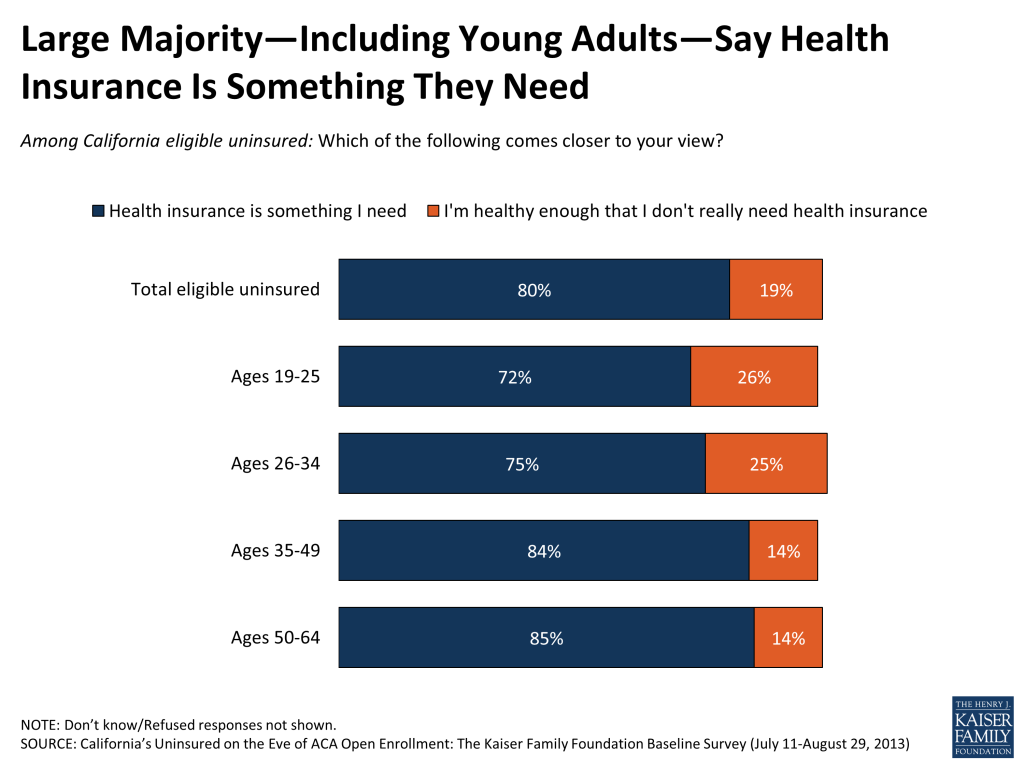
According to the survey, a large majority of California’s eligible uninsured1 – eight in ten – do feel they need health insurance coverage. Even seven in ten (72 percent) of the youngest uninsured Californians – those ages 19 to 25 – say they need health insurance.
Many have not had coverage for some time, though. About two-thirds have been without health insurance for at least two years. One in five say they’ve never had health insurance. Cost remains the primary reason for not having health insurance, followed by job loss.
A majority of the uninsured (57 percent) do believe that health insurance is worth the money it costs, while just over a third disagree. These views are obviously based on perceptions of the cost of coverage before the opening of exchange enrollment in October.
California’s uninsured and the ACA: A steep learning curve ahead, but cautious optimism
California’s eligible uninsured tilt more optimistic than pessimistic on the ACA’s expected impact in their own lives: Four in ten believe the law will enhance their ability to get health care and health insurance, compared to about two in ten who expect the law to make this more difficult. About a third don’t expect it to make any difference.
Yet at the same time, the large majority of California’s eligible uninsured –seven in ten (70 percent) –say that as of late August, before the start of the most intensive phase of outreach, they don’t yet have enough information about the ACA to understand how it will impact them in concrete terms.
At this early stage, then, among those whose incomes put them in the Medi-Cal target group, three-quarters (77 percent) say they have heard little or nothing about the program’s upcoming expansion. And among those in the exchange subsidy target group, more than eight in ten say they have heard little or nothing about the state’s newly minted health insurance marketplace.
As of late August, many doubt they are eligible, but large shares say if they qualified for Medi-Cal they would join
As of late August, there is widespread confusion among the state’s uninsured as to whether they are eligible for any of the newly expanded benefits: three-quarters in the income group targeted to get subsidies in the marketplace are either not sure or presume they will not be eligible for such financial assistance. Only half of those in the Medi-Cal income group presume they will be qualified for the program.
But there is a good deal of interest in signing up for Medi-Cal if those eligibility uncertainties could be put to rest. Nine in ten (89 percent) in the Medi-Cal eligible income group say that if told they qualified for the state health insurance program, they would want to enroll.
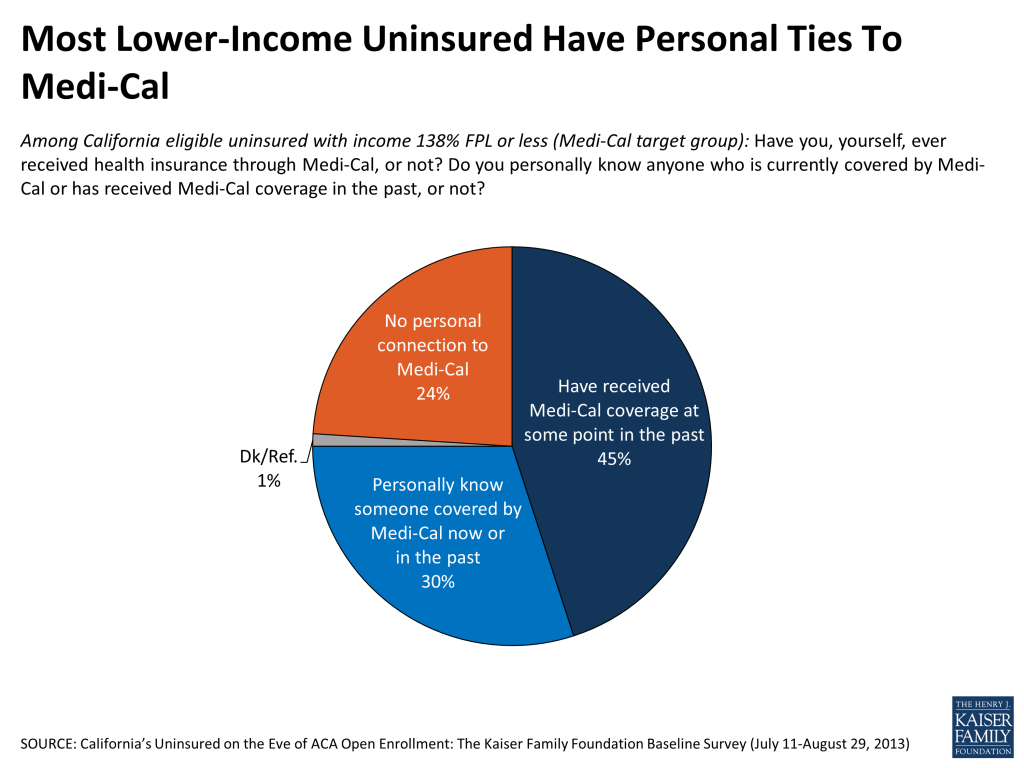
Medi-Cal is viewed quite positively by the uninsured (62 percent favorable), a group that has widespread ties to the program: over four in ten of those with incomes 138 percent of the poverty level or less say they have been on Medi-Cal at some point, and another three in ten know someone who has participated in the program.
The survey suggests that, as of late August, when told of the existence of the individual mandate, the preliminary impression of about half the population is that they would plan to get health coverage, with the other half either thinking they won’t get coverage (32 percent) or not sure what they will do (15 percent).
The survey suggests that the new coverage options will be presented to a population that is in real need of help on this front, with many skipping care they need because of cost and most feeling anxiety over their inability to pay for a major health crisis. At the same time, the rollout will meet a population already quite financially overstretched, both leery of new costs and anxious for financial relief.
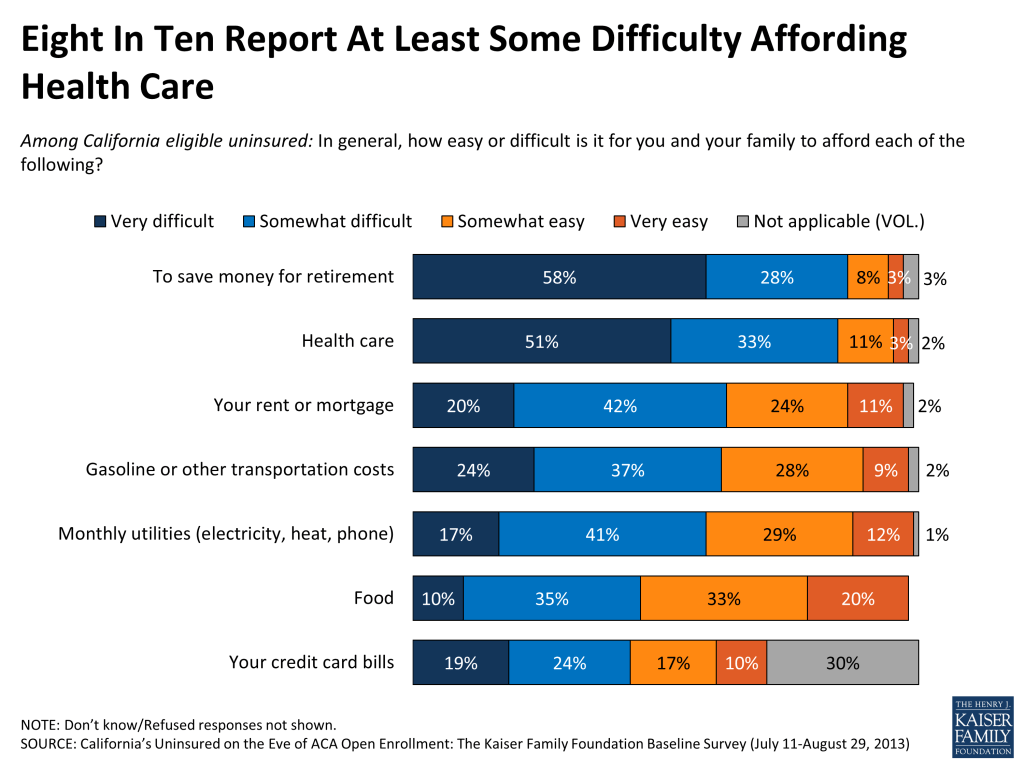
A majority of California’s eligible uninsured population (57 percent) describe themselves as financially insecure, with over eight in ten (84 percent) reporting their family finds it difficult to pay for health care.
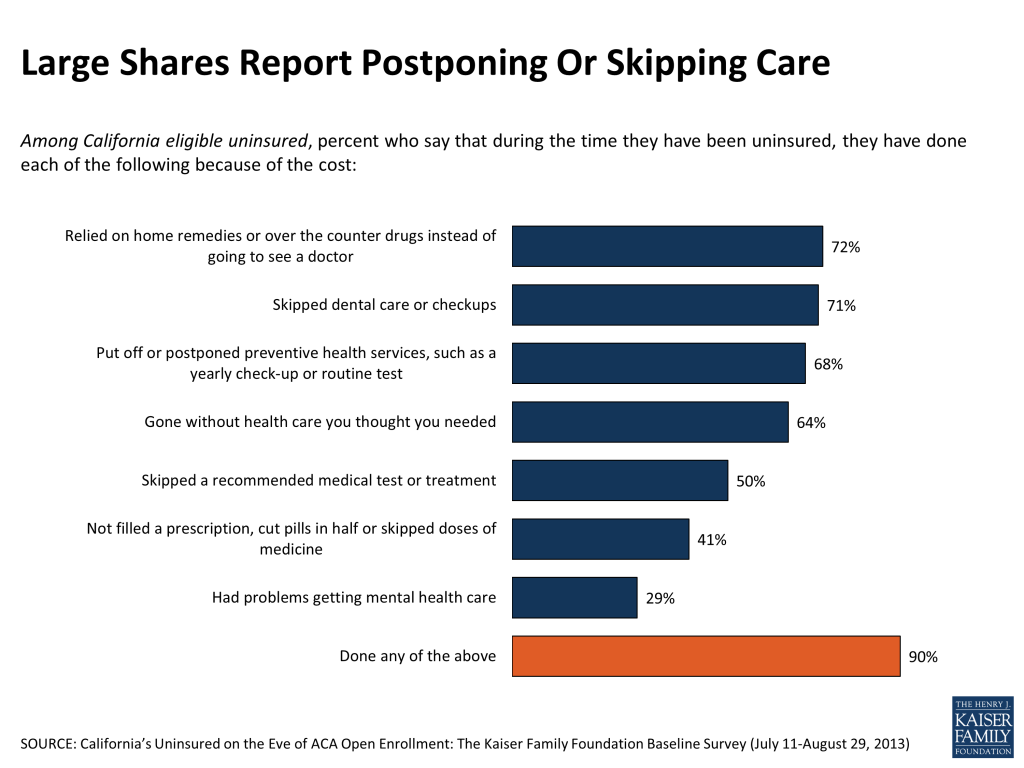
As a result, more than six in ten (64 percent) say that they’ve gone without needed health care because of the cost during the time they’ve been uninsured. Four in ten say they have had trouble paying the medical bills they did incur.
There is widespread worry about what would happen if a family member was struck by a serious illness or involved in an accident. Three in four say they are “very worried” about not being able to pay the resulting medical bills.
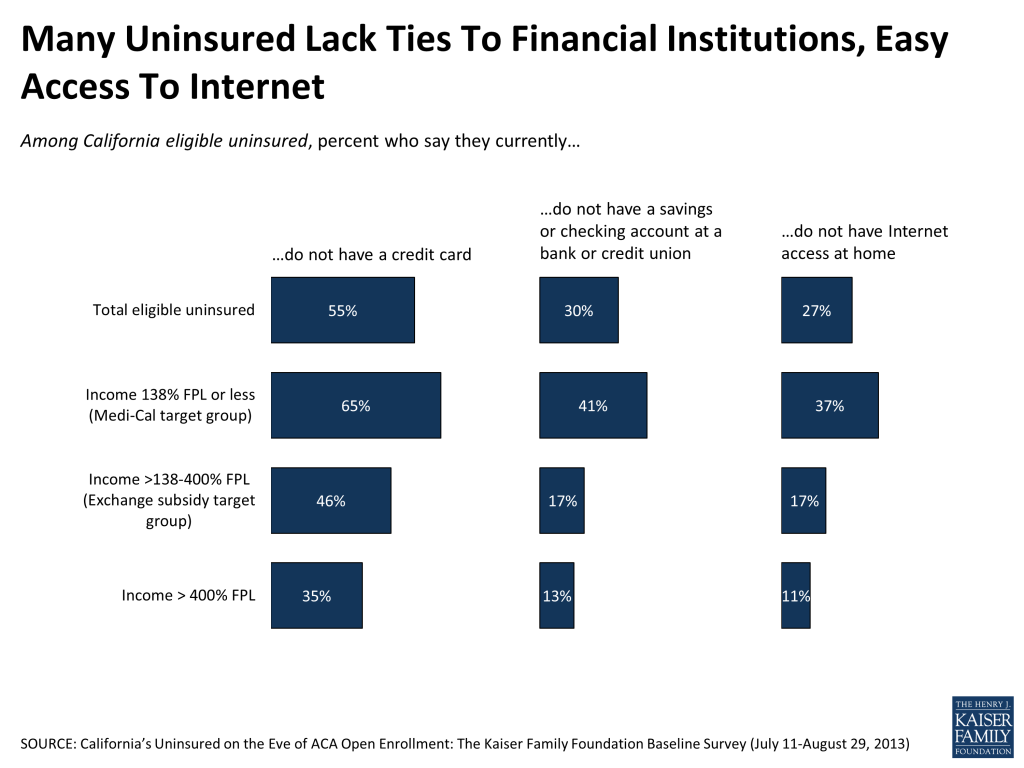
This group also stands out for more attenuated links to the financial system. More than half report they do not have a credit card, three in ten do not have a bank savings or checking account, and one in four does not have Internet access at home. Over half say they ‘rarely’ or ‘never’ shop online.
Uninsured and undocumented
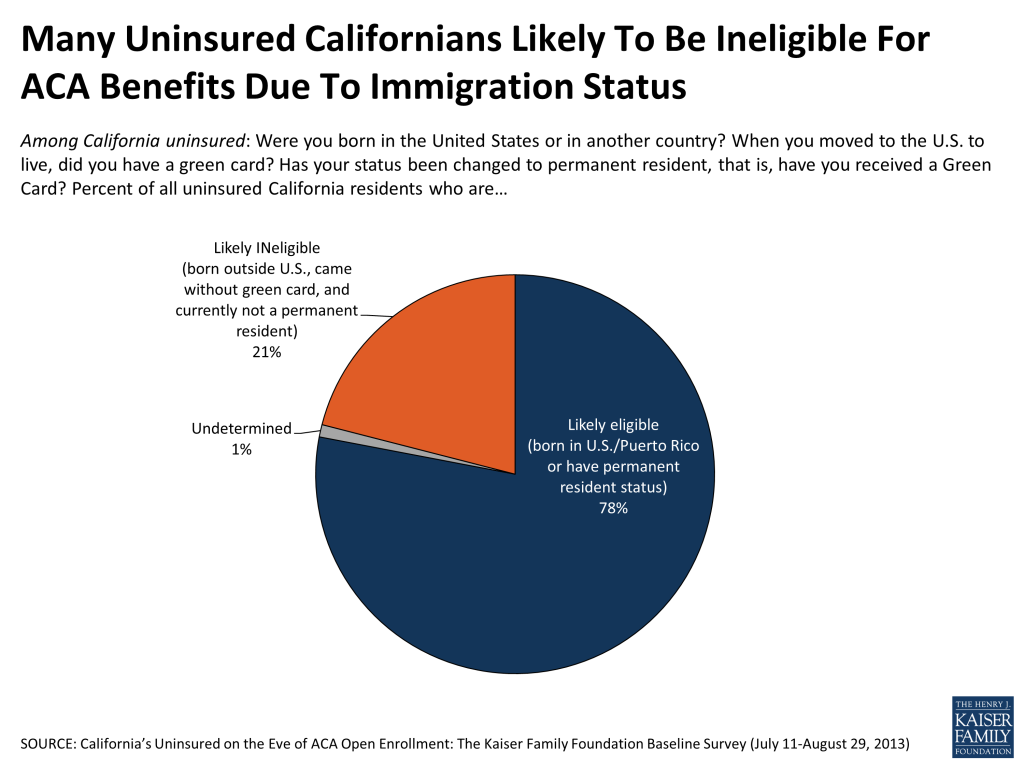
The survey suggests that about a fifth of the state’s uninsured are undocumented immigrants2 , a group that is not eligible to buy coverage through Covered California or to join Medi-Cal.
This group may have misplaced expectations of getting help that in actuality will not be forthcoming: about half (49 percent) say they think they may be eligible to get insurance through Medi-Cal as a result of the ACA. Forty-three percent expect they will be eligible to shop for health insurance on the exchange.
As is true for the rest of the state’s uninsured population, currently eight in ten undocumented uninsured report finding it difficult to pay for health care, and 46 percent say they have gone without needed health care because they couldn’t afford it.
This group stands out as particularly concerned about being able to find a doctor that would treat them if they needed one: 68 percent say they are “very worried”, nearly 30 percentage points higher than among other uninsured Californians.
Report: Introduction
The nearly six million people that make up California’s adult uninsured population are, as a group, financially stressed, medically underserved, and on the brink of what could well be a once-in-a-lifetime policy shift that will put health insurance within many of their grasps. The large majority report they do feel the need for health insurance, but based on past experience in an increasingly high-priced insurance market, some wonder whether coverage is worth the cost. They also, as a group, feel woefully under-informed about the practical mechanics of this upcoming change, and as of late August most report having heard little about the coverage expansion opportunities ahead. Though many are cautiously optimistic, they remain divided in their expectations of whether the Affordable Care Act (ACA) will, in their own lives, represent a change for the good, the bad, or no change at all. The survey suggests this may in part be due to confusion, and perhaps even misplaced pessimism, about their potential eligibility for the widespread benefits.
These are the results of a baseline survey of California’s uninsured population by the Kaiser Family Foundation (KFF), the first in what is expected to be a series of four surveys that will track the views and experiences of the same group of people over the next two years and will be complemented by a series of profiles and stories intended to put a face on these numbers. The project hopes to provide a unique contribution by beginning with a representative, random sample survey of 2,000 uninsured Californians that mirror and represent the state’s large uninsured population, and then returning to those same 2,000 residents at three future points in time – including at the end of the first enrollment period next spring – to learn how they are, or are not, interacting with the nascent coverage expansion.
With its ‘largest in the nation’ status that includes having the largest number of uninsured, its racial and ethnic diversity, and the state government’s full and early commitment to a smooth rollout of the ACA, California stands out as a laboratory of how the three year old law – up until now a remote political football for many Americans – will translate into real world, person-to-person changes. In all, 15 percent of the nation’s uninsured reside there, and will see the ACA through the window of the Golden State.3
This first report seeks to sum up the opinions, concerns and experiences of the state’s uninsured population as they are poised on the brink of this change. The first section assesses what California’s uninsured population knows and thinks about the ACA changes that are on the horizon, and examines their past experiences and current attitudes about health insurance in general. The second section presents a snapshot of the primary characteristics of this group of residents, along with the numerous challenges they currently face in getting, and paying for, the health care they need. And the third section examines the group of uninsured that will not be eligible to participate in the expansion of coverage: the undocumented uninsured.
The report analyzes the uninsured population in terms of four basic groups: those whose incomes would put them in the ‘Medi-Cal target group’ (138 percent of the federal poverty level (FPL) or less), possibly qualifying them to be covered by California’s Medicaid program; those whose incomes would put them in the ‘exchange subsidy target group’ (greater than 138 percent and up to 400 percent FPL), giving them access to subsidies to purchase insurance through the state’s new health insurance exchange marketplace, Covered California; those who will be able to shop on the exchange but will not be eligible for tax credits based on their relatively higher incomes (greater than 400 percent FPL); and finally those uninsured who will not be able to access health insurance via either option due to their immigration status. The first three groups together comprise a group we are terming the ‘eligible uninsured’. This survey of the adult population ages 19-64 somewhat underrepresents the full “eligible insured” group that also includes children.
Putting survey results in context: Numbers of uninsured in California
Nearly 7 million people in California were without health insurance in 2012, including just under 6 million adults ages 19-64.4 Estimates of the exact number who will be eligible for new coverage under the ACA vary, but according to data from the Centers for Medicare & Medicaid Services (CMS), roughly 5.5 million uninsured Californians (including roughly 4.8 million adults ages 19-64) may be eligible to participate in some way based on their income and immigration status. This includes about 3 million in the Medi-Cal eligible income range (138 percent FPL or less), about 2 million who may be eligible for subsidies to purchase insurance through Covered California (incomes greater than 138 percent and up to 400 percent FPL), and just under 500,000 who will be eligible to purchase unsubsidized coverage through the new marketplace (incomes greater than 400 percent FPL).5 According to estimates by researchers at the University of California, roughly one million uninsured Californians will be ineligible for new coverage under the ACA due to their immigration status.6
Report: Section 1: California's Uninsured And The Aca
A NOTE ON TERMINOLOGY:The ‘Eligible Uninsured’: For purposes of this report, the eligible uninsured are defined as those Californians ages 19-64 who have been without coverage for at least two months. Because the coverage expansions under the ACA do not extend to undocumented immigrants, most analysis is based on the 78 percent of the uninsured group who report being U.S. citizens or permanent residents, described for the purposes of easy understanding as the ‘eligible uninsured’.
Income categories: Because eligibility for two of the law’s main components – the Medi-Cal expansion and the tax credits to help purchase insurance on the new exchanges – is based on an individual’s family income relative to the federal poverty level (FPL), in many cases we report survey results among the eligible uninsured by FPL categories. Those with incomes 138% FPL or less (roughly $32,000 a year for a family of 4) will be eligible for Medi-Cal coverage, while those with incomes greater than 138% and up to 400% FPL (roughly $32,000-$94,000 for a family of 4), will be eligible for subsidies to purchase insurance through Covered California, the state’s new marketplace. Those with incomes above 400% FPL will be allowed to buy insurance through Covered California, but will not be eligible for subsidy assistance. For convenience, we will sometimes refer to the group with incomes 138% FPL or less as the “Medi-Cal target group”, and those greater than 138% and up to 400% FPL as the “exchange subsidy target group”. These obviously are approximations that do not allow for every real world exception to be taken into account. For example, lawfully present immigrants may remain subject to a five year wait before they may enroll in Medi-Cal, but for the purposes of this analysis they are included in the Medi-Cal target group if they meet the income criteria. Similarly, some of those in the exchange subsidy target group may not be eligible for marketplace subsidies if they have access to affordable employer coverage, a situation difficult to ascertain in a phone survey.
Limited familiarity, cautious optimism
SUMMARY: Positive views of the ACA outnumber negative among California’s eligible uninsured, even as the large majority say they don’t yet understand how the law will impact their own families and few have heard much about either the expansion of the Medi-Cal program or the creation of the state’s Covered California insurance marketplace.
California’s uninsured tilt positive on ACA
California’s eligible uninsured tilt more positive than negative on the 2010 health care law, particularly in comparison to the nation as a whole, but no one view is shared by a majority.
Overall, 48 percent of California’s eligible uninsured view the ACA favorably, while 30 percent view it unfavorably and one in five (22 percent) were not able to provide an opinion. Nationally, Americans in the same age range are more divided, 38 percent favorable versus 42 percent unfavorable in KFF’s August Health Tracking Poll, and the uninsured nationally are evenly divided at 36 percent favorable versus 38 percent unfavorable.
Figure 1
But large majority say they don’t have enough information yet to understand how ACA will impact them personally
As of late August, the large majority of California’s eligible uninsured – seven in ten (70 percent) – say they don’t feel they have enough information about the law to understand how it will impact them. In no demographic subgroup we examined does a majority say they know enough about the law at this point to understand its personal ramifications.
Figure 2
As the summer of 2013 comes to a close, and the season of intensive outreach begins, three-quarters say that they have heard “only a little” or “nothing” (32 percent and 43 percent respectively) about the expansion of Medi-Cal, including 77 percent of those in the Medi-Cal target group.
And more than eight in ten (84 percent) of those in the exchange subsidy target group say they have heard little or nothing about the state’s new marketplace, Covered California.
One in five uninsured report seeing an ACA-related ad
The state’s marketplace and other interested parties began an ongoing process of outreach toward the uninsured population earlier this summer, one that is still in the process of ramping up (for example, Covered California itself unveiled its first television ad in late August.) At this early point in the ad campaign, about one in five of California’s eligible uninsured report having seen or heard an ad having to do with the health care law, Covered California or Medi-Cal. Most of these reported having seen multiple ads on the topic, with TV by far the most frequently named delivery vehicle, followed by radio.
Figure 3
Nearly half in the group that have seen an ad report that at least one of the commercials they saw provided information about how to get health insurance coverage, while the other half do not remember being provided any instruction. Overall, so far six percent of California’s eligible uninsured report that the advertising has driven them to seek out further information about the law.
About half aware of Medi-Cal expansion, creation of marketplaces and availability of subsidies
About half the eligible insured are aware, however, of the two key coverage expansions being a part of the 2010 health law, even if they have not heard much about them recently. For example, half of the state’s eligible uninsured are aware that the ACA does provide for expansion of Medi-Cal, including similar shares of those in the eligible income group. And half report knowing that the law creates health insurance exchanges or marketplaces, with knowledge somewhat higher in the exchange subsidy target group (57 percent) than in the Medi-Cal target group (45 percent). Roughly the same share are aware that the federal government will subsidize the purchase of health insurance on Covered California for many in these income groups.
In each case, however, this does leave roughly half the target populations unaware that these provisions even exist as part of the ACA.
Figure 4: About Half of Eligible Uninsured Aware Health Reform Law Includes Medi-Cal Expansion, Provision of Tax Credits on Exchanges
Among California eligible uninsured: Percent who say yes, the health care law does each of the following
Total eligible uninsured
≤138% FPL (Medi-Cal target)
>138%-400% FPL (exchange subsidy target)
>400% FPL
Require nearly all Americans to have health insurance by 2014 or else pay a fine
57%
52%
63%
56%
Expand the Medi-Cal program to cover more low-income Californians
53
52
53
58
Provide financial help to low and moderate income Americans who don’t get insurance through their jobs to help them purchase health insurance coverage beginning in 2014
52
52
54
48
Create health insurance exchanges or marketplaces where people who don’t get coverage through their employers can shop for insurance and compare prices and benefits
50
45
57
51
Prohibit insurance companies from denying coverage because of a person’s medical history
45
39
52
48
Meanwhile, more than half the uninsured (57 percent) are aware of the existence of the individual mandate, a provision that will apply to many of them. Finally, over four in ten (45 percent) are aware of the guaranteed issue provision that mean that many of the eligible uninsured – including those who say someone in their household has a pre-existing condition – will be able to qualify for health insurance that may previously have been denied them.
In the big picture, more expect the ACA to make their situations better than worse, with a third expecting no change either way
California’s eligible uninsured have mixed expectations as to whether the ACA will be of benefit to them, but overall roughly two times as many expect to be better off as to be worse off. Four in ten believe the law will enhance their ability to get the health care (39 percent) and health insurance (40 percent) they need, compared to about two in ten who expect the law to make life more difficult on these fronts. About a third don’t expect it to make any difference.
Figure 5
Views are more closely divided, however, when it comes to the thorny issue of health care costs: About one in four (26 percent) think the law will raise health care costs for their own family, while a slightly larger share think it will bring costs down (31 percent).
California’s open enrollment period: First reactions
SUMMARY: On the eve of the start of the six-month open enrollment period, there is widespread confusion among the state’s uninsured as to whether they are eligible for any of the new and expanded benefits, with three-quarters in the exchange subsidy target group either not sure or presuming they will not be eligible for such financial assistance, and only half of those in the Medi-Cal target income group presuming they will be qualified.
But there is a good deal of interest in potentially signing up for the Medi-Cal program if those eligibility uncertainties could be put to rest. Nine in ten in the Medi-Cal target group say that, if told they qualified for the state health insurance program, they would enroll. Medi-Cal is viewed quite positively as a program by the uninsured, a group that has widespread ties to the program: over four in ten of those in the Medi-Cal target income range say they have been on Medi-Cal at some point, and another three in ten know someone who has participated in the program.
The survey suggests that, as of late August, when told of the existence of the individual mandate, the preliminary impression of about half the population is that they would plan to get health coverage, with the other half either thinking they won’t get coverage or not sure what they will do. These impressions obviously will shift as the uninsured learn more about the specific ways the law will apply to their own family situation.
Focus on Covered California: Good deal of uncertainty about eligibility to shop in marketplace, get tax credits; Group with limited experience of online shopping
Overall, roughly 2.5 million uninsured state residents may eventually be eligible to shop for coverage using the Covered California marketplace.7 But as we saw in the previous section, familiarity with the statewide marketplace and its benefits is still relatively limited at this point. In this section we examine the uninsured’s current thinking about their own potential eligibility and find that three in four in the subsidy target income group have doubts about whether they would indeed qualify for subsidy assistance. Half are not sure whether they are eligible to shop on the exchanges at all or believe they will not have this option.
Do you think you will be eligible to buy through the state marketplace? For financial assistance from the government?
At summer’s end, half of those with household incomes that fall in the subsidy-eligible range for Covered California say they believe they will be eligible to shop for insurance on the exchange, while three in ten are unsure about whether they could participate. About one in five say they do not believe they will meet the requirements for the exchange. Views among those uninsured making over 400 percent of the FPL – a group eligible to shop in the marketplace but not to receive financial assistance – are similar.
Figure 6
Even fewer in the subsidy target group – just over a quarter – say they think they will be eligible to get financial help from the federal government to help pay for health insurance. The plurality – 43 percent – say they think they will NOT be eligible, and a third aren’t sure. At the same time, roughly one in five (19 percent) of those with incomes above 400 percent of poverty believe they will be eligible for such help, when in reality they are likely to be out of the eligible income range.
Figure 7
Will Covered California help you?
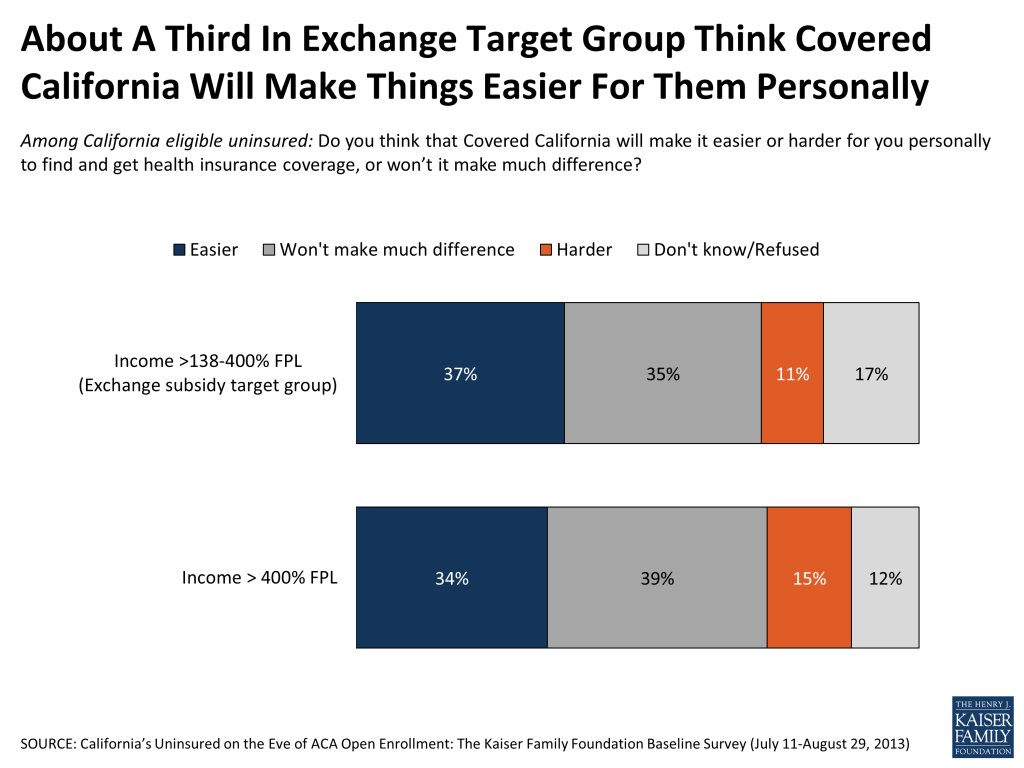
By better than three to one, those in the exchange subsidy target group think that the state marketplace will make it easier rather than harder for them to find and get insurance coverage (37 percent versus 11 percent). But half either say they don’t expect to see any change at all in their ability to get health insurance (35 percent) or they don’t know what to expect (17 percent).
The exchange eligible and the Internet
One of the primary methods – though not the only method – for accessing Covered California is through its website, www.CoveredCA.com, which allows for online comparison shopping and purchasing. Most of the uninsured in the income group eligible for the tax credits in the marketplace do have Internet access at home (83 percent), and another 9 percent have access somewhere other than home. But they are not intensive Internet shoppers: 25 percent say they very or somewhat often use the Internet to buy products online, 28 percent say they do so ‘just occasionally’, and nearly half say they ‘rarely’ (18 percent) or ‘never’ (29 percent) buy things online. And while 18 percent say they often use the Internet to access health information, 56 percent say they rarely or never do this.
Focus on Medi-Cal: Views of the program, personal connections, and expectations for eligibility in 2014
Eligible uninsured no strangers to Medi-Cal; Majority have positive views of program
Those uninsured whose incomes put them in the range of the Medi-Cal expansion are for the most part, no strangers to the program. About four in ten (45 percent) say they have already been on Medi-Cal at some point themselves. Another 30 percent know someone that receives or has received health coverage through the program. And all told 18 percent in this income group say they have unsuccessfully tried to sign up for the health insurance program at some point or another, with most of these reporting they could not enroll in Medi-Cal because they were told they were ineligible.
Figure 8
In large part, this group views the program quite positively. Overall, about two-thirds in the Medi-Cal target group have a favorable view of the program, while about a quarter have an unfavorable view. These positive views are driven by those who have themselves been on Medi-Cal or know someone who has: 67 percent and 73 percent, respectively, give the program positive reviews. Those with no connection to the program lean more positive than negative (47 percent versus 25 percent), but a quarter say they don’t know enough about Medi-Cal to offer an opinion. It’s worth noting that under the ACA, the process for Medicaid enrollment is being adjusted to remove perceived barriers to sign-up and to better coordinate with the state exchanges, a factor that could impact ratings of the program moving forward.
Figure 9
Only half believe themselves eligible for Medicaid under expansion; Nine in ten say they would sign up if told they qualified
Given their connections to the program and their positive evaluations, it follows that there would be a fair bit of interest in enrollment among this group, and the survey bears that out: Nine in ten (89 percent) in the relevant income bracket say that if they were told they were eligible for Medi-Cal, they would want to enroll. The catch at this point, at least, is eligibility confusion. While about half (53 percent) of those in the Medi-Cal target group believe they will be eligible for the program, another 21 percent are not sure and a quarter (26 percent) believe they will not be eligible. Some of this confusion may stem from the fact that eligibility standards are changing under the ACA, and public knowledge may not yet have caught up with these changes. For example, adults without dependent children were previously ineligible no matter what their household income, a standard that has changed under the law.
Figure 10
One pathway this population could use to find out about their possible Medi-Cal eligibility is the state’s new marketplace website. The survey suggests, however, that the Medi-Cal target group includes a relatively large group of people with limited Internet access and experience. More than a third (37 percent) do not have Internet access at home, and fully half have never purchased a product online.
Given knowledge of mandate, half say would likely get health insurance
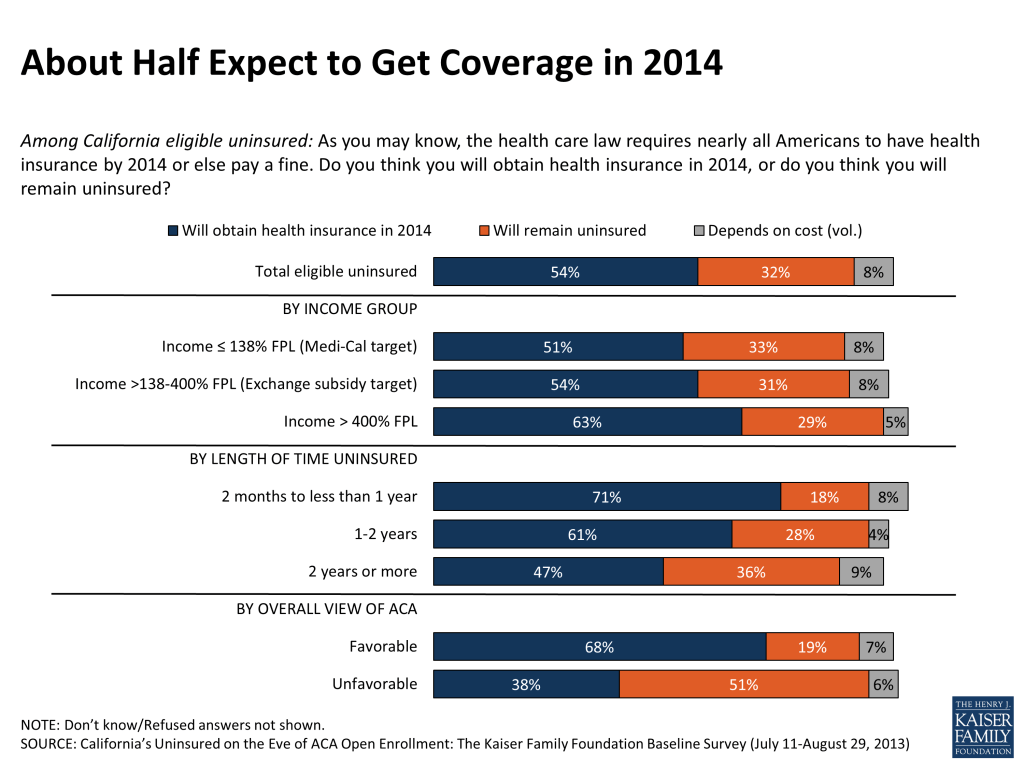
When told or reminded that “nearly all Americans [will be required] to have health insurance by 2014 or else pay a fine,” just over half (54 percent) of the eligible uninsured report they expect to obtain health insurance next year, a third (32 percent) plan to remain uninsured, 8 percent say it would depend on the cost and 7 percent don’t have a sense of how they would react.
Figure 11
The groups most likely to say they expect to get coverage are those that became uninsured only sometime in the past year (71 percent of them are ready to sign back up) and those with favorable views of the ACA (68 percent).
In terms of who is most likely to say they plan to remain uninsured: those with dim views of the health law stand out here, with 51 percent saying they do not intend to seek health insurance. (Even here, however, four in ten do say they will likely seek coverage.) Those who feel their financial situation to be “very insecure” are also disproportionately more likely to say they expect to remain uninsured (43 percent).
Among those who expect to obtain coverage in 2014, most are unsure at this point where that coverage will come from.
Figure 12: Most Who Expect to Obtain Insurance in 2014 Don’t Know Where They Will Get It
Among California eligible uninsured: Do you think you will obtain health insurance in 2014, or do you think you will remain uninsured? (If expect to obtain coverage: Do you think you will get coverage from Medi-Cal, an employer, the marketplace known as Covered California, or are you not sure where you will get insurance?)
Will obtain insurance (NET)
54%
From an employer
9
From Medi-Cal
5
From Covered California
4
From Medicare (vol.)
1
Somewhere else (vol.)
1
Not sure where
35
Will remain uninsured
32
Depends on the cost (vol.)
8
Don’t know
7
What’s driving the views of those that say they don’t plan to get coverage in 2014?
Most (62 percent) of those who say they don’t plan to get insurance explicitly point to cost as a reason, saying they don’t think they will be able to find an affordable plan or that they just don’t have the money to pay for insurance. Smaller shares say the reason they won’t seek coverage is that they don’t need it or don’t want it (21 percent), or that they don’t see how they will qualify for coverage (12 percent).
Figure 13: Voices of the Uninsured
Among California eligible uninsured who say they will remain uninsured in 2014: Why do you think you will remain uninsured?
Cost related/Don’t think will be able to find an affordable plan – 62%
“[I’m the] sole caregiver [taking care of my] with Alzheimer’s and head of household, therefore it’s financially restrictive.”
“I’d rather [pay] health and dental for my kids instead of myself.”
“The company I’m working for might not be able to help me, and if there’s no money I won’t be able to afford insurance.”
“If I get a job and remain employed and if they offer benefits [I will get insurance.] If not I will have to feed and take care of my family first before I can buy health insurance.”
“The fine will be less than the health insurance and medical bills combined.”
Don’t want/need coverage – 21%
“I’m healthy, I pay cash when I go to the doctor.”
“I don’t like being told what to do.”
“Because I completely disagree. It is my choice whether or not I want insurance.”
Not available to me/won’t qualify – 12%
“[My] employer has less than 50 people and will not provide health insurance.”
“[I’m] falling into a gray area and I don’t fit in any of the categories.”
Other
“Because there is too much of a fight right now, so I don’t think [the ACA] will be implemented.”
“I don’t think I will receive good enough health insurance.”
What do the uninsured have to say about health insurance?
To understand what will happen to California’s millions of uninsured in upcoming months, it’s helpful to understand not just what this population knows and understands about the changes ahead, but how this knowledge may interact with their existing views about health insurance: why they don’t have it, whether they actually want it and for what purpose, and whether they think that up to this point, the value of insurance has been worth its cost.
Most of California’s eligible uninsured have been without coverage for some time; Point to cost of coverage, job loss, and other factors
Two-thirds of those uninsured Californians who self-identify as either U.S. citizens or lawfully present immigrants say they have been uninsured for more than 2 years. About 17 percent have been uninsured for between one and two years, and another 17 percent are more newly uninsured than that. And about one in five say that they’ve never had insurance. The higher-income uninsured are somewhat more likely to report losing their coverage more recently: 48 percent have become uninsured in the past two years, compared to 31 percent in the lowest income bracket.
Figure 14: Majority of Uninsured Have Been Without Coverage for Two Years or More
Among California eligible uninsured: How long have you been uninsured?
Total eligible uninsured
≤138% FPL (Medi-Cal target)
>138%-400% FPL (exchange subsidy target)
>400% FPL
2 months to less than 1 year
17%
14%
16%
27%
1 year to less than 2 years
17
17
18
21
2 years or more
66
69
66
53
The main reasons they are without health insurance? Cost tops the list, with 47 percent explicitly saying they are uninsured because health coverage is too expensive. One in five refer to job loss or unemployment, and about one in eight (12 percent) point to barriers that stop them from qualifying for coverage through their employer.
Only 3 percent volunteer they don’t have health insurance because they don’t think they need it.
Figure 15: Voices of the Uninsured
Among California eligible uninsured: What’s the main reason you do not have health insurance?
Too expensive/have little or no money – 47%
“Because we cannot afford; if health insurance would be more affordable we would try to buy it.”
“My job offers it but it is too expensive.”
“Because I am self-employed and have insufficient finances to obtain insurance coverage at this time.”
Unemployed/lost job – 19%
“I’m unemployed, and have no money to purchase.”
“I had insurance through my job but not anymore.”
Employer doesn’t offer it/Not eligible for employer coverage – 12%
“My husband’s job doesn’t offer it.”
“Just started new job, health insurance won’t be in effect for 30 days.”
Not eligible for Medi-Cal or other government insurance program – 5%
“I am a care giver and they don’t give medical insurance and I applied for Medi-Cal and got disqualified.”
Don’t need it – 3%
“I’m not too sickly in general for the most part, usually if anything just a cold.”
Can’t get it/refused due to poor health – 2%
“I tried to apply to private companies but am turned down every time.”
“I became disabled and my job’s coverage did not cover me. They only covered me for 30 days because the company that bought us out won’t cover me because I have not been with the new company a year and because of my condition.”
Don’t know how to get it – 2%
“I don’t have the information needed to apply.”
This group reports having had a range of types of coverage before becoming uninsured, including employer sponsored insurance (39 percent), Medi-Cal or Medicaid (18 percent) or coverage under a parent’s plan (13 percent). One in ten (9 percent) say that at some point they have been denied health insurance coverage due to someone in their family having a pre-existing condition.
Overall, about two-thirds (68 percent) of California’s eligible uninsured say they or their spouse are working. Why, if so many are employed, are more not insured? For the majority of those who are employed or have a working spouse it’s because they are either self-employed or their employer doesn’t offer coverage. Nearly three in ten (28 percent) of the eligible uninsured do, however, have ties to an employer that offers coverage to at least some of its employees. This group gives a variety of reasons for not participating in such coverage: the most frequently mentioned option is that the cost is too high, but others say they aren’t enrolled because they aren’t eligible, either because they don’t work enough hours or haven’t worked at the firm long enough. It’s worth noting that those that do have access to affordable employer coverage will not be eligible for exchange subsidies.
Figure 16
Eight in ten say health insurance is something they need, including large majority of ‘young invincibles’
Though some may presume the reason most of the state’s uninsured lack coverage is because they don’t feel they need it, the survey suggests this isn’t true. According to the survey, the large majority of California’s eligible uninsured – eight in ten – do feel they need health insurance coverage. Even seven in ten (72 percent) of the youngest uninsured Californians – those ages 19 to 25 – say they need health insurance. Overall, just under two in ten instead say they feel healthy enough that they don’t need coverage.
Figure 17
The desire for insurance is even more widespread among those with more health problems. Among those in ‘poor’ or ‘fair’ health, nine in ten feel they need coverage. But even among those who say they are in good health, a majority—three in four—feel they need health coverage.
The main reason uninsured Californians want health coverage: to protect against the kind of financial catastrophe that can accompany a major, unexpected illness or a life-changing accident. Most (seven in ten, including majorities in all age groups), say this is their primary reason to want insurance. For one in four, however, the main point of insurance is to pay for more routine health care expenses. This rises to 40 percent among those who are already grappling with a disability or chronic health problem.
Figure 18: Those With Chronic Health Conditions More Likely to Say Insurance Is Necessary to Pay for Everyday Health Care Expenses
Among California eligible uninsured: Which one of the following do you think is the MOST important reason to have health insurance?
Total eligible uninsured
Among those who say they have a disability or chronic condition that keeps them from participating in activities
Among those with no disability/chronic condition
To pay for everyday health care expenses, like check-ups and prescriptions
27%
40%
25%
To protect against high medical bills in case of severe illness or accident
71
58
73
Up to this point, a majority have believed that health insurance is worth the cost, though a third disagree
At this point, a majority of the uninsured – 57 percent – do believe that health insurance is worth the money it costs, while just over a third disagree. These views are obviously based on perceptions of the cost of coverage before the opening of the exchange in October.
Report: Section 2: The Uninsured Experience, Pre-aca
Who are the uninsured in California?
In this section of the report, we look at a snapshot of the uninsured population in the state, with the goal of better understanding their upcoming interactions with the ACA’s coverage expansion by better understanding who they are and what challenges they currently face in getting and paying for health care services.
Most lack financial security, half say “very difficult” to pay for health care
Perhaps the most striking element of California’s uninsured population is the extent to which they, even more than the average American living through an economic downturn, are struggling to stay financially afloat. Nearly all the eligible uninsured –roughly nine in ten – have family incomes under 400 percent of the FPL (about $94,000 a year for a family of four), and nearly half are at or below 138 percent of FPL, representing an annual income of roughly $32,000 for a family of four.
Figure 19
And they feel it. A majority (57 percent) describe themselves as financially insecure, including one in four (25 percent) who say they feel “very insecure.” More than eight in ten (84 percent) report at least some difficulty affording health care, including half who find it “very difficult”. Roughly six in ten find it difficult to pay for gas and other transportation costs, their monthly utilities, and their rent or mortgage. More than four in ten have at least some difficulty affording food.
Four in ten of California’s uninsured do not have a regular source of care; when they do, most common location is a health clinic rather than a doctor’s office
More than four in ten of the eligible uninsured (44 percent) say they do not have a regular place to go to when they are sick or need advice about their health. For those who do have a usual source of care, most common (30 percent overall) is to visit a clinic or health center. Smaller groups use a doctor’s office (11 percent) or even an emergency room (7 percent) or urgent care center (4 percent).
Many experience financial struggles despite fact that most uninsured are themselves employed
Overall, about two-thirds (68 percent) of California’s eligible uninsured say they or their spouse are working. The majority (58 percent) are employed themselves, with about one in ten overall (12 percent) working more than one job. Overall 20 percent say they are unemployed and looking for work, 7 percent call themselves homemakers, and 6 percent are students.
But most of the state’s uninsured don’t have a bulwark of educational resources to draw on in terms of upward employment mobility: half have no education past high school, and just 14 percent have completed a college degree.
Uninsured have tangential relationship to financial institutions: majority have no credit card, three in ten have no savings or checking account
Though the majority of the state’s uninsured are employed, incomes among this population are low and financial resources are limited. More than half of California’s eligible uninsured report they do not have a credit card, and three in ten do not have a bank savings or checking account. In this latter group, most say they pay their bills in cash, though some used money orders or prepaid cards. In late August, the Obama Administration issued rules requiring that the ACA’s health insurance exchanges accept prepaid debit cards for payment from those that do not have a relationship with a bank.8
Figure 20
Like the state as a whole, eligible uninsured a racial and ethnic mix
California’s eligible uninsured are a racial and ethnic melting pot, like the state in which they reside. The two largest groups: 45 percent identify as Hispanic, 32 percent are non-Hispanic White. A third say they were born outside of the United States. Among Hispanics in the eligible uninsured group, more than four in ten (44 percent) prefer to communicate in Spanish rather than English, a finding particularly relevant in light of the rollout of the coverage expansion effort.
The current picture: Many uninsured Californians missing out on needed health care
Many say health needs not being well met, have gone without needed care due to cost
In the summer of 2013, as the Covered California marketplace gears up for its October debut and the state Medi-Cal offices prepare for an influx of potential new customers, roughly half (49 percent) of the eligible uninsured in California say that their health needs are not being well met at the present moment. On the flip side, half say that despite their lack of coverage, they have found a way to meet their health needs at least “somewhat well”.
Many of the state’s uninsured react to their lack of coverage by not seeking out the health care they think they need. More than six in ten (64 percent) say that they’ve gone without needed health care because of the cost during the time they’ve been uninsured. Roughly seven in ten have report skipping dental care, and a similar share say they have put off preventive care they thought they needed. Half say they have skipped a recommended test or treatment. Four in ten report cutting corners on needed medication.
Figure 21
There is a consistent gender gap in these findings: Uninsured women are more likely to report putting off care due to cost across a variety of categories. For example, 74 percent of women say they have gone without health care they needed, compared to 56 percent of men.
Not surprisingly, those with more health needs – for example, those who say they are in fair or poor health – are more likely to say health needs have come up that they have not been able to fill because of the cost.
Figure 22: Those With Health Problems More Likely to Report Problems Getting Care Due to Cost
Among California eligible uninsured: Percent who say they have done each of the following because of the cost during the time they have been uninsured
BY GENDER
BY HEALTH STATUS
Women
Men
Excellent/Very good/Good
Fair/Poor
Relied on home remedies or over the counter drugs instead of going to see a doctor
78%
68%
69%
79%
Skipped dental care or check-ups
80
63
68
76
Put off or postponed preventive health services, such as a yearly check-up or routine test
75
63
64
77
Gone without health care you thought you needed
74
56
58
76
Skipped a recommended medical test or treatment
57
44
46
57
Not filled a prescription, cut pills in half or skipped doses of medicine
47
36
33
56
Had problems getting mental health care
34
24
24
37
Four in ten ‘very worried’ about finding a doctor to treat them when needed
Overall, two in three among the eligible uninsured currently worry about being able to find a doctor to treat them, with 39 percent reporting they are “very worried”. Hispanics and Blacks are significantly more likely than whites to say they worry about finding a practitioner, those with lower incomes are more likely to worry than those in households making more money, and women are more likely to be concerned about this than men.
Figure 23: Large Shares Worry About Finding a Doctor Who Will Treat Them
Among California eligible uninsured: Percent who say they are “very” or “somewhat” worried about not being able to find a doctor or health professional who will treat them
Total eligible uninsured
66%
BY INCOME GROUP
Income ≤138% FPL (Medi-Cal target)
72
Income >138%-400% FPL (exchange subsidy target)
62
Income >400% FPL
49
BY RACE/ETHNICITY
Hispanic
79
Black (Non-Hispanic)
71
White (Non-Hispanic)
53
BY GENDER
Women
72
Men
61
Meanwhile, a third of the eligible uninsured say they are in less than good health, including higher shares of those in the lowest income groups. And just over four in ten (44 percent) overall say at least one person in their household would be considered to have a pre-existing condition of some sort.
Figure 24: Self-Reported Health Status Among California Uninsured
Among California eligible uninsured: In general, would you say your health is excellent, very good, good, fair, or poor?
Total eligible uninsured
≤138% FPL (Medi-Cal target)
>138%-400% FPL (exchange subsidy target)
>400% FPL
Excellent, very good, or good
65%
55%
73%
79%
Fair or poor
35
44
27
20
Medical bills, problems paying, worries about being able to pay
Four in ten had trouble paying medical bills in past year, many with severe consequences
Over the course of the past year, four in ten (41 percent) uninsured Californians say they had trouble paying medical bills, with roughly half that group (or 23 percent of the eligible uninsured overall) reporting that these bills had a ‘major impact’ on their family.
Figure 25: Four in Ten Uninsured Report Problems Paying Medical Bills
Among California eligible uninsured: Percent who say they had problems paying medical bills in the past 12 months
Total eligible uninsured
41%
BY INCOME GROUP
Income ≤138% FPL (Medi-Cal target)
47
Income >138%-400% FPL (exchange subsidy target)
36
Income >400% FPL
27
BY RACE/ETHNICITY
Hispanic
38
Black (Non-Hispanic)
59
White (Non-Hispanic)
41
BY GENDER
Women
47
Men
35
BY AGE
19-25
43
26-34
35
35-49
43
50-64
42
BY HEALTH STATUS
Excellent/very good/good
33
Fair/poor
55
Blacks (59 percent) and those in fair or poor health (55 percent) are the most likely to report having trouble paying their medical bills, and there is a gender gap with women 12 percentage points more likely than men to report this kind of financial trouble. Perhaps surprisingly, there is little difference across age groups here, with younger people just as likely as older to say they’ve had trouble paying for care.
Among the negative impacts of incurring these high medical bills: 21 percent have spent less on food; 20 percent borrowed money from family and friends; 20 percent used up all or most of savings; 19 percent have been contacted by collection agency; 13 percent skipped a utility payment; and 9 percent skipped a rent or mortgage payment. Overall, about one in three of the state’s eligible uninsured (36 percent) have faced at least one of these serious consequences as a result of health care expenses.
Figure 26
Intense worry about paying medical bills in the face of a serious illness or accident touches nearly all the state’s uninsured
There is a widespread concern among the uninsured about being able to pay medical bills in the event of a serious illness. Three in four are “very” worried about this, overall more than nine in ten worry at least a little about it. This concern ranks at the top of a list of six common financial worries.
Figure 27
About half say they are “very worried” about being able to pay for their routine health care expenses, including a higher share of women (57 percent) than men (44 percent).
A NOTE ON TERMINOLOGY:The Undocumented Uninsured: For the purposes of this report, undocumented immigrants are defined as those that reported a) they were not born in the United States, and b) they came to this country without a green card, and c) they have not received a green card or become permanent residents since arriving. See Section 5: “About the terms used in this report” for more details.
The fourth group of California’s uninsured – a group that we have not considered at any length in the report thus far – is the group that, because of their immigration status, will not be eligible for Medi-Cal or exchange coverage in 2014. Looking at California’s uninsured population as a whole—that is, including those who will be eligible for the ACA’s coverage benefits and those who will not – the survey suggests that about a fifth of the uninsured are undocumented immigrants and would be in this category. Under current law, undocumented immigrants will not be eligible to buy coverage through Covered California or to be covered by the Medi-Cal program.9
Figure 28
As a brief portrait: Nine in ten among the group currently ineligible due to immigration status describe themselves as Hispanic, six in ten (59 percent) are employed and a little over four in ten are married. Over half say they have been in the U.S. for more than ten years. They are more likely than the rest of the uninsured population to be parents of a dependent child and to have lower levels of education.
In their health care needs, however, they look much like the rest of the state’s uninsured population. Overall, the large majority of the undocumented uninsured – roughly eight in ten – report finding it difficult to pay for health care. And eight in ten say they feel the need for health insurance, most to cover the risk of an unforeseen illness or accident.
Figure 29: Undocumented Uninsured Feel Need for Insurance
Among California undocumented uninsured:
Which of the following comes closer to your view?
Health insurance is something I need
82%
I’m healthy enough that I don’t really need health insurance
18
Which of the following do you think is the MOST important reason to have health insurance?
To pay for everyday health care expenses, like check-ups and prescriptions
19
To protect against high medical bills in case of severe illness or accident
79
Without the benefit of insurance, many are skipping care they need because they can’t afford it. Overall, 46 percent of uninsured undocumented immigrants say they have gone without needed health care, a significant share, though a smaller proportion than among the rest of the uninsured population (where 64 percent report having skipped needed care).
Figure 30
But worry about the ability to pay bills in the case of a severe and unexpected illness is high in this group, with 86 percent saying they are “very worried”. And they stand out as particularly concerned about being able to find a doctor that would treat them if they needed one: 68 percent are “very worried”, nearly 30 percentage points higher than among other uninsured Californians.
Figure 31
The undocumented uninsured also stand out as a group with very positive views of the ACA, despite the fact that they are not covered by the law, and many have what would seem to be misplaced expectations of receiving help under the law. Among this group, 63 percent have a favorable view of the ACA, and four in ten say that they expect to see improved access to care and insurance under the law. On the other hand, between four and five in ten expect things will stay the same for them.
Figure 32: Expectations for Law’s Impact Are Similar Among Eligible Uninsured and Undocumented, Though Latter Group Not Eligible for Coverage Expansions
Among California uninsured: Under the 2010 health care law, do you think each of the following will get better, worse, or will it say about the same?
Eligible uninsured
Undocumented uninsured
Your ability to get the health care you need
Better
39%
44%
Worse
21
6
Stay about the same
33
42
Your ability to get and keep health insurance
Better
40
40
Worse
17
7
Stay about the same
37
50
The cost of health care for you and your family
Better
31
35
Worse
26
12
Stay about the same
34
46
More specifically in terms of perceived benefits, about half (49 percent) of the undocumented uninsured think they may be eligible to get insurance through Medi-Cal as a result of the ACA, and 43 percent expect they will be eligible to shop for health insurance through Covered California. These findings suggest there is a group in this population that could be left feeling disappointed and potentially frustrated come 2014.
Figure 33
Report: Section 4: What Comes Next
Over the course of the next six months, millions of uninsured Californians will likely come into contact with the enrollment expansion options being made available to them under the Affordable Care Act. As opposed to being an ideological debate, this contact will involve real life choices, possibly real life compromises. It will involve real, tangible benefits. For some, it will require a tangible financial investment.
By using the current survey as a baseline, and returning to the field to talk to this very same group of Californians after the six month open-enrollment period ends – whether they have signed up for health insurance or remain uninsured – we hope to shed light on what they make of all these changes. What choices did they make? Who enrolled in Medi-Cal and why, or why not? Who shopped on the state’s new exchange, and how do they evaluate that experience and the coverage they got there? Has expanded access to health insurance made a dent in the level of worry people without coverage currently experience in viewing an uncertain future? We will follow up over the longer term with a third and fourth wave of interviews to fully capture the views and experiences of the state’s uninsured throughout the first two years of the ACA insurance expansion.
In the interim, we plan to release additional analyses taking a closer look at key subgroups among the state’s uninsured population – such as young adults, Hispanics, and the undocumented uninsured – as well as a series of in-depth, follow-up profiles of individual uninsured Californians reflecting, illustrating and further exploring the results of the baseline survey.
Report: Section 5: About The Terms Used In This Report
The Eligible Uninsured: For purposes of this report, the uninsured are defined as those Californians ages 19-64 who have been without coverage for at least two months. Those who had been uninsured for less than two months were excluded from the survey since they may be experiencing a short period of uninsurance (i.e. someone who is between jobs), and the goal of the survey was to capture the experiences and views of those who have been without insurance for a longer period of time and are poised to experience the new coverage provisions of the ACA. Because the coverage expansions under the ACA do not extend to undocumented immigrants, most analysis is based on the 78 percent of this group who report being U.S. citizens or permanent residents, described in shorthand as the ‘eligible uninsured’. Those who volunteered they were here on student visas are also included in this category.
The Undocumented Uninsured: For the purposes of this report, undocumented immigrants are defined as those who reported a) they were not born in the United States or Puerto Rico, b) they came to this country without a green card, and c) they have not received a green card or become a permanent resident since arriving. There are several ways that this definition, while workable for the purposes of a broad analysis of this sort, falls short of the complexity of real life. First, it relies on self-reporting, and since respondents have an incentive not to reveal unlawful immigration status, it is undoubtedly a somewhat imperfect measure. Second, those that did not answer all three in the series of immigration status items (24 respondents) were not able to be categorized. Third, by necessity of time and efficiency, the survey did not allow for a full exploration of the many nuances inherent in the U.S. immigration system. For example, this category may actually include a small number of individuals in California as refugees, asylees or other humanitarian immigrants who might better be placed among the ‘eligible uninsured’. The survey, unfortunately, does not allow this level of detailed sorting.
Income categories: Because eligibility for two of the law’s main components – the Medi-Cal expansion and the tax credits being made available to purchase insurance on the new exchanges – is based on an individual’s family income relative to the federal poverty level (FPL), in many cases we report survey results among the eligible uninsured by FPL categories. Those with incomes 138% FPL or less (roughly $32,000 a year for a family of 4) will be eligible for Medi-Cal coverage, while those with incomes greater than 138% and up to 400% FPL (roughly $32,000-$94,000 for a family of 4), will be eligible for subsidies to purchase insurance through Covered California, the state’s new marketplace. Those with incomes above 400% FPL will be allowed to buy insurance through Covered California, but will not be eligible for subsidy assistance. For convenience, we will sometimes refer to the group with incomes 138% FPL or less as the “Medi-Cal target group”, and those greater than 138% and up to 400% FPL as the “exchange subsidy target group”. These obviously are approximations that do not allow for every real world exception to be taken into account. For example, lawfully present immigrants may remain subject to a five year wait before they may enroll in Medi-Cal, but for the purposes of this analysis they are included in the Medi-Cal target group if they meet the income criteria. Similarly, some of those in the exchange subsidy target group may not be eligible for marketplace subsidies if they have access to affordable employer coverage, a situation difficult to ascertain in a phone survey.
This report is based on findings from the first of what is expected to be a four-wave panel survey by the Kaiser Family Foundation (KFF). KFF plans to conduct the subsequent waves in early 2014, late 2014, and early 2015, with those surveys focusing on the coverage choices people make; experiences with enrollment and access to care; as well as tracking any changes in knowledge, attitudes, health expenses, and sense of financial security. All surveys will be conducted with the original random probability sample panel of respondents, whether they obtain coverage or remain uninsured.
The current survey was designed and analyzed by public opinion researchers at KFF, led by Mollyann Brodie, Ph.D., including Claudia Deane, Liz Hamel, and Sarah Cho, with input from Larry Levitt, Gary Claxton, and Rachel Garfield. Social Science Research Solutions (SSRS) collaborated with KFF researchers on sample design and weighting, and supervised the fieldwork.
The survey was conducted by telephone from July 11 through August 29, 2013, among a representative random sample of 2,001 adults ages 19-64 living in California, who reported having been without health insurance coverage for at least two months at the time of interview10 (note: persons without a telephone could not be included in the random selection process). Computer-assisted telephone interviews conducted by landline (990) and cell phone (1,011, including 660 who had no landline telephone) were carried out in English and Spanish11 by SSRS. Both the random digit dial landline and cell phone samples were generated through Marketing Systems Group’s GENESYS sampling system.
Because the study targeted a low-incidence population, the sample was designed to increase efficiency in reaching this group. To do so, both the landline and cell phone sampling frames oversampled areas with a lower-income population (since being uninsured is negatively correlated with income). The landline sample frame also oversampled households whose phone numbers were matched with directory listings indicating the presence of at least one person age 19-64 and a household income of less than $25,000. Additionally, 230 interviews (130 landline, 100 cell phone) were conducted with respondents who previously completed recent national SSRS omnibus surveys of the general public and indicated they were ages 19-64 and uninsured. These previous surveys were conducted with nationally representative, random-digit-dial landline and cell phone samples.
Screening for the survey involved verifying that the respondent (or another member of the household for the landline sample) met the criteria of: 1) residing in California; 2) being 19-64 years old; and 3) being currently uninsured. For the landline sample, if two or more household members met the criteria, a respondent was randomly selected by asking for the qualified person who had the most recent birthday. Selected respondents were further screened to confirm that they had been uninsured for at least two months.
A multi-stage weighting design was applied to ensure an accurate representation of the California uninsured population ages 19-64. The weighting process involved corrections for sample design, as well as sample weighting to match known demographics of the target population. The base weight accounted for the oversamples used in the sample design, as well as the likelihood of non-response for the re-contact sample, number of eligible household members for the landline sample, and a correction to account for the fact that respondents with both a landline and cell phone have a higher probability of selection. Demographic weighting parameters were based on the 19-64 year old uninsured California population using the Census Bureau’s 2011 American Community Survey (ACS) for age, education, race/ethnicity, nativity (for Hispanics only), Hispanics by gender, presence of own child in the household, marital status, California region, and poverty level.12 The sample was also weighted to match current patterns of telephone use among the uninsured in California using an estimate based on data from the July-December 2012 National Health Interview Survey combined with the weighted distribution of phone status among 996 uninsured California residents who completed interviews on SSRS omnibus surveys over the past year. All statistical tests of significance account for the effect of weighting.
The margin of sampling error including the design effect for the sample of eligible uninsured, on which most findings in the report are based, is plus or minus 4 percentage points. Numbers of respondents and margin of sampling error for key subgroups are shown in the table below.
For results based on other subgroups, the margin of sampling error may be higher. Sample sizes and margin of sampling errors for other subgroups are available by request. Note that sampling error is only one of many potential sources of error in this or any other public opinion poll.
Endnotes
For the purposes of this report, the ‘eligible uninsured’ are California residents ages 19-64 who have been uninsured for at least two months, and would be eligible for participation in the ACA coverage expansion based on their self-reported status as a citizen, permanent resident, or lawfully present immigrant. See Section 5: “About the terms used in this report” for more details. ↩︎
For the purposes of this report, ‘undocumented immigrants’ are defined as those who reported they were born outside the United States, came to the U.S. without a green card, and have not received a green card or become a permanent resident since arriving. See Section 5: “About the terms used in this report” for more details. ↩︎
Kaiser Family Foundation analysis of 2013 ASEC Supplement to the Current Population Survey. ↩︎
Kaiser Family Foundation analysis of CMS data, downloaded at: https://data.cms.gov/dataset/The-Number-of-Estimated-Eligible-Uninsured-People-/pc88-ec56. Note that these numbers exclude those who are ineligible due to immigration status. These numbers likely overestimate the number of eligible adults in each category for two reasons: 1) Breakouts by poverty level include children, as it was not possible to break out data by poverty level and age; and 2) Some of those in the middle income range (greater than 138 percent and up to 400 percent FPL) may be ineligible for subsidies if they have access to affordable employer coverage, a condition that could not be determined from these data. ↩︎
Those who had been uninsured for less than two months were excluded from the survey since they may be experiencing a short period of uninsurance (i.e. someone who is between jobs), and the goal of the survey was to capture the experiences and views of those who have been without insurance for a longer period of time and are poised to experience the new coverage provisions of the ACA. ↩︎
With over half of California’s total uninsured population being of Hispanic descent, it is essential to include Spanish interviewing as an option when surveying this population. Due to the diversity of languages spoken by California’s Asian population, we were not able to translate the questionnaire and conduct interviews in the many various Asian languages spoken by some of California’s uninsured. Roughly one in ten uninsured Californians are of Asian descent, and according to the Census, about half of this group says they speak English less than “very well.” Further, survey participation among Asians as a whole tends to be lower than among whites. As a result, we did not obtain enough interviews with Asians to report their results separately when breaking out results by race/ethnicity. Responses for Asians are included in the total, and are weighted so that they represent the appropriate share of the uninsured population. The views of non-English-speaking Asians may be underrepresented in this report, but given the small share this represents of the overall uninsured population, it is not likely to have a material impact on the overall findings. ↩︎
For purposes of income grouping and weighting, income (categorized as a percent of the federal poverty level) is aggregated by “health insurance units.” This unit includes members of a family who can be covered under one insurance policy: the policy holder, spouse, children under age 19 and some full-time students under age 23. Other family members (e.g., grandparents) who may be living in the same household might not be included based on program eligibility; therefore, their incomes are not part of the income used to calculate poverty levels. The health insurance unit more accurately reflects the income that would be counted when people apply to Medi-Cal or purchase health insurance through Covered California. The U.S. Census Bureau produces simplified – but very similar – versions of federal poverty guidelines called family poverty thresholds. ↩︎
24 respondents declined to answer questions about immigration status, and so were not classified as either eligible uninsured or undocumented immigrants. ↩︎
74 respondents declined to answer questions about family size and income, and so were not classified into one of the 3 income groupings, though their responses are included in the analysis of all eligible uninsured. ↩︎
The Affordable Care Act (ACA) provides a number of new and expanded options for states to offer home and community-based services (HCBS) to Medicaid beneficiaries. While states have made overall progress in rebalancing their long-term care systems in favor of HCBS, state adoption of the new and expanded ACA HCBS options has been relatively slow to date, despite the growing need for HCBS among beneficiaries and the enhanced federal funding associated with several of these options. To explore these issues, the Kaiser Commission on Medicaid and the Uninsured convened a roundtable meeting on July 16, 2013 with a group of federal and state officials and experts. This brief summarizes the key issues identified and discussed by the invited participants.
States are interested in increasing access to Medicaid HCBS, but participants agreed that designing and implementing the new and expanded ACA HCBS options presents administrative complexities. In addition, adoption of the ACA HCBS options is competing with state efforts to implement the ACA’s Medicaid eligibility and enrollment changes in 2014, and taking place in an environment of state budgetary pressures. While beneficiary need for HCBS is growing, more information is necessary to determine which services are needed and whether current programs are providing the proper type and amount of services.
The needs assessment process is a fundamental part of HCBS access, and participants discussed consolidating and standardizing this process and incorporating elements such as beneficiary goals and needs in the critical areas of housing and employment and quality of life. States and beneficiaries recognize the importance of being able to provide services when beneficiaries have a need for HCBS, even if their needs have not yet risen to an institutional level of care. In addition, some states are interested in integrating HCBS into their managed care programs, particularly in the absence of other options to coordinate services across all populations receiving LTSS. The opportunity for beneficiaries to self-direct services also was cited as an important element of HCBS.
Participants identified several areas for additional inquiry to further the expansion of HCBS and state adoption of the new ACA options. Coordination between the aging and disability communities and among various subpopulations within the disability community is a critical part of expanding access to HCBS. Looking ahead, participants agreed that future work is needed to better understand beneficiary needs, evaluate service quality, improve the needs assessment process, facilitate the provision of services before beneficiaries require institutional care, and streamline the various Medicaid HCBS authorities. Extending options that currently have statutory expiration dates also could facilitate state adoption of the ACA options. Continued attention to these issues can help to realize the ACA’s promise of expanded access to Medicaid HCBS and increased community integration for people with disabilities.
Issue Brief
Introduction
States have various opportunities to use Medicaid funds for home and community-based long-term services and supports (LTSS), and the Affordable Care Act (ACA) provides a number of new and expanded options for states to offer home and community-based services (HCBS) to Medicaid beneficiaries. State adoption of the new and expanded ACA HCBS options has been relatively slow despite the growing need for HCBS among beneficiaries and the enhanced federal funding associated with several of these options. Currently, all but three states are pursuing at least one HCBS option newly created or expanded under the ACA, most notably the Money Follows the Person (MFP) demonstration grant program. However, to date, fewer than half the states have taken up the Balancing Incentive Program (BIP) or the Community First Choice (CFC) or HCBS state plan options.1
Despite the relatively slow take-up of the ACA options, state spending on Medicaid HCBS delivered through the home health and personal care services state plan benefits and § 1915(c) waivers grew at a much faster rate than spending on institutional services from 2000 to 2009, with overall spending on those HCBS moving closer to the level of spending for institutional services during this period.2 While the majority of Medicaid LTSS dollars still goes toward institutional care, the national percentage of Medicaid LTSS spending on HCBS has more than doubled from 20 percent in 1995 to 45 percent in 2010.3 In addition, between 2000 and 2009, the total number of individuals receiving Medicaid HCBS grew steadily each year by an average of five percent, with the exception of the 2005-2006 period when there was a decline of one percent.4 From 2000 to 2009, however, there was great inter-state variation in both average total Medicaid HCBS participant enrollment annual growth rates and per person spending on Medicaid HCBS.5
State adoption of the various Medicaid HCBS options is driven by beneficiary preferences, the desire to reduce costs relative to institutional long-term care spending, and states’ obligation to serve individuals in the community consistent with the Americans with Disabilities Act and the Supreme Court’s Olmstead decision.6 States considering adopting the new and expanded ACA HCBS options also may encounter administrative challenges and budgetary constraints. Further, states face the competing priorities of preparing to implement the ACA’s Medicaid expansion and new streamlined eligibility and enrollment procedures that take effect on January 1, 2014.7
To explore issues related to state adoption of the new and expanded ACA HCBS options, the Kaiser Commission on Medicaid and the Uninsured convened a roundtable meeting on July 16, 2013 with a group of federal and state officials and experts. This brief summarizes the key issues identified and discussed by the invited participants. A companion paper, Medicaid Long-Term Services and Supports: An Overview of Funding Authorities, provides additional background about the various LTSS provisions, including key ACA HCBS options, available to states through the Medicaid program.8
Key Issues
1. State decisions about whether to adopt the ACA options to expand access to HCBS are taking place in a challenging environment.
States are interested in increasing access to Medicaid HCBS, but designing and implementing the new ACA HCBS options presents administrative complexities.
Roundtable participants observed that the new and expanded ACA options are helping to meet the growing need for, and increasing beneficiary interest in, HCBS. For example, participants believe that Money Follows the Person, with its enhanced federal funding for beneficiaries transitioning from institutional to community-based settings, has expanded the availability of HCBS. Participants observed that beneficiary wait times for an open waiver slot can be months or years long, although there are not waiting lists in all states or for all waivers within states.9
Participants remarked that the new ACA options enable states to offer beneficiaries greater access to HCBS and to make the type and level of services more equitable regardless of the Medicaid authority under which services are provided. In many cases, participants said that HCBS waivers have become the “gold standard” for access because these waivers may be the only means to obtain assistive technology, home modifications, and the ability to self-direct services, which are important elements of independent community living. The ACA’s Community First Choice (CFC) benefit now makes these supports available through a state plan option with enhanced federal funding that is not time-limited and may offer some administrative simplification compared to waivers.
At the same time, states are finding that significant time is required to navigate among the various HCBS options, and it often is necessary to combine multiple authorities to accomplish the goals of increasing services (e.g., § § Community First Choice (1915(k)), HCBS state plan option (1915(i)), offering beneficiary self-direction (§ 1915(j)), and implementing managed care (§ § 1115, 1915(b)). Participants discussed the desirability of being able to offer beneficiaries the services they need no matter where they live or in which program they are enrolled. Participants also voiced their wish to focus service provision on meeting beneficiary needs while making the particular waiver program or benefits category through which services are authorized transparent to beneficiaries. Participants noted that the current system is complex and believe that “people should not feel like they have to understand the system to advocate for what they need.”
Adoption of the new and expanded ACA HCBS options is competing with state efforts to implement the ACA’s Medicaid eligibility and enrollment changes in 2014 and taking place in an environment of state budgetary pressures.
Several roundtable participants cautioned that there are limited state agency personnel and staff time, information technology (IT) resources, and funding to be shared among various competing initiatives. While states are considering the new ACA Medicaid HCBS options, they also are working to implement the new streamlined Medicaid eligibility and enrollment processes required in 2014. State HCBS programs were described as “waiting in line,” especially for state IT staff time and resources to develop the systems needed to administer the programs. In addition, requests for funding to implement the new and expanded HCBS options are competing with the need for funds to implement the ACA’s Medicaid expansion in states that are moving forward, as states look ahead to 2017, when federal funding will begin to decline from 100% to 90%. Participants also pointed to the potential restriction of HCBS eligibility, with the expiration of the ACA’s Medicaid maintenance-of-effort requirement for adults (when state Marketplaces are certified, expected in January 2014). They noted that there is a need for HCBS programs to be sustainable and that, because of budgetary constraints, states need the ability to control program enrollment.
Participants observed that implementation of new Medicaid eligibility and enrollment systems may present particular challenges for beneficiaries with disabilities who rely on HCBS. The establishment of new Medicaid eligibility pathways, potentially with different benefits packages associated with each, creates the need to ensure that beneficiaries with disabilities are able to access the benefits package that is most appropriate to their needs and to which they are entitled.10 The extent to which the benefits package offered to the Medicaid expansion population differs from the traditional state plan benefits package and any additional benefits packages available through waivers, especially in terms of HCBS coverage, will be an important factor.
2. The needs assessment process is a critical part of HCBS access.
Beneficiary need for HCBS is growing, but more information is necessary to determine exactly which services are needed and whether current programs are providing the proper type and amount of services.
Participants observed that Medicaid continues to be the “only game in town” for vulnerable beneficiaries who require HCBS and suggested focusing more attention on whether needed services are available from current program options. Some participants noted that beneficiaries know what services they need, but those services are not always available due to gaps in the current care delivery system. Participants also believed that not enough attention has been paid to evaluating outcomes when providing HCBS. As discussed more below, participants suggested that needs assessments focus on beneficiary goals and outcomes, not just the services that will be provided, and suggested that beneficiaries’ overall quality of life, not just their medical needs, be considered. The tension inherent in implementing program reforms that seek to provide person-centered assessments and comprehensive care plans while at the same time achieving cost savings also was raised.
The needs assessment process is a fundamental part of HCBS access, and work is required to consolidate and standardize this process and incorporate consideration of elements such as beneficiary goals and quality of life.
Participants agreed that the assessment process is an essential part of meeting beneficiary need for HCBS and that improvements in this area are desirable. Participants observed that the current assessment process and resulting service plans can be subjective and noted the desirability of consistency across programs and beneficiary subpopulations. Participants suggested that assessments move to a more “rules based” system and that service determinations be based on beneficiary needs rather than diagnoses. There was consensus among participants to have assessments evaluate a beneficiary’s functional needs and to determine how to provide necessary services in the setting of the beneficiary’s choice instead of having the setting determine whether certain services can be accessed.
Participants also cited the need to consolidate the various assessments currently in use. States are presently required to apply different needs-based criteria when determining eligibility for different HCBS options (i.e., an institutional level of care for CFC services; less than an institutional level of care for HCBS state plan option (§ 1915(i)) services; and medical necessity without necessarily determining level of care for state plan personal care services). Participants also noted the administrative burden associated with having to establish that a beneficiary requires an institutional level of care in order for the state to qualify for the enhanced federal funding associated with CFC services. Prior to CFC, states have been providing personal care services to this population through the state plan option, which does not require a level of care determination.
Participants also discussed the challenges presented by assessments in the context of capitated managed long-term care. They observed that managed care organizations (MCOs) may have an incentive to assess beneficiaries at higher levels of care to obtain an associated higher capitation rate. Participants also noted MCOs’ relative lack of experience in assessing beneficiaries’ need for LTSS and in coordinating services for special populations, such as people with developmental disabilities. They suggested that, as part of the state oversight process when implementing capitated managed care, states may wish to prescribe the assessment tool and care coordination standards to be used by MCOs.
Participants suggested that beneficiary goals and needs in the critical areas of housing and employment be incorporated into the assessment and service planning process.
Participants suggested that housing and employment options for people with disabilities be included among the outcomes considered in the HCBS assessment process. Participants distinguished among various types of housing options, such as a beneficiary’s own home versus a small group home, which may provide different levels of community integration. States reported devoting additional resources to expanding housing options for beneficiaries with disabilities who wish to live in the community, and they cited housing access and affordability as among the most difficult challenges associated with providing HCBS.
3. States and beneficiaries see certain administrative and programmatic features in HCBS programs as beneficial.
States and beneficiaries recognized the importance of being able to provide services when beneficiaries have a need for HCBS, even if their needs have not yet risen to an institutional level of care.
Participants agreed that offering HCBS as a “preventive measure” before an institutional level of care is required is both desirable for beneficiaries and cost-effective. Providing services earlier could help prevent beneficiaries from developing higher-intensity and more expensive care needs, including potentially avoidable inpatient admissions and emergency room visits. Participants cited the § 1915(i) HCBS state plan option as a needed cost-effective alternative that enables states to offer services to beneficiaries before their needs rise to an institutional level of care. Participants emphasized the importance of having appropriate services available to support beneficiaries wherever they are living, regardless of the care setting. They also noted the relationship between level of care criteria and access to services. For example, when states tighten nursing facility functional eligibility criteria, they also effectively restrict access to § 1915(c) home and community-based waiver services, which are tied to meeting a nursing facility level of care.
Some states have included HCBS in their capitated or managed fee-for service managed care programs.
States are interested in improving care coordination, whether through capitated managed care or the addition of care management to the fee-for-service delivery system, and some states are taking steps to provide additional Medicaid benefits, including LTSS, through managed care arrangements.11 For example, some states are including nursing facility services in their managed care programs and providing financial incentives for MCOs to transition beneficiaries to the community. Some states also are including behavioral health services, such as targeted case management and mental health rehabilitative services, and medical transportation in their managed care systems. Participants also indicated interest in the ability to combine under a single authority separate § 1915(c) HCBS waivers that historically have served distinct populations to provide care management across all populations receiving LTSS. In the absence of such an option, states may look to managed care as a way to streamline administrative complexities and include a multitude of existing programs within a single care plan. Participants also noted there may be a financial incentive for managed long-term care: whereas states receive the 50 percent federal matching rate for Medicaid administrative costs when they perform care management themselves, they receive their regular federal matching rate (which exceeds 50 percent in most states12 ) for capitated payments when they contract with MCOs to provide services, including care management, to beneficiaries. Participants also noted that if states are implementing managed care, it is important to integrate both Medicaid acute and long-term care services to achieve cost savings and avoid creating separate systems such as those that face beneficiaries who are dually eligible for Medicare and Medicaid today.
The opportunity for beneficiaries to self-direct services is an important element of HCBS.
Participants agreed that beneficiaries’ ability to self-direct services through administering individual budgets and the autonomy to select, supervise, and dismiss care attendants is critical to meeting beneficiaries’ needs for HCBS. Participants also cited the importance of beneficiaries being able to choose among MCOs where managed care is offered and providing adequate information and supports to assist beneficiaries in comparing different health plans and making enrollment decisions.
4. There are several areas in which future work is needed to support expanded access to HCBS.
Coordination between the aging and disability communities and among various subpopulations within the disability community is a critical part of expanding access to HCBS.
Participants observed that expanding HCBS access requires understanding the similarities and differences between the aging and disability populations and among different disability subpopulations. Historically, programs and responsibilities for these populations have resided in separate and siloed state government agencies. Implementing and administering the new Medicaid HCBS options frequently requires coordination among various parts of federal and state agencies that separately focus on aging, disability, eligibility, benefits, and managed care, among other areas. Participants also discussed the need to bring together various constituencies representing people with developmental, mental health, and physical disabilities and the aging community to determine common goals and ways to create an integrated HCBS system that offers expanded access to all populations.
Additional work is needed to develop appropriate quality measures for HCBS.
Participants agreed that there is a need to develop additional quality measures to evaluate HCBS and questioned whether existing measures focus on the right questions. Participants also expressed interest in having a common standardized set of quality measures to evaluate HCBS. One participant suggested making enhanced federal funding contingent upon states meeting certain quality standards related to outcomes. CMS recently announced a funding opportunity for states to test new quality measures, including those focused on functional capacity and beneficiary experience, in HCBS programs, which may lead to further developments in this area.13
Developing ways to streamline the various HCBS authorities could facilitate state adoption of the new options.
Participants discussed how the ACA options can be used in a complementary fashion to expand access to HCBS and expressed interest in exploring ways to streamline and/or blend the existing HCBS authorities. They noted that different programs currently have different eligibility criteria, IT systems, and quality measures associated with them. For example, states may have an interest in combining the services that they currently offer through different authorities, such as the personal care services state plan option and § 1915(c) HCBS waivers, under one authority, such as CFC or the § 1915(i) HCBS state plan option. However, eligibility for CFC services does not extend to beneficiaries who meet less than an institutional level of care, a limitation that requires states to maintain a personal care services state plan option to continue serving that population. Participants emphasized that efforts to streamline HCBS must not leave in place or replicate the complexities that underlie the current system. The no wrong door/single entry point system that BIP requires was viewed as a positive development with the potential to facilitate information sharing across the LTSS system and alleviate the burden on beneficiaries to “tell their story” repeatedly. Participants also discussed the desire of some states to more easily incorporate the use of managed long-term care, whether capitated or managed fee-for-service, and beneficiary self-direction within the existing authorities. The idea of keeping BIP and MFP operational past their statutory expiration dates to preserve these options for states also was raised.
Conclusion
The ACA’s new and expanded Medicaid HCBS options present opportunities to increase beneficiary access to these services. Several of the ACA options offer enhanced federal matching funds, and the addition of these new services presents states with a broader array of Medicaid HCBS from which to choose than ever before. Nevertheless, state adoption of the ACA HCBS options may be hindered by administrative complexities, budgetary pressures, and the competing demands of preparing for the ACA’s 2014 Medicaid eligibility and enrollment changes. At the same time, additional work is needed to better understand beneficiary needs, evaluate service quality, improve the needs assessment process, facilitate the provision of services before beneficiaries require institutional care, and streamline the various Medicaid HCBS authorities. Continued attention to these issues can help to realize the ACA’s promise of expanded access to Medicaid HCBS and increased community integration for people with disabilities.
This brief was prepared by MaryBeth Musumeci, Erica Reaves, and Julia Paradise of the Kaiser Family Foundation’s Commission on Medicaid and the Uninsured and Henry Claypool of the American Association of People with Disabilities. The authors acknowledge Mike Nardone of Health Management Associates for moderating the roundtable and thank the discussion participants for sharing their time and expertise.
Kaiser Commission on Medicaid and the Uninsured, Medicaid Spending Growth Over the Last Decade and the Great Recession, 2000-2009 (February 2011), available at http://modern.kff.org/medicaid/upload/8152.pdf. ↩︎
In Olmstead v. L.C., the Supreme Court held that people with disabilities have the right to live at home or in the community if they are able and do not oppose doing so, rather than to be institutionalized.u00a0 527 U.S. 581 (1999), available at http://www.law.cornell.edu/supct/html/98-536.ZS.html. ↩︎
Statesu2019 regular federal matching rates range from 50% to over 73% in FY 2013, depending upon a stateu2019s per capita personal income relative to the national average. Kaiser Commission on Medicaid and the Uninsured, Medicaid: A Primer: Key Information on the Nationu2019s Health Coverage Program for Low-Income People (March 2013), available at http://modern.kff.org/medicaid/issue-brief/medicaid-a-primer;u00a0 see generally Kaiser Commission on Medicaid and the Uninsured, Medicaid Financing: An Overview of the Federal Medicaid Matching Rate (FMAP) (September 2012), available at https://modern.kff.org/health-reform/issue-brief/medicaid-financing-an-overview-of-the-federal/. ↩︎
Medicaid is the primary payer for long-term services and supports (LTSS) for four million Americans – children, adults, and seniors – who experience difficulty living independently and completing daily self-care activities as a result of cognitive disabilities, physical impairments, and/or disabling chronic conditions. Medicaid LTSS are delivered in institutional settings (e.g., nursing facilities) and community-based settings (e.g., private homes). Due in large part to the growth in beneficiary demand for home and community-based services (HCBS) and states’ obligations under the U.S. Supreme Court’s Olmstead decision to provide services to persons with disabilities in community settings rather than institutions, Medicaid HCBS program enrollment and spending have been growing.1 With the aging of the “Baby Boom” generation into older adulthood and the growing need for LTSS, states and the federal government will continue to be challenged to increase access to HCBS while improving service delivery, managing costs, and maintaining beneficiary protections and autonomy.
States provide Medicaid LTSS under state plan, waiver, and other authorities. Whereas most HCBS are optional for states, nursing facility care is a mandatory Medicaid state plan service, with the result that states’ LTSS spending historically has been skewed in favor of institutional care. States have been working to rebalance their LTSS spending and can expand HCBS through waivers and options newly established and expanded by the Affordable Care Act; incentives for states to expand the range of HCBS include enhanced federal funding, flexibility in setting financial eligibility levels and needs based criteria, and population targeting. However, navigating the various Medicaid HCBS options and coordinating new options with existing HCBS programs can present administrative complexities for states. In addition, two of the optional provisions – the Balancing Incentive Program and the Money Follows the Person demonstration – are set to expire in 2015 and 2016, respectively, limiting the amount of time that states have to take advantage of these options. This fact sheet summarizes the various Medicaid LTSS provisions by funding authority (See Table 1).
When the Affordable Care Act’s (ACA) health insurance marketplaces (also known as “exchanges”) go online this October, millions of people are expected to apply for private insurance coverage.
Nobody expects the launch will be perfect, with no hitches and problems. The law not only replaces a fragmented and confusing assortment of plan options in today’s individual insurance market, but it also integrates tax credits to help people pay their premiums, which requires an entirely new eligibility verification system. The scope of the task presents many administrative challenges for the new exchanges, existing government agencies, and insurers.
The good news is that there is time to work out the kinks. The first open enrollment period is six months (from October through next March). So, assuming early glitches are remedied promptly, people should have plenty of time to review their options, ask questions, and make decisions.
However, even when the early kinks are all smoothed out, the process will no doubt seem complicated and confusing to some. This may be particularly true of the premium tax credits — like many other things associated with the tax code – which will require documentation and verification to prevent fraud and involve complex rules about how to count income and family size.
The process of buying insurance itself will be much simpler, especially when compared with many other major purchases. Consider, for example, any number of common consumer transactions: buying a car, sorting out your options for cable TV and high speed internet service, or picking a cell phone plan. Modern life is not always simple.
Arguably, choosing a health insurance plan and applying for financial assistance (i.e., exchange tax credits or Medicaid) is more consequential than any of these other consumer decisions. However, it’s not necessarily going to be easy. Many insurance concepts (such as deductibles, out-of-pocket limits, and drug formularies and tiered copayments) are difficult for anyone to understand.
That said, much has been done to simplify the process under Obamacare:
People will be able to apply for advance premium tax credits in exchanges in a variety of ways, including online, by paper application, and over the phone through call centers. There is a standard paper application, which is three pages plus appendices for individuals and longer for families.
Plan choices will be arrayed online based on where you live. A standard, short summary of coverage will be provided for all plans. This will explain covered benefits and cost sharing and provide illustrations of how coverage would work for common medical events, such as having a baby. This summary will make it easier for consumers to compare plans. When looking online, consumers are expected to be able to sort and compare plans based on the standard coverage elements they care most about.
All insurers will be required to cover mostly the same benefits, including some services that are often excluded or limited today for people buying their own insurance (e.g., maternity care, mental health, and prescription drugs).
Coverage will be standardized into tiers (from bronze to platinum). Deductibles and copays will typically vary from plan to plan, but all plans in a given tier will provide the same overall level of protection to consumers.
But, probably the single biggest step to make buying insurance simpler than today is the prohibition of what’s known as “medical underwriting.”
Now, in all but a handful of states, insurers request detailed information about your medical history when you seek to buy insurance on your own. If you have a pre-existing health condition, an insurer will generally either refuse to sell you coverage or charge you a higher premium.
Not surprisingly, this makes insurance inaccessible for people with serious medical conditions, such as cancer, heart disease, or HIV/AIDS. In addition, as a study we did shows, even people with relatively minor ailments — like hay fever or a knee injury that was previously repaired surgically — can face challenges. This study was done more than a decade ago, but there’s no reason to believe that the findings are not still current today.
As the table below shows, 18% of applicants are denied coverage in the current individual insurance market (not accounting for those with pre-existing conditions who do not try to apply). This varies significantly across states, from 0% in a handful of states that already require insurers to accept all who apply to 30% or more in other states.
Medical underwriting not only makes insurance less accessible for people with pre-existing health conditions. It also makes applying for insurance much more complicated for everyone. Consider, for example, the standard insurance applications in Illinois and Wisconsin. (These particular applications are easily accessible online, but they are not at all out of the ordinary.)
The medical history and lifestyle questions go on for 5 pages in Wisconsin and 6 pages in Illinois, including questions such as:
Over the last five years whether you have been diagnosed with or treated for any of several dozen medical conditions. These range from ear infections, strep throat, hay fever, and eczema to cancer, hepatitis, diabetes, and bi-polar disorder.
The dates and details of treatment for any medical conditions, including lab results (e.g., cholesterol levels) and the name of the treating physician.
Whether you’ve received (or been recommended for) treatment for drug or alcohol abuse.
Whether you participate in dangerous or extreme activities like motor racing, bunjee jumping, or scuba diving.
Medical underwriting creates several challenges for consumers.
Most obviously, it means that people with pre-existing conditions can’t get insurance or face higher premiums. A recent Kaiser Family Foundation poll found that 49% of Americans under age 65 say that they or a family member has a pre-existing medical condition. Among this group, 25% say that they or someone in their household has been denied coverage or faced a premium surcharge because of a pre-existing condition.
It also makes the process of applying for individual insurance today difficult and time-consuming for many. And, because a consumer has no way of knowing what premium an insurer will charge until the application process is completed, it is quite hard to comparison shop. Benefits also vary across insurers in complex ways that make it tough to compare what value one plan offers versus another.
This all changes starting October 1. With no medical underwriting, largely uniform benefits, and standardized tiers of coverage, consumers should have a much easier time applying for insurance and comparing prices. Consumers will have to make tradeoffs between the level of the premium, the degree of patient cost-sharing, and the breadth of a plan’s provider network, but they will have access to information to help make those decisions.
And, consumers will have the benefit of trained assisters to help them make these comparisons and answer their questions. The ACA requires the establishment of Navigators and other similar programs and provides resources to pay and train assisters. Consumer assistance will be available in all states, though the funding and scale will vary significantly, with greater resources generally available in states operating their own exchanges. (State-operated exchanges have had access to substantial federal grant dollars, while limited administrative funding has been available for the federal marketplace.)
The ACA will make dramatic changes in health insurance – most especially in the individual market for people who have to buy coverage on their own. Though the changes will make coverage more accessible and uniform, they will also be complicated to absorb, particularly in the first year when everybody is mastering this big learning curve. However, amidst this change and the inevitable confusion and glitches it will bring initially, it’s worth remembering what’s required to apply for insurance today in the pre-ACA market.
–Larry Levitt, Karen Pollitz, Gary Claxton, Anthony Damico
Average Denial Rates in the Current Individual Insurance Market
State
Average Denial Rate
U.S. Average
18%
Alabama
26%
Alaska
19%
Arizona
11%
Arkansas
22%
California
22%
Colorado
19%
Connecticut
9%
Delaware
17%
District of Columbia
21%
Florida
17%
Georgia
20%
Hawaii
4%
Idaho
20%
Illinois
16%
Indiana
19%
Iowa
17%
Kansas
20%
Kentucky
33%
Louisiana
19%
Maine
0%
Maryland
30%
Massachusetts
0%
Michigan
22%
Minnesota
16%
Mississippi
26%
Missouri
26%
Montana
25%
Nebraska
26%
Nevada
22%
New Hampshire
16%
New Jersey
0%
New Mexico
26%
New York
0%
North Carolina
33%
North Dakota
27%
Ohio
33%
Oklahoma
23%
Oregon
32%
Pennsylvania
14%
Rhode Island
11%
South Carolina
27%
South Dakota
14%
Tennessee
28%
Texas
19%
Utah
14%
Vermont
0%
Virginia
16%
Washington
7%
West Virginia
7%
Wisconsin
19%
Wyoming
20%
Source: Kaiser Family Foundation analysis of data from healthcare.gov, accessed via API version 2.0 in March of 2013. We sampled every available plan from two metropolitan counties, two micropolitan counties, and two rural areas within every state using sampling probabilities proportional to the populations of those geographic areas. Denial rates were computed as simple averages from all sampled plans from those six geographies within each state.