News Release

Why Low Growth in Health Costs Still Stings

Published: Apr 8, 2015

In his latest column for The Wall Street Journal’s Think Tank, Drew Altman shows how rising deductibles have eclipsed growth in wages and discusses why that may be the main reason people think costs have been continuing to rise rapidly when instead, growth has slowed.

All previous columns by Drew Altman are available online


News Release

New Interactive Tool Allows Users to Explore Trends in US Health Spending and Share Custom-Made Charts

Published: Apr 1, 2015

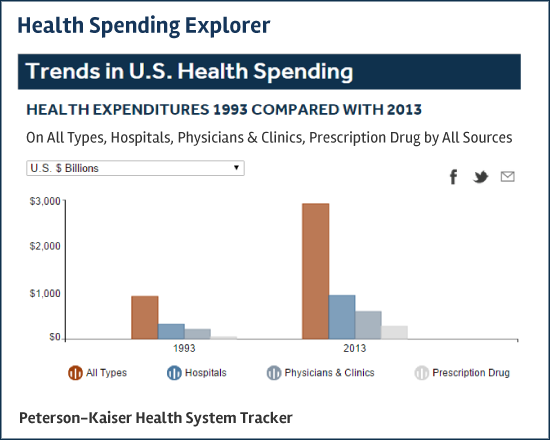
A new interactive tool on the Peterson-Kaiser Health System Tracker allows users to analyze the most up-to-date data on U.S. health spending, then build, display and share the charts they create.

Developed by analysts at the Kaiser Family Foundation, the Health Spending Explorer helps users examine five decades worth of numbers documenting expenditures by federal and local governments, private insurers, and individuals on 15 categories of health services, including hospitals, physician & clinic care, and prescription drugs. The data – which spans from 1960 to 2013 – is drawn from the National Health Expenditure Account, and will be updated with each new data release.

health-spending-explorer_email

The tool can be used to answer such questions as:

  • How much did the United States spend on health services in billions of dollars, inflation-adjusted, in 1993 vs. 2013? (Click here for graph.)
  • What was out-of-pocket per capita spending on hospitals, dental care, physician & clinic services and prescription drugs in 2000 and 2013? (Click here for graph.)
  • What percentage of the country’s total health expenditures was represented by prescription drug spending each year from 1960 to 2013? (Click here for graph.)

The Explorer’s custom-made charts are easily shared through email, Twitter and Facebook, and can be embedded on a web site.

A short video tutorial provides instructions for the tool.

A partnership of the Kaiser Family Foundation and the Peterson Center on Healthcare, the Peterson-Kaiser Health System Tracker is an online information hub dedicated to monitoring and assessing the performance of the U.S. health system.

Gender Differences in Health Care, Status, and Use: Spotlight on Men’s Health

Published: Mar 31, 2015

Women and men face different health concerns and also have different levels of connections to health providers. This slideshow presents findings from the 2013 Kaiser Men’s Health Survey and the 2013 Kaiser Women’s Health Survey contrasting gender-based differences in health, access, and utilization of care.  The data presented highlights the health care challenges facing low-income and uninsured men. The full methodology and report on Women’s Health is available here.

Medicaid Expansion in New Hampshire

Published: Mar 27, 2015

On March 4, 2015, the Centers for Medicare and Medicaid Services (CMS) approved New Hampshire’s Section 1115 waiver to convert its implementation of the Affordable Care Act’s (ACA) Medicaid expansion to a Marketplace premium assistance model as of January 1, 2016.  On August 15, 2014, New Hampshire implemented the ACA’s Medicaid expansion through a state plan amendment with coverage through existing Medicaid managed care plans; however,  authorizing legislation required the state  to obtain waiver authority to mandatorily enroll newly eligible adults in Marketplace Qualified Health Plans (QHPs) using Medicaid as premium assistance for the expansion to continue.  The expansion covers non-working parents from 38-138% of the federal poverty level (FPL, up to $16,242 per year for an individual in 2015), working parents from 47-138% FPL, and childless adults from 0-138% FPL.

As of January, 2016, New Hampshire’s demonstration:

  • Expands Medicaid by purchasing Marketplace QHP coverage for newly eligible adults.
  • Requires newly eligible adults to enroll in Marketplace QHPs to receive Medicaid services.
  • Provides services outside the QHP benefit package, such as Early Periodic Screening Diagnosis and Treatment for 19 and 20 year olds, free choice of family planning provider, non-emergency medical transportation, and limited adult dental and vision benefits, through the state’s Medicaid fee-for-service delivery system.
  • Conditionally waives retroactive coverage, to be implemented after CMS determines that there are no gaps in coverage prior to application and upon renewal for newly eligible adults, based on state data.

New Hampshire is among the 29 states (including DC) implementing the Medicaid expansion to date, most of which are doing so through a state plan amendment.   To date, CMS has approved waivers in Arkansas, Iowa, Indiana, Michigan, and Pennsylvania to implement the ACA’s Medicaid expansion (however, Pennsylvania will convert its waiver to a state plan amendment effective September 1, 2015).

Other states expanding Medicaid through Marketplace premium assistance include Arkansas (required for all newly eligible adults) and Iowa (optional for those from 101-138% FPL).  Unlike other waivers approved to date, New Hampshire did not seek waiver authority to impose premiums or restrict mandatory benefits.  Although not included in the waiver approval, New Hampshire’s application indicated that the state will work with CMS to develop wellness programs as part of its premium assistance demonstration and will include a referral for job counselling services for applicants who are unemployed.  Additional details about New Hampshire’s demonstration are included in Table 1.

Table 1: New Hampshire’s § 1115 Medicaid Expansion Demonstration Waiver
ElementNew Hampshire Waiver Provision
Overview:Uses Medicaid funds to pay Marketplace QHP premiums for all newly eligible adults (estimated 50,000) statewide under the ACA’s Medicaid expansion as of January 2016.
Duration:3/4/15 to 12/31/16.Demonstration may continue for up to 2 more years, through 12/31/18, if state legislature authorizes and state submits letter of intent to CMS at least 6 months before the end of the demonstration year.
Demonstration Goals:Cites promoting continuity of coverage, encouraging Medicaid managed care carriers to also offer Marketplace QHPs, improving economies of scale and competition among QHPs by increasing enrollment, and offering uniform provider access.
Coverage Groups Subject to QHP Premium Assistance:Newly eligible parents with incomes between 38-138% FPL (non-working) and 47-138% FPL (working) and childless adults ages 19-64 between 0-138% FPL.
Populations Exempt from QHP Premium Assistance:  Dual eligible beneficiaries, adults with access to cost-effective employer sponsored coverage, and those who are medically frail are exempt from QHP enrollment.The process to identify medically frail beneficiaries will be described in state’s new adult ABP SPA.  Beneficiaries enrolled in QHP premium assistance who are subsequently determined medically frail can disenroll from the demonstration.American Indian/Alaska Natives can opt out of the demonstration and receive state plan benefits.
Enrollment:Premium assistance enrollment will begin on November 1, 2015, with coverage effective on January 1, 2016.  QHP enrollment is mandatory for demonstration beneficiaries.State provides FFS coverage until QHP enrollment is effective (either the first or second month following QHP selection, depending on application date).
QHP Choice and Auto-Assignment:Beneficiaries will choose between at least 2 silver level QHPs.  The state Medicaid agency will determine which QHPs are available for demonstration beneficiaries.Beneficiaries transitioning to QHP premium assistance from a Medicaid managed care plan will be auto-assigned to the QHP offered by their current Medicaid MCO, if their MCO elects to offer a QHP, and may change QHPs within 30 days; other beneficiaries transitioning to QHP premium assistance can select a QHP.Beneficiaries who do not select a QHP within 30 days of their Medicaid eligibility determination will be auto-assigned to a plan.  The year 1 auto-assignment methodology will take into account factors such as family affiliation, primary care provider affiliation, and premium costs.
Retroactive Coverage:  The demonstration conditionally waives retroactive coverage, to be implemented after CMS determines that retroactive coverage is unnecessary, based on state data showing no gaps in coverage for newly eligible adults prior to their Medicaid application date and upon renewal.  Once implemented, coverage for newly eligible adults will begin on their application date.
Premiums:State pays monthly premiums directly to QHPs.Beneficiaries are not responsible for any premium costs.
Co-payments:State pays monthly cost-sharing reduction payments to QHPs.Beneficiaries with incomes below 100% FPL will be enrolled in 100% actuarial value silver plans and have no co-payments.Beneficiaries from 100-138% FPL will be enrolled in 94% actuarial value silver plans and have co-payments at state plan amounts.
Benefits:QHPs provide services in the state’s Medicaid Alternative Benefits Package (ABP) for newly eligible adults.
Federally qualified and rural health centers:Beneficiaries will have access to at least 1 QHP that contracts with at least 1 FQHC or RHC.
Prescription drugs:Limited to QHP formulary.  Prior authorization within 72 hours instead of 24 hours.
Family planning providers:State covers out-of-network family planning providers on FFS basis.
Wrap-around benefits:Provided on FFS basis (non-emergency medical transportation, EPSDT for 19 and 20 year olds, family planning services and supplies, and certain limited adult dental and vision services).
Appeals:No waivers relating to appeals.  New Hampshire’s waiver application proposed changes to the Medicaid appeals process for beneficiaries receiving premium assistance, although it did not seek waiver authority to do so.  For appeals related to decisions about benefits provided by a QHP, beneficiaries would have access to an internal plan level review and an external review by a state insurance department qualified independent review organization, instead of a Medicaid fair hearing.  Beneficiaries would continue to use the Medicaid fair hearing process for appeals of wrap-around benefits.
Oversight: State Medicaid agency will enter into MOU with QHPs regarding enrollment, payment of premiums and cost-sharing reductions, reporting and data requirements, notices, and audits.
Financing:State is at risk for the per capita cost for demonstration beneficiaries but not for the number of demonstration enrollees.  The budget neutrality determination for year 1 will use a trend rate of 3.7% and a PMPM cost estimate of $701.53.
Cost-Effectiveness:May use state-developed tests of cost-effectiveness for premium assistance that differ from those otherwise permissible.
Evaluation:State shall submit draft evaluation design within 90 days of demonstration award.  Evaluation shall be conducted by independent entity.  Evaluation design and interim and summative reports shall be posted on the state Medicaid agency’s website within 30 days of CMS approval.State shall specify for CMS approval a set of performance and outcome metrics and network characteristics to support rapid cycle assessment of trends under premium assistance and Medicaid FFS.
Cost-Effectiveness:The demonstration evaluation will assess the cost-effectiveness of Medicaid premium assistance, taking into account initial and longer term costs and other impacts such as improvements in service delivery and health outcomes.
Reporting:State must submit quarterly and annual reports to CMS.
Next Steps:QHP enrollment begins November 1, 2015 with coverage effective January 1, 2106.Within 6 months of implementation and annually thereafter, state must hold forum for public comment.


The Story of Medicare: A Timeline

Published: Mar 27, 2015

Written and produced by KFF, The Story of Medicare: A Timeline serves as a visual timeline of Medicare’s history, including the debate that led to its creation in 1965 and subsequent changes, such as: the passage and repeal of the Medicare Catastrophic Coverage Act in the late 1980s, the Medicare Modernization Act in 2003, and the Affordable Care Act in 2010. The video also highlights the program’s impact on the 55 million elderly and disabled Americans it covers today, as well as the fiscal challenges it faces in ensuring its long-term sustainability.

Awaiting New Medicaid Managed Care Rules: Key Issues to Watch

Authors: Julia Paradise and MaryBeth Musumeci
Published: Mar 24, 2015

Introduction

Today, more than half of all Medicaid beneficiaries are enrolled in risk-based managed care organizations (MCOs) through which they receive all or most of their care.1  In addition, many beneficiaries receive at least some services through prepaid health plans that provide limited benefits, such as dental or mental health care, on an at-risk basis. Not all state Medicaid programs contract with MCOs, but a large and growing number are doing so, and some states mandate that beneficiaries enroll in MCOs to receive Medicaid benefits.2  Many states are expanding their MCO programs to include larger geographic areas and more medically complex beneficiaries, and integrating additional services, including behavioral health care and long-term services and supports (LTSS), with physical health care.3  Further, states that have adopted the Affordable Care Act (ACA)’s Medicaid expansion are also relying largely on MCOs to serve the millions of newly eligible adults. In FY 2013, capitation payments to comprehensive MCOs accounted for about 28% of Medicaid spending nationally.4 

States design, administer, and oversee their own Medicaid managed care programs within minimum federal requirements set forth in federal Medicaid law and further elaborated in regulations.5  The federal regulations, last updated in 2002, set forth state responsibilities and requirements in areas including enrollee rights and protections, quality assessment and performance improvement (including provider access standards), external quality review, grievances and appeals, program integrity, and sanctions. The Centers for Medicare and Medicaid Services (CMS) is slated to issue a Notice of Proposed Rulemaking (NPRM) this Spring, revising and updating the current regulations. Numerous stakeholders submitted input and recommendations to CMS to consider in drafting the new rules, and the public will have an opportunity to comment on it before CMS finalizes the regulations.

Agency officials have offered some indications about what issues the new rules might address, including rate-setting, stronger beneficiary protections, and easing beneficiary transitions between Medicaid MCOs, Medicare Advantage plans, and Marketplace qualified health plans.6  The new rules also may address areas that have emerged since the last revision, such as managed LTSS. While this brief focuses on key issues to watch related specifically to states’ MCO programs, many of the same issues are implicated for limited-benefit prepaid plans, and parts of the proposed rule may apply, or further extend, MCO requirements and standards to them, too.7   The issues we have identified reflect assessments of Medicaid managed care over the past decade and the concerns and priorities expressed by a wide range of stakeholders, including states and groups representing beneficiaries, MCOs, and health care providers.

Issue Brief

Beneficiary information and protections

Availability and accessibility of plan information. Medicaid managed care plans are required to make a variety of information available to current and potential enrollees, including enrollment notices, provider directories, enrollee rights and responsibilities, information on covered services and cost-sharing requirements, and grievance and appeals procedures. Current regulations also include requirements that such information be accessible for specified populations, such as individuals with limited English proficiency and people with disabilities. For example, states are required to identify the prevalent non-English languages spoken by enrollees, and both states and MCOs are required to make written information available in each such language and to make oral interpretation services available free of charge. States and MCOs are also required to make information accessible to people with disabilities to ensure effective communication, such as providing information in alternative formats, consistent with the Americans with Disabilities Act (ADA).

The usefulness of MCO information can sometimes be limited for a number of different reasons. For example, MCOs may provide required information in inconsistent formats, making plan comparisons and assessments difficult for beneficiaries. Also, current managed care regulations, which were issued before the internet was so pervasive and dominant a source of public access to information, do not require states and MCOs to provide required information online, and many do not. Notably, regulations implementing the ACA Medicaid provisions call for electronic notices, applications, and appeals, modernizing the program.

Current Medicaid rules are intended to ensure that communications about and with managed care plans are effective for all beneficiaries, and other federal laws establish beneficiary protections as well. The Americans with Disabilities Act (ADA) and Section 504 of the Rehabilitation Act prohibit discrimination against people with disabilities in all programs, activities, and services of public entities, including requirements to ensure effective communication.8  However, states’ and plans’ information for beneficiaries sometimes falls short of the accessibility needs of people with disabilities. For example, plans may fail to provide communications in alternate formats, or may issue materials that are incompatible with screen-reading technology. They may also fail to provide sign language interpreters or other communication aids such as voice recognition systems.9 

What to watch. The new rule could include additional requirements aimed at improving the clarity and accessibility of MCO information. For example, it could require that plan information be made available electronically or posted online by MCOs and states, as is required for provider directories and certain other types of information provided by plans sold through the health insurance Marketplaces.10  CMS also could include additional state oversight requirements and require plans to report on accessibility measures for people with disabilities, to strengthen plan and provider compliance with the ADA and Section 504 of the Rehabilitation Act.

Enrollment and disenrollment processes. Under federal Medicaid law, states have the option to require that most beneficiaries receive Medicaid benefits through an MCO so long as they are offered a choice of two plans (except in specified situations), and other federal statutory and regulatory requirements are met.11  However, states must obtain federal waiver authority to mandate managed care enrollment for certain beneficiaries.12  Federal regulations lay out the general requirements that states must meet in establishing MCO enrollment and disenrollment processes, including a requirement that Medicaid beneficiaries must be allowed to change MCOs during the initial 90-day period following their enrollment in a plan. After that, they may be locked into the MCO until the next annual opportunity to change plans, unless they have “cause” to disenroll from the plan.13 

If beneficiaries do not have sufficient time or information to choose among their managed care plan options, particularly when they first gain Medicaid coverage or are first making the transition from fee-for-service to managed care, they cannot make an informed choice. If beneficiaries do not select an MCO on their own, they are assigned to a plan through a default enrollment process based on a state-defined algorithm. These algorithms may not adequately take into account existing beneficiary-provider relationships or other factors that may optimize beneficiary access to care. Delays in the processing of beneficiary disenrollment requests can also jeopardize beneficiaries. Finally, beneficiaries do not have the right to disenroll from an MCO if a provider from whom they have been receiving ongoing treatment or services leaves the MCO’s network, potentially disrupting their care and thereby causing harm.

What to watch. New Medicaid managed care rules could incorporate stronger beneficiary protections in the areas of enrollment and disenrollment. For example, the new rule could require states to offer independent options counseling to assist beneficiaries making enrollment decisions with this often complex and unfamiliar process. It could also require them to develop and use “intelligent assignment” algorithms that, to the extent possible, preserve continuity of providers and services for beneficiaries subject to default enrollment in plans. The regulation also could establish specific requirements for state agencies and plans regarding expedited disenrollment requests. For example, CMS could further the define the requirement that states permit beneficiaries to disenroll from an MCO for cause at any time by specifying “for cause” criteria that address the types of problems that beneficiaries in plans have encountered.14  The rule could also require states to provide beneficiaries who are disenrolling and must enroll in a different plan with the information necessary to make an informed choice when doing so, such as current provider directories.

Enrollee appeal rights. The Medicaid program includes a basic set of beneficiary protections, such as the right to adequate notice and a state fair hearing, which are grounded in the Due Process Clause of the U.S. Constitution.15   In addition to the state fair hearing process, Medicaid MCOs must establish internal appeal procedures for enrollees to challenge the denial or termination of Medicaid covered services.16  MCOs are required to notify beneficiaries when they take an action subject to appeal and provide beneficiaries with the reasons for service denials, terminations, or reductions. The notice must describe the right to and process for an appeal, how to request an expedited appeal, and how to request that services continue while an appeal is pending. The notice must be easily understandable and accessible to those with limited English proficiency and those with disabilities. MCOs must offer beneficiaries access to an internal plan hearing, during which beneficiaries can present their case and have their appeal decided by a person who was not involved in the initial decision and who has appropriate expertise if medical necessity or clinical issues are involved.

Notwithstanding these protections for Medicaid beneficiaries, problems with the MCO internal appeals processes and the required notices sometimes occur. Among these problems are impermissible delays in issuing written plan appeal decisions, despite prescribed timeframes in current regulations; notices that do not contain all required elements; insufficient state oversight of MCO appeals processes; and lack of training for MCOs regarding state and federal requirements.17  Weaknesses in the current regulations have also been cited as a factor contributing to inappropriate disruptions in enrollees’ access to services. Specifically, the regulations now provide that, when a beneficiary appeals a termination of a service, the Medicaid MCO is required to continue services until the end of the “authorization period” for the service – a formulation that conflicts with the general Medicaid appeals rule, which entitles beneficiaries to continued benefits for as long as the appeal is still pending.18  The right to continued benefits pending appeal is grounded in Constitutional due process, based on Supreme Court decisions holding that individuals cannot be deprived of public benefits such as Medicaid services without a pre-termination appeal hearing. This issue has become more pronounced with the expansion of managed LTSS programs, which involve beneficiaries who have ongoing needs for services to ensure their ability to live independently in the community. Terminating services such as personal care assistance while an appeal is pending can disrupt existing arrangements and threaten the beneficiary’s ability to remain in the community safely, even if the appeal is ultimately resolved in the beneficiary’s favor.

What to watch. In the revised rules, CMS could clarify that services must be continued pending a final appeal decision, regardless of whether an authorization period has expired. The agency could also strengthen enforcement of timeframes for MCO resolution of complaints and reviews. The rule could also provide for state oversight and review of service plan reductions and appeals as part of ongoing monitoring and during beneficiary transitions to managed care, to identify systemic issues and ensure that MCOs are providing all medically necessary covered services. The rule could also establish requirements for states to educate managed care contractors about the grievance and appeals requirements.19 

Grievance systems. MCOs also must establish an internal grievance process for beneficiaries. The grievance process allows beneficiaries to raise issues that are not subject to appeals, such as concerns about care quality or a plan’s or provider’s failure to respect enrollee rights. States have flexibility to determine the method that MCOs will use to notify enrollees of the disposition of their grievances.

There is both a lack of uniformity and variation in quality between different plans’ grievance systems. In addition, as noted above, sometimes enrollees with disabilities and limited English proficiency struggle to access the grievance and appeal system, contrary to the requirements of Section 504 of the Rehabilitation Act and Title VI of the Civil Rights Act.

What to watch. CMS could propose uniform requirements governing grievance processes and seek to ensure that states actively enforce those requirements by, for example, requiring states to certify their compliance.

Provider network adequacy

States are required by federal Medicaid law to ensure that MCO provider networks are adequate and appropriate to meet the needs of their Medicaid enrollees and that enrollees have timely access to covered services. MCOs, in turn, are required to ensure that they meet state standards.20  The federal rules do not establish specific standards for network adequacy or timeliness of access; rather, states define their own standards based on the general factors set out for consideration in the federal regulation.

Two recent studies by the Department of Health and Human Services (HHS) Office of Inspector General (OIG) identified important gaps in state and federal oversight of Medicaid MCO access standards and network adequacy. One study found that, while all 33 states identified as having MCO programs have quantitative access standards in place (e.g., maximum time or distance to a provider, required provider-to-enrollee ratios) and employ various strategies for assessing MCO compliance, few states actually test access directly, using “secret shopper” methods that involve calling provider offices to determine whether they accept new Medicaid patients or what the wait time for the next available appointment is. The study also cited limited CMS oversight of state access standards.21  In a companion study, the OIG found evidence of widespread inaccuracies in plans’ provider directories and determined that wait times for appointments exceeded one month for more than one-quarter of the providers who could offer appointments to Medicaid enrollees.22 

What to watch. The new Medicaid managed care rule could seek to address some of the problems identified in the OIG reports. For example, it could require states and MCOs to ensure that provider directories are corrected and updated in a timely manner as providers’ participation status changes (under the current regulation, this information must be provided annually or at an enrollee’s request). The new rule could also require states to conduct direct tests of access relative to state standards, such as through “secret shopper” studies as described above. Some stakeholder groups representing beneficiaries have weighed in with suggested strategies to more effectively ensure that Medicaid beneficiaries enrolled in MCOs have adequate access to providers.23  For example, the rule could require states to report to CMS on the results of their monitoring and oversight activities and the corrective actions they take. It could establish specific requirements for state and plan monitoring of provider availability, such as quarterly reporting by MCOs to states and the public, online and in written form, on the number, type, location, and current capacity of the providers in their networks providers.24  Timeliness standards could be established for state action when access problems are identified, and a system of recourse for beneficiaries who cannot gain needed access to providers could be required of states.

Quality of care

Federal rules require states that contract with MCOs to have in place a strategy for assessing and improving the quality of care provided to MCO enrollees. States must also have arrangements for annual external review of managed care quality. States have a great deal of flexibility in designing their quality strategies and standards, specifying the procedures for assessing the quality of care provided by MCOs,  monitoring plan compliance, and establishing specific performance improvement and reporting requirements in plan contracts.25  Although HHS has developed core quality measure sets for children and adults in Medicaid and a standardized reporting system for states, federal regulations do not specify which quality measures states must use in their MCO quality programs;26  in addition, there are recognized gaps in the availability of quality measures for LTSS.27  Some stakeholders have noted that standardized reporting on a limited set of quality measures would allow for meaningful comparisons of quality performance across both MCOs and states.28 

What to watch. The new Medicaid managed care rules could include more specific requirements regarding MCO quality measurement and reporting. For example, CMS could propose that MCOs and states report on a standardized set of measures, such as those common to both HHS’s pediatric and adult core quality measures and the Medicaid Healthcare Effectiveness Data and Information Set (HEDIS) measures that many states currently require MCOs to report. In light of the expansion of Medicaid managed care to include more special-needs populations, including individuals with disabilities, beneficiaries with LTSS needs, and people with behavioral health conditions, the proposed rule could also require that, in developing quality measurement and reporting strategies, states consider the needs of these populations and specify the factors that states must take into account.29 

Managed long-term services and supports

A growing number of states are expanding their Medicaid managed care programs to people with LTSS needs, including seniors and people with disabilities, some of whom are dually eligible for Medicaid and Medicare. These initiatives involve the coverage and delivery of LTSS – institutional and/or home and community-based services, increasingly with the inclusion of physical and behavioral health services – through MCO contracts, or managed LTSS (MLTSS).30   States have indicated that they are moving LTSS into managed care plans in an effort to improve care quality and health outcomes through increased coordination and MCO accountability across the full spectrum of services that beneficiaries need. However, MCOs may lack experience serving beneficiary groups with more complex needs and those who self-direct their services, and their existing networks may not include providers who are important to their care, such as those who provide HCBS.31  In addition, a shift to MLTSS risks disrupting beneficiaries’ existing care arrangements.32  Therefore, some additional beneficiary protections specifically related to MLTSS may be appropriate.

Recognizing a growing need for federal policy on MLTSS in light of widening use of these arrangements, CMS issued guidance in 2013 that identified best practices among states and laid out CMS’ expectations for MLTSS programs.33  CMS identified a number of elements that characterize a high-quality MLTSS program. These elements include: support for beneficiaries in enrolling in and disenrolling from MLTSS programs, including choice counseling to help potential participants and caregivers understand their MLTSS options; independent advocacy or ombudsman services free-of-charge to participants; processing of enrollment by an independent, disinterested entity; and enhanced disenrollment opportunities, particularly when the termination or exit of a provider from an MCO’s network could cause a disruption in a beneficiaries’ residential placement or employment. Additional elements of high-quality MLTSS programs include qualified provider networks to ensure adequate access, beneficiary protections, and a comprehensive quality improvement strategy.

What to watch. Given that the current managed care rules pre-date most MLTSS programs, the proposed new rule could formally incorporate some of the elements of the 2013 MLTSS guidance. For example, per the guidance, the rule could require states or MCOs to allow enrollees to disenroll or change MCOs if their LTSS providers leave the MCO network, if there is jeopardy to the beneficiary’s living arrangements or employment. It could also require states and plans to provide for a transition period during which new MCO enrollees can continue with their existing LTSS providers and/or previously authorized services. To help beneficiaries understand their options and rights, choose among MCOs, enroll and disenroll, access services, and navigate grievance and appeals processes, and also to identify systemic problems in MLTSS programs, the rule could require states to provide for the services of independent ombudsman.34  Some states already have managed care ombudsman programs, and the capitated financial alignment demonstrations for beneficiaries dually eligible for Medicare and Medicaid include them.

States could be held to more specific oversight standards to ensure that MCO provider networks include an appropriate range of MLTSS providers and that MCO quality improvement strategies take into account the special circumstances of populations needing LTSS. For example, CMS could require states to routinely monitor the availability of MLTSS providers, to certify to CMS that all MLTSS plans comply with standards for service availability, and/or to develop systems in their MLTSS programs for identifying, tracking, and eliminating disparities in access to health care services for enrollees. In addition, the rule could strengthen state oversight requirements regarding physical accessibility of health care services and sites (including accessibility of exam tables, x-ray equipment, etc.) and accessibility of plan information and communications for people with disabilities. Some possible approaches to strengthening enforcement could be to require states to develop and report quality measures related to accessibility for people with disabilities, or to require MLTSS providers to submit compliance plans that describe how they will ensure accessibility for all enrollees.

Capitation rates

Actuarial soundness. Federal law requires that capitation rates for MCOs be “actuarially sound,” and federal regulations define actuarially sound rates as those developed in accordance with generally accepted actuarial principles and practices, appropriate for the populations covered and services furnished, and certified by qualified actuaries.35  States are required to demonstrate their compliance by documenting the methodologies and data they use to set rates.

The purpose of the actuarial soundness requirement is to ensure that Medicaid MCO capitation rates are adequate to cover the costs of care needed by their enrollees and counteract inherent incentives to plans at financial risk to avoid higher-need beneficiaries or deny services. Appropriate rate-setting concerns MCOs and their contracted providers, Medicaid beneficiaries, and states, which are responsible for ensuring both beneficiary access to care and sound fiscal management.

In 2010, the GAO issued a report assessing CMS oversight of states’ compliance with the actuarial soundness requirements. The GAO study found weak and inconsistent CMS oversight of states’ rate-setting as well as inadequate CMS efforts to ensure the quality of the data used to set rates.36  Data quality is a particular problem in setting rates for people with complex health care needs since states have less experience providing capitated services to people with disabilities or chronic conditions, or who need LTSS or behavioral health care. In the years since the GAO report, CMS has issued “consultation guides” that provide additional guidance to states about the information they must take into account in setting actuarially sound rates for Medicaid enrollees.”37  Some stakeholders representing Medicaid MCOs and providers have expressed support for measures to increase transparency and accountability in state rate-setting processes.

What to watch. The new managed care rule could codify standards and requirements that are described in the consultation guides or strengthen those requirements by, for example, establishing standards regarding the  transparency of the rate-setting process. It could also seek to increase state accountability in this area, for example, by requiring states to conduct routine examinations of the effect of capitation payment rates on beneficiary access to care or establishing a process by which MCOs, providers, and beneficiaries can raise concerns about states’ capitation rates, which might trigger CMS review and possible adjustments.38 

Medical loss ratio.  A medical loss ratio (MLR) is the share of premium revenues that an insurer or managed care plan spends on patient care and quality improvement activities, as opposed to administration, marketing, and profits. The ACA established a minimum MLR of 80% for most insurers in the individual and small group markets, and set the threshold at 85% for large group plans. The health reform law also established a minimum MLR of 85% for Medicare Advantage and Medicare prescription drug plans. The federal minimum MLR requirements do not apply to Medicaid plans, although some states have minimum MLRs for their Medicaid MCOs in state law or contract provisions, and some states include minimum MLR requirements for plans providing care under the dual eligible financial alignment demonstrations.39 

What to watch. CMS could propose a federal minimum MLR requirement for Medicaid MCOs to ensure that plans serving Medicaid beneficiaries meet the standard that plans serving other Americans must meet and that an appropriate portion of the federal and state dollars that fund capitated rates are spent on services to beneficiaries rather than plan administration and profits.

Encounter data

Federal legislation enacted in 1997 required all states to report managed care encounter data to CMS as part of their Medicaid Statistical Information System (MSIS) submissions, and federal regulations require MCOs to collect encounter data, ensure their accuracy and completeness, and make them available to the state.40  A 2009 HHS Office of Inspector General report found that all states with MCOs require their plans to collect and report encounter data, and that the majority use the data to manage their programs, but that CMS has not enforced the requirement that states submit their managed care encounter data to the federal government. The OIG recommended that CMS clarify and enforce the federal requirements for encounter data submission and seek authority to sanction states that fail to comply.41  The ACA strengthened the requirement for Medicaid MCOs to provide encounter data to states and permits federal Medicaid matching funds to be withheld from states that fail to report accurate enrollee encounter data to CMS “at a frequency and level of detail to be specified by the Secretary.”42  Notably, CMS is requiring encounter data from states that are participating in the financial alignment demonstrations for dually eligible beneficiaries.43 

Encounter data give state and federal governments an important monitoring tool to make sure that beneficiaries are getting needed care, and can be used to assess plan performance on measures of utilization, access, and quality. These data can be used to track rates of use of high-value or high-interest services, such as preventive screening, immunizations, or hospitalizations, including readmissions, and to identify disparities in utilization of services across populations or geographic areas within communities.44  Encounter data are also important input for calculating payments under risk stabilization programs – for example, for purposes of making retrospective reinsurance payments based on the use of high-cost services or the number of high-cost beneficiaries. Encounter data are also necessary for targeted studies of high-need or other populations of key policy interest. To illustrate, they could be used to determine whether HIV+ beneficiaries are receiving needed drugs, or whether beneficiaries with mental illness are receiving appropriate preventive care.

What to watch. In the new regulations, CMS could propose specific standards for encounter data reporting by plans and states, regarding required timeframes, elements, format, validation, etc. The rule could also include provisions to strengthen state oversight responsibilities and accountability.

Program integrity

Under federal law, CMS and the states are responsible for the proper and efficient operation of the Medicaid program and must ensure Medicaid program integrity by preventing, detecting and recovering improper payments.45  CMS conducts comprehensive state program integrity reviews, which include an assessment of states’ managed care program integrity activities. CMS also contracts with Audit Medicaid Integrity Contractors to conduct post-payment audits of Medicaid providers, including MCOs. Through its Medicaid Integrity Institute, CMS offers training to state program integrity officials, including courses on managed care issues, and it provides guidance and technical assistance to states as well. In addition, MCOs are required by law to have in place a compliance plan designed to guard against fraud, waste, and abuse.

Recently, however, the Government Accountability Office (GAO) issued a report that identified gaps in state and federal efforts to ensure Medicaid managed care program integrity.46  The GAO found that CMS has largely delegated managed care program integrity oversight activities to the states but has given them little specific guidance. The study also found that CMS does not require states to audit their payments to MCOs, and that states were not closely examining the activities of MCOs. The GAO recommended that CMS require states to audit payments to and by MCOs to better ensure program integrity. In addition, it recommended that CMS increase its oversight and support for states and update its guidance on Medicaid managed care program integrity.

What to watch. CMS could incorporate requirements in the proposed rule that reflect the GAO’s recommendations. For example, it could require states to audit MCO payments and specify required elements of, or set standards for, state managed care audit systems.

Conclusion

In the more than 10 years that have elapsed since the federal Medicaid managed care regulations were last revised, states have continued to expand their reliance on managed care plans to serve Medicaid beneficiaries. States are increasingly enrolling populations with more complex medical and LTSS needs in MCOs, as well as millions of Americans who are newly gaining Medicaid under the ACA. Accordingly, state and federal Medicaid spending on managed care also continue to grow in both total dollars and as a proportion of overall Medicaid spending. Given the growing role of Medicaid managed care and the beneficiary, plan, provider, and budgetary issues at stake, the need for sound operation of managed care programs, timely and accurate data on plan and program performance, strong beneficiary protections, and robust state and CMS oversight is great.

In crafting new managed care regulations, CMS will likely seek to strike a balance between strengthening federal standards and avoiding rules that are too prescriptive to account for diverse Medicaid programs and markets or that pose barriers to desirable state innovation. The new regulations present CMS with an opportunity to address managed care developments over the last decade, such as the expansion of managed LTSS, the inclusion of populations with special health care needs, and the increased use of the internet and demand for electronic information. With the benefit of recent assessments of key aspects of Medicaid managed care, federal policy recommendations for strengthening the existing regulations, and broad stakeholder input, the new rule has the potential to enhance the framework for Medicaid managed care programs, increasing the prospects for high performance in terms of access, quality, and costs in this vital sector of Medicaid. Rigorous state and federal oversight and enforcement of Medicaid managed care will be essential to ensure that those prospects can be realized and that beneficiaries can receive the necessary services to which they are entitled.

Assistance in preparing this issue brief was provided by Health Policy Alternatives, Inc.
Endnotes

  1. Medicaid Managed Care Market Tracker, Kaiser Family Foundation, https://modern.kff.org/data-collection/medicaid-managed-care-market-tracker/ ↩︎
  2.   Vernon Smith et al. Medicaid in an Era of Health and Delivery System Reform: Results from a 50-State Medicaid Budget Survey for State Fiscal Years 2014 and 2015, Kaiser Family Foundation, October 2014, https://modern.kff.org/medicaid/report/medicaid-in-an-era-of-health-delivery-system-reform-results-from-a-50-state-medicaid-budget-survey-for-state-fiscal-years-2014-and-2015/ ↩︎
  3. MaryBeth Musumeci, Key Themes in Capitated Medicaid Managed Long-Term Services and Supports Waivers, Kaiser Commission on Medicaid and the Uninsured (November 2014), https://modern.kff.org/medicaid/issue-brief/key-themes-in-capitated-medicaid-managed-long-term-services-and-supports-waivers/ ↩︎
  4. Ibid. Table at https://modern.kff.org/other/state-indicator/total-medicaid-mco-spending/ ↩︎
  5. Mostly in Sections 1903(m) and 1932 of the Social Security Act (42 U.S.C. § § 1396b(m), 1396u-2) and 42 CFR Part 438. ↩︎
  6. Virgil Dickson, “Coming Medicaid plan rules will set new access standards,” Modern Healthcare, “October 28, 2014, http://www.modernhealthcare.com/article/20141028/NEWS/310289915 ↩︎
  7. Comprehensive Medicaid managed care organizations (MCOs) provide comprehensive acute care, and in some cases, long-term services and supports as well, to Medicaid enrollees. States pay MCOs a fixed monthly premium or “capitation rate” on behalf of each enrollee. Limited-benefit prepaid health plans (PHPs) provide a limited set of inpatient or outpatient Medicaid benefits, such as mental health services, usually on a capitation basis. ↩︎
  8. See, e.g., 28 C.F.R. § 35.104 (defining auxiliary aids and services under ADA Title II, which applies to state and local governmental entities) ↩︎
  9. Mara Youdelman and Elizabeth Edwards, Medicaid Managed Care Model Provisions: Accessibility & Language Access, Issue 4, National Health Law Program,  http://www.healthlaw.org/issues/medicaid/managed-care/medicaid-managed-care-model-provisions-issue-4#.VONaWPnF-So ↩︎
  10. Sarah Somers, Medicaid Managed Care: Modernized Federal Regulations are Long Overdue, Health Advocate, E-Newsletter of the National Health Law Program (September 2014). For ACA information transparency requirements, see 45 CFR 155.205, 155.220 and 156.230. ↩︎
  11. Section 1932(a)(3) of the Social Security Act (42 U.S.C. § 1396u-2) ↩︎
  12. States are prohibited from mandating enrollment in MCOs for children with special health care needs, beneficiaries dually eligible for Medicaid and Medicare, and Native Americans unless they obtain a federal waiver to do so.  42 U.S.C. § 1396u-2(a)(2) ↩︎
  13. Social Security Act, § 1932(a)(4) [42 U.S.C. § 1396u-2(a)(4)] ↩︎
  14. Ibid. ↩︎
  15. MaryBeth Musumeci,  A Guide to the Medicaid Appeals Process, Kaiser Commission on Medicaid and the Uninsured (March 2012), https://modern.kff.org/wp-content/uploads/2013/01/8287.pdf ↩︎
  16. 42 CFR Part 438, Subpart F ↩︎
  17. Sarah Somers, Medicaid Managed Care Model Provisions: Grievances and Appeals, Issue No. 1, National Health Law Program (September 17, 2014), http://www.healthlaw.org/publications/medicaid-managed-care-model-provisions-series-issue-1#.VRFjSvnF98E ↩︎
  18. Compare 42 C.F.R. § 438.420 with 42 C.F.R. § 431.230; see also Medicaid Managed Care: Grievances and Appeals, Fact Sheet #4, National Health Law Program (April 2012), http://www.healthlaw.org/issues/medicaid/managed-care/MMC-Fact-4#.VOtkm_nF98E ↩︎
  19. Medicaid Managed Care Model Provisions: Grievances and Appeals, op. cit. ↩︎
  20. 42 CFR § § 438.206, 438.207 ↩︎
  21. State Standards for Access to Care in Medicaid Managed Care, Department of Health and Human Services, Office of the Inspector General (September 2014), http://oig.hhs.gov/oei/reports/oei-02-11-00320.pdf ↩︎
  22. Access to Care: Provider Availability in Medicaid Managed Care, Department of Health and Human Services, Office of the Inspector General (December 2014), http://oig.hhs.gov/oei/reports/oei-02-13-00670.pdf ↩︎
  23. See, e.g., Abbi Coursolle, Medicaid Managed Care Model Provisions: Network Adequacy, Issue 3, National Health Law Program (September 16, 2014),  http://www.healthlaw.org/issues/medicaid/managed-care/medicaid-managed-Care-model-provisions-issue-3#.VRFkevnF98E and Medicaid Managed Care for People with Disabilities: Policy and Implementation Considerations for State and Federal Policymakers, National Council on Disability (March 18, 2013), http://www.ncd.gov/publications/2013/20130315/ ↩︎
  24. Medicaid Managed Care Model Provisions: Network Adequacy, op. cit. ↩︎
  25. 42 CFR §§ 438.202, 438.204 ↩︎
  26. Section 402(a) of the Children’s Health Insurance Program Reauthorization Act of 2009 (CHIPRA) requires identification of children’s core quality measures and Section 2701 of the Affordable Care Act requires identification of adult core quality measures. For more information, see the CMS Technical Assistance Center at http://www.medicaid.gov/medicaid-chip-program-information/by-topics/quality-of-care/quality-of-care.html ↩︎
  27. MaryBeth Musumeci, Measuring Long-Term Services and Supports Rebalancing, Kaiser Commission on Medicaid and the Uninsured (February 2, 2015), https://modern.kff.org/medicaid/fact-sheet/measuring-long-term-services-and-supports-rebalancing/ (See endnotes 11 and 12) ↩︎
  28. MaryBeth Musumeci, Rebalancing in Capitated Medicaid Managed Long-Term Services and Supports Programs: Key Issues from a Roundtable Discussion on Measuring Performance, Kaiser Commission on Medicaid and the Uninsured (February 2,  2015), https://modern.kff.org/medicaid/issue-brief/rebalancing-in-capitated-medicaid-managed-long-term-services-and-supports-programs-key-issues-from-a-roundtable-discussion-on-measuring-performance/ ↩︎
  29.  Ibid. ↩︎
  30. Julia Paradise, Medicaid Moving Forward, Kaiser Commission on Medicaid and the Uninsured (March 9, 2015), https://modern.kff.org/medicaid/fact-sheet/the-medicaid-program-at-a-glance-update/ ↩︎
  31. Rebalancing, op. cit. ↩︎
  32. MaryBeth Musumeci, Key Themes in Capitated Medicaid Managed Long-Term Services and Supports Waivers, Kaiser Commission on Medicaid and the Uninsured (November 2014), https://modern.kff.org/medicaid/issue-brief/key-themes-in-capitated-medicaid-managed-long-term-services-and-supports-waivers/ ↩︎
  33. Guidance to States using 1115 Demonstrations or 1915(b) Waivers for Managed Long Term Services and Supports Programs, Centers for Medicare and Medicaid Services (May 2013), http://www.medicaid.gov/Medicaid-CHIP-Program-Information/By-Topics/Delivery-Systems/Downloads/1115-and-1915b-MLTSS-guidance.pdf ↩︎
  34. Ibid. ↩︎
  35. Section 1903(m)(2)(A)(iii) of the Social Security Act requires states to pay Medicaid health plans rates that are actuarially sound. Actuarial soundness is defined through regulations at 42 CFR §438.6(c)(i). ↩︎
  36. Medicaid Managed Care: CMS’s Oversight of States’ Rate Setting Needs Improvement, U.S. Government Accountability Office  (August 2010), http://www.gao.gov/assets/310/308487.pdf ↩︎
  37. 2015 Managed Care Rate Setting Consultation Guide, Centers for Medicare and Medicaid Services (September 2014), http://www.medicaid.gov/medicaid-chip-program-information/by-topics/delivery-systems/managed-care/downloads/2015-medicaid-manged-care-rate-guidance.pdf ↩︎
  38. Letter from Association of Community Affiliated Plans to Cindy Mann, Director of the Center for Medicaid and CHIP Services, dated April 29, 2014. Letter from American Hospital Association to Cindy Mann, dated December 5, 2014. ↩︎
  39.  MaryBeth Musumeci, Financial and Administrative Alignment Demonstrations for Dual Eligible Beneficiaries Compared: States with Memoranda of Understanding Approved by CMS, Kaiser Commission on Medicaid and the Uninsured (July 24, 2014), https://modern.kff.org/medicaid/issue-brief/financial-alignment-demonstrations-for-dual-eligible-beneficiaries-compared/ ↩︎
  40. Medicaid Managed Care Encounter Data: A Toolkit for Data Collection, Validation, and Reporting, prepared by Mathematica Policy Research for Centers for Medicare and Medicaid Services (November 2013), http://www.medicaid.gov/medicaid-chip-program-information/by-topics/data-and-systems/downloads/medicaid-encounter-data-toolkit.pdf ↩︎
  41. Medicaid Managed Care Encounter Data: Collection and Use, U.S. Department of Health and Human Services, Office of Inspector General (May 2009), http://oig.hhs.gov/oei/reports/oei-07-06-00540.pdf ↩︎
  42. 42 U.S.C. § § 1396(I)(25), 1396b(r)(1)(F), 1396b(m)(2)(A)(xi) ↩︎
  43. MaryBeth Musumeci, Financial Alignment Demonstrations for Dual Eligible Beneficiaries: A Look at CMS’s Evaluation Plan, Kaiser Commission on Medicaid and the Uninsured (July 18,  2014),  https://modern.kff.org/medicaid/issue-brief/financial-alignment-demonstrations-for-dual-eligible-beneficiaries-a-look-at-cmss-evaluation-plan/ ↩︎
  44. Embry M. Howell, “Medicaid Managed Care Encounter Data: What, Why, and Where Next?” Health Care Financing Review 17(4), Summer 1996. ↩︎
  45. 42 USC § 1396a(a)(37)(B) and 42 USC § 1396b(m)(2)(A)(iv); § 1396u-6 ↩︎
  46. Medicaid Program Integrity: Increased Oversight Needed to Ensure Integrity of Growing Managed Care Expenditures, U.S. Government Accountability Office (May 2014), http://www.gao.gov/assets/670/663306.pdf ↩︎

Medicare Timeline

Published: Mar 24, 2015

This timeline provides an overview of changes that have shaped the Medicare program over the past five decades. Please explore KFF’s other Medicare resources.

Repayments and Refunds: Estimating the Effects of 2014 Premium Tax Credit Reconciliation

Authors: Cynthia Cox, Anthony Damico, Gary Claxton, Rosa Ma, and Larry Levitt
Published: Mar 24, 2015

Issue Brief

In January 2014, the Affordable Care Act (ACA) began making federal premium tax credits available to eligible individuals who purchased health coverage through exchanges, or Marketplaces.  These subsidies are a centerpiece of the law and are designed to provide financial assistance to millions of Americans who could not otherwise afford health coverage.

Taxpayers may claim a premium tax credit for themselves and other family members based on their income for the year.  An individual or family may also elect to receive an advance premium tax credit (APTC) based on projected household income.  Projected income may be based on previous income history and may be documented with the most recent available tax return or with other evidence of income.  These advance credits are an estimate and must be reconciled based on actual income when people file their taxes.  People who received an overpayment of the premium tax credit (for example, due to an unexpected increase in income midyear) have to repay some of or the entire amount overpaid when they file their taxes. Conversely, people who received an underpayment of the tax credit may get a refund when reconciling their advance payments with their actual annual income and subsidy eligibility.

There are several reasons that may cause people to need to reconcile their advance credits.  The simplest is just that their income may change.  Another is that there may be a change in the size of the family (e.g., birth, death, divorce), which affects the family’s income as a percent of poverty. People are encouraged to report these changes to the Marketplace so that their advance credit may be modified, but notification may not happen in all cases and even when midyear changes are reported, some reconciliation will likely occur when taxes are filed.

In this brief, we focus on reconciliation based only on income changes (prior year v. current year), and estimate that 50% of subsidy-eligible tax households would owe some repayment and 45% would receive a refund.  Subsidy-eligible tax households with starting incomes under 200% of poverty would be somewhat more likely to owe a repayment (54%) and somewhat less likely to receive a refund (40%). (Throughout this brief we define “subsidy-eligible tax households” as those households containing any individual who would have been determined eligible for advance payment of the premium tax credit based on their starting incomes).

Among those projected to owe a repayment, the average repayment amounts would be $667 for taxpayers with starting incomes under 200% of poverty, $886 for taxpayers with starting incomes of 200-300% of poverty, and $1,380 for taxpayers with starting incomes of 300-400% of poverty.  Among those projected to receive a refund, the average refund amounts would be $412 for taxpayers with starting incomes under 200% of poverty, $1,016 for taxpayers with starting incomes of 200-300% of poverty, and $1,601 for taxpayers with starting incomes of 300-400% of poverty.  Overall, the estimated average repayment is $794 and the refund is $773.

Overview of Reconciliation of the Premium Tax Credit

The premium tax credit is a refundable tax credit available to U.S. citizens and legal immigrants with incomes in the range of 100-400% of the federal poverty level who are not eligible for other affordable coverage.  Offered on a sliding scale based on income, the premium tax credit limits what people will be required to pay for a benchmark health plan to a percentage of their income (ranging in 2014 from 2% to 9.5% of income).

The law allows eligible enrollees to take the premium tax credit in the form of an advance payment because low- and moderate-income people generally would not be able to afford the coverage without upfront assistance.  When enrollees choose the advance payment option, their tax credits are paid directly to the insurer they select. Enrollees then pay the remaining share of the monthly premium to the insurer (and out-of-pocket costs if they use health care).

The amount of the premium tax credit a family ultimately receives, though, is based on their annual household income as reported on their tax return.  For those who choose to wait and claim the entire credit when they file their taxes the following year, the credit will be applied against any taxes they owe or will be sent as a refund to those who do not owe any taxes.  For people who choose advance payments the process is different. Because their coming year’s annual income will not be known at the time they apply for advance payment of the tax credit, eligibility for advance payment is based on an estimate of income for the year and may be verified using their most recent tax return or, if current income is different, pay stubs or other documentation.

People applying early in open enrollment for advance payments beginning in January 2014, therefore, would have likely had their incomes verified by their 2012 tax returns (as this was the most recent tax return they would have had). Unless applicants actively accounted for changes between 2012 and current income, their subsidies may have been based on an already out-of-date income. People applying toward the end of 2014 open enrollment may have been more likely to use 2013 income in their applications, particularly if they had filed their 2013 taxes before applying, but they still may have experienced changes in income during 2014.

As shown below, household incomes change, sometimes significantly, over the course of a year. Enrollees are expected to contact the Marketplace when they experience changes in their incomes so that their subsidies can be recalculated, but there is as of yet no indication of how often this contact is made.

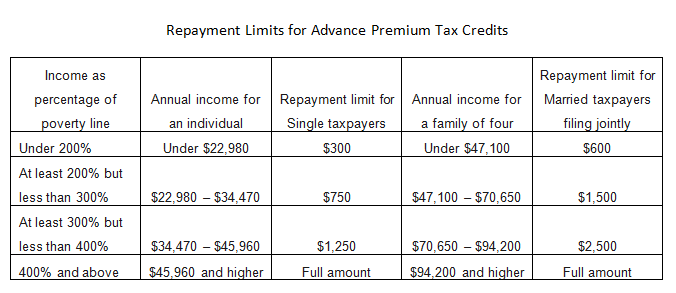
The law requires that any advance payments received in a year be reconciled against the tax credits for which individuals and families are eligible based on their annual income reported on their tax return.  If the advance payment exceeded the amount of the credit for which individuals were ultimately eligible, a portion of the overpayment must be repaid.  While the ACA originally limited the amount that had to be repaid to $250 for an individual and $400 for a family, Congress subsequently raised the repayment caps and created a scaled repayment structure, as shown in the table below.

Figure 1: Limits on Repayments For Advanced Payment of the Premium Tax Credit
Annual 2014 Income (as a % of 2013 FPL)Maximum repayment amount for a single individualMaximum repayment amount for couples and families
100% to <200%$300$600
200% to <300%$750$1,500
300% to 400%$1,250$2,500
Greater than 400% FPLFull amountFull amount
Note: Enrollees with incomes that fall below poverty at the time of reconciliation are not expected to repay the tax credit.Source: 2012-24 Internal Revenue Bulletin, § 1.36B–4.

Households that end up having an annual income within the subsidy range (100-400% of poverty) will have caps on their repayment amounts. Those whose incomes rise above the subsidy range (over 400% of poverty) have no limit on repayment and therefore may be subject to sizeable repayments when they file their taxes. Some households may have a decrease in income during the year that puts them below the subsidy range. In this case, though, the person or family would not be subject to a repayment and may even receive a refund.

For example, a single 40-year-old living in Atlanta, GA with a starting income of $17,000 (148% of 2013 FPL) may have qualified for advance payments totaling $2,614 for 2014. If the enrollee’s annual 2014 income increased to $23,000 (200% of 2013 FPL), she ultimately would qualify for $1,824 in premium assistance. Assuming she did not notify the Marketplace of her income change, she would owe a repayment of $750 (because $2,614 minus $1,824 equals $790, which exceeds her repayment cap of $750). If her annual 2014 income rose even higher to $46,000 (which is above 400% of 2013 FPL), she would no longer be eligible for assistance and would be required to repay the entire $2,614 she received in advance payments.

Some Marketplace shoppers were eligible for two types of assistance: the premium tax credit described above and a second form of assistance called cost sharing reductions, which limit out-of-pocket costs for the lowest income enrollees. The cost sharing reductions are not subject to reconciliation.

Estimates of Repayments and Refunds

We use the Survey of Income and Program Participation to model the subsidy-eligible population at the start of 2014 and to track income changes over time among this group in order to estimate how many would face repayment or receive refunds this tax season and the amounts of their repayments or refunds.  We focus on the cohort of households that were subsidy eligible at the beginning of the year and follow them through the year.  Eligible people are assumed to retain Marketplace coverage unless they obtain public coverage or they obtain or become eligible for employer-sponsored coverage.  Because we are looking at changes in income, we exclude tax households with changes in household size – such as a birth, death, or marriage – during the year.

We made several assumptions in this model, which are described in more detail in the methods section. Most notably, we assume that everyone who was eligible for a premium tax credit opted for advanced payment in the full amount; that they all received the maximum potential subsidy in the year; and that they did not report changes in income during the year or receive an adjustment to their tax credit midyear.  We assume that people who obtain other coverage inform the Marketplace and stop receiving subsidies at that time.

Although this analysis models tax households containing individuals who would have been potentially eligible to enroll with an advance payment of the tax credit, the income distribution of the households in our model is similar to that of actual Marketplace enrollees in HealthCare.gov states, according to data published by HHS.1 

We use 2013 annual income in this analysis, which we call “starting income,” to determine eligibility for advance premium tax credits, and 2014 annual income as the basis for determining final tax credit eligibility. We recognize that some families may have to use their income tax return from two years earlier (their most recent available return) to verify income at the time of application, while others would provide documentation of their current income.  In the appendix, we also provide results for two other scenarios: 2012 annual income (which addresses those who applied early in open enrollment and by default used their 2012 income tax return to verify their incomes); and March 2014 income (which captures those who signed up toward the end of open enrollment and used their current monthly incomes in their application).

Throughout this brief, we provide estimates by starting income (i.e. 2013 annual income) shown in poverty ranges. Under the ACA, eligibility for advance and final premium tax credits for 2014 is based on 2013 poverty levels2 , which range from $11,490 (100% FPL) to $45,960 (400% FPL) for a single individual; the 2014 subsidy eligibility range for a family of four was $23,550 to $94,200.

Estimates of 2014 Tax Households Owing Repayment or Receiving Refund

Incomes can change quite a bit over a year, and because premium tax credits vary continuously with income, these changes mean that most subsidized households will have a repayment or refund.  Ninety-five percent of tax households experience a change in income over the year, with 49% experiencing an increase of decrease of more than 20% (Figure 2).

Figure 2: Estimated Annual Income Volatility from 2013 to 2014 among tax households eligible to receive advance payments of tax credit
Annual 2013 Income (%FPL)Percent of tax households experiencing a change in annual income from 2013 to 2014
Decrease of 20% or moreDecrease of less than 20%No ChangeIncrease of less than 20%Increase of 20% or more
100% to <200%22%18%6%25%29%
200% to <300%25%24%4%26%21%
300% to 400%25%26%3%24%21%
All (100-400%)23%21%5%25%26%
Note: Households with a change in the tax filing unit size (e.g. due to birth, death, divorce) are not included in this analysis.Source: Kaiser Family Foundation analysis of 2008 Survey of Income and Program Participation (SIPP) panel data.

Due to these midyear changes in income, one-half (50%) of tax households who were eligible to receive advance payments of the tax credit in 2014 would face a repayment of some or all of the tax credit and 45% would receive a refund. Relative to the other starting income groups, those households with starting incomes below 200% percent of poverty would be more likely to have a repayment (54% v. 46%).

These findings are similar to reports from tax preparers Jackson Hewitt and H&R Block of the experiences of early tax households, which respectively have reported that 53% and 52% of their early filing clients have been required to issue a repayment.3 

How Many People Could be Subject to Reconciliation?

There is no definitive data yet on the number of people who received premium tax credits during 2014 and will be required to reconcile those tax credits based on actual income on their tax returns.

As of the end of open enrollment for 2014, 6.7 million people selected a plan and qualified for premium tax credits through a state or the federal Marketplace. That figure may be over-stated because not all of those people paid their premiums and actually ended up receiving advance tax credits, though it may also be under-stated because additional people qualifying for special enrollment periods signed up throughout the year. The Treasury Department has estimated that three to five percent of all taxpayers received advance premium tax credits in 2014. Based on an estimated 150 million returns filed, that would translate to 4.5 to 7.5 million tax households receiving advance payments of the premium tax credit in 2014 (with some households including more than one person).

The current number of people signed up and qualifying for subsidized coverage for 2015 is just under 10 million, and the Congressional Budget Office (CBO) projects that 18 million people will receive subsidies through the Marketplace on average each month by 2017.

Amounts of Repayments and Refunds

Repayment and refund amounts will depend on how much income changes during the year. As shown in Figure 1 above, tax households with annual income below 400% of poverty may have their repayments capped while those with higher incomes would be required to repay the entire advance credit amount.

Average repayment and refund amounts are shown in Figure 3.  Among tax households who would owe a repayment, the average repayment amounts are $667 for those with starting incomes below 200% of poverty, $886 for those with starting incomes of 200-300% of poverty, and $1,380 for those with starting incomes of 300-400% of poverty.  Among tax households who would receive a refund, the average refund amounts are $412 for those with starting incomes below 200% of poverty, $1,016 for those with staring incomes of 200-300% of poverty, and $1,601 for those with starting incomes of 300-400% of poverty.

For the 2014 benefit year, 100% of poverty was $11,490 for a single individual and $23,550 for a family of four; 400% of poverty was $45,960 for a single individual and $94,200 for a family of four.

Figure 3: Estimated Average Amount of Repayment or Refundamong tax households owing repayment or receiving a refund
Annual 2013 Income (%FPL)Average RepaymentAverage Refund
100% to <200%$667$412
200% to <300%$886$1,016
300% to 400%$1,380$1,601
All (100-400%)$794$773
Note: Repayment and refund amounts are estimated per tax household, and therefore represent the amount per tax-filing unit (household); not per person or per enrollee.Source: Kaiser Family Foundation analysis of 2008 Survey of Income and Program Participation (SIPP) panel data.

The amounts of repayments and refunds vary with income change, which means that there is considerable variation around these average amounts.  For example, among tax households who would owe a repayment, 15% would repay less than $50 and 18% would repay between $50 and $200 (Figure 4).  At the other end of the distribution, seven percent of tax households owing a repayment would owe between $2,000 and $5,000, and two percent would owe $5,000 or more. Refund amounts show a similarly wide distribution.

Figure 4: Estimated Percent of Subsidy-Eligible Tax Households Owing Repayment or Receiving a Refund, by Amount of Adjustmentamong tax households projected to owe repayment or receive refund
Reconciliation AdjustmentRepaymentRefund
Less than $5015%14%
$50 to <$20018%19%
$200 to <$50022%22%
$500 to <$100024%20%
$1000 to <$200012%16%
$2000 to <$50007%9%
More than $50002%1%
Note: Repayment and refund amounts are estimated per tax household, and therefore represent the amount per tax-filing unit (household); not per person or per enrollee.Source: Kaiser Family Foundation analysis of 2008 Survey of Income and Program Participation (SIPP) panel data.

Looking more closely at those who would be required to make a repayment, the average repayment amounts are significantly influenced by repayments for households whose final incomes exceeded 400% of poverty and who would therefore be required to repay their entire advance credit without any cap on repayment.

Figure 5: Estimated Average Repayments Amounts, by Starting and Final Incomeamong tax households owing repayment
Annual 2013 Income (%FPL)Percent of households with annual 2014 incomes that exceed 400% FPLAverage repayment among households with annual 2014 incomes that exceed 400% FPLAverage repayment among households with annual 2014 incomes that do not exceed 400% FPL
100% to <200%6%$3,837$472
200% to <300%15%$2,610$577
300% to 400%57%$2,306$157
Note: Repayment and refund amounts are estimated per tax household, and therefore represent the amount per tax-filing unit (household); not per person or per enrollee.Source: Kaiser Family Foundation analysis of 2008 Survey of Income and Program Participation (SIPP) panel data.

Figure 5 shows average repayment amounts for these households and for the other repaying households whose final incomes remain below 400% of poverty.  While the share of repaying households with final incomes exceeding 400% of poverty are relatively small, particularly among households with starting incomes below 300% of poverty, their average repayment amounts would be quite high: $3,837 for those with starting incomes below 200% of poverty; $2,610 for those with starting incomes at 200-300% of poverty; and, $2,306 for those with staring incomes at 300-400% of poverty.

Another way to look at the amounts that households would repay or receive is to look at the difference between the total premium credit amounts that ultimately would be paid to people (i.e., post reconciliation) and the advance credit amounts (which are what people qualify for based on their starting income). While final tax credits that people ultimately receive after reconciliation are very close on average to the advance credit amounts, these overall numbers mask substantial differences across households that would be required to make a repayment and those that would receive a refund.

Repaying households would return 27% of their advance credits, with households with starting incomes below 200% of poverty repaying 20% of the advance credit amounts, households with starting income at 200-300% of poverty repaying 36% of the advance tax credits, and households with starting incomes at 300-400% of poverty repaying 65% of the advance tax credits.  The large percentage for the higher-income group occurs because 57% of households owing repayments who started out with incomes between 300-400% of poverty end the year with income of 400% of poverty or more and would be required to repay the entire advance amount.

The refund amounts for tax households eligible to receive them would average 29% of the advance credit amounts, with households with starting incomes below 200% of poverty receiving an additional 13% on average, households with starting income at 200-300% of poverty receiving an additional 45% on average, and households with starting incomes at 300-400% of poverty receiving an additional 87% on average.  The relatively large percentage for the higher income group reflects the relatively low advance credit amounts that some of these households initially qualified for.

Figure 6: Estimated Repayment or Refund as a Share of Tax Credit Advance Payments
Annual 2013 Income (%FPL)Among tax households projected to owe repayment or receive refundAmong all tax households that received an advance payment
Average percentage of advance payment repaidAverage percentage received in excess of advance paymentAverage adjustment to advance payment
100% to <200%-20%+13%-6%
200% to <300%-36%+45%+4%
300% to 400%-65%+87%+12%
All (100-400%)-27%+29%+2%
Note: Repayment and refund amounts are estimated per tax household, and therefore represent the amount per tax-filing unit (household); not per person or per enrollee.Source: Kaiser Family Foundation analysis of 2008 Survey of Income and Program Participation (SIPP) panel data.

Discussion

Whether applicants use their prior year’s income or more current income when applying for the advance payments, it is likely that their estimated incomes will be different from what is ultimately reported on the tax return at the end of the year.  Many people’s income fluctuates throughout the year: the income of hourly workers can change as the number of hours worked varies, and even salaried workers with more stable earnings can receive bonus payments that increase their income.  Changes in circumstances, such as job loss or job gain can also alter income from what may have been used to determine the advance payments.

Reconciliation of premium subsidies under the ACA is a natural outgrowth of using the tax system to provide those subsidies. Income taxes – and the various credits and deductions that affect them – are generally based on actual annual income, which can only be known after the fact. Taxes that are withheld from paychecks or paid on an estimated basis by self-employed people are always reconciled on the tax return in the following year. In this respect, the ACA’s premium subsidies are no different.

However, the reconciliation of premium subsidies poses some particular challenges. The subsidies primarily go to lower-income households with very little discretionary income. An unanticipated repayment – which may require tax households to actually write a check to the IRS or get a lower-than-expected tax refund – may be difficult for these household to handle financially, even though it would only happen if their income is higher than originally estimated. Also, the premium tax credits are designed to make health insurance more affordable and encourage people who are uninsured to get covered. To the extent people are uncertain about how much of a subsidy they will ultimately qualify for, they may be more hesitant to sign up for insurance.

Repayments can be minimized – though not necessarily avoided entirely – if people promptly report any changes in income and household composition. In the first year, many people did not even realize they were receiving subsidies. State and federal marketplaces, as well as brokers and navigators, can play an important role in helping people to understand the subsidy reconciliation process and encouraging them to report any changes throughout the year. Over time, this reporting may improve as subsidy beneficiaries become more familiar with the process.

Appendix

2012 Annual Income Scenario

This scenario addresses people who applied early in open enrollment and by default used their 2012 income tax return to verify their incomes at the time of application.

 Estimates of Premium Tax Credit Repayments and Refunds for 2014 Benefit Year
Among tax households who defaulted to using 2012 annual income at time of application for 2014 tax creditAnnual 2012 Income (As a % of 2013 FPL)
100% to <200%200% to <300%300% to 400%All (100 – 400%)
Estimated percent of 2014 subsidy-eligible tax households experiencing a change in income by end of 2014
Decrease of 20% or more25%36%30%29%
Decrease of less than 20%16%18%22%17%
Increase of 20% or more35%24%29%31%
Increase of less than 20%19%20%17%19%
No Change5%2%2%4%
Estimated percent of 2014 subsidy-eligible tax households with a repayment or refund of premium tax credit
Required to repay some or all of tax credit54%44%46%50%
Receive a refund for remaining tax credit41%55%52%47%
No adjustment5%2%2%4%
Estimated amount of repayment or refund, among tax households projected to owe repayment or receive a refund
Average repayment$899$1,105$1,681$1,048
Average refund$483$1,322$1,535$963
Estimated repayment or refund as a share of tax credit advance payments, among tax households projected to owe repayment or receive refund
Repayment: Average percentage of advance payment repaid-25%-41%-81%-34%
Refund: Average percentage received in excess of advance payment+15%+54%+83%+35%
Notes: Households with a change in the tax filing unit size (e.g. due to birth, death, divorce) are not included in this analysis. Repayment amounts are estimated per tax household, and therefore represent the amount per tax-filing unit (household); not per person or per enrollee.Source: Kaiser Family Foundation analysis of 2008 Survey of Income and Program Participation (SIPP) panel data.


2013 Annual Income Scenario

This scenario captures people who applied early in open enrollment and used their 2013 income, verified through pay stubs or other documentation.

 Estimates of Premium Tax Credit Repayments and Refunds for 2014 Benefit Year
Among tax households who used their 2013 income for 2014 tax creditAnnual 2013 Income (As a % of 2013 FPL)
100% to <200%200% to <300%300% to 400%All (100 – 400%)
Estimated percent of 2014 subsidy-eligible tax households experiencing a change in income by end of 2014
Decrease of 20% or more22%25%25%23%
Decrease of less than 20%18%24%26%21%
Increase of 20% or more29%21%21%26%
Increase of less than 20%25%25%24%25%
No Change6%4%3%5%
Estimated percent of 2014 subsidy-eligible tax households with a repayment or refund of premium tax credit
Required to repay some or all of tax credit54%46%44%50%
Receive a refund for remaining tax credit40%50%53%45%
No adjustment6%4%3%5%
Estimated amount of repayment or refund, among tax households projected to owe repayment or receive a refund
Average repayment$667$886$1,380$794
Average refund$412$1,016$1,601$773
Estimated repayment or refund as a share of tax credit advance payments, among tax households projected to owe repayment or receive refund
Repayment: Average percentage of advance payment repaid-20%-36%-65%-27%
Refund: Average percentage received in excess of advance payment+13%+45%+87%+29%
Notes: Households with a change in the tax filing unit size (e.g. due to birth, death, divorce) are not included in this analysis. Repayment amounts are estimated per tax household, and therefore represent the amount per tax-filing unit (household); not per person or per enrollee.Source: Kaiser Family Foundation analysis of 2008 Survey of Income and Program Participation (SIPP) panel data.

March, 2014 Income Scenario

This scenario captures people who signed up toward the end of open enrollment and used their current (March, 2014) income in their application.

 Estimates of Premium Tax Credit Repayments and Refunds for 2014 Benefit Year
Among tax households who used March, 2014 income at time of application for 2014 tax creditAnnualized March 2014 Income (As a % of 2013 FPL)
100% to <200%200% to <300%300% to 400%All (100 – 400%)
Estimated percent of 2014 subsidy-eligible tax households experiencing a change in income by end of 2014
Decrease of 20% or more16%20%23%18%
Decrease of less than 20%29%29%30%29%
Increase of 20% or more14%15%8%14%
Increase of less than 20%26%23%27%25%
No Change15%13%12%14%
Estimated percent of 2014 subsidy-eligible tax households with a repayment or refund of premium tax credit
Required to repay some or all of tax credit40%38%35%39%
Receive a refund for remaining tax credit45%50%53%47%
No adjustment15%12%12%14%
Estimated amount of repayment or refund, among tax households projected to owe repayment or receive a refund
Average repayment$487$692$792$585
Average refund$306$835$1,179$598
Estimated repayment or refund as a share of tax credit advance payments, among tax households projected to owe repayment or receive refund
Repayment: Average percentage of advance payment repaid-15%-28%-35%-20%
Refund: Average percentage received in excess of advance payment+10%+31%+58%+21%
Notes: Households with a change in the tax filing unit size (e.g. due to birth, death, divorce) are not included in this analysis. Repayment amounts are estimated per tax household, and therefore represent the amount per tax-filing unit (household); not per person or per enrollee.Source: Kaiser Family Foundation analysis of 2008 Survey of Income and Program Participation (SIPP) panel data.


Methods

We applied our Current Population Survey (CPS) modeling work to the Survey of Income and Program Participation (SIPP) 2008 Panel to estimate the experience of tax claimants over two full calendar years. We computed each individual’s health insurance coverage, Medicaid and advance premium tax credit (APTC) poverty level, and eligibility category under the ACA (Medicaid-eligible, subsidy-eligible, coverage gap, etc.) following the methods discussed in depth in the appendices of our state estimates of the coverage gap and subsidy-eligible individuals.

The income, employment, and health insurance sections of the CPS and SIPP questionnaires include many of the same questions.  Implementing our CPS algorithm in SIPP produces similar calendar year-weighted estimates of both insurance coverage and ACA eligibility. CPS produces reliable estimates at the state-level at a single point in time while SIPP follows a cohort of individuals and families on a monthly basis over a period of four years, making SIPP the preferred microdata for estimating the dynamics of income and ACA eligibility.

We assessed tax claimants’ ability to predict their final 2014 annual income in late 2013 by shifting survey responses forward by two calendar years.  The current SIPP 2008 Panel includes a four-year, person-weighted sample of about 45,000 individuals over the 48-month period of 2009 to 2012.  Respondents’ annualized income and health insurance coverage status at the end of 2011 served as the point of initial enrollment (displayed throughout the text as 2013) and annual income collected during survey year 2012 provided amounts for the final tax reconciliation (displayed as 2014).  Both values were inflated with the Bureau of Labor Statistics factor from 2012 to 2014 when compared to 2014 premiums.

To accommodate the added dimension of time in SIPP, we imputed documentation status only at the beginning of the panel but imputed an offer of employer-sponsored insurance (ESI) for each unique job over the period.  Otherwise, both of these techniques mirrored the strategy outlined in the immigration status and offer imputation appendices of our prior work.

This analysis estimates the reconciliation experience of tax filers who were either eligible for an APTC themselves or who claimed a dependent eligible for APTC based on filing unit 2013 Modified Adjusted Gross Income (MAGI).  Additionally, that subsidy-eligible individual must have been a part of the potential marketplace population in January of 2014.  To create a tax filing unit weight, person-weights for single filers and heads of household were maintained, married couples’ person-weights were each divided by two, and all tax dependents’ weights were zeroed out.  This resulted in a starting population of approximately 11 million tax households based on an unweighted sample of 1,918 records.  Approximately ten percent of claimants experienced a change in tax filing unit structure at some point during the reconciliation year (2014) due to birth, death, marriage, divorce, or income or residence changes of a dependent relative.  Since a change in family size (and with it, monthly marketplace premiums) might precipitate the APTC recipient to report any revised income, these units were excluded from the analysis.

Starting in January 2014, we determined each individual’s monthly premium based on actual reported monthly insurance coverage.  All individuals without insurance, or with nongroup, unknown private coverage, or dependent ESI who also did not have access to an imputed offer of ESI for the month were designated as a marketplace enrollee for that month in need of coverage.  Their premiums were summed alongside others in their tax filing unit, and then capped according to their tax filing unit’s subsidy-eligibility from the point of application (2013 annual income) for a single pro-rated month.  After computing all twelve months of potential marketplace subsidies, this process was repeated using the tax filing unit’s subsidy-eligibility from the point of reconciliation (2014 annual income).  After capping based on current-law repayment limits, the difference between these two APTC amounts provided our final estimates of required repayments, overpayments, and net adjustments shown.

Endnotes

  1. We estimate that 61% of subsidy-eligible tax households in the 37 Healthcare.gov states had starting incomes between 100-200% of poverty; 31% were between 200-300% of poverty, and 8% were between 300-400% of poverty. HHS reported that 65% of enrollees had starting incomes between 100-200% of poverty; 23% were between 200-300% of poverty, and 8% were between 300-400% of poverty. ↩︎
  2. Refers to the federal poverty guideline in the 48 contiguous states; note that Alaska and Hawaii follow different poverty guidelines. ↩︎
  3. We estimate that the average repayment amount would be $794 and the refund would be $773, while H&R Block has reported average repayments of $530 and average premium tax credit refunds of $365 among its early filers, as of February 2015. These differences could be explained by timing (as the distribution of clients filing early returns may differ from overall subsidy-eligible filers) as well as possible differences between the income distribution of H&R Block clients and that of our model. Additionally, in the 2013 income scenario of our model, we assume that eligible household members are enrolled for the entire year (unless they became eligible for other coverage), but most enrollees signed up later in open enrollment, meaning that they were not covered through the Marketplace for the entire year. Finally, our model assumes that no tax households notified the exchange of mid-year income changes, but in reality some enrollees likely would have notified the exchange of income changes and therefore faced smaller repayments at the time of reconciliation. ↩︎
News Release

New Analysis: Half of U.S. Households Eligible for a Tax Subsidy Under the Health Law Would Owe a Repayment, While 45 Percent Would Receive a Refund

Published: Mar 24, 2015

Estimated Average Repayment is $794. Estimated Average Refund is $773.

Half of U.S. households eligible for a 2014 tax subsidy under the Affordable Care Act would owe a repayment to the government, while 45 percent would receive a refund, according to estimates from a new analysis by the Kaiser Family Foundation.

The analysis – which is a simulation based on historical patterns of income volatility among all households eligible for ACA premium subsidies — estimates that the average repayment amount would be $794, and the average refund would be $773.

The U.S. Department of the Treasury estimates that 3 to 5 percent of all tax-filing households will need to reconcile ACA advance premium tax credits when they file 2014 taxes, representing about 4.5 to 7.5 million households.

Under the health law, households with incomes from 100 to 400 percent of the federal poverty level ($11,490 to $45,960 for an individual in 2013, the base year for 2014 subsidies) can be eligible for tax credits on a sliding scale to help pay health insurance premiums for plans purchased in ACA marketplaces. Taxpayers may elect to receive the subsidies in advance, based on projected household income, but then must reconcile the income estimate with their actual income when filing federal taxes. If income is higher than projected, a household could be required to repay all or a portion of the credit. If income is lower, the household could receive a refund.

The new analysis finds:

Households with an original income between 100 and 200 percent of the poverty level would have the lowest average repayment ($667) and refund ($412) amounts. Recently-released federal data shows that about two-thirds of people who sign up for insurance through healthcare.gov and report their income have a household income up to 200 percent of the poverty level or $22,980 for an individual in 2013.

Households with an original income between 300 and 400 percent of the poverty level ($34,470 to $45,960 for an individual) would have the highest average repayment ($1,380) and refund ($1,601) amounts.

For nearly half (46%) of all households owing a repayment, the amount would be between $200 and $1,000. For about four in 10 (42%) households receiving a refund, the amount would fall in that range.

A relatively small share of households had final incomes greater than or equal to 400 percent of the poverty level ($45,960 for an individual). These households would owe the highest amounts because they would be required to repay the entire advance credit without a cap on the repayment. Repayment estimates for these households ranged from an average of $2,306 to $3,837, depending on the original income.

The estimates came from a model developed by Kaiser analysts using data from the U.S. Census’ Survey of Income and Program Participation 2008 Panel, which follows survey respondents from 2009 to 2012.

The analysis, Repayments and Refunds: Estimating the Effects of 2014 Premium Tax Credit Reconciliation, and other health reform resources can be found at kff.org.


News Release

Income-Related Premiums in Medicare: Who Pays, and How Much Do They Pay?

Published: Mar 20, 2015

Since 2007, seniors with incomes greater than $85,000 have had to pay higher premiums for Medicare than their counterparts with lower incomes.  Six percent of Medicare Part B enrollees are expected to pay higher monthly premiums in 2015, ranging from $147 to $336, depending on their income.  Lawmakers on Capitol Hill are considering whether to increase these income-related premiums to help offset the federal cost of repealing the Sustainable Growth Rate (SGR) payment formula, a move that would prevent scheduled cuts in Medicare payments to physicians from taking effect on April 1.  A new data note from the Kaiser Family Foundation explains how Medicare premium levels are tied to beneficiaries’ income under current law [see chart], and presents new data on the roughly 3 million people who pay these higher premiums for Part B, as well as trends over time.

Overviewof2015MedicarePremiums

For the full data note, as well as more information and analysis about Medicare, visit kff.org.