KFF designs, conducts and analyzes original public opinion and survey research on Americans’ attitudes, knowledge, and experiences with the health care system to help amplify the public’s voice in major national debates.
One year after hurricanes Maria and Irma struck Puerto Rico and the U.S. Virgin Islands (USVI), recovery has progressed but remains slow. This issue brief presents findings from the Geiger Gibson/Kaiser Family Foundation survey of community health centers in Puerto Rico and USVI one year after the hurricanes. It describes the current state of health center recovery and examines shifts in need and capacity, which have potential longer-term implications. Key findings include:
Health centers experienced an increase in the overall number of patients and an increase in patients with more complex mental and physical health needs in the year following the hurricanes. Nearly three-quarters of health centers reported an increase in the number of patients served, and some have experienced increases of 10% or more. Additionally, reflecting the lingering effects of the hurricanes, increasing numbers of health center patients are from suffering mental health problems, stress-related conditions, and poorly managed chronic health conditions. Health centers reported a substantial uptick in patients suffering from depression and anxiety, including post-traumatic stress disorder (PTSD), and said their patients are more likely to have suicidal thoughts and attempts than before the storms.
Many health centers expanded staff to meet patient needs, but some have experienced staffing losses over the past year. Most health centers have been able to retain or add key staff, including physicians and nurses as well as mental health staff. At the same time, losses of other professionals, including nurses, substance use disorder staff, and dental staff present challenges to service delivery for some health centers.
Health centers face increasing challenges referring patients with complex needs for more specialized care. While health centers have faced long-standing shortages when referring their patients for inpatient and specialty care, among health centers that refer patients, many said that these shortages have gotten worse since the hurricanes, likely due to outmigration of other community providers, and, in the USVI in particular, ongoing operational disruptions at hospitals. Provider shortages are particularly acute for mental health and other specialty care as well as substance use disorder treatment and dental care.
While most health centers reported that operations are back to normal at all sites, many continue to face critical infrastructure challenges. Over half of health centers reported that some or all sites still need repairs to their buildings and nearly 30% reported ongoing power grid and internet problems at some or all of their sites.
Meeting the increasing health needs of the community, and operating in a complex and insufficiently funded environment, emerged as top challenges. The most commonly cited challenges currently facing health centers were their patients’ growing health needs, broader health system changes, and infrastructure issues. Insurance revenue that is inadequate to cover the cost of care was reported as a top challenge by health centers in Puerto Rico, while health centers in USVI cited the loss of community providers and reduced capacity of the health system overall as a major concern.
Issue Brief
Introduction
In September 2017, hurricanes Maria and Irma struck Puerto Rico and the U.S. Virgin Islands (USVI), causing immediate widespread destruction and precipitating lingering infrastructure and health problems. In the year since the hurricanes hit, recovery of the health care system has been slow. Community health centers are an important part of the health care system and while most are fully operational, significant challenges remain.
In the wake of the hurricanes, researchers at the Geiger Gibson Program in Community Health Policy at George Washington University’s (GW’s) Milken Institute School of Public Health have been chronicling the recovery experiences of health centers in both Puerto Rico and the USVI. A report issued in early 2018 found that, a few months after the hurricanes, 65% of health centers required building repairs and nearly half (48%) needed repair or replacement of their internet and phone service.1 Health centers cited difficulties in recruiting and retaining physicians, pharmacy staff, mental health staff, and substance use disorder staff. Health centers reported that the loss of employees’ homes, transportation problems, and increased demand for care in community settings were among the top three challenges facing their staff.
This brief presents findings from the most recent Geiger Gibson/KFF survey of community health centers in Puerto Rico and USVI one year after the hurricanes. It describes the current state of health center recovery and examines shifts in need and capacity, which have potential longer-term implications.
Background
Community health centers play an especially important role in providing access to health care in both Puerto Rico and the USVI. In 2017, 20 federally-funded health centers2 and one look-alike health center3 in Puerto Rico served nearly 370,000 patients and the two health centers in the USVI served 16,010 patients.4 Together, federally-funded health centers on the islands, which operated in a total of 98 sites, registered over 1.5 million patient visits in 2017 (Table 1). Medicaid is the most important source of revenue for health centers in Puerto Rico and USVI, but they are also heavily reliant on federal Section 330 grant funding, and in the USVI, local grant funding. Health centers in Puerto Rico and USVI have been recognized by the federal government for quality and efficiency.5 In September 2018, the Department of Health and Human Services (HHS) awarded Capital Assistance for Hurricane Response and Recovery Efforts (CARE) funding to community health centers in states and territories affected by last year’s hurricanes.6 The two USVI health centers were awarded $1.26 million,7 while 19 health centers in Puerto Rico were awarded $12.8 million.8
Table 1. Federally-funded Health Centers in Puerto Rico and US Virgin Islands
Puerto Rico
US Virgin Islands
Number of sites
93
5
Total Patients
358,528
16,010
Total visits
1,465,692
47,122
Revenues
Total revenues
$301,397,359
$17,783,678
Medicaid
51%
30%
Medicare
8%
4%
Private insurance
3%
4%
Federal 330 grants
31%
30%
State/local/private grants/contracts
1%
23%
Self-pay/Other
6%
9%
Source: GW analysis of 2017 Uniform Data System data, Health Resources and Services Administration
A recent analysis increased Puerto Rico’s death toll from hurricane Maria. A study commissioned by Puerto Rico’s Governor reported that the disaster was associated with 2,975 excess deaths in the six months following the hurricane.9 This number far exceeds the official death toll of 64 reported in the immediate aftermath of the storm. The analysis, conducted by scientists at GW’s Milken Institute School of Public Health in collaboration with the University of Puerto Rico’s Graduate School of Public Health, also found that death rates were far more elevated in the poorest municipalities. While the study focuses on near-term mortality impact, its findings underscore systemic challenges and suggest that the 2017 hurricane events will carry major longer-term health consequences.
Key Findings
Greater demand and more complex needs
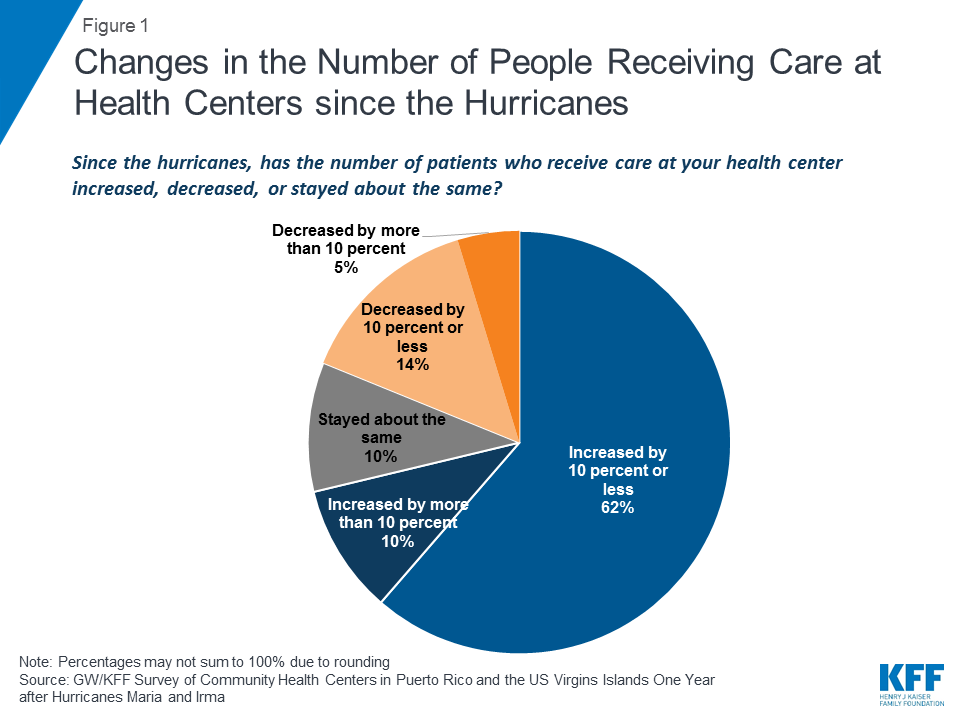
Most health centers experienced an increase in the number of patients seeking care in the year following the hurricanes. More than seven in ten (71%) health centers reported an increase in the number of patients they served (Figure 1). Both USVI health centers reported an increase in patients of 5-10%, while 68% of Puerto Rico health centers reported an increase in patients (Appendix Table 1). Still, one in five health centers said the number of patients they served had decreased, possibly due to ongoing infrastructure issues, staffing constraints, or population shifts.
Figure 1: Changes in the Number of People Receiving Care at Health Centers since the Hurricanes
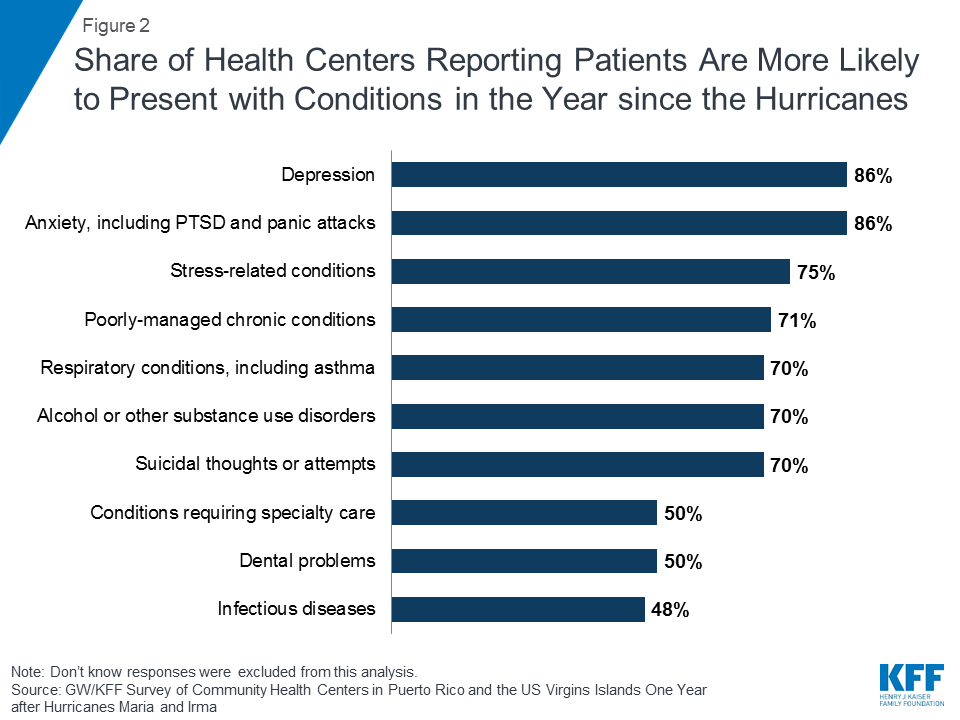
Reflecting the lingering effects of the hurricanes, increasing numbers of health center patients are suffering mental health problems, stress-related conditions, and poorly managed chronic health conditions. The trauma of living through the hurricanes and the stress of the recovery have taken a toll on the residents of Puerto Rico and USVI. Over eight in ten (86%) health centers reported an uptick in patients with depression and anxiety compared to the time period before the hurricanes, and seven in ten reported that patients were more likely to have suicidal thoughts or attempts and alcohol or other substance use disorders (Figure 2). Large shares of health centers also reported their patients were more likely to present with stress-related conditions such as insomnia and heart palpitations (75%), chronic conditions, such as diabetes and hypertension, that were not well-managed (71%), and respiratory conditions including asthma (70%).
Figure 2: Share of Health Centers Reporting Patients Are More Likely to Present with Conditions in the Year since the Hurricanes
Meeting patient demand for services
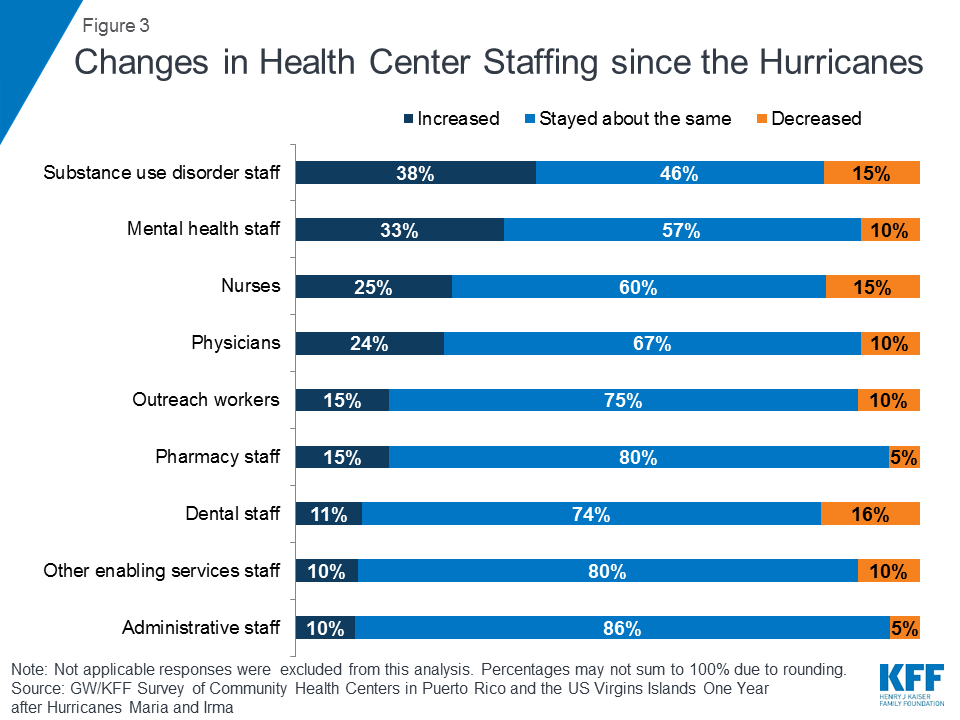
Many health centers have maintained or added staff to meet patient needs, but some have experienced staffing losses since the hurricanes. While many private providers left the islands in the aftermath of the hurricanes, most health centers were able to retain or expand key staff (Figure 3). As patient needs have increased, health centers have responded by expanding key staff. About a third of health centers reported an increase in mental health and substance use disorder staff, and one-quarter reported increased physicians and nurses. However, a small but sizable share of health centers reported decreased staffing, including dental staff (16%), nurses (15%), and substance use disorder staff (15%).
Figure 3: Changes in Health Center Staffing since the Hurricanes
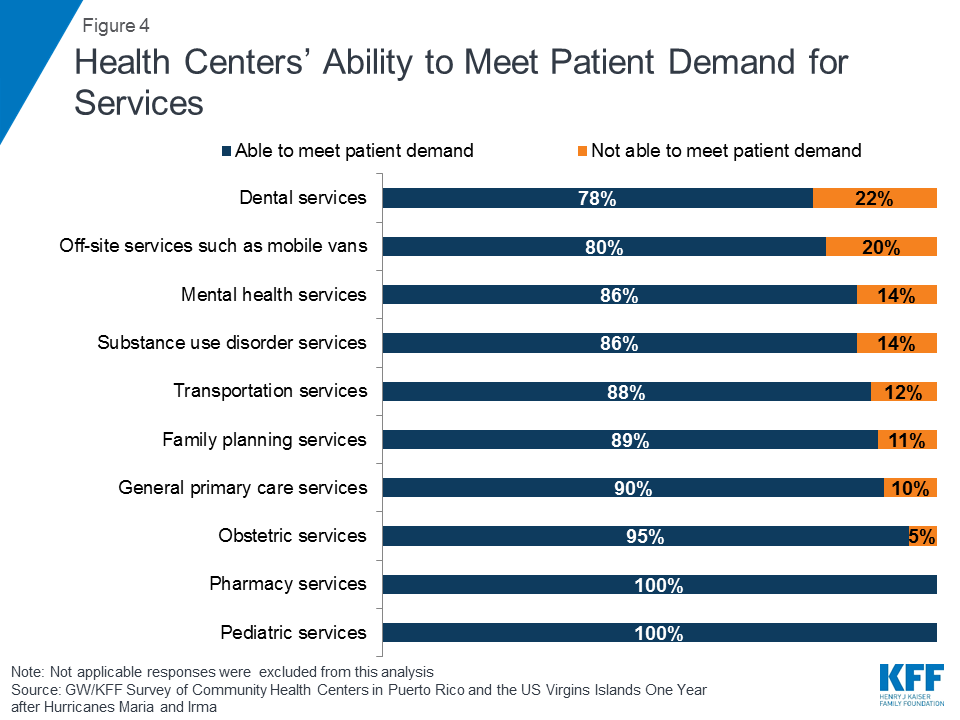
Despite increases in demand, most health centers were able to meet the need for services with available staffing. Health centers in Puerto Rico and USVI increased their capacity in response to the rising demand for services. All responding health centers reported that they were able to provide needed pediatric and pharmacy services, and nearly all were able to meet patient demand for obstetric care, family planning services, and general primary care services (Figure 4). At the same time, health centers were most likely to report not being able to meet patient demand for dental services (22%), off-site services (20%), mental health services (14%), and substance use disorder services (14%).
Figure 4: Health Centers’ Ability to Meet Patient Demand for Services
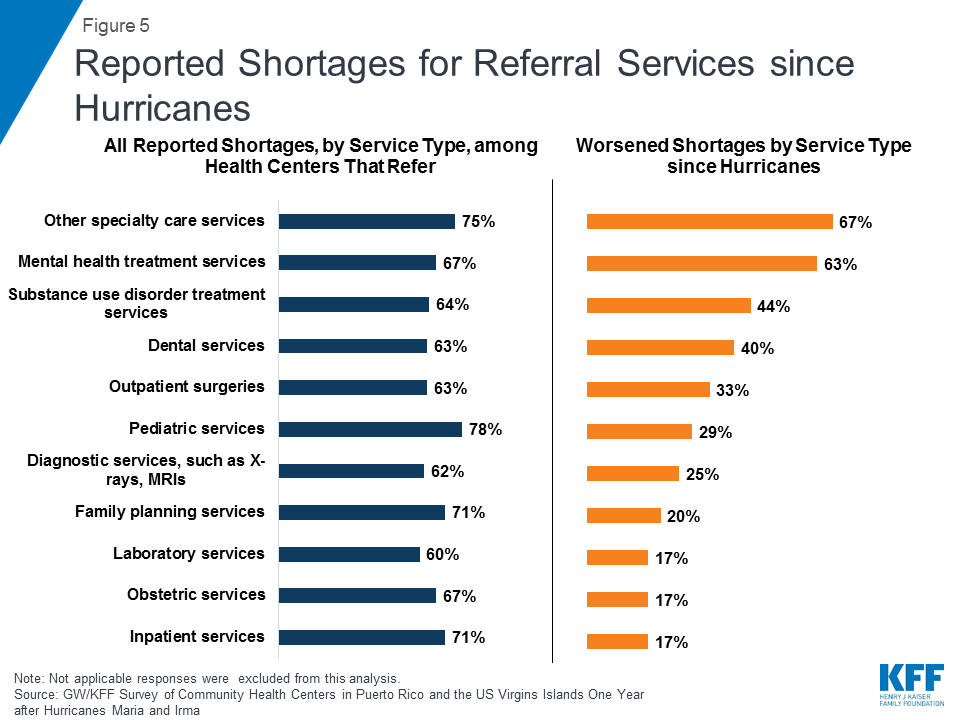
Health centers are experiencing growing constraints on their ability to secure specialty referrals for patients with complex needs. While health centers have increased capacity to meet the demand for a wide range of services at their facilities, some patients require more specialized services from other health care providers. Health centers in both Puerto Rico and USVI have faced longstanding provider shortages (defined as either no available providers or long wait times for appointments) when referring patients, but in some cases, these shortages have worsened since the hurricanes hit. Health centers that refer for services were most likely to report facing provider shortages when referring patients for inpatient hospital care, specialty care, and mental health care (Figure 5). While problems with access to hospital-based care predated the hurricanes, this remains a particular challenge in USVI where the hospital on St. Croix is operating at significantly reduced capacity.10 Although most health centers said they were able to provide needed pediatric and obstetric care on-site, when they did need to refer for these services, likely for pediatric specialty care and high-risk obstetric care, they faced significant challenges.
Even as more patients have presented with behavioral health and stress-related conditions and are in need of specialty care, shortages have worsened for mental health and other specialty care referrals. Among health centers that face shortages when referring patients, two-thirds said shortages for specialty and mental health care have gotten worse over the past year, and four in ten said access to substance use disorder treatment and dental care have worsened (Figure 5).
Figure 5: Reported Shortages for Referral Services since Hurricanes
Current status of operations, services, and supplies
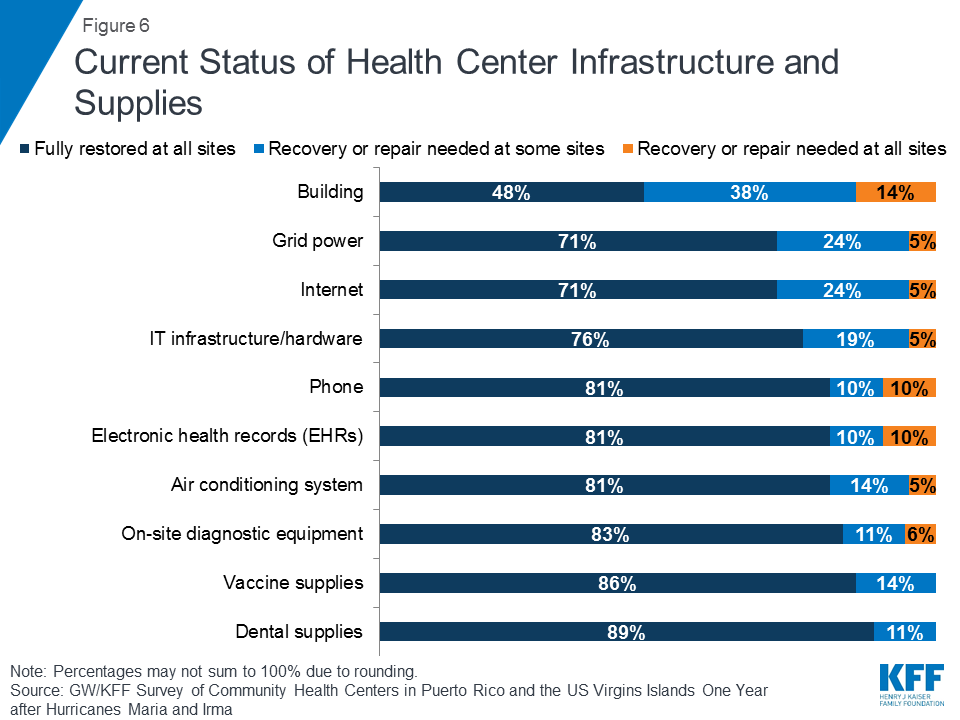
While most health centers are fully operational, many continue to face disruption and critical infrastructure challenges. Four in five (81%) health centers reported that operations are back to normal nearly a year after the hurricanes; however, this masks serious challenges facing some health centers (Appendix Table 2). Both health centers in the USVI are back to normal operations, while in Puerto Rico, three health centers continue to face minor disruptions at some or all sites and one reported critical disruptions at some sites. Over half (52%) of health centers still need repairs to buildings at some or all of their sites (Figure 6). Nearly three in ten health centers reported that grid power and internet have not been fully restored, and nearly a quarter reported that their IT infrastructure and hardware are in need of repair or replacement. While most said vaccine supplies are available at pre-hurricane levels, 14 percent noted that supplies have not been fully restocked at all sites.
Figure 6: Current Status of Health Center Infrastructure and Supplies
Hurricane preparation and community-wide recovery actions
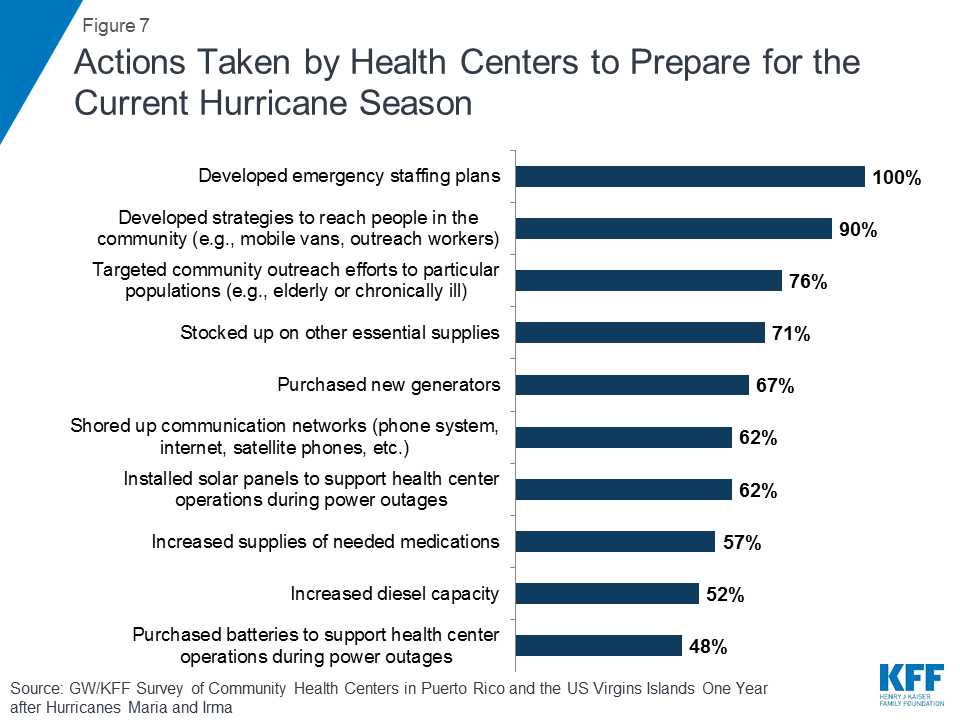
All responding health centers reported taking action to prepare for the current hurricane season, and developing emergency staffing plans was a top priority. Having withstood an unexpectedly catastrophic hurricane season, health centers have taken numerous steps to ensure they are prepared for the next storm. All said they had developed staffing plans for future emergencies and nine in ten reported developing strategies for community outreach, such as through mobile vans or community outreach workers (Figure 7). Over 70% said they planned to target community outreach to vulnerable populations like the elderly or people with chronic conditions and had stocked up on essential supplies. With ongoing electrical power problems for many health centers, over six in ten reported preparing for future power outages by purchasing new generators or installing solar panels.
Figure 7: Actions Taken by Health Centers to Prepare for the Current Hurricane Season
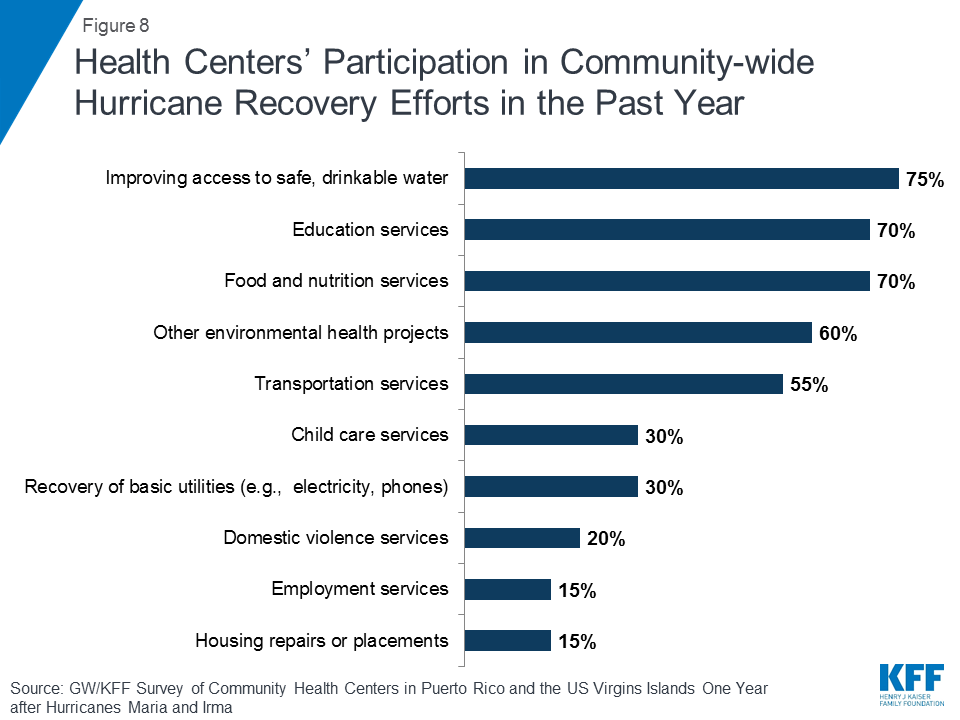
To assist in the broader hurricane recovery effort, most health centers participated in activities to improve access to critical health, social, and infrastructure services in their communities. Nearly all respondents indicated that their health centers had been involved in activities, either alone or with other community agencies and organizations, to address community-wide needs for recovery from the hurricanes in the past year. Three in four respondents reported participating in efforts to improve access to safe drinking water, seven in ten worked on education and food and nutrition initiatives, and six in ten reported participation in other environmental health projects (Figure 8).
Figure 8: Health Centers’ Participation in Community-wide Hurricane Recovery Efforts in the Past Year
Greatest challenges currently facing health centers
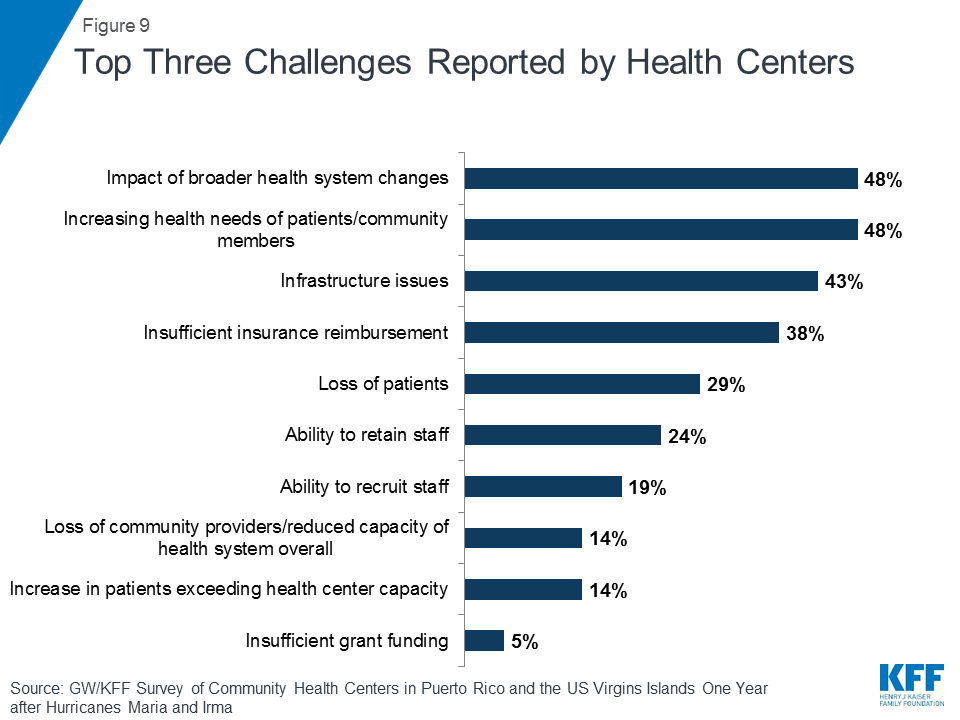
Meeting patients’ increasingly serious health care needs and operating in an insufficiently funded, complex, and rapidly evolving system emerged as top challenges. Health centers in Puerto Rico and USVI face many ongoing challenges as they work to recover fully from the hurricanes. The impact of broader health system change occurring in both territories, managing the increasingly complex health needs of patients, and ongoing infrastructure issues were among the top three challenges facing health centers in both Puerto Rico and USVI (Figure 9). More than four in five (83%) reported that the hurricanes worsened the impact of these challenges. Insufficient insurance reimbursement was reported as a top-three challenge by 42% of health centers in Puerto Rico, while health centers in USVI cited the loss of community providers and reduced capacity of the health system overall as a major concern (Appendix Table 3).
Figure 9: Top Three Challenges Reported by Health Centers
Discussion
One year after the hurricanes, health centers are grappling with a far sicker patient population, a fact that is not surprising given the devastating impact of the catastrophe on the health and well-being of the general population. Health centers continue to show recovery but still require repair, particularly of buildings, grid power, and internet. Staffing growth is underway, but health centers are also reporting the loss of key staff. Specialized referrals, never easy, present a growing challenge for some services. Nearly all health centers have been involved in community-wide recovery efforts as well as their own.
Consistent with the findings, health centers report that their top challenges are caring for a sicker patient population, meeting demand with limited revenue, and operating within the constraints of the broader changes in the health system, intensified in Puerto Rico by efforts to control health care costs in the face of the island’s ongoing financial crisis. The recovery grants awarded to health centers in both Puerto Rico and the USVI are an important step, but they are modest in size and do not obviate the need to maintain the strength of Medicaid funding, the most important source of health care financing for health centers operating on both islands. The greater reliance on federal health center funding in Puerto Rico and the USVI also underscores the importance of sustained federal grant funding to ensure that these community health centers are able to fully and effectively serve their patients.
The authors express their appreciation to Feygele Jacobs at the RCHN Community Health Foundation (RCHN CHF) for her assistance with the survey and invaluable insights on the brief. Additional funding support for this brief was provided to the George Washington University by RCHN CHF.
Methods
The Survey of Community Health Centers in Puerto Rico and US Virgin Islands One Year after Hurricanes Maria and Irma was conducted by the Geiger Gibson Program in Community Health Policy at the George Washington University (GW) and the Kaiser Family Foundation with support from the RCHN CHF. The online survey was distributed in August-September 2018 by email to upper-level management of the 23 community health centers in Puerto Rico and the USVI (21 health centers in Puerto Rico and two in USVI). Nineteen community health centers in Puerto Rico and both health centers in the USVI responded to the survey, for a 91% response rate. Survey findings are presented for all surveyed health centers and, for some questions, separately for Puerto Rico and USVI health centers.
Appendix
Appendix Table 1: Change in the number of patients who receive care at health centers since the hurricanes
Percent of health centers where the number of patients since the hurricanes…
All(N=21)
Puerto Rico(N=19)
US Virgin Islands(N=2)
Stayed about the same
10%
11%
0%
Increased by less than 5%
19%
21%
0%
Increased by 5-10%
43%
37%
100%
Increased by more than 10%
10%
11%
0%
Decreased by 5-10%
14%
16%
0%
Decreased by more than 10%
5%
5%
0%
Appendix Table 2: Status of health center operations a year after the hurricanes
Percent of health centers where…
All(N=21)
Puerto Rico(N=19)
US Virgin Islands(N=2)
Operations are mostly back to normal at all sites
81%
79%
100%
Operations remain disrupted in minor ways at some or all sites
14%
16%
0%
Operations remain disrupted in critical ways at some sites
5%
5%
0%
Appendix Table 3: The three biggest challenges currently facing health centers
Percentages reported for responses selected as a top three challenge
All(N=21)
Puerto Rico(N=19)
US Virgin Islands(N=2)
Infrastructure issues
43%
42%
50%
Ability to recruit staff
19%
21%
0%
Ability to retain staff
24%
26%
0%
Loss of patients
29%
26%
50%
Increase in patients exceeding health center capacity
14%
16%
0%
Loss of community providers/reduced capacity of health system overall
14%
5%
100%
Increasing health needs of patients/community members
48%
47%
50%
Insufficient insurance reimbursement
38%
42%
0%
Insufficient grant funding
5%
5%
0%
Impact of broader health system changes
48%
47%
50%
Other challenge
19%
21%
0%
Endnotes
Sharac, J. & Rosenbaum, S. (2018). The state of recovery: an update on community health centers in Puerto Rico and the Virgin Islands. Geiger Gibson/RCHN Community Health Foundation Research Collaborative, George Washington University. Policy Research Brief No. 52. https://www.rchnfoundation.org/?p=6694↩︎
Bureau of Primary Health Care. (2018). 2017 Puerto Rico Health Center Data: Community Health Foundation of Puerto Rico Inc. Health Resources and Services Administration. https://bphc.hrsa.gov/uds/lookalikes.aspx?q=&bid=02E01268&state=PR&year=2017 Look-alike health centers must abide by health center program requirements but do not receive Bureau of Primary Health Care (BPHC) health center program funding. ↩︎
Hall, C., Rudowitz, R., Artiga, S., and Lyons, B. (2018) One Year after the Storms: Recovery and Health Care in Puerto Rico and the U.S. Virgin Islands. Kaiser Family Foundation. ↩︎
One year after Hurricanes Irma and Maria made landfall, Puerto Rico and the U.S. Virgin Islands (USVI) are still feeling the storms’ effects. Drawing on key stakeholder interviews and public reports, this brief provides an overview of recovery status and preparation efforts for the current hurricane season one year after the storms, with a focus on the territories’ health care systems. It finds:
Recovery has progressed, but it has been slow and uneven, and challenges remain. Although power has been largely restored to the territories, Puerto Rico still experiences power instability, and its two offshore islands are still not connected to the electrical grid. In both territories, economic recovery and home repair progress are moving slowly. Heading into a new school year, many children continue to face disrupted school schedules due to delays in repair and construction of temporary classrooms. Post-hurricane outmigration has left a disproportionately elderly, disabled, and economically disadvantaged population in the territories as they cope with recovery.
One year later, mental health remains a crisis in both territories. Puerto Rico has experienced an increase in both deaths from suicide and calls to the central suicide hotline over the nine months following the hurricanes. Residents also continue to deal with physical health challenges exacerbated by the storms, such as management of diabetes and other chronic conditions.
The territories’ health care systems have seen progress with recovery, but serious gaps remain. Providers in both territories have restored access to some services limited by hurricane damage, while other services remain closed as providers await damage assessment and rebuilding. Provider shortages in mental health, nursing, and certain subspecialties present challenges to service delivery in both territories. Recovery of the health care system in Puerto Rico’s offshore islands and rural areas lags behind the rest of the territory. In USVI, hospitals and clinics remain damaged and function well below needed levels of service delivery and inpatient capacity.
Federal financing has been critical to recovery, but stakeholders report barriers to accessing federal recovery funds and are concerned about the expiration of temporary Medicaid financing support at the end of September 2019. Territory health officials have used additional Medicaid funds from the February 2018 budget bill to support coverage and increase reimbursement rates, but they worry about long-term financing. Officials cited complex rules, extensive paperwork, rotating FEMA staff, and poor communication as key barriers to accessing the array of federal recovery funds. Health care providers have found support from nongovernmental organizations (NGOs) and philanthropy helpful in moving recovery forward with less bureaucracy.
The territories are moving forward with broader health system changes, including significant spending cuts in Puerto Rico. The Financial Oversight and Management Board, created by Congress to oversee broader debt restructuring in Puerto Rico, approved the territory’s May 2018 fiscal plan that calls for $9.5 billion in spending cuts over the next six years. Health care system changes outlined in the plan may complicate the territory’s recovery from the hurricanes, as implementation of major changes is set for the fall of 2018. At the same time, USVI’s broad delivery system efforts that began before the hurricanes are moving forward alongside the territory’s work on hurricane recovery and preparation.
In the midst of recovery from the 2017 hurricanes, territory officials and health care providers are preparing for the 2018 hurricane season. Top priorities include development of alternative energy sources, such as solar power and back-up generators, as well as improved processes to identify and track patients that may need medical transfers or special care considerations. Some officials reported that they have improved procedures for the periods immediately before and after a hurricane, while others reported that drills and early storm events reveal continued gaps in preparations for another storm. These officials expressed particular concern about areas that are still suffering the most from last years’ storms.
Both Puerto Rico and USVI have released comprehensive recovery plans, but these plans call for major capital investments. Questions remain about both the availability of additional federal financing to continue recovery efforts and the possibility of long-term changes to Medicaid financing before the expiration of temporary Medicaid funds at the end of September 2019. Looking ahead, the territories are focused on making it through the 2018 hurricane season and continuing toward full recovery and fiscal stability in the future.
Issue Brief
Introduction
This brief provides an overview of the status of the recovery in Puerto Rico and USVI one year after the storms, with a focus on the progress of recovery and the preparedness for the current hurricane season as it relates to the health care systems and health needs of residents. It draws on public reports and key phone interviews conducted between July and September 2018 with the territories’ government and health officials and providers. The brief builds on earlier work that examined how the territories were faring six months after the storm and additional work on post-hurricane public health and resident challenges in the territories.
Background
Prior to the storms, Puerto Rico and USVI faced fiscal challenges, including high rates of debt, poverty, and unemployment, as well as a range of health disparities. In Puerto Rico, the population had higher rates of fair/poor health, heart attack/heart disease, diabetes, depression, disability, low-birthweight infants, and infant mortality than both USVI and the United States overall. The share of uninsured in USVI (30%) was much higher than in Puerto Rico (7%) and the rest of the United States (12%). In addition, Puerto Rico and USVI suffered from poor health infrastructure and a shrinking health care workforce.
Unlike states, Puerto Rico and USVI receive capped federal Medicaid funds and a fixed federal Medicaid match rate that is lower than the rate they would receive if they were states. The 50 states and D.C. receive federal Medicaid funding on an open-ended basis, with a federal match rate that varies based on state per capita income. In contrast, annual federal Medicaid funding for the territories is subject to a statutory cap, with a fixed federal match rate of 55%. This match rate is lower than the rate the territories would receive if it were based on per capita income like the states. Prior to the storms, Puerto Rico was also anticipating a large financial gap as funds provided under the Affordable Care Act (ACA) were running out.
Status of Recovery One Year after the Storms
Recent data show dramatic scope of storm impacts
Hurricane Maria made landfall in Puerto Rico and USVI on September 20, 2017, two weeks after Hurricane Irma hit on September 6, resulting in severe economic and health consequences. The storms caused significant physical damage to the territories’ infrastructure and health care systems and exacerbated residents’ health care needs, particularly with regard to mental health.
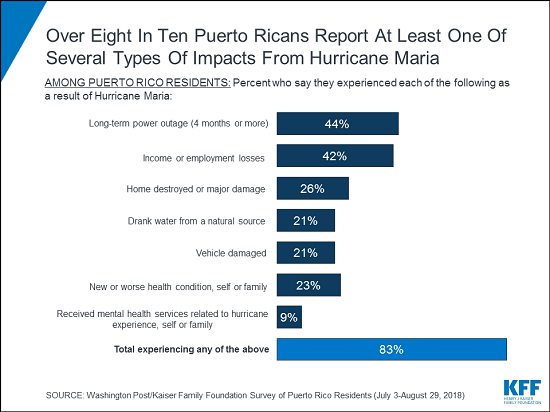
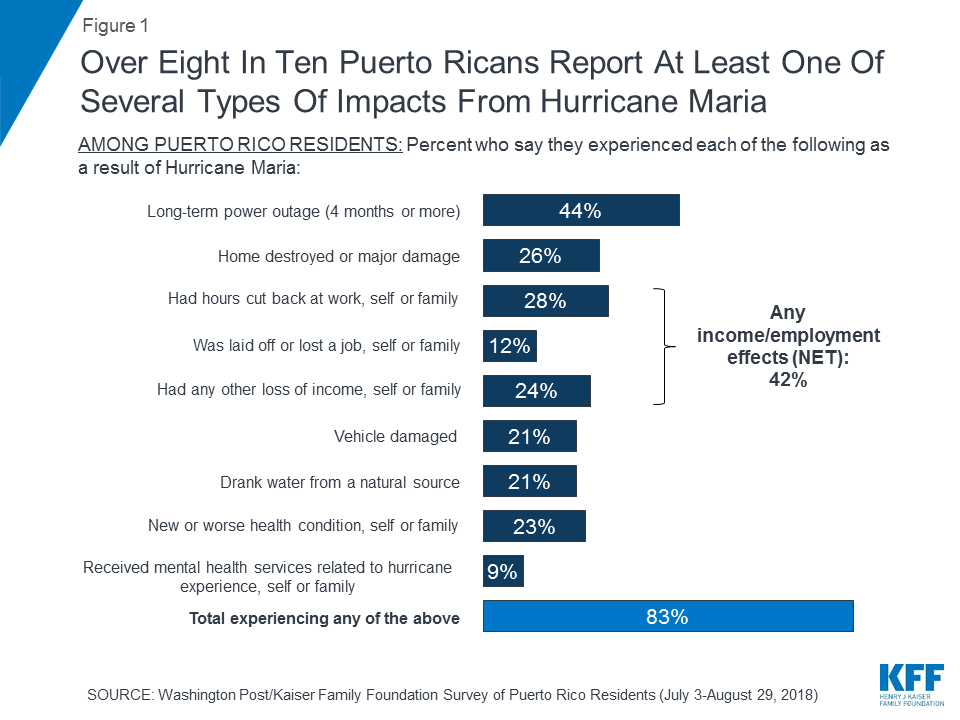
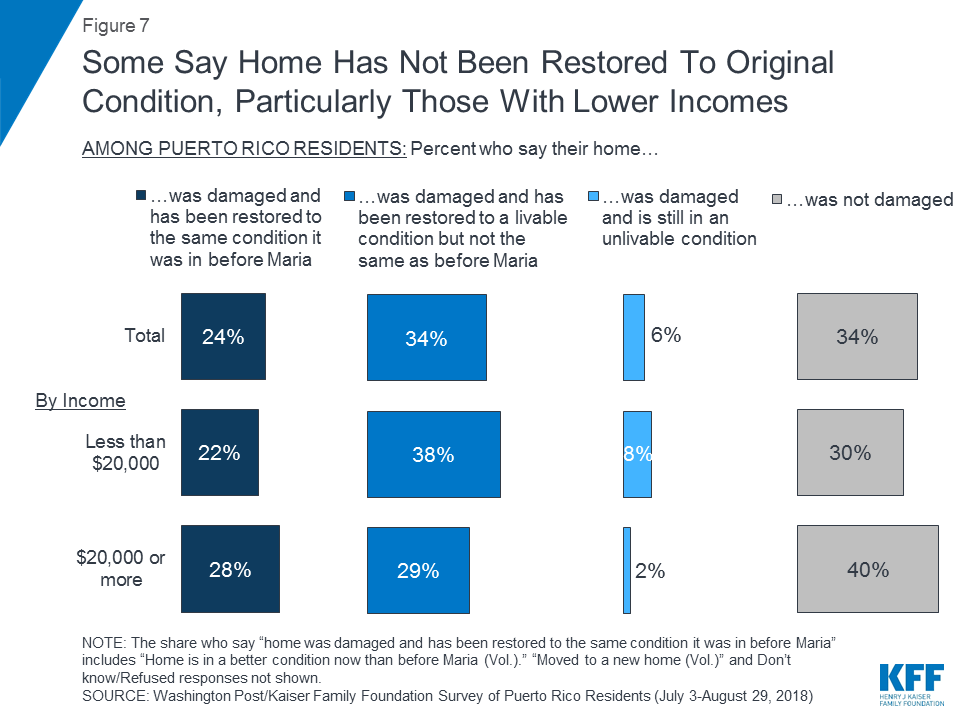
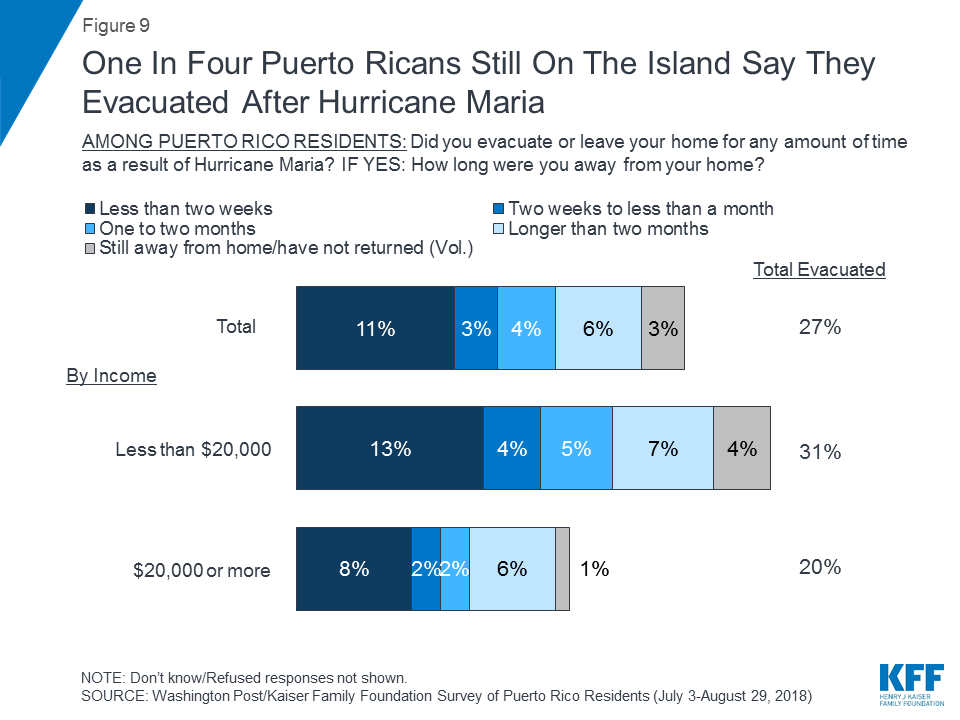
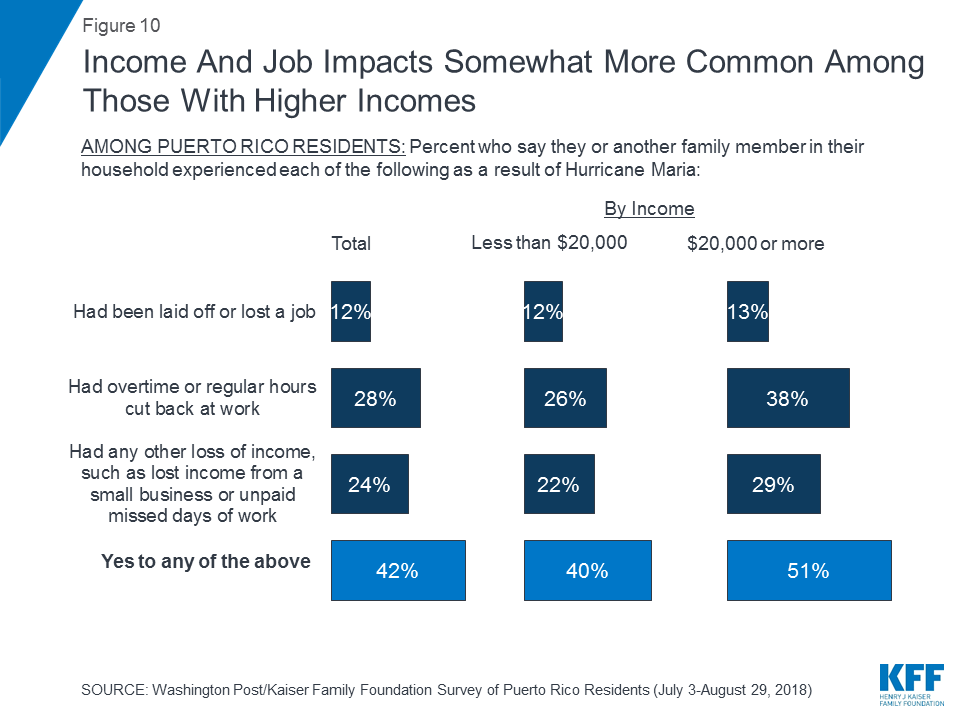
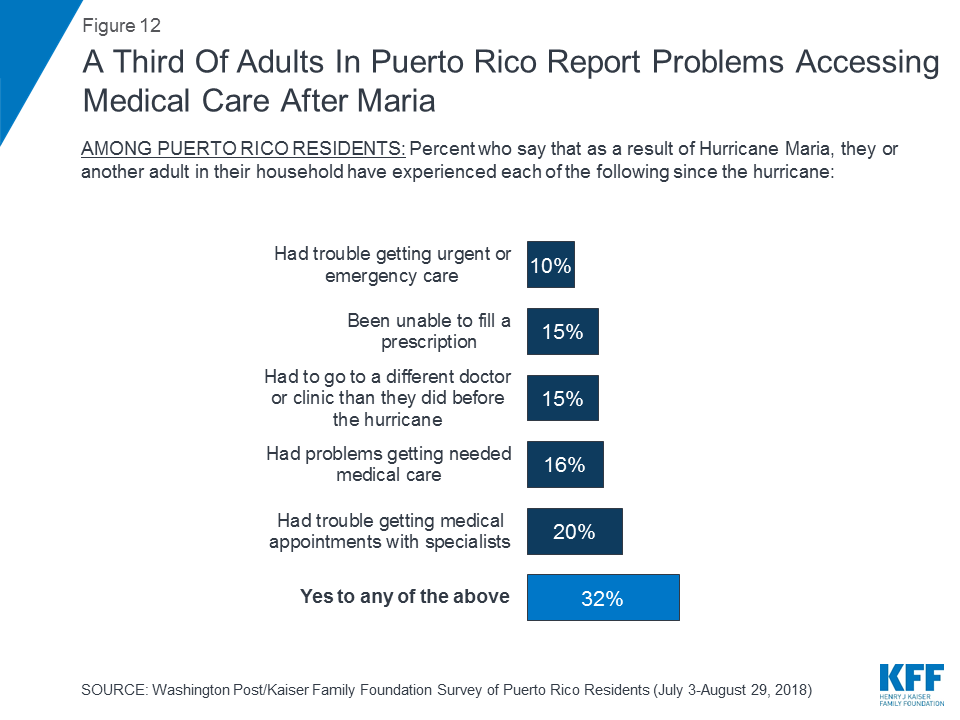
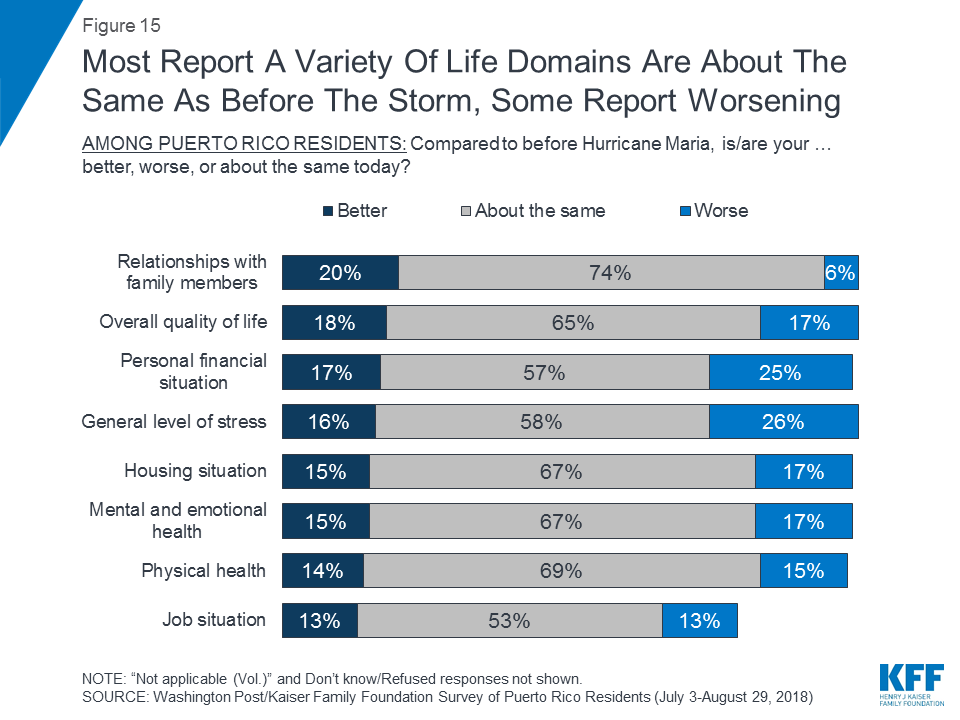
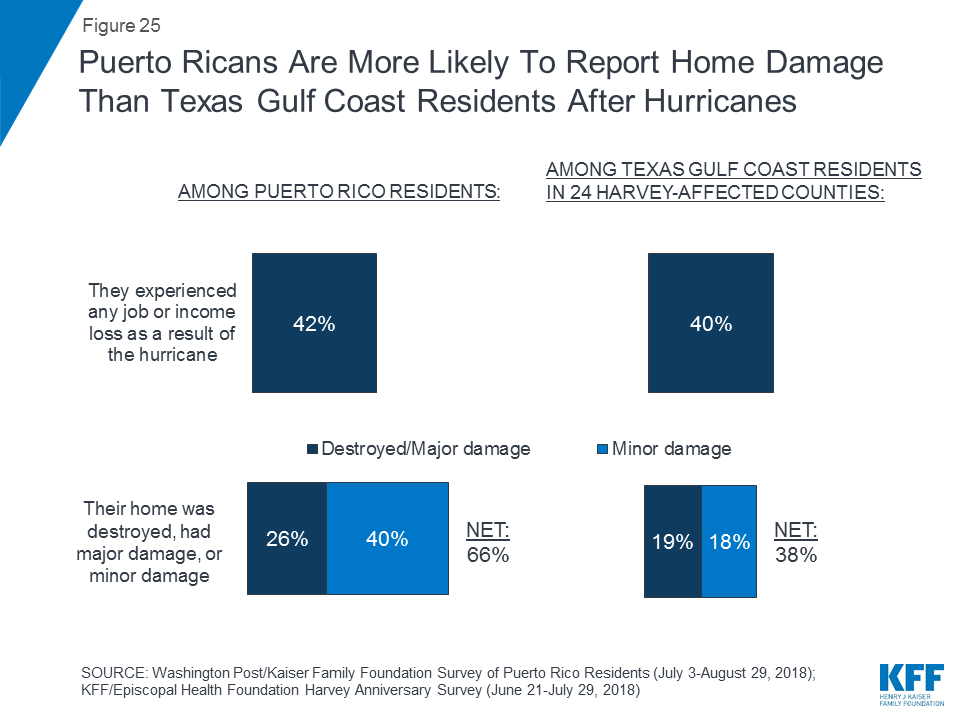
Studies and polls continue to show the widespread impact of the storms. A July 2018 FEMA report notes that Hurricane Irma affected 85% of the combined populations of Florida, Puerto Rico, and USVI, while Hurricane Maria affected 100% of the USVI and Puerto Rico populations.1 A recent Washington Post/Kaiser Family Foundation Survey of Puerto Rico Residents finds that eight in ten people residing in Puerto Rico had home or vehicle damage or employment or health setbacks due to the storms.
After additional analysis, Puerto Rico’s death toll from Hurricane Maria increased to more than 46 times the original official count. Several months after the hurricanes, Puerto Rico’s official death toll from Hurricane Maria stood at 64.2 A study commissioned by the Governor and released on August 29, 2018, finds total excess mortality of 2,975 deaths in the six months after Hurricane Maria, accounting for post-hurricane outmigration and population decline.3 In light of these findings, Puerto Rico’s governor revised the official death count to 2,975 while calling the number an estimate.4 Five deaths are directly attributed to Hurricanes Irma and Maria in USVI.5
Slow and uneven progress of recovery, with challenges remaining
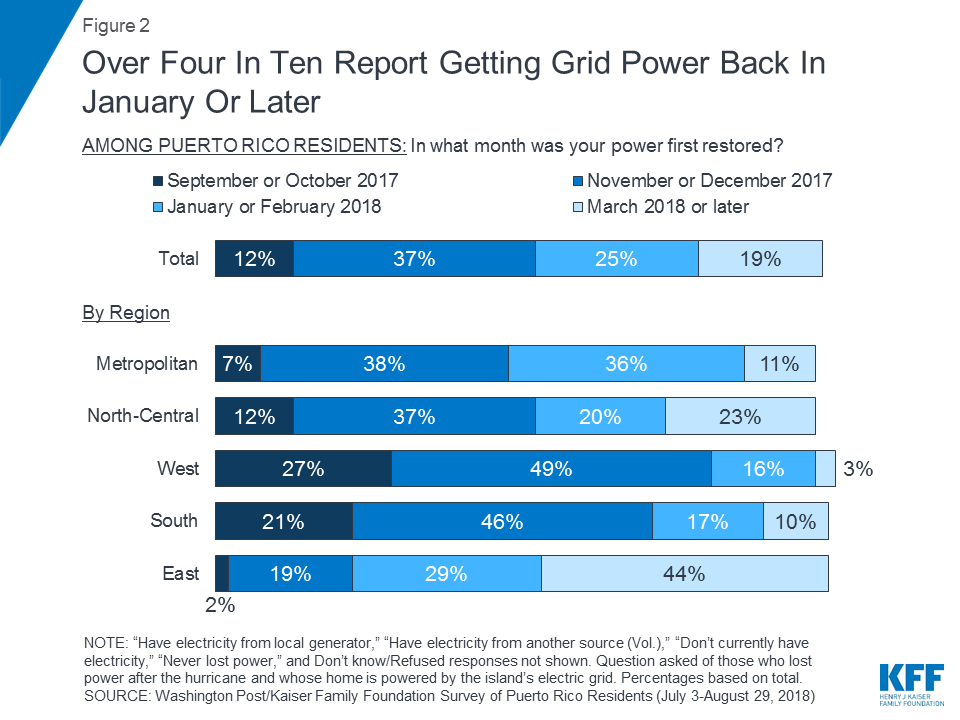
Although power has been largely restored to the territories, Puerto Rico still experiences power instability, and its remote areas are still not connected to the electrical grid. In mid-August 2018, Puerto Rico’s Electric Power Authority (PREPA) announced that it had restored power to the final remaining customers who had lost electricity in Hurricane Maria.6 However, Vieques and Culebra, Puerto Rico’s two offshore islands, remain disconnected from the territory’s main electrical grid due to damage to underwater power lines. These areas are receiving power via large generators, an arrangement expected to continue for two years until permanent repairs are complete. Rural municipalities in Puerto Rico, which are also still facing power instability, rely on large generators as backup to grid power, or they are using internet or satellite connections. A July/August Washington Post/Kaiser Family Foundation Survey of Puerto Rico Residents reveals that 77 percent of Puerto Rico residents had lost power for an hour or more at least once in the month before the survey, and 31 percent had experienced such an outage at least four times in the last month. These frequent outages were particularly common for residents in the north-central and western parts of the island. In USVI, all electricity customers had their power restored by March 9, 2018,7 and power is generally stable.
In both territories, economic recovery is slow. In Puerto Rico, local leaders report that the level of job creation has not sufficiently jumpstarted the economy, although some residents have taken up temporary work in post-hurricane construction. Some territory reports suggest that negative media coverage of Puerto Rico’s conditions have hampered efforts to promote tourism, despite the territory’s ability to welcome tourists and the improvement of its most popular areas.8 Total lodgings registered with the Puerto Rico Tourism Company in April 2018 were down over 47% from April 2017, with the decline even greater in non-metropolitan areas.9 As of February 27, 2018 (the latest available data), 85% of hotels were operating.10 Economic progress in USVI is mixed. Although restoration of the territory’s beaches, airports, seaports, and other infrastructure is complete, only about half of its lodging options are open, and flights to the territory are at 70% of pre-hurricane levels.11 The total estimated economic impact of the storms on USVI was $1.54 billion, or nearly 40% of the territory’s annual gross territorial product.12 Six of the territory’s 10 largest private employers remain closed until at least 2019.13
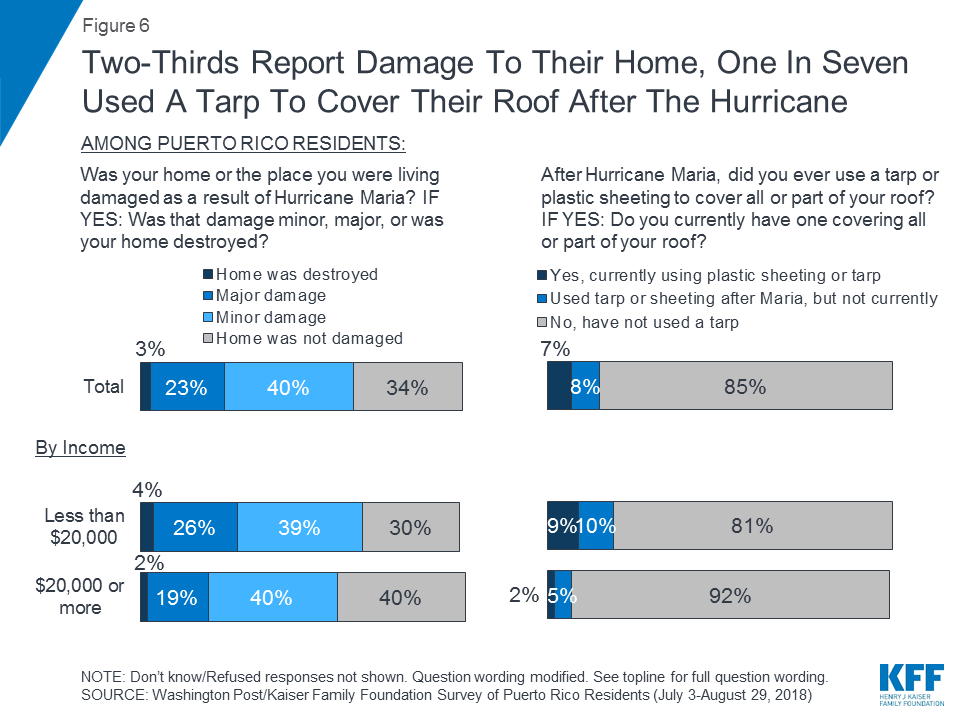
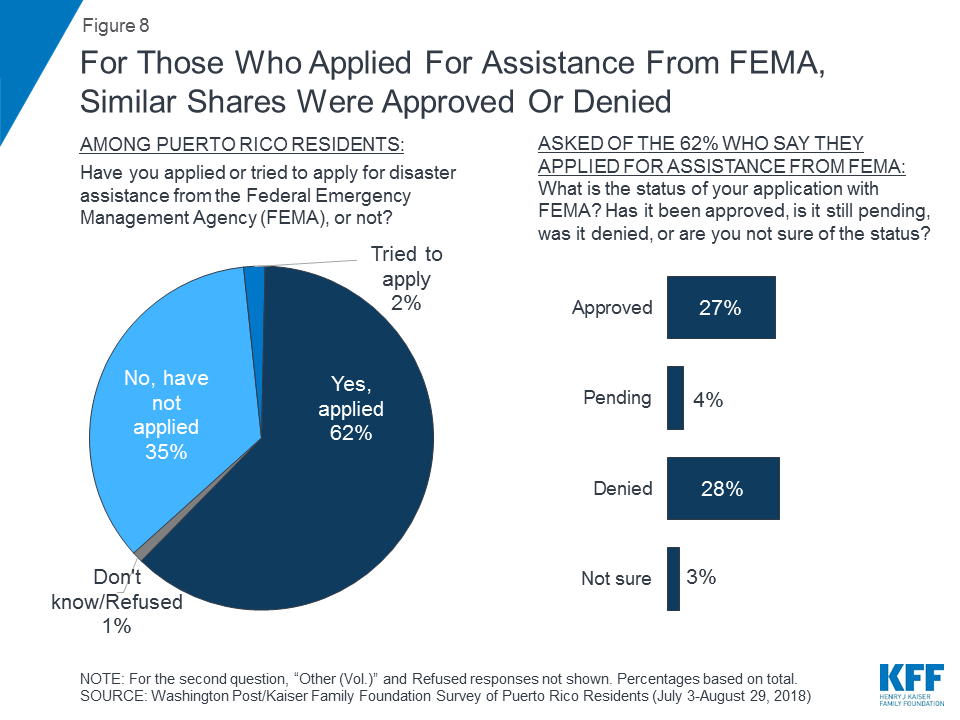
Many residents still have major damage to their homes, with repairs progressing slowly. Territory officials in Puerto Rico and USVI cited several factors for the slow repairs, including increased construction material costs, labor shortages, and bureaucracy tied to federal funds. Residents applying for federal relief funds to rebuild their homes continue to face challenges with proof of home ownership and appeals processes. According to FEMA, as of August 23, 2018, 1,045 Puerto Rican families were still living in hotels in 27 states and Puerto Rico through the Temporary Shelter Assistance (TSA) program. FEMA and the courts extended this temporary sheltering program five times total, and it expired on September 14, 2018, after assisting over 7,000 families with stays in hotel rooms in 40 states and Puerto Rico.14 USVI did not request TSA support after Hurricanes Irma and Maria since there was only one hotel operating in the territory.15 Among other rebuilding programs, USVI has participated in FEMA’s Sheltering and Temporary Essential Power (STEP) program, which funds emergency home repairs for qualifying privately owned homes with more than $33,300 of damage. As of June 2, 2018, FEMA and its USVI partner agency had approved 4,762 out of 9,967 STEP applications and completed construction on 1,328 homes.16
Schools remain disrupted at the start of the new academic year. In Puerto Rico, 805 schools will serve 298,000 students during the 2018-2019 school year, down from 1,110 schools serving 346,000 students in August 2017.17 In USVI, over 200 mobile facilities will replace damaged schools for the 2018-2019 school year.18 After USVI students from multiple schools shared space and attended half-days of instruction during the 2017-2018 school year, the territory’s Department of Education announced that all students will attend school full-time in the new academic year, with some at the temporary facilities. While 15 K-12 schools opened as scheduled on September 4, schools using temporary modular classrooms face delayed openings due to ongoing construction.19
Outmigration and demographic shifts in the population continue to present a challenge to Puerto Rico. In its draft recovery plan published in July 2018, the Puerto Rican government estimated that outmigration tied to Hurricanes Irma and Maria in the two years after the storms could match the previous decade’s level of 14% population loss from 2006 to 2016, although the final recovery plan removes this estimate.20,21 As another indicator of outmigration, the number of domestic air passengers leaving the island in the 12 months ending in March 2018 was roughly 125,000 people above trend.22 Due to demographic shifts in outmigration, officials reported that the remaining residents in both territories are disproportionately elderly, disabled, and economically disadvantaged.
Residents’ mental and physical health challenges worse after hurricanes
One year after the hurricanes, mental health remains a crisis in both territories. Territory officials and health care providers described high levels of anxiety, depression, and post-traumatic stress disorder (PTSD) among residents. In Puerto Rico, ongoing challenges such as the loss of homes and jobs and delayed repairs contribute to poor mental health, while disruptions in power generation and water trigger PTSD. Anxiety about the next hurricane season has also increased mental health needs. A recent Washington Post/Kaiser Family Foundation Survey of Puerto Rico Residents shows that 22% of Puerto Rico residents reported that they or a family member either received or needed mental health services following Hurricane Maria, and 13% of those surveyed reported starting new or higher-dose prescription medication for emotional problems since the storm. Suicide rates in Puerto Rico also remain high compared to one year ago. In the nine-month period after the hurricanes, Puerto Rico saw a nearly 18% increase in cases of suicide and a 13% increase in total calls to the territory’s main suicide hotline compared to the same period of the previous year.23 In USVI, officials noted that provider shortages have exacerbated mental health issues. In addition to the loss of Juan Luis Hospital’s behavioral health unit to storm damage, the first responder therapists who served patients immediately after the storms have largely left the territory. One official noted that most of USVI’s homeless population is struggling with mental health issues.
There are ongoing challenges addressing physical health needs. One year after the storms, health care providers are still seeing increased health care needs related to chronic conditions and medication adherence, particularly for diabetes. Access to dialysis treatment in USVI and on Vieques in Puerto Rico remains limited due to ongoing infrastructure challenges created by the storm. The elderly, people with disabilities, and other special needs populations remain the most vulnerable and need the most support accessing medical services. Among Puerto Rico residents who have a debilitating chronic condition or disability or have a household member who does, 41% of those surveyed in the Washington Post/Kaiser Family Foundation Survey of Puerto Rico Residents said that a health condition had appeared or worsened because of Hurricane Maria. Mental and physical health issues also intersect for some residents. For example, one clinic in Puerto Rico reported high appointment no-show rates, particularly for pediatric immunizations and women’s health appointments such as cervical cancer screenings, which could reflect the increased economic challenges facing patients as well as mental health issues. In one instance, a clinic social worker went to check on a mother who missed three pediatric immunization appointments and found that the woman had been in bed suffering from severe depression.
Storms exacerbated territories’ health care delivery system and provider challenges
Health care staff shortages present an ongoing challenge in both territories. Officials in both territories reported that the hurricanes have exacerbated infrastructure limitations and an inability to offer competitive salaries, which have been longstanding barriers to recruiting and retaining staff. Both territories cited problems with staff shortages in certain subspecialties or geographic areas. Across USVI, widespread provider shortages have created a major burden on the remaining staff. Schneider Regional Medical Center continues work to address the loss of 175 nurses following the hurricanes. Schneider has offered more competitive salaries, increased recruiting activities, and reengaged contract nursing agencies to address shortages in the emergency rooms, intensive care units, and operating rooms. Still, recruitment efforts have faced the hurdle of a nursing board overwhelmed by demand. Other facilities with staff shortages have reached the point at which overburdened workers have staged walkouts in protest.
In Puerto Rico, historical provider shortages and physician outmigration have continued to strain the health care system following the hurricanes. Patients must sometimes wait six to nine months for specialist appointments following referrals. Puerto Rico’s government has offered tax incentives and other strategies to try to fill provider gaps, but provider reimbursement rates in the continental U.S. continue to outpace those in the territories. Some community health clinics reported a 3-5% uptick in patients due to the loss of private providers from the island.
Lack of capacity to handle mental health needs puts additional pressure on hospitals and clinics. Increasing mental health needs and limited outpatient capacity to meet demand result in more people seeking mental health services at hospitals and clinics that may not be best suited to address these needs. Hospital emergency rooms can stabilize patients but may lack the outpatient care required for treatment after hospital discharge. Capacity to address mental health needs is particularly limited on Vieques. The clinic there reported hiring a new psychiatrist to fly to Vieques every two weeks, starting in mid-August 2018, to provide mental health services.
Health care system changes outlined in Puerto Rico’s fiscal plan complicate the territory’s recovery from the hurricanes. The certified fiscal plan calls for an $841 million reduction in health care spending by FY2023.24 As part of the plan, managed care organizations (MCOs) will shift from operating in eight regions to one territory-wide region. This change, currently pushed one month later to take effect on November 1, 2018, has caused considerable uncertainty and anxiety among Puerto Rico’s health care providers. While some officials expect that the changes could expand networks and patients’ access to care, others are concerned about which providers will be included in the new MCO networks. Exclusion from the networks would be a major challenge for some clinics. At the same time, implementation of the MCO changes could complicate the territory’s ongoing recovery and preparation efforts.
USVI’s broad delivery system efforts that began before the hurricanes are moving forward at the same time that work continues on hurricane recovery and preparation. A number of stakeholders in the USVI are collaborating on delivery system reform via workgroups on topics such as environmental health, care management, and workforce support. At the same time, officials and providers continue to focus their delivery system efforts on hurricane-related needs, such as increased support for telehealth to meet the demand for mental health services.
Damaged health care facilities continue to seek permanent solutions, particularly in USVI
Recovery of health care infrastructure in Puerto Rico’s offshore islands and rural areas lags behind the rest of the territory. While all of Puerto Rico’s community health centers on the main island are connected to the electrical grid, the clinics on the two offshore islands of Vieques and Culebra continue to rely on large generators while their underwater power lines are repaired. Dialysis patients on Vieques must still travel to the main island to receive treatment. One clinic director, who reported losing two dialysis patients in this process, has identified a new facility on Vieques to expand dialysis and other services available to patients there, but she is waiting for federal funding to conduct repairs and offer these services. The same clinic director reported interest in opening a home health program on Vieques to serve the needs of the roughly 200 homebound patients who live there. Vieques also still lacks licensing for a vaccine program, causing patients to travel by plane or ferry to the main island for immunizations.
Schneider Regional Medical Center, the hospital on St. Thomas that also serves St. John in USVI, has resumed operations for most services. Schneider is able to provide surgery, emergency, and ancillary services such as pharmacy, occupational and physical therapy, nutritional services, and radiology. However, hurricane damage keeps the hospital’s 51-bed inpatient unit and its cancer center closed, limiting both inpatient bed capacity and oncological services. The hospital is delivering chemotherapy on an outpatient basis but transporting patients needing radiation to Puerto Rico for treatment. As of late July 2018, all 49 hemodialysis patients who had been medically evacuated from St. Thomas had returned to the island.
Juan F. Luis Hospital on St. Croix in USVI has two functional operating rooms, down from six, and is able to provide only emergency surgical services a year after the hurricanes. The hospital is in the process of preparing three donated trailers to serve as additional operating units. Due to this limited surgical capacity, non-emergency surgical patients must be transferred to St. Thomas or the continental U.S. for elective procedures. Juan Luis had also evacuated its dialysis patients to the continental U.S. following the storms. As of early September 2018, 21 of these medical evacuees have returned to the island and are receiving treatment from a private provider, while 37 evacuees remain in Atlanta, Georgia. Temporary trailers for dialysis services have faced construction delays but now target a completion date of October 2018.
Both Schneider and Juan Luis hospitals are awaiting the outcome of FEMA’s assessment of their facilities for either repair or replacement. In the February 2018 Bipartisan Budget Act (BBA),25 the territories received statutory permission to rebuild “critical services,” including hospitals, regardless of their pre-hurricane condition. Under the BBA permission, the USVI hospitals may be able to rebuild to a higher standard than their pre-hurricane facilities if the FEMA assessments call for complete replacement. However, since rebuilding can only commence after a final assessment from FEMA that a facility cannot be repaired, the USVI hospitals have employed short-term mitigation efforts to support delivery of services while they await permanent solutions.
USVI’s clinics vary in operability and capacity. Myrah Keating Smith Community Health Center on St. John, part of the same health system as Schneider Regional Medical Center, was still closed as of July 2018 as it awaits federal assessment of its damage. Patients are receiving services from temporary trailers, although capacity is limited. Frederiksted Health Care, a nonprofit primary care clinic on St. Croix, has resumed delivery of all of its health care services but operates with a smaller staff, particularly for behavioral health and dental services. The clinic reported an increase in overall patients due to the limited capacity of Juan Luis and the outmigration of some private providers. More broadly, the USVI Department of Health has faced challenges delivering public health services such as immunizations, dialysis, and emergency care due to shortages in staff and functional facilities. The Department is continuing work to acquire hard-sided modules as a temporary solution to expand capacity.
Federal funds integral to recovery but difficult to access
Key stakeholders in both territories noted that federal funding has been essential to recovery efforts, but that bureaucracy has posed a barrier to access available funds. Officials cited complex rules, extensive paperwork, rotating FEMA staff, and poor communication with federal partners as key barriers to accessing federal recovery funds. These barriers have slowed the ability to pay staff, obtain resources, and participate in federal programs. For example, FEMA announced that it has worked with Puerto Rico legal aid groups to develop a “Sworn Declaration” as a tool to verify home ownership for hurricane survivors who may lack formal documents.26 Still, the level of documentation for FEMA programs has overwhelmed one municipality’s residents, who have begun trying to rebuild with their own resources. USVI officials reported use of FEMA Community Disaster Loans (CDLs) and Community Development Block Grants for expenditures such as hospital staff salaries and benefits but described challenges meeting the federal requirements attached to the CDL loans. Other barriers to rebuilding include the high cost of construction materials and insufficient numbers of construction workers. One official noted that federal partners have good intentions but that the scope of damage is too large, and there is competition for resources.
Health care providers described support from nongovernmental organizations (NGOs) and philanthropies as critical in moving recovery forward. Philanthropic donations in Puerto Rico have gone to needs such as mental health staff and health education, support for federally qualified health centers (FQHCs), and construction of a health care facility on Vieques. Some officials have said that access to these funds has helped to address essential needs while awaiting federal resources, since NGO funding often involves less complex bureaucracy and paperwork.
Increased Medicaid financing vital for territories, with major concerns about fund expiration
The February 2018 federal budget bill provided crucial financial support for the territories’ Medicaid programs. The budget bill increased the federal caps for Puerto Rico ($4.8 billion) and USVI (approximately $142.5 million) and provided Medicaid funds at 100% federal match (FMAP) from January 2018 through September 2019.27 Officials in USVI and Puerto Rico noted that the 100% federal match rate provides needed relief on territory fiscal pressures by eliminating the territory share of Medicaid financing required to draw down federal funds. Puerto Rico officials noted that they have used enhanced Medicaid funds to increase Medicaid provider reimbursement rates to Medicare rates as an effort to compete with the continental U.S. reimbursement levels and help maintain and recruit physicians. After the hurricanes, Puerto Rico delayed Medicaid renewals for 12 months, and USVI for six months. Despite continued outmigration of the population, the territories have seen relatively stable Medicaid enrollment due to the support of additional funds, delayed renewals, and additional outreach in USVI to enroll eligible individuals.
The territories fear a financial cliff when the Medicaid financing support expires at the end of September 2019. Territory leaders are continuing to lobby Congress for an increase in the FMAP from the 55% rate that is scheduled to return in October 2019. The increase in the capped amount is also set to expire, along with additional dollars provided through the ACA. Some officials reported that discussions with the federal government are underway, but real consideration at the federal level of these issues is likely to occur after the November 2018 midterm elections. One official in Puerto Rico said that, without additional support, the uninsured population could increase from about 500,000 to over 1 million people.
The Financial Oversight and Management Board (FOMB), created by Congress to oversee broader debt restructuring in Puerto Rico, adopted a fiscal plan in May 2018 that called for significant cuts in spending. Under the Puerto Rico Oversight, Management, and Economic Stability Act (PROMESA) of 2016, Congress created the FOMB to oversee Puerto Rico’s budget and fiscal policies and debt restructuring. The FOMB adopted a fiscal plan in March 2017; however, after accounting for the impact of the hurricanes and expected relief aid, the FOMB adopted a new plan in April 2018. With some minor changes, an amended fiscal plan was certified on May 30, 2018.28 The certified fiscal plan calls for spending cuts of $9.5 billion (2.2% of GNP) over the next six years, with education and health care receiving the sharpest budget cuts.29 However, tension of shared authority between Puerto Rico’s government and the FOMB led Puerto Rico to file a lawsuit in July over the FOMB’s authority to impose policy changes in Puerto Rico as part of its powers over the territory’s fiscal plans. A federal court ruled in favor of the FOMB on August 7, 2018. The ruling held that the FOMB has the power to make policy choices for Puerto Rico as part of the budgetary process, but it does not have the authority to change legislation.30
Preparedness for Current Hurricane Season and Beyond
In the midst of recovery from the 2017 hurricanes, territory officials and health care providers are addressing their top priorities for 2018 hurricane season preparation. One top priority for providers is the establishment of alternative energy sources to maintain services and communication in the event of hurricane-related outages. Puerto Rico’s primary care association has overseen the installation of donated solar panels and batteries in at least 20 clinics to support power for emergency rooms and refrigeration of medications and vaccines. Clinics have also purchased new generators and extra diesel capacity for backup generators. The territory received satellite dishes to provide consistent access to communication for health care providers and residents in the event of power loss. They expect that this access to communication will support residents’ mental health in a hurricane’s aftermath. One clinic in Puerto Rico is also addressing mental health by starting an educational campaign to support teenagers and children with stress management and other hurricane-related emotional challenges. In USVI, health care leaders described plans for alternative energy sources but no significant implementation; they have reportedly requested solar panels from the federal government but have not yet received them.
The territories have prioritized improved patient identification and tracking processes. Providers in both territories reported enhancements in their processes of identifying and evacuating patients with critical medical needs. One clinic in Puerto Rico ran a census of its patients to identify those with chronic conditions and their care needs. The clinic is using this information to develop a disaster plan for patients in vulnerable parts of the territory. In USVI, Schneider Regional Medical Center has worked with HHS to develop a day-by-day hurricane response, including a controlled medical evacuation plan. Their plan will identify critical patients based on condition acuity and begin evacuation as soon as a declaration of emergency is declared, regardless of patient financial status. In 2017, financial considerations for patient evacuation reportedly led to a less controlled disaster response. Both Schneider and Juan Luis Hospital also now have access to a military tracking system that will improve their ability to track medically transferred patients.
Territory officials and providers had mixed views on overall preparedness for another major hurricane. One USVI provider reported that all territory agency heads, FEMA, HHS, and other federal partners participated in hurricane readiness drills in July 2018. The federal government assisted the provider in reexamining patient evacuation and off-island migration as part of its planned response. Other providers in USVI described a territory-wide tabletop exercise to test their response to a potential hurricane. Although USVI officials reported improved hurricane response plans, the exercise revealed that the territory was not ready for another hurricane due to factors such as ongoing building damage and insufficient health care infrastructure. Tropical Storm Beryl also brought wind and rain to the territories in early July 2018, causing flooding in USVI that revealed gaps in recovery. Providers in Puerto Rico also expressed trepidation regarding the level of preparation for the current hurricane season. One clinic noted that there is no official plan for protection of Vieques residents in the event of a hurricane and that they have not received information from the territorial government. At the same time, the clinic reported significant financial and logistical support from NGOs for hurricane preparation activities such as mental health education and infrastructure.
Acknowledging the importance of Centers for Medicare and Medicaid Services (CMS) programs in times of disaster response and recovery, CMS developed a “Disaster Preparedness Toolkit” to help territory officials prepare for future natural disasters. The Toolkit summarizes the flexibilities and strategies available under Medicaid and CHIP to support the programs in times of crisis.31 Highlighted strategies include streamlined eligibility and enrollment processes during power outages, optional benefits targeted at disaster-related public health needs, and guidance on legal tools available to modify Medicaid programs. The Toolkit also emphasizes the importance of Medicaid agencies’ own preparation for natural disaster and provides CMS contacts to support this preparation.
Over the summer, the governments of Puerto Rico and USVI released reports with plans for continued recovery. The Economic and Disaster Recovery Plan for Puerto Rico32 calls for $139 billion in capital investments and strategic initiatives across sectors from 2018 to 2028. This total includes federal funds that the territory expects to receive as part of FEMA disaster recovery support. The plan’s short-term priorities focus on reestablishing “lifeline systems” such as reliable energy, water, communications, and transportation; repairing or rebuilding approximately 166,000 homes; improving emergency preparedness; and clarifying ownership and responsibility for infrastructure and services to facilitate efficient rebuilding. Longer-term priorities include stemming outmigration to encourage economic growth, revitalizing urban centers, meeting social service needs, rebuilding infrastructure, and modernizing methods of information sharing.33 In a similar plan,34 the USVI Hurricane Recovery and Resilience Task Force calls for four major strategies to help with rebuilding: strengthening physical infrastructure, rebuilding systems to better deliver services, strengthening governance, and enhancing preparedness for future storms.
Conclusion
In September 2017, Hurricanes Irma and Maria created historic damage to Puerto Rico and USVI, exacerbating preexisting economic and health issues. At the one-year anniversary of the storms, recovery of the economy, housing, and schools continues at a slow and uneven pace. Individuals are continuing to experience physical and mental health care issues that worsened after last year’s storms. The territories face particular challenges where recovery to the health care infrastructure has been slower and in areas of health care professional shortages. Federal financing has been critical for recovery, but stakeholders reported challenges accessing federal funds and concerns about expiration of federal Medicaid financing support at the end of September 2019. In addition, major spending cuts certified by the fiscal oversight board in Puerto Rico could impede some recovery efforts. While improvements and preparations are in place for another storm, many feel unprepared for another major hurricane given the current status of recovery efforts. Both Puerto Rico and USVI have released longer-term recovery plans that call for additional investments in infrastructure and focus on economic recovery. While some of these initiatives are underway with current resources, it is unclear if or how many additional resources will be available to carry out these plans.
Puerto Rico Department of Health, Comisión Para la Prevención del Suicido. “Estadísticas Preliminares de Casos de Suicidio Puerto Rico, Enero-Mayo 2018” (Rio Piedras, Puerto Rico: Puerto Rico Department of Health, May 2018). ↩︎
When a Family Member is Detained or Deported, Immigrant Families Often Face Financial Hardship, Physical and Emotional Health Consequences and New Fears of Engaging with Public Programs
As the Trump Administration pursues enhanced enforcement of the nation’s immigration laws, a new issue brief from the Kaiser Family Foundation documents how the detention or deportation of an individual can have major effects on families and communities.
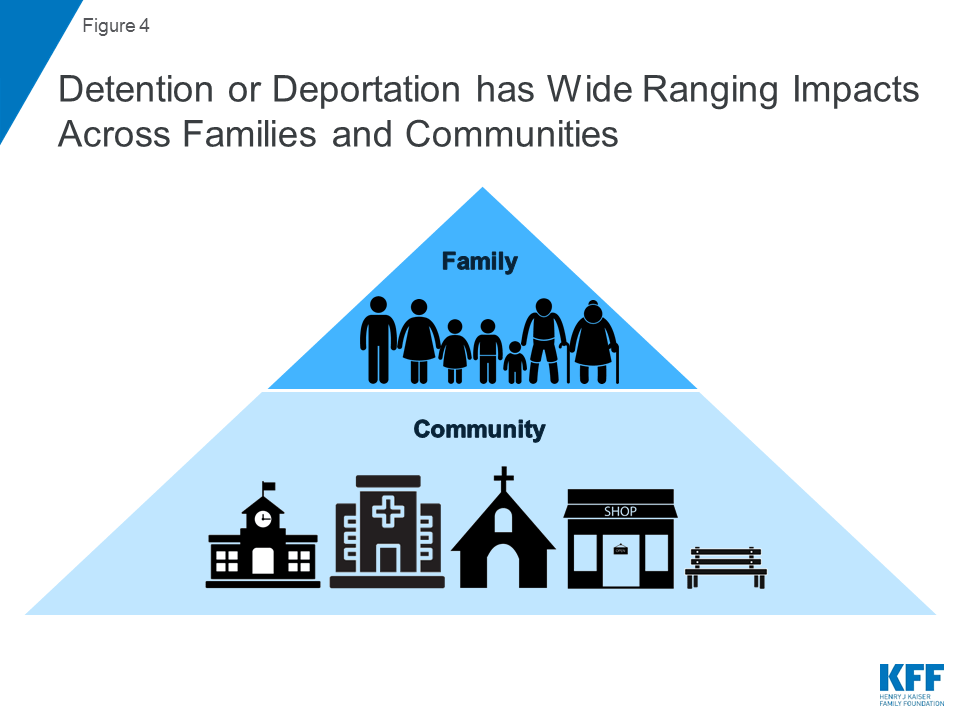
They include sudden and severe financial hardship and emotional trauma that can trigger long-term effects on mental and physical health, especially for children. At the same time as families are facing these increased needs, their fears of accessing health and nutrition programs are growing. The fears rise as word spreads about potential changes the Trump administration is proposing to “public charge” policies that could result in individuals being denied legal permanent residency or entry into the U.S. if they or their mostly U.S.-born citizen children use these programs. The effects of detention and deportation also extend into the broader community, affecting schools, health care providers, churches and faith-based organizations, and local businesses by increasing challenges related to serving immigrant families and directly impacting many staff who are in immigrant families themselves.
The report, Family Consequences of Detention/Deportation: Effects on Finances, Health, and Well-Being, examines the direct consequences to family finances, health, and well-being when a member of the household is detained or deported. It is based on 20 in-person interviews with families who recently had a family member detained or deported and 12 telephone interviews with health centers, legal services providers, educators, and community organizations serving immigrant families in California, Texas, and the Washington, DC area that were conducted during Summer 2018. The report provides an on-the-ground view from affected families and those providing services. The report is focused on detention and deportation among families already residing in the U.S., often for many years. It does not address the separation of families under the Trump administration’s zero tolerance policy for individuals entering the U.S. without authorization.
The new paper builds on a previous Kaiser Family Foundation report showed that the current immigration policy environment has significantly increased fear and uncertainty broadly among immigrant families and had wide-ranging negative impacts on their health and well-being.
Today, an array of Trump Administration policies are affecting immigrant families. A previous Kaiser Family Foundation report showed that the current immigration policy environment significantly increased fear and uncertainty among immigrant families and had wide-ranging negative impacts on their health and well-being. This report builds on that work by exploring the direct impacts of detention and deportation on family finances, health, and well-being. The findings are based on interviews with 20 families that recently had a family member detained or deported and 12 legal services providers, health centers, educators, and community organizations serving immigrant families conducted in California, Texas, and Washington, DC during Summer 2018. Most family respondents were Hispanic women with children in the household; immigrants in the families primarily came to the U.S. from Mexico and Central America.
When a family member is detained or deported, #immigrant families often face financial hardship, physical and emotional health consequences and new fears of engaging with public programs.
Sudden and Severe Financial Hardship
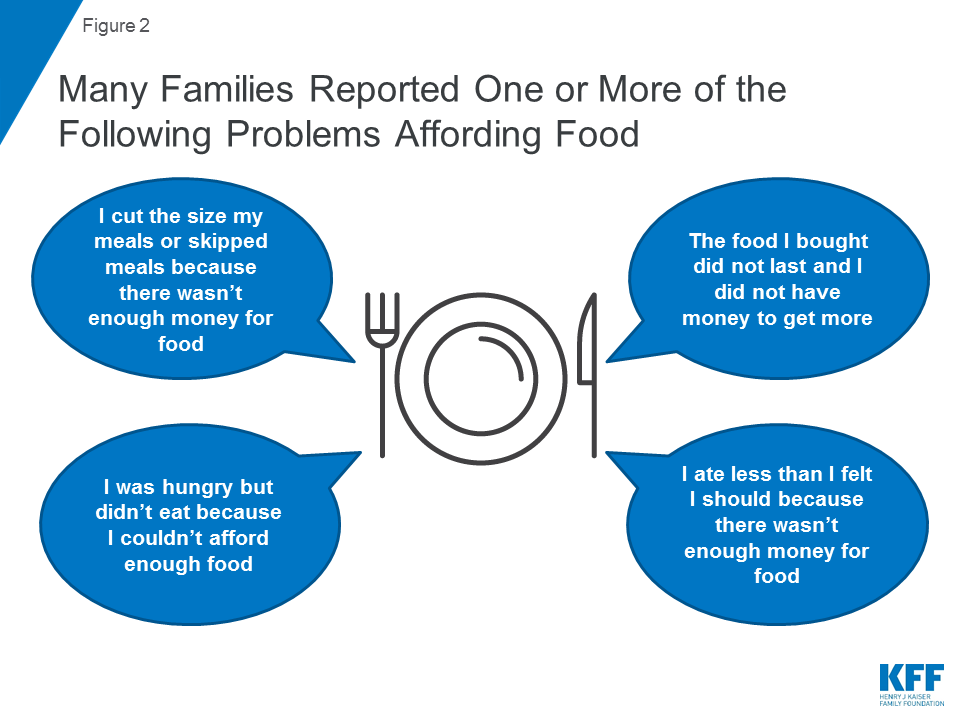
Families were left struggling to pay their bills, and many are having trouble putting food on the table. Many families reported problems affording enough food due to the loss of their family member’s income, and some adults were going hungry so their children could eat. A number also faced unstable housing situations and were worried about how they were going to pay the next month’s rent. Although remaining adults sought to increase work hours to fill in lost income, many did not have childcare to cover increased hours. Some families also faced gaps in support and care for older parents. Stakeholders said that, in some cases, individuals returned to an abusive relationship or suffered poor working conditions or exploitation by an employer because their income needs were so urgent and they had no other options.
“Sometimes I would skip a meal so that my kids could eat.” Spouse/Partner of Detained/Deported Individual, DC Area
“Six months we were homeless… One day here, one day there, we woke up sleeping with relatives…” Spouse/Partner of Detained/Deported Individual, Los Angeles, CA
Disruption to Children’s Routines and Relationships
Children are spending more time inside and participating in fewer activities because remaining adults are working all the time and/or more fearful of spending time outside. Some families reported that children became angry or resentful about remaining adults working all the time. Families and stakeholders also noted that some parents have less patience with their children because of increased work and stress. In some families, older children took on jobs or increased roles caring for siblings. Stakeholders also noted that older children often take on challenging roles advocating and translating for their parents. A number of families noted that older children changed their plans for the future, for example, getting a job instead of joining the armed forces or declining acceptance to a university.
“I cannot take them to the park; I cannot take them outside…so they stay at home with their video games.” Spouse/Partner of Detained/Deported Individual, Fresno, CA
“She’s still interested in going to the armed forces, but what’s stopping her is wanting to help bring more money home.” Spouse/Partner of Detained/Deported Individual, Los Angeles, CA
Extreme Stress, Anxiety, and Depression
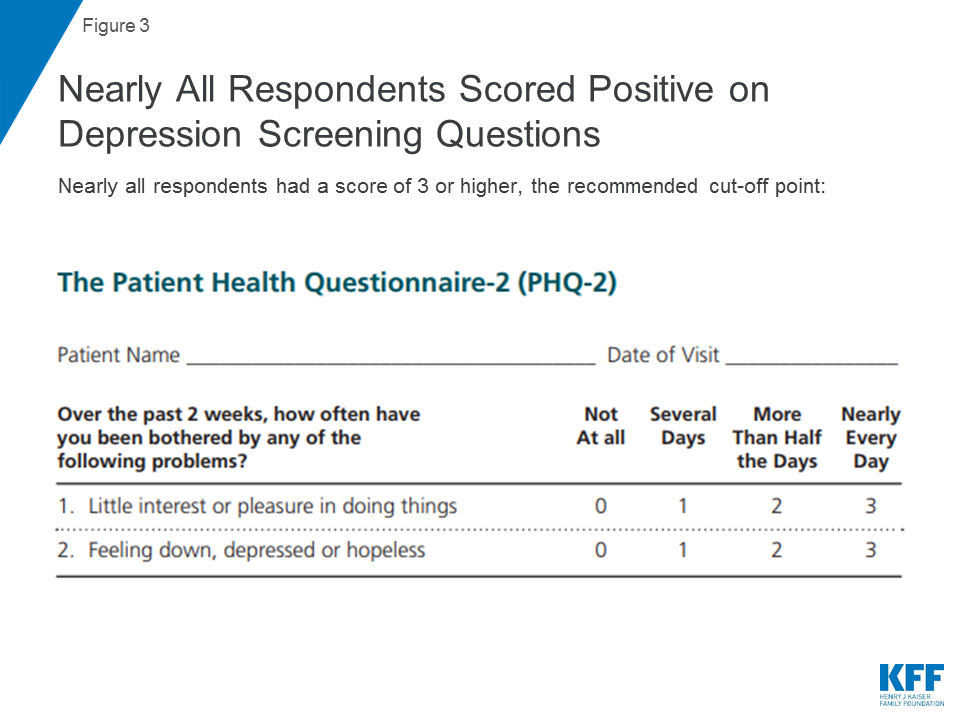
Nearly all respondents appeared to be experiencing symptoms of depression, with the majority having a positive score on a clinical depression-screening tool. They described feeling extreme sadness and, in some cases, desperation. A few said they have had suicidal thoughts. Many reported problems eating and sleeping as well as stomachaches and headaches. Several said that chronic conditions like diabetes and hypertension have gotten worse due to increased stress and anxiety. The emotional trauma of being separated from their family member sometimes compounded previous trauma individuals experienced in their home countries or during their journey to the U.S.
“Sometimes…I’ve thought about not living anymore. I want this to be over now! But, then my kids…motivate me. Because they’re the main thing that keeps me going.” Spouse/Partner of Detained/Deported Individual, Los Angeles, CA
“…my diabetes got a lot worse, a lot. My cholesterol and diabetes both got worse…” Spouse/Partner of Detained/Deported Individual, DC Area
Children also had increased mental health issues and behavioral changes that stakeholders stressed will have long-term negative impacts on their health. Children became sad and anxious, crying and frequently asking for the missing family member. They developed problems eating and sleeping, experienced developmental regressions, and became more isolated and withdrawn. Stakeholders expressed major concerns about the long-term impacts for children, referencing research showing that stress and trauma in children lead to poor long-term mental and physical health outcomes.
“…my youngest daughter is destroyed emotionally, devastated. She cries, dreams about it. She wants her dad and doesn’t have him.” Spouse/Partner of Detained/Deported Individual, DC Area
“There’s a lot of studies that indicate just the simple stress alone, the anxiety alone can, they can preclude the patient…[to] be more susceptible to chronic diseases such as hypertension and diabetes.” Health Center, TX
Abrupt Declines in School Performance
Families and stakeholders said that children had more difficulty paying attention in school due to stress and worries as well as problems sleeping. One educator noted that, physiologically, it is more difficult for children to learn because they cannot access the correct area of their brain when they are in a state of stress and experiencing trauma. Stakeholders noted that teachers are spending more time focused on reassuring and calming students, which takes away time spent on academics. Stakeholders also had concerns about the negative impacts on children’s long-term educational attainment and future success as adults.
“…it just creates a very bleak future for some of our young people…we’re creating such…an environment of hostility and discouragement for our students that’s basically going to affect generations to come, I mean we’re going to have students that perhaps are not interested in going to college, are not interested in furthering their education…” Educator, CA
Fear of Accessing Public Programs
Families have growing fears about participating in health, nutrition, and other programs. Families were scared that accessing services could jeopardize the chances of having their detained or deported family member released or allowed to return to the U.S. They also feared it could prevent themselves from obtaining legal status or citizenship in the future and/or put others at risk for deportation. As such, many were not participating in food assistance or other programs, including the Supplemental Nutrition Assistance Program (SNAP) and Free or Reduced Price Lunch, even though they were having problems affording food and their U.S.-born children would likely qualify. Stakeholders also reported declines in public program participation as well as use of other services. They noted that potential changes to public charge policies are escalating fears, even among legal permanent residents and citizens.
“I used to get Medicaid and the food stamps, but as I wanted to get my legal status, they even say that if you ask for help from the government, you’ll be denied legal status.” Mother of Detained/Deported Individual, Houston, TX
“Even clients that I am now giving them their work permits or their green cards and they are eligible for public benefits, they’re very hesitant to get anything.” Legal Services Provider, CA
Gaps in Support and Resources
Despite significant mental health needs, most families were not receiving mental health care. Families and stakeholders pointed to lack of coverage among adults, limited availability of providers, stigma associated with mental health care within the Latino community, and fear of sharing information with others as barriers to care. Teachers and schools served as an important link to counseling for some families. However, stakeholders noted that schools do not have the resources to meet the growing needs.
“[My granddaughter] has a good doctor, but we don’t want to say much to doctors because then they start to do some kind of investigations.” Mother of Detained/Deported Individual, Sunnyvale, CA
Families face major gaps in legal help and other assistance. Due to lack of sufficient legal services, many families are going without representation or going into debt for thousands of dollars to pay private attorneys. Stakeholders said that the lack of legal services makes families susceptible to fraud and limits their chances for successful outcomes with their cases. Stakeholders stressed that expanding legal resources is a crucial priority. Further, although some families received help from charities, churches, and community organizations, families and stakeholders pointed to gaps in financial, food, and housing assistance for families, particularly as they are increasingly fearful of enrolling in public programs.
“…families need lawyers. I think that representation is the most urgent need to fill….” Legal Services Provider, CA
Fear and Uncertainty for the Future
Many families felt trapped without any good options and apprehensive about their future. Many were uncertain about their future and did not know if they would remain in the U.S. For some, returning to their country of origin is not an option because it would be too dangerous. Families and stakeholders reported growing concerns among DACA recipients and individuals losing TPS status, who are fearful that Immigration and Customs Enforcement (ICE) will target them when they lose status because the government has their information. They fear having to return to a country to which they have no connection since they have lived in the U.S. for decades and established their lives and families here.
“So a lot of my TPS clients…are just devastated. They just feel that the country has turned their backs on them, that they have been in this community for some of them 25 years.” Legal Services Provider, TX
Stakeholders highlighted the resilience of families amid their challenging circumstances. They underscored families’ continued focus on working toward a better future for themselves and their children despite the challenges they face. They also stressed that many families have made huge sacrifices and overcome major obstacles to get to the U.S. with the hope of providing a better future for their children.
“…they’re really resilient… they’re still prioritizing their children, their children’s education, even their own education…it’s amazing everything that’s happening and how resilient they continue to be.” Health Center, CA
These findings show that detention or deportation has major multigenerational effects across families and the broader community. Families face severe financial hardship while at the same time they are dealing with the emotional trauma of being separated from their loved one. Loss of the family member from the home significantly disrupts children’s lives and has major negative impacts on their mental and emotional health that compromise their ability to learn and perform in school and research suggests will lead to poor long-term physical and mental health outcomes. See Box 1, next page, for one family’s story.
Text Box 1: One Family’s Story
“T” came to the U.S. from Mexico in 2001. As a domestic violence survivor, she obtained a U visa and eventually legal permanent residency (a “green card”) in 2014. After arriving in the U.S., she met her current husband, who also is from Mexico. “T” has five children ranging from age 2 to 17. Four were born in the U.S., and the oldest is a legal permanent resident. In 2017, “T’s” husband went to Mexico for an appointment as part of his process to apply for residency. Immigration officials denied him re-entry into the U.S. due to gaps in his paperwork, and he must wait 10 years before he may be able to return.
After being separated from her husband, “T” could not get by on only her income, especially without any help to watch her children. Left with no good options, she sent the youngest children to live with their father in Mexico and began working two jobs. She starts her day in a chicken packing factory from 5:00am-4:15pm and then cleans a church from 5:00 to 10:00pm. Her husband cannot work because he is caring for the children, so she took out a loan to support him and the children in Mexico. She owes between $10,000-$15,000 on her loan.
Even working two jobs, “T” struggles to keep up with her bills. She is at risk for having her water and electricity cut off and does not know how she will pay the next month’s rent for the small one-bedroom apartment she lives in with her three older children. She sometimes eats less and goes hungry because she does not have enough money for food.
“T” is very depressed and agonizes over being separated from her husband and her children. She is in a state of desperation and, at times, wonders how she can continue to live. “T” fears sharing her feelings with her doctor at the clinic, because she worries it will result in having her children taken away.
The children do not want to go to school and have lost all motivation to get ahead. All three who are still in the U.S. have had their grades go down. The children are stressed and depressed, and the 9 year old has begun wetting the bed. They accuse “T” of wanting to work instead of spending time with them. The older children have become more rebellious and withdrawn. Her eldest daughter always dreamed of going into the armed forces, but now feels she needs to get a job to help support the family.
The family lost their health coverage that they used to have through her husband’s work. The children now have Medicaid, but “T” became uninsured. Despite her major financial challenges, she has not enrolled in any other programs. She fears that use of some programs could affect her ability to obtain citizenship and that she would have to pay the government back for services used in the future.
“T” prays that her husband will obtain a pardon and be able to return without waiting 10 years. She fears for the safety of her husband and children in Mexico due to the drugs and violence in the area. She is working with an attorney that she found through a priest at the church she cleans. The church has also provided her financial support and help with food, which has helped get her through her toughest times.
Issue Brief
Introduction
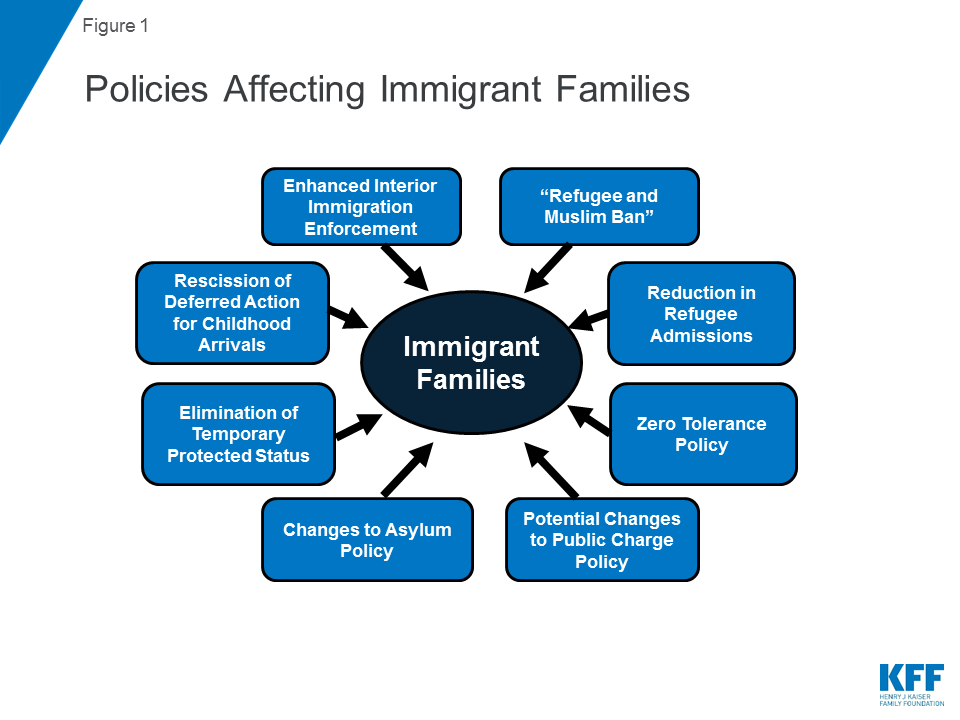
An array of Trump Administration policies currently are affecting immigrant families, including policies to enhance interior immigration enforcement, restrict entry into the U.S., and decrease use of public programs by immigrants and their U.S.-born children (Figure 1). As documented in a previous Kaiser Family Foundation report, these policies, along with growth in anti-immigrant sentiment, have significantly increased fear and uncertainty among immigrant families and had wide-ranging negative impacts on their health and well-being. This report builds on that work by exploring the direct impacts of detention and deportation on the finances, health, and well-being of families.
Figure 1: Policies Affecting Immigrant Families
The findings are based on structured interviews with 20 individuals who recently had a family member in their household detained or deported that were conducted by the Kaiser Family Foundation, working with PerryUndem Research/Communication, during Summer 2018. The interviews were conducted in five cities in three states, including, Sunnyvale, Fresno, and Los Angeles, California; Washington, DC; and Houston, Texas. In addition, 12 telephone interviews were conducted with legal services providers, health centers, educators, and community-based organizations serving immigrant families in these states. The Blue Shield of California Foundation supported the work in California.
Findings
Overview of Families
Most respondents were Hispanic women with children in the home. The ages of children ranged from infants and toddlers to teenagers. Immigrants in respondents’ families primarily came to the U.S. from Mexico and Central America, including El Salvador, Honduras, and Guatemala. Most frequently, the respondent was the spouse or partner of the detained or deported individual. However, respondents also included parents of an adult child who was detained or deported, teenage or adult children of a detained or deported individual, and an adult sibling of a detained or deported individual. Although participating families predominantly came from Mexico and Central America, stakeholders served immigrant families from a broader array of countries. They noted that, although there is less attention on the effects of immigration enforcement on other communities, they also are experiencing many of the same impacts.
Family members of detained or deported individuals had varied immigration statuses, but most children in the households were U.S.-born. Some adults were U.S. citizens, including U.S.-born and naturalized citizens. Others had varied statuses, included legal permanent residents (“green card” holders), Deferred Action for Childhood Arrivals (DACA) recipients, and individuals with temporary protected status (TPS). Some were undocumented, although a number were seeking legal permanent residency or asylum. In most cases, children in the households were U.S. born.
Respondents said their families came to the U.S. to seek safety and escape violence; some survived trauma in their home countries or during their journey to the U.S. One woman’s son had been killed in her home country. Another had received direct death threats to her family, including her six-year-old child. A few were survivors of domestic violence. One woman was kidnapped by human traffickers while entering into the U.S., and released after her family paid a ransom. Stakeholders noted that the trauma of detention or deportation of a family member often compounds previous trauma.
“[The gangs] were coming after us… On the last call they told us… they were going to start killing the youngest of the family. And the youngest was my daughter.” Spouse/Partner of Detained/Deported Individual, Fresno, CA
“They pulled a gun on me. They wanted to kill me. And they robbed me and told me that if they saw me in the street, they’d kill me….” Spouse/Partner of Detained/Deported Individual, DC Area
“Many of our families…make huge sacrifices in their home countries in order to get here and then the process of actually coming can be extremely traumatic… we have some extreme horror stories about peoples’ migration process.” Educator, DC Area
Growing Fear of Enforcement
Stakeholders reported that enforcement activity has become more arbitrary, increasing fear among the community. They indicated that enforcement previously focused on individuals with a criminal history, particularly those who committed violent crimes. In contrast, today, everyone is a priority. They also have observed an increased focus on people who have been living in the U.S. for longer periods, sometimes decades. Legal services providers noted that the U.S. Citizenship and Immigration Services (USCIS) is now referring people to Immigration and Customs Enforcement (ICE) if they deny a claim for status. They also noted that fewer people will be able to obtain asylum due to recent policy changes to reject claims based on domestic or gang-related violence. Stakeholders and families reported that the expanding nature of current enforcement activities, as well as recent raids in communities and homes, have increased fears among the broad immigrant community.
“…in the past they might’ve really been focused on…people with criminal histories… Those people are still getting removed, but not as many in proportion to the overall numbers, because…everybody’s a priority now…” Legal Services Provider, CA
“…before they would just go after criminals or people that have only been in the country for a couple years. And now, grandmas are getting deported. And so that fear of…it could be anybody, it could happen at any time.” Health Center, CA
“…because of Sessions’ new policy of not honoring domestic violence or gang-related violence as a legitimate asylum claim, we’re seeing lots and lots of folks … feel like they don’t have any hope.” Health Center, DC Area
Families and stakeholders reported growing concerns and fears among DACA recipients and individuals losing TPS status. They said that individuals are increasingly fearful that ICE will target them when they lose status because the government has their information. They noted that they feel scared, uncertain, and hopeless about their future and fear returning to a country to which they have no connection since they have lived in the U.S. for decades and established their lives and families here.
“I wanted to renew [my TPS], but by next March, we won’t have it anymore. We’re all afraid…because they have your address, everything.” Spouse/Partner of Detained/Deported Individual, DC Area
“So a lot of my TPS clients…are just devastated. They just feel that the country has turned their backs on them, that they have been in this community for some of them 25 years.” Legal Services Provider, TX
“We’ve seen…an increase in hopelessness…just kind of feeling trapped…because the thought of going back to a country that they [DACA recipients] don’t have any connections to…” Educator, DC Area
Stakeholders also observed increased fears among legal permanent residents and naturalized citizens. Some stakeholders reported an uptick in legal permanent residents seeking citizenship because they no longer feel secure with their status. Families and stakeholders also said that growing anti-immigrant sentiment has led to uneasiness in the community regardless of status.
“I’ve noticed that a lot of people who have been permanent residents for 20, 25 years are now coming and asking for, to apply for citizenship. …they’re fearful that even as legal permanent residents they could be deported…” Legal Services Provider, TX
“…there’s a lot of hate going around us Mexicans…. And I’m scared…because, in the back of your head you’re thinking that you might encounter these people with hatred, with racism….” Adult Daughter of Detained/Deported Individual, Houston, TX
Detention and Deportation of Family Members
Detention and deportation of family members occurred suddenly and unexpectedly, leaving families in shock and unprepared. Among respondents, the most common circumstances leading to detention or deportation of their family member was during a scheduled check-in or appointment for a pending immigration case or following a traffic stop or other interaction with the police. Respondents said family members went into scheduled immigration visits optimistic and hopeful about progressing forward with their case, but were detained or deported due to inaccuracies or missing information in their case, which sometimes related to issues from decades ago. Several families said these gaps or inaccuracies were due to mistakes or failures by their attorneys. Some detained or deported family members had been living in the U.S. for decades, while others had arrived recently.
“…we both had an appointment for the residency. We went in and then we were in the same office, and after 10 minutes they took him away…” Spouse/Partner of Detained/Deported Individual, Los Angeles, CA
“…he…was coming back from work and the police stopped them because one of the lights of his car wasn’t working, and he was detained….” Mother of Detained/Deported Individual, Houston, TX
Families faced significant costs and challenges to communicate with their detained or deported family member. In several cases, respondents said it was very difficult to find their family member after ICE detained them, noting that they searched the internet, made calls, and sometimes visited facilities in person to locate their family member. Families and stakeholders noted that individuals in detention facilities are not able to receive incoming calls. As such, families must place money into accounts for them to make outgoing calls, which are costly. One family said that they were placing $100 per week into an account, which covered about 2-3 phone calls per week. Families also faced challenges visiting detention facilities. Only family members with legal status can visit a facility and visits can require significant time and costs because sometimes individuals are detained hours away from their family. Families with a deported family member communicated via phone or WhatsApp. The frequency of contact varied; in some cases, it was very limited because the deported family member did not have a phone.
“…at first we didn’t know…where he was… We had to look him up online…just try different combinations of his name. Me and my older sister…we physically went in there and asked, ‘is my brother here?’” Sibling of Detained/Deported Individual, Fresno, CA
“…they have to pay to call….and now we don’t have a lot of money, so sometimes I can’t give him much, so that’s why he says he’ll talk to me once every two weeks.” Mother of Detained/Deported Individual, Houston, TX
“I had to take the five kids to see him, but just once because it’s so expensive to go there–$400 I had to pay to go see him.” Spouse/Partner of Detained/Deported Individual, DC Area
Sudden and Severe Financial Hardship
One of the most immediate and significant effects on families was the loss of income, which left them struggling to pay their bills. Remaining family members often attempted to make up for the lost income by working more hours or picking up additional jobs. For example, one mother reported working a 17-hour day, starting at a chicken packing plant from 5:00am to 4:15pm and then cleaning a church from 5:00 to 10:00pm. However, all respondents had significant difficulty paying their bills due to the loss of income. They cut back on as many expenses as possible, but some did not know how they were going to pay their rent and were behind in their utility payments, with a number at risk of having their utilities cut off. Stakeholders said that, in some cases, individuals have returned to an abusive relationship or suffered poor working conditions or exploitation by an employer because their income needs were so urgent and they had no other options.
“We have to do the impossible to have food for the kids and try to pay for the bills on time.” Spouse/Partner of Detained/Deported Individual, Fresno, CA
“At night [the children] still wear diapers, so they don’t wet the bed. I don’t even have money for that. It is very hard. Before it wasn’t like that.” Spouse/Partner of Detained/Deported Individual, Houston, TX
“…we’ve had other patients who…had to go back with an abusive partner…because they just didn’t have any other options.” Health Center, CA
Many families faced the dilemma of needing to work more hours to pay their bills but not having anyone to care for their children. This situation forced some families into very difficult situations. For example, some parents had to stop working or cut back on their hours since their spouse or partner was no longer available to watch the children but then were unable to pay their bills. One mother sent her two U.S.-born children to Mexico to be with her deported husband, because she could not work the hours necessary to support her family and care for the children at the same time. In addition, some families faced gaps in caregiving support for older adults when an adult child who was providing financial and caregiving support to older parents was detained or deported.
“So we looked at lots of different options to find a solution, and the only solution was to send [the youngest children] to Mexico and for me to get two jobs.” Spouse/Partner of Detained/Deported Individual, Los Angeles, CA
“…if I have to work at night, they have to stay somewhere else. Before that wasn’t a problem because their dad was there and stayed with them.” Spouse/Partner of Detained/Deported Individual, Houston, TX
Many families reported problems affording food, with some adults going hungry so their children could eat. Many respondents reported at least one of four problems affording food, with a number experiencing multiple or all of these problems (Figure 2). Several respondents said they sometimes go hungry so that their children can eat. Most respondents said they are eating less healthy food to save money. They are eating fewer fruits, vegetables, and meats and relying on rice and beans and canned food. Some got help from family, food banks, churches, or community organizations. Most were not participating in the Supplemental Nutrition Assistance Program (SNAP or food stamps) or Women, Infants, and Children (WIC) program even though their U.S.-born children would likely qualify because they were scared to enroll.
Figure 2: Many Families Reported One or More of the Following Problems Affording Food
“Sometimes I would skip a meal so that my kids could eat.” Spouse/Partner of Detained/Deported Individual, DC Area
“…right now the girls are asking for fruit. [My daughter] likes to eat fruit, but I don’t have money to go buy her any.” Spouse/Partner of Detained/Deported Individual, Houston, TX
“I used to buy two gallons of milk. Now I only buy one and try and make it last.” Spouse/Partner of Detained/Deported Individual, Los Angeles, CA
Some families also experienced unstable housing situations. A number moved in with family or to smaller spaces, which led to crowded living situations and increased stress. One mother became homeless for six months. She stayed with family and friends, moving frequently, which required her children to change schools three times. She moved into an apartment after receiving assistance from a community organization but is uncertain how she will pay rent when that assistance ends.
“I couldn’t pay for an apartment on my own. [So I had to] move to a room, to live in one room with my three kids…” Spouse/Partner of Detained/Deported Individual, DC Area
“Six months we were homeless… One day here, one day there, we woke up sleeping with relatives…” Spouse/Partner of Detained/Deported Individual, Los Angeles, CA
In some cases, families lost their source of transportation. Without a car, they had to rely on public transportation and/or family or friends for rides. Loss of the car increased the time, hassle, and costs to complete daily tasks like grocery shopping, commuting to work, and getting to medical appointments.
“…he was the one who would drive, who would take them to the doctor, to the dentist… Now I take the kids to the school, we walk and have to get up earlier.” Spouse/Partner of Detained/Deported Individual, Fresno, CA
Disruption to Children’s Routines and Relationships
Families and stakeholders said children are spending more time inside and participating in fewer activities because adults are working all the time and/or more fearful of spending time outside. Some families reported that children became angry or resentful about the remaining parent working all the time. Families and stakeholders also noted that some parents have less patience with their children because of the increased work and stress.
“I cannot take them to the park; I cannot take them outside…so they stay at home with their videogames.” Spouse/Partner of Detained/Deported Individual, Fresno, CA
“…before [my daughter-in-law] had more time to help [my granddaughter] with her school stuff and everything…and now, she doesn’t.” Mother of Detained/Deported Individual, Sunnyvale, CA
“…when [my daughter-in-law] gets home, she’s very tired. If the kids are awake, she doesn’t even want them to talk to her because she only wants to rest… And she’s always upset with the kids. She doesn’t want them to make noise, doesn’t want them to bother her…” Spouse/Partner of Detained/Deported Individual, Fresno, CA
In some families, older children assumed new responsibilities and changed their plans for the future. For example, some older children took on jobs to help support the family or expanded roles caring for their younger siblings. Stakeholders noted that, in some cases, older children have taken on challenging and stressful roles advocating and translating for their parents to communicate with lawyers and others involved in their family’s immigration case. Some families reported that older children changed their plans for the future. For example, one declined acceptance to a university and is attending community college because the family can no longer afford the university. Another is revaluating plans to join the armed forces because she feels she should get a job to help support the family.
“…kids aged 14, 15, 16… many times they become in charge of not just of themselves, but of the little siblings…” Health Center, CA
“…sometimes the kids they’ll…take on roles that a kid maybe shouldn’t take on, like speak, translate for their parents and for a lawyer or for the police…so, they’re having to take on difficult roles.” Community Organization, TX
“…he wants to go to college, but we decided it is better if he went to a community college. He applied to 10 universities and got accepted in 9, but, unfortunately, I cannot help financially.” Spouse/Partner of Detained/Deported Individual, Sunnyvale, CA
“She’s still interested in going to the armed forces, but what’s stopping her is wanting to help bring more money home.” Spouse/Partner of Detained/Deported Individual, Los Angeles, CA
Increased Fear
Remaining family members became significantly more fearful and worried that others in the family could be taken at any time. Families said they are living on edge and anxious all the time. A number said they limit their driving and time outside the home as well as their interactions with people in the community. For example, one woman said she no longer goes to the market or other places where there are large numbers of Latinos because she worries that ICE will target these locations. Some stakeholders reported that families are less willing to contact the police for help and one stakeholder noted that her community has had a decline in domestic violence calls.
“….after what happened with my husband I do not feel safe anywhere…I think that at any time they will come and arrest me, and they will take me.” Spouse/Partner of Detained/Deported Individual, Los Angeles, CA
“I don’t leave my house. No, I go from work to home, to school… We live in isolation from the world right now.” Spouse/Partner of Detained/Deported Individual, DC Area
Adults tried to protect children, but many children had increased fears. Some adults tried to protect children by not sharing the details of what happened to the detained or deported family member. However, children still often heard about the circumstances through siblings or other family members or heard about issues in school that made them worried. Families with older children typically had shared the details of what happened to the detained or deported family member. One respondent noted that the children witnessed their father being detained and said it was a traumatic and scarring experience. Families and stakeholders said children are scared that their remaining parent or other people in the family will be taken and often want to stay physically close to and in constant contact with them. One stakeholder said she has heard stories of children sleeping by the front door because they worry wither their parent will still be there when they wake up. Families and stakeholders also said that children fear for the safety and well-being of their detained or deported family member.
“I didn’t tell them their dad was taken. I told them their dad had to go work there, just for a time and then he will return…” Spouse/Partner of Detained/Deported Individual, Sunnyvale, CA
“…he’s being detained, in front of their eyes—so they’re scarred…” Adult Daughter of Detained/Deported Individual, Houston, TX
“There’s fear, a lot of fear….Even kids, sometimes when they’re playing they say…‘immigration is coming!’ and they all run away.” Spouse/Partner of Detained/Deported Individual, Houston, TX
Extreme Stress, Anxiety, and Depression
Nearly all respondents appeared to be experiencing symptoms of depression, with the majority having a positive score on a clinical depression-screening tool (Figure 3).1 Respondents described feeling extreme sadness and, in some cases, desperation. A few said they have had suicidal thoughts. Many reported problems eating and sleeping as well as stomachaches and headaches. Several said that chronic conditions like diabetes and hypertension have gotten worse due to increased stress and anxiety. While suffering internally, adults said that they try to be strong for their children and attempt to hide their worries and sadness.
Figure 3: Nearly All Respondents Scored Positive on Depression Screening Questions
“It’s a sense of sadness for everyone, everybody, the whole family…we all feel sick, depressed. None of us has any energy.” Mother of Detained/Deported Individual, Sunnyvale, CA
“Sometimes…I’ve thought about not living anymore. I want this to be over now! But, then my kids…motivate me. Because they’re the main thing that keeps me going.” Spouse/Partner of Detained/Deported Individual, Los Angeles, CA
“I don’t sleep at all. The days pass by and I don’t realize them, the days pass by—4:00 a.m. comes I am still awake.” Spouse/Partner of Detained/Deported Individual, Houston, TX
“…my diabetes got a lot worse, a lot. My cholesterol and diabetes both got worse…” Spouse/Partner of Detained/Deported Individual, DC Area
Children also experienced sadness, anxiety, and behavioral changes. Families and stakeholders said children are sad and anxious, crying, and frequently asking for the missing family member. They also observed problems eating and sleeping, developmental regressions, and eating disorders stemming from stress and anxiety. Several families said their children became more withdrawn and no longer socialized with friends. Teenage children felt increased stress from added responsibilities and pressures. For example, one teen said she feels a lot of pressure to do well in school while at the same time struggling with the sadness and stress of losing her older brother, who was the main breadwinner for the house.
“…my youngest daughter is destroyed emotionally, devastated. She cries, dreams about it. She wants her dad and doesn’t have him.” Spouse/Partner of Detained/Deported Individual, DC Area
“[My mother] tells me not to work during the school year…she tells me to only study…that’s the only thing I can do, get good grades so I won’t disappoint her.” Teenage Sister of Detained/Deported Individual, Houston, TX
“…she wets the bed, and she’s 9. So, I think it’s a way of seeing what’s going on, because she never did that and now she does it often.” Spouse/Partner of Detained/Deported Individual, Los Angeles, CA
“…[my granddaughter] no longer wants to play with other kids. She wants to be by herself… Before, she was never afraid…but now, she’s really isolated from everything.” Mother of Detained/Deported Individual, Sunnyvale, CA
“[My grandson] can wear the same clothes for a long time and he goes to school and he doesn’t ask for anything, because he can see that his mom cannot afford it.” Mother of Detained/Deported Individual, Fresno, CA
Stakeholders emphasized that the stress and children are experiencing today will have long-term negative effects on their physical and mental health. They pointed to research showing that stress and trauma contribute to higher rates of chronic disease and mental health issues.
“There’s a lot of studies that indicate just the simple stress alone, the anxiety alone can, they can preclude the patient…[to] be more susceptible to chronic diseases such as hypertension and diabetes.” Health Center, TX
“And, so we focused a lot on mental health because that’s where it feels most immediate, but the physical health sequela are going to be long, long, range impacts….” Health Center, DC Area
“…you can talk about them in terms of that short-term effect of the child who’s crying, but where is that child 20 years from now? And this is not the kind of trauma that sort of happens once and… it goes away. It’s the kind of trauma that lingers generationally….” Legal Services Provider, CA
Declines in School Performance
Parents and stakeholders reported abrupt declines in children’s performance in school, which stakeholders cautioned may have long-term negative impacts on their future success. In some cases, children missed days of school due to the disruption and emotional trauma in the family. Stakeholders also reported drops in school attendance after raids within a community. Some families said their children had to change schools multiple times because they moved frequently due to unstable housing situations. Families and stakeholders said that children had more difficulty paying attention in school due to stress and worries as well as problems sleeping. They noted that teens face competing pressures to do well in school and help support their families while at the same time dealing with the trauma of losing their family member. An educator noted that, physiologically, it is more difficult for children to learn because they cannot access the correct area of their brain when they are experiencing stress and trauma. Stakeholders also emphasized that increased fear and trauma among students is affecting the broader student body and school beyond those directly affected by enforcement activities. For example, teachers are spending more time reassuring and calming students, which takes away from time spent on academics. They also stressed that children may experience long-term negative impacts on educational attainment and future success due to their declining grades and loss of hope for the future.
“Her grades went down, and they sent her to summer school because she wasn’t doing well…because she was sleeping sometimes…at school. She’d be awake at night crying…and sometimes she’d be tired when she went to school.” Spouse/Partner of Detained/Deported Individual, DC Area
“I noticed that my grades would go down…I get distracted because I am thinking about it at school or sometimes I don’t sleep at night because I am thinking about it and then I get sleepy at school.” Teenage Sister of Detained/Deported Individual, Houston, TX
“…they’re also not learning because their brains are not even letting them learn… they’re not even able to access that frontal lobe and grow it out and mature it out. So yes, we do see developmental delays there associated with it.” Educator, DC Area
“…it just creates a very bleak future for some of our young people…we’re creating such…an environment of hostility and discouragement for our students that’s basically going to affect generations to come, I mean we’re going to have students that perhaps are not interested in going to college, are not interested in furthering their education…” Educator, CA
Gaps in Mental Health Care
Despite significant mental health needs, most families were not receiving counseling or other mental health services. Although a number of respondents expressed interest in and thought they might benefit from counseling or other mental health services, adults generally had not sought care for themselves. Most children also were going without counseling or other mental health services. Families and stakeholders pointed to several barriers to obtaining care, including the lack of coverage among adults and cultural biases against seeking mental health care within the Latino community. In addition, for many adults, meeting their basic needs was a higher priority than obtaining mental health services. Although some parents were interested in obtaining counseling for their children, in some cases, they were scared to share their family situation with their children’s doctor or clinic. Stakeholders also pointed to lack of available mental health services as a significant barrier and noted that waiting lists for care are sometimes months long. They stressed the importance of expanding the availability of culturally appropriate in-language services that can address the increasingly complex situations of families.
“…you can’t do therapy for somebody who is just trying to figure out how they’re going to survive during the next week.” Health Center, CA
“Normally, especially in Hispanic families, it is very frowned upon or it’s a taboo for me to ask for counseling…” Teenage Sister of Detained/Deported Individual, Houston, TX
“[My granddaughter] has a good doctor, but we don’t want to say much to doctors because then they start to do some kind of investigations.” Mother of Detained/Deported Individual, Sunnyvale, CA
“…if I refer out, parents might…have to wait two or three months before they get the services because the slots that are available are filled.” Educator, CA
Teachers and schools served as an important link to counseling for some families. Several families had shared information about their family situation with their child’s teacher or school after the teacher identified behavioral changes or the child shared information. In a number of cases, the schools connected the children and sometimes the parents to counseling. Stakeholders reported that schools are seeing an increased need for mental health services. They noted that teachers recognize behavioral changes among children, which then lead to conversations with the family that reveal immigration-related issues. Schools are responding to increased needs through direct counseling services and referrals to external providers, with some schools developing partnerships with local mental health departments. However, stakeholders stressed that schools do not have the capacity to meet growing needs.
“I always had a good relationship with their teachers. I told her what was going on because my girl had told her.” Spouse/Partner of Detained/Deported Individual, Sunnyvale, CA
“…when my son found out, he started to behave badly at school…and I didn’t have a choice but to tell the teacher that this was affecting him…” Spouse/Partner of Detained/Deported Individual, Houston, TX
“…we are fortunate in the fact that we have two amazing counselors, however, they’re limited as to what they can offer…because we’re a school of 1,500 and…2 to 1,500 is the ratio.” Educator, CA
Increased Barriers to Health Care
Some families lost their health insurance after their family member was detained or deported. In some cases, adults in the household had private coverage or Medicaid, but most were uninsured because they did not qualify for Medicaid or were fearful about enrolling in Medicaid and could not afford private coverage. Most children in the households had Medicaid coverage since many are U.S.-born and qualify for coverage. However, some were uninsured because they did not qualify or because their families were fearful of enrolling them. In several cases, the detained or deported family member had employer-sponsored insurance that covered the family. The family lost this coverage when that family member was detained or deported. Some children in these families transitioned to Medicaid, but the remaining spouse generally was not eligible and became uninsured. In one case, the employer continued the family’s coverage for six months, but the family will likely become uninsured when this coverage ends.
Families generally were continuing to obtain health care for children, but getting care became more difficult. Respondents noted that children generally were continuing to get needed health care services, including check-ups and immunizations. Families and stakeholders noted that school requirements for immunizations and well-child visits help ensure children continue to receive care. Some families said it became harder to get to doctor visits due to losses in transportation and increased work hours. Cost generally was not a barrier to care for children, since they typically had Medicaid coverage. However, some families had difficulty affording care for children who were uninsured. For example, one parent reported that she could no longer afford medical supplies or transportation to appointments for her son with disabilities. Further, one teenager was going without treatment for previously identified anemia and other health problems because her families had disenrolled her from Medicaid due to fears.
Fear of Accessing Public Programs
Many families were avoiding health, nutrition, and other programs due to fear. Families worried that participating in these programs could jeopardize the chances of having their detained or deported family member released or able to return to the U.S. They also feared it could prevent themselves from obtaining legal status or citizenship in the future. Several reported that attorneys and/or public officials had advised them not to participate in any programs or receive assistance because it could negatively affect their immigration case. As such, many families were not participating in SNAP (food stamps) or WIC, even though their U.S.-born children would likely qualify and the families were having problems affording food. A number of families continued Medicaid coverage for their children despite these worries because their children’s health care was such a high priority and they could not go without the coverage. However, a few had not enrolled their children in Medicaid or had disenrolled their children from Medicaid due to these concerns.
“In the immigration office, they told us that if we request asylum we couldn’t get anything from the government.” Spouse/Partner of Detained/Deported Individual, Fresno, CA
“I used to get Medicaid and the food stamps, but as I wanted to get my legal status, they even say that if you ask for help from the government, you’ll be denied legal status.” Mother of Detained/Deported Individual, Houston, TX
“…we’re a bit worried because my daughter has asthma. I couldn’t do it without Medi-Cal [Medicaid]. I can’t let her be without Medi-Cal [Medicaid].” Cousin of Detained/Deported Individual, Sunnyvale, CA
Stakeholders reported declines in participation in public programs and a broader array of services due to increased fear. Consistent with what families reported, stakeholders said that their clients’ concerns about participating in public programs have increased, leading to fall offs in enrollment in food assistance programs, such as SNAP, WIC, and Free or Reduced Price Lunch, as well as Medicaid and CHIP. They also said that families are avoiding other services, including libraries and services from community organizations. One health center in Texas reported significant drop offs in Medicaid and CHIP enrollment among adults and children as well as fall offs in families seeking care through the center and following up on referrals to county hospitals. Stakeholders said that media coverage of potential changes to public charge policies are escalating these fears, even among legal permanent residents and citizens. Stakeholders have revamped and enhanced outreach efforts to assure families that it is safe for them to obtain their services and that they will protect their information, but many families remain fearful even with these assurances. Stakeholders also felt it has become more difficult for them to advise families because policies are constantly changing and they are no longer confident about what to recommend.
“…there’s been people who are citizens who don’t want to access benefits because…as an immigrant, as a person of color there’s not the same security, even though they are citizens.” Health Center, CA
“…the Free and Reduced [Price} Lunch program is one that parents now are very afraid to provide any type of information that they feel the government might get a hold of.” Educator, CA
“So I have patients who have given up their food subsidies, their assistance. They don’t go for their mammograms. I order X-rays and they’re afraid to go to the county hospital because they have to register.” Health Center, TX
“…we have an emergency fund that is specifically for Latino families in the community. It doesn’t have anything to do with federal benefits, but people are afraid sometimes to access that…” Health Center, CA
“…we’re worried that folks won’t approach us, or won’t try to access services because of the fear of us being connected to law enforcement or, that somehow we won’t help them because of their status.” Community Organization, TX
“And always in the past, we’ve been able to be very clear and reassuring patients what is a risk and what is not a risk. But now with all of the changes…we feel insecure in terms of the information that we provide.” Health Center, CA
Lack of Legal Help and Other Support
Many families were going without legal representation or going into debt for thousands of dollars to pay private attorneys. Respondents described many challenges finding affordable legal help for their detained or deported family member. They said that individuals receive a list of attorneys in detention, but that list is not useful. One respondent noted that she called 20 people on the list before she found one willing to help, and, even then, that help would cost thousands of dollars. Similarly, a legal services provider noted that the list in her area has not been updated in years and that it omits many providers offering pro bono services. Families said that attorneys are expensive and they are not sure which ones to trust. Many families reported that they were unable to find pro bono legal assistance and are paying thousands of dollars in attorney fees that they are covering through loans or with help from family members. Some respondents had paid large amounts to attorneys who turned out to be frauds or failed to provide the assistance they promised. Families and stakeholders also noted that families often face huge challenges paying bonds to have their family member released from detention. One legal services attorney noted that immigration bonds must be paid in full by a legal permanent resident or citizen and often range from $3,000 to $10,000, creating both logistical and financial challenges for families to pay. Legal services providers stressed that the lack of sufficient legal services leaves families vulnerable to fraud and facing huge fees for private lawyers. They emphasized that families’ ability to access legal help has significant implications, since they are much more likely to have a successful outcome when represented by a reputable and skilled attorney.
“…there are private lawyers, and they tell you they’ll do everything for you…and then they rob you.” Mother of Detained/Deported Individual, Sunnyvale, CA
“…at first, [the lawyer] said he would charge $5,000, but later on he wanted $1,000 more, and it continued like that.” Mother of Detained/Deported Individual, Houston, TX
“…a lot of people are paying really, really high fees to private lawyers….I would say between $5,000 to $10,000 dollars a person to private lawyers…and this is money that people just do not have. …they borrow from anyone they can borrow from, and then they end up with these huge debts.” Health Center, CA
Legal services providers said it has become more challenging for them to serve families. They said that the growing number of people in detention creates challenges because more time is required to represent detained individuals. They noted that meeting with a detained client often requires a full day because the attorney must travel to the facility and often has to wait hours for space in the facility to meet with the client. One legal services provider in Texas said that many of the detention facilities are located in rural areas, which amplifies difficulties, since few attorneys are located in those areas and those in metropolitan areas have to travel long distances to meet with clients. Given these challenges, as the number of people in detention increases, attorneys must take on smaller caseloads, reducing the overall number of families they can help. Legal services providers also said that the constantly shifting policy environment makes each case more difficult and time consuming. Further, they felt it has become more challenging to obtain relief for clients and that cases are requiring more documentation and evidence.
“…families need lawyers. I think that representation is the most urgent need to fill…you have very little chance without a lawyer in immigration proceedings.” Legal Services Provider, CA
“…without more access to legal representation, there is more space for non-attorneys like notarios or predatory attorneys who exploit our communities.” Legal Services Provider, CA
“So we have an increased demand for our services, a decreased ability to provide those services because each case takes more time than it used to, which means an overall increase in the number of people who are unrepresented…” Legal Services Provider, CA
“Lots of cases are getting denied. We’re getting a lot more requests for evidence…” Legal Services Provider, TX
Families received some assistance from family, friends, and community-based organizations, but many continued to struggle to meet their basic needs. Some families received financial help from family and friends, but not all respondents had this assistance available. Churches, faith-based groups, and community organizations also were important sources of help, providing direct assistance to some families and helping to connect them to available resources. Most families learned about these resources through radio and television or word of mouth. A few employers had also been helpful to families, providing time off and, in some cases, extra financial support to the family. However, families and stakeholders noted that many families are still in need of help to meet their basic needs, particularly as they are more fearful of enrolling in public programs.
“The only people who understand me and help me a lot with my children is my family. Financially they have helped me a lot, taking care of my daughters so I can keep working.” Spouse/Partner of Detained/Deported Individual, Sunnyvale, CA
“I have good neighbors. When my husband got deported, they supported me a lot.” Spouse/Partner of Detained/Deported Individual, Houston, TX
“…an organization helped me last month to pay for one month of rent and for electricity. I never used to ask for that.” Spouse/Partner of Detained/Deported Individual, Houston, TX
Strains on Organizations Serving Immigrant Families
Organizations and individuals serving immigrant families have experienced increased strains and challenges. Some stakeholders noted that they do not have sufficient resources to meet the growing needs among families. They have tried to enhance support available to families by deepening and expanding networks and connections to other local organizations. However, some have had to limit and refocus their priorities. Some stakeholders also made changes to their policies and operations to respond to the shifting environment. For example, health centers and some educators reported engaging in planning efforts and policy changes to better protect family information and develop procedures to respond if ICE officials were to come on premises.
“…nowadays there’s so much, that we’re having to have deep, internal conversations to prevent ourselves from jumping on every opportunity to ensure we conserve some of our resources for other things that we foresee coming down the line…” Legal Services Provider, California
“I think the like biggest operational impact has really just been trying to train staff about what to do if there’s an ICE raid.” Health Center, CA
Stakeholders reported increased stress and pressures among individuals serving immigrant families. Stakeholders noted that many of their staff are in mixed immigration status families and are dealing with their own family immigration issues while continuing to serve families. Stakeholders also pointed to “compassion fatigue” among individuals serving families, noting that hearing the trauma and suffering families endure takes a toll on those serving families, particularly when they feel helpless to improve the situation. As such, staff are experiencing increased stress and burnout. One organization reported bringing in mental health support for staff to try to buffer these effects.
“Most of our staff also have a family member or a friend who is at risk for deportation, and so a lot of our team is providing care, while also trying to take care of themselves with these same levels of stressors, which makes it that much more intense for everybody because its personal.” Health Center, DC Area
“But it’s still very, very difficult…because of the level of trauma that we’re hearing, the level of suffering that people have experienced and continue to experience, is just extremely difficult to hear.” Health Center, CA
“The teachers are very stressed over it and they sometimes meet with our counselors as well to help them get through it because it’s hard to see a child in crisis.” Educator, CA
Future Plans
Families felt lost and apprehensive about their future. Many felt trapped and that they did not have any good options available. Some indicated that they plan to stay in the U.S. even if their detained or deported family member is unable to return, but were distressed about the possibility of never reuniting the family. A few were considering leaving the U.S. to be with their deported family member, but feared the violence and poverty they would experience. For a number, returning to their country of origin is not an option because they fled direct death threats and violence.
“Here we’re discriminated against, we’re mistreated and everything else, but they’re not going to kill us…in Mexico, for a tiny thing, they’d kill you.” Mother of Detained/Deported Individual, Sunnyvale, CA
“We can’t go back to our country. …It isn’t just that they could beat you up, because they just gave me three big shoves—I did have bruises, but that was just a warning.” Spouse/Partner of Detained/Deported Individual, Houston, TX
Stakeholders underscored the resilience of families, and remarked on their ability to continue moving forward amid their extremely difficult circumstances. They noted that despite their difficult circumstances, they continue to prioritize their children’s needs and education and work to improve their own situations. They also stressed that many families have made huge sacrifices and already overcome major obstacles to get to the U.S. with the hope of providing a better future for their children.
“…we also are working with probably the most resilient bunch of people you could possibly ever imagine…they are dedicated to taking care of themselves and working hard in the face of almost insurmountable pressures…and they are dedicating all their resources towards making a better life for their kids.” Health Center, DC Area
“Some of these people have given everything up, they’ve cut ties with their families and everything just to get here…for this American dream.” Educator, TX
Conclusion
Taken together, the findings show that when an individual is detained or deported, there are major cascading, effects across the family and broader community (Figure 4). These effects touch spouses/partners, children, siblings, older parents and other family members. The effects are far-reaching, impacting families’ finances, daily lives and routines, and their emotional and physical health. They also extend into the community, affecting schools, health care providers, churches and faith-based organizations, and local businesses.
Figure 4: Detention or Deportation has Wide Ranging Impacts Across Families and Communities
Detention or deportation of a family member left families suddenly struggling to pay their bills, with many having difficulty putting food on the table. Detention or deportation of a family member often occurs suddenly and unexpectedly, leaving families in disarray and struggling to pay their bills. With the loss the detained or deported family member’s income, many families face problems paying their bills and have difficulty affording enough food as well as housing insecurity.
Families are suffering significant emotional trauma that will have lifelong negative effects on children’s health and future success. Adults and children are experiencing extreme levels of stress, anxiety, and depression. Stakeholders emphasized that the stress and trauma children are experiencing today will have long-term negative effects on their physical and mental health. They also stressed that it could limit their future educational attainment and success as adults.
Despite the significant mental health needs among families, few were receiving mental health care. The findings point to several barriers to care, including lack of coverage among adults, limited availability of providers, stigma associated with mental health care within the Latino community, and families’ fear of sharing information. Schools and teachers are playing an important role linking some families to counseling. However, stakeholders stressed that schools lack the necessary resources to meet growing needs.
At the same time needs are growing among families, they have become increasingly fearful of accessing support from public programs and other services. Although many families are facing difficulty affording food and housing, they are increasingly turning away from food and other assistance programs for which their U.S. born children would likely qualify. Draft changes that the Trump Administration has proposed to public charge policies are further escalating families’ fears of accessing programs and services, even among legal permanent residents and citizens.
There are major gaps in legal help and other support for families. Due to the lack of sufficient legal services, many families are going without representation or going into debt for thousands of dollars to pay private attorneys. Stakeholders stressed that expanding legal services available to families is a significant priority to support families at this time. Moreover, although some families received assistance through charities, churches, and community organizations, there remain significant unmet needs for financial, food, and housing assistance. These needs will likely continue to grow as families become more fearful of accessing food and health programs.
The authors also thank the Blue Shield of California Foundation for its support of the interviews conducted in California. They also extend their deep appreciation to the families and organizations who shared their time and experiences to inform this brief, as well as the numerous organizations and individuals who helped connect us to families and service providers.
Endnotes
Respondents were asked questions from the Patient Health Questionnaire-2, a two-item depression screener. Those who had a score of three or higher were considered as responding positive to the screener, consistent with recommendations of using a cut-off point of three to indicate a need for additional screening and diagnosis. See https://www.jstor.org/stable/3768417?seq=1#page_scan_tab_contents for more information on the screener and its recommended cut-off point. ↩︎
The Washington Post/KFF Survey: Nearly a Year After Hurricane Maria, Over 8 in 10 Residents of Puerto Rico Report That the Storm Affected Their Lives in Major Ways, Including Losing Power for Months, Job Losses, Major Housing Damage, Drinking Water Shortages and New or Worsening Health Problems
A Quarter Say Day-to-Day Life is Still Disrupted. Majorities Rate Government Response to Hurricane Maria Negatively and Say Rebuilding after Maria Not a Priority for the Federal Government
Nearly a year after Hurricane Maria swamped their island, eighty-three percent of the residents of Puerto Rico say the storm affected their lives in major and lasting ways, from months-long power outages to employment losses, damaged or destroyed homes, drinking water shortages and new or worsening health problems, finds a new Washington Post/Kaiser Family Foundation survey. A quarter report their day-to-day life is still disrupted.
More than half of residents (55%) say rebuilding Puerto Rico is not a priority for the federal government, the new survey finds. Fifty-eight percent rate the federal response as fair or poor, and six in in ten (61%) believe it would have been better if the U.S. territory were a state. Majorities say both the federal government and Puerto Ricans are unprepared to deal with future hurricanes.
Featured in Wednesday’s Washington Post, the representative survey takes stock of how residents of Puerto Rico have fared in the year following the Sept. 20, 2017 storm that led to deaths, damaged homes and infrastructure, curtailed access to food and water and knocked out power for months. The survey explores their experiences after the storm, their ongoing needs and their views of rebuilding priorities. Findings also appear in a separate KFF Report.
In a related analysis, KFF President and CEO Drew Altman compares affected Puerto Rican residents’ views of the response to Hurricane Maria with the views of those affected by Hurricanes Harvey and Katrina.
Among the key findings of the new survey, many residents report that they were without grid power for four months or more (44%); they had employment losses (42%); their home was destroyed or majorly damaged (26%); their vehicle was damaged (21%); they resorted to drinking water from a natural source (21%); and they or a family member have a new or worsened health condition (23%), or have received mental health services as a result of the storm (9%).
A quarter of residents say their day-to-day life is still somewhat (18%) or very (7%) disrupted. Thirteen percent say their housing conditions are not safe, and six percent say that their home that was damaged during the storm is still unlivable. Three in ten residents (31%) say they personally still need help repairing damage to their home and two in ten (21%) say they need help navigating systems for aid.
Majorities of adults living in Puerto Rico have negative impressions of how all levels of government responded to the storm. The most negative views are of President Trump, with 80 percent rating his response as fair or poor, including 52 percent who say poor. Fifty-eight percent of residents rate the federal response to Maria as fair or poor, and 54 percent say it was worse than the response to Hurricanes Harvey and Irma that struck Texas and Florida around the same time. Roughly seven in 10 residents rate as fair or poor the response of the Puerto Rican government and Governor Rossellό.
Large majorities of residents say more resources are necessary for improving basic infrastructure like roads and highways (93%) and restoring the power grid (76%). Majorities also say more resources are needed in employment assistance (86%), repairing homes (78%), and in helping small businesses (79%).
This survey is the 33rd in a series of surveys dating back to 1995 that have been conducted as part of The Washington Post/Kaiser Family Foundation Survey Project. All surveys in the series are designed and analyzed by survey researchers at KFF and The Post. Full survey results are now available. The Washington Post’s journalism drawing on the survey findings is available at Washingtonpost.com.
This survey also is part of the Kaiser Family Foundation’s ongoing efforts to survey and hear directly from those affected by major hurricanes throughout the U.S. It was conducted in person in July and August with adult residents of Puerto Rico who endured Hurricane Maria nearly a year earlier. Visit our special topic page of KFF resources that examine various aspects of recovery efforts in Puerto Rico and the U.S. Virgin Islands.
This partnership survey from The Washington Post and the Kaiser Family Foundation explores how Puerto Ricans are faring one year after Hurricane Maria struck the U.S. territory. This face-to-face survey of those living in Puerto Rico examines the impact the hurricane had on their lives, including their housing situation, financial status, and mental and physical health. It also covers issues of access to water and electricity and Puerto Ricans’ views of the government’s response to the storm and its recovery. Looking ahead, it provides insight into Puerto Rican residents’ priorities for rebuilding, their perceptions about the relationship between Puerto Rico and the mainland United States, and their concerns about future storms. This is the first, and only, comprehensive, island-wide representative survey to assess a broad array of impacts from Hurricane Maria and hear directly from the people of Puerto Rico about what they experienced and what the ongoing needs are.
This survey is the 33rd in a series of surveys dating back to 1995 that have been conducted as a part of The Washington Post/Kaiser Family Foundation Survey Project.
Read The Washington Post’s reporting on Puerto Rico after Maria:
Hurricane Maria made landfall in Puerto Rico on September 20,2017 as a category 4 storm causing significant destruction across the U.S. territory leaving people with damaged homes, limited access to food and water, and in the dark due to massive power failures. Since the hurricane hit, news reports have described the far-reaching consequences of the storm, but data on how widespread some issues are has been lacking. In order to give voice to the people of Puerto Rico and to quantify the current status of the situation nearly one year after the storm’s devastation, the Kaiser Family Foundation and The Washington Post conducted an in-person representative survey in July and August 2018 of current adult residents of Puerto Rico who endured the storm nearly a year earlier.1 The survey explores Puerto Ricans’ experiences after the storm, their ongoing needs, and their views of rebuilding priorities going forward.
When thinking about the damage Hurricane Maria has done in Puerto Rico, it is important to note that the territory was already facing a variety of challenges before the hurricane struck. For example, the population is largely low income, with a median annual income of about $20,000, compared to $57,000 in the rest of the U.S.2 Even before Maria, the territory has been in economic crisis and experiencing outward migration as people leave for more opportunity elsewhere.3,4 Because of these factors, the hurricane likely further exacerbated issues that were already present on the island and made rebuilding that much more difficult.
This survey is part of the Kaiser Family Foundation’s ongoing efforts to survey and hear directly from those affected by major hurricanes throughout the U.S. It builds on a series of surveys that were conducted between 2005 and 2015 after Hurricane Katrina struck the New Orleans area and more recent work in the Texas Gulf Coast area after Hurricane Harvey.5,6 In Puerto Rico, the Kaiser Family Foundation also has done focus groups and in-depth interviews across the territory since the hurricane hit as well as covered the recovery progress with its news reporting through Kaiser Health News.7,8 And, while the Kaiser Family Foundation/Washington Post survey does not include residents of the U.S. Virgin Islands who were hit by Hurricanes Irma and Maria last year due to the feasibility of interviewing in-person across multiple islands in multiple languages, the Kaiser Family Foundation has done in-depth interviews with residents and government officials to gather information about their ongoing experiences in the U.S.V.I.9
Some of the key findings from this survey of Puerto Rico residents are below:
Key findings:
Impacts of the storm were ubiquitous. Over eight in ten (83 percent) say they were affected by the hurricane in at least one of the following ways: they were without grid power for four or more months, they had employment losses, their home was destroyed or majorly damaged, their vehicle was damaged, they drank water from a natural source, they or a family member have a new or worsened health condition, or have received mental health services as a result of the storm. In addition, half say they had trouble getting enough water to drink (50 percent) and 70 percent say the lack of electricity caused them to have trouble storing and preparing fresh foods.
For some, the day-to-day life disruption continues. A quarter of Puerto Rican residents say their day-to-day life is still somewhat (18 percent) or very (7 percent) disrupted. While majorities say many aspects of their lives are about the same, or even better, than before the hurricane, some say specific aspects of their life are worse now than before Hurricane Maria, including their general level of stress (26 percent) or their personal financial situation (25 percent). In addition, some are still struggling with housing including 13 percent who say conditions in the place they are living are not safe and 6 percent who say their home that was damaged during the storm is still unlivable. Now, a year out from the storm, three in ten (31 percent) say they personally still need help repairing damage to their home and two in ten (21 percent) say they need help navigating systems for aid. Those with lower incomes (less than $20,000 annually) are more likely than others to report challenges related to housing. For example, 30 percent of those with lower incomes say their home was majorly damaged or destroyed, 17 percent say that conditions in their home are not safe, and 37 percent say they need more help repairing their damaged homes.
The storm brought physical and mental health challenges for some Puerto Ricans. About a quarter say they or a household member has a new or worsened health condition since the storm and 22 percent say they or a household member has received mental health services related to their experiences with Maria or that they or a household member needed mental health services since the storm but didn’t receive them. In addition, about a third (32 percent) say that as a result of Hurricane Maria they have faced at least one of several types of challenges accessing medical care, including problems getting needed medical care (16 percent), or trouble getting appointments with specialists (20 percent).
Households with someone who has a debilitating chronic condition or disability more often report negative health impacts of Maria. For example, they are more likely than others to say they or a household member has a new or worsened health condition (41 percent vs. 14 percent), to report problems getting needed care (26 percent vs. 11 percent), or to report getting mental health care due to Maria (17 percent vs. 5 percent).
Large majorities say more resources are necessary for rebuilding in Puerto Rico. In terms of community needs for rebuilding, large majorities say more resources are necessary in improving basic infrastructure like roads and highways (93 percent) and restoring the power grid (76 percent). Many also say more resources are needed in employment assistance (86 percent), repairing homes (78 percent), and in helping small businesses (79 percent).
Many express apprehension of Puerto Rico’s standing in the U.S. and how that may have affected the response and the recovery. More than half (55 percent) say that rebuilding Puerto Rico is not a priority for the federal government and six in ten (61 percent) say that the federal government’s response to Maria would have been better if it were a state. In addition, over half (54 percent) say the federal government’s response to Hurricane Maria was worse than its response to Hurricanes Harvey and Irma that struck Texas and Florida around the same time. Across the board, majorities rate the storm response of the local, territory, and federal government as fair or poor, while smaller shares rate the response as good, very good, or excellent.
Looking forward, half of Puerto Ricans are optimistic, but worries are widespread. Puerto Ricans lean towards being optimistic about the future of the Many know people who have left the island and some are considering leaving themselves. Worries about future hurricanes, electricity outages, and accessing needed health care services are pervasive and majorities say both the federal government and Puerto Ricans are not prepared to deal with future hurricanes in Puerto Rico.
The report also includes comparisons to the views and experiences of those in the New Orleans area after Hurricane Katrina and those in the Texas Gulf Coast area after Hurricane Harvey, as well as the U.S. public’s perceptions of how Puerto Ricans are faring and the federal government’s response to Hurricane Maria.
Hurricane Maria’s impacts ranged widely, from interrupting basic services such as electricity and water to damaging homes, and limiting individuals’ employment opportunities. While organizations such as the power company and local and federal governments have released data on the number of people without electricity or applying for assistance to repair their homes, this is the first comprehensive, island-wide representative survey to assess a broad array of the storm’s impacts and hear directly from the people of Puerto Rico about what they experienced and what the ongoing needs are.
Hurricane Maria’s impacts were pervasive. Over eight in ten (83 percent) say they were affected by the hurricane in at least one of the following ways: they were without grid power for four or more months (44 percent), they had employment losses (42 percent), their home was destroyed or majorly damaged (26 percent), their vehicle was damaged (21 percent), they drank water from a natural source (21 percent), they or a family member have a new or worsened health condition (23 percent), or have received mental health services as a result of the storm (9 percent). Those closest to the path of the hurricane are somewhat more likely to say they were impacted (89 percent) than those further from the eye of the storm, however, still 74 percent of those more than 20 miles from the storm’s path say they were impacted in at least one of these ways, indicating the storm’s widespread effects across the entire island. Each of these impact areas is explored more in the following sections.
Figure 1: Over Eight In Ten Puerto Ricans Report At Least One Of Several Types Of Impacts From Hurricane Maria
Many Plagued by Long-Term Power Outages
Power outages were universal after the storm and while electricity has just recently been fully restored, many were without grid power for several months and some were without power for six months or longer.10 Just 12 percent say their power was restored in October, the month after the storm, while 37 percent say it was restored in November or December, and 25 percent say it was restored in January or February. For others (19 percent), it was restored in March or later, roughly six or more months after the hurricane. Residents in areas closest to the center of the storm are more likely to say they had longer periods without grid power than others. For example, three in ten adults in Puerto Rico who live in municipalities that were within ten miles of the center of the storm say they had their power restored in March or later (30 percent), at least twice the share of people who were further from the storm’s center. In the eastern region, where the storm made landfall, 44 percent say their power was restored in March or later.
Figure 2: Over Four In Ten Report Getting Grid Power Back In January Or Later
With this long-term loss of electricity came consequences. Seven in ten adults in Puerto Rico who were there during Hurricane Maria say the loss of electricity caused them to have problems storing or preparing fresh foods. Nearly three in ten report more potentially consequential challenges such as problems storing medications safely (29 percent) and problems using medical devices that needed electricity (26 percent).
Figure 3: Many Say Lack Of Electricity Caused Problems Storing And Preparing Food, Some Had Problems Storing Medicines
Although power has been recently restored island-wide, a large share (77 percent) report recent outages lasting at least an hour. Three in ten (31 percent) report that in the past month they have lost power for more than an hour at least four times and another 35 percent say they have lost power for more than an hour two or three times.
Figure 4: Three-Quarters Of Puerto Ricans Say They Have Lost Power For An Hour Or More At Least Once In Past Month
Lack Of Water Led Some To Drink From Rivers and Streams
Another area where people faced significant challenges after the hurricane was in accessing fresh water. Half of people living in Puerto Rico during Hurricane Maria said they or someone in their household had problems getting enough water to drink after the hurricane and 21 percent say they drank water from a natural source, such as a stream or river. Many report being very or somewhat worried about the quality of water in their home since the hurricane (53 percent).
Figure 5: Half Say They Had Problems Getting Enough Water To Drink After The Storm, Some Drank From Natural Sources
Home Damage Was Widespread
Overall, two-thirds (66 percent) report their home was damaged as a result of the hurricane. About a quarter say that their home suffered major damage (23 percent) or was destroyed (3 percent), while 40 percent describe the damage to their home as minor. Most of those with home damage (74 percent) say they did not have homeowners’ or renters’ insurance at the time the hurricane hit, while 22 percent say they did. Reports of majorly damaged or destroyed homes are more common among those with incomes of less than $20,000 a year than those with higher incomes (30 percent vs. 21 percent).
A frequently reported image of home damage in Puerto Rico after the hurricane has been blue tarps covering roofs. Fifteen percent say they have used plastic sheeting or a tarp to cover their roof at some point since the hurricane, including more than a third (38 percent) of those who report their home was destroyed or majorly damaged. Nearly half of those who used a tarp or plastic sheeting to cover their roof say they are still using one (7 percent overall). The use of tarps was more common among those with incomes of less than $20,000, with about one-fifth saying they used a plastic tarp compared to about one in ten of those with higher incomes (19 percent vs. 8 percent).
Figure 6: Two-Thirds Report Damage To Their Home, One In Seven Used A Tarp To Cover Their Roof After The Hurricane
While about a quarter (24 percent) of adults say that their damaged home has been restored to its original status, about four in ten say their damaged home is now in a livable condition but it’s not the same as before Maria (34 percent) or that it’s still unlivable (6 percent). People that were closest to the center of the storm (in a municipality within 10 miles) are more likely than those furthest away (in a municipality more than 20 miles from the storm’s center) to say their homes are livable but not in the same condition or that their home is still unlivable (45 percent vs. 32 percent). In addition, those with an annual household income of less than $20,000 are more likely than those with higher incomes to say their homes are livable but not the same as before Maria (38 percent vs. 29 percent) or that their home is still unlivable (8 percent vs. 2 percent). Some also say the current conditions in their home are not safe (13 percent), including 17 percent of those with incomes of less than $20,000.
Figure 7: Some Say Home Has Not Been Restored To Original Condition, Particularly Those With Lower Incomes
The Federal Emergency Management Agency and Small Business Administration provide disaster assistance for some people after hurricanes. In Puerto Rico, 63 percent say they applied for assistance through either source, largely through FEMA (62 percent). For those applying for assistance through FEMA, more than a quarter of adults living in Puerto Rico say they applied and were denied (28 percent), while about as many say their application was approved (27 percent). A few others say they applied and that their application is still pending (4 percent) or they are not sure of its status (3 percent). Among those who were approved, most were satisfied with the assistance they received (71 percent) but others were not (28 percent).
Figure 8: For Those Who Applied For Assistance From FEMA, Similar Shares Were Approved Or Denied
About a quarter of Puerto Rico residents still living on the island say they evacuated their home after the storm (27 percent) and most of them (88 percent of evacuees) went somewhere else in the territory. Because the survey was conducted face-to-face with current residents on the island, this estimate of the share who evacuated, by definition, does not include any residents who may have evacuated and not returned to Puerto Rico.11 Nearly half of the evacuees (13 percent of Puerto Ricans overall) say they were away from their home for at least a month, including 10 percent of evacuees (3 percent of Puerto Ricans overall) who say they haven’t returned home yet.
Figure 9: One In Four Puerto Ricans Still On The Island Say They Evacuated After Hurricane Maria
Financial Challenges Since the Hurricane
As noted above, about four in ten (42 percent) report employment losses, such as being laid off or losing a job (12 percent), having overtime or regular hours cut back at work (28 percent), or any other loss of income such as lost income from a small business or unpaid missed days of work (24 percent). Those making at least $20,000 a year are somewhat more likely to report having hours cut than those who are lower income (38 percent vs. 26 percent).
Figure 10: Income And Job Impacts Somewhat More Common Among Those With Higher Incomes
In addition to challenges with employment, nearly half (47 percent) report at least one of several types of financial challenges since Hurricane Maria, including having problems paying for food (26 percent), having to borrow money from friends or relatives in order to make ends meet (24 percent), having to take on an extra job or working extra hours to make ends meet (22 percent), or falling behind in paying their rent or mortgage (17 percent).
Figure 11: About Half Report Some Sort Of Financial Difficulty After Hurricane Maria
Physical and Mental Health Impacts
In addition to some saying their mental or physical health is worse after the storm, about a third (32 percent) report at least one of several issues related to getting medical care for themselves or a family member since the hurricane. One-fifth report that, as a result of the storm, they or a household member had trouble seeing a specialist (20 percent); others report problems getting needed care (16 percent), getting a prescription filled (15 percent), or that they had to go to a different doctor than they had before the storm (15 percent). One in ten (10 percent) say they had trouble getting emergency care for themselves or a family member.
Figure 12: A Third Of Adults In Puerto Rico Report Problems Accessing Medical Care After Maria
When asked more directly about how the storm affected health, nearly a quarter (23 percent) say that they or a household member has a new or worsened health condition as a result of the storm. Of those with a debilitating chronic condition or disability or a household member with one, 41 percent say a health condition is new or worse for themselves or a family member after the storm. The reported health impacts for this group are more pronounced and described in detail on page 17.
Figure 13: Nearly A Quarter Report New Or Worsened Health Conditions For Them Or A Family Member Due To Maria
In terms of specific mental health impacts, 13 percent say they have taken a new prescription medicine or increased their dose since the storm for problems with their emotions, nerves, or mental health. About two in ten (22 percent) say they or a household member received mental health care related to their experiences with the storm (9 percent) or think they or a household member needed mental health services since the storm but didn’t receive them (17 percent).
Figure 14: Some Report Increased Use Or Need Of Mental Health Services Due To Maria
The storm’s death toll has been a subject of controversy with varying estimates and reports.12 In order to get a general sense of how many people in Puerto Rico attribute a loved one’s death to the storm, the survey asked if anyone close to them died as a result of the storm. In response, about one in five (19 percent) say that someone close to them, such as a family member or close friend, died as a result of Hurricane Maria, either because they were injured during the storm or because they had trouble getting clean water, food, or medical care in the months after the storm. This broad measure of Puerto Ricans’ perception of the death toll is not meant to be an epidemiological estimate. It may include people whose loved one would have died soon after the storm regardless, or may double count individuals that multiple people knew given that the in-person interviews happened in localized areas, but it does suggest that some people across the island associate the hurricane with the death of a loved one.
Spotlight OnHouseholds With An Individual With A Debilitating Chronic Condition Or Disability
Adults who either have a debilitating health condition or live in a household with someone who does are much more likely to report negative health impacts of Hurricane Maria. For example, they’re more likely than others to say they or a household member has a new or worsened health condition, to report problems getting needed care, or to report getting mental health care due to Maria. In addition, roughly four in ten say that the loss of electricity to their home caused them to have problems storing medications safely (41 percent) or say it caused problems using medical devices that needed electricity (39 percent).
Looking forward, this group is also more likely than others to say their lives are still at least somewhat disrupted (37 percent vs. 20 percent) and to say they need more help in getting the medical or mental health care they or their family need.
Table 1: Households With An Individual With A Debilitating Chronic Condition or Disability More Often Report Health Challenges Related To Hurricane Maria
Percent who say…
Self or Household Member Has Debilitating Chronic Condition or Disability
No Debilitating Chronic Condition or Disability in Household
They or a household member has a health condition that is new or worse as a result of Maria
41%
14%
They or a household member have…
Had problems getting needed medical care
26%
11%
Been unable to fill a prescription
25%
10%
Had trouble getting urgent care
18%
6%
Had to go to a different doctor or clinic than they did before the hurricane
25%
10%
Had trouble getting medical appointments with a specialist
34%
14%
They have started taking a new prescription medicine or increased the dose for problems with their emotions, nerves, or mental health
25%
7%
They or a household member has received mental health services for issues related to Maria
17%
5%
That a family member or close friend died as a result of the storm
25%
16%
The loss of electricity to their home caused them to have problems storing or preparing fresh foods
76%
67%
The loss of electricity to their home caused them to have problems storing medications safely
41%
23%
The loss of electricity to their home caused them to have problems using medical devices that needed electricity
39%
21%
Their physical health is worse
24%
11%
Their mental and emotional health is worse
26%
12%
Their life is still somewhat or very disrupted
37%
20%
Need more help getting the medical care they and their family need
24%
10%
Need more help getting mental health care for them and their family
19%
5%
Residents’ Assessment of the Storm’s Personal Impact
Despite these various impacts, most adults in Puerto Rico say many aspects of their life are about the same as they were compared to before the hurricane hit. In many areas similar shares say better as say worse, such as their housing situation, job situation, physical and mental health, and overall quality of life. However, in other areas such as their personal financial situation and general level of stress, more say things are worse now than better.
Figure 15: Most Report A Variety Of Life Domains Are About The Same As Before The Storm, Some Report Worsening
And, for those with children, majorities say the mental and physical health of their kids and their school situation is about the same as it was before the storm. Notably, 18 percent say their child’s school situation is worse than before the storm, but a similar share (14 percent) say it is better.
Figure 16: Large Majorities With Kids Say Their Children’s Situation Is About The Same As Before The Hurricane
Report: Section 2: Moving Forward With Recovery And Continued Need
Just shy of a year after Hurricane Maria devastated Puerto Rico, about four in ten (39 percent) say their day-to-day life is largely back to normal and another 36 percent say it is almost back to normal. For a quarter (25 percent), they report their lives are still somewhat or very disrupted (18 percent and 7 percent, respectively). Those with lower incomes (less than $20,000 annually) are more likely than others to say their lives are still very or somewhat disrupted (29 percent vs. 21 percent). The responses from Puerto Ricans are in stark contrast with the U.S. public’s assessment of how people in Puerto Rico are faring – 85 percent say they think day-to-day life for most people in Puerto Rico is still somewhat (39 percent) or very (46 percent) disrupted.13
Figure 17: A Quarter Of Adults In Puerto Rico Report Their Day-To-Day Life Is Still Disrupted Nearly One Year After The Storm
In terms of the ongoing needs people have, about three in ten (31 percent) say they need more help repairing damage to their home, topping the list of needs asked about. Around two in ten (21 percent) report needing more help navigating the different systems for receiving help from the government. Lower on the list are issues like getting the medical care they and their family need (15 percent), restoring electricity to their home (13 percent), finding affordable permanent housing (10 percent) and getting mental health care for themselves or a family member (10 percent). Those with lower incomes more often report needing more help in many of these areas than others, particularly in repairing their damaged homes (37 percent vs. 23 percent) and navigating aid systems (25 percent vs. 14 percent).
Figure 18: Three In Ten Report Needing More Help Repairing Damage To Their Home, Topping List Of Ongoing Needs
While relatively few say they need more help personally, large majorities say that more resources are necessary in a number of areas for rebuilding and recovering from the hurricane. Nearly everyone in Puerto Rico (93 percent) says more resources are necessary to rebuild roads and highways. Other areas with large shares of Puerto Ricans saying more resources are needed include: helping people whose jobs were affected by Maria find new employment (86 percent), helping small business recover (79 percent), repairing damaged homes (78 percent), and generally getting financial help to those who need it (76 percent). Notably, most adults in Puerto Rico don’t see restoring electricity to their home as something they personally need more help with, perhaps because the vast majority report now having grid power; however, a large majority (76 percent) see restoring the electrical grid as an area where more resources are necessary for the rebuilding and recovery efforts.
Figure 19: Majorities Say More Resources Are Necessary To Rebuild And Recover From Hurricane Maria
Views of Government’s Response and Priorities
Majorities of adults living in Puerto Rico have negative impressions of how all levels of government responded to the storm. The most negative response was for President Trump, with 80 percent rating his response to the hurricane as fair or poor, including 52 percent who say poor. The Puerto Rican government and Governor Rossellό have roughly seven in ten rating their response negatively, followed by six and ten giving a fair or poor rating to their municipal government and mayor (58 percent) and the federal government (58 percent) for the job each has done responding to Maria.
Figure 20: Majorities Rate Government Officials Fair Or Poor In Their Response To Hurricane Maria
Many express apprehension of Puerto Rico’s standing in the U.S. and how that may have affected the response and the ongoing recovery. More than half (55 percent) say that rebuilding Puerto Rico is not a priority for the federal government, although nearly three-quarters the U.S. public thinks it should be (73 percent). Majorities of both Puerto Ricans and the U.S. public say the federal government’s response to Hurricane Maria was worse than its response to Hurricanes Harvey and Irma that struck Texas and Florida around the same time and that the federal government’s response to Maria would have been better if Puerto Rico were a state.14
Figure 21: Most Feel Federal Response To Hurricane Maria Was Worse Than Response To Hurricanes Irma And Harvey
Looking Toward the Future
Puerto Ricans lean toward being optimistic about the future. Half say they’re optimistic (50 percent) and a similar share (43 percent) say they are pessimistic about the future of Puerto Rico. While there are many reasons why views in Puerto Rico after Hurricane Maria may be different from views of people in New Orleans after Hurricane Katrina, such as cultural differences or the area’s economic situation, many more in New Orleans said they were optimistic about the future of the area one year after the storm (70 percent).15
Puerto Rico has been experiencing outward migration for some time now and Hurricane Maria’s devastation has only exacerbated that movement or interest in leaving.16 Two-thirds of adults in Puerto Rico (68 percent) say that a close friend or family member moved away from the island because of Hurricane Maria. About a quarter (27 percent) say that they, themselves, are currently planning to move or are seriously considering moving away from Puerto Rico. Roughly half as many in New Orleans one year after Hurricane Katrina said they were seriously considering moving away (12 percent); however, this share rose over time to 28 percent in 2015, 10 years after Hurricane Katrina.
Figure 22: Many Say Friend Or Family Member Left Puerto Rico After The Hurricane
Perhaps contributing to this sense of pessimism for some are worries about the future in Puerto Rico. The vast majority express concern that another hurricane will hit the island and cause similar or worse damage (91 percent) or that they will lose electric power (88 percent). Many also report worrying about health services not being available when they need them (85 percent) and not having enough income to meet their needs (77 percent). In addition, about half report being worried about affording housing (55 percent), finding a good job (51 percent), or their kids getting a quality education (50 percent).
Figure 23: Many Adults In Puerto Rico Report Worries About Future Hurricanes, Electricity, And Health Care
When asked how prepared Puerto Ricans and the federal government are to deal with future hurricanes in Puerto Rico, majorities say both are not too or not at all prepared (67 percent and 54 percent, respectively), including more than a third (35 percent) who say Puerto Ricans themselves are not at all prepared to deal with hurricanes in the future. However, 81 percent say they and their family have personally taken steps to prepare for future hurricanes in their area.
Figure 24: Most Say Puerto Ricans And The Federal Government Are Not Prepared To Deal With Future Hurricanes In Puerto Rico
Comparing Experiences in Texas Gulf Coast Area After Hurricane Harvey
Another category 4 hurricane, Hurricane Harvey, struck the Houston, Texas area on August 25, 2017, about a month before Hurricane Maria hit Puerto Rico, and caused major flooding and damage. The Kaiser Family Foundation in partnership with the Episcopal Health Foundation has conducted two surveys of adults living in 24 counties along the Texas coast that were particularly hard hit by Harvey. The first survey was conducted between two and three months after the storm and the second was conducted this summer prior to the one year anniversary. While the communities affected – as well as the storms and their impacts – differ in several ways, comparisons can be made to understand how people in each place are coping and rebuilding.
In Puerto Rico and the Texas Gulf Coast area, similar shares report experiencing job or income losses as a result of the storm. However, more in Puerto Rico report their home was damaged during the storm than those in the Texas Gulf Coast area (66 percent vs. 38 percent), but most of this difference is due to the fact that more in Puerto Rico report minor damage than in the Gulf Coast area (40 percent vs. 18 percent), likely because Hurricane Harvey resulted in a lot of flood damage whereas Hurricane Maria’s damage was more wind-related.
Figure 25: Puerto Ricans Are More Likely To Report Home Damage Than Texas Gulf Coast Residents After Hurricanes
In terms of the recovery, Puerto Ricans are less likely than Texas Gulf Coast residents to say their lives are largely back to normal (39 percent vs. 65 percent), however, when including those who say their life is almost back to normal, the shares are similar in both areas (81 percent in the Texas Gulf Coast area and 75 percent in Puerto Rico). Similar shares of Texas Gulf Coast and Puerto Rico residents report personally needing more help in a number of areas, but more in Puerto Rico say more resources are necessary for rebuilding and recovering in the following areas: repairing roads and highways (93 percent vs. 49 percent), repairing homes (78 percent vs. 62 percent), getting financial assistance to those who need it (76 percent vs. 63 percent), getting mental health services to those who need them (71 percent vs. 52 percent), repairing damaged schools (74 percent vs. 44 percent), and helping small businesses affected by storm (79 percent vs. 51 percent). Puerto Ricans are also much less likely to feel like the federal government is prepared to deal with future hurricanes in the area than people in the Texas Gulf Coast area (41 percent vs. 64 percent).
Figure 26: Puerto Ricans More Likely To Say More Resources Are Necessary To Rebuild After Hurricanes
Economic Impacts and Worries More Pronounced Among Working-Age Puerto Ricans
Adults of working age more often report employment-related impacts of the storm and corresponding economic challenges such as trouble paying their rent or mortgage, problems paying for food, or having to borrow money from friends or family to make ends meet. Working-age adults are also more likely to say they are very worried about their economic future and large shares see close friends or family moving away from Puerto Rico.
Table 2: Economic Impacts and Worries More Pronounced Among Working-Age Puerto Ricans
Age 18-64
Age 65+
Employment Impacts: As a result of Hurricane Maria, percent who say they have…
Been laid off or lost a job
14%
4%
Had overtime or regular hours cut back at work
35%
8%
Had any other loss of income, such as lost income from a small business or unpaid missed days of work
28%
10%
Any of the Above
50%
16%
Financial Impacts: Percent who say they or any other adult in their household has…
Fallen behind in paying their rent or mortgage
20%
7%
Had problems paying for food
28%
18%
Taken on an extra job or worked extra hours to make ends meet
27%
4%
Borrowed money from friends or relatives to make ends meet
28%
13%
Any of the Above
53%
28%
Concerns about their financial future: Percent who say they are…
Very worried they won’t have enough income to meet all their needs
53%
35%
Very worried they won’t be able to find or afford a decent place to live
43%
20%
Very worried they won’t be able to find or keep a good job
44%
8%
Leaving Puerto Rico: Percent who say they…
Have close friends or family members who moved away from Puerto Rico because of Hurricane Maria
73%
49%
Are currently planning to move or seriously considering moving away from Puerto Rico
33%
11%
Report: Conclusion
After Hurricane Maria walloped the U.S. territory of Puerto Rico last year, an area already facing widespread poverty and in economic crisis, it left the people of Puerto Rico with a wide range of challenges, from long-term power outages and challenges accessing fresh water to home damage and economic setbacks. This survey, the first comprehensive representative survey in Puerto Rico after the hurricane, helps illuminate what the people of Puerto Rico went through after the storm, how they are faring now, and what their ongoing needs are, finding that some still see their lives as disrupted or personally need more help rebuilding their homes, and many say more resources are necessary to rebuild in a variety of areas, including roads and highways and the power grid. Those with lower incomes or closer to the center of the storm were more often impacted demonstrating that, while the impact was nearly universal, it was not uniform and some areas and people may need more help rebuilding than others. And, while about half of Puerto Ricans are optimistic about the future, majorities feel Puerto Ricans and the federal government are not prepared for future hurricanes in the area.
Methodology
The Washington Post-Kaiser Family Foundation Survey Project is a partnership combining survey research and reporting to better inform the public. The Post-Kaiser Survey of Puerto Rico Residents, the 33rd in the series, was conducted in-person from July 3 to August 29, 2018 among a random sample of 1,500 adults ages 18 or older residing in Puerto Rico who were living there when Hurricane Maria struck the island on September 20, 2017. Computer-assisted in-person interviews were conducted at the respondent’s home and were carried out in Spanish.
Sampling, questionnaire translation, data collection and weighting were managed by Estudios Tecnicos of San Juan, Puerto Rico in close collaboration with The Washington Post and the Kaiser Family Foundation. SSRS of Glen Mills, Pennsylvania provided methodological consultation and data tabulations.
Sample Selection and Fieldwork
To ensure representation across Puerto Rico, the sample was stratified into five regions comprised of Puerto Rico’s 78 municipalities. These included Metropolitan, North-Central, West, East and South. Across all regions, 100 Census Block Groups were randomly sampled in proportion to each region’s size (i.e. more Block Groups were selected in more populous areas) and 15 interviews with randomly selected adults were conducted in each Block Group. The sample frame was based on the 2010 U.S. Census of Population and Housing in Puerto Rico and the 2016 Puerto Rico American Community Survey. Regions and selected Block Groups are identified in the map below.
Regions and Selected Block Groups
In order to randomly select adults to interview, interviewers went to a randomly selected block within each Block Group. The first household was selected randomly and subsequent households were selected following a systematic pattern (i.e. every fifth house or every sixth house). Interviewers made three attempts at different times of the day and different days of the week at each randomly selected household until an interview or a hard refusal was obtained. If the selected household was not available, the interviewer went to the house immediately next door. These field methods were put in place to ensure a representative sample of people who were home at different times, rather than just including the people who were easiest to find at home.
When an interviewer made contact with a randomly selected household, an eligible adult within the household was randomly selected to complete the interview by asking for the eligible adult at home with the next or last birthday based on a random rotation.
Weighting and Data Processing
A multi-stage weighting process was applied to ensure an accurate representation of the Puerto Rican population. The first stage of weighting involved computing a household weight and was followed by the creation of a population weight. The sample was then weighted to match demographic estimates for the Puerto Rican population using data from the Census Bureau’s 2012-2016 American Community Survey on sex and age within each region and that regions are proportionately representative of the adult Puerto Rico population. Finally, data were balanced by education using the overall 2016 Puerto Rico ACS estimates.
At the end of the field period, Estudios Tecnicos and SSRS completed several data validation processes on the data that included: internal validity checks, testing for straightlining and analyzing paradata (interviewer workload, interview length, interview time and overlap of interviews). The Kaiser Family Foundation, along with SSRS, also conducted a percent-match procedure to identify cases that share a high percentage of identical responses to a large set of questions. This extra validation measure allows for detection of possible duplicate data, whether as a result of intentional falsification or due to errors in data-processing.
All sampling error margins and tests of statistical significance have been adjusted to account for the stratified, cluster sampling design and weighting. The margin of sampling error for the total sample is plus or minus 3.5 percentage points. The margin of sampling error may be higher for subgroups and specific questions. Note that sampling error is only one of many potential sources of error in this or any other public opinion poll. All statistical tests of significance account for the effect of weighting and sampling design.
The Kaiser Family Foundation and The Washington Post paid for the survey and representatives of The Washington Post and the Kaiser Family Foundation worked together to develop the survey questionnaire and analyze the results. Each organization bears the sole responsibility for the work that appears under its name. The project team from the Kaiser Family Foundation included: Mollyann Brodie, Ph.D., Bianca DiJulio and Cailey Muñana. The project team from The Washington Post included: Scott Clement and Emily Guskin. Both The Washington Post and the Kaiser Family Foundation public opinion and survey research are charter members of the Transparency Initiative of the American Association for Public Opinion Research.
Endnotes
Because the survey only includes adults who are currently in Puerto Rico, it does not include those who experienced the hurricane but have since left the territory and have not returned. The latest estimates of net air traffic movement is negative 155,000 in the first 10 months of fiscal year 2018, representing a relatively small share of Puerto Rico’s population. Caribbean Business, Some 72,000 people return to Puerto Rico in first 4 months of 2018, https://caribbeanbusiness.com/some-72000-people-return-to-puerto-rico-in-first-4-months-of-2018↩︎
The latest Kaiser Health Tracking Poll finds recent political events weighing heavy on the minds of voters when it comes to the 2018 midterm elections. Three in ten voters (33 percent of independent voters, 32 percent of Democratic voters, and 25 percent of Republican voters) say corruption in Washington is the “most important” topic for 2018 candidates to discuss. This is the first time corruption in D.C. was included in KFF’s list of possible campaign topics and, along with health care (27 percent) and the economy and jobs (25 percent), it is among the top topics for voters three months before the 2018 midterm election.
Poll: 4 in 10 Americans are “very worried” that they or a family member will lose coverage if #SCOTUS overturns the ACA’s pre-existing conditions protections
KFF polling continues to find pre-existing conditions as a widespread concern and with the impending lawsuit Texas v. United States, a majority of the public say it is “very important” that the Affordable Care Act’s (ACA) protections for people with pre-existing conditions ensuring guaranteed coverage (75 percent) and community rating (72 percent) remain law. About half (52 percent) of the public are “very worried” that they or someone in their family will have to pay more for health insurance and four in ten (41 percent) are “very worried” they will lose their coverage if the Supreme Court overturns these protections.
Over the past few months President Trump has maintained a tense relationship with drug companies over the price of prescription drugs. This month’s tracking poll finds an increase in the share of the public who say drug companies making too much profit is a “major reason” why people’s health care costs have been rising (78 percent compared to 62 percent in 2014). However, less than half of the public – four in ten (42 percent) – say they think President Trump’s strategy of publicly shaming drug companies and asking them to cut prices will be effective in reducing prescription drug costs overall and a similar share (38 percent) are confident that the president will be able to deliver on his promise that Americans will pay less for prescription drugs under his administration.
Health care costs continue to be an important issue in the 2018 midterm election and beyond. When given a list of possible worries, unexpected medical bills tops the list that includes other health care costs such as premiums, deductibles and even drug costs, as well as other household expenses. Four in ten insured adults ages 18-64 say there has been a time in the past 12 months when they received an unexpected medical bill and one in ten say they received a “surprise” medical bill from an out-of-network provider in the past year.
The 2018 Midterm Election
With the 2018 midterm election in full swing, the latest Kaiser Health Tracking Poll finds corruption in Washington emerging as one of the top topics voters want to hear candidates talk about during their campaigns. Fielded in the days after the indictment of Michael Cohen and jury decision in the Paul Manafort trial, three in ten voters (30 percent) – including about one-third of independent voters and Democratic voters, and one-fourth of Republican voters – say corruption in Washington, D.C. is the most important topic for 2018 candidates to talk about during their campaigns. This ranks among the top topics, which also includes health care (27 percent) and economy and jobs (25 percent).
Figure 1: Corruption In D.C., Health Care Are What Voters Want To Hear 2018 Candidates Talk About
About one-fifth of voters say various other topics including immigration (19 percent), the investigation of whether Russian meddled in the 2016 U.S. presidential election (19 percent), and gun policy (18 percent) are the most important issues for the 2018 campaigns. Similar shares also say it is most important for candidates to talk about President Trump’s nomination of Brett Kavanaugh to the U.S. Supreme Court (17 percent) and tax cuts and tax reform (15 percent).
Health Care Continues to Be Top topic for Democratic Voters
As reported in previous KFF Tracking Polls during the 2018 election season, health care remains a top topic for Democratic voters (34 percent) along with corruption in D.C. (32 percent) and the investigation into Russian meddling in the U.S. election (29 percent). A larger share of independent voters want to hear the candidates discuss corruption (33 percent) than any other topic except health care (26 percent), while similar shares of Republican voters want to hear candidates talk about the economy and jobs (31 percent), immigration (27 percent), and corruption in D.C. (25 percent).
Table 1: Top Topics for 2018 Campaigns Vary by Partisanship
Percent who say each of the following is the most important topic for the 2018 candidates to talk about:
Democratic voters
Independent voters
Republican voters
Corruption in Washington
32%
33%
25%
Health care
34
26
20
The economy and jobs
21
24
31
Immigration
18
15
27
Investigation into whether Russia meddled in the 2016 U.S. election
29
20
6
Gun policy
24
15
14
President Trump’s Supreme Court nomination
18
17
19
Tax cuts and tax reform
16
14
18
Battleground Voters
Corruption in Washington D.C. (32 percent), the economy and jobs (27 percent), and health care (26 percent) are the top topics among voters living in areas where there are competitive House, Senate, or Governor races. Voters in areas with competitive elections – similar to voters, generally – are less likely to prioritize candidates talking about immigration (17 percent), Russian meddling in the U.S. election (17 percent), tax cuts and tax reform (16 percent), President Trump’s Supreme Court nomination (15 percent), and gun policy (14 percent).
Figure 2: Top Campaign Topics For Battleground Voters Include Corruption In D.C., The Economy, And Health Care
2018 Midterm Election Analysis
As part of Kaiser Family Foundation’s effort to examine the role of health care in the 2018 midterm elections, throughout the year we will be tracking the views of voters – paying special attention to those living in states or congressional districts in which both parties have a viable path to win the election. This group, referred to in our analysis as “voters in battlegrounds” is defined by the 2018 Senate, House, and Governor ratings provided by The Cook Political Report. Congressional and Governor races categorized as “toss-up” were included in this group. A complete list of the states and congressional districts included in the comparison group is available in Appendix A.
Health Care Costs Remain Top Health Care Issue for 2018 Campaigns
When voters who want to hear candidates talk about health care are asked what health care issue they most want to hear the candidates discuss, about one-third (27 percent of all voters) mention health care costs. Health care costs are mentioned three times more often than any other health care issue such as increasing access to health care (9 percent of all voters), universal coverage (8 percent of all voters), Medicare or senior concerns (7 percent), or prescription drug costs (7 percent). Health care costs are also the top health care issue mentioned by Democratic voters (29 percent), independent voters (29 percent), and Republican voters (25 percent).
Figure 3: Health Care Costs Are Top Health Care Issue For Voters
The Public and Health Care Costs
With health care costs reigning as the top health care issue in the 2018 midterm election, this month’s poll looks at the public’s perceptions of and experiences with health care costs and finds Democrats, independents, and Republicans less polarized on the issue of health care costs than other health care issues.
Overall, nearly nine in ten (89 percent) Americans say they are concerned about the increases in the amount individuals pay for health care, with about six in ten saying they are “very concerned.” A larger share of the public say they are “very concerned” about increases in the amount individuals pay than say the same about increases in what the nation as a whole spends on health care (49 percent). Four in ten (41 percent) of the public are “very concerned” about increases in spending on government health insurance programs like Medicare and Medicaid while fewer – about three in ten – are “very concerned” about increases in the amount employers pay for employees’ health care.
Figure 4: Six In Ten Of The Public Are Very Concerned About Increases In The Amount Individuals Pay For Health Care
There are no differences by partisanship with similar shares of Democrats, independents, and Republicans reporting being concerned about the increases in the amount individuals pay for health care costs.
Who Does the Public Blame For Rising Costs?
When asked about the reasons behind rising health care costs, the public finds plenty of sources to blame and an increasing share of the public blames prescription drug companies. Eight in ten (78 percent) say drug companies making too much money is a “major reason” why people’s health care costs have been rising, which is up from 62 percent in 2014.
Figure 5: A Growing Share Say Drug Companies Making Too Much Money Is A Major Reason Behind Rising Health Care Costs
Joining drug companies’ profits at the top of the list are fraud and waste in the health care system (71 percent), hospitals charging too much (71 percent), and insurance companies making too much money (70 percent). About six in ten also say a “major reason” why people’s health care costs have been rising is because new drugs, treatments, and medical technologies are often very expensive.
Fewer, but still about half, say doctors charging too much (49 percent), an aging population (47 percent), and the cost of medical malpractice lawsuits (45 percent) are “major reasons” for rising costs. Less than half of the public blame health care consumers or political actions: people getting more services than they really need (41 percent), the 2010 ACA (39 percent), the Trump Administration’s recent actions on health care (38 percent), or people not shopping for lower-priced doctors and services (28 percent).
Figure 6: Public Blames Fraud, Drug And Insurance Companies’ Profits, And Hospital Charges For Rising Health Care Costs
The ranking of the top reasons behind rising health care costs doesn’t vary across party identification but a larger share of Republicans place blame on the 2010 health care law (69 percent) and a larger share of Democrats say the Trump administration’s recent actions are a “major reason” (59 percent) for rising costs.
Unexpected Medical Bills
One component of health care costs are unexpected medical bills. Two-thirds of Americans say they are either “very worried” (38 percent) or “somewhat worried” (29 percent) about being able to afford their own or a family member’s unexpected medical bills. When given a list of possible problems, unexpected medical bills tops the list that includes other health care costs as well as other household expenses. Three health care costs are included in the top five worries among Americans, with half of insured adults saying they worry about being able to afford their health insurance deductible (53 percent) and more than four in ten adults worrying about affording prescription drug costs (44 percent).
Figure 7: Large Majority Are Worried About Being Able To Afford Surprise Medical Bills For Them And Their Family
One type of unexpected medical bill is a “surprise bill” for out-of-network care, when a patient receives care from a health care provider who is not part of their insurance network. This can occur either when a patient receives care from a hospital outside of their network or an out-of-network doctor who provides care at an in-network facility. Four in ten (39 percent) insured adults ages 18-64 say there has been a time in the past 12 months when they received care from a doctor, hospital, or lab that they thought was covered and their health plan either didn’t cover the bill at all or covered less than they expected. For many of these (one in ten insured adults, 18-64, overall), this surprise bill was related to care received from an out-of-network provider.
Figure 8: Four In Ten Insured Adults, 18-64, Say They Had Unexpected Medical Bill, One In Ten Had Surprise Out-Of-Network Bill
Half of those who had an unexpected medical bill (39 percent of insured adults, 18-64) say the amount they were expected to pay was less than $500 overall while 13 percent say the unexpected costs were $2000 or more.
Figure 9: Insured Adults, 18-64, With Unexpected Medical Bills Report They Owed Varying Amounts But Half Owed Less Than $500
The Trump Administration and Health Care
This month’s tracking poll also examines the public’s reaction to two areas of health care where there has been recent action by the Trump administration: prescription drug prices and continued protections for people with pre-existing conditions.
President Trump and Prescription Drug Prices
President Trump has recently criticized several prescription drug companies and publicly called on them to lower the cost of their prescription drugs.1 A majority of the public (55 percent) say President Trump’s strategy of publicly calling on drug companies to lower their costs will either be “not too effective” or “not at all effective” in reducing the cost of prescription drugs overall, while four in ten (42 percent) say it will be effective (either “very” or “somewhat”).
Figure 10: Partisans Differ In How Effective President Trump’s Criticism Of Drug Companies Will Be In Reducing Costs
There are large partisan differences with three-fourths (74 percent) of Democrats saying this strategy will not be effective while two-thirds of Republicans say it will be effective. A larger share of independents say it will not be effective than will be effective (57 percent v. 41 percent).
In addition, four in ten (38 percent) say there are either “very confident” or “somewhat confident” President Trump and his administration will be able to deliver on his promise that Americans will pay less for prescription drugs than they pay now. This number remains virtually unchanged since March 2018, which was prior to President Trump releasing his plan titled “American Patients First,” aimed at lowering the price of prescription drugs.
Figure 11: Four In Ten Say They Are Confident Americans Will Pay Less For Prescription Drugs Under Trump Administration
The Trump Administration and Pre-Existing Conditions
In June 2018, President Trump’s administration announced – as part of a lawsuit known as Texas v. United States, brought by 20 Republican state attorneys general – it will no longer defend the ACA’s protections for people with pre-existing medical conditions. These provisions prohibit insurance companies from denying coverage based on a person’s medical history (known as guaranteed issue), and prohibit insurance companies from charging those with pre-existing conditions more for coverage (known as community rating). Texas v. United States will decide, among other things, whether both of these protections are unconstitutional and if they will be deemed invalid once the individual mandate penalty goes away starting January 1, 2019.
The majority of the public say it is “very important” to them that the ACA’s provisions protecting those with pre-existing conditions remain law. Three-fourths of the public say it is “very important” to them that the provision that prohibits health insurance companies from denying coverage because of a person’s medical history remains law. An additional fifteen percent say it is “somewhat important” this provision remains law. Similarly, about seven in ten say it is “very important” that the provision that prohibits health insurance companies from charging sick people more remains law, while an additional one in five (19 percent) say it is “somewhat important.”
Figure 12: Majorities Say It Is Very Important That ACA Provisions Protecting Those With Pre-Existing Conditions Remain Law
Majorities Across PArty Lines Support Protections for Those With Pre-eXisting Conditions
Majorities, across party identification and household health status, say it is “very important” that these protections remain law. Nine in ten Democrats (86 percent), three-fourths of independents, and 58 percent of Republicans say it is “very important” that insurance companies cannot deny coverage because of a person’s medical history. Similarly, a majority (88 percent of Democrats, 71 percent of independents, and 56 percent of Republicans) say it is “very important” that health insurance companies cannot charge sick people more. Even among those living in households without anyone with pre-existing conditions – therefore, unlikely to be affected negatively by this change in policy – a majority say it is “very important” these protections remain.
Figure 13: Most Groups Say It Is Very Important That Protections For People With Pre-Existing Conditions Remain Law
Majorities Worry about losing coverage or having to pay more if protections are taken away
A KFF analysis estimates that 27 percent of adults ages 18-64 have a pre-existing condition that would have led to a denial of insurance in the individual market prior to the implementation of the ACA. This month’s tracking poll finds four in ten (41 percent) of the public are “very worried” that they or a family member will lose coverage if the Supreme Court overturns the ACA’s pre-existing condition protections. In addition, half (52 percent) are “very worried” they or a family member will have to pay more for health insurance coverage.
Figure 14: Large Shares Are Worried About Paying More For Or Losing Coverage If Protections Are Overturned
Majorities – across gender and age groups – report being worried that they or someone in their family will either lose health insurance coverage or have to pay more for their coverage if the Supreme Court overturns the health care law’s protections for people with pre-existing health conditions. As expected, people living in households with someone with a pre-existing condition are more likely to report being “very worried” or “somewhat worried” about losing coverage or having to pay more.
Figure 15: Large Shares Across Groups Worry About Paying More For Or Losing Coverage Without Pre-Existing Protections
The survey also finds six in ten of the public saying they or someone in their household suffers from a pre-existing medical condition such as asthma, diabetes, or high blood pressure. 2 Older adults are more likely to report someone in their household with a pre-existing condition than younger adults.
Figure 16: Six In Ten Say They Or A Household Member Has A Pre-Existing Health Condition
The Affordable Care Act
This month marks the 90th time KFF has asked the public’s perception of the 2010 Affordable Care Act on a poll since April 2010. This month, half of the public holds a favorable view of the Affordable Care Act while four in ten hold an unfavorable view. Similar shares of Republicans hold unfavorable views of the 2010 law (78 percent) as Democrats hold favorable views (77 percent). Half of independents say they hold favorable views toward the ACA, while 39 percent hold unfavorable views.
Figure 17: Half Of The Public Continue To Hold Favorable Views Of The ACA
Methodology
This Kaiser Health Tracking Poll was designed and analyzed by public opinion researchers at the Kaiser Family Foundation (KFF). The survey was conducted August 23th-28th 2018, among a nationally representative random digit dial telephone sample of 1,201 adults ages 18 and older, living in the United States, including Alaska and Hawaii (note: persons without a telephone could not be included in the random selection process). Computer-assisted telephone interviews conducted by landline (301) and cell phone (900, including 605 who had no landline telephone) were carried out in English and Spanish by SSRS of Glen Mills, PA. To efficiently obtain a sample of lower-income and non-White respondents, the sample also included an oversample of prepaid (pay-as-you-go) telephone numbers (25% of the cell phone sample consisted of prepaid numbers) as well as a subsample of respondents who had previously completed Spanish language interviews on the SSRS Omnibus poll (n=10). Both the random digit dial landline and cell phone samples were provided by Marketing Systems Group (MSG). For the landline sample, respondents were selected by asking for the youngest adult male or female currently at home based on a random rotation. If no one of that gender was available, interviewers asked to speak with the youngest adult of the opposite gender. For the cell phone sample, interviews were conducted with the adult who answered the phone. KFF paid for all costs associated with the survey.
The combined landline and cell phone sample was weighted to balance the sample demographics to match estimates for the national population using data from the Census Bureau’s 2016 American Community Survey (ACS) on sex, age, education, race, Hispanic origin, and region along with data from the 2010 Census on population density. The sample was also weighted to match current patterns of telephone use using data from the July-December 2017 National Health Interview Survey. The weight takes into account the fact that respondents with both a landline and cell phone have a higher probability of selection in the combined sample and also adjusts for the household size for the landline sample, and design modifications, namely, the oversampling of prepaid cell phones and likelihood of non-response for the re-contacted sample. All statistical tests of significance account for the effect of weighting.
The margin of sampling error including the design effect for the full sample is plus or minus 3 percentage points. Numbers of respondents and margins of sampling error for key subgroups are shown in the table below. For results based on other subgroups, the margin of sampling error may be higher. Sample sizes and margins of sampling error for other subgroups are available by request. Note that sampling error is only one of many potential sources of error in this or any other public opinion poll. Kaiser Family Foundation public opinion and survey research is a charter member of the Transparency Initiative of the American Association for Public Opinion Research.
Poll: The ACA’s Pre-Existing Condition Protections Remain Popular with the Public, including Republicans, As Legal Challenge Looms This Week
As Health Care Costs Remain on Top of Voters’ Minds, Americans Cite Unexpected Medical Bills as Their Top Problem, Ahead of Premiums, Deductibles and Drugs
Public Not Confident in President Trump’s Calls on Drug Companies to Lower Prices
As a federal court considers a challenge to the Affordable Care Act’s constitutionality, the public, including most Republicans, wants protections for people with pre-existing conditions preserved, the latest Kaiser Family Foundation tracking poll finds.
Large majorities of Americans say it is “very important” to retain the ACA provisions that prevent insurance companies from denying coverage based on a person’s medical history (75%) and from charging sick people more (72%). This includes majorities of Democrats, independents and Republicans, as well as majorities of those with and without people with pre-existing conditions in their households.
The ACA’s pre-existing condition protections have emerged as a hot topic in some key Congressional races in part because of a pending legal challenge filed by 20 state attorneys general. The Trump Administration has opted not to defend the law’s pre-existing condition protections in the case, and a federal district court in Fort Worth, Texas is scheduled to hear arguments on the challenge today. Republican Senators also introduced a bill to address the issue if the ACA were overturned, though some analysts say its protections fall short.
Four in 10 Americans (41%) say they are “very worried” that they or a family member will lose coverage if the Supreme Court overturns the ACA’s pre-existing condition protections. In addition, half (52%) are “very worried” they or a family member will have to pay more for coverage.
Americans Cite Unexpected Medical Bills as Their Top Health Cost Concern
The public overall also sees health costs as a major problem – with six in 10 (58%) saying they are “very concerned” about increases in what people pay for health care.
When given a list of possible worries, unexpected medical bills tops the list that includes other health care costs such as premiums, deductibles and even drug costs. Two-thirds (67%) say they are at least “somewhat” worried about affording an unexpected medical bill – more than say the same about their deductibles (53%), drug costs (44%) or premiums (42%).
Unexpected medical bills also ranked higher than other pocketbook concerns such as gasoline or transportation costs (46%), monthly utility bills (43%) and rent or mortgage (41%).
Overall, 39 percent of insured adults ages 18-64 say that in the past year they have received an unexpected medical bill – either from a doctor, hospital, or lab that they thought was covered and their health plan either didn’t cover the bill at all or covered less than they expected. For 10 percent of insured adults ages 18-64, the surprise bill was related to care received from an out-of-network provider.
Half (50%) of those who had an unexpected medical bill say the amount they were expected to pay was less than $500 overall. Smaller shares say the amount was between $500 and $999 (16%), between $1,000 and $1,999 (12%); or $2,000 or more (13%).
Partisans Split on Effectiveness of Trump Administration’s Efforts to Lower Drug Prices
President Trump recently has publicly criticized several drug companies and called on them to lower the cost of their prescription drugs. A majority (55%) of the public say that this strategy of publicly calling on drug companies to lower their costs will not be too effective or at all effective. Fewer (42%) say it will be very or somewhat effective.
There are large partisan differences. Three-fourths of Democrats (74%) say this strategy will not be effective, while two-thirds of Republicans (67%) say it will be effective. More independents say it will not be effective than will be effective (57% v. 41%).
In addition, 38 percent of Americans say they are either “very” or “somewhat” confident that President Trump and his administration will be able to deliver on his promise that Americans will pay less for prescription drugs than they pay now. This number remains virtually unchanged since March 2018, before the administration released its “American Patients First” plan aimed at lowering drug prices.
The public debate over drug prices appears to having an impact on the public’s views of drug companies. When asked about the reasons behind rising health care costs, an increasing share of the public blames prescription drug companies. Eight in ten (78%) say drug companies making too much money is a “major reason” why people’s health care costs have been rising, up from 62 percent in 2014.
Other top causes in the public’s mind include fraud and waste in the health care system (71%), hospitals charging too much (71%), and insurance companies making too much money (70%). About six in 10 (62%) say a major reason for rising costs is due to the expense of new drugs, treatments, and medical technologies.
Fewer, but still about half, say doctors charging too much (49%), an aging population (47%), and medical malpractice lawsuits (45%) are “major reasons” for rising costs. Less than half blame people getting more services than they really need (41%), the Affordable Care Act (39%), the Trump administration’s recent actions on health care (38%), or people not shopping for lower-priced services (28%).
Across Parties, Costs Top Voters’ Health Care Concerns Heading into the Midterm Elections
The poll finds corruption in Washington, health care and the economy and jobs are what voters want to hear candidates discuss on the campaign trail ahead of November’s midterm election. Fielded after of the indictment of Michael Cohen and initial trial of Paul Manafort, this is the first time the KFF poll included corruption in Washington, D.C. in the list of possible campaign topics, and the issue jumped to the top of the list.
Three in 10 of voters (30%) say Washington corruption is the “most important” topic for candidates to discuss, with health care (27%) and the economy and jobs (25%) close by. In June, when Washington corruption wasn’t offered as an option, health care and the economy topped the list of topics voters want to hear candidates discuss.
Battleground voters – those living in states and districts that the Cook Political Report rates as having the most competitive House, Senate and gubernatorial races – rank campaign topics similarly, with corruption (32%), the economy and jobs (27%) and health care (26%) topping their list of “most important” topics.
When voters are asked what health care issue they most want to hear the candidates discuss, a quarter (27%) mention health care costs – three times the share that mention any other health care issue, such as increasing access (9%), universal coverage (8%), Medicare or senior concerns (7%), or prescription drug costs (7%). Health care costs are the top health care issue mentioned by Democratic voters (29%), independent voters (29%), and Republican voters (25%).
Half of Public Views the ACA Favorably This Month
This month marks the 90th time that KFF has asked about the public’s perception of the Affordable Care Act on a poll since April 2010. This month, half (50%) of the public holds a favorable view of the law, while 40 percent hold an unfavorable view. Similar shares of Republicans hold unfavorable views (78%) as Democrats hold favorable views (77%). Half (50%) of independents holds favorable views toward the ACA, while 39 percent hold unfavorable views.
Methodology
Designed and analyzed by public opinion researchers at the Kaiser Family Foundation, the poll was conducted from August 23-28, 2018 among a nationally representative random digit dial telephone sample of 1,201 adults. Interviews were conducted in English and Spanish by landline (301) and cell phone (900). The margin of sampling error is plus or minus 3 percentage points for the full sample. For results based on subgroups, the margin of sampling error may be higher.