
Availability of Rural Hospitals Providing Inpatient Maternity Care in Medicaid
In recent years, concerns about access to maternity care in rural areas have grown as hundreds of rural hospitals have closed their obstetrics units. In 2023, approximately half of rural hospitals offered obstetrics services, and almost half of rural counties did not have a hospital offering obstetrics services. A lack of access to maternity care can lead to negative health outcomes, such as low birthweight and premature births, and increased maternal mortality. According to a Government Accountability Office study, difficulty recruiting and retaining providers and low Medicaid reimbursement rates are some of the biggest challenges to providing obstetric services in rural areas. Medicaid is a major payer of obstetrics care in rural communities, covering almost 1 in 4 rural women of reproductive age and financing nearly half of all births in rural communities.
Existing concerns for hospital-based rural maternity care access are expected to grow due to cuts to Medicaid in the 2025 reconciliation law that are projected to reduce spending in rural areas through changes to hospital supplemental payments and reduced Medicaid enrollment. Although increasing obstetric payments to hospitals has been a priority for many states over the past decade, changes from the reconciliation law could result in reduced Medicaid revenues for hospital services, including for rural hospitals that already have lower financial margins. While the temporary rural health fund included in the law allocates $50 billion over ten years to reduce the impact of the Medicaid cuts in rural areas, not all of it is directed to rural hospitals and, overall, it is not likely to offset the longer-term impacts of the cuts.
Considering the existing challenges to hospital-based maternity care in rural areas and the potential for worsening trends, this brief analyzes the availability of hospitals providing inpatient maternity care in rural areas for Medicaid enrollees and illustrates how access to these services could be affected if additional rural hospitals were to close or eliminate those services. For the purposes of this data note, hospitals offering inpatient maternity care are defined as those that delivered 10 or more births in the year (see Methods).
Over 1 in 3 hospitals providing inpatient maternity care to Medicaid enrollees are in rural areas.
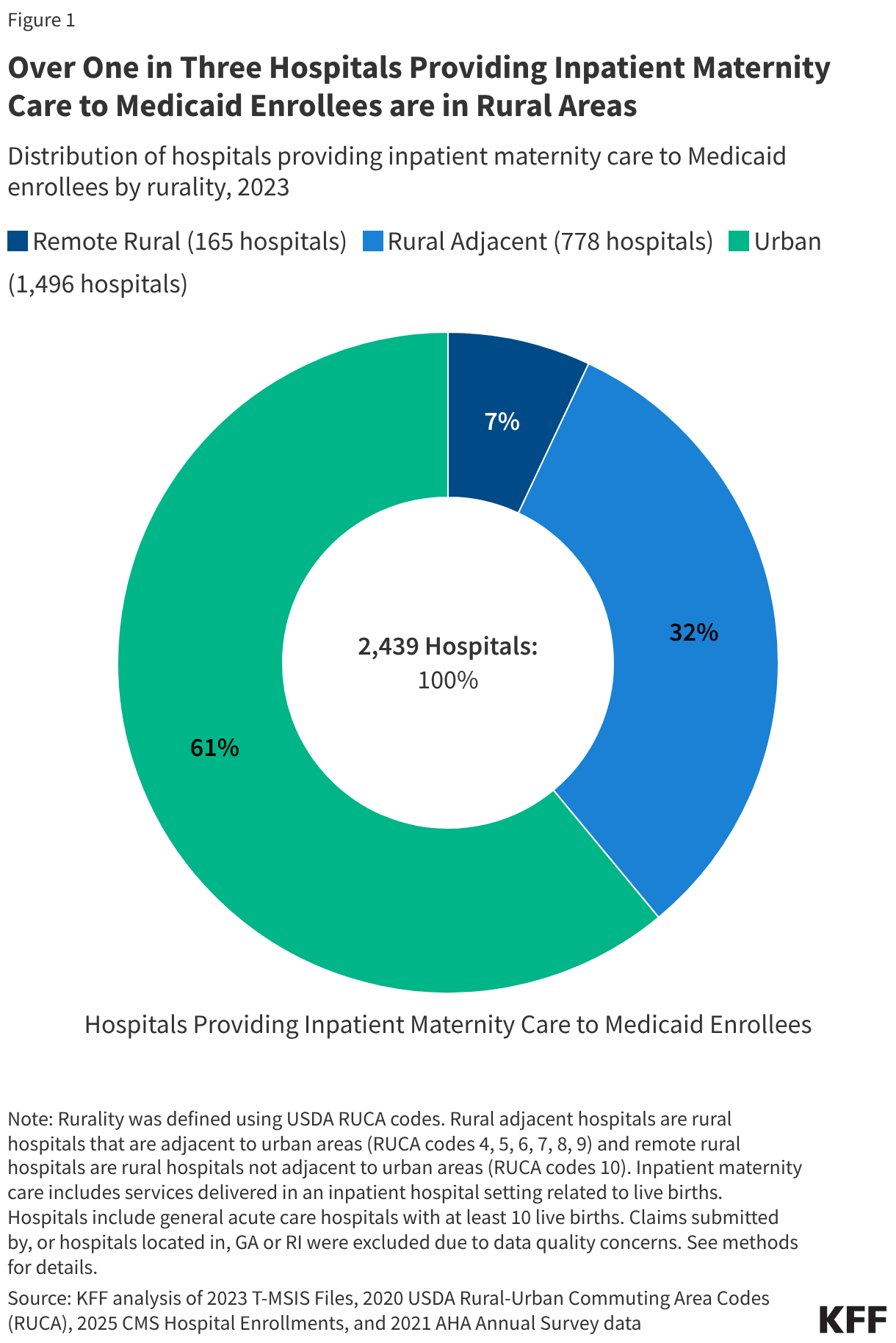
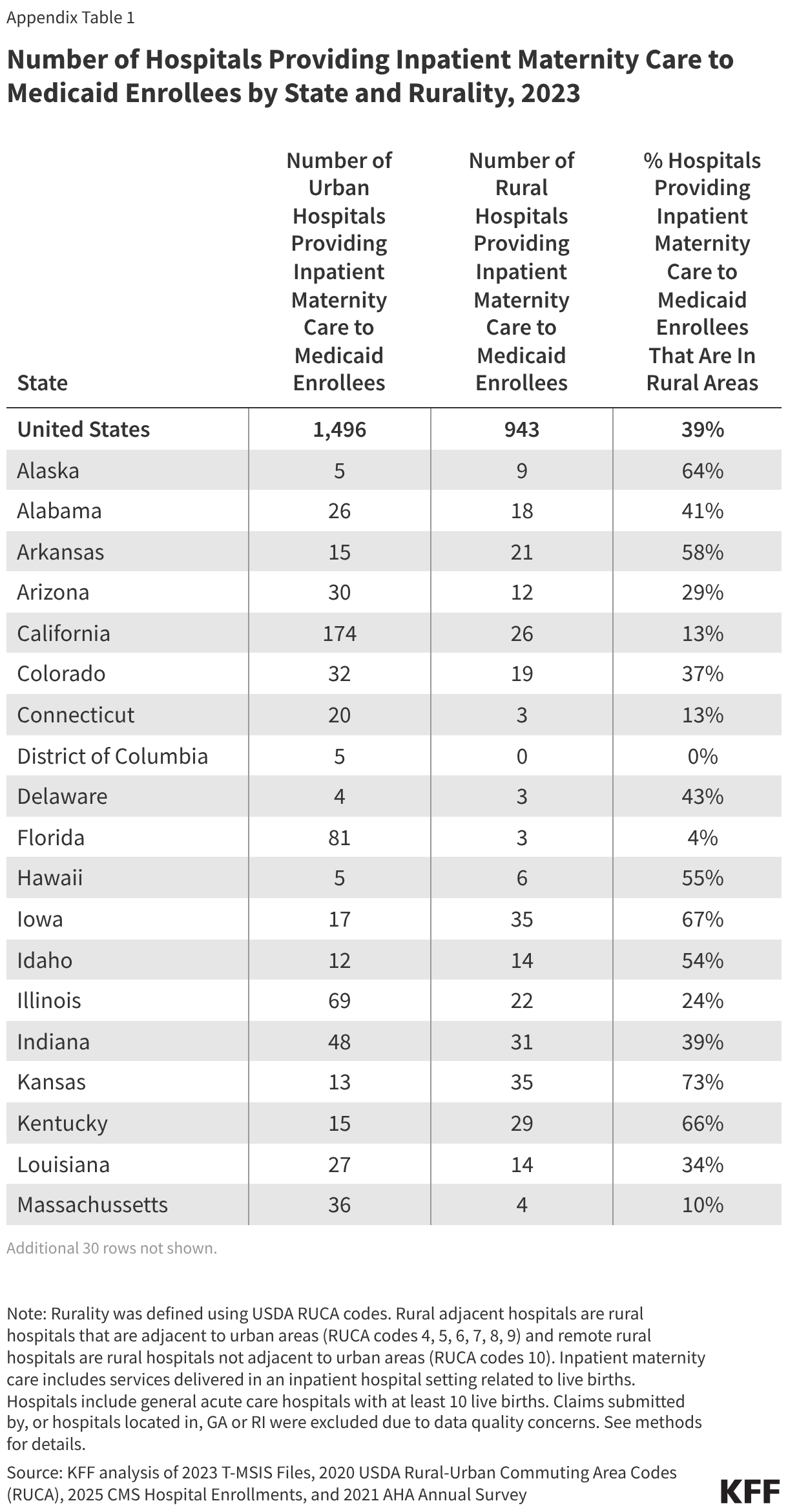
In 2023, 943 rural hospitals provided inpatient maternity care to Medicaid enrollees, constituting 39% of hospitals nationally providing inpatient maternity care to Medicaid enrollees. Rural hospitals that were adjacent to urban areas (rural adjacent) accounted for 778 (32%) hospitals, and the most rural hospitals (those not adjacent to urban areas, remote rural) accounted for 165 (7%) hospitals (Figure 1).
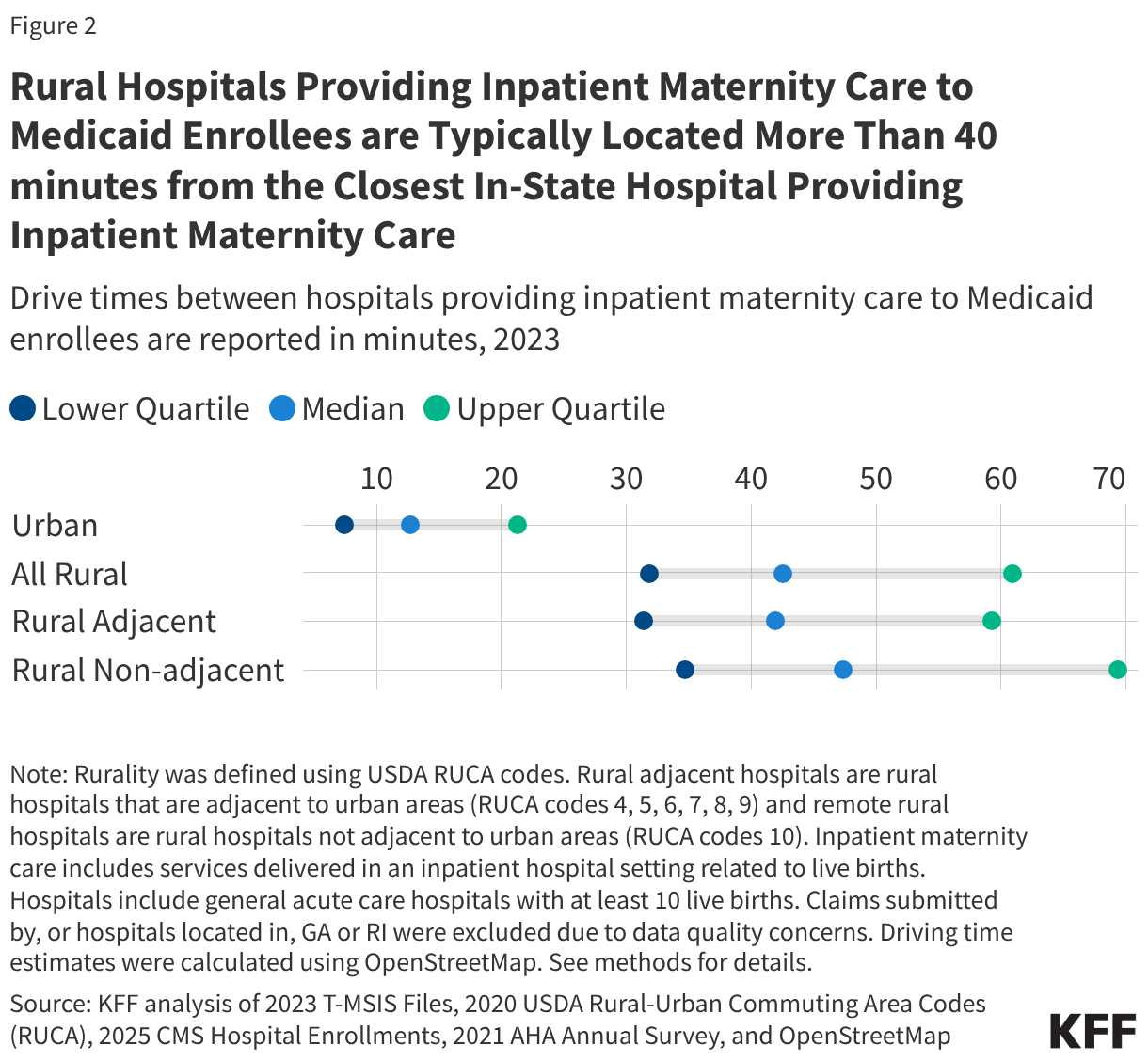
Rural hospitals providing inpatient maternity care to Medicaid enrollees are typically located more than 40 minutes from the closest in-state hospital providing inpatient maternity care.
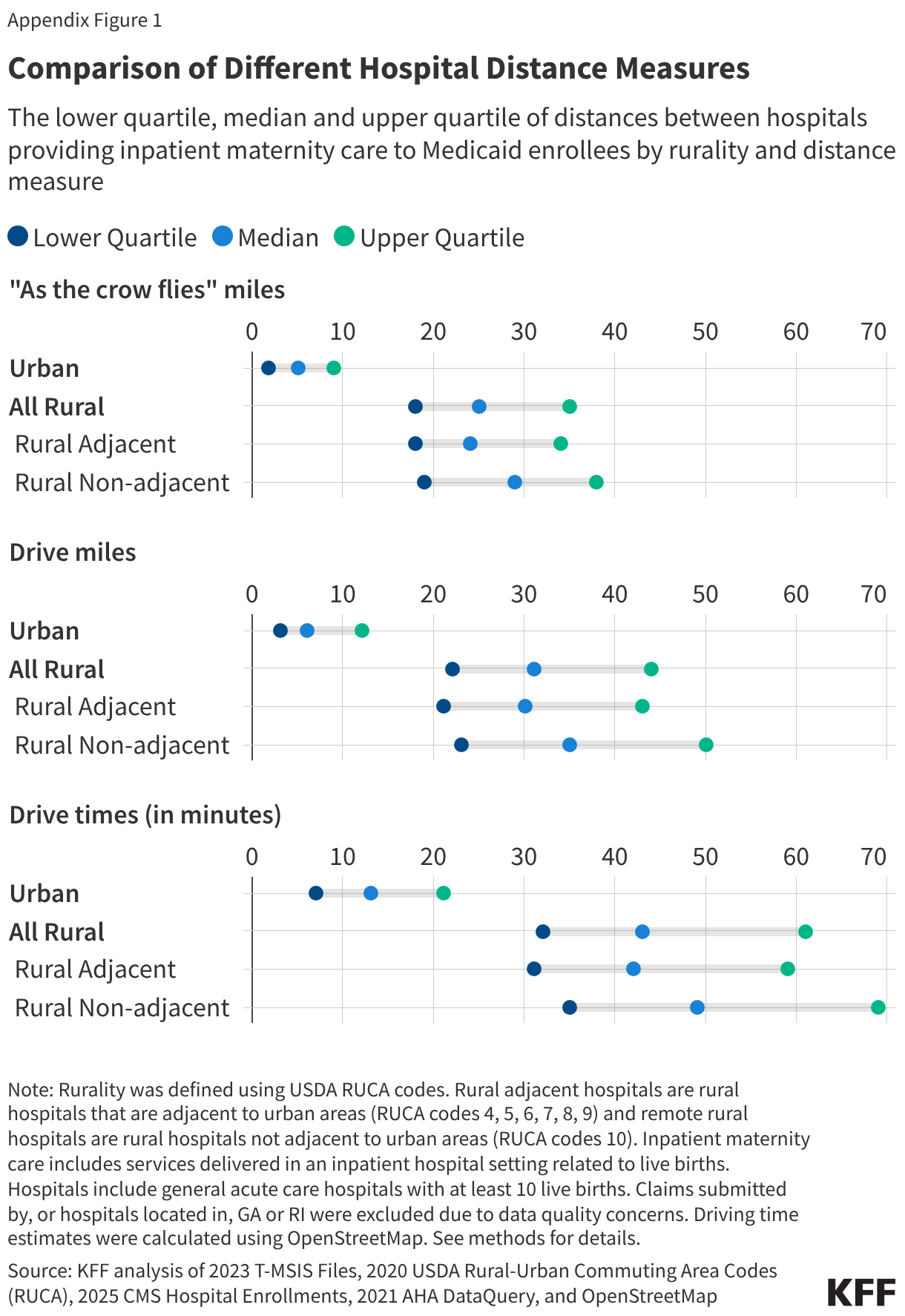
If a rural hospital closes, one measure of the effect on Medicaid enrollees is the amount of time it would take to drive to the nearest in-state hospital. The typical drive time between hospitals providing inpatient maternity care to Medicaid enrollees and their closest in-state neighbors is 43 minutes for rural hospitals compared with 13 minutes for urban hospitals (Figure 2). For 1 in 4 of these rural hospitals, the nearest in-state hospital that provided inpatient maternity care is at least one hour away (Figure 2). Distance to the nearest in-state hospital was calculated because most Medicaid enrollees obtain medical services within their state of residence, and though states have special processes for enrolling and paying out-of-state hospitals, seeing providers across state lines is challenging for enrollees (see Methods). The analysis uses driving time (in minutes) as a measure of distance between two hospitals because it accounts for traffic patterns between rural and urban areas, but results are similar when using other measures of distance (Appendix Figure 1).
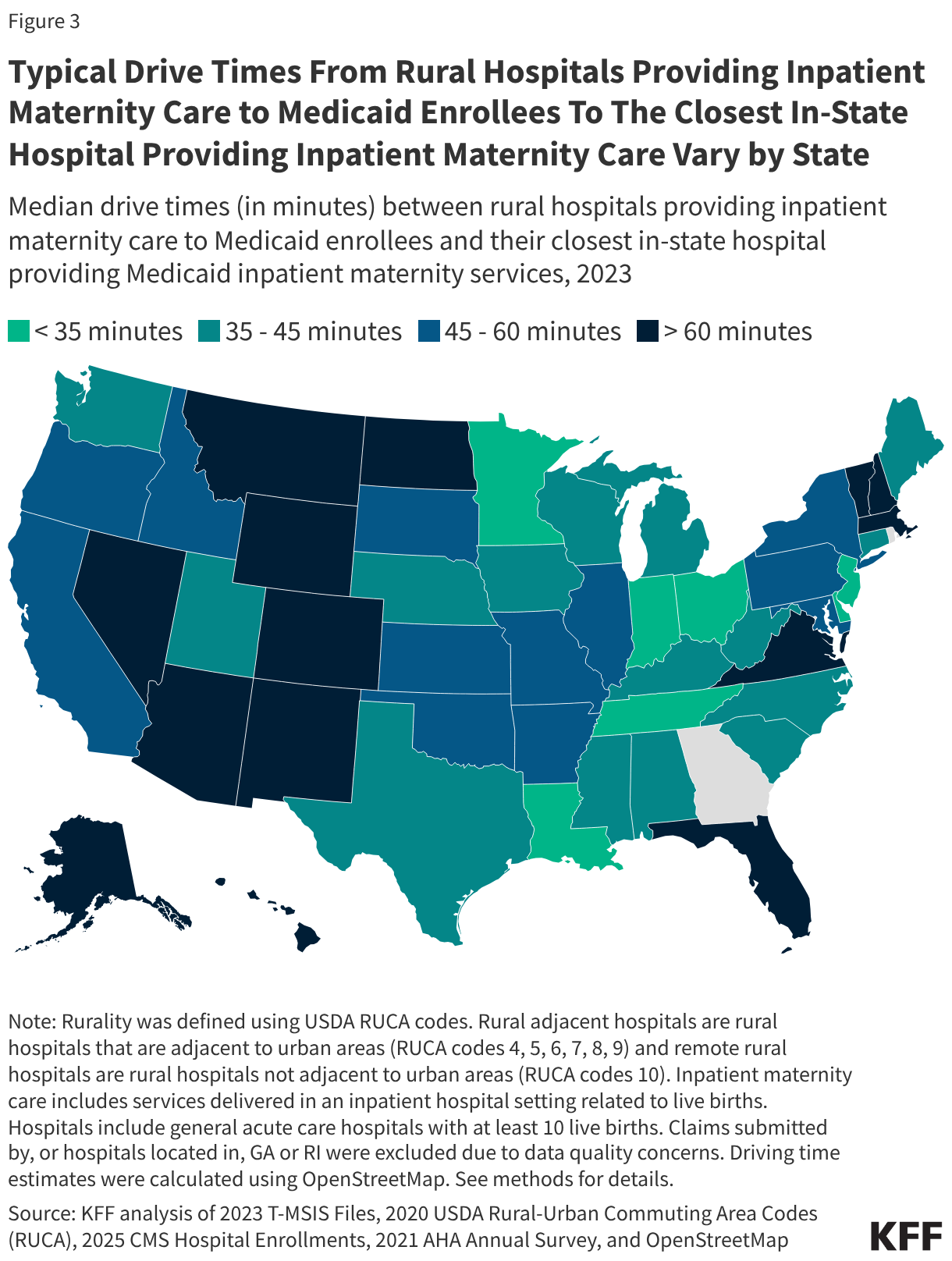
Typical drive times from rural hospitals providing inpatient maternity care to Medicaid enrollees to the closest in-state hospital providing inpatient maternity care vary by state.
In 14 states, the typical drive time from rural hospitals providing inpatient maternity care to Medicaid enrollees to their nearest in-state neighbor is one hour or more (Figure 3).The top three states with the longest typical driving times are Alaska, Nevada, and North Dakota. The states with the shortest drive times between their rural hospitals and another hospital providing inpatient maternity care to Medicaid enrollees are New Jersey, Louisiana, and Ohio.
Patrick Drake, an independent consultant, contributed to the analysis of driving time data.
Appendix
Methods
Data: This analysis uses data available from the 2023 Preliminary T-MSIS Research Identifiable Demographic-Eligibility and Claims Files. The Inpatient (IP) Header File was used to identify hospitals providing inpatient maternity care to Medicaid enrollees.
State Inclusion Criteria: To assess the usability of states’ data, four relevant quality assessments from the DQ Atlas were examined for IP claims file and billing provider completeness. KFF also evaluated usability based on the percentage of hospitals that merged with two external data sources used in the analysis for hospital addresses (CMS Hospital Enrollments and AHA Annual Survey data). The billing provider National Provider Identifier (NPI) is the primary hospital identifier in the claims data for this analysis (see more details under “Identifying Hospitals”). Below are the states that were excluded according to each criterion:
- DQ Atlas Claims Volume – IP: No states excluded
- DQ Atlas Service Users – IP: No states excluded
- DQ Atlas Billing Provider NPI – IP: Georgia was deemed “unusable” for this assessment and excluded. Approximately 81% of its IP Header claims were missing a billing provider NPI.
- DQ Atlas Billing Provider Type, Specialty, and Taxonomy – IP: No states excluded
- KFF state-level merge rates to CMS Hospital Enrollments and AHA Annual Survey data: Rhode Island was excluded. Approximately 44% of its IP Header claims were unable to merge onto either the CMS Hospital Enrollments or the AHA Annual Survey data, and thus hospital address could not be determined (other states, except Georgia, had 15% or less of their claims unable to merge).
Identifying Inpatient Maternity Care: A hospital was identified as providing “inpatient maternity care” when it provided 10 or more live births to Medicaid enrollees, following other studies on obstetric care access in rural areas. Diagnosis and procedure codes in the T-MSIS inpatient header claims files were used to identify live birth codes from the Office of Population Affairs’ published code lists for the Contraceptive Care Measures that are endorsed by CMS’ consensus-based entity. A list of diagnosis and procedure codes is available upon request.
Identifying Hospitals: Hospitals were identified in the claims data using billing provider NPI. According to DQ Atlas methodology, the billing provider in the IP file primarily represents the hospital where the inpatient care occurred.
Hospital address information: This analysis used data available from the 2025 CMS Hospital Enrollments (accessed in November 2025) and data available from FY2021 AHA Annual Survey (accessed in February 2023) to identify hospital addresses. The CMS Hospital Enrollments data set provides monthly enrollment information for all hospitals currently enrolled in Medicare and the AHA Annual Survey provides data from an annual survey of all hospitals in the U.S. and its associated areas. KFF used both sources to account for hospitals that may have closed between 2023 and 2025 or opened between 2021 and 2023 (2023 was the most current year of T-MSIS data at the time of analysis).
The analysis used these external sources rather than the T-MSIS Annual Provider File (APR) because of concerns regarding data quality in the APR file. Technical documentation for the APR suggests that users may want to use the NPI to link to external data sources to obtain additional provider information, and other researchers have found provider legal name and address in the APR to be inconsistent.
Hospital exclusion criteria: Below is a list of criteria used to identify hospitals providing inpatient maternity care to Medicaid enrollees in the analysis. The number of unique NPIs and the number of IP Header claims that were kept after each step are reported.
Only hospitals identified as a general acute care hospital using National Plan and Provider Enumeration System (NPPES) taxonomy codes were included in the analysis because they are accessible to all Medicaid enrollees and treat a range of health care conditions. Hospital types that were excluded from the analysis include: chronic disease hospitals, long-term care hospitals, religious nonmedical health care institutions, psychiatric hospitals, rehabilitation hospitals and military hospitals.
| Exclusion Criteria | # of Unique Billing Provider NPIs Remaining | # of IP Header Claims |
| Start: All unique billing provider NPIs/header claims in the IP file | 10,973 (100%) | 12,267,627 (100%) |
| Claims without a live birth diagnosis or procedure code | 3,132 (7,841 dropped) | 1,715,496 (10,552,131 dropped) |
| Submitting state for the claim is GA or RI (see “State Inclusion Criteria”) | 2,995 (137 dropped) | 1,648,650 (66,846 dropped) |
| Billing provider NPI is associated with a RI, GA or PR zip code | 2,953 (42 dropped) | 1,646,590 (2,060 dropped) |
| Billing provider NPI is missing or less than 10 digits | 2,951 (2 dropped) | 1,644,384 (2,206 dropped) |
| Billing provider taxonomy code is not a general acute care hospital or is missing | 2,675 (276 dropped) | 1,626,606 (17,778 dropped) |
| Did not merge onto CMS Hospital Enrollments or AHA Annual Survey data | 2,596 (79 dropped) | 1,600,273 (26,333 dropped) |
| Claim is not for a Medicaid eligible enrollee (CHIP_CD = 1 or, if missing, ELGBLTY_GRP_CD = 1-60 or 69-75) or with a Medicaid claim type code (CLM_TYPE_CD = 1 or 3). | 2,595 (1 dropped) | 1,466,715 (133,558 dropped) |
| NPIs that correspond to the same hospital address/coordinates/CCN | 2,537 (58 dropped) | 1,466,715 (claims not dropped since they represent the same hospital) |
| NPIs that had fewer than 10 births | 2,439 (98 dropped) | 1,419,113 (47,602 dropped) |
| End: Final unique billing provider NPIs/header claims in the IP file included in the analysis | 2,439 (22%) | 1,419,113 (12%) |
Defining Rural Hospitals: To define hospital rurality, this analysis uses 2020 USDA Rural-Urban Commuting Area (RUCA) Codes at the hospital zip code level, which is the main geographic identifier included in either the CMS Hospital Enrollments or AHA Annual Survey data. This analysis categorized hospitals as urban, rural adjacent, and remote rural as follows:
Urban
- 1: Metropolitan core: primary flow is within a metro urban area (UA)
- 2: Metropolitan high commuting: primary flow is 30% or more to a metro UA
- 3: Metropolitan low commuting: primary flow is 10% to 30% to a metro UA
Rural adjacent
- 4: Micropolitan core: primary flow is within an urban area of 10,000 to 49,999 people (micro UA)
- 5: Micropolitan high commuting: primary flow is 30% or more to a micro UA
- 6: Micropolitan low commuting: primary flow is 10% to 30% to a micro UA
- 7: Small town core: primary flow is within an urban area of 9,999 or fewer people (small town UA)
- 8: Small town high commuting: primary flow is 30% or more to a small town UA
- 9: Small town low commuting: primary flow is 10% to 30% to a small town UA
Remote rural
- 10: Rural area: primary flow is to a tract outside an UA
Calculating Distance Measures Between Hospitals: Hospital addresses were geocoded using data from OpenStreetMap (OSM). Hospital names and addresses were matched to OSM features, and corresponding latitude and longitude coordinates were extracted. Thirty-five hospitals (1%) were not matched to coordinates using OSM and were manually geocoded using Google Maps searches of hospital names and addresses.
Hospital distances were calculated between hospitals within the same state because most Medicaid enrollees obtain medical services within their state of residence, and because states have special processes for enrolling and paying out-of-state hospitals. Only 7% of hospitals in this analysis have the nearest hospital in another state, and results were not meaningfully changed by this decision.
To identify the nearest hospital within a state, straight-line distances were calculated using the Haversine formula (“as the crow flies”) for each hospital pair in a state, which is consistent with other hospital distance analyses. The hospital with the shortest “as the crow flies” distance was chosen as the nearest hospital. Travel mileage and times to the nearest hospital were then computed using the OSM road network via the Open Source Routing Machine (OSRM) public API. Routing followed drivable paths and incorporated road characteristics from OSM (see OSM Routing documentation).