
Analysis: At Least 37 States Have Medicaid State Directed Payments for Hospital Services That Could Be Reduced by the 2025 Reconciliation Law Limits
States with the Biggest Potential Reductions in Medicaid Payments to Hospitals Include California, Illinois, Kentucky, Texas, North Carolina, Louisiana, Arizona and Michigan
An estimated $60 billion in federal Medicaid spending in 37 states (including the District of Columbia) would likely exceed new federal limits on state directed payments for hospital services once fully implemented, a new KFF analysis finds.
The 2025 reconciliation law made major changes to Medicaid eligibility and financing, including new limits on how much states can direct Medicaid managed-care organizations to pay for certain services, including hospital care.
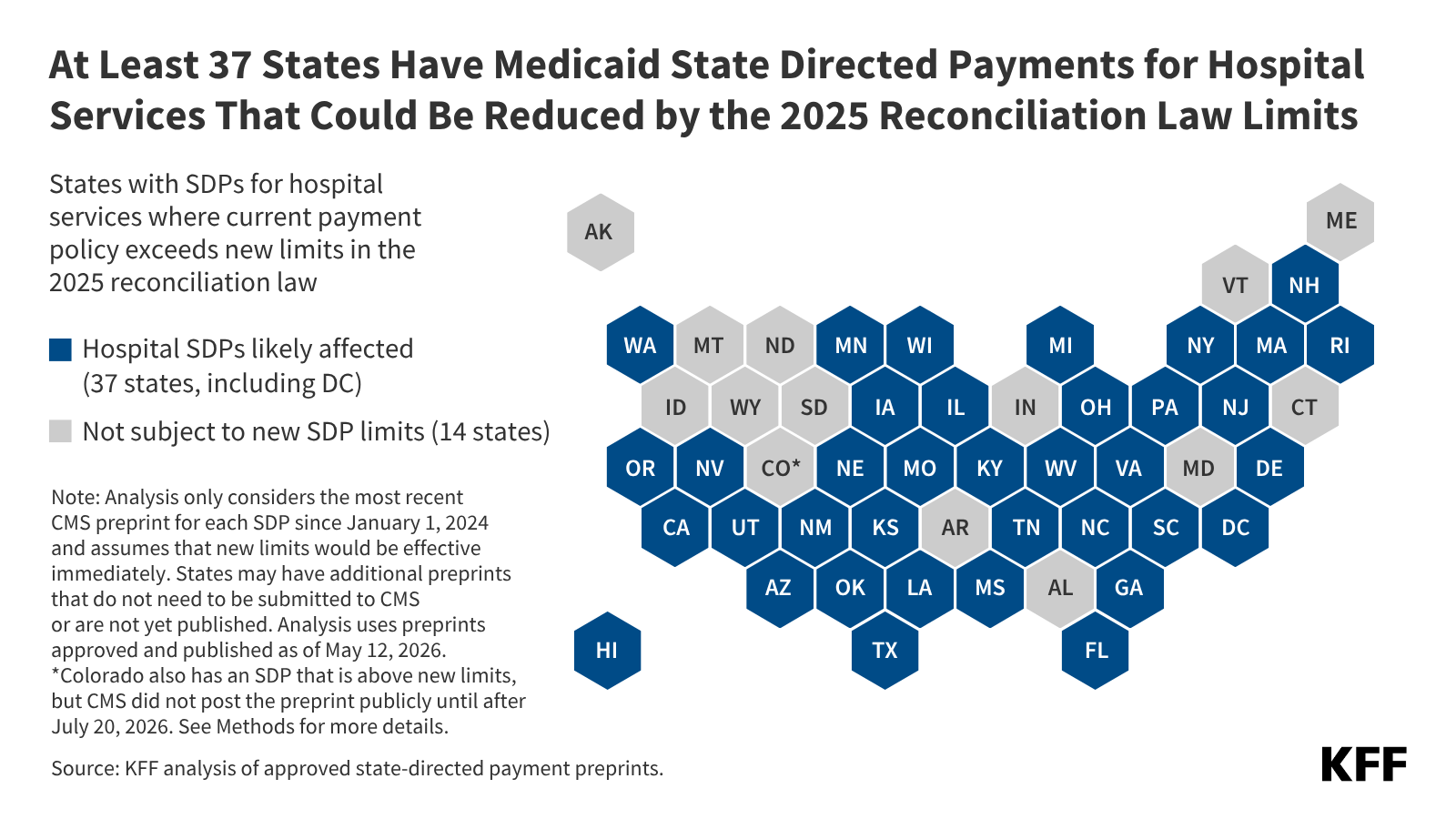
The eight states with the biggest potential reductions in Medicaid payments to hospitals account for half of the total: California ($7.4 billion), Illinois ($4.0 billion), Kentucky ($3.9 billion), Texas ($3.5 billion), North Carolina ($3.4 billion), Louisiana ($3.3 billion), Arizona ($3.0 billion) and Michigan ($2.6 billion).
In the past, states were allowed to direct managed care plans to pay hospitals and other providers up to the average commercial rates for such services. Once implemented, the new law limits such payments in most states to Medicare payment rates, which typically are substantially lower than commercial rates. In the 10 states that have not expanded their Medicaid programs under the Affordable Care Act, payments are capped just above Medicare rates.
The Trump administration in June 2025 issued a proposed rule to implement the change but has not yet finalized those regulations. The analysis assesses the scope of federal funding for hospital services that could be affected once the new limits are fully in place, including insights into how the magnitude of the changes will vary by state.
The estimates do not project actual revenue losses for hospitals annually, which would be affected by other coverage changes, provider tax changes as well as state responses to the new limits.
States with state directed payments that exceed the new limit could take a range of actions in response, including increasing base payment rates for hospital services, though their ability to do so may be limited by other new restrictions on financing mechanisms, such as provider taxes. Hospitals’ ability to absorb reduced payment rates also varies and could pose particular challenges for hospitals with low operating margins, including many rural hospitals and hospitals with relatively large numbers of Medicaid patients.