

VOLUME 43
New KFF Tracking Poll on Health Information and Trust Finds One in Three Adults Have Used AI Chatbots for Health Advice
Highlights
KFF’s latest Tracking Poll on Health Information and Trust finds that one-third of the public report using AI chatbots for health information and advice in the past year, similar to the share who have relied on social media for health. One in five adults who use AI for health cite difficulties accessing or affording health care as reasons they turned to these chatbots, including larger shares of younger and lower income users. These findings, as well as data from dozens of past KFF polls, are also available on KFF’s Health Information and Trust Polling dashboard.
And a federal judge suspended, for now, the appointments of thirteen members of the Advisory Committee on Immunization Practices (ACIP), the federal committee responsible for recommending vaccines to Americans, halting a scheduled meeting and staying recent changes to the childhood vaccine schedule. The ruling comes as KFF polling finds that fewer than half of U.S. adults express confidence in federal agencies to make recommendations about the childhood vaccine schedule, with more adults saying recent changes will have a negative rather than positive impact on children’s health.
Featured
KFF Poll Finds One in Three Adults Have Used AI for Health Information and Advice in the Past Year, With Younger Users More Likely to Cite Difficulty Accessing or Affording Health Care as a Reason They Turned to AI
Amid the AI technology boom, KFF’s latest Tracking Poll on Health Information and Trust finds that one-third (32%) of the public says they used AI for health information and advice in the past year – rivaling the share who have sought health information from social media in the past year (29%), but less common than seeking health advice from doctors (80%) or internet search engines (68%), which may themselves include AI-generated summaries.
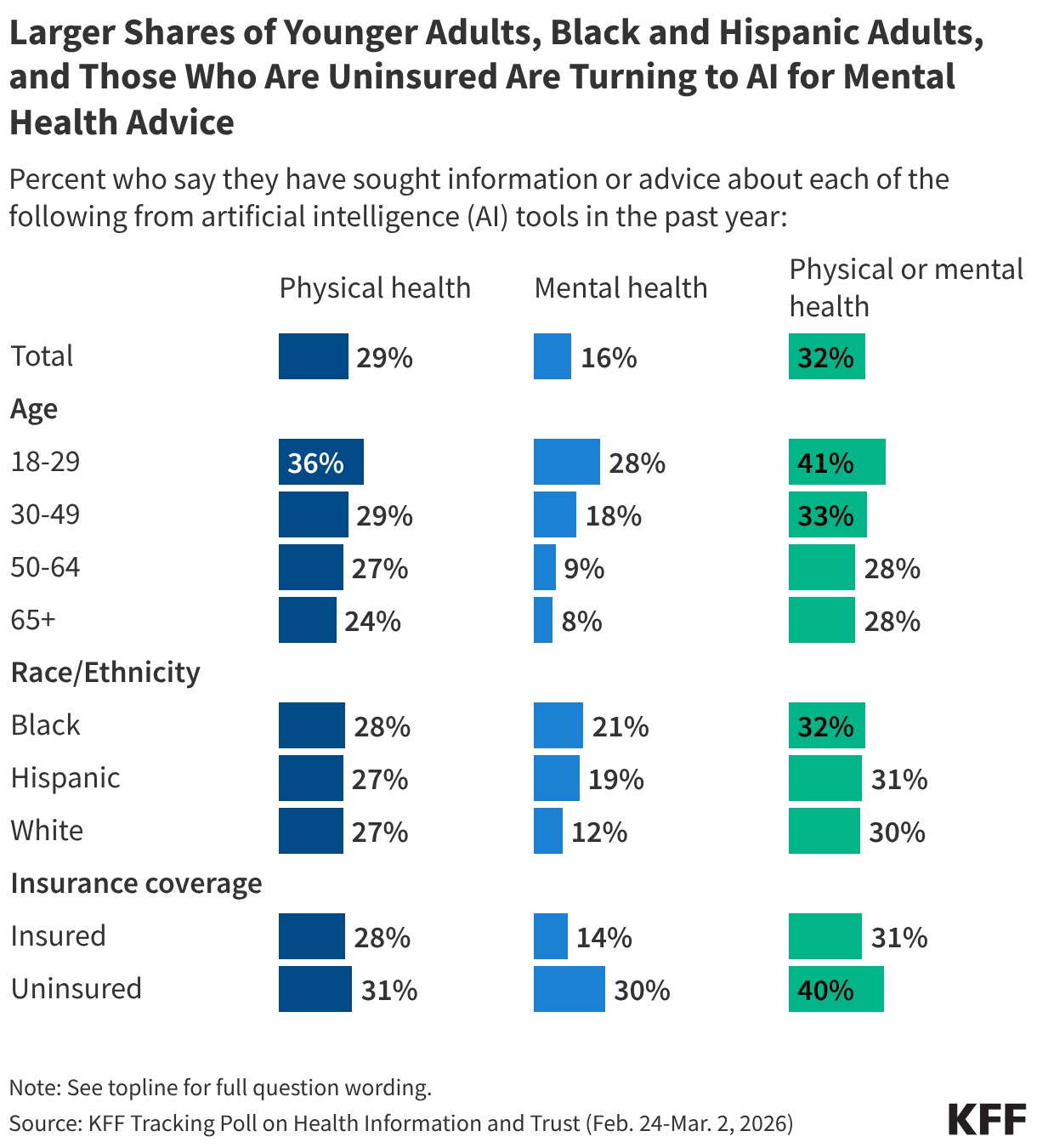
The share of adults who report using AI for health information in the past year includes three in ten (29%) who say they sought information or advice about their physical health and about one in six (16%) who sought information or advice about their mental health. Compared to older adults, larger shares of adults under age 30 (who are more likely to use AI in the first place) say they turned to AI for information or advice related to their physical health (36%) or mental health (28%). When it comes to use of AI for mental health advice, Black adults and Hispanic adults, as well as those who are uninsured, are more likely to say they have used the technology.
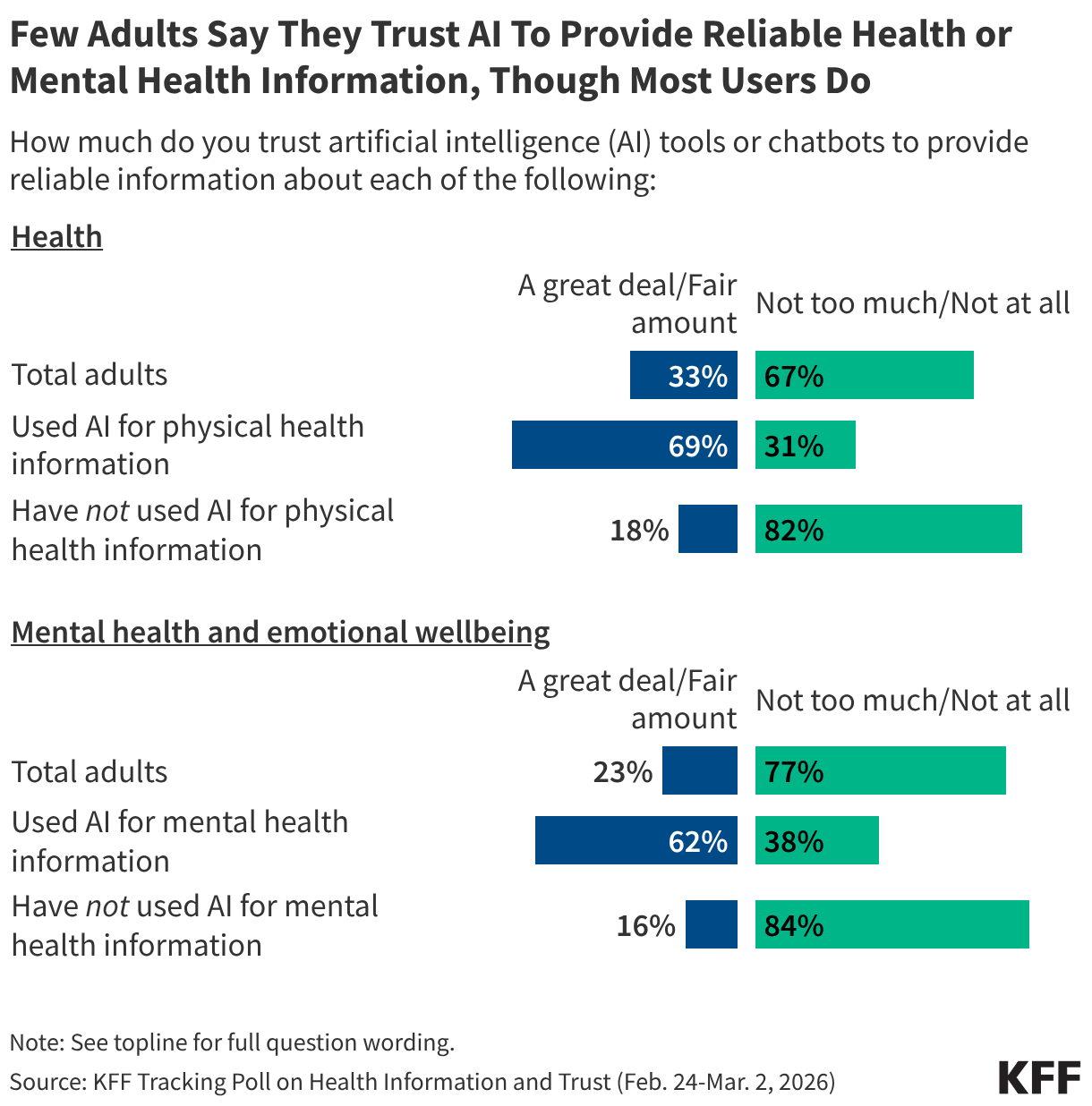
Public trust in AI for health information is relatively low, particularly for those who have not used these tools or chatbots for health advice. About eight in ten adults who have not used AI for health or mental health information say they trust these tools “not too much” or “not at all” to provide reliable information about health or mental health. Conversely, majorities of adults who have used AI for health or mental health information say they trust these chatbots “a great deal” or “a fair amount” to provide reliable information on health (69%) or mental health (62%), respectively. At the same time, there is some skepticism among users, with three in ten (31%) who use AI for physical health saying they don’t trust AI for reliable information on health, and nearly four in ten (38%) who use AI for mental health saying they don’t trust these tools to provide reliable mental health information.
What We’re Watching
Court Ruling on Vaccine Schedule May Add to Confusion as Trust in Federal Recommendations Declines
A federal judge has blocked recent changes to the federal childhood vaccine schedule and suspended, for now, the appointments of some members of the advisory committee responsible for making vaccine recommendations. The lawsuit, brought by the American Academy of Pediatrics (AAP) and other medical organizations, argued that changes to the Advisory Committee on Immunization Practices’ (ACIP’s) membership and decision-making process undermined the committee’s credibility and departed from established standards. The AAP also alleged that the committee relied on what it called “spurious evidence” to make its recommendations and suggested that committee members and speakers made inaccurate or misleading claims prior to votes. The ruling does not assess the merits of the changes to vaccine recommendations, instead focusing on whether federal procedures for appointing committee members and developing recommendations were followed. The administration has indicated it is weighing its legal options, including a potential appeal, meaning the dispute could continue, but AAP’s president has framed the decision as a win for science that would bring clarity to vaccine recommendations. A KFF Quick Take provides additional detail on the ruling and what may come next.
For parents, patients, and providers, the ruling and ongoing dispute may deepen existing confusion about which vaccine guidance to trust. KFF’s January Tracking Poll on Health Information and Trust found that among adults who had heard about the recent changes to the childhood vaccine schedule (51% of all adults), twice as many said the changes would have a negative impact on children’s health (54%) as said they would have a positive impact (26%). As of early March, 29 states and Washington, D.C. had announced they would no longer fully follow the new CDC childhood vaccine schedule, creating a patchwork of vaccine guidance that varies by state.
What To Watch Out For: How will the ruling, future actions by the administration, and the growing divide between guidance from federal agencies and professional medical organizations affect vaccine-related narratives and public trust?
Polling Insights: KFF’s January Tracking Poll on Health Information and Trust, conducted shortly after changes to the federal vaccine schedule recommendations were announced, found that fewer than half of adults are confident in federal health agencies to make recommendations about childhood vaccines. Overall, just under half (44%) of adults said they have at least “some confidence” in federal health agencies to make recommendations about childhood vaccine schedules, including about half (51%) of Democrats and fewer than half of independents (45%) and Republicans (40%).
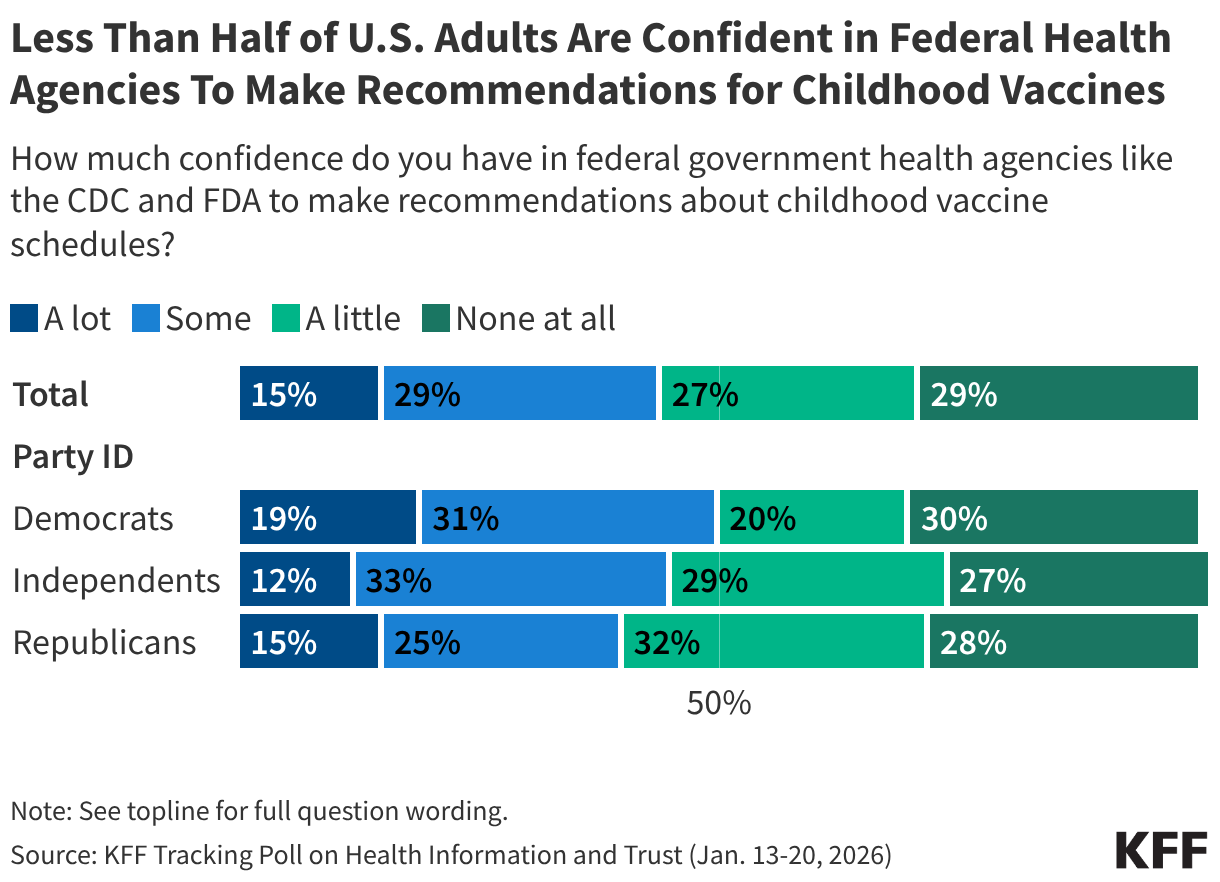
Beyond making recommendations for childhood vaccines, fewer than half of the public expressed confidence in these agencies to ensure vaccine safety and effectiveness (46%), make decisions based on science (38%), or act independently (34%). Across partisanship, fewer than half of Democrats, independents, and Republicans are confident in these agencies to act independently or make decisions based on science.
Public Trust Higher in CDC, NIH, FDA Scientists Than Federal Health Agency Leadership
Two-thirds of Americans (67%) are confident that career scientists at federal health agencies, including the Centers for Disease Control and Prevention (CDC), National Institutes of Health (NIH), and Food and Drug Administration (FDA), are providing the public with trustworthy health information, compared to 43% who said the same of the leaders of those agencies, according to a new poll from the Annenberg Public Policy Center. This new poll gives additional context to KFF polling that has found declining public trust in agencies like the CDC and FDA since the beginning of the COVID-19 pandemic.
What To Watch Out For: The gap between trust in career scientists and trust in agency leadership may take on added significance as changes are made to the federal health workforce. The NIH, for example, has lost more than 20% of its workforce since the start of the Trump administration, according to federal data reported by KFF Health News. As thousands of career scientists leave, federal agencies may face additional challenges in maintaining capacity and public confidence.
More From KFF
- KFF Quick Take: The Court’s Opening Shot on Federal Vaccine Policy Changes
- KFF Health News: Republicans Fret Over RFK Jr.’s Anti-Vaccine Policies While MAHA Moms Stew
- KFF Issue Brief: 5 Key Facts About Medicaid Prescription Drugs
- KFF Tracker: America First MOU Bilateral Global Health Agreements
- KFF Issue Brief: The Impact of Gun Violence on Youth Mental Health and Well-Being
About The Health Information and Trust Initiative: the Health Information and Trust Initiative is a KFF program aimed at tracking health misinformation in the U.S., analyzing its impact on the American people, and mobilizing media to address the problem. Our goal is to be of service to everyone working on health misinformation, strengthen efforts to counter misinformation, and build trust.
The Monitor is a report from KFF’s Health Information and Trust initiative that focuses on recent developments in health information. It’s free and published twice a month.
Sign up to receive KFF Monitor
email updates
Support for the Health Information and Trust initiative is provided by the Robert Wood Johnson Foundation (RWJF). The views expressed do not necessarily reflect the views of RWJF and KFF maintains full editorial control over all of its policy analysis, polling, and journalism activities. The data shared in the Monitor is sourced through media monitoring research conducted by KFF.