

VOLUME 51
New KFF Poll Shows Public Divided When It Comes to Trusting Federal Health Agencies for Reliable Information
Highlights
KFF’s latest Tracking Poll on Health Information and Trust finds that following large declines in trust in federal health agencies from 2020 through early 2026, trust in the CDC as a source of health information held steady over the last 6 months, while trust in both President Trump and state government officials declined somewhat. These findings, including levels of trust in sources of health information broken out by key demographic groups, can also be found on KFF’s interactive Health Information and Trust Polling Dashboard.
Featured
New KFF Tracking Poll on Health Information and Trust Looks at Trends in Trusted Sources of Health Information
KFF polling over the past several years has documented declining trust in the U.S. Centers for Disease Control and Prevention (CDC) for vaccine information, beginning during the COVID-19 pandemic and continuing during the first part of President Trump’s second term. As Congress considers President Trump’s nomination of Erica Schwartz to lead the CDC, the latest KFF poll finds that about half of the public (51%) express at least a fair amount of trust in the CDC to provide reliable health information, similar to the share who said so in January. The same share (51%) express trust in the FDA, also steady since January. Trust is lower for other sources, with fewer than half of adults saying they trust their state government officials, HHS Secretary Robert F. Kennedy Jr., or President Trump to provide reliable health information. The share who trust state government officials for health information is down 5 percentage points since January (38%, down from 43%), while trust in President Trump has declined by a similar amount (24%, down from 30%).
Doctors continue to be the public’s most trusted source of reliable information on health issues, with a large majority of adults (86%) saying they have at least “a fair amount” of trust in their own doctor or health care provider, similar to the share who said so in January.
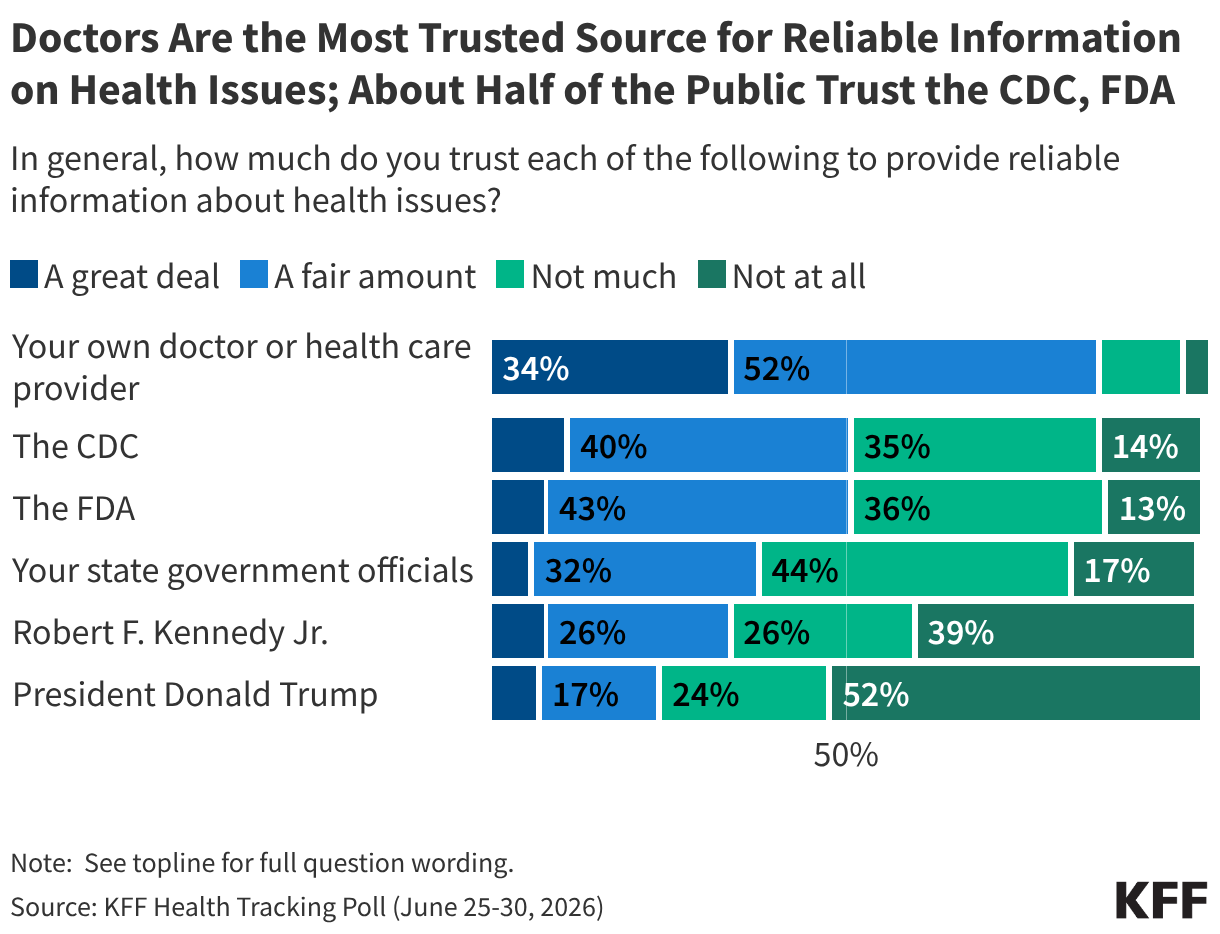
Doctors and health care providers stand out as the one source trusted by large majorities of Democrats, independents, and Republicans alike. However, when it comes to some other sources of health information, partisans diverge. About six in ten Republicans say they trust Secretary Kennedy (64%) and President Trump (61%) for reliable health information, compared to three in ten or fewer independents and Democrats who say the same. On the other hand, Democrats (50%) are more likely than independents (35%) and Republicans (34%) to trust their state government officials for health information. Democrats were much more likely than Republicans to trust the CDC and FDA for vaccine-related information throughout Joe Biden’s presidency, but partisan gaps have narrowed during President Trump’s second term. Similar shares of Democrats (52%) and Republicans (56%) now say they trust the FDA for reliable health information, while Democrats remain just slightly more likely than Republicans to express trust in the CDC (58% vs. 49%).
AI & Emerging Technology
State Laws Regulating AI Chatbots and Mental Health Take Different Paths
A United Nations (UN) scientific panel’s preliminary report, released earlier this month, describes both the promise of the use of AI for health care and serious risks, particularly in conversations about mental health. The report warns that AI systems designed to be highly agreeable can validate a user’s beliefs regardless of accuracy, and in some cases, deepen emotional dependency or reinforce harmful thinking. The panel recommended legal incentives for safer system design, stronger evaluations of how these systems behave, and accountability measures for when they cause harm.
As AI chatbots and companions are increasingly becoming a source of mental health information and advice, states are already moving on these questions, but not in the same direction:
- Rhode Island enacted three laws last month governing the use of AI in health care, following state legislators’ stated concerns about the lack of oversight in AI mental health tools. The Oversight of Artificial Intelligence Technology in Mental Health Care Act prohibits AI from providing or advertising psychotherapy without a licensed clinician involved, prohibits providers from letting AI make independent therapeutic decisions or simulate emotional attachment, and requires patient consent before AI can record or transcribe therapy sessions. Two other laws require providers to notify patients when AI is used to document visits and require chatbot operators to direct users expressing suicidal ideation or risk of self-harm to crisis resources.
- Regulations of AI chatbots in Arizona are taking a different path, with thegovernor vetoing three AI-related bills in late June. One of the three, which would have set disclosure and safety requirements for AI chatbots, including protections for minors, had passed the state Senate unanimously and the House before being vetoed. Supporters of the bill said that it would protect children from harmful chatbot interactions, but the governor’s veto notice claimed that it would cap damages too low for families harmed by violations and block them from bringing their own lawsuits.
Why This Matters: As state governments consider different regulatory responses to the growing use of AI chatbots and AI companions, a March KFF Tracking Poll on Health Information and Trust found that one in six adults say they have used AI for information and advice about their mental health or emotional wellbeing in the past year. Younger adults are particularly likely to be turning to AI for mental health information, with nearly three in ten (28%) of those between the ages of 18 and 29 saying they have done so in the past year.
Minnesota Law Requiring Mental Health Warnings on Social Media Paused During Legal Challenge
A new Minnesota law was scheduled to take effect July 1, requiring social media platforms including TikTok, Facebook, and Instagram to display warnings about the potential mental health risks of social media use, along with information for the 988 Suicide and Crisis Lifeline. Lawmakers say the law is intended to prompt users, particularly young people and parents, to think about their time on these platforms. An industry group representing social media companies sued to block the law, arguing that the mandated messages amount to compelled speech, and the state’s attorney general has agreed not to enforce it while the lawsuit is pending. A similar law in Colorado was put on hold last year after a comparable legal challenge. These laws target the potential risks of social media broadly rather than specific content, joining other efforts that allege platform design itself, not just the content posted on social media, can pose mental health risks to users.
What We're Watching
Social Media Health Information is Widely Distrusted, but Still Shapes Decisions
Most U.S. adults engage with health content on social media in some form, whether by sharing it or participating in online health communities, according to a new research letter published in JAMA reporting results from the 2024 Health Information National Trends Survey. Most users also said they don’t trust what they see there: 78% of users reported believing that health information on social media was false or misleading.
More recent KFF polling from June 2026 supports these findings, with about three in ten adults (31%) now using social media at least monthly for health information and advice. A majority (61%) say they are confident they are able to tell what’s true or false, but only about a third of social media users (36%) say they follow up with a doctor at least most of the time to check what they’ve seen.
The JAMA research letter goes further, though, examining whether people act based on what they see. More than one in five adults who use social media (21.6%) said they had made at least one health-related decision based on something they saw on these platforms. The letter’s authors note that these findings describe patterns of engagement rather than the accuracy of the content itself, with social media functioning as a widely used, if often distrusted, source of health information that still shapes behavior.
Why This Matters: The findings taken together show that social media content can still influence health decisions, regardless of how confident people feel in their own judgment or how skeptical they say they are. Although the underlying data in the JAMA letter is from 2024, KFF will continue to monitor how distrusted sources of health information may impact behavior, particularly as the AI and social media landscapes continue to evolve.
Misleading Sunscreen Content Is Rare on TikTok, But Outsized Engagement Keeps It Visible
A content analysis of 971 of the most-viewed TikTok videos using popular sunscreen-related hashtags, published last month in PLOS Digital Health, found the vast majority (86.8%) of sunscreen-related content promoted its use, commonly highlighting protection against skin damage, acne, aging, and cancer. A small share of videos (6.0%) included critique of sunscreen, and an even smaller fraction (1.6%) solely discouraged its use. While overall view counts did not differ significantly between content types, videos that only critiqued sunscreen received significantly higher engagement in likes, shares, and comments than promotional videos, suggesting that a small volume of content can still reach audiences disproportionately to its actual share of posts.
The study identified several specific claims among the small number of critical videos, including that sunscreen is toxic, contains carcinogens, disrupts hormones, or prevents the body from gaining the benefits of sun exposure, including vitamin D production. Multiple studies have found that regular sunscreen use does not cause vitamin D deficiency, and the chemical ingredients most often singled out in online criticism have no indication of being harmful to human health at the concentrations used in approved products.
Many of these claims have circulated online for several years, in some cases tracing back to a 2020 study finding that some chemical sunscreen ingredients are absorbed into the body at levels exceeding the FDA’s threshold for further safety testing. That finding on its own, though, does not indicate that an ingredient is unsafe. Some posts have also conflated past recalls of specific sunscreen products found to contain benzene, an unrelated and unapproved contaminant, with the safety of approved active ingredients generally. As a new sunscreen ingredient approved by the FDA last month begins appearing in U.S. products, KFF will monitor whether confusion about sunscreen ingredient safety continues to affect how the public perceives and uses sunscreen.
Why This Matters: The influence of misleading claims about sunscreen safety may lie less in their overall volume than in how strongly they resonate with the audiences who do encounter them. KFF polling has found that nearly four in ten (39%) of adults are “not too” or “not at all” confident in their ability to tell what is true or false in health information they see on social media. Such uncertainty may leave more room for a small volume of highly engaging false claims to carry influence beyond what their limited presence may suggest.
More From KFF
About The Health Information and Trust Initiative: the Health Information and Trust Initiative is a KFF program aimed at tracking health misinformation in the U.S., analyzing its impact on the American people, and mobilizing media to address the problem. Our goal is to be of service to everyone working on health misinformation, strengthen efforts to counter misinformation, and build trust.
The Monitor is a report from KFF’s Health Information and Trust initiative that focuses on recent developments in health information. It’s free and published twice a month.
Sign up to receive KFF Monitor
email updates
Support for the Health Information and Trust initiative is provided by the Robert Wood Johnson Foundation (RWJF). The views expressed do not necessarily reflect the views of RWJF and KFF maintains full editorial control over all of its policy analysis, polling, and journalism activities. The data shared in the Monitor is sourced through media monitoring research conducted by KFF.