

VOLUME 52
Many Adults Are Unaware of the Abortion Pill’s Safety and Prevalence as Misleading Claims Link the Medication to Wastewater Contamination
Highlights
Recently released findings from KFF’s July Health Tracking Poll show that much of the public is unsure of the abortion pill mifepristone’s safety, and most lack awareness that most abortions in the U.S. are performed via medications. These findings come as some groups opposed to abortion are citing a misleading paper in an effort to classify mifepristone as a water contaminant, despite criticism of the paper’s methodology and a lack of evidence demonstrating the drug poses an environmental risk.
Featured
The latest KFF Health Tracking Poll examines the public’s knowledge and views of mifepristone – or medication abortion – amid an ongoing FDA re-review of the medication’s safety.
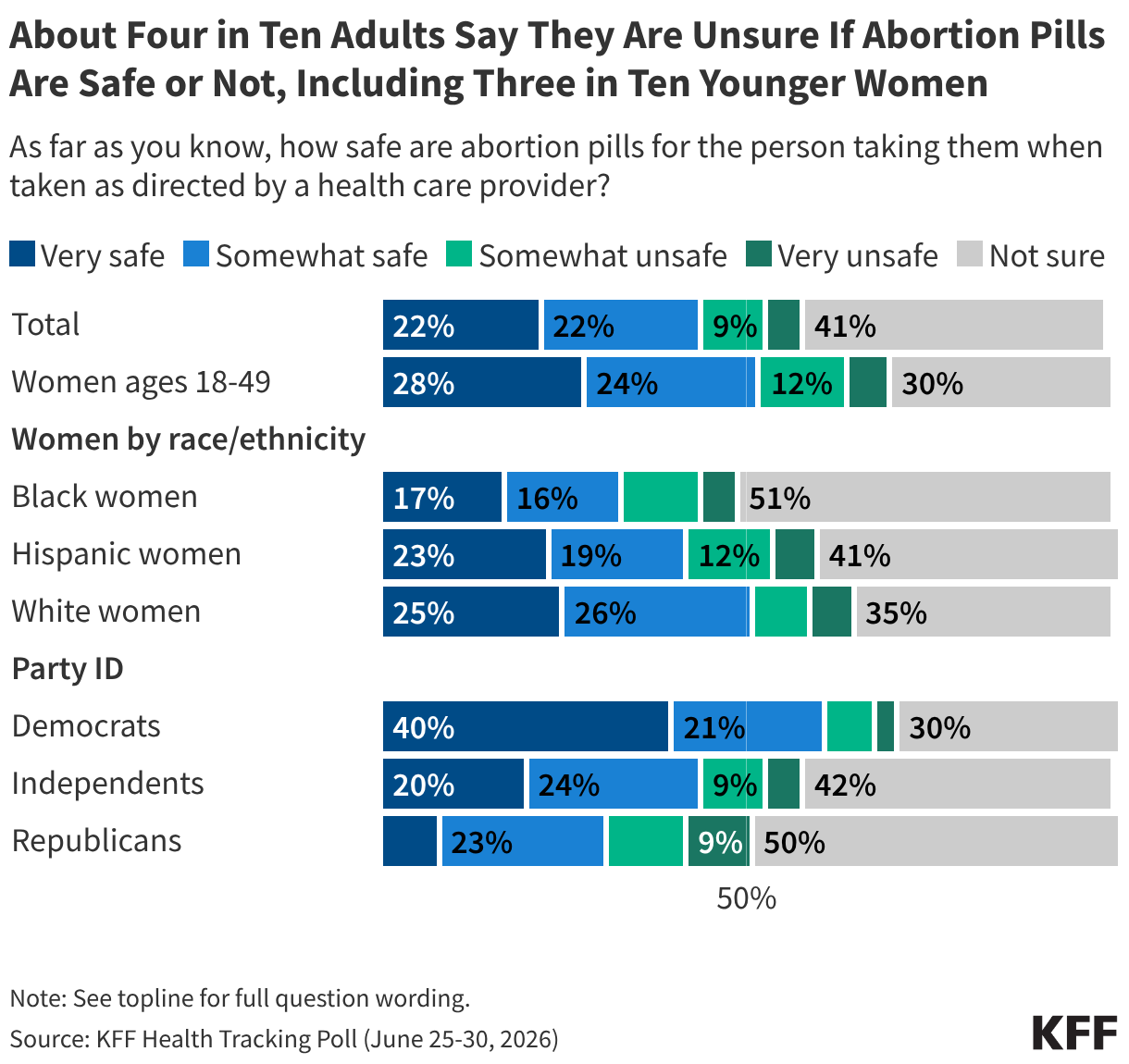
Much of the public is unaware of mifepristone’s long-standing safety record. While larger shares of adults say medication abortion is safe (44%) than say it is unsafe (15%) when taken as directed by a health care provider, about four in ten (41%) say they are unsure. This uncertainty is higher among Black women, with half (51%) saying they are unsure whether abortion pills are safe. Among women of reproductive age – or those ages 18-49 – roughly half (52%) view the abortion pills as safe while three in ten are not sure.
Republicans (50%) and independents (42%) are most likely to be uncertain about mifepristone’s safety, while a majority of Democrats (61%) view the medication as safe.
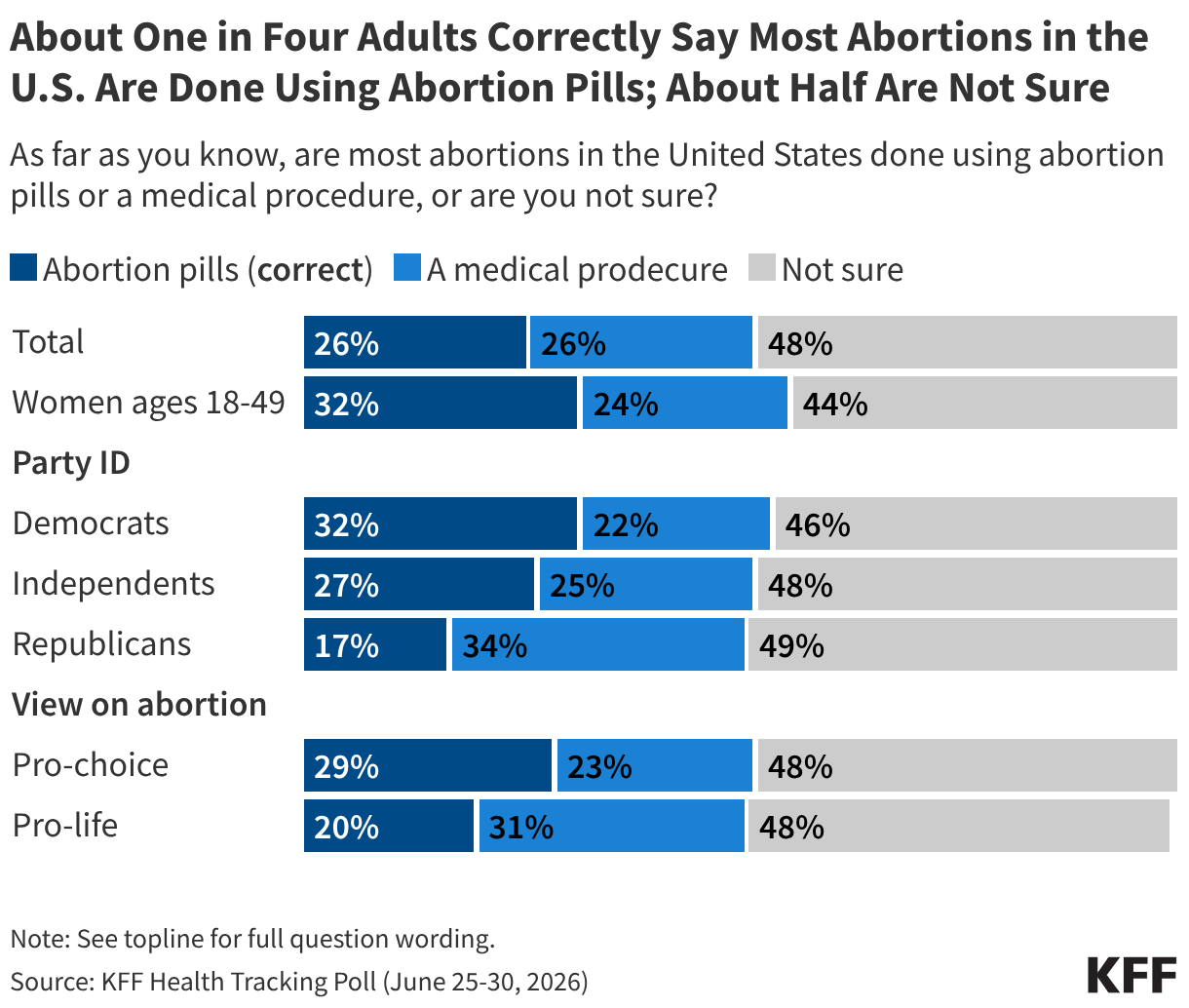
In addition to the lack of awareness of mifepristone’s safety record, just about a quarter (26%) of the public is aware that most abortions in the U.S. are performed via abortion pills, while 26% incorrectly say most abortions are performed via medical procedure and about half of the public (48%) are unsure. Larger shares of Democrats, independents, women of reproductive age, and those who identify as “pro-choice” correctly say that most U.S. abortions are performed with abortion pills, though uncertainty is still high among these groups, with roughly half saying they are unsure.
As the FDA undertakes a re-evaluation of mifepristone’s safety, slightly more than half (54%) of the public say they have little to no confidence in the FDA to make decisions based on science when it comes to reviewing the drug’s safety. This lack of confidence is shared among roughly half of Democrats (47%) and Republicans (53%), while nearly six in ten (57%) independents lack confidence in the agency in this regard. These findings are in line with KFF’s past health information and trust polling, which has found that fewer than half of the public and partisans express confidence in federal health agencies to carry out core responsibilities, such as acting independently or making decisions based on science rather than personal views of officials. Trust in federal agencies such as the FDA and CDC as health information sources declined precipitously after the onset of the COVID-19 pandemic.
What We’re Watching
Misleading Wastewater Claims Cited in Effort to Classify Mifepristone as a Contaminant
A paper purporting to show mifepristone contaminating wastewater in three U.S. cities is being cited by an activist group opposed to abortion as the group attempts to persuade the Environmental Protection Agency (EPA) to classify the drug as a water contaminant and to push the Food and Drug Administration (FDA) to restrict or pull it from the market.
The paper was posted as a preprint in a journal run by physicians who oppose abortion. Environmental health scientists, including a former scientist at the EPA’s Office of Water, have said that it uses a testing method that does not distinguish between compounds that interact with progesterone receptors. Because of this limitation, the paper cannot accurately distinguish mifepristone from other chemicals, like bisphenol A (BPA), which is found in many plastics. An FDA environmental assessment of mifepristone conducted during the drug’s approval process estimated its environmental concentration at less than one part per billion, a level that the agency described as a likely overestimate and still too low to affect standard test organisms.
Using environmental claims to call for new restrictions on access to mifepristone is among the latest efforts in ongoing attempts to portray the drug as unsafe, despite those claims not being supported by evidence. Mifepristone’s safety has been extensively studied, with serious adverse events occurring in fewer than 0.5% of patients. Still, though, a report published by a group opposed to abortion last year that claimed to show a much higher rate of adverse events is still being cited in legislative challenges to mifepristone access, despite that report similarly being met with criticism over its methodology.
AI & Emerging Technology
AI-Generated “Doctors” and Deepfakes of Real Physicians Are Being Used to Sell Supplements Online
A series of recent investigations have found networks of AI-generated “doctors” across social media platforms promoting supplements and unproven treatments as supposed “miracle cures” for a range of conditions. A New York Times video investigation found hundreds of entirely AI-generated wellness influencers and doctors on social media, not based on any real person and with fabricated names, faces, and credentials. These videos often target older women with before-and-after transformation videos and fake diplomas displayed in fake offices. In Spain, the fact-checking organization Maldita.es found more than 1,000 AI-generated “doctor” channels on YouTube and 25 similar accounts on Instagram, often promoting the same types of unproven cures.
One 71-year-old woman interviewed by the Times said she began taking a supplement after seeing an AI-generated ad for a product she was led to believe could help treat symptoms of an autoimmune disease. The product was later recalled after being linked to salmonella contamination. In other cases, ads made dangerous health claims, including that a supplement could be more effective in treating Stage 3 kidney disease than medication. In addition to these synthetic personas, deepfake videos of actual, named physicians have also been used to promote unproven treatments.
Medical Organizations Call for Legislative Protections Against AI Physician Deepfakes
Legislative efforts to prevent such impersonation have been introduced at both the federal and state level, with the American Medical Association (AMA) endorsing a bill that would hold individuals or platforms liable for distributing an unauthorized digital replica of a person’s voice or likeness. In California, a bill supported by the California Medical Association would require ads using an AI-generated or altered likeness of a real person to include a clear disclosure that the content was AI-generated.
Social Media Platform Enforcement of AI-Generated Content Remains Inconsistent
Social media platforms, including Meta and TikTok, have said that they label AI-generated content and remove ads making misleading health claims, but the Times investigation found uneven enforcement. Maldita.es found some flagged Instagram accounts carrying the platform’s blue verification badge, typically reserved for confirming a user’s identity. A separate audit that posted more than 200 AI-generated images and videos across five platforms similarly found inconsistent labeling, with Instagram correctly labeling only 15 of 105 synthetic images posted to the platform, while TikTok labeled about a third.
Why This Matters
AI-generated videos that imitate the credibility of real or fabricated health professionals may exploit both the public’s high trust in doctors as purveyors of health information and the confidence that some social media users have in their ability to discern false health claims. June KFF polling found that fewer than four in ten (36%) adults who seek health information on social media follow up with a doctor or health professional at least most of the time to verify what they’ve seen, and a majority of those who use social media for health (65%) say they’re confident in their ability to tell whether health information posted on these platforms is true or false.
More From KFF
- KFF Quick Take: The FDA’s Retraction of a Positive Test in the Cyclosporiasis Outbreak Raises Questions About Corrections and Trust
- KFF Issue Brief: Comparing U.S. Ebola Outbreak Response Capabilities and Practices Over Time
- KFF Health News: Abortion Drug Law in Louisiana Heightens Hemorrhage Risk for Pregnant Patients
About The Health Information and Trust Initiative: the Health Information and Trust Initiative is a KFF program aimed at tracking health misinformation in the U.S., analyzing its impact on the American people, and mobilizing media to address the problem. Our goal is to be of service to everyone working on health misinformation, strengthen efforts to counter misinformation, and build trust.
The Monitor is a report from KFF’s Health Information and Trust initiative that focuses on recent developments in health information. It’s free and published twice a month.
Sign up to receive KFF Monitor
email updates
Support for the Health Information and Trust initiative is provided by the Robert Wood Johnson Foundation (RWJF). The views expressed do not necessarily reflect the views of RWJF and KFF maintains full editorial control over all of its policy analysis, polling, and journalism activities. The data shared in the Monitor is sourced through media monitoring research conducted by KFF.