
The FDA’s Retraction of a Positive Test in the Cyclosporiasis Outbreak Raises Questions About Corrections and Trust

The FDA is investigating a multistate cyclosporiasis outbreak that the agency has linked to shredded iceberg lettuce from Taylor Farms de Mexico. Taylor Farms voluntarily recalled the product on July 17. On July 18, the FDA reported that a lettuce sample from the company had tested positive for cyclospora. The next day, agency lab experts re-checked the result and called it a false positive, meaning the test had not actually detected the parasite. At that point, the FDA said no product samples had confirmed positive for cyclospora. The agency said the error did not change its conclusion about the source of the outbreak, citing epidemiological data still pointing to Taylor Farms’ lettuce.
Some social media posts have claimed that Taylor Farms’ political donations and its executives’ meetings with White House and FDA officials shaped the FDA’s decision to retract the test result. There is no confirmed evidence for that, and HHS has denied any political influence, saying the agency’s decisions are guided only by science and public safety.
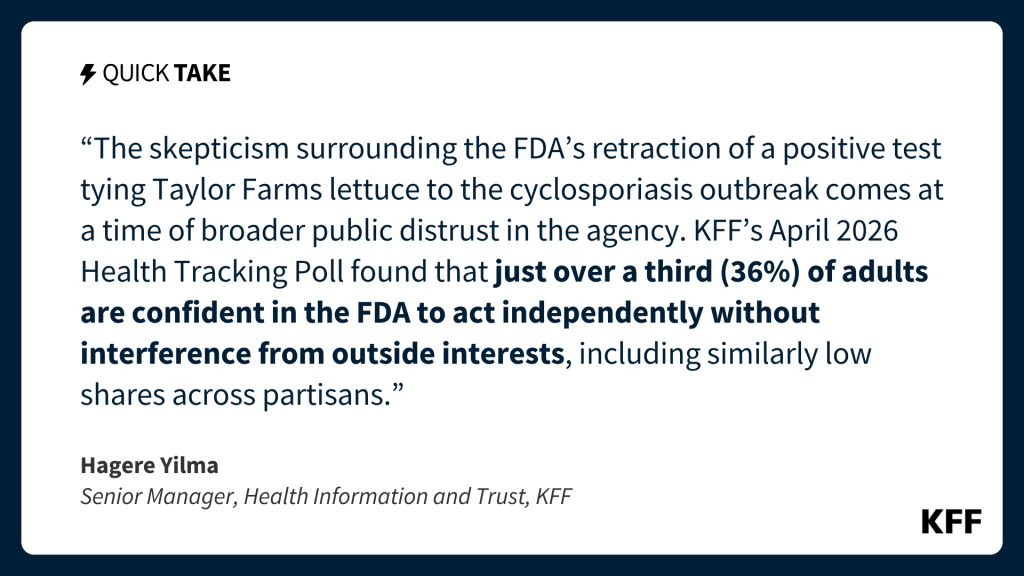
The skepticism surrounding the FDA’s retraction of a positive test tying Taylor Farms lettuce to the cyclosporiasis outbreak comes at a time of broader public distrust in the agency. KFF’s April 2026 Health Tracking Poll found that just over a third (36%) of adults are confident in the FDA to act independently without interference from outside interests, including similarly low shares across partisans. Recent KFF polling also shows that about half of Americans have at least a fair amount of trust in the FDA for reliable health information, while the other half express little to no trust. These dynamics illustrate how unsubstantiated claims can circulate alongside a factual correction, particularly in a period when confidence in federal health agencies is eroding.
Making factual corrections is a routine part of how science and public health work, since findings often get revised as more evidence comes in. But doing so in an environment where trust in these institutions is already limited adds a layer of difficulty. How to explain a correction clearly enough to hold up against public skepticism, particularly when investigations are still underway and full details may not yet be available, is a recurring question for science and public health communicators operating in this environment.