

VOLUME 46
KFF Poll Finds That Most Adults Lack Confidence in Key Health Agencies to Act Independently
Highlights
KFF’s latest Health Tracking Poll finds that confidence in the independence of key government health agencies overseeing food and drug safety and public health is low among the public and across partisans. Most of the public also share a distrust of agriculture, food, and pharmaceutical companies to act in the public’s best interest, compared with doctors and health care providers who are much more trusted among the public.
Featured
KFF Poll Finds Low Levels of Confidence in Federal Health Agencies to Act Independently, Along with Low Trust in Food, Agriculture, and Pharmaceutical Industries to Act in the Public’s Interest
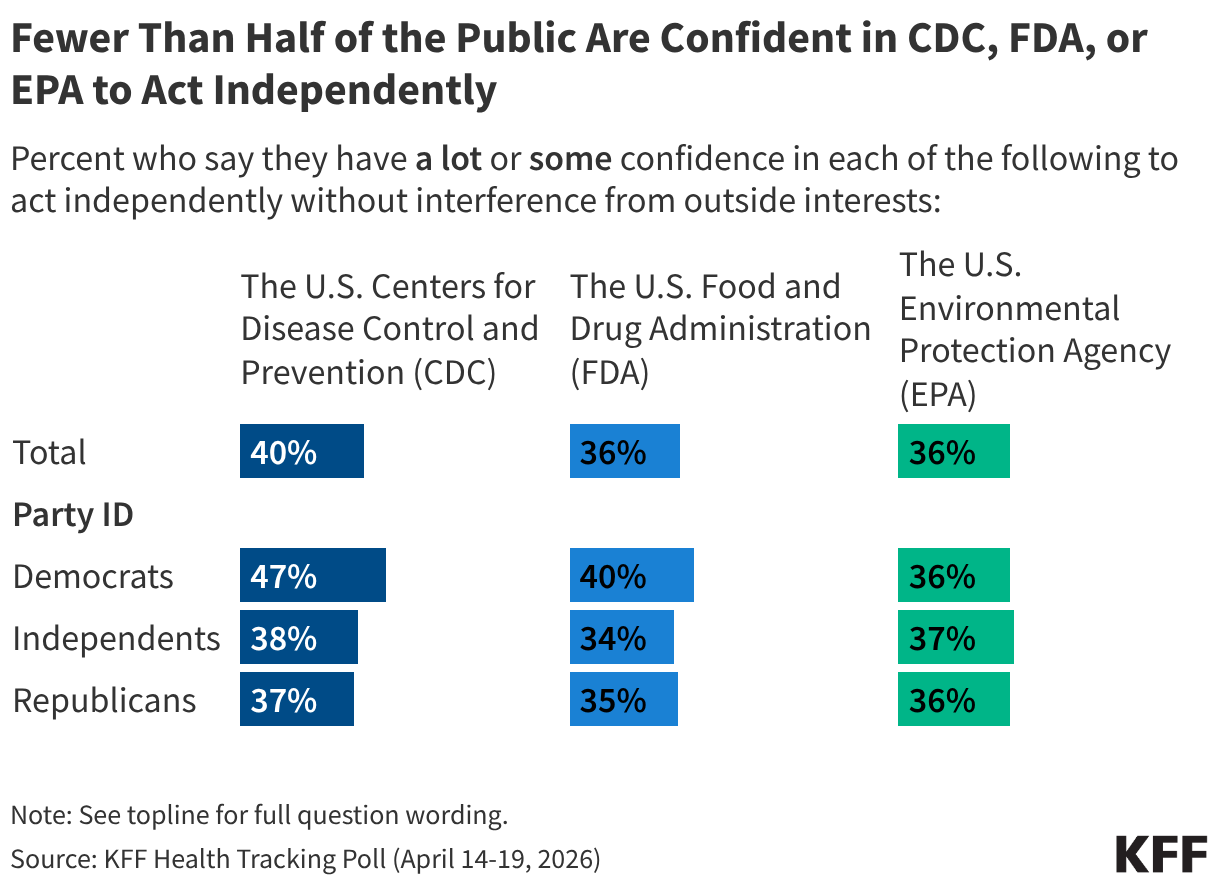
KFF’s latest April Health Tracking Poll finds that fewer than half the public express confidence in the independence of the CDC, FDA, or EPA – government agencies that hold key responsibilities over food and drug safety and public health. Overall, four in ten or fewer adults say they have “a lot” or “some” confidence in the U.S. Centers for Disease Control and Prevention (CDC) (40%), the U.S. Food and Drug Administration (FDA) (36%), or the U.S. Environmental Protection Agency (EPA) (36%) to act independently without interference from outside interests.
While Democrats are somewhat more likely than Republicans or independents to express confidence in the CDC (47% vs. 37% and 38%, respectively), four in ten or fewer across partisanship say they are confident in the FDA or EPA to act independently.
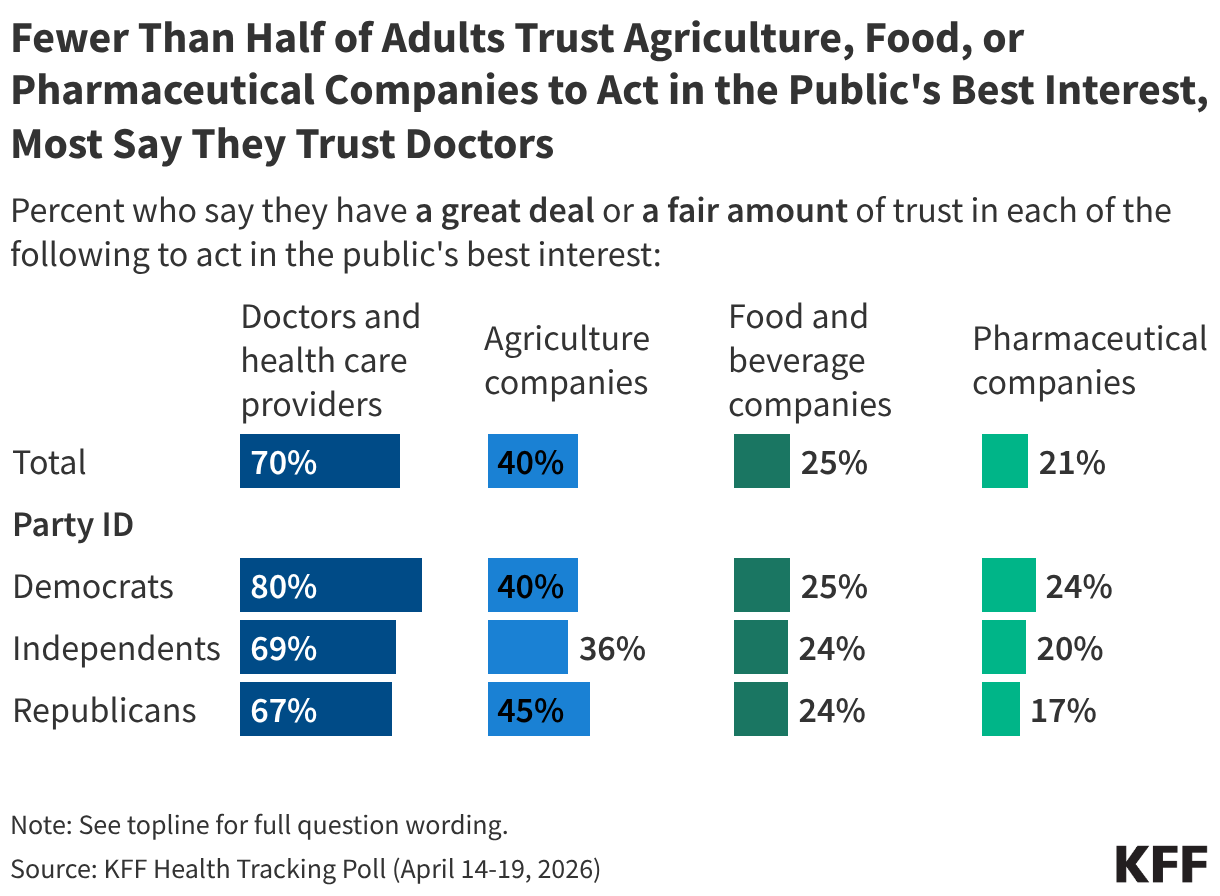
Coupled with concerns about the independence of government agencies, most of the public lacks trust in agriculture, food, and pharmaceutical companies to act in the public’s best interest. One in four or fewer adults say they trust food and beverage companies (25%) or pharmaceutical companies (21%) “a great deal” or “a fair amount” to act in the public’s best interest, while a somewhat larger share (40%) trust agriculture companies. These findings hold across partisanship, with fewer than half of Democrats, independents, and Republicans expressing trust in these industries to act in the public’s interest.
On the other hand, most of the public say they trust doctors and health care providers to act in the public’s best interest– a sentiment that is shared across partisanship. These findings are in line with past KFF polling showing that doctors and health care providers are consistently the public’s most trusted source of health information.
What We’re Watching
Differences in News Consumption Correlate with Trust in MMR Vaccine
A peer-reviewed study published in Vaccine found that among study participants, the type of media people consumed was associated with their attitudes toward the MMR vaccine, even after accounting for political identity and other demographic factors. Researchers assigned 22 media outlets to five categories, using data on media usage from Pew Research Center and AllSides Media, and selected one representative outlet from each category. Those who frequently engaged with “new” or primarily digital right-leaning media, like Breitbart, were about twice as likely to say that the risks of the MMR vaccine outweighed the benefits, compared to those who never did. Even infrequent engagement with such outlets was associated with elevated odds. At the same time, engagement with “legacy” right-leaning media, like Fox News, was not significantly associated with MMR vaccine hesitancy among participants.
What To Watch Out For: The information environment in which people consume news may shape vaccine attitudes, even within political identity. As health communicators work to increase vaccine confidence, understanding how differences in media consumption shape attitudes may help predict what populations are more likely to encounter and be influenced by misleading claims about vaccine safety.
Some Pregnant People Are Choosing to Deliver Without Medical Support, and Online Communities May Be Playing a Role
Online interest in "free births,” a movement that embraces delivering a baby without any medical professional present and was recently featured in the Season 2 finale of The Pitt, has trended upward over the last year, according to reporting from The New York Times. Research on women who choose free births points to a range of motivations, including previous negative or traumatic experiences with providers, concerns about unnecessary medical interventions and wanting a more natural birth, a desire for autonomy and control during birth, and cost and access barriers. These concerns are not without basis: research and polling have documented patterns of disrespectful and nonconsensual care in maternity settings, and women of color in particular face documented disparities in how they are treated and in maternal health outcomes. At the same time, a “free birth” can put both pregnant women and their infants at greater risk for adverse outcomes and death.
Misleading online narratives have entered this space, exploiting these real grievances to promote practices that can carry serious medical risks including infant deaths. Some online communities promoting free birth frequently invoke women’s autonomy and bodily sovereignty in ways that may resonate with some women given documented patterns of disrespectful maternal care. Some also promote narratives of women being empowered or “badass” by so-called free birth. But these communities and individuals promoting free birth also spread misguided approaches to manage birth emergencies that can cause women to delay seeking care and encourage unsafe practices. Even in low-risk pregnancies, up to 29% of births involve unexpected complications that can quickly escalate. According to the CDC, nearly one in 10 births in 2023 resulted in an admission to a neonatal intensive care unit. Without trained professionals present during childbirth, life-threatening emergencies like hemorrhage or shoulder dystocia cannot be quickly identified or treated.
An investigation by The Guardian, though, has documented cases in which organizations promoting free birth have characterized life-threatening emergencies as normal and actively discouraged members from seeking emergency care. Proponents sell access to “classes” and private online forums, some of which shame or prohibit participants who mention medical care. According to The Guardian’s reporting, one of the more prominent groups promoting free birth has earned more than $13 million in revenue since 2018 and charged $6,000 for a three-month Zoom course for so-called “authentic midwives.”
AI & Emerging Technology
World Health Organization Launches AI Tool Designed to Ground Responses in Evidence
The World Health Organization (WHO) has launched a beta version of a new health AI chatbot designed to help health workers, policymakers, and researchers find sexual and reproductive health information that is grounded in WHO and Human Reproduction Programme (HRP) evidence. The tool, called ChatHRP, uses retrieval-augmented generation (RAG), a technique that grounds AI responses in a curated external database rather than in broad training data, reducing the risk of inaccurate outputs and allowing users to trace answers back to specific vetted sources.
Misinformation in Sexual and Reproductive Health
A December 2025 review published in JMIR Infodemiology found that false sexual and reproductive health and rights information in digital spaces undermined informed decision-making and health-seeking behavior across multiple levels, from individuals to health systems. The review found that at the individual level, misinformation shaped beliefs and deterred seeking care; at the community level, it reinforced harmful norms and stigma; and at the policy level, it has been used as a tool to erode legal protections for reproductive rights. WHO has positioned its new AI tool as a response to this problem, saying it would steer users “away from algorithms, opinions, or misinformation.”
Why It Matters
While ChatHRP targets health workers and policymakers rather than the general public, its use of RAG to ground responses in vetted, traceable sources may offer a model for improving the reliability of the general-purpose AI tools that many consumers are already turning to for health information. About a third of U.S. adults now turn to AI for health information, according to KFF’s March 2026 Tracking Poll on Health Information and Trust, and while most users express trust in AI chatbots to provide reliable health information, only a third of adults overall say they have a “great deal” or “fair amount” of trust in these tools for health information. As more health institutions turn to AI to deliver information, how they design for accuracy and reliability will shape both the quality of information people receive and how willing people are to trust these tools.
More From KFF
- KFF Policy Brief: The Growing Use of Artificial Intelligence in Health Care and Implications for Disparities
- KFF Policy Brief: Estimating Effectiveness of Influenza and COVID-19 Vaccines/ The “Test-Negative” Design
- KFF Quick Take: Secretary Kennedy Remains Popular with MAGA and MAHA Supporters, But Few Others
About The Health Information and Trust Initiative: the Health Information and Trust Initiative is a KFF program aimed at tracking health misinformation in the U.S., analyzing its impact on the American people, and mobilizing media to address the problem. Our goal is to be of service to everyone working on health misinformation, strengthen efforts to counter misinformation, and build trust.
The Monitor is a report from KFF’s Health Information and Trust initiative that focuses on recent developments in health information. It’s free and published twice a month.
Sign up to receive KFF Monitor
email updates
Support for the Health Information and Trust initiative is provided by the Robert Wood Johnson Foundation (RWJF). The views expressed do not necessarily reflect the views of RWJF and KFF maintains full editorial control over all of its policy analysis, polling, and journalism activities. The data shared in the Monitor is sourced through media monitoring research conducted by KFF.