
This resource provides visualizations on the U.S. global health budget and will be updated as needed. Click through the table of contents to jump to different figures.
Table of Contents
- U.S. Global Health Funding as a Share of the Federal Budget
- U.S. is the Largest Donor of International Health Assistance
- Top 10 Donor Governments to International Health Assistance as a Share of Total Assistance
- U.S. Funding for Global Health, Trends Over Time
- U.S. Funding for Global Health, Request vs. Enacted Levels
- U.S. Global Health Funding (in millions), By Program Area
- U.S. Global Health Funding (in millions), By Program Area, FY 2024
- U.S. Global Health Funding (in millions), By Program Area, FY 2025 Request
- U.S. Global Health Funding Percent Change by Program Area, Request Compared to Enacted
- U.S. Funding for Global Health (in millions), Bilateral and Multilateral Share
1. U.S. Global Health Funding as a Share of the Federal Budget
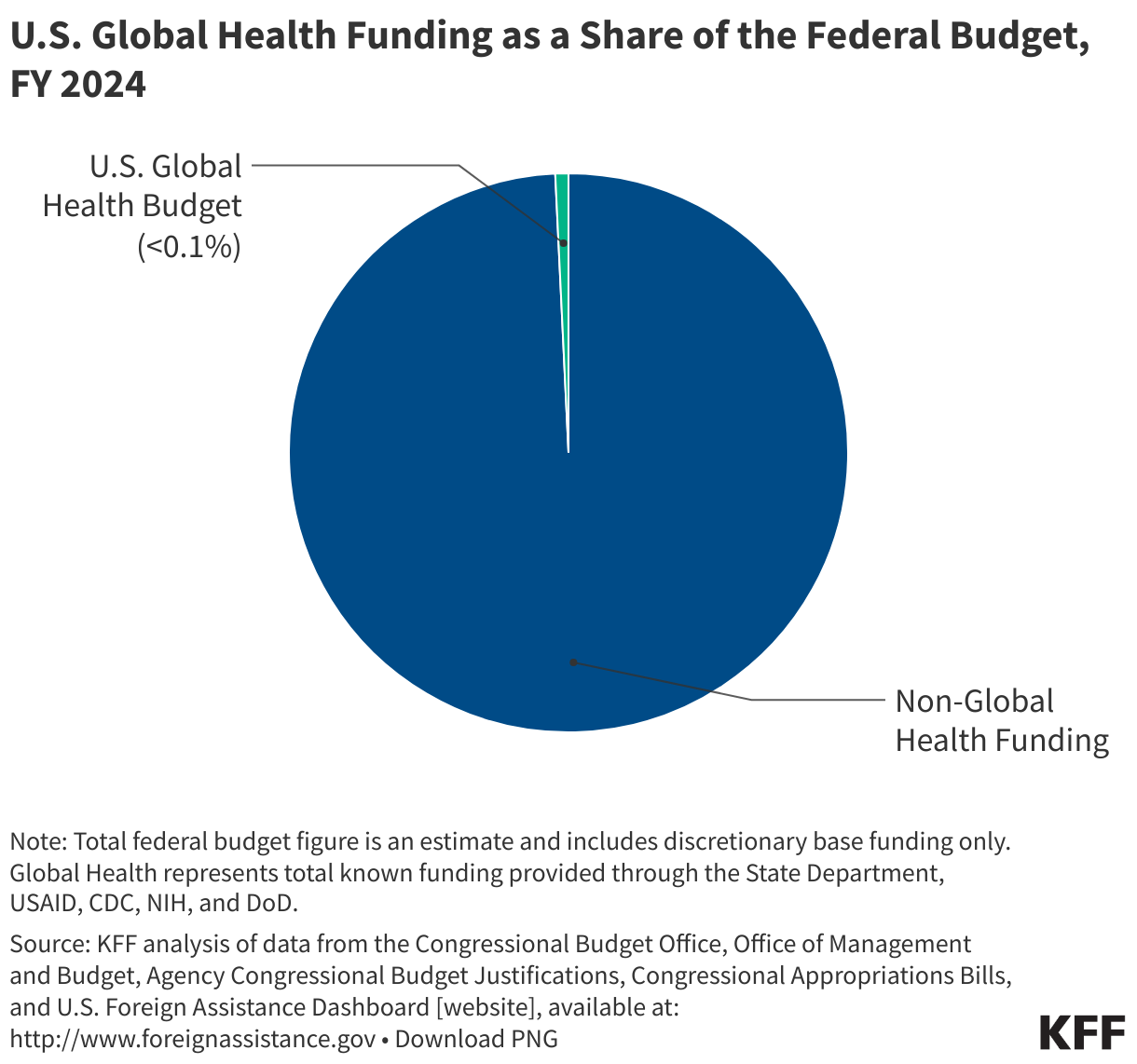
U.S. Global Health Funding as a Share of the Federal Budget, FY 2026
Total federal budget figure is an estimate and includes discretionary base funding only. Global Health represents total known funding provided through the State Department, USAID, CDC, NIH, and DoD. FY26 is based on funding provided in the "Consolidated Appropriations Act, 2026" (P.L. 119-75) and is a preliminary estimate.
KFF analysis of data from the Congressional Budget Office, Office of Management and Budget, Agency Congressional Budget Justifications, Congressional Appropriations Bills, and U.S. Foreign Assistance Dashboard [website], available at: <a href="http://www.foreignassistance.gov" target="_blank" rel="nofollow noopener noreferrer">http://www.foreignassistance.gov</a> • <a href=https://datawrapper.dwcdn.net/uiNyR/1200px.png download=us-global-health-share-of-federal-budget.png>Download PNG</a>
2. U.S. is the Largest Donor of International Health Assistance
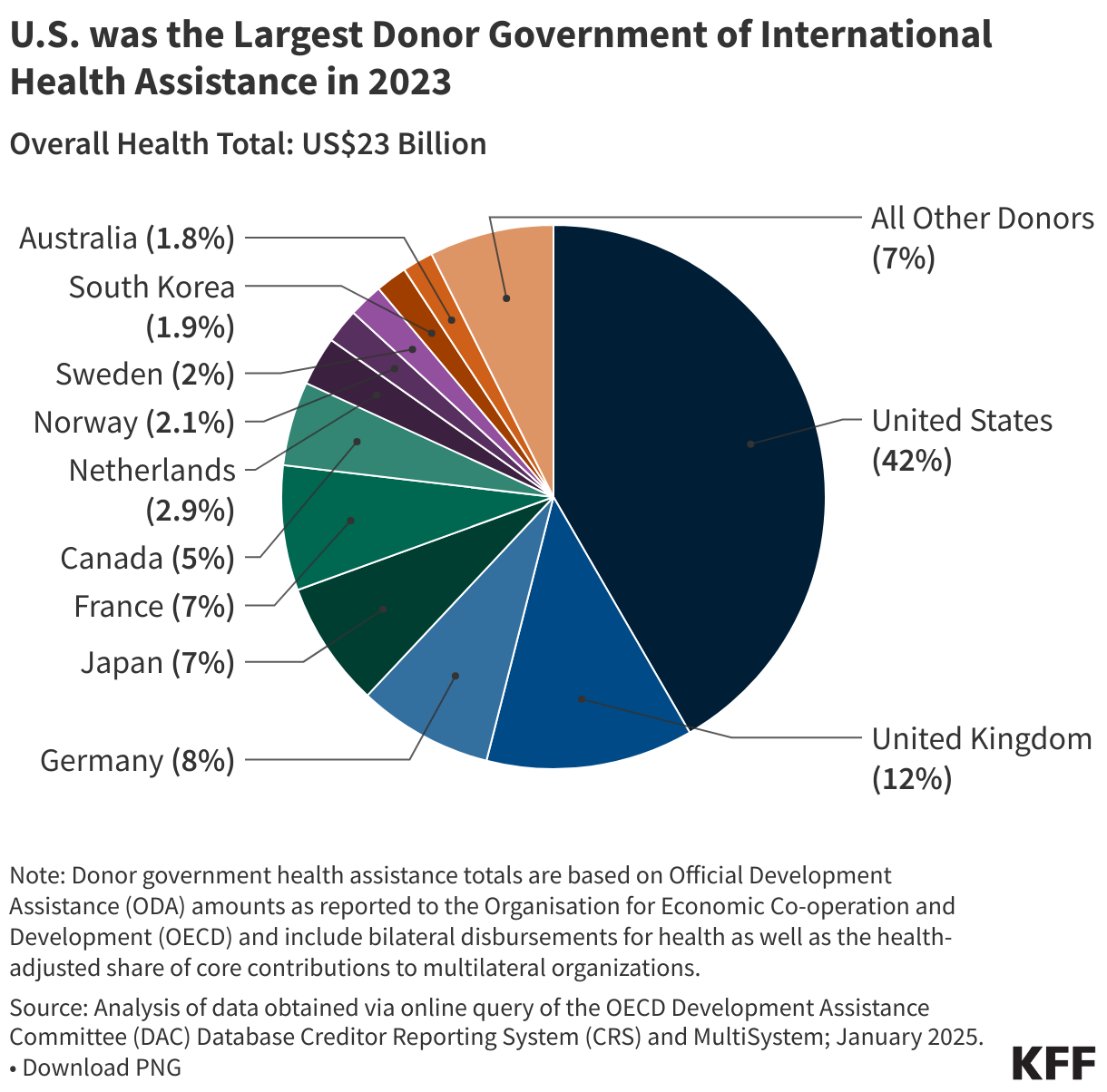
U.S. was the Largest Donor Government of International Health Assistance in 2024
Overall Health Total: US$24 Billion
Donor government health assistance totals are based on Official Development Assistance (ODA) amounts as reported to the Organisation for Economic Co-operation and Development (OECD) and include bilateral disbursements for health as well as the health-adjusted share of core contributions to multilateral organizations.
Analysis of data obtained via online query of the OECD Development Assistance Committee (DAC) Database Creditor Reporting System (CRS) and MultiSystem; April 2026. • <a href=https://datawrapper.dwcdn.net/5WeF2/1200px.png download=us-funding-largest-donor-international-health-assistance-pie.png>Download PNG</a>
3. Top 10 Donor Governments to International Health Assistance as a Share of Total Assistance
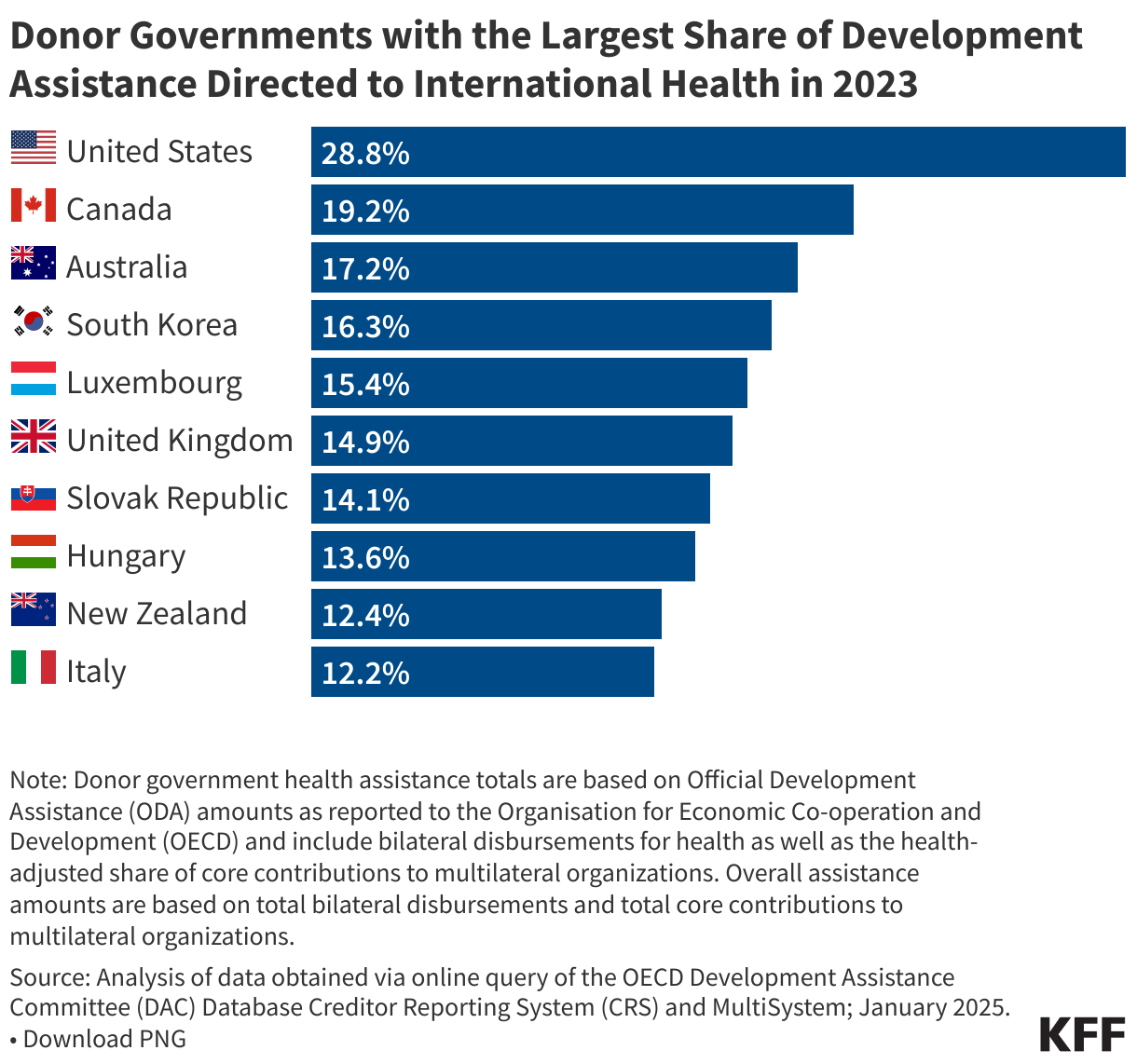
Donor Governments with the Largest Share of Development Assistance Directed to International Health in 2024
Donor government health assistance totals are based on Official Development Assistance (ODA) amounts as reported to the Organisation for Economic Co-operation and Development (OECD) and include bilateral disbursements for health as well as the health-adjusted share of core contributions to multilateral organizations. Overall assistance amounts are based on total bilateral disbursements and total core contributions to multilateral organizations. All amounts are for Development Assistance Committee (DAC) members only.
Analysis of data obtained via online query of the OECD Development Assistance Committee (DAC) Database Creditor Reporting System (CRS) and MultiSystem; April 2026. • <a href=https://datawrapper.dwcdn.net/oBEfR/1200px.png download=us-funding-for-global-health-vs-other-donors.png>Download PNG</a>
4. U.S. Funding for Global Health, Trends Over Time
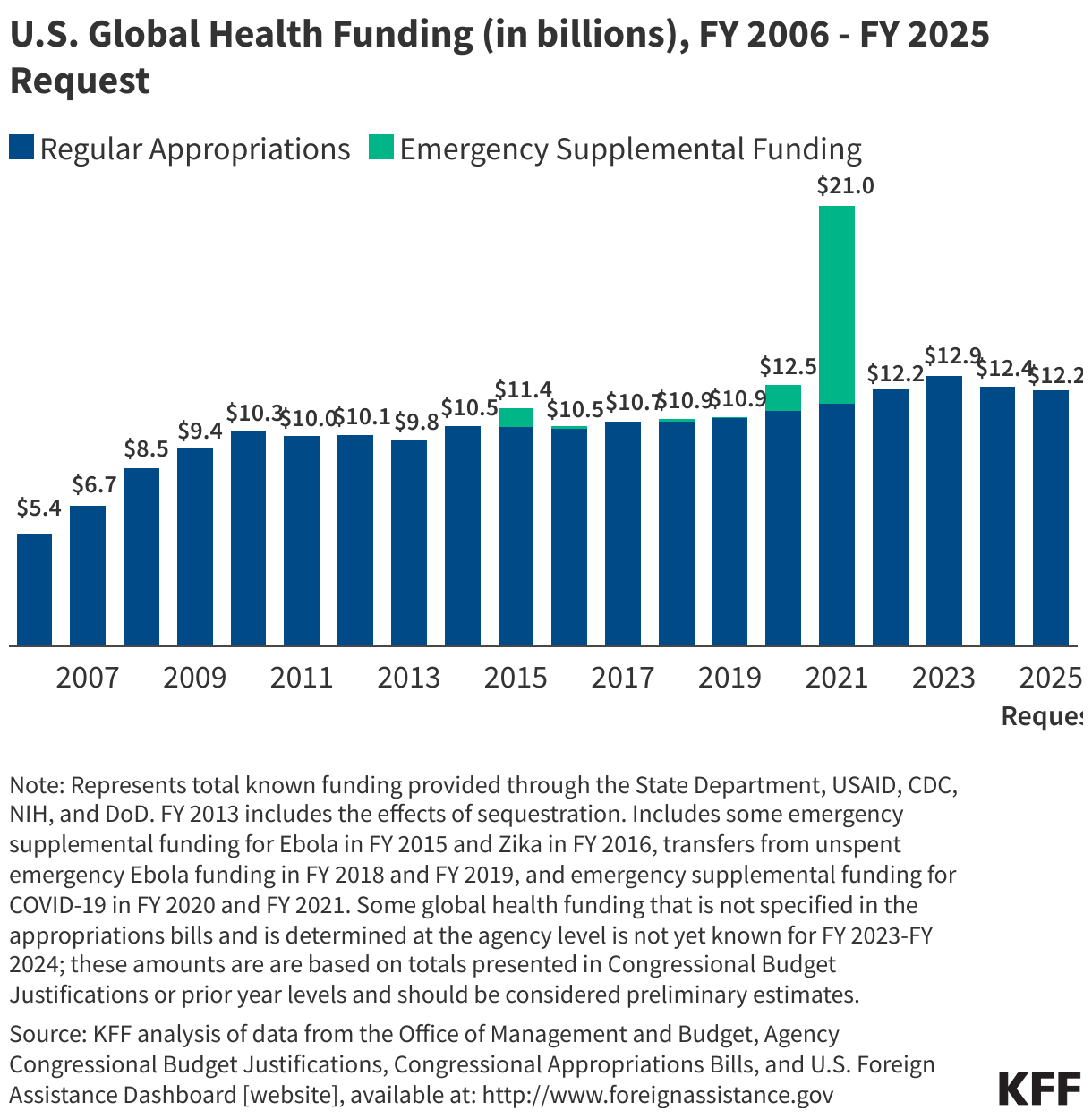
U.S. Global Health Funding (in billions), FY 2006 - FY 2025 Request
Represents total known funding provided through the State Department, USAID, CDC, NIH, and DoD. FY 2013 includes the effects of sequestration. Includes some emergency supplemental funding for Ebola in FY 2015 and Zika in FY 2016, transfers from unspent emergency Ebola funding in FY 2018 and FY 2019, and emergency supplemental funding for COVID-19 in FY 2020 and FY 2021. Some global health funding that is not specified in the appropriations bills and is determined at the agency level is not yet known for FY 2023-FY 2024; these amounts are are based on totals presented in Congressional Budget Justifications or prior year levels and should be considered preliminary estimates.
KFF analysis of data from the Office of Management and Budget, Agency Congressional Budget Justifications, Congressional Appropriations Bills, and U.S. Foreign Assistance Dashboard [website], available at: <a href="http://www.foreignassistance.gov" target="_blank" rel="nofollow noopener noreferrer"> http://www.foreignassistance.gov</a>
5. U.S. Funding for Global Health, Request vs. Enacted Levels
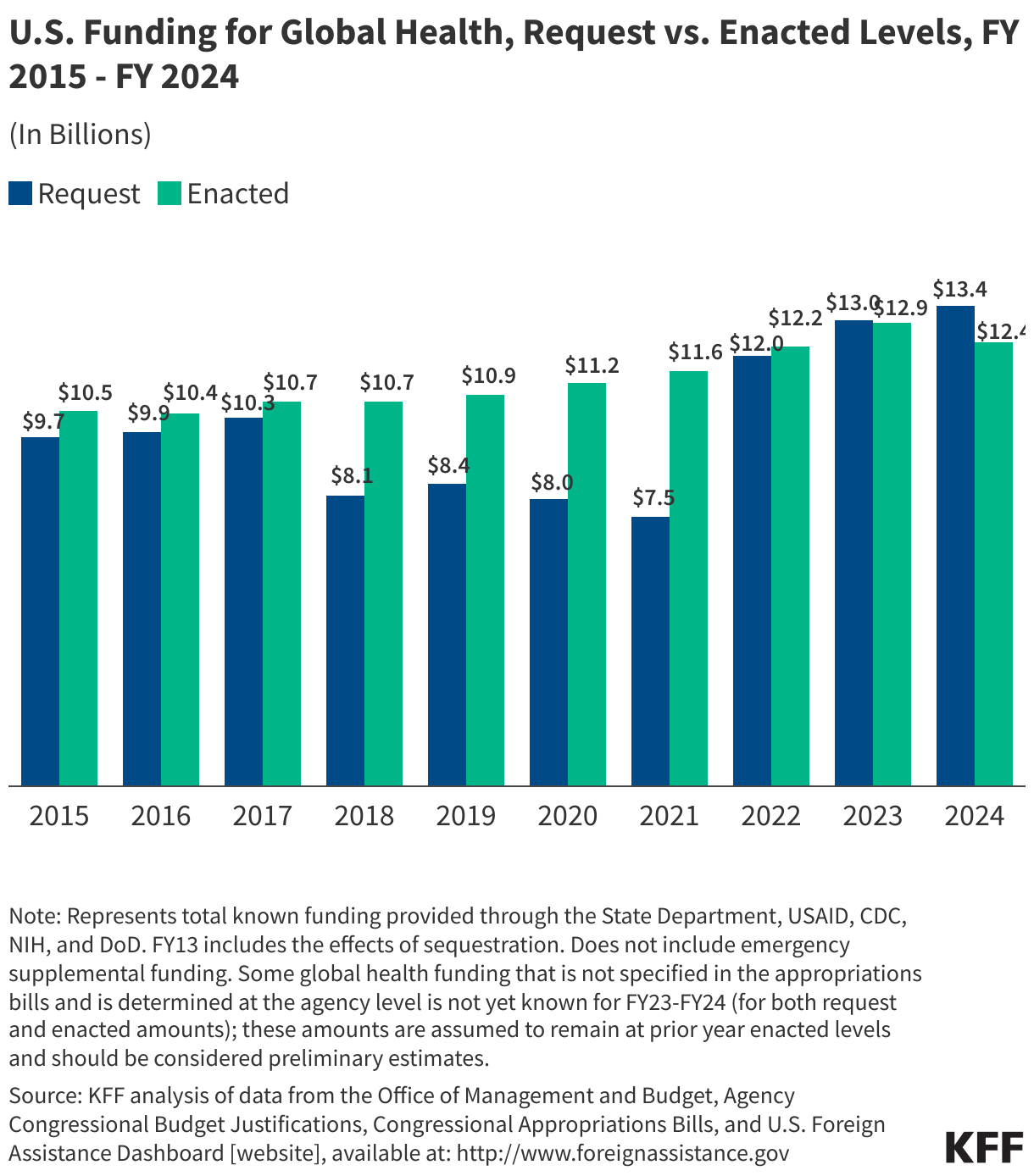
U.S. Funding for Global Health, Request vs. Enacted Levels, FY 2016 - FY 2025
(In Billions)
Represents total known funding provided through the State Department, USAID, CDC, NIH, and DoD. FY13 includes the effects of sequestration. Does not include emergency supplemental funding. Some global health funding that is not specified in the appropriations bills and is determined at the agency level is not yet known for FY23-FY25 (for both request and enacted amounts); these amounts are assumed to remain at prior year enacted levels and should be considered preliminary estimates. FY25 enacted is based on funding provided in the "Full-Year Continuing Appropriations and Extensions Act, 2025" (P.L. 119-4) and is a preliminary estimate.
KFF analysis of data from the Office of Management and Budget, Agency Congressional Budget Justifications, Congressional Appropriations Bills, and U.S. Foreign Assistance Dashboard [website], available at: <a href=“http://www.foreignassistance.gov"> http://www.foreignassistance.gov</a>
6. U.S. Global Health Funding (in millions), By Program Area
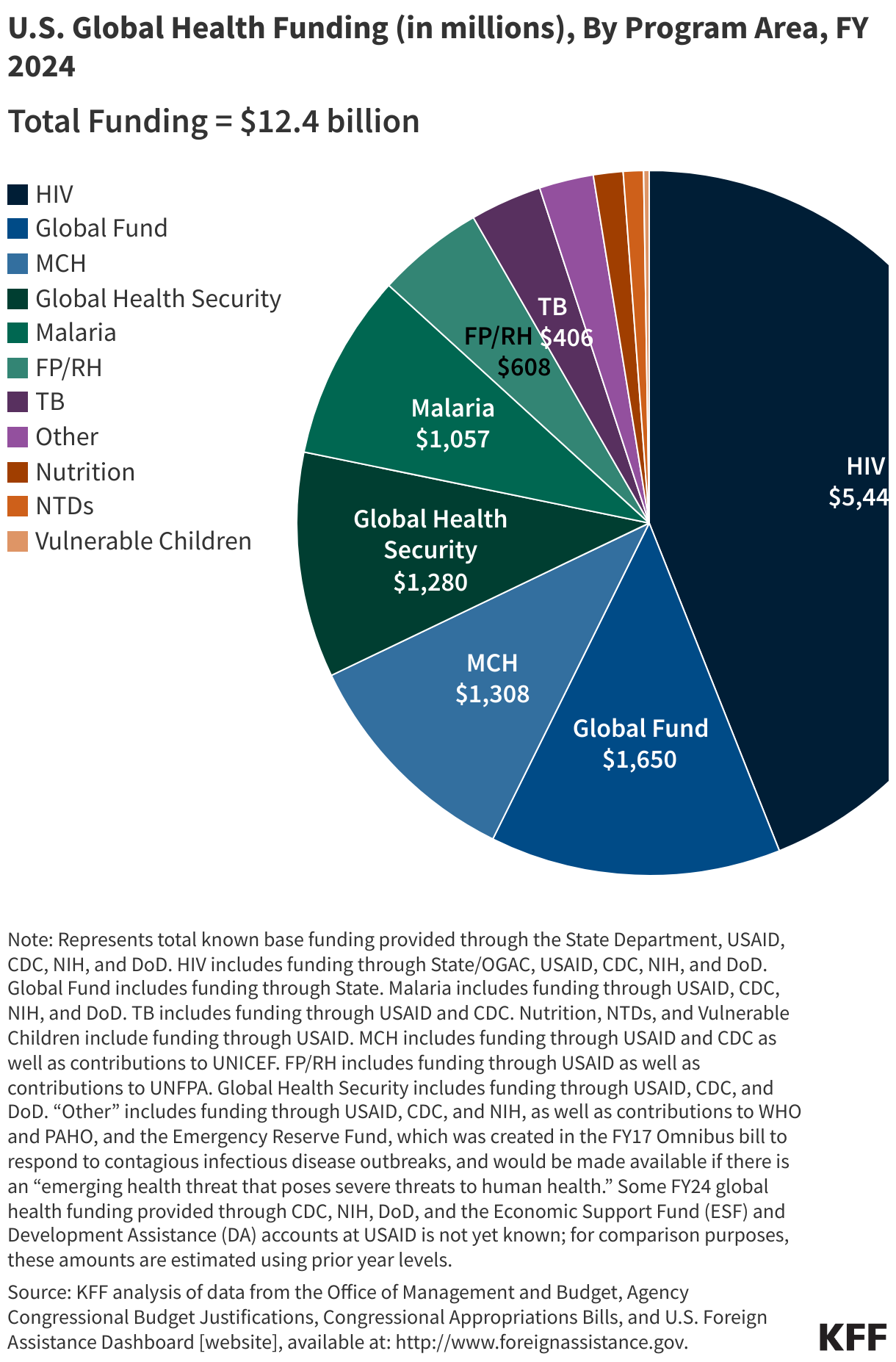
U.S. Global Health Funding (in millions), By Program Area, FY 2024
Total Funding = $12.4 billion
Represents total known base funding provided through the State Department, USAID, CDC, NIH, and DoD. HIV includes funding through State/OGAC, USAID, CDC, NIH, and DoD. Global Fund includes funding through State. Malaria includes funding through USAID, CDC, NIH, and DoD. TB includes funding through USAID and CDC. Nutrition, NTDs, and Vulnerable Children include funding through USAID. MCH includes funding through USAID and CDC as well as contributions to UNICEF. FP/RH includes funding through USAID as well as contributions to UNFPA. Global Health Security includes funding through USAID, CDC, and DoD. “Other” includes funding through USAID, CDC, and NIH, as well as contributions to WHO and PAHO, and the Emergency Reserve Fund, which was created in the FY17 Omnibus bill to respond to contagious infectious disease outbreaks, and would be made available if there is an “emerging health threat that poses severe threats to human health.” Some FY24 global health funding provided through CDC, NIH, DoD, and the Economic Support Fund (ESF) and Development Assistance (DA) accounts at USAID is not yet known; for comparison purposes, these amounts are estimated using prior year levels.
KFF analysis of data from the Office of Management and Budget, Agency Congressional Budget Justifications, Congressional Appropriations Bills, and U.S. Foreign Assistance Dashboard [website], available at: <a href=http://www.foreignassistance.gov>http://www.foreignassistance.gov</a>.
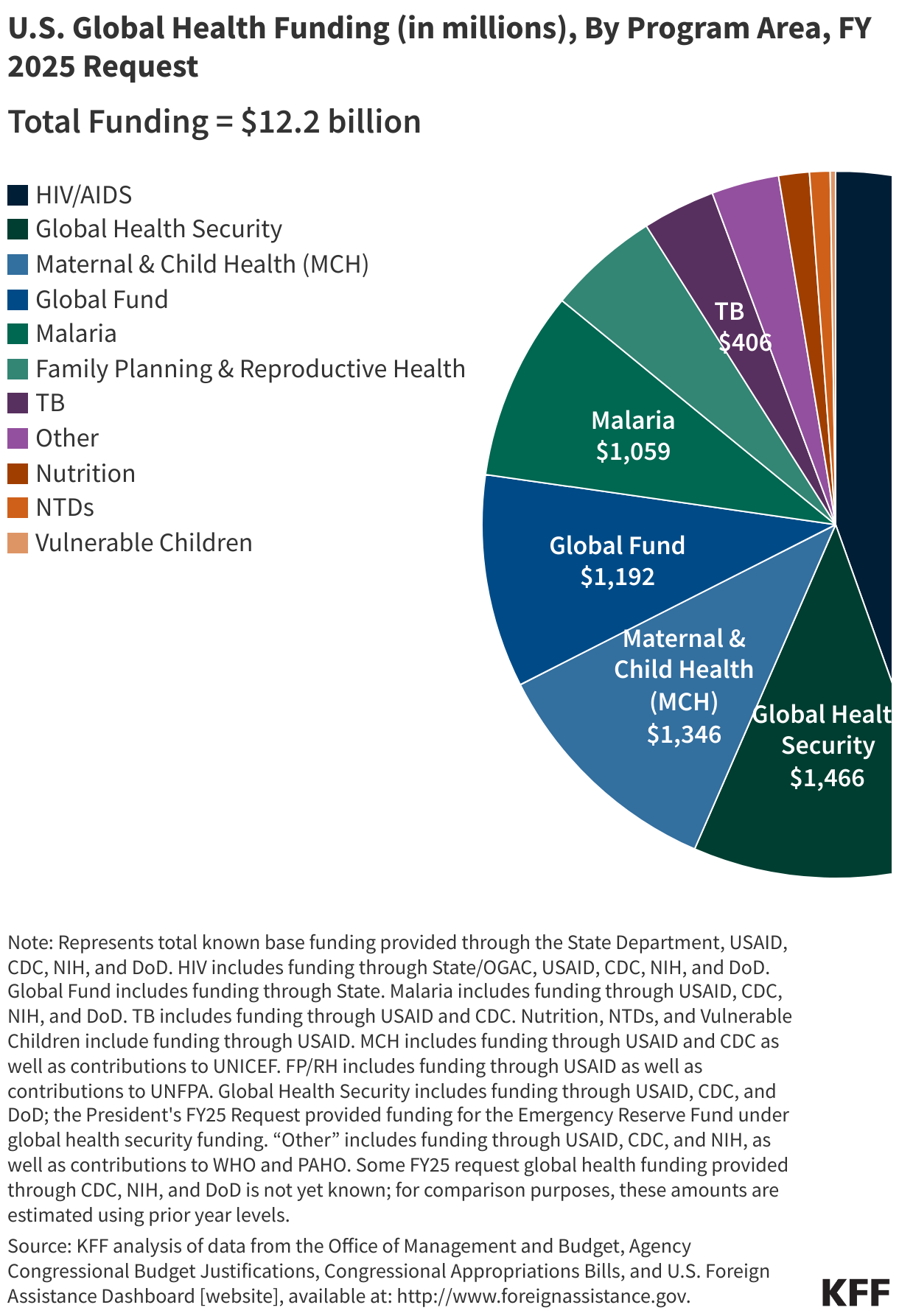
U.S. Global Health Funding (in millions), By Program Area, FY 2025 Request
Total Funding = $12.2 billion
Represents total known base funding provided through the State Department, USAID, CDC, NIH, and DoD. HIV includes funding through State/OGAC, USAID, CDC, NIH, and DoD. Global Fund includes funding through State. Malaria includes funding through USAID, CDC, NIH, and DoD. TB includes funding through USAID and CDC. Nutrition, NTDs, and Vulnerable Children include funding through USAID. MCH includes funding through USAID and CDC as well as contributions to UNICEF. FP/RH includes funding through USAID as well as contributions to UNFPA. Global Health Security includes funding through USAID, CDC, and DoD; the President's FY25 Request provided funding for the Emergency Reserve Fund under global health security funding. “Other” includes funding through USAID, CDC, and NIH, as well as contributions to WHO and PAHO. Some FY25 request global health funding provided through CDC, NIH, and DoD is not yet known; for comparison purposes, these amounts are estimated using prior year levels.
KFF analysis of data from the Office of Management and Budget, Agency Congressional Budget Justifications, Congressional Appropriations Bills, and U.S. Foreign Assistance Dashboard [website], available at: <a href="http://www.foreignassistance.gov" target="_blank" rel="nofollow noopener noreferrer">http://www.foreignassistance.gov</a>.
7. U.S. Global Health Funding Percent Change by Program Area, Request Compared to Enacted
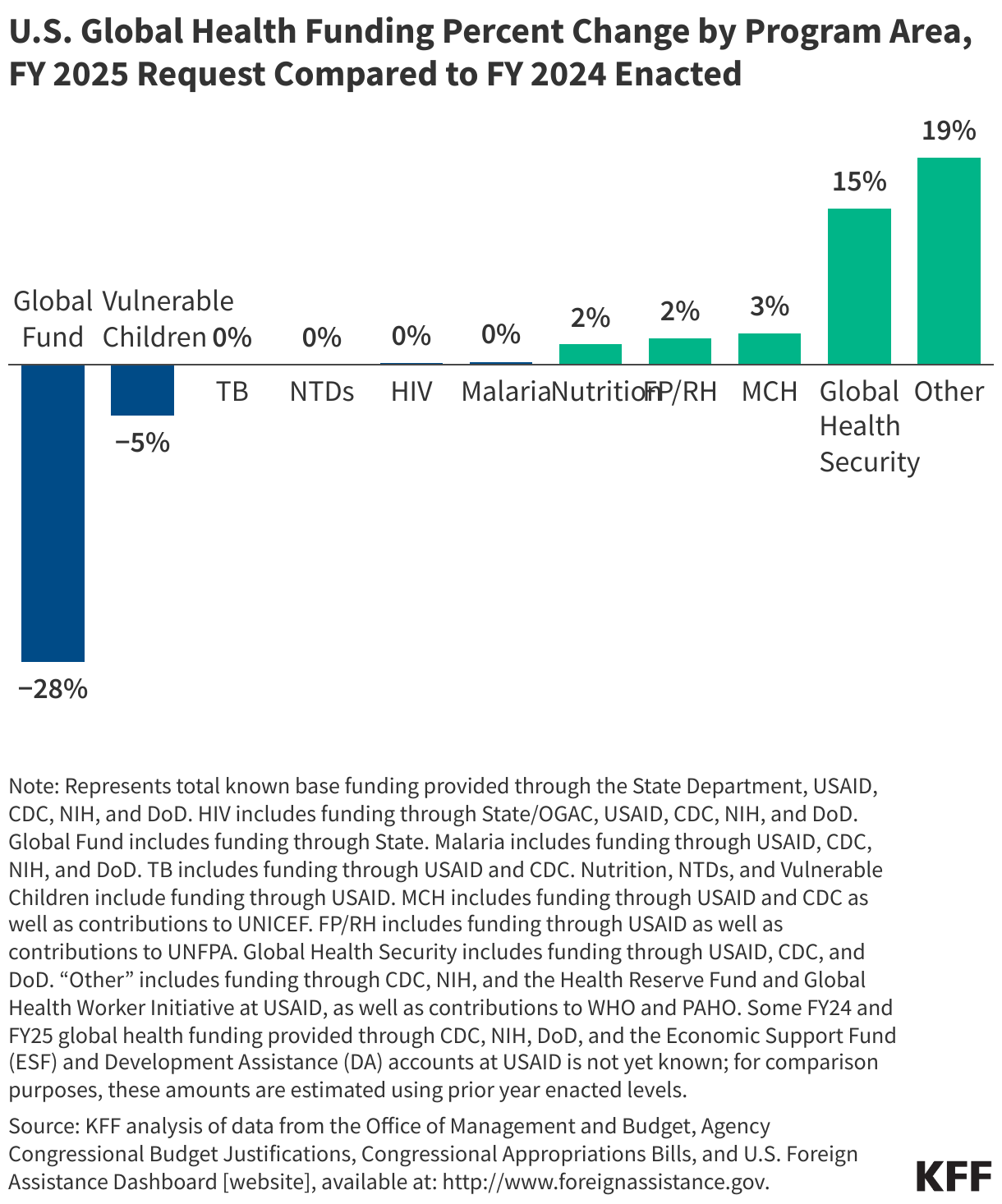
U.S. Global Health Funding Percent Change by Program Area, FY 2025 Request Compared to FY 2024 Enacted
Represents total known base funding provided through the State Department, USAID, CDC, NIH, and DoD. HIV includes funding through State/OGAC, USAID, CDC, NIH, and DoD. Global Fund includes funding through State. Malaria includes funding through USAID, CDC, NIH, and DoD. TB includes funding through USAID and CDC. Nutrition, NTDs, and Vulnerable Children include funding through USAID. MCH includes funding through USAID and CDC as well as contributions to UNICEF. FP/RH includes funding through USAID as well as contributions to UNFPA. Global Health Security includes funding through USAID, CDC, and DoD. “Other” includes funding through CDC, NIH, and the Health Reserve Fund and Global Health Worker Initiative at USAID, as well as contributions to WHO and PAHO. Some FY24 and FY25 global health funding provided through CDC, NIH, DoD, and the Economic Support Fund (ESF) and Development Assistance (DA) accounts at USAID is not yet known; for comparison purposes, these amounts are estimated using prior year enacted levels.
KFF analysis of data from the Office of Management and Budget, Agency Congressional Budget Justifications, Congressional Appropriations Bills, and U.S. Foreign Assistance Dashboard [website], available at: <a href=http://www.foreignassistance.gov>http://www.foreignassistance.gov</a>.
8. U.S. Funding for Global Health, Bilateral and Multilateral Share
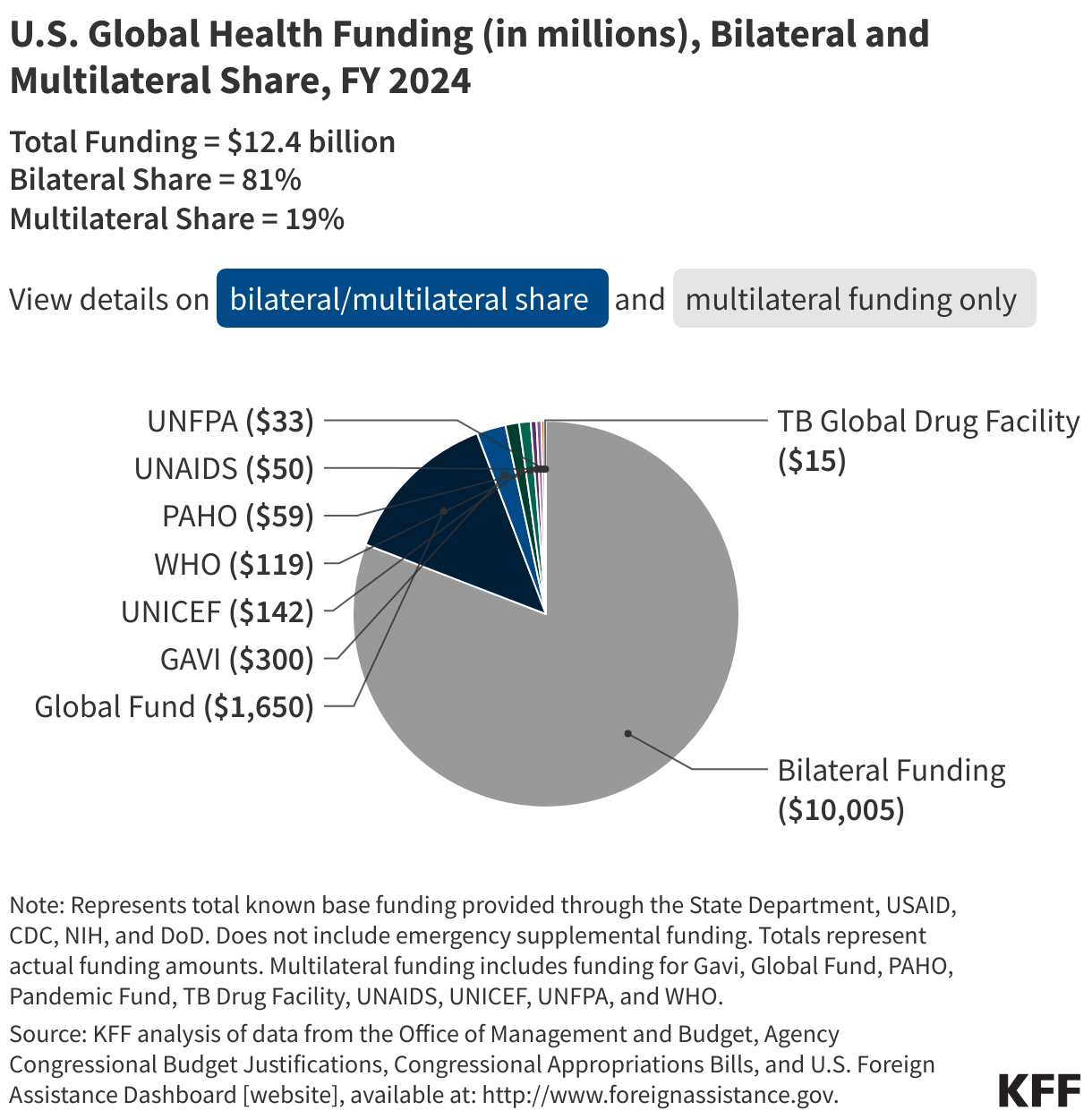
U.S. Global Health Funding (in millions), Bilateral and Multilateral Share, FY 2025
Total Funding = $12.4 billion Bilateral Share = 81% Multilateral Share = 19% View details on bilateral/multilateral share  and multilateral funding only  
Represents total known base funding provided through the State Department, USAID, CDC, NIH, and DoD. Does not include emergency supplemental funding. Totals represent actual funding amounts. Multilateral funding includes funding for Gavi, Global Fund, PAHO, Pandemic Fund, TB Drug Facility, UNAIDS, UNICEF, UNFPA, and WHO. FY25 is based on funding provided in the "Full-Year Continuing Appropriations and Extensions Act, 2025" (P.L. 119-4) and is a preliminary estimate. These amounts do not take into account the administration’s recent actions to withdraw membership and halt funding to WHO and withhold funding to UNFPA.
KFF analysis of data from the Office of Management and Budget, Agency Congressional Budget Justifications, Congressional Appropriations Bills, and U.S. Foreign Assistance Dashboard [website], available at: <a href=http://www.foreignassistance.gov>http://www.foreignassistance.gov</a>.
U.S. Global Health Funding for Multilateral Organizations, FY 2025
Total Funding = $12.4 billion Bilateral Share = 81% Multilateral Share = 19% View details on bilateral/multilateral share  and multilateral funding only  
Represents total known base funding provided through the State Department, USAID, CDC, NIH, and DoD. Does not include emergency supplemental funding. Totals represent actual funding amounts. Multilateral funding includes funding for Gavi, Global Fund, PAHO, Pandemic Fund, TB Drug Facility, UNAIDS, UNICEF, UNFPA, and WHO. FY25 is based on funding provided in the "Full-Year Continuing Appropriations and Extensions Act, 2025" (P.L. 119-4) and is a preliminary estimate. These amounts do not take into account the administration’s recent actions to withdraw membership and halt funding to WHO and withhold funding to UNFPA.
KFF analysis of data from the Office of Management and Budget, Agency Congressional Budget Justifications, Congressional Appropriations Bills, and U.S. Foreign Assistance Dashboard [website], available at: <a href=http://www.foreignassistance.gov>http://www.foreignassistance.gov</a>.