KFF COVID-19 Vaccine Monitor: In Their Own Words, Six Months Later
Findings
The KFF COVID-19 Vaccine Monitor is an ongoing research project tracking the public’s attitudes and experiences with COVID-19 vaccinations. Using a combination of surveys and qualitative research, this project tracks the dynamic nature of public opinion as vaccine development and distribution unfold, including vaccine confidence and hesitancy, trusted messengers and messages, as well as the public’s experiences with vaccination.
Key Findings
At the beginning of 2021 as vaccine distribution began in the U.S., KFF conducted interviews with a nationally representative sample of adults using open-ended questions to better understand public concerns around receiving a COVID-19 vaccine. Six months later, we recontacted these individuals to find out whether they chose to receive a COVID-19 vaccine, their reasoning behind their decisions, and how they are feeling about their choice.
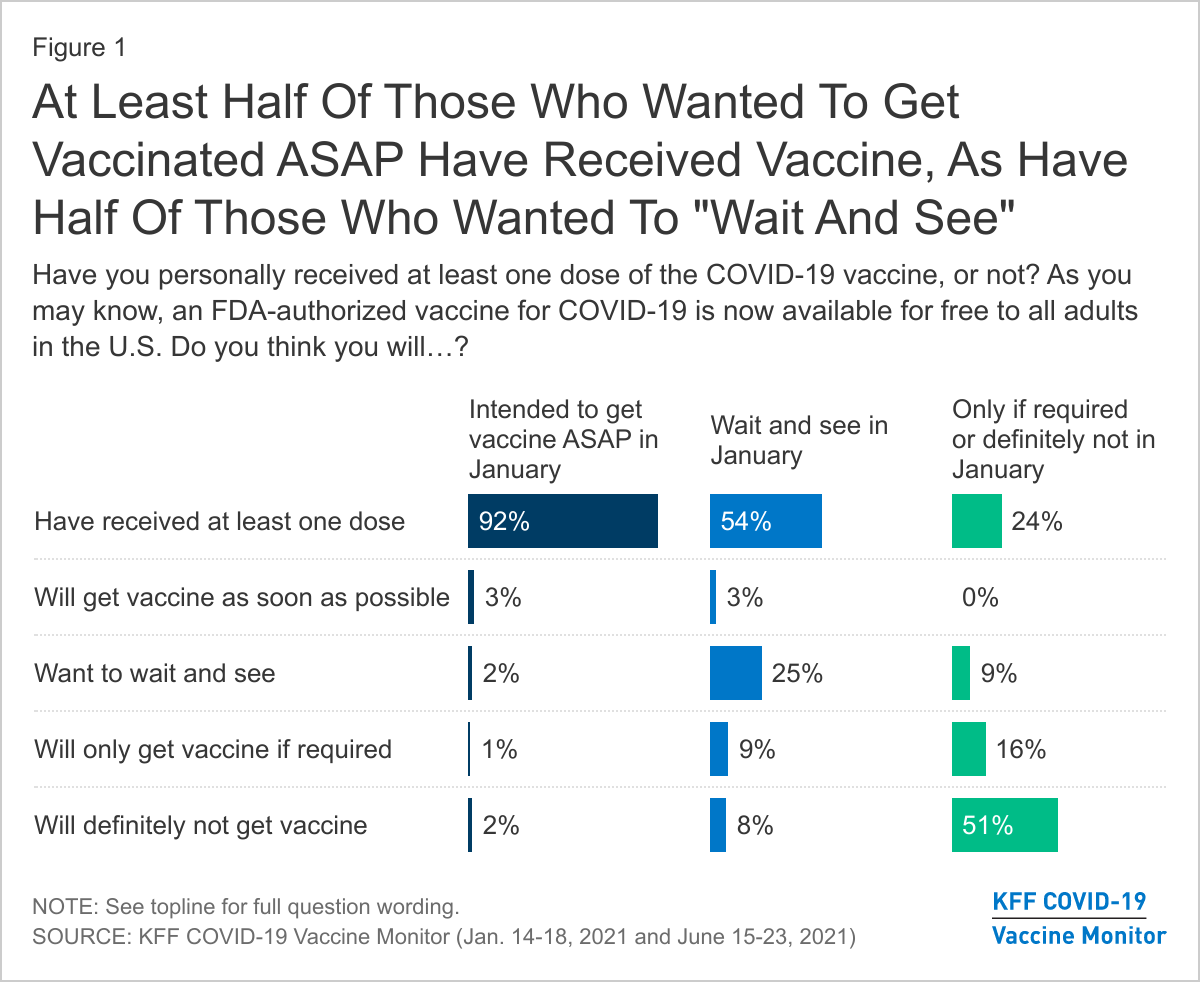
- The vast majority (92%) of those who planned to get vaccinated “as soon as possible” in early 2021 have received at least one dose of a COVID-19 vaccine, as have slightly more than half (54%) of individuals who had previously said they wanted to “wait and see” before getting vaccinated. On the other hand, a majority (76%) of people who had previously said they would “only get vaccinated if required” or said they would “definitely not” get a COVID-19 vaccine remain unvaccinated.
- One-fifth of adults (21%) now report being vaccinated after saying in January they planned on waiting to get vaccinated, would only get it if required, or would definitely not get vaccinated. Many of these individuals noted the role of their friends and family members as well as their personal doctors in persuading them to get a vaccine. Seeing their friends and family members get vaccinated without serious side effects, talking to family members about being able to safely visit, and conversations with their personal doctors about their own risks were all persuasive factors for these individuals. A small but meaningful share also say the easing of restrictions for vaccinated people was a factor in their decision to get a vaccine.
- When asked to name the feeling that best describes how they feel now that they have been vaccinated, nearly a quarter of vaccinated adults offer responses around feeling safe (24%) and relieved (22%). Other positive feelings reported were freedom, confidence, and more certainty that if they did get COVID-19 it would be less serious or they were less likely to die from it. And while most respondents react with some positive emotion, one in ten said they felt the same or neutral. This feeling was more common among those who initially said they would “wait and see” in January or who said they would only get vaccinated if required or would not get vaccinated.
- Conversations with family members and friends have played a major role in persuading people to get vaccinated. Two-thirds of vaccinated adults say they have tried to persuade their friends and family members to get a COVID-19 vaccine, and 17% of adults who are now vaccinated after saying in January they planned on waiting to get vaccinated, would only get it if required, or would definitely not get vaccinated, say they were persuaded to do so by a family member and 5% say they were persuaded by a friend. In addition to this, others cite protecting friends and family members as the main reason for getting vaccinated and others offer being able to see their friends and family members as well as family pressure or encouragement as the main reasons why they chose to receive a vaccine.
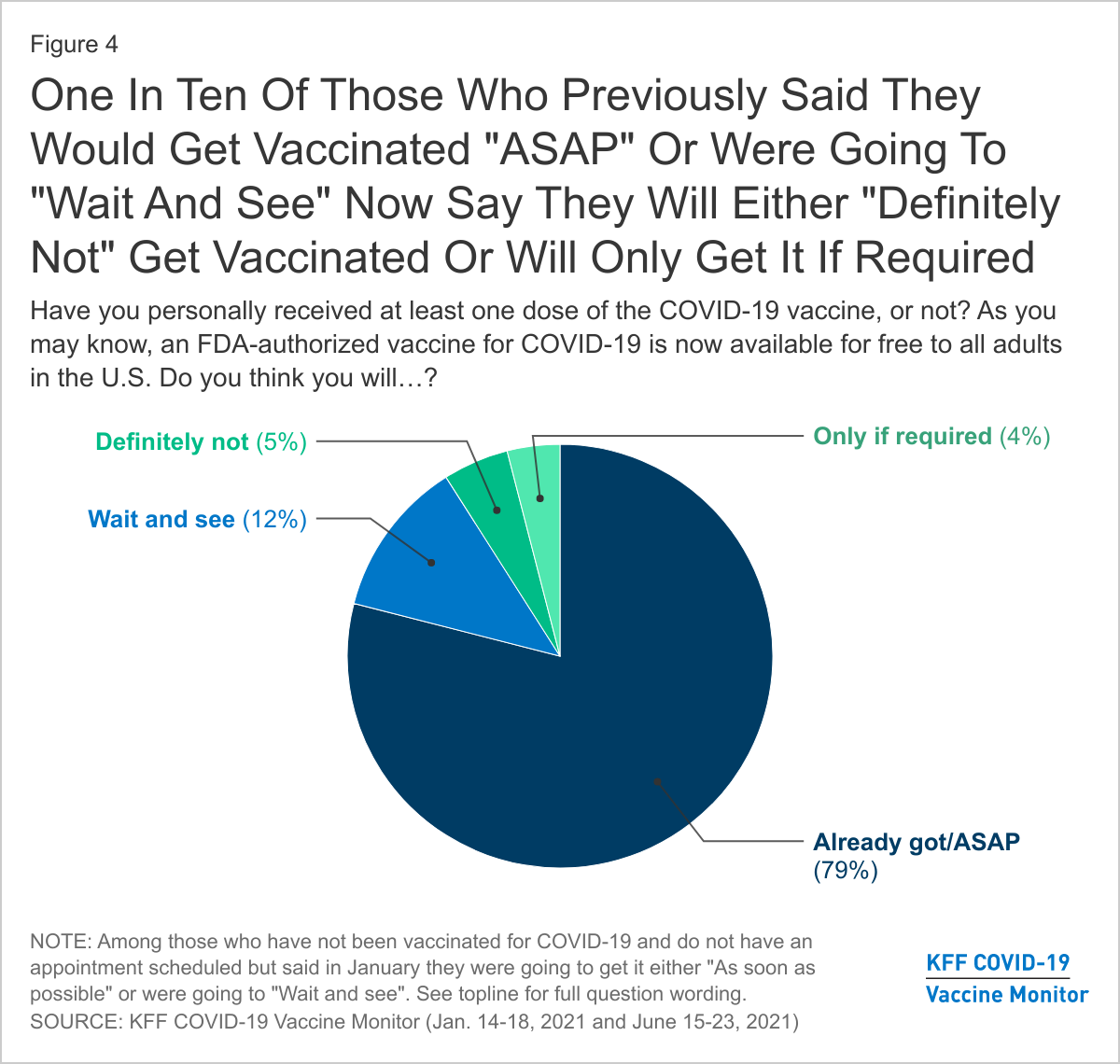
- About one-fourth of those who previously said they planned on getting vaccinated “as soon as possible” or were wanting to “wait and see” before getting a vaccine, remain unvaccinated six months later. Some of these individuals either have an appointment to get a vaccine or still plan on getting it as soon as they are able, but one in ten (6% of total) now say they either will “only get vaccinated if required” or say they will “definitely not” get a vaccine. When asked what changed their mind, many offer concerns about the side effects of the vaccine as the reasons why they now do not plan on getting vaccinated.
- Being concerned about side effects is the top reason offered by unvaccinated people for why they haven’t gotten a COVID-19 vaccine. When asked what would motivate them to get vaccinated against COVID-19, most in the “wait and see” group say they just want more time to see how the vaccine affects others who have already gotten it.
Vaccine Behavior Largely Matches Previous Intentions
Nine in ten (92%) of those who said back in January 2021 they would get vaccinated as soon as they were able now report, six months later, that they have received at least one dose of a COVID-19 vaccine. In addition, slightly more than half (54%) of those who were in the “wait and see” group back in January, say they have received a COVID-19 vaccine while 46% of adults in this group report not being vaccinated against COVID-19. A smaller share, one-fourth (24%) of those who said they would “only get vaccinated if required” or they would “definitely not” get vaccinated now report receiving at least one dose, while the majority (76%) of adults in this group say they remain unvaccinated.
Three-fourths (72%) of the most vaccine enthusiastic group (those who said they would get vaccinated as soon as they could back in January) say they received a COVID-19 vaccine more than two months ago, compared to a majority of vaccinated adults from the “wait and see” group who say they received their vaccine either less than one month ago (10%) or between one and two months ago (46%).
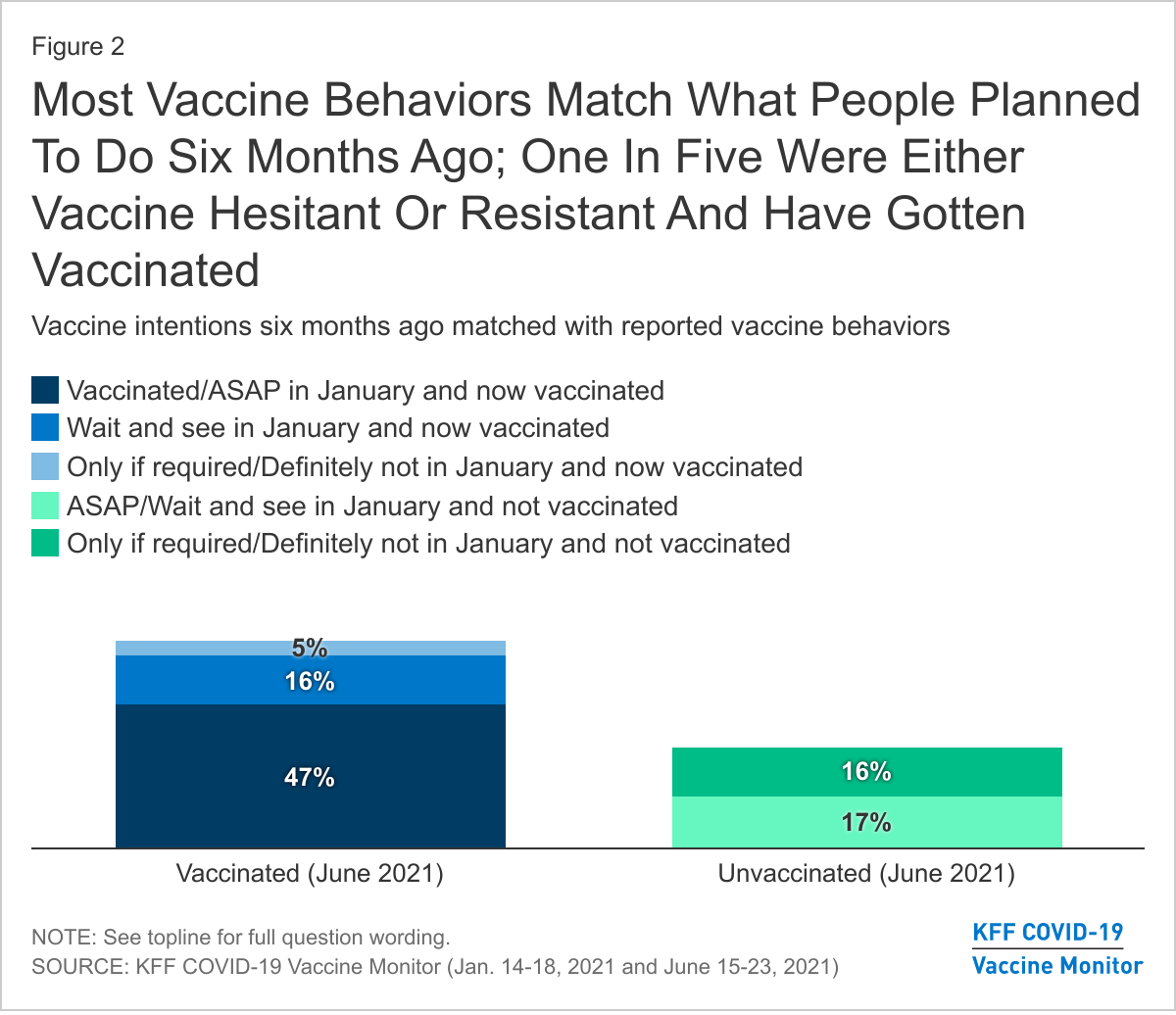
Overall nearly half of adults either were already vaccinated in January (8%) or had said they planned to get vaccinated as soon as possible and have now received at least one dose (39%). An additional one in five adults (21%) are now vaccinated after saying in January they planned on waiting to get vaccinated, would only get it if required, or would definitely not get vaccinated. One-third of adults remain unvaccinated after either planning to get it as soon as possible or were going to wait and see back in January (17%) or had said they were only going to get vaccinated if required or were definitely not getting a COVID-19 vaccine (16%).
What Made Some People Decide to Get vaccinated?
When the 21% of adults who are now vaccinated after saying in January they planned on waiting to get vaccinated, would only get it if required, or would definitely not get vaccinated are asked in their own words what they learned or heard that persuaded them to get vaccinated, many discussed the role of their friends and family members as well as their personal doctors in their decision.
A common response mentioned by one-fourth of these individuals was that seeing others, especially friends and family, get vaccinated without side effects made them decide to get a vaccine.
In their own words: What did you learn or hear that persuaded you to get vaccinated?
“Almost all of my friends were vaccinated with no side effects.” – 64 year old, female, black, Democrat, Tennessee (“wait and see” in January)
“Family members and friends who got vaccinated had no serious side effects. Lots of regulations got lifted for vaccinated people.” – 43 year old, female, Asian, independent, Massachusetts (“wait and see” in January)
“Not many side effects and others have been vaccinated” – 21 year old, male, white, independent, Georgia (“wait and see” in January)
“That it was clearly safe. No one was dying” – 32 year old, male, white, Republican, South Carolina (“wait and see” in January)
“I feel since our President got vaccinated & all is well with him, it was also safe for me.” – 75 year old, female, white, Democrat, Virginia (“wait and see” in January)
“I became convinced that some of the rumored side effects were not true” – 69 year old, male, white, independent, Colorado (“only if required” in January)
Others said they chose to get vaccinated either due to pressure from friends and family (8%), or they wanted to be able to safely visit with their friends and family members (3%).
In their own words: What did you learn or hear that persuaded you to get vaccinated?
“I went to visit my family members in another state and everyone there had been vaccinated with no problems so that encouraged me to go ahead and get vaccinated also I would the better protected and not a threat to them not being having it” – 63 year old, male, black, independent, Texas (“wait and see” in January)
“Friends and family talked me into it, as did my place of employment” – 28 year old, male, white, independent, Virginia (“definitely not” in January)
“My husband bugged me to get it and I gave in” – 42 year old, female, white, Republican, Indiana (“definitely not” in January)
“Five generations of our family are getting together in one week from now.” – 68 year old, male, white, Democrat, California (“wait and see” in January)
“My family persuaded me because of my sick kids” – 28 year old, female, Hispanic, Democrat, Texas (“wait and see” in January)
Another common response was that conversations with their doctors or health providers encouraged them to get vaccinated (11%).
In their own words: What did you learn or hear that persuaded you to get vaccinated?
“My doctor recommended it” – 70 year old, female, white, Democrat, Arizona (“definitely not” in January)
“My asthma doctor recommended I get it” – 64 year old, female, white, Republican, Texas (“wait and see” in January)
“My Ob/Gyn advised it was safe to take while pregnant and/or trying to conceive and there are studies showing women who get pregnant that caught COVID had more hematological problems during and after birth” – 32 year old, female, white, independent, Alabama (“wait and see” in January)
“My daughter is a doctor and she got vaccinated which was reassuring that it was okay to get vaccinated.” – 64 year old, female, Asian, Democrat, Texas (“wait and see” in January)
“I was nervous about breastfeeding while getting vaccinated, but then found out from doctors it's actually good to get vaccinated while breastfeeding because the babies will get antibodies also” – 28 year old, female, white, independent, Iowa (“wait and see” in January)
Half (52%) of those who were initially vaccine hesitant or resistant (saying in January they planned on waiting to get vaccinated, would only get it if required, or would definitely not get vaccinated) and have now received a COVID-19 vaccine say they heard or read something that persuaded them and more than one-third (36%) say they spoke with someone who persuaded them to get vaccinated.
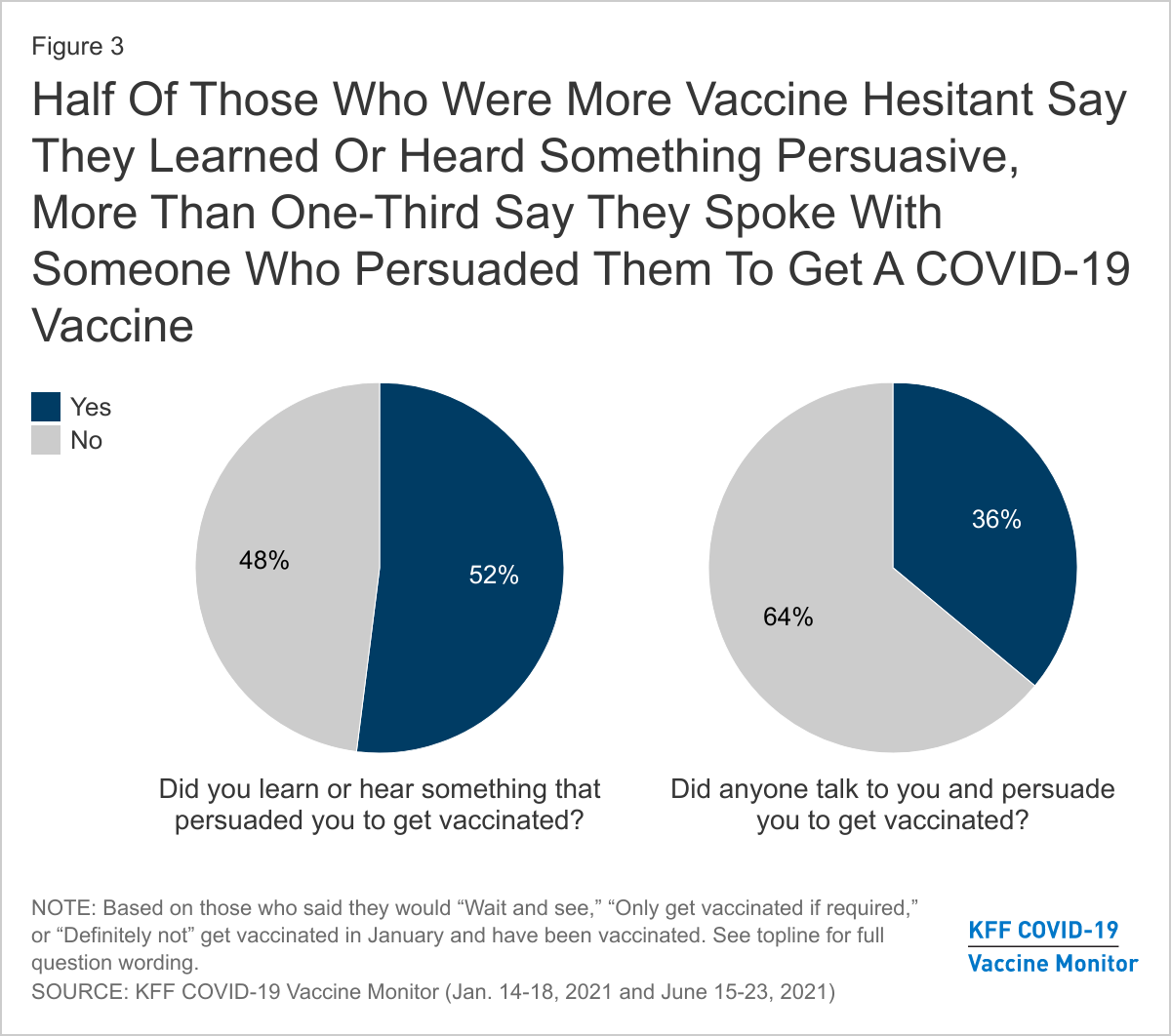
Most commonly, people reported talking to and being persuaded by a family member (17% of all previously vaccine hesitant or resistant individuals) or their own doctor or health care provider (10%), followed by a close friend (5%) or a co-worker or classmate (2%).
Many of those who said they were persuaded after talking to their own doctor mentioned their doctor encouraging them due to their own or a family member’s medical condition.
In their own words: What did they say that persuaded you to get vaccinated?
“Discussed my spouse’s immune system.” – 58 year old, male, white, Republican, Washington (“only if required” in January)
“I could not get treated for the lymphoma on my lower left leg unless I was vaccinated” – 78 year old, female, white, Republican, Missouri (“wait and see” in January)
“COVID causes lung damage not good with COPD” – 57 year old, male, white, independent, Pennsylvania (“wait and see” in January)
“I was told by my doctor that she strongly recommend I get the vaccine because I have diabetes.” – 47 year old, female, white, Republican, Florida (“wait and see” in January)
A small but meaningful share said the easing of restrictions for vaccinated people made them decide to get a vaccine.
In their own words: What did you learn or hear that persuaded you to get vaccinated?
“Hearing that the travel quarantine restrictions would be lifted for those people that are vaccinated was a major reason for my change of thought. Also the possibility that business and other resources may be limited to non-vaccinated individuals was also a major factor.” – 43 year old, male, black, Democrat, Virginia (“wait and see” in January)
“To see events or visit some restaurants, it was easier to be vaccinated.” – 39 year old, male, white, independent, New Jersey (“only if required” in January)
“Bahamas trip required a COVID shot” – 43 year old, male, Hispanic, independent, Pennsylvania (“wait and see” in January)
Two-thirds (65%) of vaccinated adults, including many of those who were previously vaccine hesitant, say they have tried to persuade close friends or family members to get vaccinated.
What Made Some People Decide to Not Get vaccinated?
One-third of adults remain unvaccinated, including a quarter of adults who previously had said they planned on getting vaccinated “as soon as possible” or wanted to “wait and see” before getting a vaccine and remain unvaccinated six months later. Some of these individuals (3%) either have an appointment to get a vaccine or still plan on getting it as soon as they are able, but one in ten (6% of total) now say they either will only get vaccinated if required or say they will “definitely not” get a vaccine.
When asked what changed their mind, many of these individuals offer concerns about the side effects of the vaccine as the reason why they now do not plan on getting vaccinated.
In their own words: What changed your mind?
“What's changed my mind is people telling me how sick they got after they received the vaccination I really don't want to be sick from a vaccination so I kind of lost interest” – 54 year old, male, white, Republican, California (“ASAP” in January)
“There’s still not enough data proving that the vaccine is effectively and definitely not enough data showing the side effects.” – 54 year old, female, black, Democrat, Arkansas (“wait and see” in January)
“I have allergies considering the possible risks. The risks in my opinion are not a chance I'm willing to take.” – 18 year old, male, Hispanic, Democrat, Florida (“ASAP” in January)
“My husband got the vaccine and he experienced a lot of side effects I usually end of having some all the listed side effects” – 42 year old, female, Hispanic, independent, California (“wait and see” in January)
“We are now starting to see adverse reactions, deaths and other problems with young people also. We do not know the long term effects on the body, reproduction etc. it could take years to see that information come out” – 60 year old, male, white, Republican, Delaware (“wait and see” in January)
For some, others’ views of the pandemic influenced their decisions to not get vaccinated, with several people offering responses about the pandemic being exaggerated and no longer feeling that a vaccine was necessary.
In their own words: What changed your mind?
“COVID was not the pandemic it was made out to be and I am not getting vaccinated for it” – 26 year old, female, white, Republican, Iowa (“ASAP” in January)
“This event seems more and more just like the flu. Everyone is exposed and has the same chance of getting it. I never got a flu vaccine either. This whole mask thing is a joke. Most people wear them beneath their nose or even chin. This event is over for me except as mandated to me by those above me who control me in some way such as employer.” – 58 year old, male, black, independent, Alabama (“wait and see” in January)
“My daughter has had covid and I never tested positive or showed symptoms, and she never had symptoms. My thought is I am either immune or I have antibodies. My other thought is that we didn't have it and they made the numbers grow by false positive tests.” – 28 year old, female, white, Republican, Tennessee (“wait and see” in January)
The Experiences Of Vaccinated Adults
When adults who have received at least one dose of a COVID-19 vaccine were asked how they feel now they have been vaccinated, the most common responses were about feeling safe and relieved. One-fourth (24%) of vaccinated adults say they felt “safe” or some variation after being vaccinated, with a similar share (22%) offering responses that they felt relieved. Other positive feelings reported were those of freedom, confidence, and more certainty that if they did get COVID-19, it would be less serious, or they were less likely to die from it.
In their own words: What feeling best describes how you feel now that you have been vaccinated?
“Relief....I am a cancer guy and my immune system is compromised, so getting the vaccine is great news for me.” – 81 year old, male, white, independent, Washington (“ASAP” in January)
“I feel relieved and hopeful.” – 64 year old, female, black, Democrat, Tennessee (“wait and see” in January)
“There is no difference in my body or my mind, I just feel safer and more confident to go out to public places although I still wear a mask, where is it necessary.” – 33 year old, female, Hispanic, independent, Arkansas, (“wait and see” in January)
While most respondents reacted with some positive emotion, another one in ten said they felt the same or neutral. Others offered responses about not experiencing any or only mild side effects as a result of the vaccinations, while some were excited about the “return to normal.” A much smaller share expressed a negative emotion (about 1% of vaccinated adults).
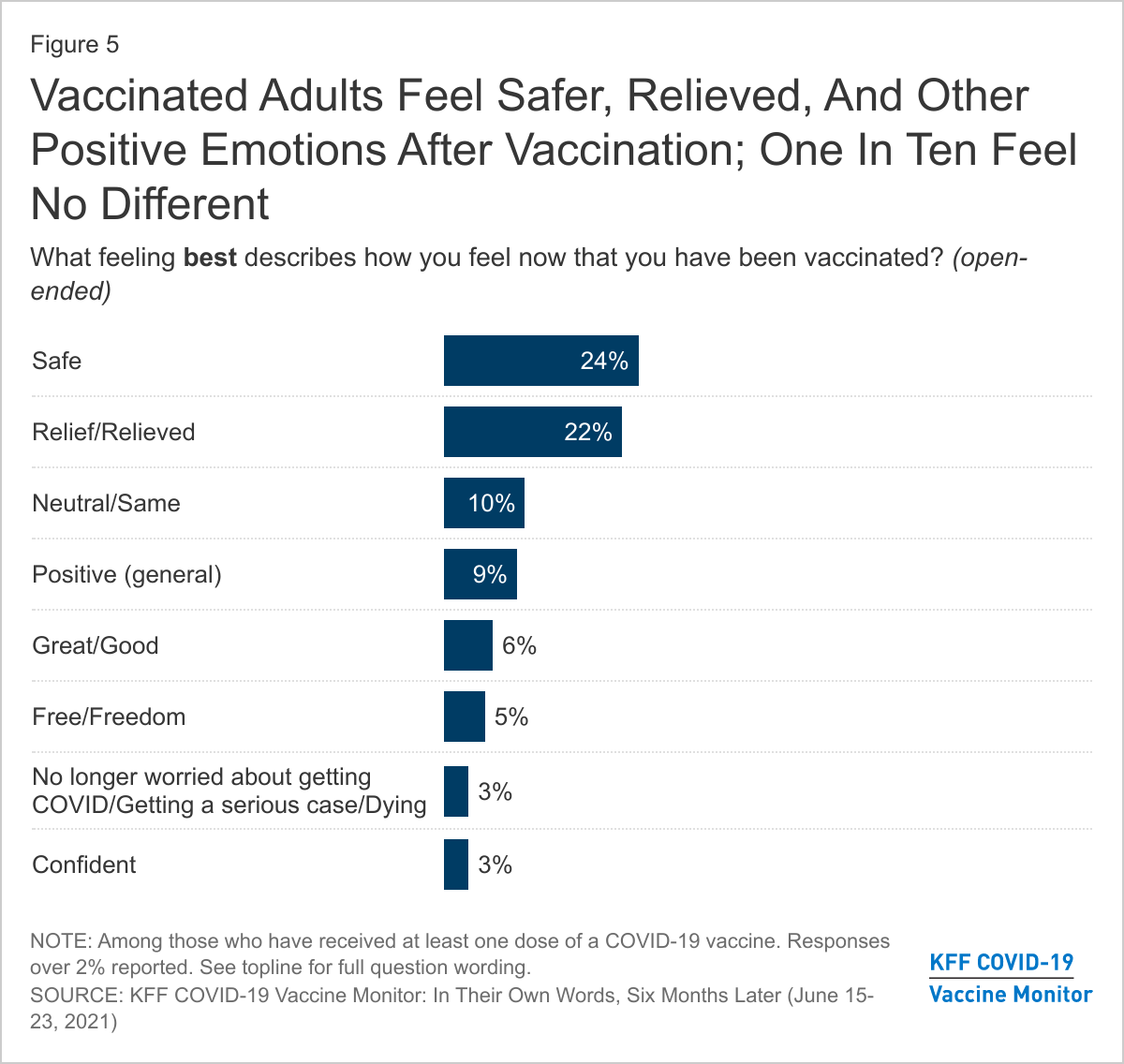
Those who initially said they would “wait and see” in January were less likely than those most enthusiastic about the vaccine (“as soon as possible” in January) to say they felt relief (14% vs. 29%), and more likely to express feeling the same or neutral about getting vaccinated (19% vs. 5%).
In their own words: What feeling best describes how you feel now that you have been vaccinated?
“In order to protect my family and myself, I chose to get vaccinated.” – 57 year old, female, black, Democrat, Kentucky (“wait and see” in January)
“Required for work.” – 27 year old, female, black, independent, South Carolina (“only if required” in January)
“Meh!!!” – 69 year old, male, white, independent, Illinois (“wait and see” in January)
More than a quarter of vaccinated adults say the main reason they chose to get vaccinated was to protect themselves or reduce their own risk (27%), while another 16% mentioned they were afraid of getting COVID-19 and wanted to avoid getting sick. One in ten respondents cited being at risk of getting sick due to their age or other health condition as their reason for getting vaccinated. Others wanted to protect their family members (7%) or protect others around them and help with herd immunity (6%).
In their own words: What is the main reason you chose to get vaccinated?
“To stop being afraid of getting it, afraid of the huge medical bills, to go back to normal, to protect others.” – 31 year old, female, white, Democrat, Nevada (“wait and see” in January)
“Protect my family from this deadly virus.” – 39 year old, male, black, Democrat, Virginia (“as soon as possible” in January)
“Because I had COVID already so the vaccine will only help me double.” – 20 year old, male, Hispanic, independent, Florida (“definitely not” in January)
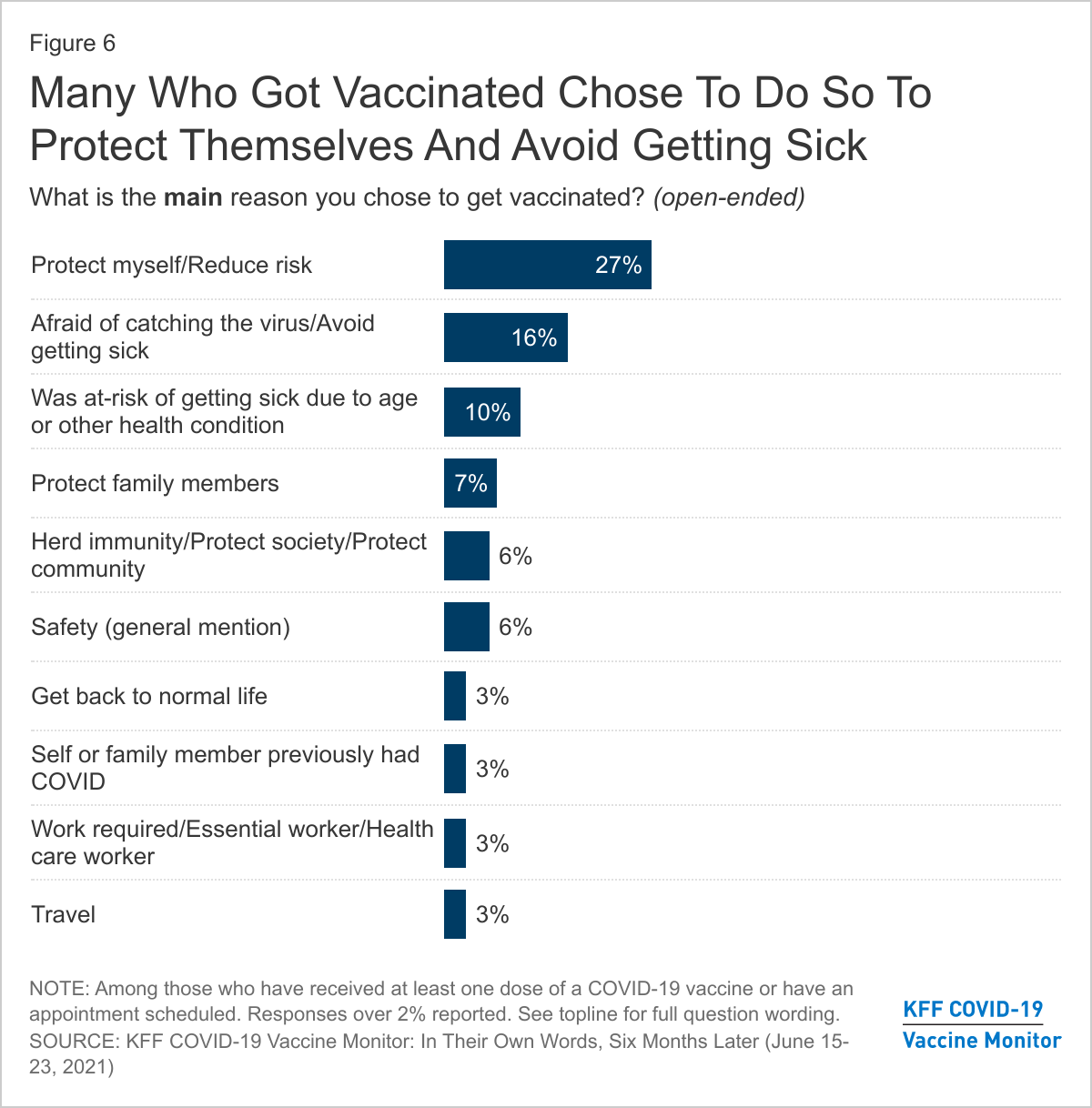
Those who previously had said they were going to “wait and see” offer similar reasons for getting vaccinated as the vaccine enthusiastic group but were slightly less likely to say they got vaccinated to protect themselves (21% vs. 33%), and slightly larger shares offer reasons related to not having to wear a mask anymore (5% vs. 0%) and because of encouragement or pressure from family members (6% vs. 1%).
In their own words: What is the main reason you chose to get vaccinated?
“My holistic Dr. recommended it.” – 61 year old, female, white, Republican, Connecticut (“wait and see” in January)
“I wanted to start living my life and start traveling and stop wearing masks.” – 27 year old, female, black, Democrat, Ohio, (“wait and see” in January)
“To shut the wife up.” – 65 year old, male, white, Republican, Michigan (“wait and see” in January)
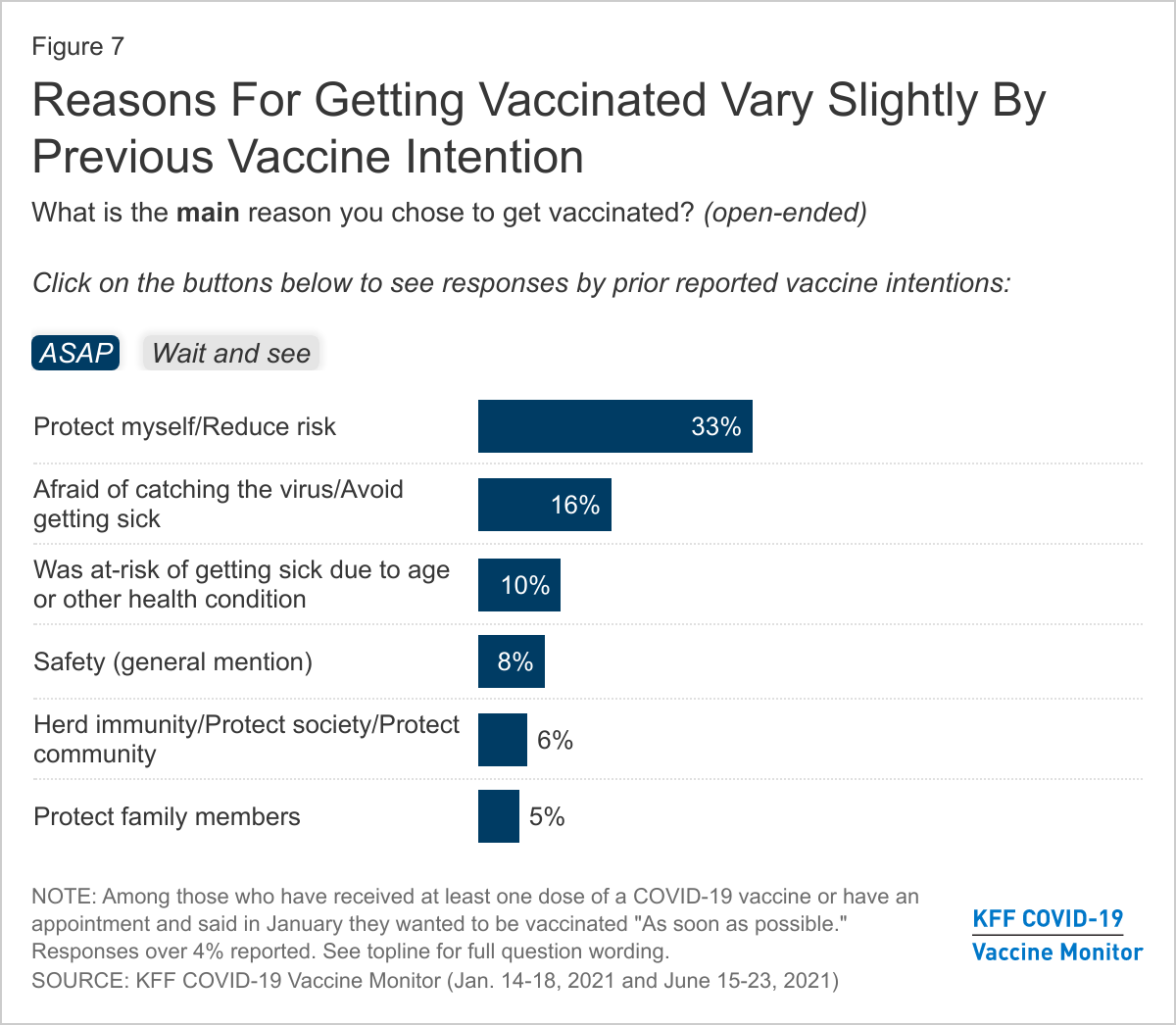
One of the most common responses among the more vaccine resistant group who have received a vaccine were about getting vaccinated in order to travel or being required to due to a job.
In their own words: What is the main reason you chose to get vaccinated?
“I am an educator and we needed to re-open schools.” – 51 year old, female, white, Democrat, Kentucky (“definitely not” in January)
“To be able to travel.” – 35 year old, male, black, Democrat, Virginia (“only if required” in January)
“Limited options without it.” – 51 year old, male, white, independent, New York (“only if required” in January)
Why Some Adults Remain Unvaccinated
When those who remain unvaccinated were asked about their main reason for not getting a COVID-19 vaccine, the most commonly offered reasons are around concerns about side effects (21%), followed by concerns that the vaccine was too new, too unknown, or not tested enough (16%). One in ten (12%) offer they haven’t gotten vaccinated because they don’t think they need the vaccine. Smaller, but still significant shares, say they haven’t gotten vaccinated because they just want to wait and see (7%), they don’t trust the vaccine and don’t normally get vaccines (7%), have a medical condition which prevents them from receiving a COVID-19 vaccine (7%), or think COVID-19 is not that bad or that the vaccine is worse (7%).
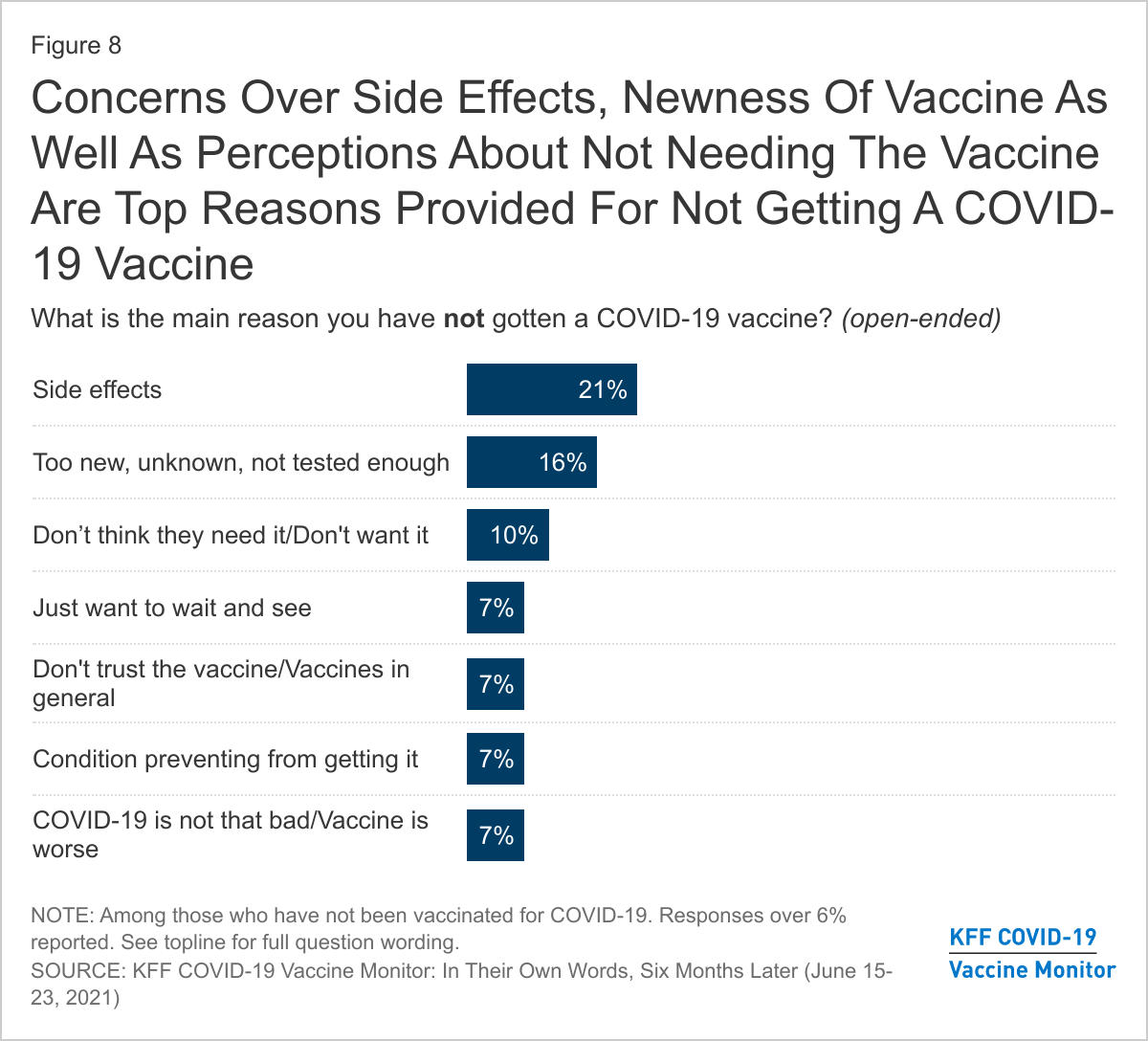
Being concerned about side effects was also the top reason back in January why people said they may not get vaccinated. The latest report finds one-fifth of unvaccinated adults still offer concerns over possible side effects as the main reason why they haven’t gotten a COVID-19 vaccine.
In their own words: What is the main reason you have not gotten a COVID-19 vaccine?
“My husband got the vaccine and all the side effects. I cannot be sick, I am the rock of the family” – 42 year old, female, Hispanic, independent, California (“definitely not”)
“I’m scared of the side effects” – 20 year old, female, black, independent, Texas (“only if required”)
“I’m a little nervous knowing the possibility of side effects. I know it’s probably beneficial to my health, I just wanted to wait a little longer” – 43 year old, male, white, Republican, Arizona (“ASAP”)
“I didn’t want to get sick” – 26 year old, female, black Hispanic, Democrat, Florida (“definitely not”)
Another one of the most commonly offered reason for not getting vaccinated were concerns that the vaccine was too new, too unknown, or not tested enough. This was one of the top reasons offered across vaccine intention groups.
In their own words: What is the main reason you have not gotten a COVID-19 vaccine?
“Because I do not trust the vaccine safety and I’ve also heard and seen about side effects” – 22 year old, female, white, Republican, Arkansas (“definitely not”)
“Because it’s an experimental drug” – 59 year old, female, white, Republican, Texas (“definitely not”)
“I am not sure about it yet. I don't feel it was properly tested and there are so many different stories, good and bad, that I don't know what to believe anymore” – 44 year old, male, Hispanic, independent, California (“only if required”)
“I do not believe there has been adequate testing to show that this is a safe vaccine for everyone and every preexisting condition” – 51 year old, female, white, independent, North Carolina (“definitely not”)
“I feel as if it’s fairly new and not enough research has been done” – 40 year old, female black, Democrat, Pennsylvania (“only if required”)
Some unvaccinated people say they don’t see the benefit of getting vaccinated either because they do not think they are at risk of getting sick from the virus, or that they already had COVID-19.
In their own words: What is the main reason you have not gotten a COVID-19 vaccine?
“As a young and healthy person, I don’t think I need it” – 34 year old, male, black, independent, Mississippi (“only if required”)
“Benefit not worth the risks” – 55 year old, male, white, independent, Minnesota (“definitely not”)
“Didn’t feel the need!” – 26 year old, female, white, independent, Alabama (“only if required”)
“I don’t believe contracting COVID is a death sentence. We blew this entire pandemic out of proportion.” – 46 year old, male, white, Republican, Massachusetts (“definitely not”)
“I had the virus, I have antibodies.” – 50 year old, female, white, Republican, Nebraska (“only if required”)
“I had COVID for 3 weeks recently. I will have antibodies for a while. I also do not believe the vaccine(s) are true vaccines with antibodies. I've checked the CDC lists of ingredients and many are toxic, and they mess with RNA. I believe it's mainly about making money.” – 60 year old, female, white, independent, Montana (“definitely not”)
many unvaccinated Adults Just Want to Wait and See
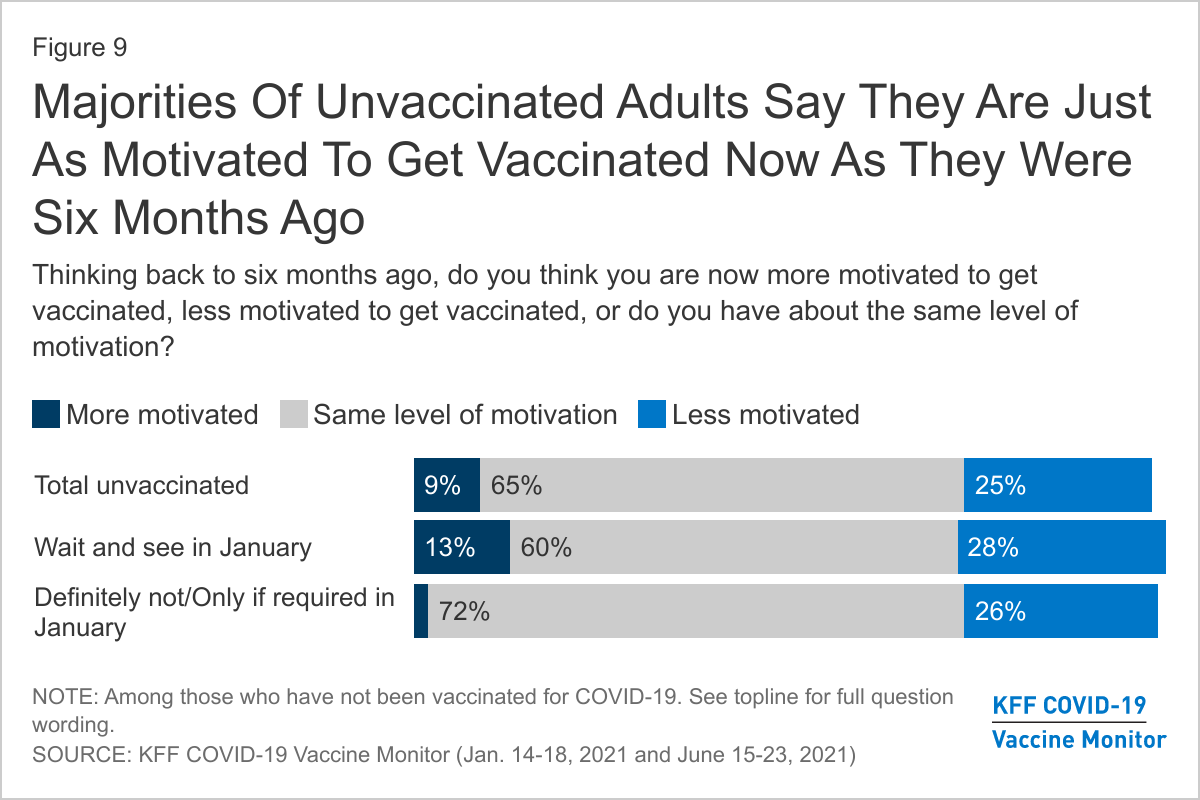
As millions of adults in the U.S. have received a COVID-19 vaccine and access to vaccines has increased throughout the country, the share of adults who say they either will get vaccinated “as soon as possible” or want to “wait and see” before getting vaccinated has decreased to about one in eight adults. Few adults (9%) say they are now “more motivated” to get vaccinated than they were six months ago while most (65% of all unvaccinated adults and 60% of those in the “wait and see” group from January) say they have the same level of motivation now to get vaccinated as they did six months ago. About a quarter across groups say they are “less motivated” to get vaccinated than they were six months ago.
Among those who are still unvaccinated but are not resistant to getting vaccinated (now say they either plan to get it ASAP or are wanting to wait and see), about four in ten say they plan on waiting more than a year before getting a COVID-19 vaccine, while about three in ten (28%) say they plan on getting vaccinated within the next three months and an additional third say they will get vaccinated between 4 months and a year. Many adults in this group (unvaccinated adults who say they either plan to get it ASAP or are wanting to wait and see) offer side effects as the main reason why they have not gotten vaccinated yet.
In their own words: What is the main reason you have not gotten a COVID-19 vaccine?
“A lot of people have negative reactions to the vaccines and some die. I'm not willing to risk my life for a vaccine that you need yearly.” – 64 year old, female, white, independent, Ohio (“wait and see”)
“A little bit scared because of the side effect.” – 69 year old, female, Hispanic, Democrat, Florida (“ASAP”)
“Bad side effects. Will wait a year and then decide.” – 67 year old, male, white, Republican, New York (“wait and see”)
“It’s too soon to tell if it is safe. Not worth the risk” – 19 year old, female, black, independent, Indiana (“wait and see”)
“Not comfortable with unknown long-term possible side effects.” – unknown age, female, black, Delaware (“wait and see”)
“The ‘product’ was rushed into production, it is probably flawed and we have not seen these flaws.” – 57 year old, male, white, Republican, Texas (“wait and see”)
“Unsure about possible side effects, concerns over massive Johnson and Johnson recall.” – 38 year old, female, white, Democrat, Florida (“wait and see”)
When those who say they want to “wait and see” before getting vaccinated are asked what, if anything, would motivate them to get vaccinated against COVID-19, few tangible motivations are mentioned. Most of these individuals say they just want more time to see how the vaccine affects others who have already gotten it. A few individuals explicitly mention wanting full FDA approval, a motivation found in previous KFF COVID-19 Vaccine Monitor reports.
In their own words: What, if anything, would motivate you to get fully vaccinated against COVID-19? (among those who are “wait and see”)
“Time and proof that it is working and has no lasting negative effects on the body.” – 60 year old, female, white, Republican, Washington
“Only time will motivate me.” – 44 year old, female, Asian, Democrat, North Carolina
“Years of study and an idea about possible long term effects of the vaccine. There is only Emergency Use Authorization for the vaccines. Not full approval for use as they have literally not completed the full testing process.” – 54 year old, male, white, Republican, Kentucky
“Waiting to see if people have any adverse effects” – 44 year old, female, black, Democrat, West Virginia
“Read more reports from people who have taken the vaccine and investigate if they had side effects.” – 81 year old, male, Hispanic, Democrat, Texas
Methodology
This KFF COVID-19 Vaccine Monitor: In Their Own Words, Six Months Later was designed and analyzed by public opinion researchers at the Kaiser Family Foundation (KFF). The survey was conducted June 15-23, 2021 using the SSRS Opinion Panel, a nationally representative panel of U.S. adults age 18 or older recruited using probability-based sampling techniques. For the Kaiser Family Foundation, SSRS re-invited adult panelists in the U.S. who previously participated in a survey in January 14-18, 2021. The original sampling targeted panel respondents by gender, age, race, education, and region. SSRS regularly monitored data collection to check for demographic composition of the sample and data quality. Cases determined to be poor-quality, as defined by surveys with a length of interview of less than 33% of the mean length of interview and with invalid text responses were removed from the final data. In total, 1,009 panelists were invited to participate in this follow-up survey and 878 respondents completed the full questionnaire online on June 15-23, 2021 with additional follow-ups conducted on July 2,2021. 859 surveys were completed in English and 19 surveys were completed in Spanish. Panelists were compensated for their participation, with incentives distributed by the SSRS Opinion Panel through their standard procedures.
The margin of sampling error including the design effect for the full sample is plus or minus 4 percentage points. Numbers of respondents and margins of sampling error for key subgroups are shown in the table below. For results based on other subgroups, the margin of sampling error may be higher. Sample sizes and margins of sampling error for other subgroups are available by request. Note that sampling error is only one of many potential sources of error in this or any other public opinion poll. Kaiser Family Foundation public opinion and survey research is a charter member of the Transparency Initiative of the American Association for Public Opinion Research.
| Group | N (unweighted) | M.O.S.E. |
| Total | 878 | ± 4 percentage points |
| Total who have gotten a COVID-19 vaccine | 632 | ± 5 percentage points |
| Total who have not gotten a COVID-19 vaccine | 246 | ± 8 percentage points |
| January Vaccine Intentions | ||
| As soon as they can | 395 | ± 6 percentage points |
| Wait and see | 242 | ± 8 percentage points |
| Only if required/ Definitely not getting a vaccine | 168 | ± 10 percentage points |
| June Vaccine Intentions | ||
| Only if required/ Definitely not getting a vaccine | 161 | ± 10 percentage points |