
Paid Family and Sick Leave in the U.S.
Paid family and medical leave and sick leave can help workers meet their personal and family health care needs, while also fulfilling work responsibilities. Access to paid leave is a particularly salient concern for women, who comprise nearly half of the nation’s workforce and often take on the bulk of caregiving responsibilities. The federal Family and Medical Leave Act (FMLA) requires eligible employers to provide certain workers unpaid family leave; however, unlike nearly all other industrialized nations, the U.S. does not have a national requirement for paid family or sick leave, resulting in a patchwork of policies determined by state and local laws, employers, and/or labor contracts. While many have been advocating a national standard for paid leave for decades, there has been relatively little federal action.
Though many states and localities have passed laws to expand access to paid leave within their jurisdictions, many workers still do not have access to these benefits. Employees not covered by these state and local laws must rely on voluntary employer policies, which can vary considerably in scope and compensation. This fact sheet summarizes federal, state, and local policies on paid family and medical leave and paid sick leave.
Paid Sick Leave: Paid sick leave can be used to recover from a short-term injury or illness such as a cold or for doctor’s appointments. It is often provided on an accrual basis up to a set number of hours or days per year, such as one hour of leave earned for every 30 hours worked up to seven days per year, and replaces 100% of the worker’s regular wages. On average, private sector workers are offered seven days of paid sick leave per year. Paid sick leave benefits are paid by the employer.
Paid Family and Medical Leave: Paid family and medical leave typically provides a set number of weeks or months to be used for a worker’s own serious, longer-term health condition, to care for a family member with a serious health condition, or to care for or bond with a new child, and for reasons related to a family’s member’s military service. On average, it provides six to twelve weeks of fully or partially paid leave per year, without the need for accrual. Paid family and medical leave may be insured and is often funded by contributions from the employer and/or the worker.
Federal, State, and Local Policies on Sick, Family, and Medical Leave
Sick Leave
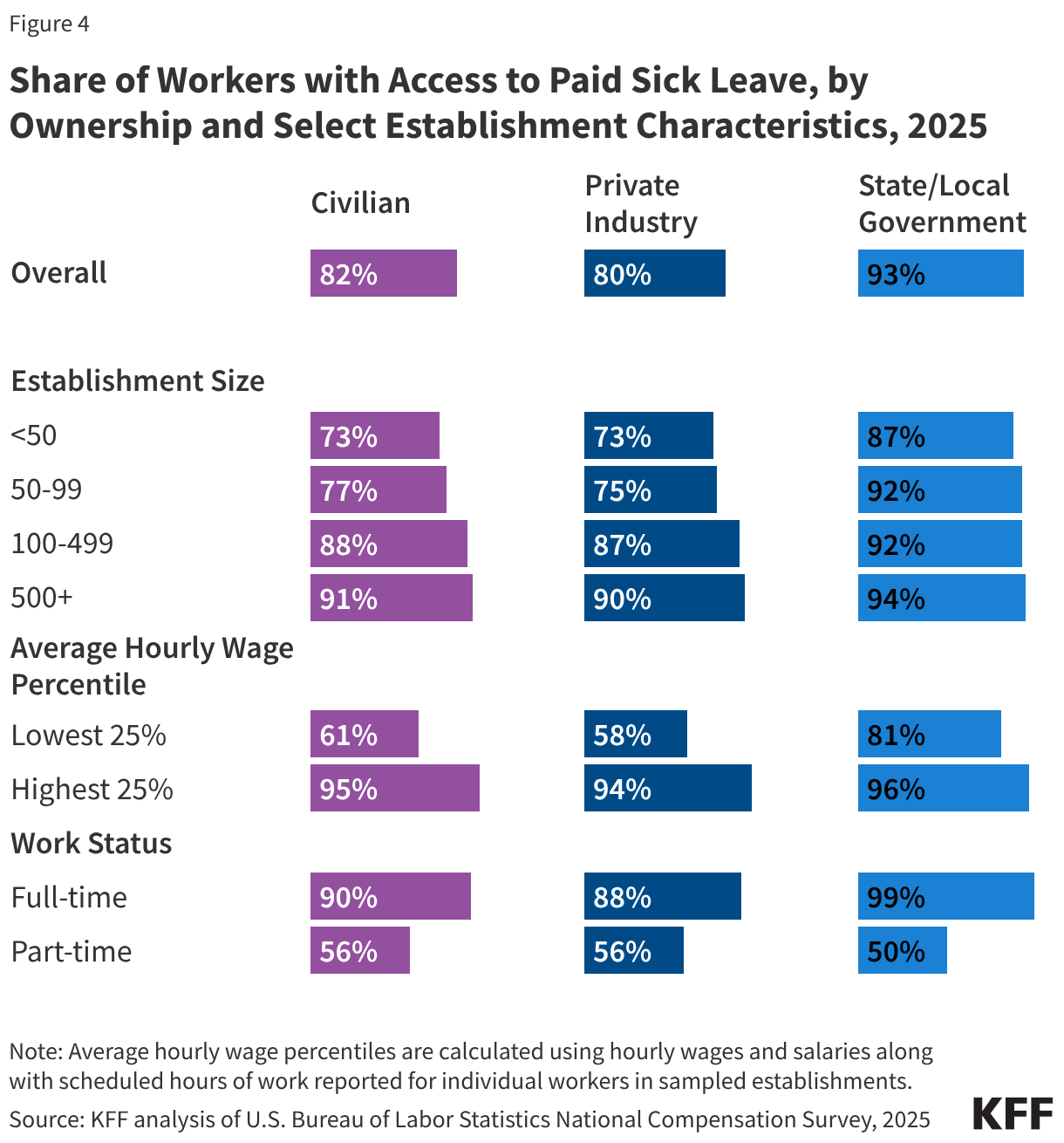
Paid sick leave allows workers to take short durations of time off if they are sick or need to care for a family member who is sick without losing pay. There is no federal requirement that employers offer paid leave benefits, but many states have requirements, and some employers do so voluntarily. According to the Bureau of Labor Statistics (BLS), eight in ten workers (82%) had access to paid sick leave through their employer in 2025.
Proponents of a national paid sick leave mandate stress that workers should not be forced to choose between going to work while sick and losing pay or their job, pointing to numerous studies on the benefits of paid sick leave, such as preventing the spread of illnesses, increased use of preventive health care services, reduced on-the-job injuries, and fewer inappropriate emergency room visits. Opponents of a national paid sick leave mandate generally contend that it is not necessary because many employers already provide these benefits, or that it should be a voluntary benefit. They cite concerns about the financial implications for employers who would be required to provide this benefit, particularly for smaller businesses, and potential reductions in wages designed to offset those costs.
At the federal level, the Healthy Families Act has been reintroduced annually and would require employers nationwide with 15 or more employees to provide at least 7 days annually, based on a 40-hour work week if it were to pass. Employees would be able to use sick leave for their own illness, to care for a sick family member, obtain medical care, or address needs resulting from domestic violence, sexual assault, or stalking, known as “safe time,” “safe days,” or “safe leave.” Federal government employees have generally had access to paid sick leave through employee benefits packages.
There has been more traction on paid sick leave policies at the state and local level. Since the first law was passed by voter initiative in 2006 in San Francisco, 18 states plus D.C., and 18 other localities have passed laws requiring covered employers to provide eligible employees paid sick leave (Figure 1). Most of these policies permit the use of accrued sick leave for “safe time.” Three additional states and three localities have general paid time off laws that allow employees to use accrued leave for any reason, including illness. Ten states and 12 localities permit use of accrued paid sick leave for workplace closure or closure of the worker’s child’s school or childcare associated with a public health emergency.
The scope and generosity of paid sick leave laws vary. Most state and local laws have exemptions based on the size and type of employer and/or permit employers to impose certain worker eligibility requirements. Most laws also permit employers to impose a waiting period before new employees can use accrued leave, most often 90 days from the start of employment. Laws generally provide for accrual of 30-40 hours per year, though there is wide variation by policy, with lower accrual rates for smaller employers in many cases.
Family and Medical Leave
FMLA and Unpaid Family and Medical Leave
It has been more than 30 years since the federal government passed the Family and Medical Leave Act (FMLA), giving eligible employees up to 12 weeks of unpaid, job-protected leave per year for their own serious health condition, to care for a seriously ill family member, for the arrival of a new child, and to address needs related to a family member’s military deployment. Eligible employees also receive up to 26 weeks of unpaid, job-protected leave per year to care for a seriously ill or injured family servicemember or veteran. The law applies to public agencies and local educational agencies of all sizes, as well as private employers with 50 or more employees. The FMLA has provided job security to millions of workers who need to take time off work for a qualifying reason; however, just over half (56%) of the workforce is eligible for FMLA protections because small employers are exempt, and even in covered worksites, not all employees meet FMLA eligibility requirements. Most states have opted to expand job-protected leave benefits beyond FMLA’s minimum standards by expanding eligibility, the duration of leave, the definition of family members, or qualified reasons for taking leave in the private and/or public sector in the private and/or public sector.
Paid Family and Medical Leave
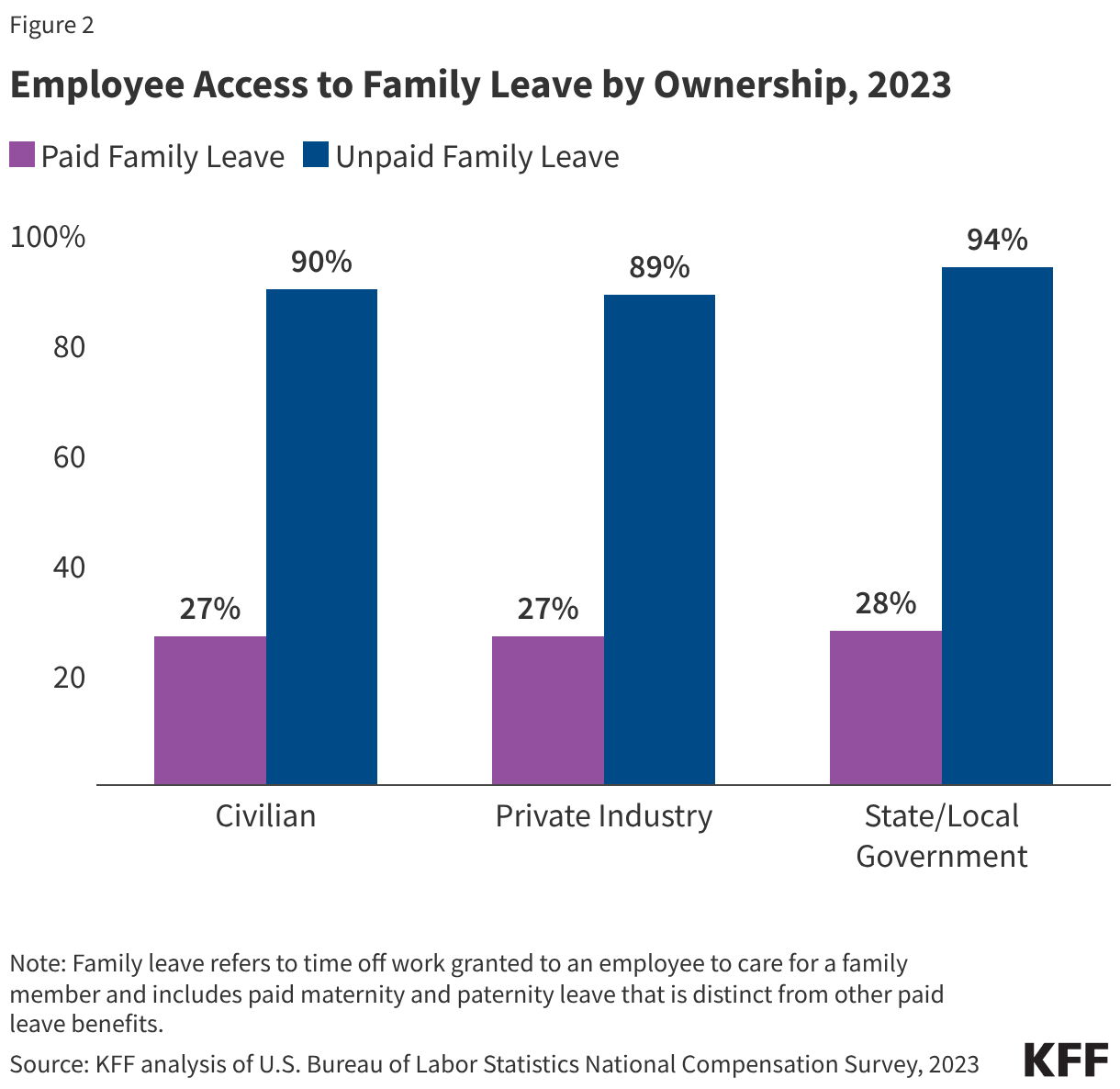
BLS data found that just over one in four (27%) workers had access to paid family leave in 2023, the most recent year for which there is data (Figure 2). Data on the share of workers with explicit access to paid medical leave for a longer, serious illness are limited, but BLS also estimates that 42% of workers had access to short-term disability insurance in 2025, which can be used to take paid time off for parental leave or medical leave.
Proponents of a national paid family and medical leave program urge that it would provide employees with greater financial security when they must take extended leave for medical reasons or to care for an ailing family member or new child. Research indicates that access to paid family and medical leave is associated with improved physical and mental health for new parents, improved birth outcomes, financial security for caregivers in the short- and long-term, and improved connections to the workforce, particularly for women, who are more likely than men to be caregivers for children and older adults. Opponents often cite concerns about the impact of new federal requirements on businesses, government overreach into the free market, increased taxes for businesses (should that be the funding mechanism), as well as the financial implications a new benefit would have on wages and employment.
Like sick leave, there have been many attempts to enact a national paid family and medical leave policy, but no permanent, broad-scale federal legislation has ever been passed. The Family and Medical Insurance Leave (FAMILY) Act, re-introduced in 119th Congress, if passed, would create a national insurance program to provide workers up to 12 weeks of their partial income for their own serious health condition or that of an immediate family member, and for the birth or placement of a child. The program would be funded by employee and employer payroll contributions. The program would be funded by employee and employer payroll contributions.
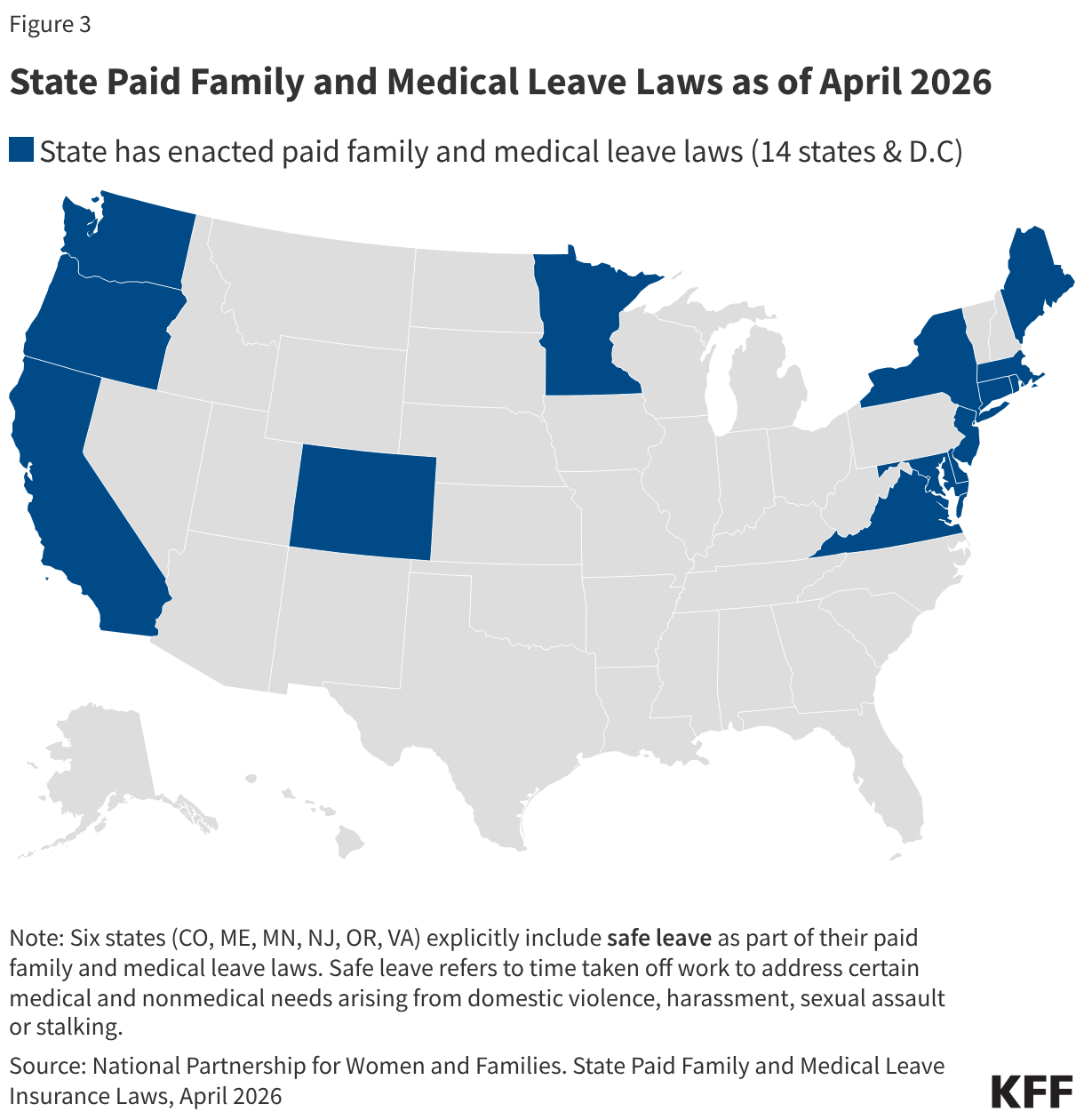
At the state level, 14 states and D.C. have enacted paid family and medical leave (Figure 3). In November 2020, Colorado became the first state to enact paid family and medical leave through a ballot measure. In 2026, Virginia became the first southern state to pass a statewide requirement for paid family and medical leave. Six states (Colorado, Maine, Minnesota, New Jersey, Oregon, and Virginia) also explicitly include safe leave as part of their paid family and medical leave laws. Oregon permits use of paid leave for reasons associated with a public health emergency. Paid leave durations for an employee’s own serious medical condition range from 6 to 52 weeks per year and 8-12 weeks for family leave. Four states (Colorado, Connecticut, Oregon, and Washington) plus D.C. provide a 2–4-week extension for a worker’s own pregnancy-related health issues. Wage replacement ranges from 50% to 100% of regular pay, up to certain caps, and requirements vary by state. Some states provide benefits on a sliding scale, with a higher percentage of wage replacement for lower-income workers. All states offering paid family and medical leave have minimum earnings or employment length requirements to qualify, and some have 7-day unpaid waiting periods. Paid leave benefits are administered by the state or by employers with qualifying programs and are funded through employer and/or employee contributions.
Employer Provision of Paid Leave Benefits
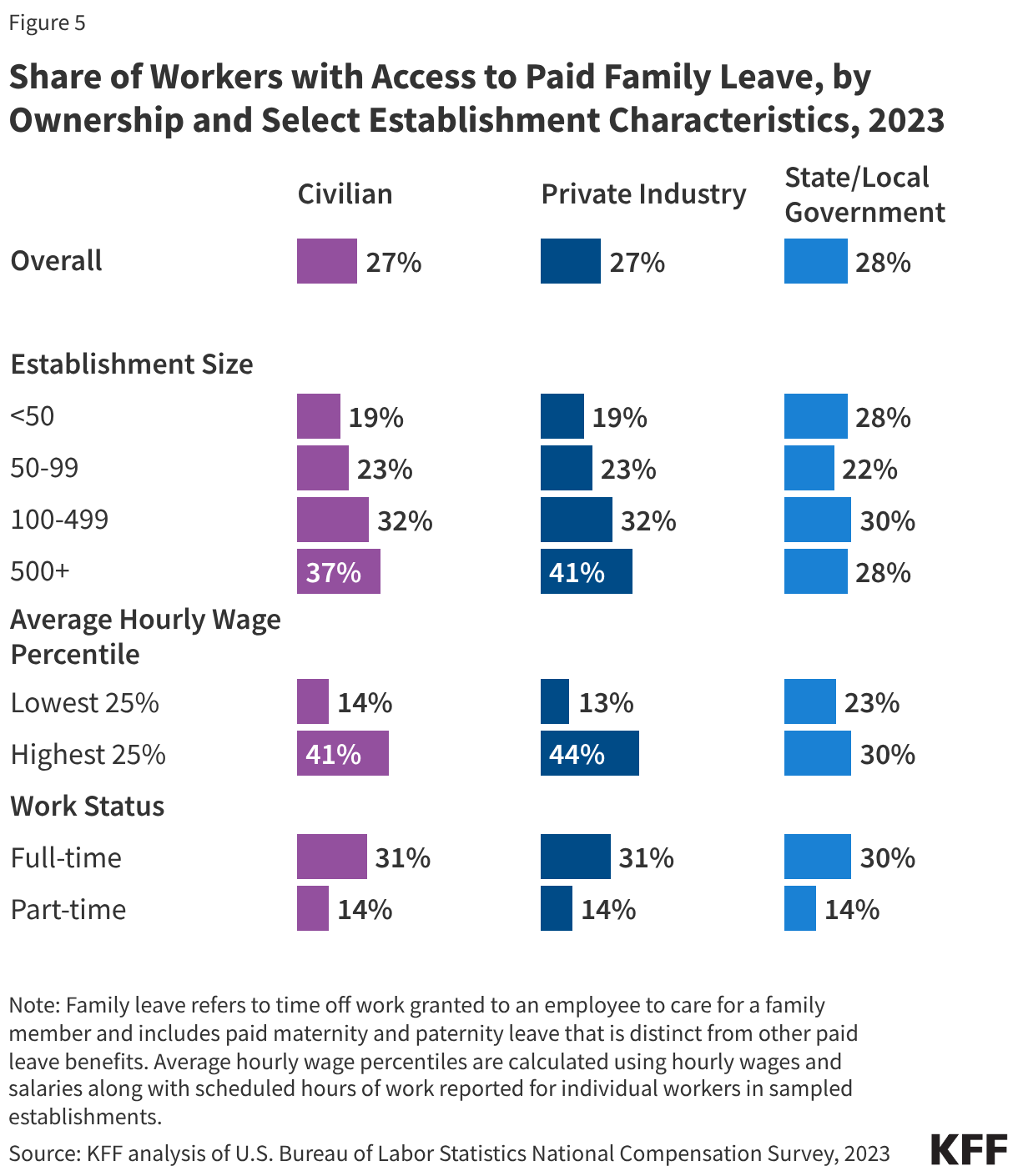
The BLS’s National Compensation Survey (NCS) releases annual data related to employer benefit plans, including leave benefits. The share of employees with access to paid leave benefits varies by establishment characteristics, such as size, worker status, and wages. Nonetheless, access to paid leave benefits has increased overall in the last few years. The share of workers with access to paid family leave increased from 17% in 2018 to 27% in 2023; similarly, the share of workers with access to paid sick leave slightly increased from 78% in 2020 to 82% in 2025.
There are differences between different groups of workers in access to paid sick leave (Figure 4). Just over half (56%) of part-time workers had access, compared to nine in ten (90%) full-time workers. The lower likelihood of paid sick leave for part-time workers has a disproportionate impact on women, who are more likely than men to hold part-time jobs and more likely than men to care for sick children when they stay home from school. Among establishments with 500 workers or more, the share of workers with access to this benefit was 91%, compared to 73% of workers in establishments with less than 50 workers.
Similarly, in 2023, 31% of full-time workers had access to paid family leave benefits compared to 14% of part-time workers (Figure 5). Among establishments with less than 50 workers, the share of workers with access to this benefit was about one in five (19%). The share of workers with access nearly doubles (37%) in establishments with over 500 workers.
Short of federal action, the movement for paid leave will likely continue to be centered on state and local policies or those voluntarily adopted by employers or negotiated through union contracts. Given that most people will need time off during their working lives to care for a personal or family illness, or for a new child, this issue will continue to be a salient concern for working families across the country in the years to come.