Abortion on the 2026 Ballot: The Evolving Landscape of State Abortion Initiatives
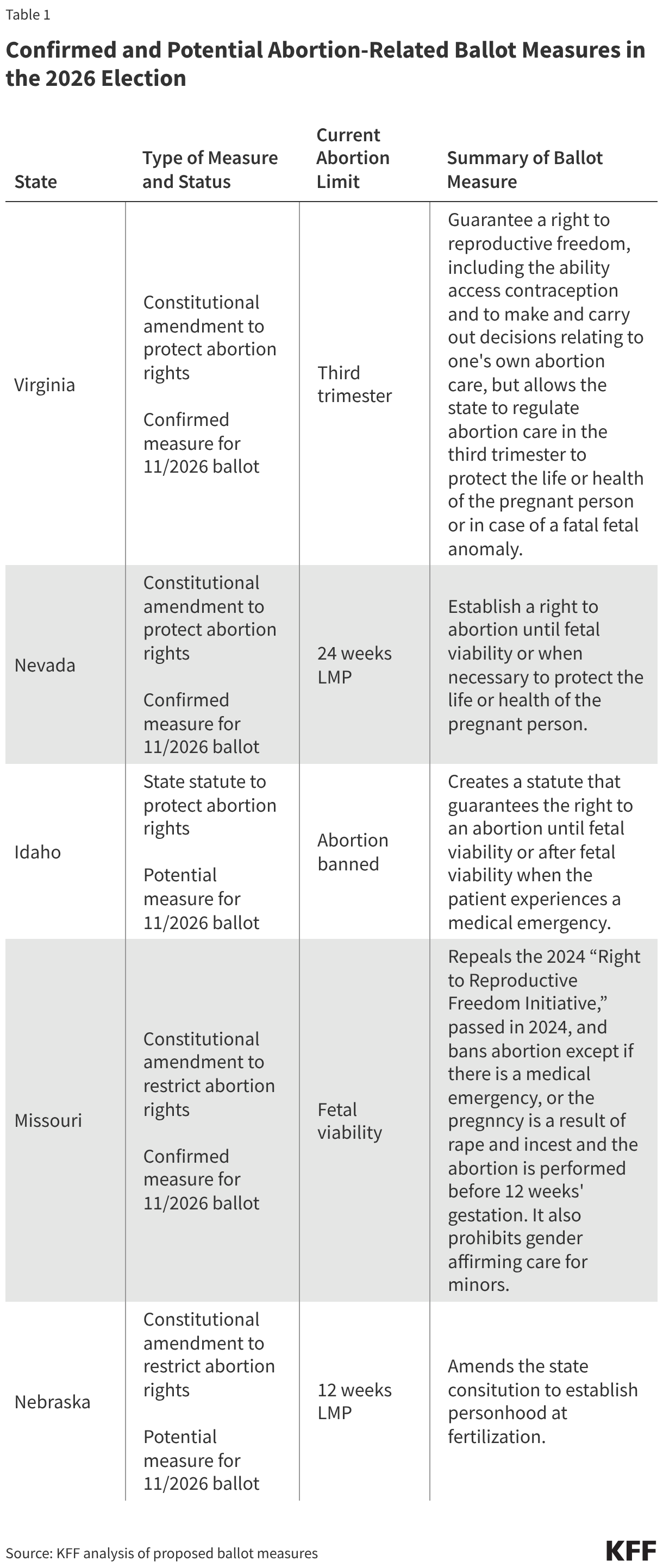
Since the Supreme Court’s 2022 Dobbs ruling, state ballot initiatives have become a powerful tool used by advocates on both sides hoping to either protect or limit abortion access in their state. Successful ballot initiatives that enact state constitutional amendments provide stronger legal authority to either protect or restrict abortion than laws enacted by the legislature or state Supreme Court rulings. Since 2022, twelve states have passed ballot initiatives, usually, but not exclusively, to protect abortion rights in their state. Once again, this November, five states (Table 1) may have abortion-related measures for their voters to consider. Abortion rights advocates in Nevada and Virginia have placed a constitutional amendment protecting the right to abortion on the November ballot. The Missouri legislature has placed an initiative on the ballot to repeal a state constitutional amendment protecting the right to abortion approved by voters in 2024. In addition, voters in Idaho and Nebraska may vote on abortion initiatives if the measures qualify for the ballot. This issue brief reviews the abortion-related initiatives currently slated to be on the ballot in November 2026 and examines how these measures may impact abortion access in the state.
Ballot Initiatives Seeking to Protect Abortion Rights
Virginia
Virginia is currently the only state in the South without a total abortion ban or early gestational limit, allowing abortion until the third trimester. Unless the litigation challenging the placement of the ballot measure succeeds, voters in Virginia will decide whether to enshrine these abortion protections into the state constitution in November. On February 6, 2026, Governor Spanberger signed a bill, placing the Right to Reproductive Freedom Amendment on the ballot, after the legislature passed it in two successive sessions as is required by state law. However, on March 3, 2026, Charla Bansely, the District 3 Supervisor for the Bedford County Board of Supervisors filed a lawsuit seeking to block the placement of the measure on the November ballot. Ms. Bansely alleges state election officials failed to distribute the constitutional amendment to circuit clerks in all counties, as required by state law, before certifying the abortion measure for the ballot.
The Right to Reproductive Freedom Amendment would amend the state constitution to guarantee a fundamental right to abortion until the third trimester, as well as contraception and fertility care. The Amendment would allow the Commonwealth of Virginia to regulate abortion in the third trimester; however, abortion cannot be prohibited if the pregnant person’s life or physical, or mental health is at risk, or if the fetus is not viable. If passed, the Amendment will provide durable protection for abortion rights in the state’s constitution by ensuring that changes in the composition of the legislature or the courts in the Commonwealth do not impede access to abortion care.
Nevada
Nevada law requires citizen-initiated ballot initiatives amending the state’s constitution to pass in two successive general elections. Therefore, Nevadans will vote for the second time on the Reproductive Rights Amendment initially approved by voters in 2024. If passed, the Reproductive Rights Amendment will, “guarantee a right to all individuals to abortion performed or administered by a qualified health care practitioner until fetal viability or when needed to protect the life or health of the pregnant patient, without interference from the state or its political subdivisions.”
Abortion is currently legal in Nevada until 24 weeks gestation. In 1990, voters passed as a “statute affirmation” which upheld the existing law, NRS 442.250, which legalized abortion until 24 weeks, and prohibited the state legislature from amending or repealing the law unless it was placed on the ballot. In 2019, Nevada enacted the Trust Nevada Women Act, which decriminalized medication abortion and removed informed consent laws. The Reproductive Rights Amendment would protect the individuals’ right to abortion beyond the existing law by limiting state interference. While passage of the Reproductive Rights Amendment would provide the strongest protection against efforts to limit reproductive rights by the legislature or courts, any effort to change the gestational limit for abortion in Nevada would have to be approved by a direct vote of state residents, not by the legislature.
If the Reproductive Rights Amendment passes, abortion rights advocates are likely to bring a new challenge to Nevada’s parental notification for minors law, contending it is not permissible under the new constitutional amendment. If successful, this challenge would allow minors to consent for their own abortions. Last year, a court lifted a 1985 injunction blocking the notification law and reinstated the parental notification requirement. Planned Parenthood Mar Monte, the affiliate that operates the Nevada Planned Parenthood clinics, has challenged this law in a case currently pending at the Nevada Supreme Court.
Idaho
Idaho has among the most restrictive abortion laws in the nation. Abortion rights advocates are seeking to reverse these bans by trying to get a new law approved, the Reproductive Freedom and Privacy Act, which will change the legality of abortion in the state. However, the initiative faces considerable barriers to getting on the ballot. In Idaho, a citizen-initiated ballot initiative can only be placed on the ballot if the petitioner gathers signatures from 6% of the registered voters in the last election in 18 of the state’s 35 legislative districts and submits these signatures by May 1 of the election year. The signatures must then be verified by the county clerks and submitted to the secretary of state for certification.
Idahoans United for Women and Families, a nonprofit group that advocates for comprehensive reproductive health care in the state, is organizing the 2026 ballot initiative. In January 2025, the group sued the attorney general’s office arguing that the financial impact statement and the short title of the ballot initiative contained biased language. On June 16, 2025, the Idaho Supreme Court agreed and ordered the attorney general to draft a new financial statement and short title.
The Reproductive Freedom and Privacy Act would create a state law giving people the right to make decisions about their own reproductive health care including abortion up to fetal viability and in medical emergencies, miscarriage care, prenatal, pregnancy and postpartum care, contraception, and fertility treatment. The statute defines a medical emergency as a physical medical condition, based on the physician’s good faith medical judgment, that complicates the physical medical condition of a pregnant patient as to warrant an abortion to protect a pregnant person’s life, or for which a delay will create a serious impairment of a major bodily function or organ of the pregnant person. In January 2026, Idahoans United for Women and Families announced that they collected over 63,000 signatures towards the signature requirement for the ballot initiative. Idaho is currently enforcing a total abortion ban with exceptions only to prevent the death of the pregnant person or in the first trimester for reported cases of rape or incest.
If passed, the Reproductive Freedom and Privacy Act could expand access to abortion in Idaho. However, the Act would still face challenges after the election because Idaho allows its legislature to amend or repeal a citizen-initiated statute without restrictions.
There are numerous examples where the legislature has reversed or amended the will of the electorate. In 2002, the Idaho legislature repealed citizen-initiated statutes that sought to place term-limits on elected officials. In 2019, the Idaho legislature amended a citizen-initiated statute that expanded Medicaid eligibility. In addition, the Idaho legislature is currently considering a bill that would give the governor veto power over ballot initiatives that pass with less than two-thirds support from voters. Therefore, even if the Reproductive Freedom and Privacy Act is on the ballot and voters approve it, the Republican-majority legislature is likely to amend or repeal the law. Additionally, if legislation granting the governor power to veto voter-approved initiatives is enacted, the Governor would likely exercise that authority to veto the measure.
Ballot Initiatives Seeking to Curtail Abortion Rights
Missouri
In 2026, voters in Missouri will again be asked to decide the legal status of abortion in their state, but this time to reverse a recently approved constitutional amendment. In 2024, Missouri voters approved Amendment 3, the Right to Reproductive Freedom Amendment, which amended the state’s constitution to guarantee a right to abortion until fetal viability. Before Amendment 3 was passed, Missouri banned abortion with exceptions only to avert the death of the pregnant person or to avert a serious risk of substantial and irreversible physical impairment of a major bodily function of the pregnant person. After Amendment 3 passed, Planned Parenthood, one of the abortion providers in the state, filed a lawsuit challenging not only the state’s total abortion ban, but also a series of regulations on facilities and clinicians providing abortions. These restrictions included a 72-hour waiting period between an initial appointment and when an abortion could be performed, as well as abortion specific informed consent requirements. The court struck down the abortion ban, allowing abortion to be legal in the state, but did not block regulations on facilities and clinicians providing abortions while the litigation continues.
State legislators that oppose abortion rights have drafted a new ballot initiative that seeks to repeal Amendment 3. The 2026 ballot initiative, also known as Amendment 3, would ban abortion except in cases of medical emergencies, fatal fetal anomalies, or pregnancies 12 weeks or less gestation that are a result of rape or incest. The initiative includes a parental or guardian consent requirement for minors except in medical emergencies and prohibits state funding of abortions in most circumstances. The Amendment defines a medical emergency as “a condition that, based on reasonable medical judgment, so complicates the medical condition of a pregnant woman as to necessitate the immediate termination of her pregnancy to avert the death of the pregnant woman or for which a delay will create a serious risk of substantial and irreversible physical impairment of a major bodily function of the pregnant woman. A medical emergency shall include, but not be limited to, an ectopic pregnancy at any point following the diagnosis of such and treatment for a miscarriage.” The ballot initiative explicitly allows the legislature to regulate abortion provision, facilities, and providers including, “requiring physicians providing abortion care to have admitting privileges at a nearby hospital; laws requiring facilities where abortions are performed or induced to be licensed and inspected for clean and safe conditions and adequate instruments to treat any emergencies arising from an abortion procedure; laws requiring physicians to perform a sufficient examination of the woman to determine the unborn child’s gestational age and any preexisting medical conditions that may influence the procedure; and laws requiring ultrasounds to be performed only by physicians or licensed medical technicians.” In addition, the initiative includes a ban on gender affirming care for minors.
The 2026 ballot initiative has faced legal scrutiny. On July 2, 2025, the ACLU of Missouri filed a lawsuit against the secretary of state alleging that the language for the 2026 ballot initiative was intentionally misleading, contained an inaccurate summary, and is unconstitutional because it included more than one subject. The ACLU argued that the language of the ballot initiative failed to properly inform voters that a “yes” vote would lead to a repeal of reproductive rights protections that passed in 2024. The ACLU also contended that the subject of the ballot initiative is related to “reproductive health care,” but includes topics unrelated to reproductive health, including a ban on gender-affirming care for minors. On July 4, 2025, the Missouri Western District Court of Appeals ruled that the language of the 2026 ballot initiative failed to inform voters that the initiative would repeal and replace the 2024 Right to Reproductive Freedom Amendment, and certified new ballot language for the 2026 ballot initiative. The language certified by the court will appear on the November 3, 2026, ballot. This is the first time voters could decide to repeal a state constitutional amendment protecting abortion. Passage of the 2026 ballot initiative would ban abortion in Missouri and prevent minors from accessing gender affirming care.
Nebraska
In 2024, Nebraskans voted on two citizen-initiated ballot initiatives related to abortion, and in 2026 voters could once again be asked to decide on the legality of abortion in their state. In 2024, Nebraska voters weighed in on two separate constitutional amendments related to abortion rights. Voters approved the Prohibit Abortions After the First Trimester Amendment, which bans abortion after the first trimester unless the pregnant person experiences a medical emergency or the pregnancy is a result of rape or incest. Voters opposed the competing ballot measure, the Right to Abortion Initiative, which would have amended the state constitution to recognize a fundamental right to abortion until fetal viability. As a result, abortion is banned after 12 weeks gestation in the state.
The 2026 ballot initiative would impose a total abortion ban in the state. Choose Life Now, the same campaign that initiated the 2024 Prohibit Abortion After the First Trimester Amendment, is collecting signatures to have the Establish Personhood of Preborn Children Amendment added to the 2026 ballot. This new initiative would establish personhood at fertilization. Nebraska law requires citizen-initiated ballot initiatives to collect signatures from 10% of registered voters before it can appear on the ballot. Choose Life Now is still gathering signatures.
Some Abortion Restrictions Remain in Place After Voters Pass Constitutional Amendments
Voters in Arizona, Ohio and Missouri passed state constitutional amendments establishing the right to abortion in recent elections. After abortion advocates challenged existing state abortion bans under the new constitutional amendments, courts have blocked the pre-existing state abortion bans. However, legal challenges to existing abortion restrictions such as waiting periods, and telemedicine bans, have taken longer as courts have not uniformly blocked these provisions.
On November 5, 2024, Arizona voters passed Proposition 139, a ballot initiative that amended the state constitution to guarantee a right to abortion until fetal viability. The amendment also allows abortions after fetal viability if the physician providing the abortion determines that the abortion is necessary to protect the life, or physical or mental health of the pregnant person. After this constitutional amendment became effective in December 2024, advocates filed legal challenges to block Arizona’s 15-week ban and other abortion restrictions. In March 2025, a court ruled Arizona’s 15-week ban was unconstitutional under the new amendment. In February 2026, an Arizona state court ruling blocked several abortion restrictions including: (1) a ban on abortion based on fetal diagnoses; (2) a 24-hour waiting period and (3) a prohibition on telemedicine for abortion care due to new protections granted in the state’s constitutional amendment. However, Republican state legislators who have intervened in the lawsuit may appeal this decision. The Democratic Arizona Attorney General declined to defend the laws on behalf of the state, and therefore it is unlikely the state will appeal.
There are, however, still abortion restrictions in effect in Arizona including a ban on state funds for abortion (which affects Medicaid), a parental consent requirement for minors seeking abortions, and a law that bars medical professionals other than doctors from providing abortions. In February 2026, the ACLU of Arizona filed a lawsuit on behalf of advanced practice clinicians contending the physician only law violates the constitutional amendment protecting abortion.
On November 7, 2023, Ohio voters passed Issue 1, a ballot initiative that amended the state constitution to guarantee every individual has the right to make their own reproductive decisions including contraception, fertility treatment, continuing a pregnancy, miscarriage care, and abortion care. The amendment also allows the state to prohibit abortion after fetal viability; however, an abortion cannot be prohibited after viability if it is necessary to protect the life or health of the pregnant person. After the passage of Issue 1, advocates cited the new amendment in legal challenges to the state’s 6-week ban as well as the many other abortion restrictions. In October 2024, the Hamilton County Court of Common Pleas issued a permanent injunction blocking Ohio’s 6-week abortion ban from taking effect, marking the first permanent injunction based on Ohio’s Reproductive Freedom Amendment. Courts have blocked many of the other abortion restrictions as well. One provision that was challenged, but is still in effect, is a requirement for providers to document the reason for an abortion, but this provision does not impact patients’ access to abortion care. Ohio law still requires parental consent for minors seeking abortions and blocks public funding for abortions.
As was discussed earlier, Missouri voters approved Amendment 3, the Right to Reproductive Freedom Amendment in 2024, which guarantees a right to make and carry out decisions about all matters relating to reproductive health care including: prenatal care, childbirth, postpartum care, birth control, abortion care, miscarriage care, and respectful birthing conditions. The amendment also allows the government to regulate abortion after fetal viability; however, it prevents the government from restricting abortion after fetal viability if the abortion is necessary to protect the life, physical or mental health of the pregnant person. After the passage of Amendment 3, a court blocked the state’s abortion ban but many restrictions on abortion (72-hour waiting period and abortion specific informed consent requirements) remain in place and are the subject of ongoing litigation.
Options for Future Citizen Referred Ballot Measures Are Limited
Citizens are allowed to propose a constitutional amendment for the ballot in 17 states. There are only two states, Arkansas and Oklahoma, with current bans on abortion which allow for citizen-initiated constitutional amendments and have yet to vote on an abortion measure (Figure 1). There were efforts in Arkansas (where there is a near total abortion ban) to get an initiative on the ballot, but the Arkansas Secretary of State rejected the petition for the initiative on the grounds that the signatures were not properly gathered, and thus the initiative did not make it to the ballot. The Arkansas Supreme Court upheld this decision.
Oklahoma has a total abortion ban, with an exception only to save the life of the pregnant person and classifies performing an abortion as a felony. A citizen-led effort to put a state constitutional amendment that would have added an “individual right to reproductive freedom” on the ballot was withdrawn in December 2022, before signature gathering began.
In 2024, in Florida, Nebraska, and South Dakota, abortion rights amendments failed to garner sufficient votes for passage. In Nebraska, voters approved a competing measure to ban abortion after the first trimester. In South Dakota, the measure failed to pass, only garnering 41% of the votes. In Florida, the initiative received 57% approval. However, state law requires 60% approval for a constitutional amendment. As the popular vote fell just 3 percentage points short of approval, abortion rights supporters in Florida may try again in a future election to reverse the 6-week abortion ban.
Conversely, in states with current abortion protections without a constitutional amendment protecting abortion, only three states (Illinois, Massachusetts, Oregon) have a process for citizen initiated constitutional amendments. However, in today’s political climate it is unlikely that new citizen initiatives will be brought to the electorate to weaken existing abortion protections.