Racial Equity and Health Policy

Survey of Immigrants

KFF-New York Times Survey: Immigrants Report Rising Fear, Negative Economic and Health Impacts, and Changing Political Views During the First Year of President Trump’s Second Term

The 2025 Survey of Immigrants, a partnership between KFF and The New York Times, takes an in-depth look at the experiences of immigrants during the first year of President Trump’s second term, including their worries related to increased immigration enforcement, their health and economic wellbeing, and the political views and preferences of immigrant voters. The survey paints a portrait of families under strain — where fear of detention and economic instability are negatively impacting immigrants’ health and reshaping immigrant families’ daily lives and views of U.S. political parties.

Read the News Release | Explore The New York Times’ Reporting
the Essentials
  • Disparities in Health and Health Care: 5 Key Questions and Answers

    This brief provides an introduction to what health and health care disparities are, why it is important to address them, what the status of disparities is today, recent federal actions to address disparities, and key issues related to addressing disparities in the future.
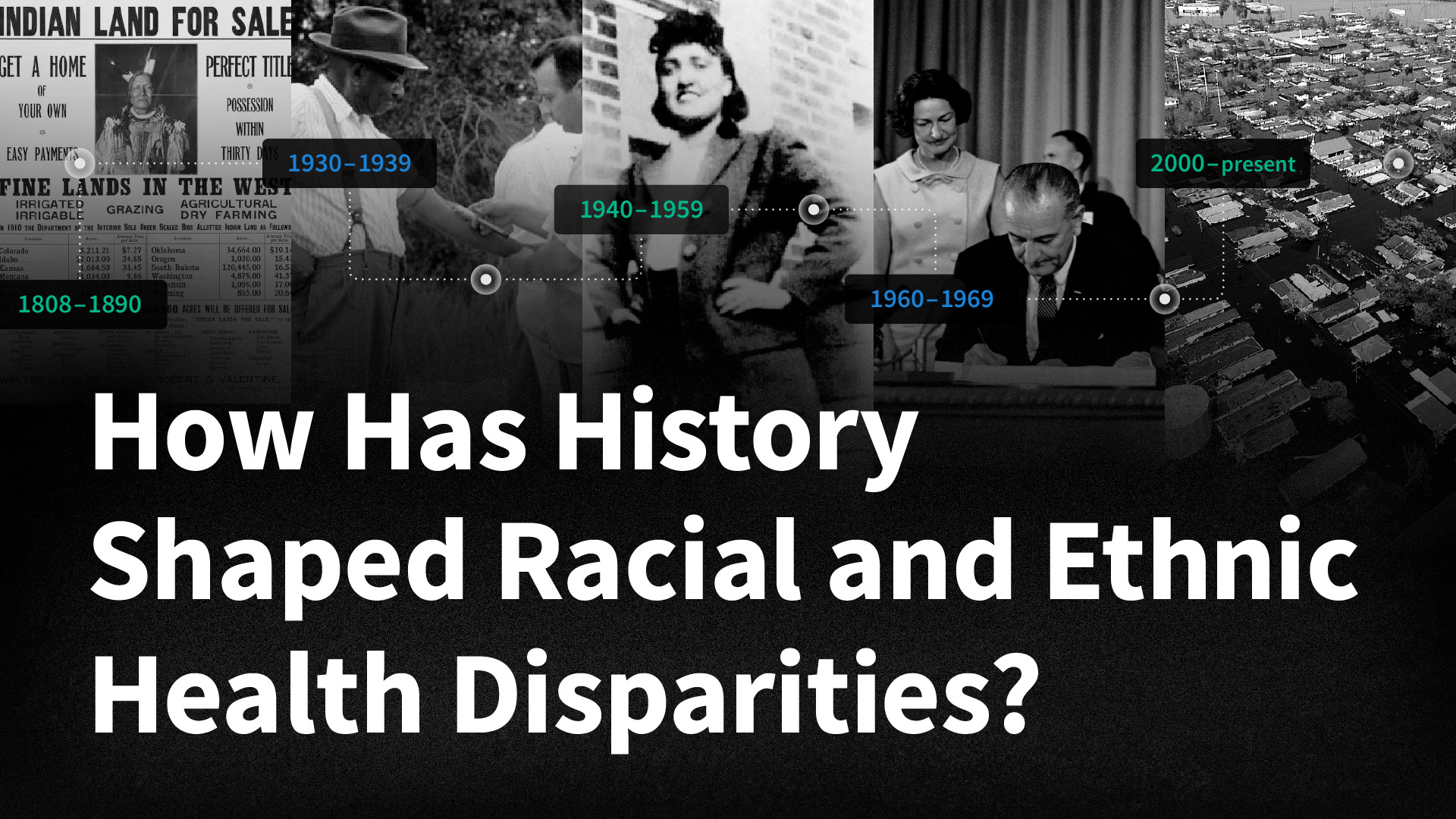
  • Timeline: How History Has Shaped Racial and Ethnic Health Disparities

    This timeline offers a historical view of significant U.S. federal policies and events spanning the early 1800s to today that have influenced present-day health disparities.
  • Health Policy 101: Chapter on Race, Inequality and Health

    Addressing persistent racial and ethnic disparities in health and health care is important for improving the nation’s health and economic prosperity. KFF explains such disparities and the factors that drive them, examines the actions to address them, and outlines future considerations.
  • Key Data on Health and Health Care by Race and Ethnicity

    Racial and ethnic disparities in health and health care remain a persistent challenge in the United States. An updated KFF resource examines how people of color fare compared to White people across 64 measures of health, health care, and social determinants of health.

Subscribe to KFF Emails

Choose which emails are best for you.
Sign up here

Filter

521 - 530 of 595 Results

  • Medicaid Administrative Data: Challenges with Race, Ethnicity, and Other Demographic Variables

    Issue Brief

    There are persistent disparities in health and health care for people of color, which reflect structural and systemic inequities rooted in racism and discrimination. High-quality comprehensive data are key to enabling policymakers, community leaders, and other key stakeholders to identify and address these inequities and measure progress over time. Medicaid/CHIP administrative data, also known as Transformed Medicaid Statistical Information System (T-MSIS) or TAF (T-MSIS Analytic File), hold the potential to inform disparities research through detailed demographic, service utilization, and spending data of Medicaid and CHIP beneficiaries —but there are current limitations.

  • In Wake of Dallas, Minnesota and Baton Rouge Shootings, an Opening for Local Leaders

    From Drew Altman

    In this The Wall Street Journal Think Tank column, Drew Altman discusses how incidents in Dallas, Baton Rouge and Minnesota create opportunities for local leaders to take steps to reduce police-involved violence, citing data from the KFF-CNN survey of Americans on Race and KFF-New York Times Survey of Chicago Residents.

  • Summary of HHS’s Final Rule on Nondiscrimination in Health Programs and Activities

    Issue Brief

    On May 18, 2016, the Department of Health and Human Services (HHS) published a final rule to implement Section 1557 of the Affordable Care Act (ACA), which prohibits discrimination in health coverage and care based on race, color, national origin, age or disability, and, for the first time sex. This Issue Brief provides a technical summary of Section 1557 and the final rule and highlights new protections and provisions included in the law and rule. Notably, Section 1557 is the first federal civil rights law to prohibit discrimination on the basis of sex in health care. Moreover, the proposed rule extends the definition of sex discrimination to include discrimination on the basis of gender identity. In addition, the final rule establishes regulations related to the provision of language assistance services based on long-standing HHS policy guidance.

  • Addressing the Justice-Involved Population in Coronavirus Response Efforts

    Issue Brief

    Addressing health care needs of people moving into and out of the criminal justice system and staff who work them is an important component of coronavirus response efforts and protecting and promoting public health within the communities in which correctional facilities are located. This brief provides data on spread of coronavirus within correctional facilities, discusses the health risks for the justice-involved population and the staff who work with them, identifies the role Medicaid can play in response efforts for justice-involved individuals, and highlights other steps correctional systems can take to mitigate risk of coronavirus for the justice-involved population and promote public health.

  • Addressing Health and Social Needs of Immigrant Families: Lessons from Local Communities

    Issue Brief

    This brief presents findings from discussions with service providers across sectors (including health, legal, and education), local officials, and parents in immigrant families in the San Francisco Bay Area and San Diego about issues facing immigrant families and providers in the current environment, how the local communities have responded to growing needs, and key priorities and opportunities identified for serving immigrant communities.

  • Characteristics that could count against immigrants in public charge determinations, kff

    Nearly 8 in 10 Immigrants Who Entered the U.S. Without Legal Permanent Resident Status Have At Least One Characteristic That Could Count Against Them under the New “Public Charge” Rule

    News Release

    Seventy-nine percent of noncitizen residents who originally entered the United States without legal permanent resident status have at least one characteristic that could count against them under the Trump Administration’s new “public charge” rule, according to an updated KFF analysis.

  • Advancing Opportunities, Assessing Challenges: Key Themes from a Roundtable Discussion of Health Care and Health Equity in the South

    Issue Brief

    This brief summarizes the primary themes expressed by participants of a roundtable discussion of current and future opportunities and challenges for advancing health care and health equity in the South organized by Kaiser Family Foundation’s Commission on Medicaid and the Uninsured and the Satcher Health Leadership Institute at Morehouse School of Medicine in Atlanta, Georgia.