Racial Equity and Health Policy

the Essentials
  • How Experiencing Racial Discrimination Impacts Health

    This brief highlights research examining mechanisms underlying health outcomes linked to self-reported experiences of racial discrimination, including biological changes, chronic stress, mental health, substance use, pregnancy-related outcomes, and sleep.
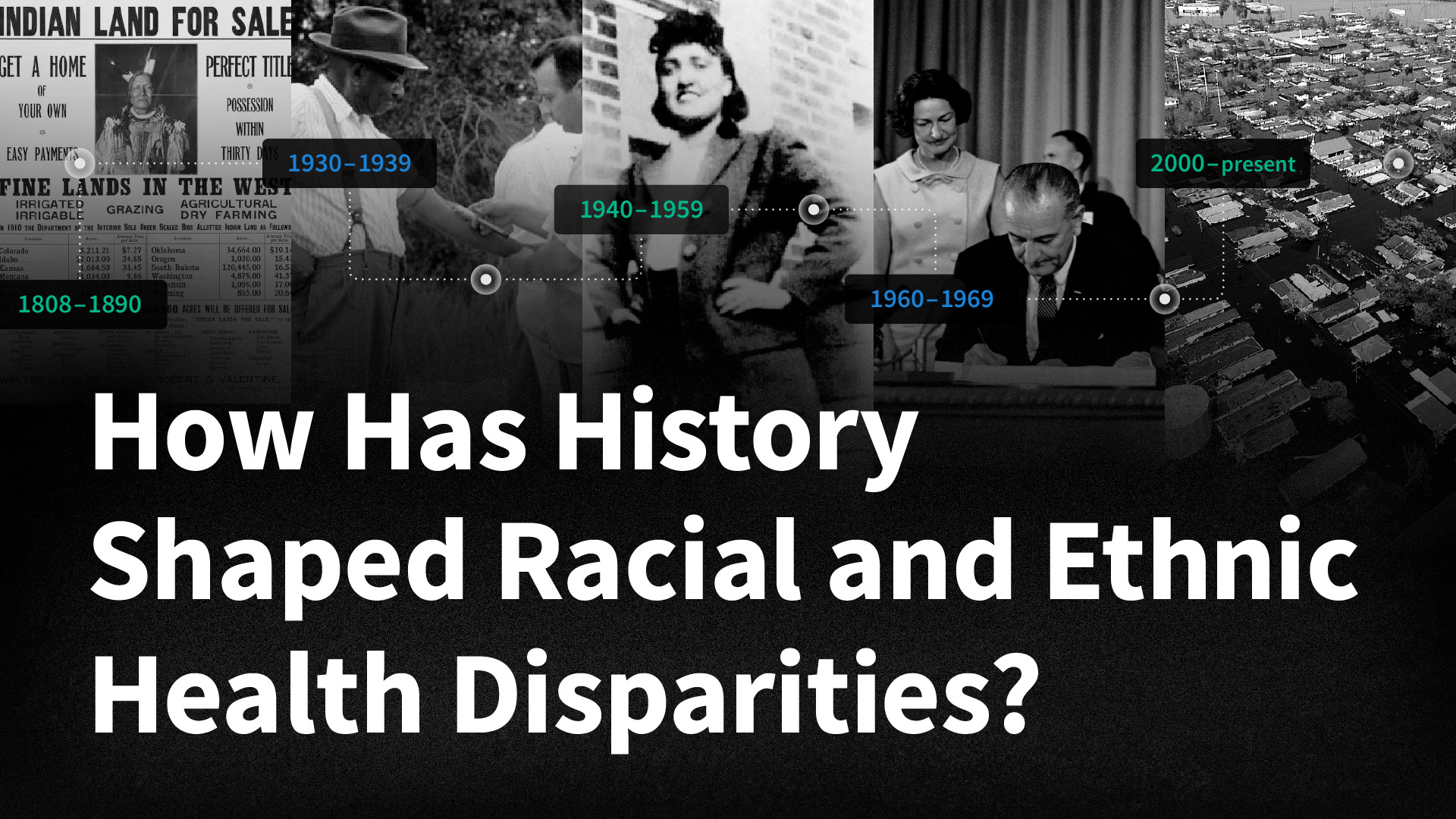
  • Timeline: How History Has Shaped Racial and Ethnic Health Disparities

    This timeline offers a historical view of significant U.S. federal policies and events spanning the early 1800s to today that have influenced present-day health disparities.
  • Health Policy 101: Chapter on Race, Inequality and Health

    Addressing persistent racial and ethnic disparities in health and health care is important for improving the nation’s health and economic prosperity. KFF explains such disparities and the factors that drive them, examines the actions to address them, and outlines future considerations.
  • Key Data on Health and Health Care by Race and Ethnicity

    Racial and ethnic disparities in health and health care remain a persistent challenge in the United States. An updated KFF resource examines how people of color fare compared to White people across 64 measures of health, health care, and social determinants of health.

Survey of Immigrants

KFF-New York Times Survey: Immigrants Report Rising Fear, Negative Economic and Health Impacts, and Changing Political Views During the First Year of President Trump’s Second Term

The 2025 Survey of Immigrants, a partnership between KFF and The New York Times, takes an in-depth look at the experiences of immigrants during the first year of President Trump’s second term, including their worries related to increased immigration enforcement, their health and economic wellbeing, and the political views and preferences of immigrant voters. The survey paints a portrait of families under strain — where fear of detention and economic instability are negatively impacting immigrants’ health and reshaping immigrant families’ daily lives and views of U.S. political parties.

Read the News Release | Explore The New York Times’ Reporting
Stay informed.

Stay informed.

Filter

501 - 510 of 603 Results

  • Racial/Ethnic Disparities in Access to Care Among Children: How Does Medicaid do in Closing the Gaps?

    Other Post

    While Medicaid and the Children's Health Insurance Program (CHIP) have become increasingly important sources of health coverage for low-income children in all racial and ethnic groups, the program plays an especially large role for children of color, who are more likely than white children to be low-income. In 2007, Medicaid and CHIP covered nearly one in five white children, but roughly two in five African American and Hispanic children. As policymakers engaged in health reform…

  • Connecting Eligible Immigrant Families to Health Coverage and Care: Key Lessons from Outreach and Enrollment Workers

    Issue Brief

    Beginning in 2014, health coverage options will significantly expand under health reform through an expansion in Medicaid eligibility and by making tax credits available to help individuals purchase coverage through new Health Benefit Exchanges. Given their high uninsured rate and limited access to private and public coverage, one group who could significantly benefit from this coverage expansion is lawfully residing immigrant families. However, it will be important to address barriers eligible immigrant families often face…

  • Welfare Reform and Elderly Legal Immigrants

    Report

    This report presents the findings of researchers at the National Academy on Aging on welfare reform and elderly legal imigrants. The Personal Responsibility and Work Opportunity Reconciliation Actof 1996 included an array of structural reforms affecting access to cash assistance programs such as AFDC and SSI as well as Medicaid. This study profiles elderly legal immigrants in the United States and explores the implications of welfare reform for this population. Report Report

  • Survey of Americans on HIV/AIDS — Part Three: Experiences and Opinions by Race/Ethnicity and Age

    Poll Finding

    These findings are the third part of a national survey of Americans’ views on HIV/AIDS, “Survey of Americans on HIV/AIDS,” conducted in spring 2004. It explores the views and experiences of, as well as the key differences among, African Americans, Latinos, Whites, and young people. The first part of the survey, on global HIV/AIDS, was released on June 2, 2004. The second part of the survey, on HIV Testing, was released on June 15, 2004.…

  • Hispanic People are Facing Widening Gaps in Health Coverage

    Policy Watch

    New analysis shows that, in 2019, the number of uninsured continued to increase for the third year in a row. Much of the coverage loss between 2018 and 2019 was among Hispanic people, and these data point to significant increased barriers to health care for Hispanic people.

  • New Brief Examines COVID-19 Risks and Impacts for Health Care Workers by Race and Ethnicity

    News Release

    New coronavirus cases in the United States have hit daily records multiple times in the past week and hospitalizations are rising in several areas of the country. Health care workers face some of the greatest risk of exposure to the coronavirus and a new KFF brief examines the composition of the workforce and how the risks and the impact of the pandemic on this workforce vary across racial/ethnic groups. With prospects for a successful vaccine…

  • Under the Affordable Care Act, People of Color Have Seen Greater Gains in Health Coverage But Remain More Likely Than Whites to Be Uninsured

    News Release

    The uninsured rate has fallen among all racial and ethnic groups under the Affordable Care Act with steeper declines among people of color compared to Whites, according to a new analysis by the Kaiser Family Foundation. The findings for Hispanics were especially striking. Between 2013 and 2015, the uninsured rate for Hispanics fell from 26 percent to 17 percent – a sharper decline than for any other group. Nationally, the total number of nonelderly uninsured…