Racial Equity and Health Policy

Survey of Immigrants

KFF-New York Times Survey: Immigrants Report Rising Fear, Negative Economic and Health Impacts, and Changing Political Views During the First Year of President Trump’s Second Term

The 2025 Survey of Immigrants, a partnership between KFF and The New York Times, takes an in-depth look at the experiences of immigrants during the first year of President Trump’s second term, including their worries related to increased immigration enforcement, their health and economic wellbeing, and the political views and preferences of immigrant voters. The survey paints a portrait of families under strain — where fear of detention and economic instability are negatively impacting immigrants’ health and reshaping immigrant families’ daily lives and views of U.S. political parties.

Read the News Release | Explore The New York Times’ Reporting
the Essentials
  • Disparities in Health and Health Care: 5 Key Questions and Answers

    This brief provides an introduction to what health and health care disparities are, why it is important to address them, what the status of disparities is today, recent federal actions to address disparities, and key issues related to addressing disparities in the future.
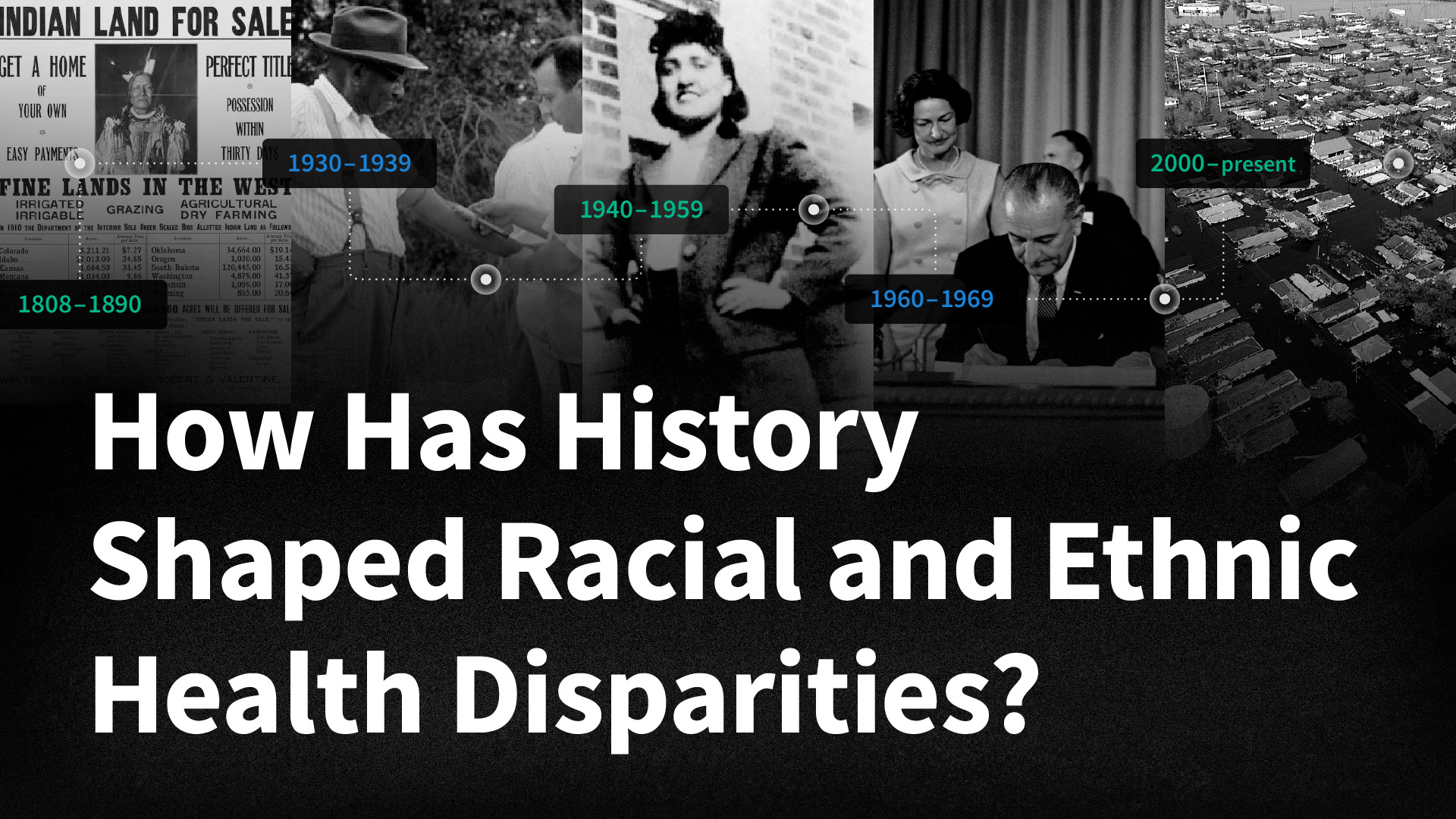
  • Timeline: How History Has Shaped Racial and Ethnic Health Disparities

    This timeline offers a historical view of significant U.S. federal policies and events spanning the early 1800s to today that have influenced present-day health disparities.
  • Health Policy 101: Chapter on Race, Inequality and Health

    Addressing persistent racial and ethnic disparities in health and health care is important for improving the nation’s health and economic prosperity. KFF explains such disparities and the factors that drive them, examines the actions to address them, and outlines future considerations.
  • Key Data on Health and Health Care by Race and Ethnicity

    Racial and ethnic disparities in health and health care remain a persistent challenge in the United States. An updated KFF resource examines how people of color fare compared to White people across 64 measures of health, health care, and social determinants of health.

Subscribe to KFF Emails

Choose which emails are best for you.
Sign up here

Filter

461 - 470 of 594 Results

  • Key Facts: Latinos and HIV/AIDS

    Report

    This report provides an overview of the impact of the HIV/AIDS epidemic on Latinos in the United States.

  • D.C. Health Care Access Survey, 2003

    Report

    The Henry J. Kaiser Family Foundation District of Columbia Health Care Access Survey, 2003, is based on a representative sample of 1,581 adults, ages 18 and older, living in Washington, DC.

  • Millions of Seniors Live In Households with School-Age Children

    Issue Brief

    About 3.3 million adults age 65 or older live in a household with school-age children, a factor that state and local officials may want to take into account when deciding when and how fully to re-open schools this fall, a new KFF analysis finds.
    These older adults, who represent roughly 6 percent of all seniors in the U.S., live with 4.1 million school age children, who comprise about seven percent of all kids ages 5 to 18, the analysis finds. And the data show that older people of color are significantly more likely to live with a school-age child compared to their White counterparts.

  • Health Coverage for the Hispanic Population Today and Under the Affordable Care Act

    Report

    The more than 50 million Hispanics living in the United States make up 17 percent of the total population and are the nation's fastest growing racial or ethnic group. Many Hispanics continue to face disparities in health coverage and care, and they have the highest uninsured rate among racial/ethnic groups, with nearly one in three lacking coverage. This brief provides an overview of the Hispanic population in the U.S., their health coverage today and the potential impact of the ACA coverage expansions.

  • An Overview of HIV/AIDS in Black America

    Report

    Black Americans account for more HIV and AIDS cases, people estimated to be living with AIDS, and HIV-related deaths than any other racial/ethnic group in the U.S. Today, Black Americans make up about 12 percent of the U.S. population, but account for half of all new AIDS cases.

  • Putting Men’s Health Care Disparities On The Map: Examining Racial and Ethnic Disparities at the State Level

    Report

    This report documents the persistence of disparities between white men and men of color -- and among different groups within men of color -- on 22 indicators of health and well-being, including rates of diseases such as AIDS, cancer, heart disease and diabetes, as well as insurance coverage and health screenings. It also catalogues disparities in factors that influence health and access to care such as income and education, and other social determinants of health.

  • Women at Risk: A View from the Safety Net

    Video

    This video provides a snapshot of the Arlington (Va.) Free Clinic where, four times a month, medical personnel provide care and screenings exclusively to women. The video explores the hurdles that uninsured women face in accessing health care and the social issues, including work and family responsibilities, that create challenges for them. It is a companion to the report, “Putting Women’s Health Care Disparities On The Map: Examining Racial and Ethnic Disparities at the State Level.”