Racial Equity and Health Policy

the Essentials
  • Health Coverage by Race and Ethnicity, 2010-2024

    There have been longstanding racial and ethnic disparities in health coverage that contribute to disparities in health. This brief examines trends in health coverage by race and ethnicity from 2010 through 2024 and discusses the implications for such disparities.
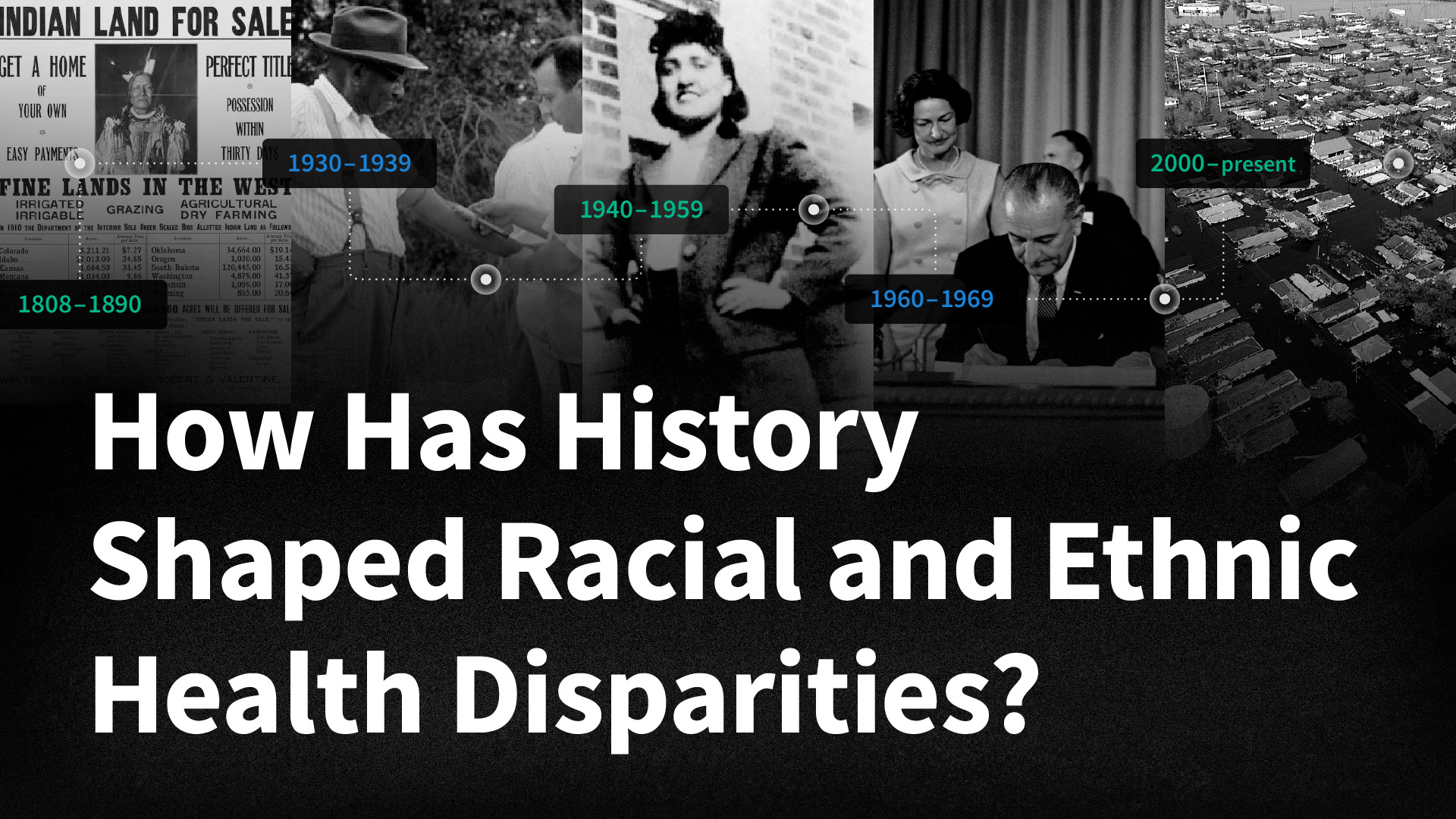
  • Timeline: How History Has Shaped Racial and Ethnic Health Disparities

    This timeline offers a historical view of significant U.S. federal policies and events spanning the early 1800s to today that have influenced present-day health disparities.
  • Health Policy 101: Chapter on Race, Inequality and Health

    Addressing persistent racial and ethnic disparities in health and health care is important for improving the nation’s health and economic prosperity. KFF explains such disparities and the factors that drive them, examines the actions to address them, and outlines future considerations.
  • Key Data on Health and Health Care by Race and Ethnicity

    Racial and ethnic disparities in health and health care remain a persistent challenge in the United States. An updated KFF resource examines how people of color fare compared to White people across 64 measures of health, health care, and social determinants of health.

Survey of Immigrants

KFF-New York Times Survey: Immigrants Report Rising Fear, Negative Economic and Health Impacts, and Changing Political Views During the First Year of President Trump’s Second Term

The 2025 Survey of Immigrants, a partnership between KFF and The New York Times, takes an in-depth look at the experiences of immigrants during the first year of President Trump’s second term, including their worries related to increased immigration enforcement, their health and economic wellbeing, and the political views and preferences of immigrant voters. The survey paints a portrait of families under strain — where fear of detention and economic instability are negatively impacting immigrants’ health and reshaping immigrant families’ daily lives and views of U.S. political parties.

Read the News Release | Explore The New York Times’ Reporting
Subscribe to KFF Emails

Choose which emails are best for you.
Sign up here

Filter

131 - 140 of 602 Results

  • Pulling It Together: New Orleans Five Years After the Levees Broke

    Perspective

    President Obama's visit to New Orleans on August 29, five years after Hurricane Katrina and the levee failures nearly destroyed the city, presented an opportunity for him to deliver a message on behalf of us all: The country still cares. It was a timely message. Seven-in-ten residents of New Orleans told us in our recent survey that they believe the rest of the country has forgotten them and the difficulties the city still faces in…

  • Section 1115 Waiver Watch: Medicaid Services for Traditional American Indian and Alaska Native Health Care Practices

    Issue Brief

    In October 2024, the Centers for Medicare and Medicaid Services (CMS) approved the first ever Section 1115 waiver demonstration amendments that would allow Medicaid and CHIP coverage of traditional health care practices for American Indian or Alaska Native (AIAN) people in Arizona, California, New Mexico, and Oregon. This Waiver Watch reviews disparities in health and health care for AIAN people and summarizes the key features of the approved waivers.

  • Explainer: How States Are Using Medicaid Waivers to Help Incarcerated Individuals Get Care and Transition Back into Their Communities 

    News Release

    Compared to the general population, individuals who are incarcerated have higher rates of mental illness, substance use disorder, and chronic disease. However, the federal “inmate exclusion” policy prohibits Medicaid coverage for people who are incarcerated (except for limited inpatient hospital services). When people leave incarceration, they are at greater risk of overdose death and suicide, as well as hospitalization and emergency department use.  In a new explainer, KFF examines a new waiver opportunity that allows…

  • Pulling It Together: A Recovery Raises Expectations Too

    Perspective

    New Orleans is a city still struggling with the aftermath of Katrina and the levee breaks. The people of New Orleans feel that the nation and the federal government have largely forgotten them. Those are the results of our 2008 survey of the people of New Orleans, the second in a series we are doing to track progress in the recovery from the perspective of the residents of the city themselves. As the head of a…

  • Medicare’s Role for Latinos – (Spanish version)

    Other Post

    Medicare's Role for Latinos - (Spanish version) Note: This publication is no longer in circulation. However, a few copies may still exist in the Foundation's internal library that could be xeroxed. Please email order@kff.org if you would like to pursue this option

  • Today’s Topics In Health Disparities

    Event Date:
    Event

    The Kaiser Family Foundation presents a series of live, interactive webcasts devoted to addressing a range of issues relating to health and health care disparities in the United States. Each discussion will feature a panel of experts tackling current issues in health disparities and answering questions from webcast viewers. 2011 HHS' New Action Plan to Reduce Racial and Ethnic Disparities(4/25/2011) PREVIOUS SHOWS: 2009 What Might Health Reform Mean for Women of Color?(12/16/2009) Is the Health…

  • New Analysis: Updated State Data Continues To Show Wide Disparities in COVID-19 Vaccination Rates by Race/Ethnicity

    News Release

    KFF has an updated analysis of state-reported data as of February 16, 2021 on COVID-19 vaccinations, cases, and deaths by race/ethnicity. New to the analysis are comparisons of vaccination rates in each racial/ethnic group based on state-reported data of total people who have received at least one dose of the vaccine. Among just over half of states reporting data, the vaccination rate among White people is over three times higher than the rate for Hispanic…