Medicare

NEW AND NOTEWORTHY

Examining the Potential Impact of Medicare’s New WISeR Model

A federal initiative to establish new prior authorization requirements in traditional Medicare, called the Wasteful and Inappropriate Service Reduction (WISeR) model, is likely to have only modest impact in its first year.

State Profiles for Dual-Eligible Individuals

This data collection draws on Medicare and Medicaid administrative data to present national and state-level information on people who are covered by both Medicare and Medicaid, referred to as dual-eligible individuals (also known as dually-enrolled beneficiaries).

Data Visualization

The Facts About Medicare Spending

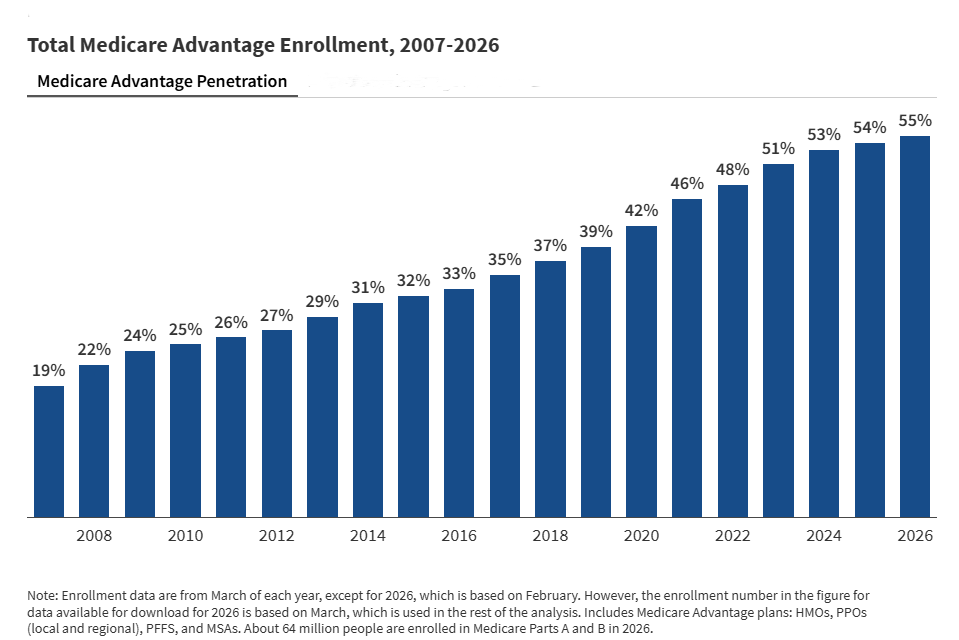
This interactive provides the facts on Medicare spending. Medicare, which serves 67 million people and accounts for 12 percent of the federal budget and 21 percent of national health spending, is often the focus of discussions about health expenditures, health care affordability and the sustainability of federal health programs. Explore data on enrollment growth, Medicare spending trends overall and per person, growth in Medicare spending relative to private insurance, spending on benefits and Medicare Advantage, Part A trust fund solvency challenges, and growth in out-of-pocket spending by beneficiaries.

Read More

Stay informed.

https://js.hsforms.net/forms/embed/292449.js

Stay informed.

https://js.hsforms.net/forms/embed/292449.js

Filter

511 - 520 of 1,605 Results

  • Limiting Private Insurance Reimbursement to Medicare Rates Would Reduce Health Spending by About $350 Billion in 2021

    Issue Brief

    This analysis estimates the total annual reduction in health care spending by employers and privately insured individuals that would result from having private insurers reimburse hospitals and other health care providers at Medicare rates. In total, we estimate spending for the privately insured population would be an estimated $352 billion lower in 2021 if employers and other insurers reimbursed health care providers at Medicare rates.

  • States Have Made Progress in Vaccinating Older Adults Against COVID-19 in Recent Weeks, But No State Has Vaccinated At Least Half of its Older Population

    News Release

    Twenty-two states and the District of Columbia have vaccinated at least one-third of their residents who are 65 and older against COVID-19, an updated KFF analysis finds, but no state has crossed the threshold of vaccinating 50 percent or more of its older population. The share of adults 65 and older who have received at least one dose of a vaccine ranges from 49 percent in North Carolina to 27 percent in Pennsylvania. (The relatively low…

  • Is the End of the Long-Term Care Crisis Within Sight? New COVID-19 Cases and Deaths in Long-Term Care Facilities Are Dropping

    Policy Watch

    This analysis compares trends in new COVID-19 cases and deaths among nursing facility residents with trends in all other new COVID-19 cases and deaths excluding nursing facility residents through February 7, 2021. This analysis shows a marked divergence in new cases and deaths per week between nursing facility residents and the rest of the US population since December 2020. This drop in new deaths and cases in nursing facility residents coincides with the start of…

  • The COVID-19 Pandemic Has Hit People of Color the Hardest, Including Among People With Medicare

    News Release

    The COVID-19 pandemic has underscored the stark racial and ethnic health inequities in the U.S., including among Medicare beneficiaries. Among this group, people of color, including older adults and others on Medicare, account for disproportionate shares of COVID-19 cases, hospitalizations and deaths, according to data presented in a new KFF report about racial and ethnic disparities in health among people with Medicare. Older Black, Hispanic, and American Indian/Alaska Native adults were nearly twice as likely…

  • Does Education Narrow the Gap in Wealth Among Older Adults, by Race and Ethnicity?

    Issue Brief

    This analysis of per capita income and assets among older adults in 2019 shows that differences in median per capita income among White, Black, and Hispanic adults ages 65 and older are narrower when comparing people with similar levels of education, although among college graduates, the gap in income continues to be wide between Hispanic and White seniors. The gaps in savings and home equity remain wide, and are particularly striking among seniors with less…

  • Racial and Ethnic Health Inequities and Medicare

    Report

    This chart collection draws on primary and secondary data analyses by KFF and other sources to examine the characteristics, experiences, and outcomes of the Medicare population by race and ethnicity

  • A Status Report on Prescription Drug Policies and Proposals at the Start of the Biden Administration

    Issue Brief

    This brief provides a status update on prescription drug final rules advanced by the Trump Administration in its final months related to Medicare, importation, and 340B pricing for insulin and epinephrine, and an overview of key drug pricing proposals related to Medicare and prescription drug prices generally that were voted on but not enacted in the previous Congress that may return to the forefront of health policy discussions in the coming years.

  • Addressing the Risk of Medicare Trust Fund Insolvency

    Perspective

    In this Viewpoint for the Journal of the American Medical Association (JAMA), KFF's Tricia Neuman and co-author Richard G. Frank of Harvard Medical School explain that the looming 2024 insolvency of the Medicare Hospital Insurance Trust Fund cannot be ignored for long.

  • January 14 Web Event: A Shot in the Arm For Long-Term Care Facilities? Early Lessons from the COVID-19 Vaccine Rollout to High Priority Populations

    Event Date:
    Event

    With the pandemic taking a heavy toll among older Americans, the Centers for Disease Control and Prevention and most states have placed a high priority on vaccinating residents and staff of long-term care facilities. People in nursing homes and other long-term care settings account for 6 percent of cases but 38 percent of deaths from COVID-19, a share that has remained largely consistent throughout the pandemic, according to KFF’s updated analysis. KFF held an interactive…