Medicaid

new and noteworthy

Medicaid: What to Watch in 2026

Medicaid: What to Watch in 2026

In this brief, KFF explores how state fiscal pressures are likely to converge with the implementation of the 2025 reconciliation law to affect Medicaid coverage, financing, and access to care over the next year, especially leading up to the midterm elections.

Medicaid Watch

Featuring policy research, polling and news about how Medicaid is changing, and the impact of those changes due to the tax and spending cuts law

Medicaid and work

Tracking Medicaid Work Requirements:
Data and Policies

To implement Medicaid work requirements, states will need to make important policy and operational decisions, implement needed system upgrades or changes, develop new outreach and education strategies, and hire and train staff, all within a relatively short timeframe. The information tracked here can serve as a resource to understand Medicaid work requirements and state options, gauge readiness, and track implementation of the requirements.

understanding medicaid

5 Facts: Provider Taxes

All states except Alaska cover some state Medicaid costs with taxes on health care providers. This brief uses data from KFF’s 2024-2025 survey of Medicaid directors to describe current practices and the federal rules governing them.

5 Facts: Medicaid and Hospitals

Absorbing reductions in Medicaid spending could be challenging for hospitals, particularly for those that are financially vulnerable. This brief provides data on the reach of Medicaid across hospitals, patients, and charity care.

5 Facts: Medicaid and Immigrants

Confusion persists about immigrants’ eligibility for federal programs. This brief helps readers understand how current Medicaid policy affects immigrants as well as the potential impacts of policy changes under the Trump administration.

5 Facts: Medicaid and Rural Areas

Approximately 66 million people live in rural areas – about 20% of the U.S. population. Nearly 1 in 4 of them have Medicaid, a higher share than in urban areas (24% vs 21%).

5 Facts: Nursing Facilities

The substantial Medicaid savings in the reconciliation bill that has been passed by the House could have major implications for nearly 15,000 federally certified nursing facilities and the 1.2 million people living in them.

2025 Medicaid Home Care survey

Payment Rates Ahead of 2025 Reconciliation Law

This issue brief describes Medicaid payment rates for home care and other workforce supports that are in place in 2025, before the majority of the 2025 reconciliation law provisions start taking effect.

Home Care Support for Family Caregivers in 2025
number of responding states, including DC, that allow payments for family caregivers by type of home care program and type of caregiver.

This issue brief describes the availability of self-directed services and supports for family caregivers in Medicaid home care in 2025, before most provisions in the reconciliation law take effect.

States’ Management of Home Care Spending

This issue brief describes the mechanisms states are currently using to limit Medicaid spending on home care and their plans for adopting new mechanisms in state fiscal year (FY) 2026.

Waiting Lists for Medicaid Home Care, 2016 to 2025
A Look at Waiting Lists for Medicaid Home- and Community-Based Services from 2016 to 2025

This data note provides new information about waiting lists in Medicaid home care before many of the provisions in the 2025 reconciliation law go into effect.

Eligibility and coverage
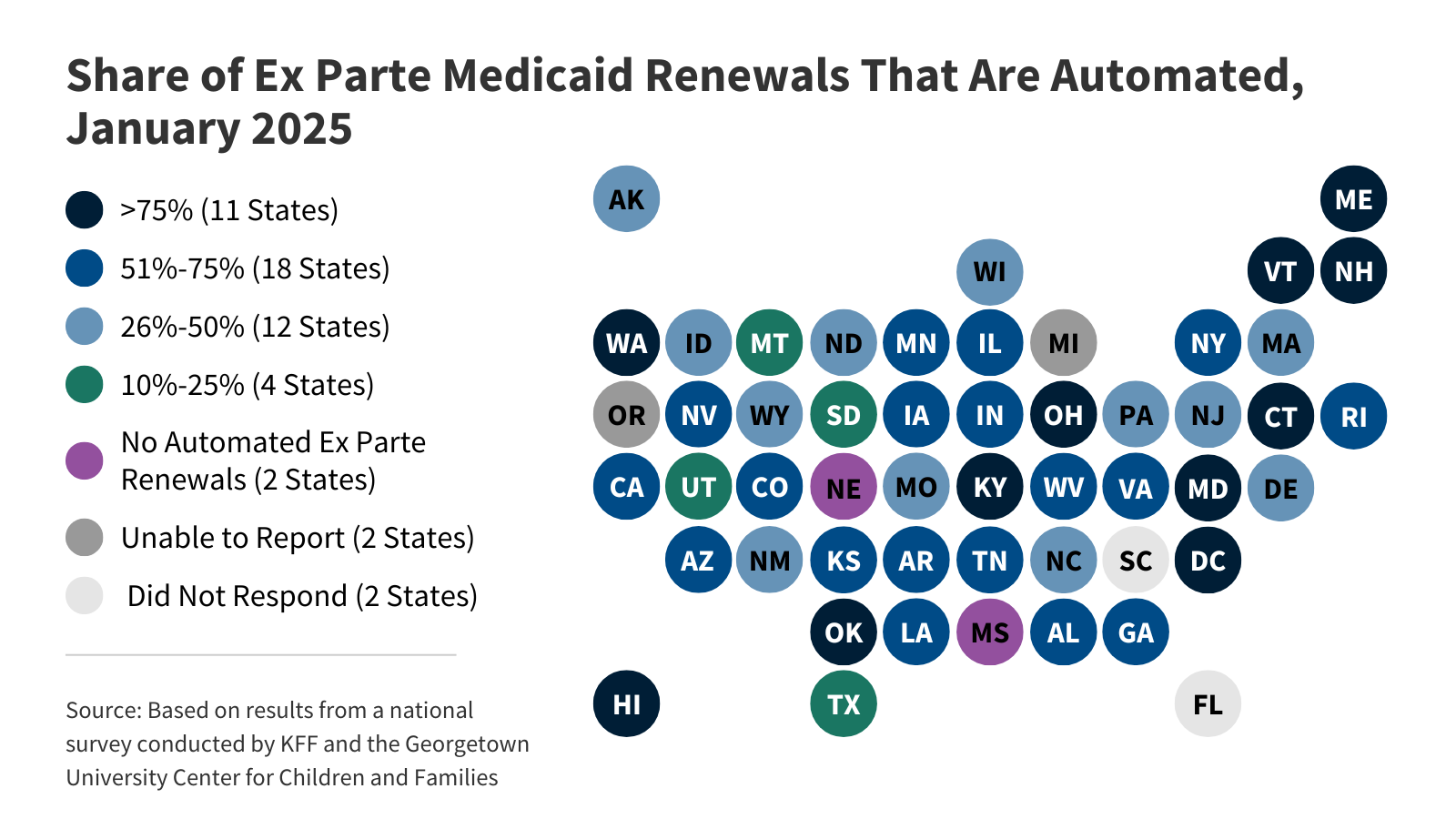
  • Eligibility, Enrollment, and Renewal Policies

    KFF's survey findings capture state actions that seek to improve the accuracy and efficiency of Medicaid and CHIP enrollment and renewal processes, as of January 2025.
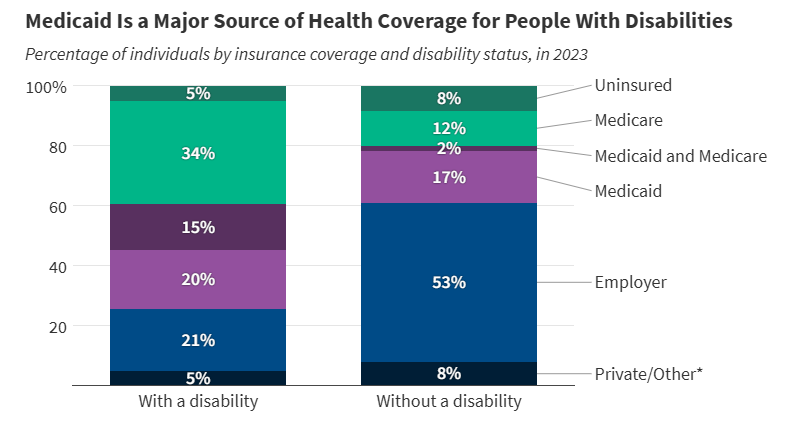
  • Seniors and People with Disabilities

    More than 1 in 3 people with disabilities (15 million) have Medicaid (35%). In comparison, only 19% of people without disabilities have Medicaid.
  • Children with Special Needs

    Amid debates about proposed cuts to federal Medicaid spending, this brief analyzes key characteristics of children with special health care needs and explores how Medicaid provides them with coverage.
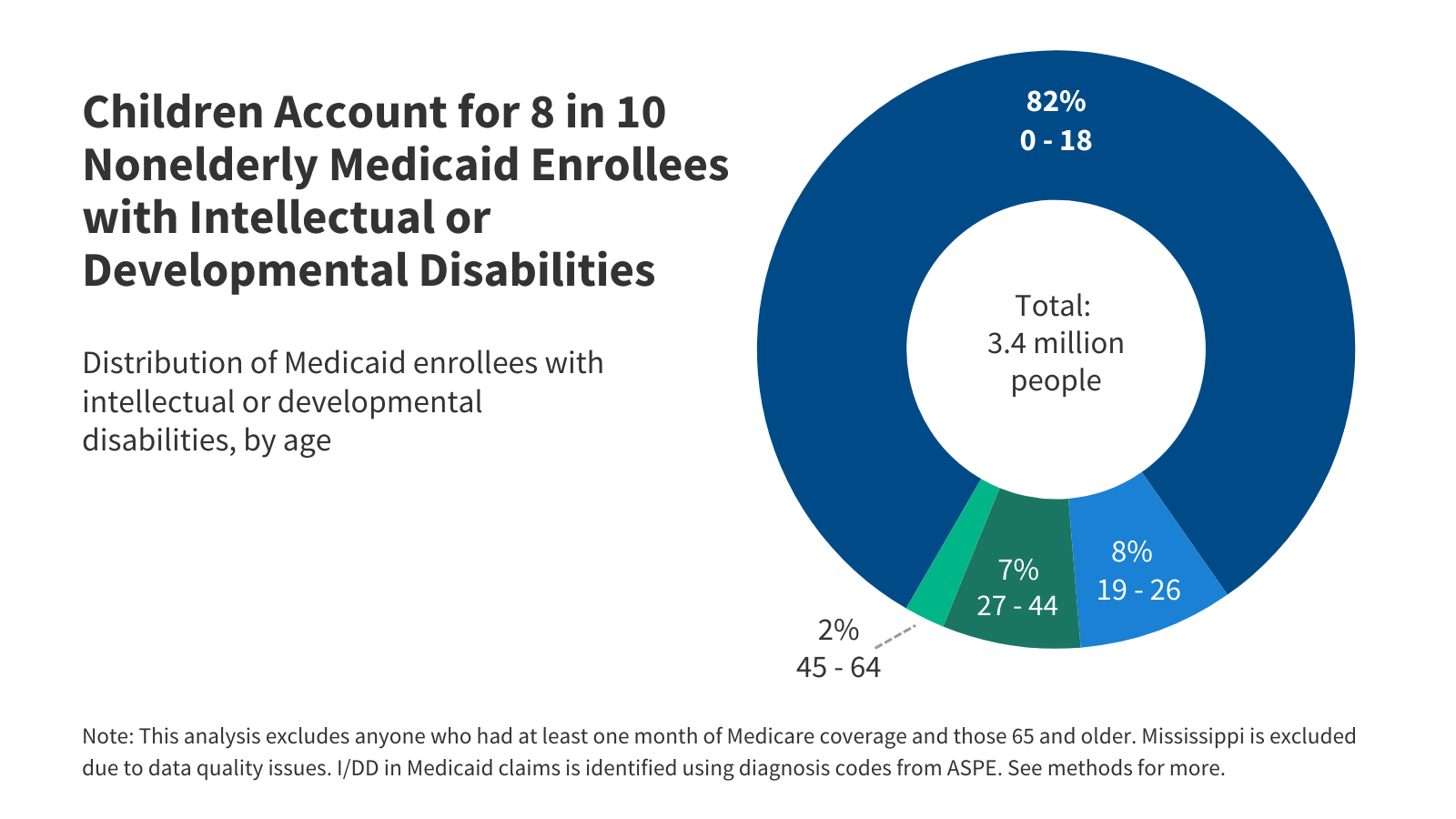
  • People With Intellectual and Developmental Disabilities

    Among the estimated 8 million people with intellectual and developmental disabilities (I/DD), over three million have Medicaid coverage.
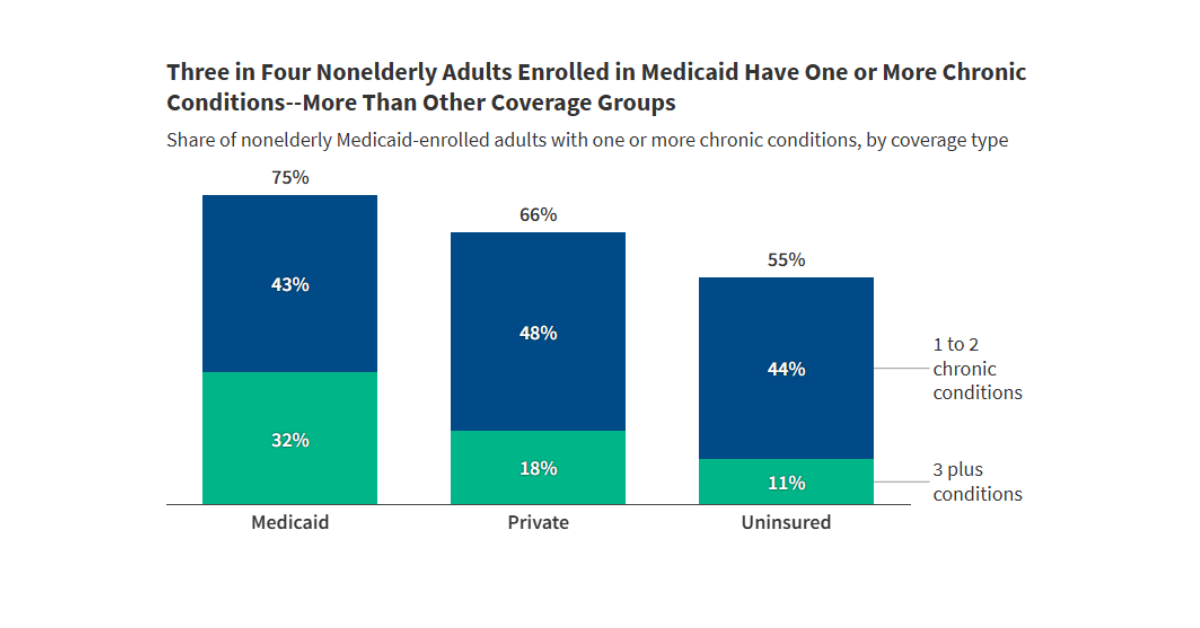
  • Adults with Chronic Conditions

    Among working age adults enrolled in Medicaid, approximately three quarters have one or more chronic conditions, and nearly one-third have three or more.

Subscribe to KFF Emails

Choose which emails are best for you.
Sign up here
Filter

1,371 - 1,380 of 2,685 Results

  • What Drives Spending and Utilization on Medicaid Drug Benefits in States?

    Issue Brief

    With the approval of new specialty drugs, such as the Hepatitis C treatments Sovaldi and Harvoni, states are mindful that the cost the Medicaid prescription drug benefit could increase. To achieve savings, and improve management and health outcomes, it is important to understand which drugs are most frequently prescribed and which drive spending. Using state drug utilization data provided through the Medicaid Drug Rebate Program, as well as an industry drug database, this issue brief examines trends in prescriptions and spending before rebates, and places findings in the context of policy discussion.

  • The State Innovation Models (SIM) Program: An Overview

    Fact Sheet

    This fact sheet provides an overview of the Center for Medicare and Medicaid Innovation (Innovation Center)'s State Innovation Models (SIM) initiative. It focuses on the delivery system and payment approaches that Model Testing states are taking and discusses what SIM means for Medicaid. Six states – Arkansas, Maine, Massachusetts, Minnesota, Oregon, and Vermont -- received Model Testing awards to implement and test their Innovation Plans over 42 months.

  • New Interactive Data Tool Tracks Medicaid Managed Care Market

    News Release

    The Medicaid Managed Care Market Tracker, a new feature of the Foundation’s State Health Facts data center, provides the latest data on key dimensions of risk-based Medicaid managed care for the 39 states that contract with MCOs – these states are home to more than 90 percent of all Medicaid beneficiaries nationwide. On Thursday, December 11 at 12:30 p.m. ET, the Foundation will host an interactive web briefing with Medicaid managed care expert Julia Paradise, an Associate Director of the Foundation’s Kaiser Commission on Medicaid and the Uninsured.

  • Key Findings on Medicaid Managed Care: Highlights from the Medicaid Managed Care Market Tracker

    Report

    This report highlights 10 key findings on the Medicaid managed care market, based on analysis of data included in the Kaiser Family Foundation's Medicaid Managed Care Market Tracker. The findings provide a partial profile of the Medicaid MCO market nationally and by state. They also illuminate the involvement of large, multi-state health insurance companies in the Medicaid market and the participation of these firms in other markets as well, including the managed long-term services and supports market, the new ACA marketplaces, and the Medicare Advantage market. Finally, these selected highlights serve to illustrate the array of ways the Tracker can be used to understand more about the Medicaid managed care market and its place in the broader market.

  • Health Insurance Explained: The YouToons Have it Covered

    Video

    In this five-minute animated video, the YouToons help consumers understand their health insurance through fun, easy-to-understand explanations and scenarios. This cartoon serves as a tutorial for consumers and organizations. The YouToons previously appeared in the 2010 animated movie, "Health Reform Hits Main Street" and the 2013, "The YouToons Get Ready for Obamacare: Health Insurance Changes Coming Your Way Under the Affordable Care Act."

  • Estimating Federal Payments and Eligibility for Basic Health Programs: An Illustrative Example

    Report

    In some states, policymakers and stakeholders are considering adoption of the Basic Health Program (BHP) option permitted under the Patient Protection and Affordable Care Act (ACA). Federal regulations allow BHP implementation beginning in 2015. Through BHP, consumers with incomes at or below 200 percent of the federal poverty level (FPL) who would otherwise qualify for subsidized qualified health plans (QHPs) offered in health insurance marketplaces instead are offered state-contracting standard health plans that provide coverage no less generous and affordable than what have been provided in the marketplace. To operate BHPs, states receive federal funding equal to 95 percent of the premium tax credits (PTCs) and cost-sharing reductions (CSRs) that BHP enrollees would have received if they had been covered through QHPs. This paper seeks to inform state-level analysts about the characteristics of BHP-eligible people in their state and how to use that information to estimate the approximate federal BHP payment amount per average BHP-eligible resident.

  • The ACA’s Basic Health Program Option: Federal Requirements and State Trade-Offs

    Report

    The Patient Protection and Affordable Care Act (ACA) gives states the option to implement a Basic Health Program (BHP) that covers low-income residents through state-contracting plans outside the health insurance marketplace, rather than qualified health plans (QHPs). In March 2014, the Centers for Medicare & Medicaid Services (CMS) issued final regulations on the requirements for a BHP and the methodology for calculating federal payments to states. States can choose to implement BHP beginning in 2015. This report summarizes these federal policies, including the requirements for BHP as well as the methodology for determining federal BHP payments. It then analyzes the key trade-offs facing states as they decide whether and, if so, how to implement BHP, with a particular focus on the impact of BHP on state budgets and the size, stability, and risk level of state marketplaces.

  • Medicaid Quiz

    Feature

    How much do you know about Medicaid, the role it plays in the lives of many Americans, how program dollars are spent and how Medicaid eligibility will change under health reform? Take this interactive quiz to find out.

  • Key Themes in Capitated Medicaid Managed Long-Term Services and Supports Waivers

    Issue Brief

    This issue brief analyzes key themes in 19 capitated § 1115 and § 1915(b)/(c) Medicaid managed long-term services and supports (MLTSS) waivers approved to date by the Centers for Medicare and Medicaid Services (CMS) with a focus on covered populations and services, provisions aimed at expanding beneficiary access to HCBS, beneficiary protections, and quality measurement and oversight.

  • Early Impacts of the Medicaid Expansion for the Homeless Population

    Issue Brief

    This analysis provides an early look at the impact of the expansion for homeless providers and the patients they serve. It is based on focus groups conducted with administrators, providers, and enrollment workers at four sites serving homeless individuals in states that have expanded Medicaid (Albuquerque, NM; Baltimore, MD; Chicago, IL; and Portland, OR) and one site in a state that has not expanded (Jacksonville, FL), as well as administrative data collected from the sites.