Medicare

New & Noteworthy

What to Know About Pharmacy Benefit Managers and Federal Efforts at Regulation

The top three pharmacy benefit managers (PBMs) manage 79% of prescription drug claims on behalf of 270 million people. We look at the role PBMs play in influencing drug costs and access to medicines, as well as efforts to regulate them.

State Profiles for Dual-Eligible Individuals

This data collection draws on Medicare and Medicaid administrative data to present national and state-level information on people who are covered by both Medicare and Medicaid, referred to as dual-eligible individuals (also known as dually-enrolled beneficiaries).

Data Visualization

The Facts About Medicare Spending

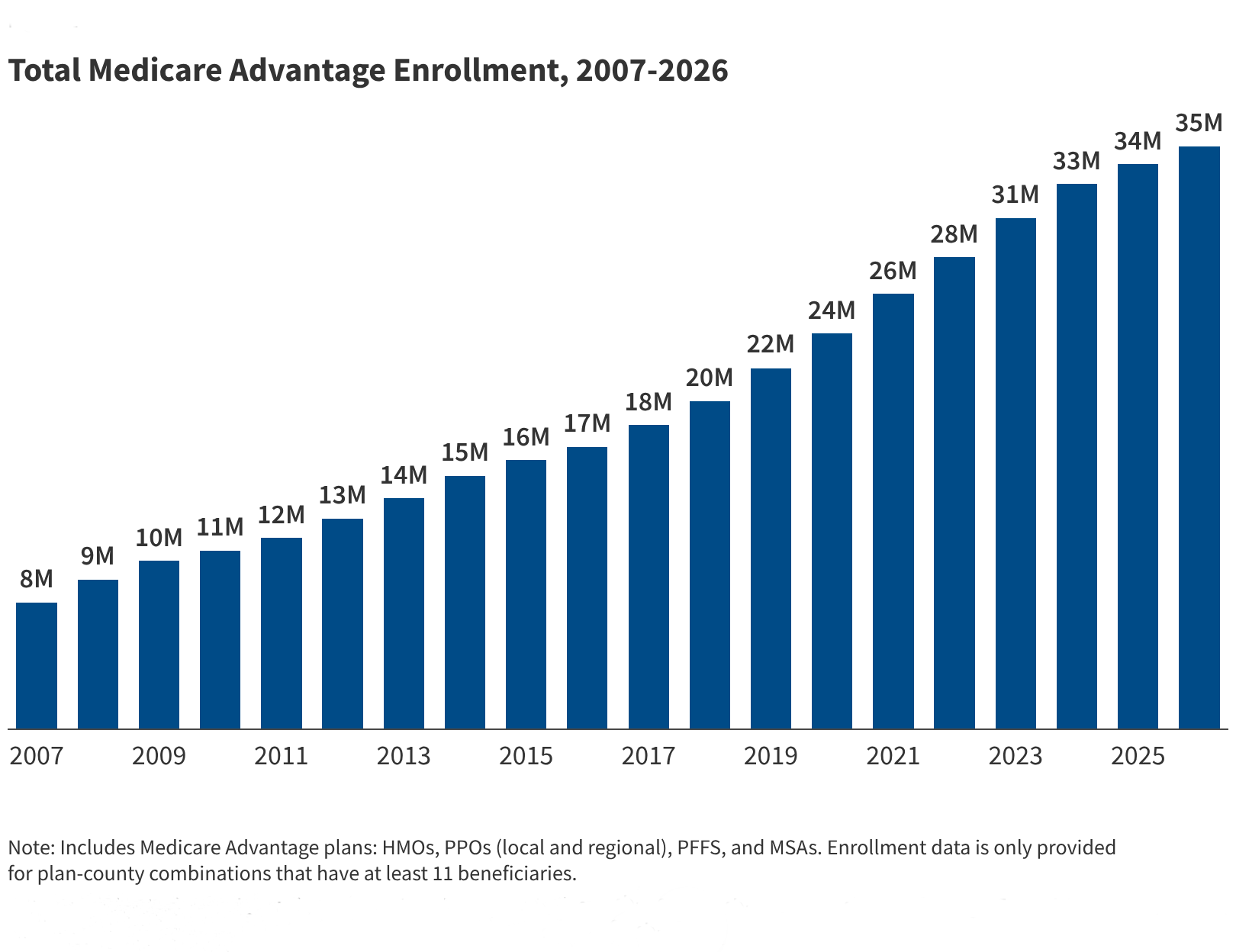
This interactive provides the facts on Medicare spending. Medicare, which serves 67 million people and accounts for 12 percent of the federal budget and 21 percent of national health spending, is often the focus of discussions about health expenditures, health care affordability and the sustainability of federal health programs.

Explore data on enrollment growth, Medicare spending trends overall and per person, growth in Medicare spending relative to private insurance, spending on benefits and Medicare Advantage, Part A trust fund solvency challenges, and growth in out-of-pocket spending by beneficiaries.

Related: FAQs on Medicare Financing and Trust Fund Solvency

Read More

Subscribe to KFF Emails

Choose which emails are best for you.
Sign up here

Filter

21 - 30 of 1,588 Results

  • Data Note: Abbreviated January 2016 Health Tracking Poll Topline

    Feature

    This is an abbreviated topline for the upcoming January 2016 Kaiser Health Tracking Poll.  It contains the survey questions addressed in Drew Altman's column, "Candidate Policy Plans Resonate More With Democrats. Here’s Why," for The Wall Street Journal's Think Tank.

  • What is Medicare’s Role in End-of-Life Care?

    News Release

    Medicare plays an integral role in end-of-life care, an issue that is emotionally-charged and easily politicized.  About three-quarters of the 2.5 million Americans who die each year are ages 65 and older, and covered by Medicare at the time of their death, yet policy issues related to Medicare and end-of-life care are often poorly understood.

  • Medicare Advantage Hospital Networks: How Much Do They Vary?

    Report

    This report takes an in-depth look at Medicare Advantage plans’ hospital networks. The analysis draws upon data from 409 Medicare Advantage plans serving beneficiaries in 20 diverse counties that together accounted for about one in seven (14%) Medicare Advantage enrollees nationwide in 2015. The report examines the size and composition of plans’ hospital networks, the variation across counties, the inclusion of Academic Medical Centers and NCI-Designated Cancer Centers, and the relationship between network size and other plan features, including premiums, quality star ratings, per capita Medicare spending, parent organization, and plan tax status.

  • Medicare Advantage 2016 Data Spotlight: Overview of Plan Changes

    Issue Brief

    This issue brief analyzes the number and variety of Medicare Advantage plan choices available to beneficiaries in 2016. It describes trends in number of Medicare Advantage plans, plan premiums, and plan quality ratings, including changes in prescription drug coverage and limits on out-of-pocket expenses. This spotlight is part of a series of spotlights tracking key changes in the Medicare Advantage program.

  • What’s in Store for Medicare’s Part B Premiums and Deductible in 2016, and Why?

    Issue Brief

    As a result of the recently-enacted Bipartisan Budget Act of 2015, the Medicare Part B monthly premium will be $121.80 in 2016 according to the Centers for Medicare and Medicaid Services, an increase of 16 percent over the 2015 amount for 30 percent of beneficiaries —far lower than the 52 percent increase initially projected by the Medicare actuaries. This Issue Brief reviews how Medicare Part B premiums and deductibles are affected by the recent budget deal (including the premium surcharge that covers the costs) and explains the connection between the Social Security cost-of-living adjustment (COLA), Medicare premiums, and the “hold harmless” provision that will keep premiums flat for 70 percent of beneficiaries in 2016.

  • Dual Eligible Demonstrations: The Beneficiary Perspective

    Issue Brief

    This issue brief provides insights about initial implementation of the financial alignment demonstrations from the perspective of dual eligible beneficiaries in Massachusetts, Ohio, and Virginia, based on 12 individual interviews conducted in early 2015. Profiles of six beneficiaries are presented to illustrate representative program experiences, along with key findings from across all of the interviews.

  • Primary Care Providers’ Views Of Recent Trends In Health Care Delivery And Payment

    Poll Finding

    A new survey from The Commonwealth Fund and The Kaiser Family Foundation asked primary care providers—physicians, nurse practitioners, and physician assistants—about their experiences with and reactions to recent changes in health care delivery and payment. Providers’ views are generally positive regarding the impact of health information technology on quality of care, but they are more divided on the increased use of medical homes and accountable care organizations. Overall, providers are more negative about the increased reliance on quality metrics to assess their performance and about financial penalties.

  • New Article and Infographics in JAMA Examine Medicaid and Medicare at 50 Years

    News Release

    The July 28 special issue of the Journal of the American Medical Association (JAMA) includes an article written by Kaiser Family Foundation President and CEO Drew Altman and former U.S. Senate Majority Leader William H. Frist, MD, and two infographics from the Foundation that examine the past, present, and future of Medicaid and Medicare.