
The Trump Administration’s Proposed $103,265 Fee for H-1B Visas Could Affect the Health Care Workforce

On August 25th, 2026, the Department of Homeland Security (DHS) published a proposed rule to establish a $103,265 fee on every H-1B visa petition subject to the annual visa cap. H-1B visa workers are immigrants with temporary approval to work in the U.S. in jobs that require specialized skills or knowledge. They have comprised an increasing role in the health care and social assistance industries, helping to fill workforce shortages. The number of new H-1B visas is capped at 65,000 each year with an additional 20,000 visas for those with a U.S. master’s degree or higher, although the cap is typically exceeded via exemptions. President Trump earlier sought to implement a $100,000 entry fee for new H1-B visas through a Presidential Proclamation in 2025, but it was halted by a District Court ruling on June 8, 2026. The proposed rule effectively replaces the 2025 Proclamation and would impact a broader group. The DHS states that the fee “would serve as a dedicated revenue mechanism to help recover a portion of the federal government’s costs of administering the lawful immigration system.” An increased fee for H-1B visas could lead to workforce reductions, which could exacerbate health care worker shortages.
While the 2025 Proclamation only applied to new H-1B visa petitions from outside the U.S., the fee under the proposed rule would apply to all H-1B visa petitions subject to the annual cap, including those already in the U.S. converting to an H-1B visa. Since the fee is applicable at the time of petition filing, it will apply to a significantly larger number of petitions than the 85,000 approved annually under the cap, including those that are not approved. Employers that are exempt from the annual cap, such as institutions of higher education, government research organizations, and certain nonprofits, will be exempt from the fee. However, private employers of any size, including small businesses and private hospitals, will be subject to the fee. Petitions for H-1B extensions, amendments, and transfers are not subject to the fee.
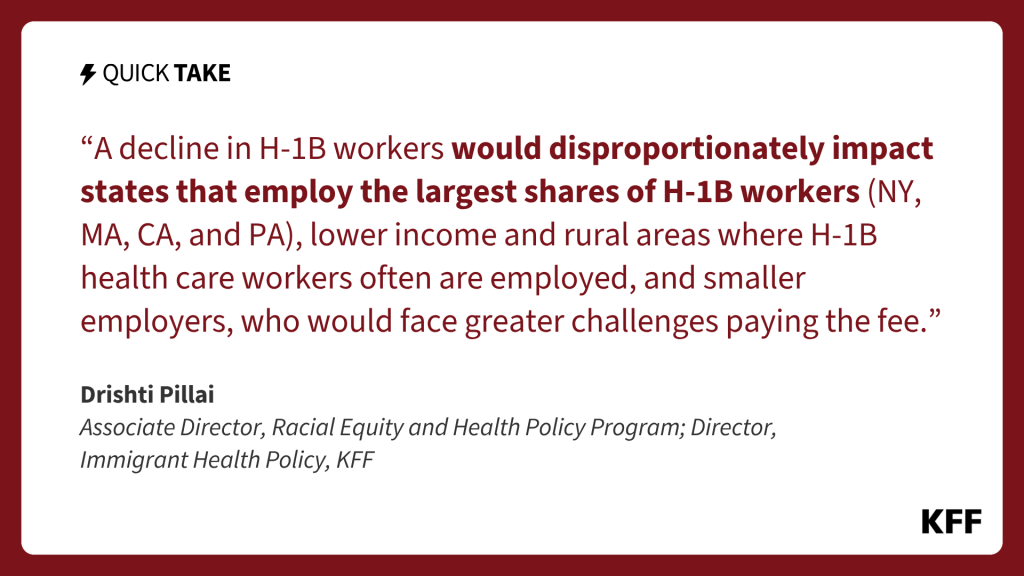
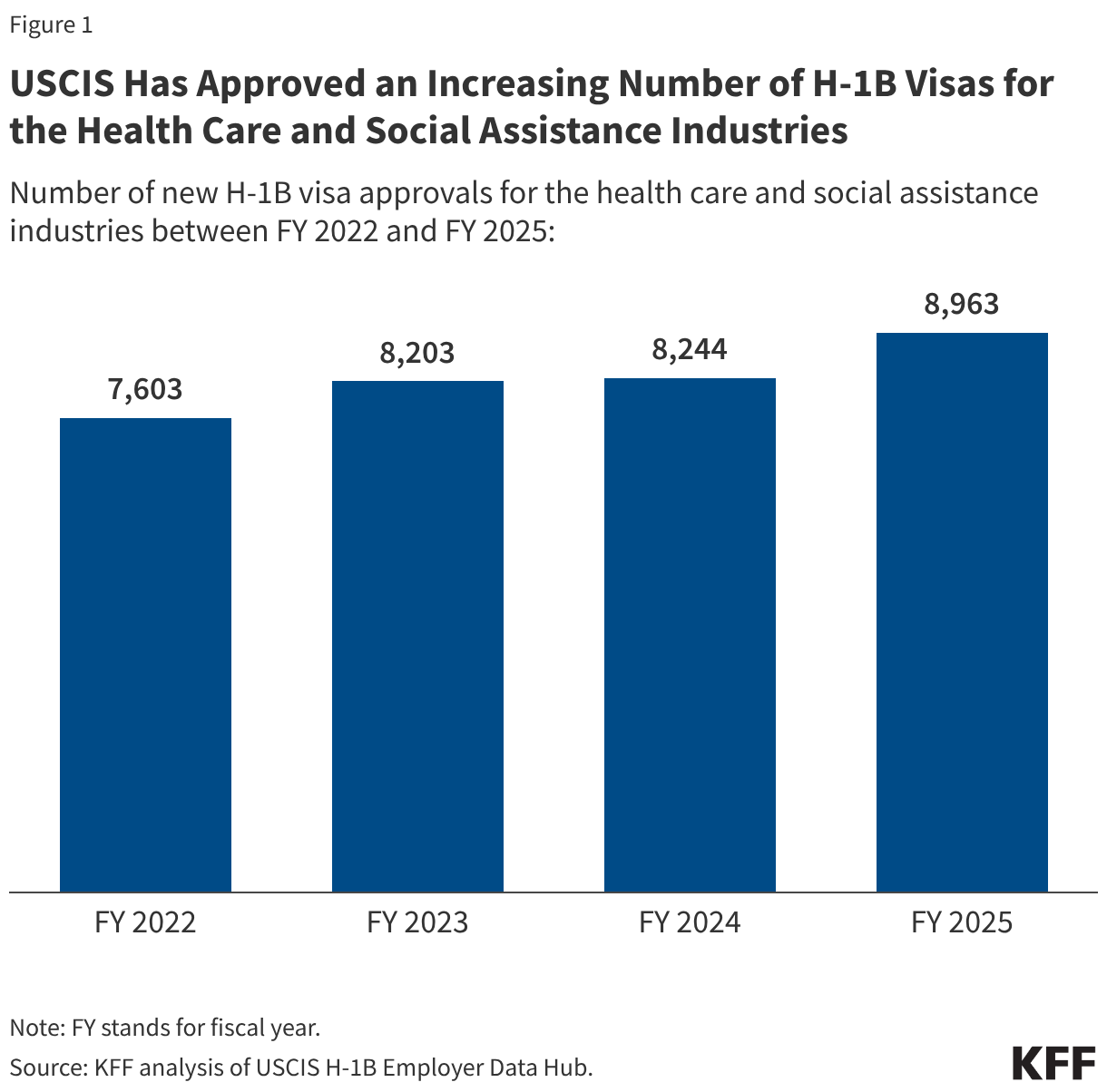
The proposed $103,265 fee could lead to reductions in U.S. health care workforce, increasing barriers to care. KFF analysis of U.S. Citizenship and Immigration Services data shows that new H-1B visa approvals for the health care and social assistance industries increased by around 18% between 2022 and 2025 (Figure 1). A decline in H-1B workers would disproportionately impact states that employ the largest shares of H-1B workers (NY, MA, CA, and PA), lower income and rural areas where H-1B health care workers often are employed, and smaller employers, who would face greater challenges paying the fee.
Public comments on the proposed rule are due by September 24th, 2026, after which the DHS is legally required to review and consider the feedback received before it can publish a final rule. Although the proposed rule does not mention an implementation date, the rule could go into effect as early as March 2027, when the registration period for the following fiscal year’s H-1B cap officially opens.