Court Decision Eases Burden of Proof to Qualify for Medical Frailty Exclusion to Medicaid Work Requirements

On October 29, 2026, a district judge ruled in Massachusetts v. Oz that the Centers for Medicare and Medicaid Services (CMS) exceeded its authority when it narrowed the definition of medical frailty to require individuals to show that a health condition limits their ability to work or volunteer to qualify for an exclusion from Medicaid work requirements. This ruling applies nationwide to all states implementing Medicaid work requirements and means that individuals will now only need to show that they have a condition that falls into one of the five medical frailty categories listed in the statute to qualify for the exclusion. The Department of Health and Human Services has not announced whether it will appeal the decision.
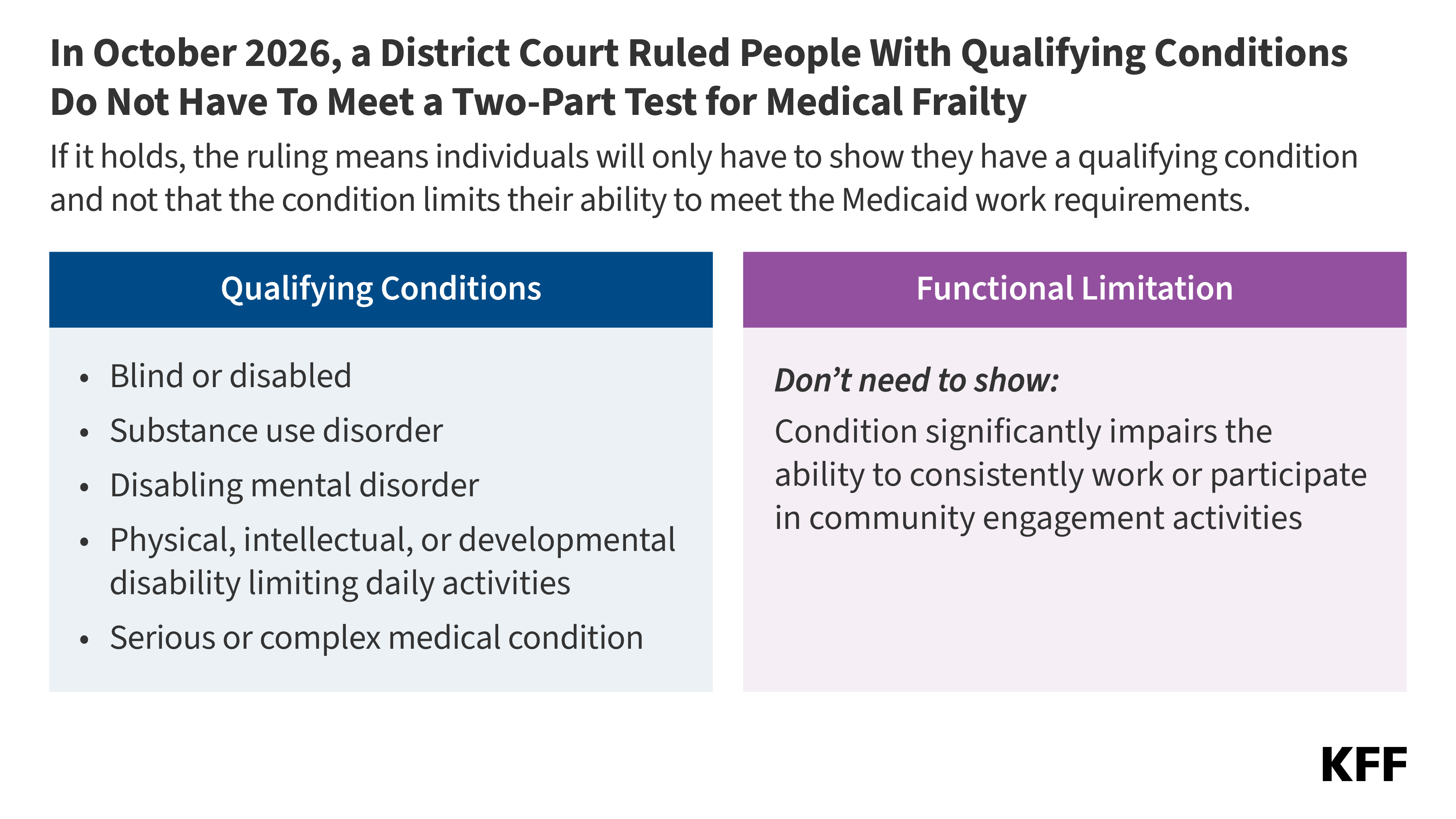
The lawsuit was filed in June 2026 by Democratic Attorneys General from 24 states including the District of Columbia and two Democratic Governors soon after CMS released an interim final rule (IFR) implementing Medicaid work requirements. The lawsuit challenged aspects of the Trump administration’s interpretation of the 2025 reconciliation law’s requirements, including most notably the medical frailty exclusion. The IFR introduced a two-part test to qualify for the medical frailty exclusion, requiring an individual to have a medical condition that meets the statutory requirements and that the condition impair the individual’s ability to comply with community engagement requirements.
The plaintiff states argued this two-part test for medical frailty went beyond a plain language reading of the statute, in which Congress provided a broad rather than narrow exclusion for people who are medically frail. Siding with the states, the judge agreed that otherwise “eligible vulnerable individuals relying on Medicaid” could lose coverage and declared the requirement unlawful (Figure 1).
The ruling will ease somewhat the administrative burden associated with implementing the medical frailty exclusion by reducing the complexity of the verification process, likely leading to fewer people losing coverage for paperwork reasons. It will also reduce some concerns among providers who would have been asked to determine whether a patient’s condition limited their ability to meet the work requirements in most states starting in 2028, something they are not typically trained to do. States are permitted to accept self-attestation of medical frailty status in 2027. It does not, however, eliminate entirely the complexity and uncertainty states are facing with the January 1, 2027 deadline to implement work requirements fast approaching. States are likely to be cautious about shifting course completely to undo work in progress to implement the two-part medical frailty test, such as creating tiered frameworks (in line with later CMS guidance) or making system changes, until it is clear the decision will stand.
The court’s full decision was not a complete victory for the states that brought the litigation. The plaintiff states had also challenged the rule’s restrictions on using claims data for only the preceding 12 months to verify medical frailty status and limiting the use of self-attestation to no more than once per continuous enrollment period starting in 2028. The ruling upheld these restrictions.