Managed Care Plan Liability: An Analysis of Texas and Missouri Legislation

Published: Oct 30, 1997

The Impact of Managed Care Legislation: An Analysis of Five Legislative Proposals from California

Health Policy Economics GroupPrice Waterhouse LLP

November, 1997

Executive Summary

Managed care has grown tremendously in recent years. From 1988 to 1997, at firms with 200 or more employees, the proportion of employees enrolled in HMOs nationwide increased from 18 percent to 33 percent. The presence of managed care varies by state across the country but is particularly strong in California where the proportion of HMO enrollment is more than 50 percent of the private insurance market in several large metropolitan areas. For example, in Sacramento, 92 percent of those with private insurance are enrolled in HMOs; in San Francisco and San Jose, the proportion is more than 68 percent.

As managed care has grown, in California and throughout the country, complaints against managed care plans have also mounted. Patients have raised concerns that managed care plans deny necessary coverage or provide access to mainly lower quality services. Physicians and other providers have expressed concerns that managed care plans may dictate care, monopolize the marketplace, and exclude independent practitioners. As a result, legislation aimed at addressing some of these concerns has been proposed at the federal and state levels.

This report presents results from a study conducted by Price Waterhouse LLP which was commissioned by The Henry J. Kaiser Family Foundation. The purpose of the study was to assess the impact of managed care reform legislation on HMOs and their enrollees. Specifically, the study analyzes five areas of California legislation: insurer liability, use of drug formularies, mental health parity, direct access to obstetric and gynecologic services, and lengths of stay for mastectomy patients. For each of these areas, the paper examines the specifics of the legislative bills in California, the likely impact of the legislation on HMOs by organizational type, and the corresponding effects for consumers.

Measuring the Impact of Managed Care Legislation

For the most part, many of the concerns about managed care plans have arisen because of the nature of the services provided by these plans. Managed care plans offer a lower-cost alternative to traditional, fee-for-service health insurance. Managed care plans are able to keep costs low through the use of various cost-saving strategies. For example, most HMOs limit access to providers by the use of a gatekeeper, usually a primary care physician, who must give prior approval before enrollees receive services from other providers, such as hospitals and medical specialists. Managed care plans also engage in practices of limiting the types of services provided to enrollees. For example, they may deny coverage for diagnostic tests and other procedures that the plan determines not to be medically necessary. They encourage outpatient treatment rather than inpatient care, and, when inpatient treatment is necessary, they encourage short hospital stays. The purpose of much of the recently proposed legislation is to protect consumers from some of the least desirable features of managed care cost-saving practices.

Managed care legislation, like most consumer protection, has positive and negative aspects. On the positive side, most of the proposals are intended to improve access to health care providers and medical services. As an example of managed care legislation, health plans could be required to give enrollees access to any provider that they choose. This would increase access to a variety of providers and have positive benefits for enrollees. On the other hand, this type of legislation might be costly to HMOs and other managed care organizations. If HMOs incur increased costs as a result of legislation, they would likely reduce covered services or increase enrollee premiums and/or out-of-pocket costs. If HMOs increase their rates, or reduce benefits, then some enrollees may decide to enroll in traditional insurance plans. In the extreme, managed care regulation could make managed care noncompetitive with traditional, fee-for-service insurance.

Difference in Impact by Type of HMO. The impact of consumer protection legislation may vary depending on the type of managed care plan. There are four basic types of HMOs:

  • Staff model-Physicians practice as employees of the organization, frequently in an office comprised of only HMO staff.
  • Group model-The managed care organization pays a physician group a negotiated, per capita rate which the group then distributes among the individual physicians.
  • Network model-HMOs contract with two or more group practices and usually pay a fixed monthly fee per enrollee.
  • Independent practice/physician association (IPA) model-HMOs contract with individual physicians in independent practice or with associations of independent physicians.

Because the physician and the plan are much more integrated in staff and group model HMOs than in IPA and network model HMOs, staff and group model HMOs are most likely to be able to manage care as well as coordinate and control the behavior of plan physicians. IPA and network model HMOs, on the other hand, are more loosely designed and thus are more limited in the methods by which they can control plan physicians.

For the most part, legislation aimed at reforming managed care seems directed toward HMOs. Although there are forms of managed care plans other than HMOs-such as preferred provider organizations (PPOs) and point-of-service plans (POSs)-that may be impacted by health care legislation, this study primarily focuses on the impact of managed care legislation on HMOs.

ERISA. The impact of state managed care legislation could be limited because of preemptions under the Employee Retirement Income Security Act (ERISA) of 1974. ERISA provides a broad federal preemption of state laws that relate to employee benefit plans. State insurance laws, however, do not fall under this preemption. Thus, state laws may affect non-self-insured employer-sponsored plans through regulation of the insurers. Because of ERISA, non-risk-bearing networks contracting only with self-insured plans and the self-insured plans themselves are exempt from complying with state managed care legislation. With respect to liability, however, both non-self-insured and self-insured plans can be shielded by ERISA from state attempts to expand insurer liability. Plaintiffs are permitted to sue only for the value of the benefit denied. They are not permitted to sue for other damages under ERISA. Because of ERISA preemptions, the effects of state-level managed care reforms would be limited since many employer-sponsored plans will not be affected by these reforms. Only the federal government can enact legislation that governs all managed care plans.

Insurer Liability

Background. Traditionally, insurance plans have not been the target of liability suits since they have not been viewed as being participants in the decision-making process regarding the treatment of patents. With the evolution of managed care, this has changed. By definition, managed care plans manage patient care. The plans not only reimburse a portion of the medical expenses incurred by a patient, they may also greatly influence a patient’s treatment. As a result, recently, there has been a legislative movement to hold managed care plans legally accountable for their role in the decision-making process of patient care. The concept behind the legislation is the idea that if managed care plans face a greater potential for lawsuits, they will be more likely to make decisions that are in the best interest of their patients.

Legislation. Insurer liability legislation has been introduced in the U.S. Congress and in numerous states. In 1997, the California legislature considered five bills related to insurer liability. Three of the bills-SB 324, SB 557, and AB 794-extend liability to managed care organizations by expanding the definition of the practice of medicine to include decisions regarding the medical necessity or appropriateness of any diagnosis, treatment, operation, or prescription. Among other actions, AB 794 also requires that health plans make available to the public, upon request, the criteria used by plans to determine whether to deny or authorize health care services. A fourth bill, AB 536, solely requires plans to make available to the public, upon request, the criteria used in deciding whether to deny or authorize care. The fifth bill, AB 977, provides that a health care service plan would be liable for damages for harm to an enrollee that is caused by the plans failure to exercise ordinary care or caused by decisions made by employees, agents, ostensible agents, or certain representatives of the health care service plan.

Impact. In this study, we assess the impact of expanding liability to managed care organizations through legislation. We find that the impact of expanding malpractice to managed care plans has the potential to greatly reduce their ability to control costs through case management, especially for group model HMOs, but the actual impact may be negligible because of a number of mitigating factors.

First, most employer-sponsored plans may be able to avoid liability by claiming the ERISA preemption. Second, to the extent that group model HMOs are currently being successfully sued in California, then the potential for additional lawsuits may be slight for those HMOs. Therefore, the impact of managed care liability legislation may mainly be limited to a subset of IPA model HMOs, but the effect on these HMOs would be modest. We estimate that at the most, premiums of IPA model HMOs would increase from 0.1 to 0.4 percent.

To the extent that management efficiency is reduced as a result of expanded liability, enrollees would likely gain access to care that they otherwise would not have received. Some of this care may be appropriate and necessary, thus improving the quality of treatment for some enrollees.

Use of Drug Formularies

Background. In the early 1990s, many managed care organizations adopted the use of drug formularies as a method for reducing the costs of prescription drug coverage. A formulary is a list of drugs, rated on clinical and cost criteria, that have been approved and are covered by the plan for treatment of particular illnesses. As a result of concerns about the effects of formularies on managed care enrollees, various forms of legislation have been created.

Legislation. In 1997, more than 40 bills concerning drug formularies have been introduced in more than 25 states. In 1997, the California legislature considered three bills that address issues related to drug formularies: SB 625, AB 974, and AB 1333. SB 625 requires that plans provide an expeditious process by which prescribing providers may obtain authorization for a medically necessary nonformulary prescription drug, make known to the enrollee any reason for disapproval, and make available their formularies upon request. AB 974 requires that a plan provide coverage for a drug if coverage for that drug had been previously approved by the plan for the enrollee and if the drug continues to be prescribed by the physician. AB 1333 prohibits a plan from requiring physicians to prescribe a drug from the formulary if the appropriate drugs from the formulary have been tried and have been unsuccessful in treating the patient.

Impact. By making the consumer better informed, legislation such as SB 625 may enable enrollees in managed care plans to have more negotiating power regarding their treatment, but we do not expect large financial consequences for managed care plans. Based on our assumption that formularies enable plans to save money by providing the most cost-effective medications, as a result of AB 974 and AB 1333, we would expect HMOs (particularly IPA model HMOs) to incur increased costs. Because these bills are limited in scope, the resulting increases in premiums for HMOs would be fairly modest-most likely significantly less than 0.6 percent. In general, both AB 974 and AB 1333 provide certain enrollees easier access to nonformulary drugs while not having a significant impact on the financial stability or the management style of HMOs.

Mental Health Parity

Background and Legislation. The idea of requiring parity in health insurance coverage for mental disorders has been a much debated issue in recent years. In 1996, President Clinton signed into law the Mental Health Parity Act of 1996 which amended ERISA and the Public Health Service Act to provide parity between annual and/or aggregate lifetime dollar limits on mental health benefits with the limits on medical and surgical benefits of group health plans. Various forms of mental health parity legislation have been passed in numerous states. In 1997, the California legislature considered AB 1100 which would mandate health care plans to cover biologically based severe mental illnesses for enrollees of all ages and cover serious emotional disturbances of children under the same policy terms and conditions applied to other medical conditions.

Impact. As a result of AB 1100, those with severe biologically based mental illnesses and children with serious emotional disturbances would likely obtain improved access to mental health services, since their conditions would be subject to the same policy coverage as other physical illnesses. These enrollees would be likely to use more mental health services which, in turn, would lead to increased costs for the health plans.

We estimate the increase in premiums resulting from these increased costs would be approximately 2.1 percent for all plan types in California. Specifically, we estimate that there would be a 1.0 percent premium increase for HMOs, 2.7 percent increase for PPOs/POSs, and 3.6 percent increase for fee-for-service plans.

This bill would also increase the market share for managed care plans since those plans would have lower increases in premiums than traditional fee-for-service plans. Furthermore, since HMOs, particularly group models, are good at managing care, enrollees may not experience as significant an increase in access to mental health services as those in fee-for-service plans. The effects of parity would fall more strongly on fee-for-service plans which use the limits on services to control costs instead of case management techniques which are the mainstay of managed care. For that reason, the mental health parity legislation would tend to increase enrollment in HMOs.

Direct Access to Obstetrical and Gynecological Services

Background and Legislation. As with care from other specialists, many HMOs require that a woman have a referral from her primary care physician to see an obstetrician and gynecologist. However, many have argued that women should have direct access to obstetricians and gynecologists who, in many situations, are viewed as primary care physicians. Legislation providing some form of such access has been passed in many states. In 1994, California enacted legislation enabling women to choose an obstetrician and gynecologist as their primary care physician. In 1997, the Assembly and the Senate in California passed legislation (AB 1354) that would have required health plans to provide women with direct access to obstetrical and gynecological services, but that bill was vetoed by the Governor.

Impact. Given that women in California could already choose obstetricians and gynecologists as their primary care physicians, we estimate that AB 1354 would result in slightly higher premiums and out-of-pocket costs for HMO enrollees, approximately a 0.35 percent increase.

At the same time, enrollees would benefit from easier access to obstetrical and gynecological services and, in some circumstances, would benefit from improved quality of care. We expect similar impacts on both IPA model and group model HMOs. However, this type of legislation could have a longer-term impact on managed care that would be much larger in magnitude, if it sets in motion other legislation that would hinder the ability of managed care plans to limit access to specialists other than obstetricians and gynecologists.

Lengths of Stay for Mastectomy Patients

Background and Legislation. Since the 1996 passage of federal legislation mandating lengths of stay for maternity visits, mandating lengths of stay for mastectomies has become a common area for managed care legislation. In response to increased outpatient surgeries and decreased inpatient lengths of stays for mastectomies, legislation mandating minimum hospital stays has been introduced at both state and federal levels. In 1997, the California legislature considered bills that would mandate that the hospital length of stay for mastectomies be determined by the physician in consultation with the patient and those that mandate a 48-hour minimum stay.

Impact. We estimate that if a 48-hour minimum stay for mastectomies were enacted, the mean length of hospital stay for mastectomies would increase by 11 percent, from 2.0 days to 2.2 days. This estimation is based on the assumption that 25 percent of the short-stay patients-those who would have previously stayed less than 48 hours-elect to stay the full 48 hours if this legislation is enacted. In terms of an increase in health plan premiums, we estimate that the 48-hour minimum stay would result in only a one-hundredth of a percent (0.01%) increase in premiums, for both IPA model and group model HMOs. We would expect a similar increase in California and nationwide.

Conclusion

Based on our analyses, we were able to draw several conclusions which we hope will provide a starting point for further analyses of these proposals as well as other proposals that would regulate this industry.

First, proposals for managed care reforms improve some aspect of medical care or access to services for enrollees in managed care plans. Every proposal that we considered would, to some extent, force HMOs to offer more and/or better services to enrollees.

Second, proposals for managed care reforms tend to increase health plan costs and raise premiums. More services implies higher benefit costs for health plans. The plans, in turn, pass the costs along in the form of higher premiums. We estimate only small premium increases as a result of specific pieces of managed care legislation. However, if a large proportion of current managed care legislation were enacted, then the impact might be very large premium increases accompanied by a large shift in enrollment to fee-for-service plans. The impact of legislation, however, would likely vary according to type of HMO.

Finally, the impact of state managed care legislation could be severely limited by ERISA which enables self-insured plans to avoid compliance with state legislation. Furthermore, under ERISA, both self-insured and non-self-insured plans can avoid the attempts of states to expand insurer liability. In order to ensure that reforms affect all health plans, legislation would have to be passed at the federal level.

* * *A full copy of the report can be ordered by calling the Kaiser Family Foundation’s publication request line at (800) 656-4KFF and asking for document #1342. A report on Managed Care Plan Liability: An Analysis of Texas and Missouri Legislation is available separately. Return to top

The Impact of Managed Care Legislation: An Analysis of Five Legislative Proposals from California

Managed Care Plan Liability: An Analysis Of Texas And Missouri Legislation Library Index
Kaiser/Harvard National Survey of Americans’ Views on Managed Care

Published: Oct 30, 1997

Is There A Managed Care “Backlash?”

Embargoed for release: 9:30 a.m. ET, Wednesday, November 5, 1997

For further information contact: Matt James or Tina Hoff

Most Americans Give Their Own Health Plan A Good Grade, But Have Concerns About Key Aspects Of Managed Care

Washington, DC — At a time of expanding enrollment and stricter federal and state regulation, how does the public feel about managed care? Most insured Americans — regardless of whether they have managed care or traditional coverage — give their own health plan a letter grade of “B” or higher. However, majorities of the public also say they are concerned about key aspects of managed health care. According to a new national survey by the Kaiser Family Foundation and Harvard University:

  • A majority of Americans (59%) say managed care plans have made it harder for people who are sick to see medical specialists (25% say easier);
  • Half (51%) say managed care has decreased the quality of care for people who are sick (32% say increased);
  • Three out of five (61%) say managed care has reduced the amount of time doctors spend with patients (16% say increased);
  • A majority of people in managed care — 55 percent — say they are at least “somewhat worried” that if they were sick their “health plan would be more concerned about saving money than about what is the best medical treatment;” 34 percent of those with traditional health insurance coverage feel this way.

One area where managed care does come out on top is preventive care: nearly half (46%) of people say managed care has made it easier to get services such as immunizations, health screenings, and physical exams (31% say harder).

The survey also found that people seem to generalize from anecdotal reports in the news about problems with managed care. When asked about specific examples taken from news stories about the problems some people have reported to have had with managed care, the public’s perception is that these are fairly common occurrences. For example, two thirds of Americans believe that a Health Maintenance Organization (HMO) holding back on a child’s cancer treatment is something that happens “often” (26%) or “sometimes” (40%). Two out of five (39%) think newborn babies being sent home after just one day because of a managed care plan’s policy, in spite of mothers’ concerns, happens “often;” an additional third (34%) think this occurs at least “sometimes.”

“Managed care is winning in the health care marketplace, but it is in danger of losing the battle for public opinion,” said Drew E. Altman, Ph.D., President, Kaiser Family Foundation.

More people — 34 percent — think managed care health plans do a “good job” in serving health care consumers than think do a “bad job” (21%). However, overall, other health care groups are viewed far more favorably than managed care health plans: solid majorities of Americans think nurses (83%), doctors (69%), hospitals (61%), and pharmaceutical companies (62%) generally do a “good job.” For many people, though, the jury is simply still out: 32 percent have no opinion about the kind of job managed care health plans are doing.

Who Benefits from Managed Care Savings?

Many people perceive the cost savings from managed care as benefiting both employers (56%) and individuals (49%), but it is the health insurance companies themselves that most (72%) say reap the rewards in the form of greater profits. Few Americans believe the trend to managed care has had a significant impact on the overall cost of health care in this country, with most — 55 percent — saying they don’t see that it has made much of a difference; 28 percent say it has helped bring down costs.

Should Managed Care Be Regulated?

In recent weeks, the push for regulation of managed care has intensified with some industry leaders now calling for “legally enforceable national standards.” The President’s Advisory Committee on Consumer Protection and Quality in the Health Care Industry is also expected to soon release a “consumer bill of rights.” A slight majority of Americans — 52 percent — say the government should protect consumers of managed care; 40 percent say such intervention is not worth the increased costs that would result. When asked who they would “most like to see managed care plans regulated by,” the public is divided over whether the government — federal (19%) or state (18%) — or an independent organization (34%) should regulate the industry. Sixteen percent (16%) maintain that managed care plans should not be regulated at all.

Managed … What?

Few Americans are familiar with some of the key terms used in debates over health care policy. A sizeable percentage of people — 28 percent — have never heard of “managed care” (45% know what it means; 26% have heard of it but are not sure what it means). “Fee-for-service” is even less recognized: while 41 percent say they know what it means, 43 percent say they have never heard the term (15% have heard of it but are not sure what it means). HMOs are more familiar: 62 percent say they know what it means (24% have heard of but are not sure what it means, and 14% have never heard the term).

Comparing the Views of Managed Care Enrollees with People in Traditional Health Plans

People in managed care are more worried than those with traditional coverage when it comes to the perceived motivations of their health plans. Insured respondents under 65 in this survey were grouped into three categories based on their health care coverage: “heavy” managed care, reflecting the most restrictive arrangements; “light” managed care, reflecting less restrictive arrangements; and “traditional” fee-for-service plans. Three out of five people (61%) in “heavy” managed care say they would be at least “somewhat worried” that their health plan would be more concerned about saving money than providing the best treatment option if they were sick. Fifty-one percent (51%) of those in “light” managed care agree. By comparison, 34 percent of those with traditional coverage report a similar anxiety; 62 percent say they would not be overly worried that cost might affect medical care.

“People in managed care are much more anxious than those in traditional plans about whether or not their insurance plan will pay for what they need when they are sick,” said Robert J. Blendon, Sc.D., Professor of Health Policy at Harvard University. “Members appear satisfied with their plans today, but are concerned about what might happen to them in the future.”

While most insured Americans say they trust their health plan to do the right thing at least “most of the time,” those in traditional health plans have a greater degree of confidence than those in managed care that this is “just about always” the case (55% in traditional plans vs. 30% in “heavy” and 31% in “light” managed care).

Managed care enrollees are more likely to have cost concerns than those in traditional fee-for-service plans. While 69 percent of people in traditional health insurance say they think it would be “very likely” that their plan would cover most of the cost of serious illness, by comparison 44 percent of those in “heavy” and 54% in “light” managed care are equally sure their plan would pay. Similarly, three quarters (78%) of those with a traditional plan say it is “very likely” that a visit to the emergency room would be covered, while fewer of those in managed care (56% in “heavy” and 63% in “light”) are as confident their plan would pay.

While managed care enrollees appear more anxious about their health plan than those with traditional health care coverage, people with all types of insurance coverage grade their plans generally favorably. Twenty percent (20%) of those with “heavy” managed care give their plan a letter grade of “A,” 44 percent give a “B;” about the same percentages given by those with “light” managed care (“A” 24%, and “B” 44%). Slightly more people with traditional health insurance give an “A” (33%), and 43 percent give a “B.”

How Type of Health Care Coverage was Determined.

Because many people are unsure — or don’t know — what kind of health insurance they have, insured respondents under 65 in this survey (778 respondents) were asked a series of questions about their health plan to establish what kind of coverage they have. They were asked if they were required to do any of the following by their plan: choose doctors from a list and pay more for doctors not on the list; select a primary care doctor or medical group; and/or obtain a referral before seeing a medical specialist or a doctor outside of the plan. Respondents were listed as being in “heavy” managed care if they reported their plans had all of the characteristics described above (34% of the sample). Respondents were listed as being in “light” managed care if they reported their plans had some but not all of the characteristics listed above (45% of the sample). And, respondents were listed as having “traditional” insurance if they reported their plans as having none of the characteristics (21% of the sample).

Shaping Public Opinion: Personal Experience, Family, Friends, and the Media

People say that their feelings about managed care — favorable as well as unfavorable — are more likely to be based on personal experiences and what they have heard from family members and friends than on media coverage. Two thirds of those who say they think managed care plans generally do a “bad job” serving consumers report that the main reason they feel this way is their own experience (39%) or what they have heard from family or friends (32%). Similar percentages of people who think managed care is doing a “good job” say the same thing (35% say own experience, 32% say family or friends). About a quarter say media coverage of managed care has most influenced their views. Those with unfavorable impressions of managed care are again as likely to cite the media (22%) as those with more favorable opinions (24%).

Media coverage of HMOs or managed care is largely seen by the public as “fair” (54%) and as including a mix of favorable and unfavorable stories (57%). Most people — 56 percent — say they have personally seen at least “some” media coverage about managed care in the past year.


Methodology

The Kaiser/Harvard National Survey of Americans’ Views on Managed Care is a product of the Kaiser-Harvard Program on the Public and Health/Social Policy. It was designed and analyzed by researchers at the Kaiser Family Foundation and Harvard University. The survey was conducted by telephone by Princeton Survey Research Associates with 1,204 adults nationwide between August 22 and September 23, 1997. The margin of error is plus or minus 3 percent for the national sample.

The Kaiser Family Foundation, based in Menlo Park, California, is a non-profit, independent national health care philanthropy and is not associated with Kaiser Permanente or Kaiser Industries. The Foundation’s work is focused on four main areas: health policy, reproductive health, and HIV policy in the United States, and health and development in South Africa.

Return to top

National Election Night Survey of VotersPress Release Survey Chart Pack

Is There a Common Ground? Affiliations Between Catholic and Non-Catholic Health Care Providers and

Published: Oct 30, 1997

3. The Affiliation Process and the Role of Reproductive Health Services in the case studies

The four case studies conducted for this project provide insight into the affiliation process between Catholic and non-Catholic health care providers and the role of reproductive health services in the process. The four successfully negotiated affiliations studied included an acquisition, a merger, a consolidation, and a 50/50 joint venture. (See Figure 1 for a summary of the contextual, organizational, and affiliation attributes of the four case studies, and Appendix C for the case study reports.) In case A, a non-sectarian not-for-profit hospital that was part of a large not-for-profit system acquired a financially stressed Catholic hospital of smaller size, which now operates as a non-sectarian hospital. In case B, a large academic medical center merged with a small, financially stressed Catholic hospital a few miles away as part of a strategy to form a non-sectarian integrated delivery system. In case C, a consolidation between two competing religious hospitals of similar size – one Catholic, one Protestant – formed a non-sectarian not-for-profit medical center. In case D, a 50/50 joint venture occurred between a large regional Catholic hospital system and a medium-sized, financially stressed public/district hospital, which did not assume a Catholic identity following the affiliation. None of the cases involved a non-sectarian organization adopting Catholic identity or agreeing to abide by the Directives.

A. Factors Motivating the Case Study Affiliations

The case studies illustrate that the prominence of market forces, including threats to financial viability, was a key factor driving organizations with disparate values and missions (including different religious traditions) to seek to accomodate their different commitments in affiliation agreements. A number of important factors motivating affiliations between Catholic and non-Catholic providers were identified. Key informants in all sites reported that a variety of market factors motivated the decision to affiliate, and they articulated these motivations in terms of improved access to capital, reduced duplication of services, economies of scale, and greater market power. In two cases, the survival of the Catholic partner was at stake due to financial problems.

In general, cases B, C, and D reported that the actual or anticipated increase in managed care penetration in local markets was an important factor motivating the decision to affiliate. All three of these cases also cited the impending financial challenges posed by the shift toward capitated payments for health care services under managed care arrangements as an important factor. The partners to the affiliation in case A, however, did not report that the growth of managed care was a primary motivator. In that case, the most important motivator for the Catholic provider was the need to ensure the survival of the Catholic hospital; the non-Catholic hospital, on the other hand, was primarily motivated to affiliate by the need to increase its market share.

In addition to case A, hospital survival was an important motivator in cases B and D. Both the Catholic facility in case B and the district hospital in case D were struggling financially due to a declining census and operating inefficiencies. The hospitals had begun to close clinical departments and lay off staff in an attempt to reduce their deficits. Concern about possible closures and the consequent loss of inpatient and emergency services to the surrounding communities prompted the hospitals to seek affiliation.

As in case A, case B informants reported that the goal of increasing market share was an important factor motivating the decision to affiliate. In case A, the non-Catholic hospital had established a number of ambulatory care sites (primary care centers) in surrounding communities that provided referrals to the hospital. One center was actually opened in the Catholic hospital’s service area. Acquiring the Catholic facility was therefore part of a larger strategy to strengthen the non-Catholic hospital’s position as a major provider. As for case B, the merger of the two hospitals was part of a larger integration that involved a medical school and a physician group practice, with the goal of forming the only integrated system in the area.

B.The Role of Reproductive Health Services Issues in the Affiliation Process

The case studies illustrate that ethical and religious concerns about reproductive health services are important issues in affiliations between Catholic and non-Catholic providers, that the abortion issue has the potential to derail affiliations, and that there are various strategies for dealing with reproductive issues in the affiliation negotiation process. The historical context of affiliation agreements, the financial status of the Catholic party, the pre-affiliation status of reproductive services in the affiliating organizations, and the community context were all factors that affected the role of reproductive health services in the affiliation process. We found no simple relationship between the type of affiliation and the nature of decisions about reproductive health services. There is evidence in all cases that both theological considerations and market forces affected how affiliations were negotiated and how reproductive issues played out.

Theological considerations necessarily inform affiliation arrangements involving Catholic health care facilities. Although the document specifically guiding the provision of health care in Catholic institutions is the Directives, this document presupposes an earlier statement by the United States Catholic Bishops (NCCB 1981). In these documents, the Bishops identify the dignity of the human person, the biblical mandate to care for the poor, contribution to the common good, the responsible stewardship of resources, and conscience as the normative principles that inform the church’s healing ministry. These principles not only support the church’s position on reproductive services, but also its position on humane care for the dying and the proscription of euthanasia. More broadly, these principles support the church’s commitment to social justice, which entails the view that health care is a fundamental right of all persons and that Catholic health care should distinguish itself by service to, and advocacy for, the poor and vulnerable. Social justice and concern for the common good entail that limited health care resources be used wisely and that employees in Catholic facilities be treated with respect and justice. It is therefore important to note that theological considerations not related to reproductive health services also may be explicitly introduced in affiliation arrangements.

In two of the case studies (A and C), earlier attempts at affiliation had failed because of differences over abortion, and this historical context provided the basis for strategies to deal with proscribed services in the second, ultimately completed, affiliation attempts. In case A, the first affiliation attempt (a proposed merger) in the early 1990s was abandoned because the system under which the non-Catholic hospital operated provided abortions at one of its other hospitals. The Catholic hospital believed that the Directives prohibited a merger under these circumstances. By the mid-1990s, however, the financial instability of the Catholic hospital was such that it could no longer survive as an independent provider. The decision by the Catholic hospital’s governing board to sell its facility to the non-Catholic hospital (rather than to merge) was driven by the need to avoid conflict over the provision of abortion that emerged during the first attempt. The board decided that the continuation of hospital services to the community took precedence over maintaining a Catholic presence. As part of the acquisition agreement, the Catholic facility would no longer retain its identity as Catholic and, accordingly, would cease to operate under the Directives. However, the non-Catholic hospital agreed in writing that no “life-terminating procedures” – including abortion, euthanasia, or assisted suicide – would be provided on the former Catholic campus.

In case C, an earlier affiliation attempt had been made in the 1970s; over a three-year period, the two hospital governing boards pursued plans for a merger, but it was only at the end of this period that the plans were communicated to the public (which then protested the merger, largely on the basis of anti-abortion sentiments) and to the religious order overseeing the Catholic hospital. Given that the Protestant hospital provided abortions, the Catholic Diocese could not authorize merger, and the affiliations plans were abandoned at considerable cost to both parties. Because of the role that abortion had played in defeating the earlier affiliation attempt, the decision was made in the 1990s to defer the abortion question to the governing board of the post-consolidation, non-sectarian medical center. Members of the two existing governing boards felt strongly that, for the benefit of the community, religious ideology should not be allowed to derail the consolidation. Contraceptive and sterilization services were not an issue for the governing boards in the affiliation process because these services had been provided at both institutions prior to affiliation. After consolidation, the new governing board voted to discontinue abortions (except to save the life of the woman) at the former Protestant hospital. This decision was supported by vocal segments of the community.

In case B, the prospects for survival of the Catholic hospital and the pre-affiliation status of reproductive services in the partnering hospitals were the key factors that shaped the role of reproductive services in the affiliation process. The merger in case B was the first affiliation attempt between the parties. In this case, the CEO of the Catholic hospital, the local Bishop, and the order of Sisters sponsoring the Catholic hospital recognized that marketplace changes and a declining census threatened the survival of the 83-bed hospital, which provided no obstetrical or related services. In addition, they recognized that increased competition between their hospital and the nearby academic medical center represented poor stewardship of community resources. The governing board of the Catholic hospital agreed that the alleviation of financial pressures and the means of responsible stewardship lay in a merger agreement with the academic medical center to form a new, non-sectarian, not-for-profit integrated delivery system. As part of the merger agreement, it was decided that the former Catholic campus would continue to operate under the Directives; in effect, this meant that no services in conflict with Catholic values would be offered on that campus. The Directives, however, would not apply on the medical center campus, where obstetrical, gynecological, contraceptive, sterilization, and infertility workups and treatments would continue to be provided. Because the medical center would continue its practice of providing only medically indicated second-trimester abortions, rather than elective abortions, the Bishop supported the merger agreement.

In case D, the community context shaped the role that reproductive health services played in the affiliation process. At the early stages of negotiation between the district hospital and the Catholic system, reproductive issues were a lightening rod for opposition by local reproductive rights groups, hospital physicians, and community members who feared that partnership with a Catholic health system would mean a loss of reproductive services in the district hospital. Through a series of public meetings, representatives of the Catholic system and of the district hospital governing board made it clear that under the conditions of the 50/50 joint venture, the district hospital would not assume a Catholic identity and would not operate under the Directives. With the exception of abortion services, which were readily available at neighboring hospitals and clinics and which had rarely been provided at the district hospital, all other reproductive services would continue to be offered at the district hospital following the affiliation.

A key element in the affiliation process in case D was the articulation of common values in a document that became part of the affiliation contract. Developed by Catholic system ethicists, the diocesian Bishop, and the Catholic system legal counsel, the document outlined the values of the Catholic health care ministry that should be shared by the parties (i.e. social justice, the promotion of human dignity, and responsible stewardship of resources). The document also states that direct abortion and assisted suicide will not be permitted in affiliating hospitals. Because terminations of pregnancy to save the life of the woman are not considered “direct” abortions, they would be permitted at the district hospital under the terms of the joint venture.

All cases therefore developed explicit strategies for dealing with religious values and controversial reproductive health services early in the negotiation process. These strategies included decisions about the type of affiliation, the future Catholic identity (if any) of the partners, and the future role of the Directives in guiding service delivery. Although theological considerations influenced decisions regarding reproductive services, concerns about social justice and responsible stewardship of resources also played prominent roles in affiliation agreements.

C.Factors in Successfully Negotiated Affiliations

Several key factors to successfully negotiating an affiliation agreement between Catholic and non-Catholic providers were identified. The first, as noted above, is the early formulation of a strategy for dealing with religious values and controversial reproductive health services, particularly abortion, within the context of affiliation agreements.

In addition, strategies to inform and involve the community throughout the affiliation process were employed in all four cases. Hospital publications explaining the need to affiliate and the process of affiliation were distributed internally and externally to keep the community informed. Hotlines were established to respond to questions and concerns. In cases A and D, open forums were held to allow community members to express their concerns about the proposed affiliation. In case D, this approach was particularly valuable for ensuring that the abortion issue was addressed early and openly. Additional efforts to ensure community involvement included holding public ceremonies to “mark the death” of the former Catholic hospital (when Catholic identity was relinquished) and soliciting input from community members in naming newly formed organizations. These strategies were considered critical in cases A, B and C, in which the affiliations resulted in the loss of identity of the two Catholic hospitals and the creation of a single, new organizational identity.

Other strategies employed to ensure a successful affiliation focused on managing the affiliation process itself. Outside consultants were hired to help board members, religious leaders, and senior executives come to an agreement about how religious issues would be addressed. Consultants were also hired to facilitate the development of strategies and implementation plans or to assist in the process of obtaining approvals for an affiliation from the Department of Justice.

The strategy employed in case C to facilitate the Department of Justice review process was carefully thought out and executed. A steering committee was organized to oversee the process, and an outside consultant with expertise in managing merger approvals was hired. The partners to the consolidation recognized from other organizations’ failed attempts to affiliate that poor planning could result in a denial from the Department of Justice. The partners to the affiliation in this case were particularly sensitive to these issues, given that they stood to gain 80% of the hospital market share.

In addition to using consultants, careful management of how the affiliations were operationalized was critical to a smooth integration process. Typically, an integration team representing the partners’ senior executives, clinicians, and administrative personnel was assembled to oversee the transition. Workgroups to address the different operational areas were also formed to align services between campuses and to review policies and procedures. Top administrators for the affiliated institutions were selected early, and their responsibilities and performance expectations were defined. Particular attention to human resources issues was identified as critical, in part because of the need to bridge cultural differences stemming from different religious traditions or service ideologies in the affiliating organizations.

The models for structuring governance arrangements that were employed in cases B, C, and D facilitated the integration of the partners to the affiliations. In case B, for example, a new integrated delivery system was formed. Each of the four partners to the integration maintained a separate governing board and had equal representation on a fifth board overseeing the system. Despite the small size of the board of the Catholic facility, its retained powers in the affiliation agreement ensured strong representation within the integrated delivery system. In case C, a single board for the new medical center was established, with equal representation from the two partners as well as community representation. A new corporation was formed to run the district hospital in case D; its board equally represents the Catholic system and the district hospital. The hospital also retained its own elected board, primarily to oversee the use of funds contributed by the Catholic system as part of the affiliation agreement.

Finally, key informants reported that gaining physician support for the proposed affiliations was a critical factor for successfully completing the affiliations. In case B, for example, physician involvement was solicited throughout the process by promoting a leadership role for physicians in managing consolidated clinical service lines. In case D, the strategy to promote physician involvement was to organize members of the district hospital’s medical staff into a committee to evaluate the quality of medical care provided by the Catholic and for-profit health systems competing to affiliate with the hospital.

D.Post-Affiliation Challenges

Affiliations are long-term processes that do not end when a formal agreement is negotiated. Although our site visits were conducted early in the post-affiliation phase of organizational development, it is important to note that ongoing challenges to completing integration activities were identified in all four cases.One of the most important challenges that emerged in all of the cases was completing the process of merging disparate organizational cultures. The human resources issues that are involved in merging cultures were compounded by religious vs. non-sectarian orientations of the partners, by workforce reductions, and by changes in the models of clinical care delivery (e.g. from departments to multidisciplinary service lines). In case B, in particular, cultural integration emerged as one of the most important issues. Key informants reported that management had failed to consider the impact of the merger on staff productivity and morale. Failure to plan for the cultural change process has led to the publication of an underground newsletter and a disgruntled management team.Although there were similar challenges of managing the cultural change process, the cases differed in their identification of challenges to the future of their partnerships. Cases B and D were still struggling with internal integration challenges. In case B, informants reported that an important challenge is finding strategies to help build physician management skills. This emerged as an important skill deficit among physicians during clinical department consolidation activities. In case D, key informants reported that workforce reductions and managing disagreements between unionized labor and management were the key challenges.Both cases A and C were focused on the challenges that lie ahead, now that basic integration strategies have been completed. In case A, informants reported that the most pressing needs are developing strategies for growth in new markets and for streamlining existing services. Case C informants also identified outcomes-focused challenges and the need to become more responsive to women’s health care needs in the communities served by the new medical center. Return to top

Is There a Common Ground? Affiliations Between Catholic and Non-Catholic Health Care Providers and the Availability of Reproductive Health Services

Table of Contents, Acknowledgements, Executive Summary1. Introduction2. Trends in Affiliations Involving Catholic Providers3. The Affiliation Process and the Role of Reproductive Health Services in the Case Studies4. The Outcomes of Affiliations in the Case Studies5. Conclusions and Policy ImplicationsFigures Tables ReferencesAppendix A Appendix B Appendix C

Summary

Poll Finding

Kaiser/Harvard Health News Index, September/October 1997

Published: Sep 29, 1997

The September/October 1997 edition of the Kaiser Family Foundation/Harvard Health News Index includes questions about major health stories covered by news media, including questions about AIDS, Condoms in Schools and Tobacco Companies. The survey was based on a national random sample of 1,007 Americans conducted October 17-21, 1997 which measures public knowledge of health stories covered in the news media the previous month. The Health News Index is designed to help the news media and people in the health field gain a better understanding of which health stories in the news Americans are following and what they understand about those health issues. Every two months, Kaiser/Harvard issues a new index report.

Comparison of the Medicaid Provisions in the Balanced Budget Act of 1997 (P.L. 105-33) with Prior Law

Published: Sep 29, 1997
  • Report: A Comparison of the Medicaid Provisions in the Balanced Budget Act of 1997 (P.L. 105-33) w-Prior Law

Small Employers and Health Insurance and State Reforms of Small Group Health Insurance – Fact Sheet

Published: Sep 1, 1997

State Reforms of Small Group Health Insurance

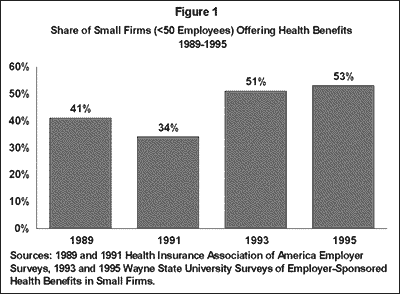
Between 1989 and 1995, 45 states enacted laws to make health insurance more accessible and attractive to small businesses. The small group market was targeted for reform because about half of all uninsured workers are either self-employed or working in firms with fewer than 25 employees (EBRI, 1996).

The problem is that only about half of all small firms offer health insurance (Figure 1). In 1995, 53% of small businesses (<50 employees) offered health benefits, and while this is up from 1989 when only 41% offered coverage, it is still much lower than health coverage among larger firms.

1315-fig1.gif

Many insurers are willing to sell coverage to small firms, but some insurer practices in the small group market have drawn concern. Some companies refused to sell policies to businesses in specific “high-risk” industries for example, or to firms with fewer than 10 employees. Also, because insurers tended to base premiums for small groups on the medical histories of prospective enrollees, some small businesses have reported that the poor health of their employees or employees’ dependents resulted in their inability to qualify for coverage.

Although these problems exist, they are not widespread. Most small firms say that they can get coverage if they want it. More than three-quarters (of both insured and uninsured small firms) say that they have been solicited to buy health insurance in the last six months, and more than a third indicate that they have received at least six or more inquires.

Three General Types of Small Group Reform

“Bare-bones” policies.

These laws allow insurers to sell “bare-bones” insurance to certain classes of small firms, typically those newly entering the group coverage market. The policies are dubbed “bare-bones” because they are usually exempt from most mandated benefit laws and premium taxes, which allows small firms to purchase basic coverage at lower premiums.

Premium regulations.

Premium rating bands or requirements that insurers follow community rating are two examples of such regulations. These rules are intended to narrow the range in premiums, so that coverage will be more affordable for higher-risk firms.

Standards for underwriting and contracting practices.

These are designed to make coverage both more attractive and available to employers. Included under this category are laws which:

  • limit the non-issue of policies to certain types of firms,
  • guarantee the renewability of employer coverage,
  • allow insured persons to move between plans without having to satisfy new pre-existing condition clauses, and
  • limit initial waiting periods that workers must satisfy for coverage of their pre-existing conditions.

The most common reforms are listed in Figure 2 with the number of states that have enacted them. In many cases, the state enacted a small package of measures in 1991 or 1992 and then adopted additional reforms a couple of years later. By 1995, most states had enacted all of the reforms listed here.

Figure 2Small Group Reforms at the State Level Number of States with the Measure as of: Type of State Legislative Reform: ’89 ’91 ’93 ’95 Bare-Bones Insurance Plans Can be Sold 1 9 31 43

Retiree Health Trends and Implications of Possible Medicare Reforms

Published: Sep 1, 1997

Background

Health care benefits had been offered to active employees for a long period of time before health coverage became a retiree benefit offered by employers. The key event that made employer-sponsored retiree health care a possible benefit for retirees was the enactment of Medicare in 1965. It was then felt possible to provide a widely desired benefit at a relatively low cost, since the Medicare program would pay the majority of the costs.

Millions of Retirees Have Employer-Sponsored Coverage

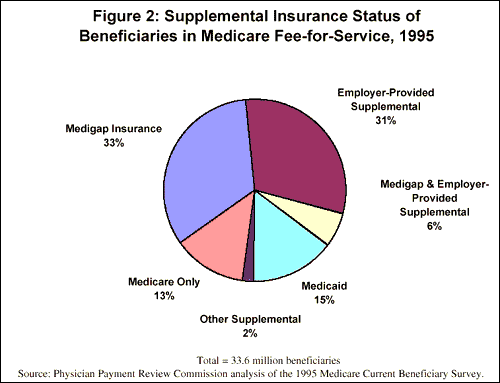
Based on the 1995 Medicare Current Beneficiary Survey5 analysis by Physician Payment Review Commission (PPRC), about 12 million individuals (37 percent of Medicare aged and disabled beneficiaries) have employer-provided supplemental coverage, including about 2 million with employer-provided coverage and Medigap.

1318-chart2.gif

Retiree Health Is a Highly Valued Medicare Supplement

As with other matters related to retirement, the appreciation of retiree health benefits increases with age. For example, based on a Hewitt database of employee surveys, there is a twelve-fold increase in value assigned to retiree health care benefits for employees age 55 and over compared to the group age 25 to 34.6

The availability of employer-provided coverage is more critical for the pre-65 retirees because they will generally not have access to other insurance or it will be very expensive for them to purchase, if it is available at all. Post-65 retirees at least have Medicare if they have no other health insurance.

Even Medicare, however, provides a relatively low level of benefit when compared to the typical employer plan for active employees. Comparing the Medicare level of benefits to 250 large employers participating in the 1996 Hewitt Health Value InitiativeTM who offer indemnity type benefits, the Medicare design falls in the lowest quartile measured by plan value (18th percentile). That is, 82 percent of the indemnity plans offered by large employers to active employees provide richer or better benefit levels than traditional Medicare. Most of the employers participating in the 1996 Hewitt Health Value Initiative have more than 5,000 employees. Employers with fewer employees will tend to provide a lower level of benefit.

Assuming that the typical employer medical plan considers about 65 percent of total health care costs as a cost covered by the medical plan (excluded costs include items such as over-the-counter drugs, dental care and eye glasses)7, and that the average indemnity medical plan reimburses about 83 percent of covered costs8, the typical employer plan will pay 54 percent (0.83

It’s Your (Sex) Life:  Your Guide to Safe and Responsible Sex

Published: Aug 31, 1997

Contraception 911

If a condom breaks, a diaphragm slips, or you realize after having sex that you forgot to take the pill for three days in a row, it can be enough to make the calmest person very upset! Fortunately, there is something you can do. If you act within 72 hours after unprotected intercourse, two doses of a special combination of birth control pills, available by prescription, can prevent or delay ovulation and reduce the chance of pregnancy by about 75 percent. The method is called emergency contraception (the morning-after pill).

You can get the pills from a doctor or a family planning clinic. If there is any chance you might already be pregnant you’ll need a pregnancy test. (If you are pregnant, the treatment won’t work.) The medication isn’t without side effects, though; nausea, especially, is very common for a day or so. And it’s not foolproof – it only reduces your chance of pregnancy by 75%. And even if it does work, the pregnancy protection doesn’t last so you’ll need to go back to another birth control method right away. Generally, emergency contraception costs $55 to $245 for the whole shebang (examination, pregnancy test, and pills); costs are less – or even free – at family planning clinics and health centers. To find a provider near you, you can call the Emergency Contraception Hotline at 1-888-NOT2LATE.

What Doesn’t Work

If you’re considering any of these folklorist contraceptive methods, fuhgeddaboudit!!! Here’s why:

  • Douching: Rather than rinsing sperm out of the vagina, douching could actually send them swimming upstream towards an egg. (It can also increase the risk of infection.) All in all, a bad idea!
  • Peeing after intercourse: An old folks’ tale! Urinating after sex does nothing to protect against pregnancy because the urinary opening is near to, but not inside, the vagina. So sperm won’t be touched by the liquid rush.
  • Having intercourse during your period: First of all, just because you’re bleeding doesn’t mean you’re having your “true” period; some women bleed during ovulation. And it’s often hard to predict when you’ll ovulate. So you’d better use protection whenever you have intercourse, all month long.

How to Negotiate with Your Partner

Think you might be ready to have sex with a special someone? Before deciding, make sure you’ve considered all the issues and discussed them with your partner. After all, the decision is – always! – up to both partners. Here are three tricky sexual scenarios and solutions for how to handle them:

Scenario #1: You’re thinking about having sex but you’re just not comfortable talking about it with your partner.

Solution: First things first: If you can’t talk about it, how are you going to feel comfortable doing it? Maybe one of you thinks that talking about sex kills the mood or that it should just happen naturally when the moment is right. Wrong, wrong, wrong. Talking about sex can actually help you trust each other more and feel closer to each other because it shows you care. But most importantly, it helps you make wiser decisions, and if you decide to begin a sexual relationship, to plan ahead to protect yourselves against pregnancy and STDs. In fact, you should hash out what you’re willing to do and what you’re not and agree to use condoms for your mutual protection before things get too intimate.

Scenario #2: Your partner does not want to use a condom.

Solution: Some people will use a zillion lame excuses to weasel out of using condoms so you’d better be armed with a snappy comeback. If she says, “It takes away the romance,” you could say, “So could getting an STD.” If he says, “I can’t feel anything with a condom,” tell him “You’ll feel even less if you don’t use one because we won’t be having sex.” If she swears she won’t give you any diseases, tell her it’s nothing personal but you want to make sure both of you stay healthy. The bottom line: Don’t feel bad about saying “No condom, no sex.”

Scenario #3: You’ve already had intercourse together but now you realize that it’s just too soon for you – and you don’t want it to happen again.

Solution: It’s not too late to slam on the brakes. One thing to keep in mind is that just because you’ve done it once or twice doesn’t mean you have to do it again and again. It’s okay to say “no” to any part of sex at any time, regardless of what you’ve done in the past. The key is to be firm and clear – hopefully, before you get to the undressing stage – about how you’re feeling and what you want for the future. If your partner tries to push the issue, stand your ground, and remind him or her how strongly you feel about slowing things down. Anyone worth your time and affection should respect that.

Sexually Transmitted Diseases

You’ve heard about all these scary things that can happen to you if you don’t practice safer sex, and you may even know people who have caught sexually transmitted diseases (STDs). Which isn’t surprising, considering that at least one in four people will contract an STD at some point in his or her life. What is there to worry about? Plenty. Here’s what you need to know about the risks of unprotected sex.

Each year more than 12 million Americans, including 3 million teenagers, are infected with STDs, and many of them probably thought they didn’t need to worry about protection. While a few STDs are just annoying, many others can have lasting effects on your health and sex life. We all know that HIV is an incredibly deadly STD. In fact, half of all new HIV infections occur in people under 25, and AIDS has become the leading cause of death among Americans between the ages of 25 and 44. And if you think the new AIDS drugs you have been hearing about are a magic cure, forget it. They are hard to take, often have strong side effects, and do not always work. Other STDs can cause nasty recurrent symptoms, such as painful or itchy sores, and a select few can cause death or increase the risk of cancer for both women and men. What’s more, several STDs can cause infertility, meaning you could never have children.

And get this: Almost any STD increases your chances of contracting HIV. In fact, people who already have an STD, like herpes, gonorrhea or chlamydia, are three to five times more likely to become infected with HIV than someone who does not have an STD if they have unsafe sex with an HIV-positive partner.

It’s a myth that you can tell if someone has an STD by the way he or she looks or acts. That wholesome-looking guy or woman may look safe and seem safe but appearances can be deceiving. After all, you’re not just having sex with that person but with everyone they’ve ever had sex with . . . and everyone THEY’VE ever had sex with… and… well, you get the point. Because lots of STDs have no symptoms (or only subtle ones), your partner may not even know he or she has one. That’s why if you have had sex in your life, you should get tested for STDs like chlamydia, and for HIV, even if you have no symptoms and are feeling just fine.

To be blunt about it: The only way to be sure you’re having safer sex is to keep your partner’s blood, semen, or vaginal fluids out of your body. Abstinence is the safest course. But, if you’re going to have sex, always use a condom.

How can you tell if you’re infected with an STD?What should you do if you are?

If you’ve been experiencing burning urination; heavy, smelly discharge from the vagina, penis or anus; bumps, sores or itching in the genital area; pain or tenderness in the pelvic area; or other funky symptoms, you may have a sexually transmitted disease. In that case, you need a medical visit right away so you can get tested.

Why is it important to get tested early? Because if you have an STD and don’t know it – and so don’t get treatment – you could pass it on to your partner and you could risk your health and your ability to have kids in the future. Not all STDs are curable, but even for ones that aren’t, treatments are available that can help. If you have HIV, for example, finding out early means you can take advantage of new medications that are more effective if you take them before you start to get sick.

If you are a woman and you’ve been experiencing cramping or persistent pain in the abdomen or back; abdominal tenderness with movement or going to the bathroom; abnormal vaginal discharge; pain during intercourse; or any of these symptoms with a fever over 100.5 degrees Fahrenheit – these may be signs of pelvic inflammatory disease (PID). If you have these symptoms, see a doctor or go to a clinic or a hospital emergency room immediately; PID can lead to infertility in a woman if it’s left untreated. PID can also be silent – an infection that spreads to your tubes from chlamydia or gonorrhea with no severe signs that could alert you that something is wrong.

Now, to get the inside scoop on the most common STDs, consult this table:

STD Chart

STD: Chlamydia What it is: A bacterial infection of the genital area. How many get it: About 4 million Americans each year; the highest rates are among women aged 15 to 19 – in fact, in some communities studies have found that up to 30 percent of sexually active teenage women and 10 percent of sexually active teenage men are infected. Signs: There are no symptoms in most women and many men who have it. Others may experience abnormal vaginal bleeding (not your period), unusual discharge or pain within one to three weeks of having sex with an infected partner. How it’s spread: Through vaginal or anal intercourse. Treatment: Oral antibiotics cure the infection; both partners must be treated at the same time to prevent passing the infection back and forth – and need to abstain from intercourse until the infection is gone. Possible consequences: Pelvic inflammatory disease (PID) in women, tubal (ectopic) pregnancy, infertility, and increased risk of HIV infection.

STD: Trichomoniasis (“Trich”) What it is: A parasitic infection of the genital area. How many get it: As many as 3 million Americans each year. Signs: Often there are no symptoms, especially in men. Some women note a frothy, smelly, yellowish – green vaginal discharge, and/or genital area discomfort, usually within 3 to 28 days after exposure to the parasite. How it’s spread: Through vaginal intercourse. Treatment: Antibiotics can cure the infection. Both partners need to be treated at the same time to prevent passing the infection back and forth – and need to abstain from intercourse until the infection is gone. Possible consequences: Increased risk of HIV infection; can cause complications during pregnancy. Also, it’s common for this infection to happen again and again.

STD: Gonorrhea What it is: A bacterial infection of the genital area. How many get it: Approximately 800,000 Americans a year; the highest rates are among women aged 15 to 19. Signs: Most women and many men who get it have no symptoms. For those who do get symptoms, it can cause a burning sensation while urinating, green or yellowish vaginal or penile discharge, and for women, abnormal vaginal bleeding, pelvic pain, and/or fever within 10 days of getting infected. It takes 1 to 14 days for symptoms – such as discharge or pain – to appear. How it’s spread: Through vaginal, oral, or anal intercourse. Treatment: Oral antibiotics. Both partners need to be treated at the same time to prevent passing the infection back and forth – and need to abstain from intercourse until the infection is gone. Possible consequences: PID, tubal (ectopic) pregnancy, sterility, increased risk of HIV infection. The infection can spread into the uterus and fallopian tubes. It can also cause complications during pregnancy (including stillbirth) or infant blindness or meningitis (from an infected mom during delivery).

STD: Human Papilloma Virus (HPV) What it is: A viral infection with 60 different types, primarily affecting the genital area, both the outer and inner surfaces. How many get it: An estimated 500,000 to 1 million Americans per year; about 40 million people already have it. Signs: Soft, itchy warts in and around the vagina, penis, and anus, may appear two weeks to three months after exposure. Many people, however, have no symptoms but may still be contagious. How it’s spread: Through vaginal or anal intercourse, or by touching or rubbing an infected area. Treatment: There is no cure. Warts can be removed through medication or surgery. Even with such treatments, the virus stays in the body and can cause future outbreaks. Possible consequences: Increased risk of genital cancer for men and women. Some virus types cause the most common form of cervical cancer in women.

STD: Genital Herpes What it is: A viral infection of the genital area (and sometimes around the mouth). How many get it: Between 200,000 and 500,000 Americans each year; an estimated 40 million Americans already have genital herpes. Signs: There are two kinds of herpes. Herpes 1 causes cold sores and fever blisters on the mouth but can be spread to the genitals; Herpes 2 is usually on the genitals. Nearly two – thirds of people who are infected with herpes don’t even realize it. An outbreak can cause red bumps that turn into painful blisters or sores on the vagina, penis, buttocks, thighs, or elsewhere. During the first attack, it can also lead to fever, headaches, and a burning sensation when you urinate. Symptoms usually appear within 2 to 20 days of infection but can take longer in some cases. The first outbreak is usually more severe than later recurrences. How it’s spread: By touching an infected area or having vaginal, oral, or anal intercourse. Warning: some people may be contagious even when they don’t have symptoms. Treatment: There is no cure. An antiviral drug can help the pain and itching and also reduce the frequency of recurrent outbreaks. Possible consequences: Recurrent sores (the virus lives in the nerve roots and keeps coming back), as well as increased risk of HIV infection. May cause complications during pregnancy, possibly causing severe illness, disabilities, or (in rare cases) death for an infant if there is active infection during childbirth. (A cesarean section delivery can reduce this risk.)

STD: Syphilis What it is: An infection caused by small organisms, which can spread throughout the body. How many get it: About 120,000 Americans a year. Signs: In the first phase, sores may appear on the genitals or mouth about three weeks to three months after exposure, lasting for three to six weeks. Often, however, there are no noticeable symptoms. In the second stage, about three to six weeks after sores appear, a variety of symptoms can appear, including a rash (often on the palms of the hands and soles of the feet). How it’s spread: Through vaginal, oral, or anal sex – and through kissing. Treatment: Antibiotic treatment can cure the disease if it’s caught early, but medication can’t undo damage the disease has already done. Both partners must be treated at the same time. Possible consequences: Increased risk of HIV infection. If syphilis is untreated, about a third of people who reach the disease’s late phase may experience brain damage, heart disease, nerve damage, and other incapacitating health problems. If untreated, it can seriously harm or even kill a developing fetus during pregnancy.

STD: Hepatitis B Virus (HBV) What it is: A viral infection primarily affecting the liver. How many get it: About 200,000 Americans a year; more than 1.5 million people in the U.S. now have HBV. Signs: Many people don’t have any symptoms. Others may experience severe fatigue, achiness, nausea and vomiting, loss of appetite, darkening of urine, or abdominal tenderness, usually within one to two months of exposure. Yellowing of the skin and whites of the eyes (called jaundice), and darkening of the urine can occur later. How it’s spread: Through vaginal, oral, and anal sex – and through kissing. Also by sharing contaminated needles. Treatment: Most cases clear up within one to two months without treatment, during which complete abstinence from alcohol is recommended until liver function returns to normal. Some people are contagious for the rest of their lives. A vaccine is now available to prevent this STD. Possible consequences: Chronic, persistent inflammation of the liver and later cirrhosis or cancer of the liver; plus, 90 percent of babies born to women with HBV will carry the virus unless they are vaccinated within an hour of birth.

STD: HIV What it is: The human immunodeficiency virus (HIV), the cause of AIDS. How many get it: An estimated 40,000 to 80,000 Americans are infected each year. AIDS is the leading cause of death among Americans between the ages of 25 and 44. Signs: Many people who have HIV don’t even know it because symptoms may not appear for 10 years or longer. Others experience unexplained weight loss, flu-like symptoms, diarrhea, fatigue, persistent fevers, night sweats, headaches, mental disorders, or severe or recurring vaginal yeast infections. How it’s spread: Through body fluids such as blood, semen, vaginal fluids and breast milk – in other words, during vaginal, oral or anal intercourse; by sharing contaminated needles; via pregnancy or breast – feeding. During vaginal intercourse, the risks of catching the virus are higher for women than for men. Treatment: There is no cure – and AIDS is considered fatal. Several new antiviral medications can slow progression of the infection and delay the onset of AIDS symptoms. Early treatment can make a big difference. Possible consequences: It is the deadliest STD of all and can weaken the body’s ability to fight disease, making someone with HIV vulnerable to certain cancers and infections such as pneumonia. Fifteen to thirty percent of babies born to HIV – positive mothers can get the disease if the mother is not receiving treatment, but treatment can reduce that rate significantly.

Possible STD Symptoms

Do you or your partner have any of these symptoms? If so, you can review the information in the corresponding sections, and consult your doctor.

Return to top

It’s Your (Sex) Life; Your Guide to Safe & Responsible SexReport Two Part One Part Three

Estimated Cost of a Child Health Program in California – Report

Published: Aug 31, 1997

Estimated Cost of a Child Health Program in California

Prepared by Gordon R. Trapnell, F.S.A., Actuarial Research Corporation

For the Kaiser Family Foundation

September 10, 1997

Summary

The Balanced Budget Act of 1997 created a new federal/state program to cover uninsured children. The new federal legislation provides states with a substantial amount of flexibility in designing their child health insurance programs by expanding their existing Medicaid programs, creating new state child health insurance programs, or a combination of both. This report provides an analysis of the cost of covering California children through the options available under the federal program.

The analysis is based on an August 27th plan presented by the Wilson Administration for covering uninsured children in California — the California Children’s Health Plan (CCHP). A key element of the proposed CCHP is to expand coverage to uninsured children using a private insurance mechanism, which the Wilson Administration has said would be slightly less expensive on a per child basis than using the Medicaid program (which is called Medi-Cal in California). The Wilson Administration estimates that the proposed CCHP would cost $74.75 per child per month, while expanding Medi-Cal would cost $76.60 per child. These figures do not include premium contributions made by families or various state administrative costs that might be required under either approach. If families made an average $8 monthly premium contribution per child as suggested in the CCHP proposal, then the government’s cost per child under the CCHP would drop to $66.75 per month. The table on page 33 of the Administration’s published August 27th plan shows that the estimated total program costs assuming full participation at 580,000 children under Medi-Cal would be more costly than under their proposed private insurance approach.

Our analysis follows the same basic approach used in the comparative fiscal analysis in the August 27th description of the CCHP. Our analysis finds that while the per month enrollee premium estimate for a private insurance plan is only slightly less than the premium estimated by the Administration for its private insurance proposal, the per enrollee cost of a Medi-Cal approach is significantly less than the Administration’s Medi-Cal estimate. The primary reason our cost estimates for the Medi-Cal option are less expensive than the Wilson Administration’s Medi-Cal estimates is that we have assumed that children who will enroll in the new program will be less expensive than children currently enrolled in Medi-Cal. In a full-participation scenario, we find that a Medi-Cal expansion would be significantly less costly than a private insurance approach. (See Exhibit 1)

In sum, in our analysis:

  • the cost of a private insurance option would be $74.39 per child per month, slightly less (-0.5%) than the Wilson Administration’s estimates for its CCHP proposal;
  • the cost of a Medi-Cal approach would be $60.65 per child per month, substantially less (-21%) than the Wilson Administration’s Medi-Cal estimates. As a result, we estimate that a Medi-Cal approach would cost 18 percent less than the Wilson Administration’s CCHP private insurance option. If the average $8 per month enrollee premium contribution per child is used to offset government expenditures under the private option, the private insurance option premium would be $66.39, making the Medi-Cal estimated cost 9 percent less than the private insurance option amount.

The Wilson Administration estimates that 580,000 uninsured children would be eligible for a new program. Our analysis suggests that if all of these children enrolled (and no currently insured children dropped private coverage and became eligible), then using our estimate of per child costs would yield a Medi-Cal option cost for 1998 that would be approximately $96 million per year less than a private insurance option. If a family average premium contribution of $8 per enrollee per month is used to offset government expenditures under the private option, government spending for the Medi-Cal expansion option would be approximately $40 million per year less than for the private insurance option.

One reason why using Medi-Cal might be less expensive than providing coverage through a private insurance mechanism is that Medi-Cal has historically paid providers at lower rates than private health plans. However, the benefits provided by Medi-Cal are more comprehensive — and therefore more expensive — than those provided by most private health plans (and than those provided in the proposed CCHP).

Exhibit 1

ARC Premium Calculations For Child Health Insurance In California — CY 1998

Per Child Per Month Costs Medi-Cal Option Base Monthly Per Capita $50.32 Adjusted Benefit Package $50.22 Projected to 1998 $54.86 Adjusted to HMO rates $54.31 Adjusted for Additional Administrative Functions $60.65 HIPC-Based Consortia Plan (Private Insurance Option) Base Monthly Per Capita $60.03 Adjusted Benefit Package $67.28 Projected to 1998 $70.84 Adjusted to HMO rates $70.84 Adjusted for Additional Administrative Functions $74.39

Estimated 1998 Aggregate Costs(Maximum-Enrollment-Based Calculations, Assuming Total Enrollment of 580,000) Medi-Cal Plan $422.1 million Consortia Plan – gross $517.8 million minus $8/month enrollee charge $55.7 million Net Consortia Plan $462.1 million Difference $40.0 million Source: Estimates based on analysis by Actuarial Research Corporation.

Objective

Our objective is to estimate the cost per child covered of implementing a Child Health Program in California (CCHP) in one of two modes:

  • Through an expansion of Medi-Cal income limits and liberalizing asset restrictions
  • Through an independent program as suggested by Governor Wilson, modeled on the California HIPC structure, but with plans limited to HMOs (and EPOs) in order to keep cost sharing at levels suitable for a low income population.

In both cases we project the incurred cost of the first year of an expansion or new program that begins in July 1998.

Medi-Cal Expansion

1. Base

We do not have a comprehensive set of premium rates for Medi-Cal, but rather:

  • A DHS tabulation of the Medi-Cal FFS claims for children other than infants and foster children, for the period July 1995 through June 1996.
  • A somewhat detailed description of the derivation of the original premium rates proposed for Local Initiatives and Commercial Plans under the two plan model county rates from the experience of the Santa Barbara County Operated Health Plan, together with supporting data and information provided in the report “Two Plan Model; Capitation Rates for July 1, 1995 – May 31, 1996 and June 1, 1996 – September 30, 1997.”
  • DHS estimates of the average incurred FFS cost per capita for (i) members of families and (ii) foster children for the periods July ’95 through June ’96 and July ’96 through June ’97. In both cases the estimates exclude the costs of those institutionalized and specialized services for such children, and any other services not capitated with the “local initiative” prepaid plans.
  • A comprehensive set of HMO payment rates from several years ago.

In addition, we have a copy of the Capitation Rate Manual for Fiscal Year 1990-91, compiled by the California Medi-Cal actuaries, which provides a number of factors concerning key financial relationships.

Of these data sets the most relevant are (i) the rate structure derived from the Santa Barbara plan and calibrated with the estimated average FFS claims incurred per capita for July 1996 through June 1997 and (ii) the tabulation, apparently on an incurred basis, of a sample of children ages 1-18. The average incurred FFS cost per child per month of eligibility from the DHS tabulation for the period July 1995 through June 1996 was $50.32 per eligible per month (PEPM).

This rate is somewhat lower than the average FFS cost per eligible month in that period for foster children in the eight counties in which the two plan model will be implemented, $58.20 (which was actually higher than the estimated cost a year later of $57.47). This cost PEPM for foster children appears to be higher than found in the tabulation of all children for some combination of area differentials (most of the two plan counties are in the areas with higher average Medi-Cal costs) and a higher average cost for foster children than for children in families (which apparently are somewhat older on average and may include more children with special Medi-Cal needs). Both the estimate for foster children and that for all eligible children exclude the cost of expensive conditions found in infants.

Given the methodology followed by California in setting rates to be paid to health plans, the estimated FFS cost PEPM in July ’95 through June ’96 appears to provide the most reliable basis for an estimate of what the State would offer HMOs to cover an expanded child population. (It also necessarily provides the basis for an estimate of the average that would be paid if the services are not provided through prepaid plans, i.e. on a FFS basis.) The California methodology, well documented by the Medi-Cal actuaries in various reports, has been to:

  • Project the average FFS cost by category of eligibility, age-sex group and county of residence
  • Adjust for difference in the average cost of those eligible for enrollment in an HMO in each category of eligibility
  • Adjust for differences in the benefits for which HMOs are responsible and those retained by Medi-Cal
  • Increase the per capitas by an allowance for those state administrative expenses that will be replaced by contracting with managed care plans
  • Decrease the results for the state’s share of managed cost savings.

Prepaid plans are offered the resulting rates on a take it or leave it basis.

In addition, the total paid to prepaid plans can not exceed estimates of what would have been paid in a FFS system, according to Federal laws and regulations. Thus the estimated FFS cost PEPM controls what can be paid to prepaid plans under Medicaid, and is by definition what a FFS program would cost.

The rate structure derived by the Medi-Cal actuaries produces numbers that appear to be reasonable in relationship to those from the FFS tabulation, but require adjustments for:

  • Deriving a rate for children between 1st and 18th birthdays from the average family member rates
  • Area differences between payments in the twelve two plan counties and the entire state
  • Differences in the benefit package offered through the prepaid plans and all Medi-Cal benefits (to the extent that benefits were limited in the prepaid benefit packages).

Since each of these steps may involve error, we rely here on the rate ($50.23) derived from FFS data for a population most like what is to be enrolled under CCHP. However, we note that to the extent that the new program will enroll some age groups in larger numbers than others (especially if distinctions are introduced), this provides a promising base for estimates of the relative cost of different age groups.

2. Adjustments to benefit package and eligibility

By definition, the benefit package would be the same as the full Medicaid program. Thus the tabulations of FFS data cited above exclude services not currently capitated with HMOs. The value for the average experience of all eligible children during the twelve months ending in June 1996 appears to include all categories of benefits, including some related to institutional services. These should probably be excluded from the estimate, on the grounds that most needing institutional services are already eligible for Medi-Cal, and would not be included in the expansion population. The adjustment appears to be a decrease of the order of $.10 PEPM.

It is not clear whether the services provided to crippled children are included in the base data. If they were, the cost PEPM should be further reduced by around 5% to allow for the relatively high cost per capita of this group, compared to what may be expected to be found in the expansion program.

3. Projection to First Program Year

The period for which the base rates were tabulated was from July 1995 through June 1996. The estimates from DHS estimates for the average incurred FFS cost per capita for (i) members of families and (ii) foster children for the periods July 1995 through June 1996 and July 1996 through June 1997 can be used to update this base for another year. The average increase is 2.1%.

The resulting rate represents the average cost of FFS Medi-Cal during the period from July 1996 through June 1997. We wish to project the cost to the period July 1998 through June 1999, which occurs two years later. We project the increase to be 3.5% per year. After incorporating these two trend factors, the estimated average FFS claims incurred for non-infant non-foster-child Medi-Cal children is $54.86.

4. Adjustments for prepaid plan payment rates

Medi-Cal has increased payment rates to HMOs by 1% to reflect the estimated savings in Medi-Cal administrative expenses, and decreased rates by a small percentage to obtain a state share of managed care savings, e.g. a projected 2% in the calculation of two plan county rates. The rates are also reduced by around 0.5% to reflect a loss of interest when capitations are paid in advance rather than claims paid some time after the date on which services are performed.

After these adjustments, the average payment rates to prepaid plans for Medi-Cal children ages 1 – 18 would be $54.31 PEPM.

5. Medi-Cal administrative expense

The primary categories of expense that will be expanded would be expenses relating to eligibility determination and enrollment in prepaid plans. There would also be a modest increase in the workloads of the central staff and auditors. All additional expenses would be marginal expenses, since the same basic systems and procedures in place for Medi-Cal would be extended to the new eligible groups.

The most important new expense would be determining eligibility for a large new population. There would also be increased cost to calculate a new category of rates and to integrate the new beneficiary class into the current system of contracting with prepaid plans. The new categories would also produce an increase in auditing expense and the cost to analyze encounter data from the prepaid plans. Even relatively large such increases in the work loads of central staff, however, would not produce more than nominal increases in administrative outlays.

We have been provided the following information from the operation of the Medi-Cal program and plans for an expansion through Medi-Cal to cover new eligible children:

  • Medi-Cal reimburses the counties $119.51 per intake per case (family) and $20.46 per month for “ongoing costs”.
  • Planning for an expansion of Medi-Cal under the Child Health Program is based on payment to the counties of $119.51 per case “at least once per case” per year for “intake” and “redetermination” after any year of continuous eligibility and an allowance of $10.23 per month per active case.

The latter amounts appear excessive for the marginal costs of administering an expansion population under Medi-Cal, but would produce the $116.02 projected per case (and something more than the $9.67 projected in the August 27 description, as a monthly cost per eligible since some children would not be eligible for multiples of full years). In addition, although eligibility determination is the largest expense of an expansion of Medi-Cal, it is not the only additional expense. There would also be increases in Medi-Cal expenditures for a number of other functional expenses, including hearings and appeals, auditing of payments to health plans, central office staff time, etc.

The level of reimbursement to counties, however, appears to be excessive for the marginal cost of determining eligibility for an expansion population in which incomes should be more stable, and for which income verification will not have to be performed for all eligibles (since many with relatively low health needs will never apply). We also note that past expansions of eligibility of children do not appear to have produced significant increases in Medi-Cal administrative costs as a percentage of benefits Consequently, we will base our estimate on an average administrative expense for eligibility of 60% of that projected, and increase the result by 1% of the average benefits per capita (including payments to health plans) to allow for other functions.

This produces an average administrative cost of $6.34 in addition to the basis of payment to health plans, bringing the total estimate to $60.65 PEPM.

6. Payment of bad debts

An important effect of the expansion should be some relief to major providers from the burden of bad debts. The primary beneficiaries would be the “essential providers”, i.e. institutions that now receive Disproportionate Share payments and cross subsidies to Federally Qualified Health Centers. To the extent that the state’s share of differential payments (including the extent to which a higher payment rate has been built into the two plan county rates) will be reduced by the new benefits, the state’s cost for the program will be reduced.

7. Coverage of children now covered by employer plans

A strong incentive is created by the new coverage for families that now pay for coverage of their children through employer plans to drop this coverage. Their children would become eligible for Medicaid immediately.

Medicaid, however, can consider such coverage in determining eligibility. Further, the Medicaid eligibility is designed to detect employment and ask about such coverage, and the questions would be repeated quarterly. Medicaid has the option (and, if cost-effective, is required by HCFA) to pay the employee contribution rates to obtain coverage for persons eligible for Medicaid. It should be noted, however, that this affects aggregate outlays, but not necessarily the PEPM).

8. Selection

The average rate PEPM derived above is determined for coverage of the full population eligible for the expansion, estimated to be some 580,000 children. In practice, only some fraction of these children would actually become enrolled, issued health cards and enrolled in prepaid plans. Thus there would continue to be a FFS program paying some claims for eligibles before they are enrolled in prepaid plans. The method of estimation implicitly averages such claim payments and the cost of processing with the premium rates paid to the prepaid plans.

Further, although those who are enrolled will include most with major health expenses, some of the expenses of the potential expansion population will not be paid under the expansion because the providers to not find obtaining eligibility worth the effort and because some care will not be provided to those who do not obtain eligibility. On the other hand, the average cost per person found eligible will be significantly higher than the average expenditure per potential eligible derived above.

9. Other considerations

One possible shortcoming of the estimates derived above is that the plans may balk at the level of rates being offered. Since we assume the newly covered group will be offered as part of the overall package, however, a decision to withdraw would necessarily involve losing the rest of the Medi-Cal enrollment. For this reason, we only mention the possibility that the increased size of the contract at what appear to be below market rates may result in some loss of potential contractors.

Consortia Plan

1. Base

The most important consideration in the choice of a base is to emulate the procedures that will be followed to determine the premium rates that will be paid for the coverage. A fundamental difference between the procedures used to determine rates for the consortia plans offered in California and the managed Medicaid plans is that the plans are free to bid rates that they believe constitute prudent business decisions, without the implicit threat of loss of existing market share.

In contrast, in the managed Medi-Cal program, the prepaid plans must accept the rates offered, or not participate. Many have participated despite the apparently low level of payment rates offered. Further, if additional volume is not accepted, the plans would lose their present share of this market. It is much more difficult for a HMO management to decide to drop an existing product line than to decide not to bid on a new class of business.

The most appropriate base for which we have adequate publicly available information from which to estimate the premium rates that would be bid by health plans in a new program offered by MRMIB would be the average of the HMO “Preferred” plans being offered through the HIPC, averaged over the areas in which the uninsured children live. This base is most appropriate for the CCHP plan because:

  • The mechanism is more like that to be used for CCHP than CalPERS, since there will be needs to maintain eligibility roll by individual/family, eligibility depends on payment of premiums (complete with grace periods), there are enrollments taking place throughout the year, etc.
  • In addition, enrollment is open to biased selection through dumping of sick employees by very small employers (who constitute a large proportion of the actual enrollment).
  • The average is less biased toward urban areas where there are proportionately more civil servants than the near poverty population.

Since we do not have the enrollment by plan in HIPC, nor any rates specifically for children living alone, we determine an adjusted premium rate for those plans offered widely throughout each of the six HIPC areas from that charged for single adults using (i) standard demographic relationships relating to the average cost of covering children and single adults through HMOs and (ii) the average Medi-Cal costs of children over age one to that for all children under age 19.

The next step is based on an assumption concerning how the premium rates would be charged, namely that payments by CCHP would be based on the lowest rate of prepaid plans widely available throughout each county (less $8.00) and families would be responsible for the additional premium charged by the health plan chosen. This would mean that the CCHP expenditure would in effect be based on the premium rates of the lowest cost plan in each county. To simulate this basis, we based the estimate on the average of the lowest cost among plans widely available in each area. (We believe that this method (i) overweights areas 1 and 2, which have the highest of the lowest premium rates for widely available plans to offset (ii) a bias in projecting the lowest cost plans (usually Kaiser Permanente) to be fully available in all counties in areas 3 through 6. The result was an average child premium of $60.03.

2. Adjustments to benefit package

We estimate the benefits included in the August 27 descriptive proposal. (These benefits may have to be increased to meet the “actuarial equivalence tests” required by federal law.) Accordingly, adjustments must be made for including vision care (including eyeglasses) and a full benefit package for preventive and restorative services for dental care. We estimate the cost of these additional benefits to be $7.25.

3. Projection to first program year

The present HIPC rates are for calendar year 1997. We are estimating the average cost during the first operating year of a program that would be in effect during 1999, and perhaps begin as early as July 1998. We project the cost for July 1998 through June 1999. Thus the general level of rates needs to be projected for 1.5 years. The projection was made at 3.5% annually.

4. Administrative expenses

The average administrative expenses will be significantly higher than currently experienced in the HIPC for:

  • Enrollment, eligibility determination and premium processing for individual family units rather than employers, meaning smaller numbers of persons per contract.
  • Premium collection costs will be higher, with more late payments and grace period notices and processing. (Dealing with inexperienced family heads rather than the administrators of small employers.)
  • More rapid turnover, with higher finders fees and enrollment expenses as a proportion of total expenses.
  • Units are limited to one or more children, without any adults, meaning both smaller families and much lower premium per family unit, than found in individual insurance.

Administrative expenses as a percentage of the average benefits will be increased for two primary reasons: (i) the additional cost to deal with individual families, especially low income families and (ii) the cost of administrative functions will be divided by a much lower average premium per unit.

Unlike the situation with an expansion of Medi-Cal, a new operation is to be brought into existence under MRMIB, requiring the hiring a completely new staff, renting new facilities and purchase or lease of equipment, software, etc. The cost to set up and run the organization will be a higher percentage of the relatively low premium rates for children compared to those of the HIPC. Thus there should be no savings compared to the level of functional costs of the HIPC, but these will constitute a much higher percentage of benefits.

The primary functional area in which the unit expenses will be greater is in dealing with individual enrollments and all the attendant problems. The complications will affect both the umbrella organization and the health plans, although primarily the former. (It is also not clear that the HMOs will build the additional cost of dealing with individuals into their bids, since many HMOs cross subsidize individual product administrative expenses.)

Typical administrative expenses of health insuring organizations that deal primarily with individuals run 15% to 20% or more of benefits (although much of this is marketing expenses). Further, although the average duration of individual health insurance policies tends to be relatively short, e.g. an average of three to four years, turnover in the population to be covered is likely to be much higher, perhaps one third to one half of the enrollment each year. Further, by limiting coverage to children in the families, there is less premium over which to spread the cost of administration. Consequently, the average administrative expenses are likely to run an order of magnitude higher than for the current mix of small employer groups. The $50 finder’s fees, which are payable for nearly all new enrollments, with one-third turnover each year, by themselves increase premiums by nearly 2%.

The most suitable starting point would be the total administrative costs of the HIPC divided by the number of employment groups. This would be biased upward, since the cost to deal with employment groups of many individuals will be higher than for a family. But the calculation is likely to be more instructive than beginning with the percentage allowance in the current HIPC rates.

In comparison to the administrative costs found in Medi-Cal, allowances must be made for the additional functions associated with coverage dependent not only on eligibility determination but on the collection of monthly premium rates, especially given the targeted income group and the creation of a completely separate organization to handle all staff functions. The latter include:

  • Maintaining enrollment files
  • Premium collection (including pursuit of unpaid premiums due)
  • Margins to fund uncollectible premiums due and interest on grace periods
  • Commissions and finders’ fees
  • Accounting, audit, etc.
  • Actuarial
  • Investment of surplus
  • Employee services and benefits management
  • Insurances (e.g. E&O)
  • Provider/plan relations
  • Compliance with regulations and other staff functions (e.g. legal, actuarial, etc.).
  • Corporate overhead
  • Risk/profit charges to fund increasing needs for working capital.

Although this is a highly uncertain estimate, it is difficult to see how administrative expenses could be less than 10% to 15% of benefits. This compares to a present level of administrative expenses of a few percent of premium built into the rates charged by the HIPC, i.e. an increase of the order of 5% beyond the percentage included in HIPC rates. Compounding these factors from the base rate yields a final cost per child of $74.39.

4. Anti-selection

The average cost per child under the proposed CCHP program would be increased by limiting eligibility to those willing to pay the premium. This is not reflected in these estimates. As with the August 27 proposal’s support material, for purposes of discussing the relative merits of alternative implementations, the estimates are based on a “high cost” scenario reflecting enrollment at the total number of uninsured eligible children implied by Census data.

5. Coverage of children now covered by employer plans

A strong incentive is created by the new coverage for families that now pay for coverage of their children through employer plans to drop this coverage. Their children would become eligible for the new program after six months.

There would appear to be few barriers to such conversion of child coverage from employer plans to CCHP. First, eligibility is only determined on an annual basis, and without the kind of investigation that is likely to find all existing insurance coverage. Further, some families would decide that a six month waiting period was well worth having the new program pick up a much higher proportion of the cost. Thus a substantial coverage of children now covered by employer sponsored insurance must be anticipated under this program. However, as noted previously, this primarily affects the aggregate program costs, rather than the PEPM.