Section 3: Employee Coverage, Eligibility, and Participation

Published: Jul 30, 2004

Employers are the principal source of health insurance in the U.S., providing health benefits to about 63% of nonelderly persons in 2002.4 Although the percentage of workers receiving health insurance through their own employer has exhibited only slight annual declines, the cumulative drop since 2001 is over four percentage points. The majority of this decline is among all small firms (3-199 workers). As a consequence, we estimate that there are at least five million fewer jobs providing health insurance in 2004 than in 2001.

Most workers are offered health coverage at work, and the vast majority of workers who are offered coverage take it. Workers without coverage through their own employer may not be offered coverage by their firm, may be ineligible for benefits offered by their firm, or may refuse an offer of coverage from their firm.

  • Among firms offering health benefits, 67% of workers are covered by their own firm’s health plan, a similar rate to last year (Exhibit 3.2).
    • Despite only small annual declines in the percentage of workers receiving coverage through their own employer, coverage (in firms both offering and not offering health benefits) decreased significantly between 2001 and 2004 from 65% to 61%. The majority of this decline in the number of jobs with health insurance is among all small firms (3-199 workers) (Exhibit 3.1).
    • Coverage rates do not differ significantly by firm size, but they do vary by industry, likely due to differences in eligibility. The coverage rate for workers in the retail industry is 47%, compared to 84% for state and local government workers and 82% for those working in the transportation, communication, and utility industries (Exhibit 3.2).
    • Higher wage firms—where fewer than 35% of workers earn $20,000 or less annually —have higher coverage rates than lower wage firms—where 35% or more of workers earn $20,000 or less annually. Seventy percent of workers in higher wage firms that offer health benefits are covered, compared to 46% of workers in lower wage firms offering benefits.
  • Even in firms that offer coverage, not all employees are eligible for their firm’s health benefits. Additionally, not all employees with an offer of health coverage participate in it. The number of workers covered is a product of both the percentage of workers who are actually eligible for the firm’s health insurance and the percentage who choose to “take up” (i.e., elect to participate in) the benefit.
    • Eligibility for health benefits does not vary by firm size and is unchanged from last year. Overall, 80% of workers in firms offering health benefits are eligible for coverage (Exhibit 3.2).
    • Employees who are offered coverage through their employer generally elect to participate in it (the “takeup” rate). Eighty percent of workers in all small firms (3- 199 workers) take up coverage, similar to 83% of workers in all large firms (200 or more workers) who choose to participate. These numbers are statistically unchanged from 2003, but the percentage of workers who take up coverage in all small firms is statistically different from 2001 (84%) (Exhibits 3.2, 3.3).
    • The take-up of employer-sponsored coverage varies somewhat by industry. Workers in retail have a lower take-up rate (77%) than workers in other industries. Ninety-four percent of workers in state/ local government and 92% of workers in the transportation, communication, and utility industries take up an offer of employer-sponsored coverage (Exhibit 3.2).
    • The likelihood of accepting a firm’s offer of coverage varies by firm wage level. Employees in higher wage firms—where fewer than 35% of workers earn $20,000 or less annually—are more likely to take up coverage (84%) than employees in lower wage firms (35% or more of workers earn $20,000 or less annually) (71%).
  • One aspect of coverage affecting eligibility is new employees’ waiting period for coverage. Eighty-two percent of covered workers in all small firms (3-199 workers) and 65% of covered workers in all large firms (200 or more workers) work for a firm that imposes a waiting period on new employees before they are eligible for coverage. The average waiting period for coverage is unchanged from last year at 1.6 months (Exhibit 3.5).
Poll Finding

Key Issues for Hispanic Voters Include Education, Economy and Health Care

Published: Jul 21, 2004

Embargoed for release until: Thursday, July 22, 2004, 9:30 a.m. EST

For further information contact:Craig Palosky, Kaiser Family Foundation, (202) 347-5270Barbara Beck, Pew Hispanic Center, (215) 209-3076

Key Issues for Hispanic Voters Include Education, Economy and Health CarePoll finds Kerry ahead of Bush 62% to 32% among Latino Voters

WASHINGTON, DC (July 22, 2004) — Hispanic voters are more concerned this year about issues that affect all Americans — such as education, the economy, health care and the war against terrorism — than about immigration, according to a new comprehensive survey of Latino registered voters. As has long been the case, these voters are much more concerned about education than the general public, and they are most likely to say education will be extremely important in their vote for president this year, according to the survey released today by the Pew Hispanic Center and the Kaiser Family Foundation.

On the immigration issue, the survey reveals that more than eight in 10 registered Hispanics favor Democratic plans for resolving the status of unauthorized immigrants, more than the just over half who favor President Bush’s proposal for a temporary worker program. In addition, a majority of Latino voters say that government should provide health insurance for Americans without it and that they are willing to pay higher taxes or higher insurance premiums to increase the number of Americans who have health insurance. Most Hispanics are troubled about the conduct of the war in Iraq.

Hispanics, the biggest minority group in the U.S., according to the U.S. Census Bureau, are a significant pool of voters in states such as New Mexico and Florida that will be battlegrounds for the presidential election. Both parties are actively courting Hispanics as an important voting bloc in the upcoming presidential election.

“The 2004 National Survey of Latinos: Politics and Civic Participation,” conducted by telephone from April 21, 2004 to June 9, 2004 among a nationally representative sample of 2,288 Latino respondents, including 1,166 registered voters, examines the views of Latino registered voters on a range of issues and concerns that are subject of debate in the current political campaign.

“Given the tremendous growth of the Latino population, candidates, political organizations and the news media are paying greater attention to Latino voters in 2004 than in any previous election year,” said Roberto Suro, Director of the Pew Hispanic Center. “Although this is a diverse collection of voters not easily labeled, substantial majorities of Hispanic voters hold strong views on health care and immigration and while more divided over the war in Iraq, many are critical of the way President Bush is handling the conflict.”

The survey also looks at the differences in characteristics, attitudes and civic participation among three groups of Latinos — Latino registered voters, those who are eligible to vote but have not registered and those Latinos who are not U.S. citizens. The report also explores Hispanic views on a question that has risen to prominence each time the United States has experienced a substantial influx of immigrants: Is there a single American culture?

This is the third such collaboration. The first National Survey of Latinos in 2002 also examined political views as well as a range of attitudes regarding ethnic identity and the assimilation process. The second, conducted in 2003, focused on education.

“The issues that Latino voters care about mirror those of concern for all registered voters, with the economy and health care high on their lists,” said Mollyann Brodie, Ph.D.,Vice President and Director of Public Opinion and Media Research at the Kaiser Family Foundation. “Education is the one area that Latinos are even more likely than other voters to deem critical to their vote this fall.”

A separate survey conducted July 12-20, 2004 among 786 registered Latinos shows that at this point Democratic presidential candidate Sen. John F. Kerry leads President Bush by 62% to 32% in a two-way race.

Here is a sample of the results from the main Kaiser-Pew poll:

Party AffiliationRegistered Latinos are most likely to identify themselves as Democrats. However, a sizable minority does not affiliate themselves with either party. The Democrats two-to-one advantage over the Republicans in party identification has not changed significantly since the 2000 presidential election. Latinos of Cuban origins, as has long been the case, are more likely than other Latinos to say they are Republican.

* Nearly half (45%) of registered Latinos consider themselves Democrats. Two in 10 (20%) say that they are Republicans. Another two in 10 (21%) say they are Independents, 8% say that they are “something else,” and 5% say that they do not know their party affiliation.* Surveys similar in scope and methodology to this one found virtually identical breakdowns in party identification in 1999 and 2002.* Registered voters who trace their origins to Cuba make up 6% of the Latino electorate. More than half (52%) say they are Republicans. Less than two in 10 (17%) say they are Democrats, and 9% say they are independents.* Registered voters of Mexican origins make up 60% of the Latino electorate. Nearly half (47%) say they are Democrats, while 18% identify as Republicans and 22% say they are independents.* Registered voters of Puerto Rican origins account for 15% of the Latino electorate. Half (50%) are Democrats while 17% are Republicans and 15% are independents.

Ranking IssuesOnly half as many Hispanics (27%) said that immigration would be extremely important in determining their vote as cited education (54%).

* Percent of registered Latinos who say each will be extremely important in their vote for president this year:o Education (54%)o The economy and jobs (51%)o Health care and Medicare (51%)o U.S. campaign against terrorism (45%)o The war in Iraq (40%)o Crime (40%)o Social Security (39%)o Moral Values (36%)o Taxes (33%)o The federal budget deficit (30%)o Immigration (27%)

War in Iraq

At the time of this survey, registered Latinos were evenly split on whether the United States made the right or wrong decision in using military force in Iraq. However, a majority of Hispanic voters are critical of President Bush’s conduct of the war and say they believe that the Bush Administration deliberately misled the American public in its justification for the war. Latino views of the war reflect their partisan loyalties.

* Nearly half (46%) of registered Latinos say that the United States made the right decision in using military force against Iraq. The same amount (46%) says that the United States made the wrong choice. Seven percent say that they did not know. Those views are somewhat more negative than responses to similar questions in surveys of the general population and appear to reflect partisan loyalties among Latinos that favor the Democrats.* About four in 10 (41%) registered Latinos say that they strongly disapprove of the way President Bush is handling the situation in Iraq, and another 15% say that they disapprove somewhat. About two in 10 (22%) strongly approve of the way the President is handling the situation in Iraq and another 15% say they somewhat approve.* Most registered Latinos (54%) say that the Bush Administration deliberately misled the American public about how big a threat Iraq was to the United States before the war began. However, about four in 10 (39%) disagree and 7% say that they do not know.

Attitudes About Political LeadersRegistered Latinos are also split on whether or not political leaders care what people like them think and most say that political leaders are not interested in the problems of particular interest to Latinos living in the United States.

* About half of registered Latinos agree strongly (29%) or somewhat (23%) that political leaders do not care much what people like them think. Just under half disagree strongly (21%) or somewhat (25%).* Most registered Latinos (54%) say that based on their experience political leaders are not interested in the problems of particular concern to Latinos living in the United States. However, about four in 10 (39%) disagree and say that political leaders are interested in Latino concerns.

Registered Latinos are considerably more likely to say that the Democratic Party has more concern for Latinos than the Republican Party. However, an equal amount says that there is no difference between the two parties.

* When asked if the Democratic Party or the Republican Party has more concern for Latinos, over four in 10 (43%) registered Latinos say that the Democratic Party is more concerned while about one in 10 (11%) say the Republican Party. However, over four in 10 (42%) say that there is no difference between the two parties.

Methodology

The Pew Hispanic Center/ Kaiser Family Foundation 2004 National Survey of Latinos: Politics and Civic Engagement was conducted by telephone between April 21 and June 9, 2004 among a nationally representative sample of 2,288 Latino adults, 18 years and older, who were selected at random. Latinos were identified based on the question “Are you, yourself, of Hispanic or Latino origin or descent, such as Mexican, Puerto Rican, Cuban, Dominican, Central or South American, Caribbean, or some other Latin background?” Representatives of the Pew Hispanic Center and The Kaiser Family Foundation worked together to develop the survey questionnaire and analyze the results. International Communications Research of Media, PA conducted the fieldwork in either English or Spanish, based on therespondent’s preference.

The sample design employed a highly stratified disproportionate RDD sample of the 48 contiguous states. The results are weighted to represent the actual distribution of adults throughout theUnited States.

Latinos have been classified into four groups: total Latinos; registered Latinos; Latinos who are citizens of the United States, but not registered to vote; and Latinos who are not citizens. Total Latinos includes all respondents interviewed in this survey. Registered Latinos includes all respondents who say they are citizens of the United States and are currently registered to vote. Citizens who are not registered includes all respondents who say they are citizens of the United States, but say they are not currently registered to vote or do not know if they are registered to vote. Non-citizens includes all respondents who were not born in the United States or Puerto Rico and who say they have not become citizens of the United States.

The margin of sampling error for total Latinos in the survey is +/-2.83 percentage points. The survey sample included 1166 registered Latinos (margin for sampling error +/-4.18 percentage points); 311 Latinos who are citizens, but not registered to vote (margin for sampling error of +/-7.68 percentage points); and 788 Latinos who are not citizens (margin for sampling error +/-4.51 percentage points).

An additional election survey was conducted by telephone between July 12th and July 20th, 2004 among a national sample of 788 Latino adults, 18 years and older, who are registered to vote. 62% of these respondents also participated in previous Pew/Kaiser national RDD surveys of Latinos and 38% of respondents were contacted using a new RDD sample of the 48 contiguous states. The results are weighted to represent the best available estimates of the Latino electorate in the United States. The margin of error for the survey is +/-3.5%. International Communications Research of Media, PA conducted the fieldwork in either English (71% of interviews) or Spanish (29%), based on the respondent’s preference.

Please note that sampling error may be larger for other subgroups and sampling error is only one of many potential sources of error in this or any other public opinion poll.

The Kaiser Family Foundation is a non-profit, private operating foundation dedicated to providing information and analysis on health care issues to policymakers, the media, the health care community, and the general public. The foundation is not associated with Kaiser Permanente or Kaiser Industries.

The Pew Hispanic Center, based in Washington, D.C., is a non-profit research organization supported by a grant from The Pew Charitable Trusts of Philadelphia. The Center is a project of the University of Southern California Annenberg School for Communication. The Center’s mission is to improve understanding of the diverse Hispanic population in the United States and to chronicle Latinos’ growing impact on the nation.
Section 2: Page One

Published: Jul 14, 2004

Although nearly all large firms (200 or more workers) offer health benefits, all small firms (3-199 workers) are only about half as likely as all large firms to offer coverage (Exhibit 2.2).

Annual changes in the offer rate over the last several years have been small; however, the cumulative result is a statistically significant drop in the percentage of firms offering health benefits since 2001. This change is driven primarily by a decrease of five percent in the number of all small firms (3-199 workers) offering coverage over this time period. The decline in coverage is likely a response to four consecutive years of double-digit premium growth, combined with a slow job market.

  • Sixty-three percent of all small firms (3-199 workers) offer health insurance in 2004, down from 68% in 2001 (p<.10), but statistically unchanged from last year. The offer rate for all firms has fallen from 68% in 2001 to 63% over the same period (p<.10). Because there are so many more small firms than large firms, the offering practices of small firms dominate the all-firm rate (Exhibit 2.2).
  • The likelihood that a firm offers health benefits to its workers varies considerably with the firm’s characteristics, such as firm size, the proportion of part-time workers in the firm, and whether workers are unionized.
    • The smallest firms are least likely to offer health insurance. Only 52% of firms with 3-9 workers offer coverage, compared to 74% of firms with 10-24 workers and 87% of firms with 25-49 workers. Nearly all firms with 50 or more employees offer health insurance coverage (Exhibit 2.2).
    • Firms with many part-time workers—where 35% or more of employees work parttime —are also less likely to offer coverage to their workers than firms with fewer part-time employees. Among firms with many part-time workers, only 42% offer health insurance, compared to 68% of firms with a lower percentage of part-time workers (Exhibit 2.3).
    • Firms that employ union workers are significantly more likely than firms without union workers to offer health benefits to their employees. Ninety-six percent of firms with union workers offer health benefits, whereas only 61% of firms that do not have union employees offer health coverage (Exhibit 2.3).
  • Among firms offering health benefits, few offer benefits to their part-time and temporary workers. The number of firms offering health benefits to part-time and temporary workers is similar to last year.
    • In 2004, 23% of all firms offer health benefits to part-time workers. Larger firms are more likely than smaller firms to do so. Only 20% of firms with 3-24 workers offer benefits to part-time workers, compared to 59% of jumbo firms (5,000 or more workers) (Exhibit 2.5).
    • Regardless of firm size, very few firms overall (4%) offer health benefits to temporary workers. Less than four percent of firms with fewer than 200 workers and only seven percent of firms with 5,000 or more workers offer benefits to their temporary employees in 2004 (Exhibit 2.6).
  • Fourteen percent of all firms offer health benefits to same-sex couples, and twelve percent offer health benefits to unmarried heterosexual couples. Jumbo firms (5,000 or more workers) are more likely to offer benefits to same-sex couples than smaller firms. There are no significant differences by firm size in firms’ likelihood of offering benefits to unmarried heterosexual couples (Exhibit 2.8).

Russian Media Partnership to Combat HIV/AIDS Announces $26 Million in Media Commitments for Year One, Issues Challenge to Partners to Join the Effort

Published: Jul 12, 2004

Embargoed for release until:July 13, 2004

For further information contact: Stephen MasseyVice President for Programs Program AssociateTransatlantic Partners Against AIDSTel: +1 (212) 228.8940Bangkok Mobile: 250.0419Email: smassey@tpaa.net

Natalya Katsap Vice President for Programs Program AssociateTPAA/Moscow Tel: +7 (095) 956.0578Bangkok Mobile: 250.0426Email: nkatsap@tpaa.net

Russian Media Partnership to Combat HIV/AIDSAnnounces $26 Million in Media Commitments for Year OneIssues Challenge to Partners to Join the Effort

BANGKOK, Tuesday, July 13, 2004 – A group of leading Russian media companies – including Gazprom-Media, Prof-Media, and ROL (Russia Online) – announced today the official launch of the Russian Media Partnership to Combat HIV/AIDS (RMP) and committed over $26 million in free commercial advertising space for the first year of the campaign. This unprecedented national HIV/AIDS public awareness campaign will deliver public service messages and mainstream HIV/AIDS coverage through a coordinated cross-platform cross-market PSA campaign; HIV/AIDS news, analytical and entertainment programming; specialized training for journalists; special events; and free access to informational resources. The Partnership is coordinated by Transatlantic Partners Against AIDS (TPAA) in close collaboration with the Henry J. Kaiser Family Foundation, Viacom – through its KNOW HIV/AIDS campaign, – and UNAIDS in the context of the Global Media AIDS Initiative.

Utilizing a wide variety of communication channels – television, radio, print, internet, consumer products and outdoor advertising – the multi-year campaign seeks to improve awareness of HIV/AIDS among the Russian population, increase understanding of effective prevention strategies and safe behaviors, and shape more tolerant attitudes toward people living with HIV/AIDS. RPM announced today that the total commercial value of advertising committed for Year One of the campaign exceeds $26 million, and issued a challenge to Russian and international partners to commit over $200 million in free advertising space over three years.

“Gazprom-Media recognizes the serious threat posed by HIV/AIDS to the future of the Russia, and are committed to leveraging our media resources to help slow the spread of the epidemic and tackle stigma and discrimination against people living with HIV/AIDS,” said Alexander Dybal, Chairman of the Board of Directors of Gazprom-Media – the largest private media holding in Russia. “On behalf of all Gazprom-Media holdings, I am very proud to be joined in this effort by our Russian partners – Prof-Media, ROL and others — as well as Viacom, the Kaiser Family Foundation and UNAIDS. Most of all, I would like to highlight the leadership of Transatlantic Partners Against AIDS, who managed to bring together competing companies and competing interests in one common effort to battle HIV/AIDS.” Alexander Dybal was among 22 global media leaders who participated in the historic first meeting of the Global Media AIDS Initiative, convened in New York by United Nations Secretary General Kofi Annan in January 2004.

“Russia has the unique opportunity to prevent an explosion of HIV within its borders and in its region. The spread of HIV is like a tsunami, and once you can see a tsunami, it is already too late to react,” said Cliff Gauntlett, Managing Director of Russia Online and Vice President of Golden Telecom. “As representatives of mass media, it is our duty to educate our viewers, listeners and readers about HIV, and give them the information they need to protect themselves and loved ones while also being aware of how to help others already affected by the virus.”

“We have been incredibly encouraged by the leadership demonstrated by the company-members of the Russian Media Partnership to Combat HIV/AIDS,” underscored John Tedstrom, President and CEO, Transatlantic Partners Against AIDS. “They are true heroes in the fight against AIDS in Russia and their stepping up to the plate on this issue sends a powerful and far-reaching signal that Russia’s political and economic leadership is ready to actively address the epidemic. I would like to thank our international partners – the Kaiser Family Foundation, Viacom, UNAIDS and others – who have inspired this effort and provided invaluable support and guidance. This is a truly incredible effort in its scope and reach and TPAA is privileged to be part of it.”

“The media is uniquely positioned to break the silence that surrounds HIV/AIDS and to help mobilize society against the epidemic,” said Drew Altman, Ph. D., President and CEO of the Kaiser Family Foundation. “The Russian Media Partnership is especially promising because Gazprom-Media and Transatlantic Partners Against AIDS are partnering with other leading media companies to ensure that the HIV/AIDS messages will reach Russian audiences in multiple and reinforcing ways.”

“UNAIDS is pleased to be a part of this unique effort. The commitments made by the Russian Media Partnership today are one of the most important collective contributions to the fight against AIDS in Russia and its region to date,” said Bertil Lindblad, UNAIDS representative in Russia. “By harnessing its unparalleled ability to communicate with millions of people, media can become an essential vehicle for spreading out vital and reliable information on AIDS that will save millions of lives.”

Background: Russia has emerged as a new epicenter in the global HIV/AIDS pandemic, registering one of the world’s highest rates of new infections. Independent local and international experts estimate that between 700,000 and 1.5 million Russians may be infected, representing between 1 and 2 percent of its adult population. If current trends persist, epidemiologists warn that up to 8 million Russians could be infected within a decade, reflecting an adult prevalence rate of approximately 10 percent. At present, the epidemic is growing fastest among the general (non-drug using, heterosexual) population aged 15-30. Misinformation leads to lack of understanding of the disease and methods of prevention as well to stigma and discrimination that block public discussion of the epidemic and the emergence of a national response to HIV/AIDS.

Tennessee’s New “Medically Necessary” Standard:  Uncovering the Insured?

Published: Jul 2, 2004

Tennessee’s New “Medically Necessary” Standard: Uncovering the Insured?

This policy brief describes a new standard passed by Tennessee’s legislature for determining whether an item or service is “medically necessary” under the state’s Medicaid program, TennCare. The brief concludes with some questions regarding the implications of the new standard for the populations that Medicaid covers nationally, especially low-income children under age 21, individuals with disabilities, and the elderly, as well as the providers who treat them.

Policy Brief (.pdf)

Page Two

Published: Jul 2, 2004

Employee Contributions

Almost 80% of covered workers with single coverage, and over 90% of covered workers with family coverage make a contribution toward premiums in 2004 (Exhibit C). Workers on average contribute $558 of the $3,695 annual cost of single coverage and $2,661 of the $9,950 annual cost of family coverage toward premiums (Exhibit B).

SOF_C.jpg

Click on Thumbnail for larger image (opens in a new window)

Chart_6-2.jpg

Click on Thumbnail for larger image (opens in a new window)

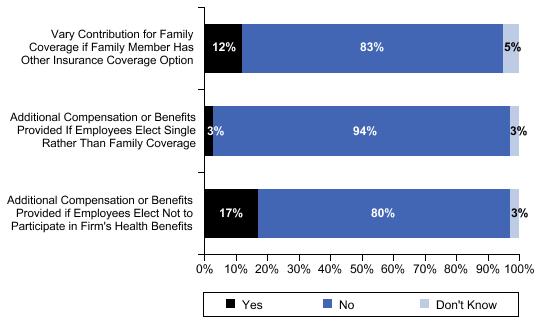
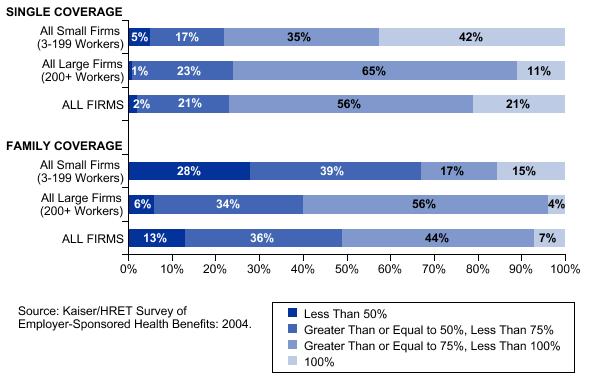
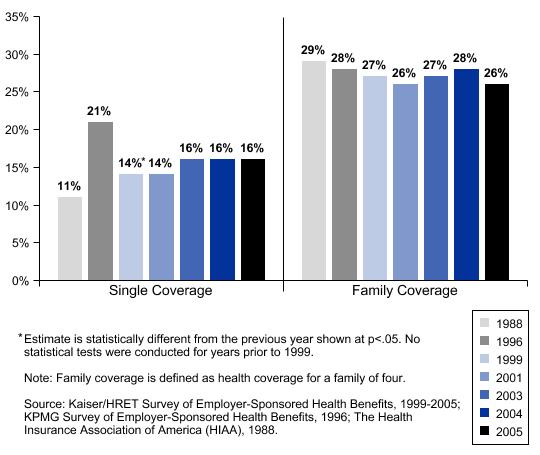
The percentage of premiums paid by workers is statistically unchanged over the last several years, at 16% for single coverage and 28% for family coverage (Exhibit D). All small (3-199 workers) and all large (200 or more workers) firms contribute about the same amount toward single coverage, but all large firms contribute significantly more than all small firms towards family coverage.This year we asked employers about benefit practices that might discourage employees from enrolling in health benefit plans. Of firms offering health benefits, 17% provide additional compensation or benefits to employees who decline the offer of health coverage altogether. Twelve percent of employers offering coverage vary the amount that an employee must pay for family coverage depending on whether the employee’s family member has access to coverage from another source, and three percent of employers provide additional compensation or benefits to employees that elect single rather than family coverage (Exhibit E). Few employers say that they are likely to adopt any of these practices in the near future, but 41% of employers offering health benefits say that they are “very likely” or “somewhat likely” to increase the percentage of the family premium that employees must pay in the next two years.

Chart_12-4.jpg

Click on Thumbnail for larger image (opens in a new window)

Employee Cost Sharing

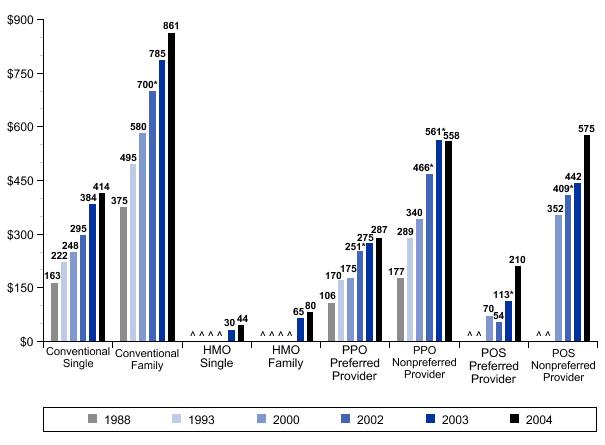
In addition to their premium contributions, most workers make additional payments when they use health care services. Cost sharing rose only modestly in 2004, compared to the larger increases observed in recent years. Fifty-one percent of workers are in a health plan that requires that a deductible be met before most plan benefits are provided. The average single coverage deductible for PPO plans is $287 for services from preferred providers and $558 for services from nonpreferred providers. Both are statistically unchanged from 2003 (Exhibit F). PPO deductibles in all small firms (3-199 workers) are substantially higher than PPO deductibles in larger firms, with single coverage deductibles of $420 for preferred provider services and $676 for nonpreferred-provider services.

Chart_7-2.jpg

Click on Thumbnail for larger image (opens in a new window)

More than half of covered workers face separate cost sharing when they are admitted to a hospital. Thirty percent of covered workers face a separate deductible or copayment when they are hospitalized, with an average payment of $224. Thirteen percent of workers face separate coinsurance when they are hospitalized, with an average coinsurance rate of 16%. An additional five percent of workers face both a deductible or copayment and coinsurance when hospitalized.

The vast majority of covered workers face copayments when they go to the doctor or fill a prescription. Copayments for physician office visits rose modestly in 2004, with the percentage of covered workers in plans with a $20 copayment for office visits increasing from 19% in 2003 to 27% this year. The average drug copayments for generic ($10), preferred ($21), and nonpreferred ($33) drugs increased slightly over the last year.

Next Page (Coverage, Retiree Coverage)

The California Medicaid Program at a Glance

Published: Jul 1, 2004

This fact sheet summarizes Medi-Cal, California’s Medicaid program including who is eligible, what is covered, spending trends, and how it is financed.

Fact Sheet (.pdf)

Medicare Drug Discount Cards: A Work In Progress (Briefing)

Published: Jul 1, 2004

Medicare Drug Discount Cards: A Work In Progress

This report examines the early experience with the Medicare-Approved Drug Discount Card Program, prices offered by card sponsors, and potential savings for enrollees. The report presents information about approved discount card programs, including sponsors, enrollment fees, and drugs covered, as well as beneficiary education and outreach efforts by the Centers for Medicare & Medicaid Services. The pricing analysis shows that discount cards can deliver savings off of full retail drug prices, but also that savings for individual beneficiaries can vary significantly across card programs. In contrast to predictions that market forces would result in lower drugs prices, no notable price changes were observed after the program’s initial start up period.

Report and Executive Summary

The report was released at a July 28, 2004 briefing:

icon_presentations.gif

Agenda

icon_presentations.gif

Speaker Biographies

icon_presentations.gif

Presentation Slides

Webcast