Medicare Chart Book 2005

Published: Jun 30, 2005

This updated resource features more than 80 charts and tables with detailed information about the Medicare program and the 42 million seniors and younger people with disabilities who rely on the program for health insurance coverage. It covers a wide range of relevant data, including state-by-state information when available. Each section can be accessed individually, or the full chartbook can be downloaded in its entirety.

Complete Medicare Chartbook 2005 (.pdf)

Overview (.pdf)

Section 1: Medicare Beneficiaries (.pdf)

Section 2: Medicare Benefits and Utilization (.pdf)

Section 3: Supplemental Insurance Coverage and Medicare Advantage (.pdf)

Section 4: Out-of-Pocket Spending (.pdf)

Section 5: Medicare and Prescription Drugs (.pdf)

Section 6: Medicare Spending (.pdf)

Section 7: Medicare Financing and Future Projections (.pdf)

Appendices (.pdf)

For a copy of this report, please refer to the “Order this Publication” tool located on your right-hand side.
Poll Finding

Public Opinion Snapshot on Health Information Sources – July 2005

Published: Jun 30, 2005

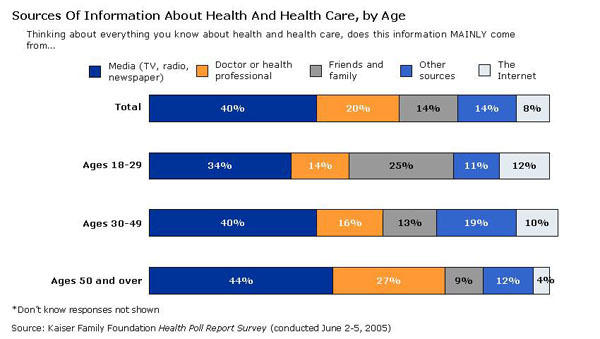
While Americans of all ages are most likely to get information about health and health care mainly from traditional media sources, there are significant generational differences in their reliance on other sources of health information, according to the latest Kaiser Health Poll Report survey.

For example, younger Americans are more likely than older adults to say they get health information from friends and family (25% of ages 18-29, versus 13% of ages 30-49 and 9% of ages 50 and over). Older adults are more likely to rely on doctors or other health professionals (27% of ages 50 and over, versus 14% of ages 18-29 and 16% of ages 30-49).

The Internet is also a more popular source of health information among younger adults. About one in 10 adults ages 18-29 (12%) and ages 30-49 (10%) say the Internet is their main source for health information, compared with just 4% of adults ages 50 and over.

HealthInfoSource_age_jpg.jpg

Overall, the Kaiser Health Poll Report survey finds that four in 10 (40%) of all adults say their information about health and health care comes mainly from traditional media sources such as TV, radio and newspapers. Two in 10 (20%) adults say doctors and other health professionals are their main source for health information, while fewer than one in ten (8%) get this information primarily from the Internet. Findings for the current survey are based on a national random sample of 1,202 adults conducted June 2-5, 2005. The margin of sampling error is +/- 3 %. Complete topline results for the survey are available online.

Women and Health Care: A National Profile

Published: Jun 29, 2005

A new national survey of women on their health finds that a substantial percentage of women cannot afford to go to the doctor or get prescriptions filled. Although a majority of women are in good health and satisfied with their health care, many have health problems and do not get adequate levels of preventive care. The report also examines women’s health status, health care costs, insurance, access to care, prevention, and their role in family health care.

is a nationally representative telephone survey of 2,766 women ages 18 and older. A shorter companion survey of 507 men was conducted for comparison purposes.

icon_news_release.gif

News Release

Report and Report Highlights

Survey Questionnaire (.pdf)

The report was released at a July 7, 2005 briefing:

Agenda (.pdf)

Speaker Biographies (.pdf)

icon_video_audio.gif

Webcast of Briefing

Chartpack (.pdf)

Survey of G7 Nations on HIV Spending in Developing Countries – Chartpack

Published: Jun 29, 2005

Kaiser has prepared this survey of more than 7,000 people in G7 nations in advance of the Group of 8 meeting in Gleneagles, Scotland. Public opinion in the countries (Canada, France, Germany, Great Britain, Italy, Japan, and the United States) shows similarities among the nations on whether progress is being made on HIV/AIDS, if other countries are spending too little, and whether spending will lead to meaningful progress in slowing the epidemic.

The survey was originally presented at a meeting hosted by Kaiser, the Royal African Society, and the Overseas Development Institute (ODI) at the Marlborough House in London, England on June 30, 2005. Select leaders and experts from different sectors (government, business, research and development) participated in the meeting to explore the long-term financing implications of the HIV/AIDS pandemic.

Survey Chartpack (.pdf)

Poll Finding

Survey of G7 Nations on HIV Spending in Developing Countries

Published: Jun 29, 2005

Kaiser has prepared this survey of more than 7,000 people in G7 nations in advance of the Group of 8 meeting in Gleneagles, Scotland. Public opinion in the countries (Canada, France, Germany, Great Britain, Italy, Japan, and the United States) shows similarities among the nations on whether progress is being made on HIV/AIDS, if other countries are spending too little, and whether spending will lead to meaningful progress in slowing the epidemic.

The survey was originally presented at a meeting hosted by Kaiser, the Royal African Society, and the Overseas Development Institute (ODI) at the Marlborough House in London, England on June 30, 2005. Select leaders and experts from different sectors (government, business, research and development) participated in the meeting to explore the long-term financing implications of the HIV/AIDS pandemic.

Survey Toplines

Chartpack

Poll Finding

Survey of G7 Nations on HIV Spending in Developing Countries – Survey Toplines

Published: Jun 29, 2005

Kaiser has prepared this survey of more than 7,000 people in G7 nations in advance of the Group of 8 meeting in Gleneagles, Scotland. Public opinion in the countries (Canada, France, Germany, Great Britain, Italy, Japan, and the United States) shows similarities among the nations on whether progress is being made on HIV/AIDS, if other countries are spending too little, and whether spending will lead to meaningful progress in slowing the epidemic.

The survey was originally presented at a meeting hosted by Kaiser, the Royal African Society, and the Overseas Development Institute (ODI) at the Marlborough House in London, England on June 30, 2005. Select leaders and experts from different sectors (government, business, research and development) participated in the meeting to explore the long-term financing implications of the HIV/AIDS pandemic.

Survey Toplines (.pdf)

The California Medicaid Program at a Glance

Published: Jun 2, 2005

This fact sheet provides an overview of California’s Medicaid program, Medi-Cal, the population that it serves, and the services it covers.

Fact Sheet (.pdf)

Link to the Medicaid Timeline of Key Developements

Published: Jun 1, 2005

How to Link to the Medicaid Timeline

The Kaiser Family Foundation encourages non-profit organizations, government agencies, academic institutions, and other organizations to link to its online information. To link to the timeline, please use the following graphic, title and url.

Title:Medicaid: A Timeline of Key Developments, Kaiser Family FoundationURL:http://www.kff.org/medicaidtimeline/Graphic:

22431093.gif

(right click on the graphic and select “Save Picture As” to save it to your computer)

Thank you for your interest. Please let us know when you have posted the link. Email kcmu@kff.org when the link is live or if you have any questions.

The Distribution of Assets in the Elderly Population Living in the Community

Published: Jun 1, 2005

Individuals cannot qualify for Medicaid nursing home care or home and community-based services unless they meet their state’s asset eligibility standards. Currently, states are required to examine all transfers for less than fair market value that occurred within 36 months prior to an individual’s application for Medicaid. This issue paper examines the assets of elderly people living in the community, focusing on those most at risk of using nursing home care. The paper finds that most elderly people living in the community do not have assets, excluding home equity, sufficient to finance a nursing home stay of one year or more. Of the one million elderly at high risk for nursing home use, 84 percent have asset levels that would be exhausted within one year of nursing home care and, of these, three-quarters have asset levels less than $5000.

Issue Paper (.pdf)