Poll Finding

Giving Voice to the People of New Orleans: The Kaiser Post-Katrina Baseline Survey

Published: Apr 30, 2007

This house-to-house survey of people living in the New Orleans area examines the ongoing struggles of residents seeking to recover from the Hurricane Katrina disaster, including a detailed look at differences in views and experiences by race. Designed and analyzed by researchers at the Kaiser Family Foundation, the survey provides a portrait of the enormous needs of the population in order to inform recovery efforts and policy development on the Gulf Coast and in Washington.

The survey of people living in Orleans, Jefferson, Plaquemines and St. Bernard Parishes documents the devastating impact that Hurricane Katrina and the failure to respond quickly and effectively to it has had on the economic well-being, physical and mental health, and personal lives of the people of the New Orleans area. The survey also found a sharp divide in the way that African Americans and whites in the New Orleans area experienced the storm and perceive the recovery efforts, especially in hard-hit Orleans Parish. Future Kaiser surveys are planned in 18 months and 36 months to monitor progress and changes.

The study is unique not only due to the difficulty of conducting a scientific survey in the recovering New Orleans area, but also because it assesses residents’ quality of life across such a wide variety of areas. To conduct the study, a team of 41 interviewers visited 456 randomly selected census areas, documented the physical condition of nearly 17,000 housing locations and completed interviews with 1,504 randomly chosen adults living in the four parishes between September and November 2006. The survey’s margin of sampling error is plus or minus four percentage points.

icon_news_release.gif

News Release

icon_reports_studies.gif

Executive Summary and Full Report

Chartpack

Audio Interview with Kaiser President and CEO Drew E. Altman, Ph.D., on the study’s findings and implications.

audioicon.gif

Streaming Audio

podcasticon.gif

Mp3 (Downloadable Audio File)

audioicon.gif

Audio Interview with Kaiser Vice President and Director of Public Opinion and Media Research Mollyann Brodie, Ph.D., on how the survey was conducted.

audioicon.gif

Streaming Audio

podcasticon.gif

Mp3 (Downloadable Audio File)

Enrolling Children in Medicaid and SCHIP: Insights From Focus Groups With Low-Income Parents

Published: Apr 30, 2007

This focus group report explores the perceptions, motivations, and experiences of low-income parents enrolling their children in Medicaid and SCHIP. The 11 focus groups were conducted in Chicago, Houston, Los Angeles and Miami in early 2007.

Report (.pdf)

Perspectives on Medicare Part D and Dual Eligibles: Key Informants’ Views From Three States

Published: Apr 30, 2007

In 2006, low-income individuals receiving health coverage through both the Medicaid and Medicare programs, “dual eligibles,” experienced a change in their prescription drug benefit when their Medicaid prescription coverage was replaced by the Medicare prescription drug program known as Medicare Part D. This study provides information on the ongoing successes and challenges that dual eligibles faced in the first eight months of Part D and how different state approaches may affect dual eligibles’ ability to access prescription medications.

It was conducted in three states that adopted different approaches to helping dual eligibles with their Part D expenses: Connecticut, Washington and Florida. Connecticut offers substantial assistance, paying co-payments and providing a “wraparound” to Part D that covers prescription drugs that are not on a dual eligible’s Part D plan formulary. Washington pays dual eligibles’ co-payments but does not cover non-formulary medications. Florida offers neither type of assistance to dual eligibles. In addition, all three states cover certain drugs excluded from Medicare Part D through their Medicaid programs.

Report (.pdf)

E-Health Snapshot: Harnessing Technology To Improve Medicaid and SCHIP Enrollment and Retention Practices

Published: Apr 30, 2007

Information technology holds considerable promise for improving outreach to families with uninsured children, getting them enrolled in Medicaid and SCHIP and keeping them covered. This report documents the promising practices underway across the country to use technology to make enrollment and renewal more efficient, more responsive to family needs and more accountable to the public. The report identifies additional actions that can be taken at the federal and state level to use these tools wisely to benefit the administration of public programs.

Report (.pdf)

President’s FY 2008 Budget

Published: Apr 29, 2007

President’s FY 2008 Budget and Medicaid

The President’s FY 2008 budget proposes $25.7 billion in federal Medicaid cuts over the next five years through a combination of both legislative and regulatory changes. This fact sheet summarizes the President’s FY 2008 budget proposals for the Medicaid program.

Fact Sheet (.pdf)

Health Affairs Article: From ‘Soak The Rich’ To ‘Soak The Poor: Recent Trends In Hospital Pricing

Published: Apr 29, 2007

Health Affairs Article: From ‘Soak The Rich’ To ‘Soak The Poor’: Recent Trends In Hospital Pricing

The May-June 2007 issue of Health Affairs features a Foundation-supported study on recent trends in hospital pricing, including comparisons of rates charged to self-pay patients versus those with insurance coverage. The article also examies three specific policy options that could lower the markups for self-pay patients: a voluntary effort by hospitals, litigation, and legislation

Health Affairs article “From ‘Soak The Rich’ To ‘Soak The Poor’: Recent Trends In Hospital Pricing” (free access)

Full text

Abstract

Medicare Advantage Chartpack

Published: Apr 29, 2007

These charts highlight key data about the Medicare Advantage program, which has grown rapidly in terms of enrollment and number of plans since the enactment of the Medicare Modernization Act in 2003. The package includes a map showing Medicare Advantage penetration by state as well as key facts about private fee-for-service plans, which have contributed significantly to the recent growth of the Medicare Advantage program.

Chartpack (.pdf)

Poll Finding

Kaiser Polls: Prescription Drugs

Published: Apr 17, 2007


function SubmitNewSearch(){// validate date rangeselected1 = frmSort.sm.selectedIndex;selected2 = frmSort.sy.selectedIndex;selected3 = frmSort.em.selectedIndex;selected4 = frmSort.ey.selectedIndex;if ((selected1 == 0) && (selected2 == 0) && (selected3 == 0) && (selected4 == 0))document.frmSort.submit();else if ((selected1 > 0) && (selected2 > 0) && (selected3 > 0) && (selected4 > 0))document.frmSort.submit();elsealert(“Please enter all date range criteria”);}function MoveToPage(page){document.frmMoveToPage.page.value = page;document.frmMoveToPage.submit();return true;}function ViewAll(){document.frmMoveToPage.page.value = 1;document.frmMoveToPage.viewall.value = 1;document.frmMoveToPage.submit();return true;}

View RSS Feed

About Kaiser Polls

The Foundation runs the largest public opinion research program in health. It undertakes original research on the public’s attitudes towards health and social policy issues. Working independently – or in partnership with major national media organizations and academic partners – the Foundation examines Americans’ knowledge and beliefs on major issues and challenges in order to amplify the public’s voice in national debates.

For more information, please contact kaiserpolls@kff.org.


clear.gif
clear.gif
clear.gif
clear.gif
clear.gif
clear.gif
Poll Finding

KaiserPolls

Published: Apr 13, 2007

About Kaiser Polls

The Foundation runs the largest public opinion research program in health. It undertakes original research on the public’s attitudes towards health and social policy issues. Working independently – or in partnership with major national media organizations and academic partners – the Foundation examines Americans’ knowledge and beliefs on major issues and challenges in order to amplify the public’s voice in national debates.

For more information, please email kaiserpolls@kff.org

clear.gif
clear.gif
clear.gif
clear.gif
clear.gif

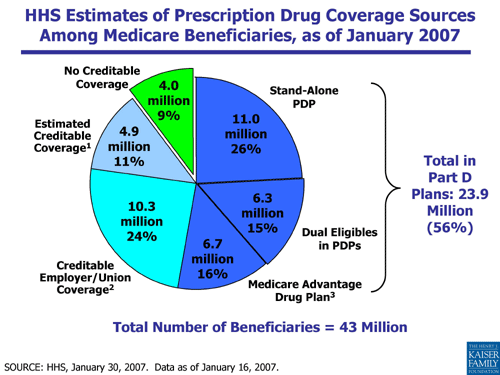
Prescription Drug Sources Among Medicare Beneficiaries

Published: Apr 2, 2007
prescriptiondrugsources.gif

Note: Estimates are rounded to the nearest whole number, therefore do not sum to total. (1) Includes Veterans Administration, Indian Health Service, employer plans without retiree subsidies, employer plans for active workers, and state pharmaceutical assistance programs. (2) Includes employer/union, FEHB, and TRICARE coverage. (3) Approximately 0.5 million dual eligibles are enrolled in Medicare Advantage drug plans and are reported in this category.

Source: HHS, January 30, 2007. Data as of January 16, 2007.