KFF designs, conducts and analyzes original public opinion and survey research on Americans’ attitudes, knowledge, and experiences with the health care system to help amplify the public’s voice in major national debates.
The Foundation and the USC Annenberg Norman Lear Center’s Hollywood, Health & Society examined three seasons (2004-2006) of top-ten-rated prime time scripted shows to measure the prevalence of health content on entertainment shows and to categorize the type of health content on prime time television. The analysis reveals that an average of six out of ten episodes (59%) had at least one health storyline.
This document contains detailed toplines from the August Kaiser Health Tracking Poll: Election 2008 poll. The poll involved a nationally representative random sample of 1,517 adults (including 1,362 who say they were registered to vote), who were interviewed by telephone between July 29 and August 6, 2008. The margin of sampling error for the total sample and for registered voters is plus or minus 3 percentage points. For results based on subgroups, the sampling error is higher.
This document contains the key findings from the August Kaiser Health Tracking Poll: Election 2008 poll. The poll involved a nationally representative random sample of 1,517 adults (including 1,362 who say they were registered to vote), who were interviewed by telephone between July 29 and August 6, 2008. The margin of sampling error for the total sample and for registered voters is plus or minus 3 percentage points. For results based on subgroups, the sampling error is higher.
The latest Kaiser Health Tracking Poll: Election 2008 poll finds that one in four (24%) Americans continues to struggle with paying for health care. Health care ranks as a “serious problem” above paying for food (18%), problems with debt (16%), and paying the rent or mortgage (15%) and below paying for gas (37%) or getting a good paying job or raise in pay (26%).
Among the 24 percent that find paying for health care or health insurance a serious problem, those in the poorest health and those with the most need disproportionately report difficulties.
• Half (50%) of the uninsured say paying for health care is a serious problem.
• About four in ten of those with annual household incomes under $30,000 (42%), those living with someone who requires care (42%), those who report their physical health as “fair” or “poor” (40%), and the unemployed (37%) also report struggling with the cost of health care.
• Members of two minority groups, Hispanics (39%) and African Americans (35%), indicate disproportionate problems paying for care.
• Three in ten of those with two or more hospital overnight stays (31%) and two or more emergency room visits (30%) in the past year also report problems paying for care. The August poll, the ninth in a new series designed and analyzed by the Foundation’s public opinion research team, also examines public perception of the major presidential candidates’ positions on health care and reform.
After Nearly Three Years, New Orleans Residents Give Recovery A Very Mixed Report Card, But See It Moving In The Right Direction And Remain Optimistic For The Future
For further information contact:Rakesh Singh, KFF, (202) 654-1313, rsingh@kff.orgKirran Syed, KFF, (202) 347-5270, ksyed@kff.org
AFTER NEARLY THREE YEARS, NEW ORLEANS RESIDENTS GIVE RECOVERY A VERY MIXED REPORT CARD, BUT SEE IT MOVING IN THE RIGHT DIRECTION AND REMAIN OPTIMISTIC FOR THE FUTURE
Four in 10 Who Lived Through Katrina Report Their Lives Remain Disrupted; More Plan To Leave Than Two Years Ago
Most Say the Nation and the Federal Government Have Forgotten New Orleans
MENLO PARK, Calif. – A comprehensive new Kaiser Family Foundation survey of the experiences of New Orleans residents – the second since Hurricane Katrina – reveals a still-struggling population that gives very mixed reviews in key areas of the recovery efforts. Most residents feel forgotten by the nation and its leaders, yet are still optimistic about their city’s future.
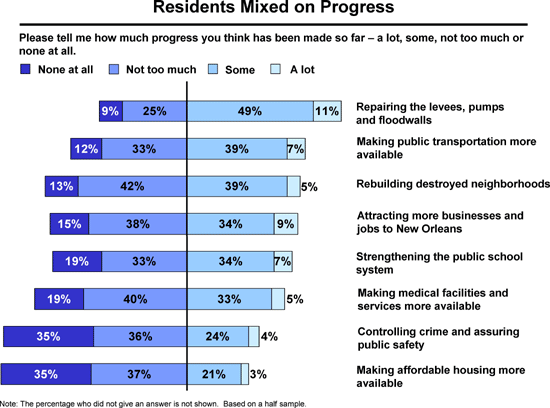
In two critical areas, housing (72 percent) and crime (71 percent), the vast majority of city residents see little or no progress. In other key areas – medical facilities, public schools, jobs, and rebuilding neighborhoods – reviews are more mixed, but with majorities seeing little or no progress. Only in one area, levee repair, does a majority (60 percent) see progress.
“Residents are not satisfied with the pace of the recovery effort, but they do see it moving in the right direction,” Foundation President and CEO Drew Altman said.
The survey also finds that an increasing number of residents say they face mental health challenges as the recovery drags on. In addition, the results show some easing of racial tensions, though many residents still see a city divided between haves and have-nots.
Designed and analyzed by Foundation researchers, the survey was fielded house to house and by telephone in the spring among 1,294 residents of Orleans Parish, the area with the most residents affected by the storm’s aftermath. It finds about four in 10 (41 percent) residents who lived through the storm report that their lives are still very or somewhat disrupted – only marginally better than the 46 percent who reported this level of disruption in Kaiser’s first survey in Fall 2006. Similarly, residents’ assessment of their overall quality of life is low – with only 25 percent saying they would rate their lives as very satisfying, unchanged from 2006. (In 2006, 65 percent reported that their lives had been very satisfying before Katrina.)
As in 2006, a majority of New Orleans residents (56 percent) say that the rebuilding and recovery process is going in the right direction. But at the same time, fully half of those living in the city say they are either dissatisfied (41 percent) or angry (11 percent) with the amount of progress that has been made. And 22 percent say they are thinking about leaving, up from 12 percent in 2006.
Overall, residents give a gloomy report about opportunities available in the city. Nearly two in three (64 percent) say that “good jobs are difficult to find” and 61 percent rate job opportunities as not so good or poor. These sentiments were specific to the city, but may also reflect the wave of economic unease sweeping the nation this year.
Overall, six in 10 New Orleans residents say they do not think the rebuilding of New Orleans is a priority for Congress and the president, and even more (65 percent) say they think “most Americans have forgotten about the challenges facing New Orleans.” Three in four say the federal government has not provided enough money and other support to the city. Most residents (86 percent) also say that the city has at least a somewhat serious problem with political corruption.
Nevertheless, the survey finds widespread hope that things will improve. Three in four (74 percent) say they are optimistic about the city’s future, a level of confidence that has hardly wavered since 2006.
Divisions Remain, But Improvement In Racial Tensions
Looking at life in New Orleans three years after the storm, the new survey finds a large majority of residents (70 percent) see the city as “mainly divided by things like race and income,” and that most of this group see the divide as a problem. However, significantly more of the population says it is the divide between rich and poor that is the problem (33 percent) than say it is the racial divide (15 percent). Roughly a fifth sees both as causing divisions. It is unclear how much of this perceived divide is new and how much of it predated the disaster. The focus on income may be particularly relevant in a city where four in 10 adults say they live in low-income families (making less than $42,400 for a family of four).
The survey does suggest that race relations in the city may be improving. In the latest survey, 28 percent say race relations are “worse [than] they were before Hurricane Katrina,” down 9 percentage points from the results of the 2006 survey. Three in four residents (74 percent) say that the diversity of racial and ethnic groups in the city is good for New Orleans, and a majority (58 percent) says that the growing number of immigrant workers in the city is a good thing.
In addition, the percentage of African Americans who feel the recovery process is racially biased against them has declined from 2006, dropping from a majority of 55 percent to the current 46 percent. African Americans are nearly twice as likely as whites to report than their lives still remain at least somewhat disrupted by the disaster nearly three years later (50 percent versus 26 percent).
Growing Reports of Stress and Mental Health Problems, While Access to Care Improves
The challenges facing New Orleans are compounded by a fairly high-needs population whose problems are not easily solved. The new survey finds 84 percent of adults living in New Orleans facing ongoing health challenges in at least one of four critical areas: a physical or mental health challenge, a problem with health care coverage or access, or a health problem facing a child.
The survey finds a substantial deterioration in residents’ self-reported mental health status. Currently, 15 percent of residents say they have been diagnosed with a serious mental illness such as depression, up from 5 percent in 2006. Similarly, the proportion who report taking a prescription medicine for problems with their mental health rose from 8 percent to 17 percent.
The survey also finds a higher proportion of residents reporting a physical health challenge. Overall, 65 percent report either having some sort of chronic condition or disability or being in “fair” or “poor” health, up from 45 percent in 2006. Three in ten (31 percent) of those with a child under 19 at home say that at least one of their children suffers from a chronic condition or disability, up from 21 percent in 2006.
It’s unclear what has caused these shifts over the past 18 months. It’s possible that, having survived the disaster and the immediate aftermath, the slow recovery is taking a toll on the population. But it’s also possible that the increased rates of reported health problems are the result of a different factor: Now that the health system is at least partially up and functioning again, residents have a better opportunity to be diagnosed and treated for any mental or physical health issues.
More residents report having health insurance coverage (with 18 percent saying they are uninsured, down from 26 percent in 2006), and fewer say that they do not have a usual source of health care or primarily depend on a hospital emergency room (25 percent, down from 34 percent).
At the same time, the affordability of care appears to be a bigger issue, perhaps partly due to the difficult economic climate gripping Louisiana and the rest of the nation this year and possibly due to the impact of medical costs on family budgets as care becomes more available. Overall, fully one in four (25 percent) say they had a problem paying for medical bills in the past six months, up dramatically from 9 percent in 2006. At least twice as many as in 2006 report that they recently skipped or postponed needed care (18 percent vs. 9 percent) or skipped needed doses of medication in the same time period (15 percent vs. 6 percent), bringing these experiences more in line with the current national average.
The survey is the second of at least three that the Foundation will conduct to track residents’ experiences and views as the city rebuilds after Hurricane Katrina and the subsequent levee breaches that devastated huge sections in August 2005. The first survey around the first anniversary of Katrina quantified the many ways in which the disaster impacted people’s lives financially, emotionally, and personally. The next will take place in about 18 months. By providing an over-time assessment of residents’ experiences, priorities, goals, and concerns, the Foundation hopes to give people a continuing chance to report on how the recovery effort is affecting them, to inform leaders of the public’s priorities, and to maintain national attention on the efforts to rebuild New Orleans.
METHODOLOGY
New Orleans Three Years after the Storm: The Second Kaiser Post-Katrina Survey, 2008 was designed and analyzed by researchers at the Kaiser Family Foundation including: the survey research team led by Kaiser Vice President and Director for Public Opinion and Survey Research Mollyann Brodie along with Claudia Deane and including Liz Hamel, Sasha Buscho, and Pam Murnane; the health policy team led by Kaiser Executive Vice President Diane Rowland and including Adele Shartzer, Samantha Artiga, and David Rousseau; and Kaiser President and CEO Drew Altman. Dr. Brodie had overall responsibility for the project. The survey was conducted from March 5 to April 28, 2008, among 1,294 randomly selected adults ages 18 and older residing in Orleans Parish. The sample design was a multi-stage stratified area probability sample starting with 275 randomly selected segments based on Census Block Groups distributed proportionate to expected population in each of fourteen Census tract defined neighborhoods in Orleans Parish and then selecting a random sample of addresses from those areas using the U.S. Postal Service’s Delivery Sequence File. To ensure coverage of all residents, interviewing was conducted using a mixed-mode design including by telephone (669 interviews), web (178), and face-to-face (447). Interviews were completed in English and Spanish. The margin of sampling error for the full sample is plus or minus 3 percentage points. For results based on other subsets of respondents the margin of sampling error may be higher. The 2006 Kaiser survey referenced was conducted in a four parish area, but for reasons of comparability the 2006 results are based only on Orleans Parish residents. ICR/International Communications Research collaborated with Kaiser researchers on sample design and weighting, and supervised the fieldwork.
New Orleans is a city still struggling with the aftermath of Katrina and the levee breaks. The people of New Orleans feel that the nation and the federal government have largely forgotten them. Those are the results of our 2008 survey of the people of New Orleans, the second in a series we are doing to track progress in the recovery from the perspective of the residents of the city themselves.
As the head of a research organization that has put out hundreds of surveys over the years I know that it is in the nature of things that attention will focus most on the more negative findings, which are very real, but as is often the case, the glass can be seen as half empty or half full. There were positive findings in the survey that should not be overlooked.
We found that a majority of New Orleans residents see the recovery moving in the right direction and are optimistic about the future, even as they told us they are unhappy with the pace of the recovery in virtually every area and are especially dissatisfied with progress on housing and crime. This contrasts sharply with the nation as a whole, where polls show the vast majority of Americans see the country going in the wrong direction. The optimism for the future we found in our survey gives New Orleans and the recovery a foundation of hope to build on.
We found that while majorities saw little or no progress in affordable housing, crime, medical facilities, strengthening the schools, bringing back jobs and rebuilding destroyed neighborhoods, significant minorities did see progress in these areas and in one area, repairing levees, pumps and firewalls, a solid majority see progress.
New Orleans residents also report modest improvements in race relations since our survey in 2006. They say the most important divide in the city is about income, not race. And they say the influx of immigrant workers into the city is a good thing, no doubt because of the labor needed to aid in the rebuilding effort. Race has long been an issue in New Orleans, as in the nation, and documenting a perception of progress on this difficult issue is positive news.
Finally, while we found that the number of residents saying they are considering leaving New Orleans is up from 12 percent in 2006 to 22 percent today, we discovered that fully 90 percent of New Orleans current residents lived there when Katrina hit . These residents are not newcomers and clearly have deep ties to the city. The biggest challenge will be retaining young adults and younger professionals, and convincing them that New Orleans is a good place to build careers and raise children, but there is a core population with a strong commitment to the city who are not planning to leave.
On the streets of New Orleans grassroots groups are working hard to make things better, as are public servants at all levels, no matter the red tape and institutional obstacles that get in their way. The unique challenge in New Orleans is that expectations may have been raised as the city suffered a historic disaster, and in the aftermath, its people had hopes for an equally historic rebuilding and recovery effort. The question now is whether the optimism our survey found will dissipate or even turn sour if the pace of the recovery does not quicken and frustration grows. Let us hope that when we conduct our next survey in about 18 months we will find that the people of New Orleans are still optimistic about the future of the city and are feeling a little less forgotten by their fellow Americans.
— A version of this piece was also published in the New Orleans Times-Picayune.
New Study Examines the Current Spending on Health Care for the Uninsured and Projects the Cost of Additional Medical Care if the Population Were Insured
This study examines the current spending on care for the uninsured and projects additional medical spending if the population had health insurance coverage.
The study finds that the uninsured will spend $30 billion out-of-pocket for health care in 2008 while receiving $56 billion in uncompensated care, three quarters of which will be from government sources.
The study is an update of a previous Kaiser study and also projects the additional cost to the nation’s health care system if all the uninsured were covered by insurance. If everyone were covered, overall costs would increase by $123 billion dollars, or an additional five percent of national health spending. The analysis does not assess how much a universal coverage plan would cost the government, which would vary depending on the details of the approach.
With the upcoming U.S. Census Bureau release of 2007 health insurance coverage data, the Foundation has compiled some key resources about the nation’s uninsured population and related health policy issues.
This document contains the full findings and methodology from a Kaiser study featured in Health Affairs that examines the current spending on care for the uninsured and projects additional medical spending if the population had health insurance coverage.

;%22)
;%22)
;%22)
;%22)
;%22)
;%22)