News Release

KaiserEDU.org Selects Winning Student Essays Identifying Future Health Policy Challenges

Published: Apr 29, 2010

The Kaiser Family Foundation announced the winners of its fourth annual essay contest today, sponsored by the foundation’s educational health policy website, kaiserEDU.org. The contest invited students to identify the major health policy challenges the nation will face in the year 2015 and discuss how the top two priorities should be addressed.

Entries were received from more than 400 undergraduate and graduate students enrolled at colleges and universities across the country in a wide range of disciplines including public health, medicine, nursing, economics, and law.

“The passage of health reform brings a great opportunity for students to play a more active role in health care policy through their studies and after they graduate as our future policy analysts, health care providers, and policy makers,” said Kaiser President and CEO Drew Altman. “The interest in the contest this year shows that health reform has activated student interest across the country,” Altman added.

The winners from the graduate student entries are:

  • 1st Place:  Marilyn Michelow, Weill Cornell Medical College, studying Medicine (expected graduation 2012), whose essay was titled “Health Care Reform 5 Years Out: Payment, Pricing and Primary Care.”
  • 2nd Place: Sarah Katz, Georgetown University, studying Health Systems Administration (expected graduation May 2010), whose essay was titled “The State of Health Care in 2015: Access Problems and Health Disparities Persist.”

The winners from the undergraduate student entries are:

  • 1st Place: Catherine Denver, Johns Hopkins University, Major: Nursing (expected graduation May 2010), whose essay was titled “2015: Health Policy Issues of Our Time.”

Tied for 2nd Place:

  • Danielle De Luca, Georgetown University, Major: Healthcare Management and Policy (expected graduation May 2012), whose essay was titled “The Future of American Healthcare: What Lies Ahead.”
  • Yuri Hanada, Massachusetts Institute of Technology, Major: Biology (expected graduation June 2010), whose essay was titled “Disparities and Shortages: Major Policy Challenges in American Medicine.”

The panel of final judges for the essay contest was comprised of leading national experts on health policy and politics, including Jonathan Cohn of the New Republic; Sheila Burke of Harvard Kennedy School of Government; Ruth Katz, Congressional staffer and former Dean of the George Washington University School of Public Health; Drew Altman, Ph.D., Kaiser president and CEO; and Diane Rowland, Sc.D., Kaiser executive vice president.

KaiserEDU.org is a free website for students, faculty and others interested in learning about health policy. The site presents a broad array of resources, including tutorials on health policy basics, issue modules on current topics under debate and a directory of internships and fellowships.

 

GreaterThanAIDS Media Partnership: Press Releases

Published: Apr 29, 2010
GTA_sm.jpg

Press Releases

Walgreens And Greater Than AIDS Team Up With Health Departments And Local AIDS Service Organizations To Provide Free HIV Testing In Support Of National HIV Testing Day2012-06-14

“I Got Tested” Campaign Encourages Americans To Know Their HIV Status2012-06-12

SiriusXM OutQ and Greater Than AIDS Empower Gay Community to “SpeakOUT”2012-03-16

Black Women from TV, Film and Music Speak Out in a Powerful New Message on National Women & Girls HIV/AIDS Awareness Day (March 10th): “Make Every Moment, A Deciding Moment”2012-03-06

New Greater Than AIDS PSAs and Social Media Messages Mark National Black HIV/AIDS Awareness Day (Feb. 7)2012-02-06

Leading Media and Other Corporate Allies Encourage Americans to Be “Greater Than AIDS” on World AIDS Day2011-11-30

Walgreens HIV Centers of Excellence Pharmacies Now Top 500 Nationwide in Areas Most Impacted by HIV/AIDS2011-11-10

B Holding Group Teams Up With Greater Than AIDS for First Annual HBCU b Healthy Tour2011-09-08

Walgreens, EBONY Encourage Americans to “Be Greater Than AIDS”Free HIV Testing, Targeted HIV/AIDS Resources at Walgreens Stores in Heavily Affected Areas2011-06-21

Greater Than AIDS, GYT Campaigns Join Forces To Get Out the Word About HIV Testing2011-05-26

The LA Clippers Join With Supervisor Ridley-Thomas, The LA County Public Health Department and HIV/AIDS Organizations to Mobilize Fans to be “Greater Than AIDS”2011-03-30

The Miami Heat Join With Local Health Department and AIDS Organizations to Mobilize Fans to be “Greater THAN AIDS”2011-03-24

The Houston Rockets Join With Mayor Parker, Local Health Department and AIDS Organizations to Mobilize Fans to be “Greater Than AIDS”2011-03-17

The San Antonio Spurs Join With Mayor Castro, Local Health Department and AIDS Organizations to Mobilize Fans to be “Greater Than AIDS”2011-03-08

Here Media Empowers Gay Community to be “Greater Than AIDS”Here Media Empowers Gay Community to be “Greater Than AIDS”2011-03-01

The Sacramento Kings Join With Mayor Johnson and Local Organizations to Mobilize Fans to be “Greater Than AIDS”2011-02-11

The LA Clippers Join With Local Organizations to Mobilize Fans to be “Greater Than AIDS”2011-02-02

Oakland Mayor, Danny Glover, & the Golden State Warriors Join With Local Organizations to Mobilize Fans to be “Greater Than AIDS”2011-01-26

NBA, Walgreens, Major Media, Among Those Who Declare “We Are Greater Than AIDS” on World AIDS Day2010-11-30

A “Deciding Moment” for AIDS After 30 Years – New National Media Campaign Inspires Black Americans to Take Action to Stem Spread of HIV2010-10-05

Be Greater Than AIDS: Get Yourself Tested Week Promotes Free HIV Testing in 10 Cities from June 19-June 27, 20102010-06-16

Clear Channel Makes a Bold Commitment to HIV/AIDS in Lead Up to National HIV Testing Day2010-04-02

San Francisco AIDS Foundation Introduces HIV Testing to Sixth Street2010-03-22

Black AIDS Institute and The Magic Johnson Foundation Announce New Collaboration to Fight Black HIV2010-02-03

New Media-led Effort Responds to AIDS Crisis in Black America2009-06-25

GreaterThanAIDS Media Partnership: Resources and Materials

Published: Apr 29, 2010
GTA_sm.jpg
clear.gif

Greater Than AIDS Toolkit

An abundance of community materials are avialable on GreaterThan.org.

The Greater Than AIDS toolkit offers promotional and informational materials which are available rights-free for educational purposes and to extend the reach of Greater Than AIDS on the ground and online. Materials are available to download on the spot or hard copies can be requested right from the toolkit

. Materials subject to available quantities.

Custom materials, including t-shirts, bannerstands, and fans can be purchased direct from vendors. Greater Than AIDS does not profit from custom merchandise sales.

Organizations are finding innovative ways to be Greater Than AIDS. To find out what you can do in your community, read their success stories:

For more Resources, visit http://www.greaterthan.org/take-action/resources/.

clear.gif

Health Care Reform and the CLASS Act

Published: Apr 28, 2010

This issue brief examines the Community Living Assistance Services and Supports (CLASS) program, a component of the health reform law that establishes a national, voluntary insurance program for purchasing community living services and supports that is designed to expand options for people who become functionally disabled and require long-term help. This brief describes the major components of the CLASS program including its financing, eligibility criteria, benefit design and interaction with Medicaid.

Issue Brief (.pdf)

Expanding Medicaid under Health Reform: A Look at Adults at or below 133% of Poverty

Published: Apr 22, 2010

This issue brief from the Kaiser Commission on Medicaid and the Uninsured examines the key characteristics of the 17.1 million low-income uninsured adults who currently have incomes that would qualify them for Medicaid under the expansion of the program in health reform.

The planned expansion of Medicaid to all individuals with incomes at or below 133 percent of the federal poverty level will establish a national foundation of coverage based on income. Adults whose incomes will make them eligible for Medicaid under health reform compromise 37 percent of all the uninsured in the United States. The majority of them do not have dependent children, and about half have family incomes below 50 percent of the federal poverty level. The members of this group have problems accessing health care and about one third of them have been diagnosed with a chronic condition.

This analysis does not take into account immigration status. Some of the adults in the analysis will not gain Medicaid eligibility either because they are undocumented immigrants or because they have not legally been in the U.S. for five years. Additionally, some of these adults may already be eligible for Medicaid.

Issue Brief (.pdf)

Previous Version:

Expanding Medicaid: Coverage for Low-Income Adults Under Health Reform (.pdf)

Explaining Health Care Reform: Questions About Medicaid’s Role

Published: Apr 22, 2010

Medicaid plays a major role in covering more of the uninsured under the new health reform law. The new law includes a significant expansion of Medicaid, an individual requirement to obtain health insurance, and subsidies to help low-income individuals buy coverage through newly established Health Benefit Exchanges. This brief explains the how Medicaid works today and answers some key questions about Medicaid’s role in health reform.

Issue Brief (.pdf)

News Release

Americans Remain Divided on Health Reform But Are Confused About The Law And How And When It Will Affect Them

Published: Apr 22, 2010

Many Provisions That Take Effect in 2010 Are Popular and Have Bipartisan Support

Cable News Tops List of the Public’s “Most Important” Information Sources

MENLO PARK, Calif. –The first Kaiser Health Tracking Poll fielded since the passage of health reform last month finds that 8 in 10 Americans know that President Obama signed the legislation  into law.  But 55 percent say they are confused about the law and more than half (56%) say they don’t yet have enough information to understand how it will affect them personally.

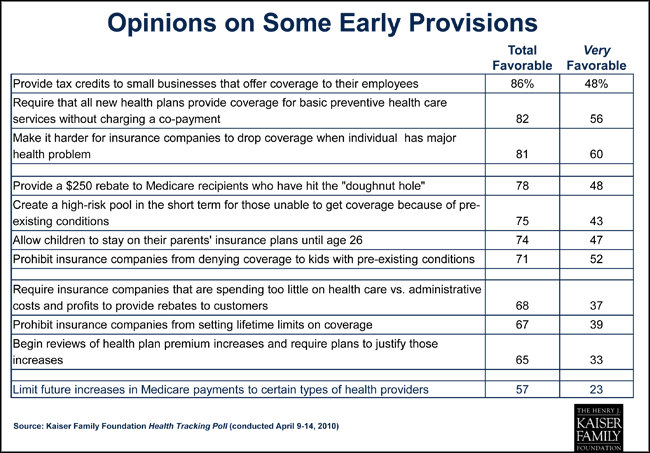
The April poll finds that the public supports many of the provisions of health reform that are set to be implemented in the short term.  When asked about 11 specific provisions scheduled to take effect this year, in each case a majority of Americans viewed them favorably, often with bipartisan support.

Still, the public remains divided on the law overall, with 46 percent viewing it favorably, 40 percent unfavorably and 14 percent undecided.  Similarly, 31 percent of Americans say they expect personally to be better off because of the law, while 32 percent say they will be worse off and 30 percent say they don’t expect to be affected.

“People are struggling to understand how the law will affect them and their families and to separate fact from political spin,” said Kaiser President and CEO Drew Altman.

Many Reform Provisions That Take Effect in 2010 Are Popular With Bipartisan Support

The new law was constructed to include some provisions that take effect in the first year so that the public would feel tangible results in the short term.  The poll tested the popularity of many of these early measures and finds widespread support for them across the political spectrum, including among Republicans and independents

Nearly 9 in 10 Americans favor providing tax credits to small businesses that want to provide coverage for their workers, for instance. And roughly 8 in 10 have favorable views of provisions that would offer access to basic preventive care with no copayments, provide financial help to seniors who hit the gap in Medicare drug coverage known as the “doughnut hole,” and end insurance companies’ practice of dropping coverage if a person has a major health problem.

In each of these cases, at least two-thirds of Republicans and independents join most Democrats in viewing the provisions favorably.

042010_chart2-NEWSRELEASE

Americans Are More Confused Than Angry About Health Reform

Although anger grabs the headlines, the only emotion shared by more than half of the public when it comes to the health reform law is confusion.  Overall, 55 percent say they are confused, an emotion more deeply rooted among those who feel unfavorably toward reform (61% of whom feel confused) than among those who favor it (44% of whom feel confused).

Minorities of Americans report feeling other emotions, including 45 percent each who say they are “pleased” or “disappointed,” 42 percent who are “anxious,” and 40 percent who are “relieved.”  Anger is at the bottom of the list, a feeling reported by 30 percent of the public, including 16 percent who say they are “very angry.”  Asked what about health reform made them angry, that 30 percent divided as follows: 9 percent did not like the way the policymaking process worked, 7 percent did not like the final content, and 12 percent did not approve of either.

Cable TV News Is The “Most Important” Source of Information About Reform Law

Americans of all political leanings pointed to cable television news more than any other source when they were asked to choose their most important source of news and information about the law.  More than a third (36%) cited cable TV news stations and their websites as their most important outlet, followed by network news (16%), newspapers (12%), friends and family (10%) and the radio (9%).

There were some differences along party lines, however. Republicans were more likely to name cable TV as their most important news source, with 45 percent saying so compared to 30 percent of Democrats.  On the other hand, Democrats were twice as likely as Republicans and independents to say that they got most of their information from network news (23% of Democrats compared to 12% of the other two groups).

Overall sentiment about the new law still breaks sharply along partisan lines. Nearly 8 in 10 Democrats (77%) favor the new law, while about as many Republicans (79%) view it unfavorably, a mix very similar to that seen before the bill’s passage in March. Political independents tilt against the law (46 percent opposed compared to 37 percent in favor), while self-described moderates favor the measure 55 percent to 31 percent.

Methodology

This Kaiser Health Tracking Poll was designed and analyzed by public opinion researchers at the Kaiser Family Foundation.  The survey was conducted April 9 through April 14, 2010, among a nationally representative random sample of 1,208 adults ages 18 and older.  Telephone interviews conducted by landline (801) and cell phone (407, including 171 who had no landline telephone) were carried out in English and Spanish. The margin of sampling error for the total sample is plus or minus 3 percentage points. For results based on subgroups, the margin of sampling error may be higher. The full question wording, results, charts and a brief on the poll can be viewed online at http://www.kff.org/kaiserpolls.

The Kaiser Family Foundation is a non-profit private operating foundation, based in Menlo Park, California, dedicated to producing and communicating the best possible information and analysis on health issues.

 # # #

The COBRA Subsidy and Health Insurance for the Unemployed

Published: Apr 16, 2010

With the nation’s unemployment rate rising to its highest levels in decades as a result of the recession, many families have lost their employer-sponsored health coverage or are at risk of doing so. In an effort to help people maintain coverage after a layoff, the stimulus legislation known as the American Recovery and Reinvestment Act of 2009 provides temporary subsidies to some workers so that they can maintain their previous employer-sponsored coverage through COBRA after losing their job.

This issue brief examines the COBRA provisions of the legislation and answers key questions about how the subsidy works and who might benefit. It also explains how the provisions interact with other laws and programs designed to help people obtain and maintain health coverage, and it discusses other coverage options for the unemployed. Congress and President Obama have repeatedly extended both the eligibility period and the duration of the COBRA subsidy. It now lasts for up to 15 months. An updated fact sheet answers key questions about the subsidy extension.

Fact Sheet: Extension of COBRA Subsidy – An Update (.pdf)

Issue Brief: The COBRA Subsidy and Health Insurance for the Unemployed (.pdf)