KFF designs, conducts and analyzes original public opinion and survey research on Americans’ attitudes, knowledge, and experiences with the health care system to help amplify the public’s voice in major national debates.
To receive federal Medicaid matching funds, states that participate in Medicaid must meet federal requirements, which include covering specified “federal core” enrollee groups and mandatory health benefits. States also may choose to cover additional “state expansion” enrollees and optional benefits with federal Medicaid matching funds.
The federal core eligibility standards have expanded incrementally over time, mostly for children and pregnant women, as the Medicaid program separated from welfare. Moreover, many states have taken up options to extend coverage to expansion groups, primarily for children and individuals in need of nursing home care. In addition, all states offer at least some optional benefits, but there is significant variation across states in the scope of their benefit packages. Using 2007 data, this analysis examines the proportion of Medicaid enrollment and spending attributable to state expansion enrollees versus federal core enrollees and presents estimates of spending on mandatory versus optional health benefits across all enrollee types.
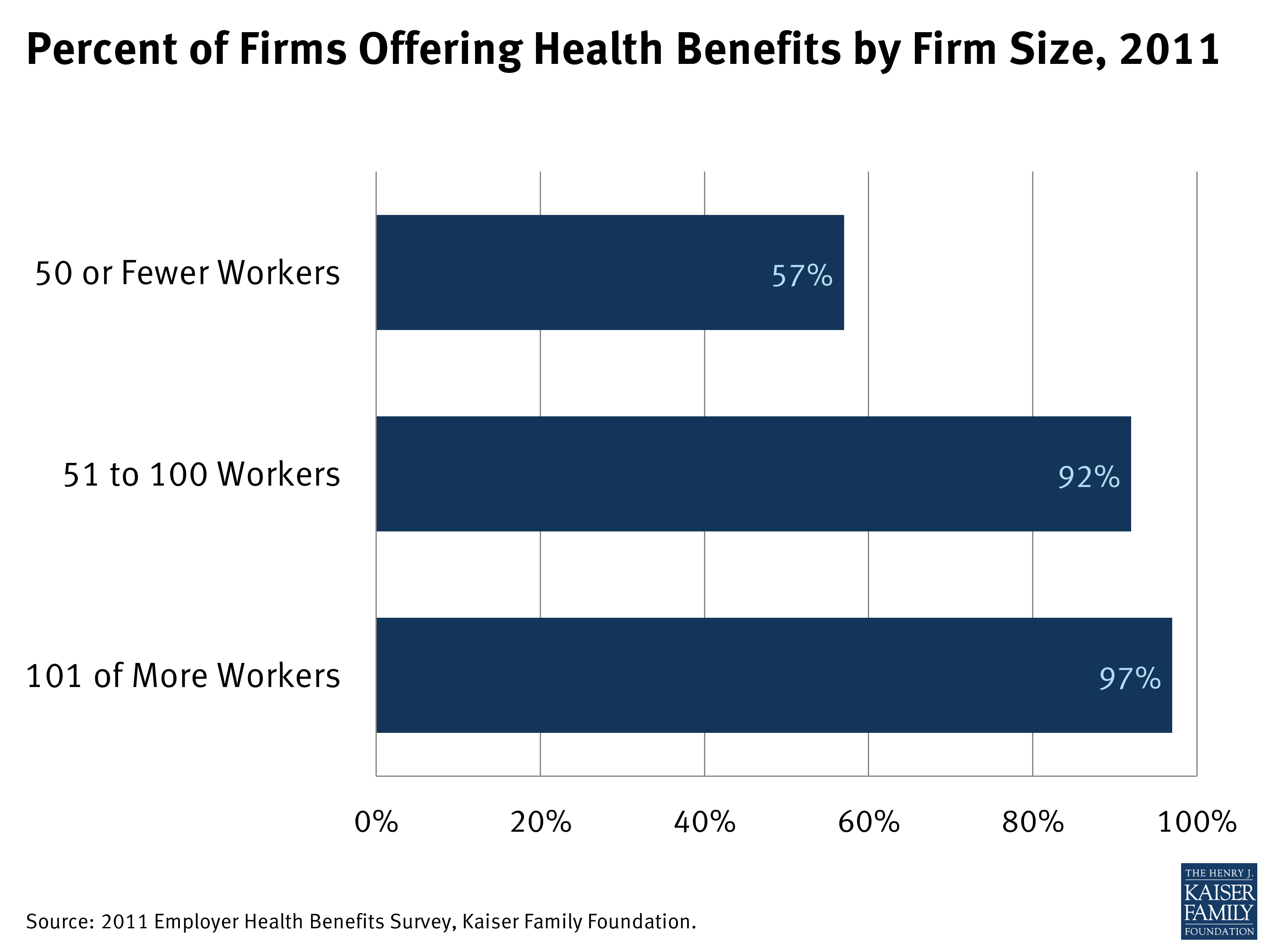
Several provisions of the Affordable Care Act (ACA) will likely have significant effects on small businesses, their employees, and families. Currently, smaller businesses are less likely to offer health insurance coverage to their employees than larger companies: 57% of small businesses with 50 or fewer workers offered health benefits to employees, compared to 92% of businesses with 51 to 100 workers, and 97% of businesses with 101 or more workers in 2011.1 This fact sheet explains the changes that are likely to take place with reform, when they go into effect, and which businesses will be affected.
Maintaining Current Coverage: “Grandfathered” Group Health Plans
The ACA permits those small businesses that wish to keep the insurance plan they currently have to do so. In 2011, approximately 72% of small businesses (with 100 or fewer workers) had at least one plan grandfathered under the ACA.2 So-called “grandfathered” group plans are subject to fewer requirements under the ACA. For example, grandfathered plans are not required to:
cover preventive services without cost sharing;
cover Essential Health Benefits (discussed below);
provide for an internal and external appeals process for contesting coverage decisions; or
allow direct access to an OB/GYN without referral
If a company’s plan is grandfathered under reform (meaning that it was in place before March 23, 2010), the plan remains grandfathered even if the company enrolls new employees in the plan. Businesses wishing to keep their grandfathered plans may even change insurance carriers and keep grandfathered status if the benefits and costs to employees stay largely the same. Grandfathered plans may keep this status so long as they do not make significant changes to coverage (such as increasing cost-sharing or cutting benefits).3
Changes to Health Insurance Purchased by Small Businesses
The ACA includes broad changes to the insurance market for plans purchased by small businesses. Note that some of these changes only apply to new (non-grandfathered) plans and others apply to all plans, regardless of grandfathered status.
Access: Beginning in 2014, all health insurance plans must guarantee the availability and renewal of coverage regardless of health status. (Note that small employers with 50 or fewer employees already have guaranteed issue in all states, but this provision of the ACA expands the guaranteed availability of insurance).4 Furthermore, young adults may remain on their parents’ plan until age 26.
Costs: As of 2014, premium rating based on health status will be prohibited for new (non-grandfathered) plans. Premiums for new plans will only be allowed to vary by age, tobacco use, policy type (individual or family), and geographic location. Health plans may reward participation in a qualified wellness program by providing up to a 30% discount on the cost of coverage, so long as reasonable alternatives or waivers are made available for employees with medical conditions that would preclude them from participating.
Coverage: New (non-grandfathered) plans will cover a set of minimum benefits (called Essential Health Benefits) beginning in 2014. Based on initial guidance issued by the federal government, each state would determine its benefit package based on a range of benchmark plans in the state.5 All plans (regardless of whether they are grandfathered) will be prohibited from imposing exclusions for pre-existing conditions (effective since 2010 for children under 19; effective in 2014 for adults).
Value: All plans (regardless of grandfathered status) will have to report the proportion of their income from premiums that are used on medical care and quality improvement. If this amount (called the Medical Loss Ratio or MLR) is less than 80%, small businesses and individuals enrolled in the plan will receive a rebate.
Comparison: New plans will be labeled as bronze, silver, gold, and platinum “tiers” demonstrating the actuarial value of the plan (the percentage of costs covered for a typical population) to facilitate comparison across plans.
Provisions of the ACA Relating Specifically to Small Businesses
The aspects of the ACA that relate most directly to small businesses are the creation of new insurance exchanges, tax credit subsidies, and penalties if some employers do not offer coverage.6
Creation of Insurance Exchanges
Small businesses will have the option to purchase insurance through a new market, called the Small Business Health Options Program (or SHOP Exchange). The exchange will be designed to offer individuals and small employers an easier way to compare and purchase plans. Employers may continue to purchase insurance through the market outside of the exchange, and the insurance reforms above will apply throughout both markets. Each state is required to create an exchange by 2014; otherwise the federal government will run one in the state. Until 2016, states will have the option to define small businesses as either 1-50 employees or 1-100 Full-Time Equivalent (FTE) employees for the purposes of exchange enrollment and the insurance market reforms described above.7 After 2016, all businesses with 100 or fewer FTE employees will be able to purchase insurance through the SHOP exchange. The non-partisan Congressional Budget Office (CBO) estimates that approximately 2.6 million small business employees will get coverage through the exchanges in their first year (2014), increasing to approximately 3.7 million employees receiving coverage through the exchanges in 2017.8
Penalties for Not Providing Affordable Coverage
Though there is no requirement that small businesses offer health insurance, some smaller businesses (with at least 50 employees) will have to pay a penalty if they do not offer affordable coverage. Enforcement of those penalties will begin in 2015, a year later than originally scheduled.
Businesses with 49 or fewer FTE employees are exempt from these penalties.
Businesses with 50 or more FTE employees will be fined $2,000 per employee (excluding the first 30 employees) if they do not offer coverage for employees who average 30 or more hours per week. Note that there is no penalty for part-time employees not offered coverage.
To avoid penalties, employers must offer insurance that covers at least 60% of the actuarial value of the cost of benefits. The coverage also must be affordable to employees, meaning an individual employee’s premium cannot exceed 9.5% of their household income. If the coverage offered does not meet the affordability standard, employees may receive tax credits to purchase insurance on their own through the exchange. If this is the case, small employers will either have to pay $3,000 per employee receiving the tax credit, or pay $2,000 per employee excluding the first 30 workers (whichever amount is less).
Tax Credits to Assist in the Cost of Health Insurance
Small businesses with fewer than 25 FTE employees may be eligible for tax credits to assist in the cost of health insurance.9 To qualify, such businesses must have average annual wages below $50,000 and must pay at least half of the cost of their employee’s health insurance. There are two phases to the tax credit:
Phase 1: (2010-2013) Eligible employers receive a tax credit of up to 35% of the employer’s contribution toward insurance premiums, calculated on a sliding scale basis tied to average wages and number of employees. Small businesses with tax-exempt status meeting the requirements above may receive 25% of the employer’s contribution in the form of tax credits.
Phase 2: (2014 and onward) Eligible employers that purchase insurance through the SHOP exchange may receive a tax credit of up to 50% of the employer’s contribution toward insurance premiums. These employers may take the tax credit for up to two years. Tax-exempt small businesses meeting the requirements above may receive 35% of their contribution in the form of tax credits. The exact amount each small business receives in tax credits will depend on the number of employees and average wages.
Grants for Wellness Programs
Small businesses (with fewer than 100 employees who work 25 or more hours per week on average) that didnot have a workplace wellness program in effect at as of March 2010 are eligible for grants to start such programs.
Additional Resources for Small Employers and their Employees
Changes to a plan (from the way the coverage was structured on March 23, 2010) which would cause it to relinquish grandfathered status include: increases in copayments, deductibles, or out-of-pocket limits above the rate of medical inflation, plus 15 percentage points; any increase in co-insurance rates; decreases in the amount of annual limits, or instituting a new annual limit not previously in place; a decrease in employer contributions by more than 5 percentage points; or the elimination of coverage for treating or diagnosis a specific condition. ↩︎
Compilation of Patient Protection and Affordable Care Act as Amended through November 1, 2010 including Patient Protection and Affordable Care Act Health-related Portions of the Health Care and Education Reconciliation Act of 2010. Washington: U.S. Government Printing Office, 2010. ↩︎
Full-time Equivalents (FTEs) are calculated by summing the hours of full and part-time employees. For example, two half-time employees are equivalent to one full-time employee. ↩︎
The October downturn in the share of Americans with a favorable view of the health reform law, a dip driven by an erosion of support among Democrats, has been fully reversed in December, with support among Democrats rebounding and overall national opinion on the law returning to the roughly even split seen in Kaiser polls for most of 2011. The concept of health exchanges, a key piece of the law, has wide, bipartisan support. The individual mandate is the least popular aspect of the law, yet the poll shows that opinion on the mandate is malleable.The December poll is the latest in a series designed and analyzed by the Foundation’s public opinion research team.
(You may need Firefox or Chrome to view the .pdfs)
According to the December Kaiser Health Tracking Poll, the October downturn in the share of Americans with a favorable view of the health reform law has been fully reversed in December and overall opinion on the law returned to the roughly even split seen for most of 2011. Forty-three percent of Americans expressed unfavorable views of the law in December, while 41 percent had favorable views. Partisan divisions persist and the findings suggest not only that opinions of the law are polarized along partisan lines, but also that views are similarly hardened and polarized among many independents. Among independents who say they “lean Democratic,” for instance, a majority (59 percent) favor the law. At the same time, among those who “lean Republican,” 78 percent oppose the law. And among that narrow sliver of the public (18 percent) that reports not having an inclination toward one party or the other, support for the ACA is at 29 percent while opposition is at 47 percent.
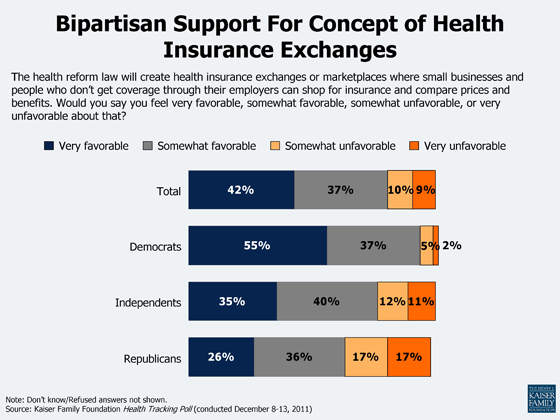
The concept of state-based health insurance exchanges, a key element of the health reform law, has wide, bipartisan support. As many states prepare to set up such exchanges and others hold off in anticipation of a Supreme Court ruling on health reform next year, about eight in ten Americans say they have a favorable view of the creation of “health insurance exchanges or marketplaces”. The provision is backed by 92 percent of Democrats, 75 percent of independents and a solid majority (62 percent) of Republicans.
One of the most interesting conversations on a health topic happened recently on The Daily Show between Bono and Jon Stewart. Bono told Stewart that we were “at the beginning of the end of the AIDS epidemic,” promising an announcement the next day that would explain how a combination of early treatment, treatment for pregnant women, and circumcision, would turn the epidemic around if the American people would continue to put money into the cause. Stewart responded cautiously: “I am looking forward to hearing that,” he said, “because that sounds remarkable and people’s hopes have been raised before about the end of this disease, but I really hope that there is something.”
The conversation between the two captures the tension between the opportunity for new optimism and the continuing need for realism about the AIDS epidemic. How do we strike the right balance between these two messages? Are there other essential messages?
Bono is right that research now shows the potentially transformative impact of early treatment. Studies now show that HIV, if treated early, need not progress to AIDS any longer. Just as important, the chances of people with HIV passing on the virus to uninfected partners is reduced by 96% if they are treated early. As a result, modeling shows that the combination of early treatment and other measures such as circumcision can have a huge impact on the global epidemic if they are implemented together and with adequate funding. It was certainly appropriate for Bono to choose World AIDS Day to spotlight the remarkable progress that has been made. And the message of new hope focused renewed attention on HIV, including by President Obama.
But, Jon Stewart’s note of caution is as appropriate as Bono’s enthusiasm. Marshaling new resources on the scale needed to achieve the kind of impact Bono is touting will be a challenge, especially in today’s global economic and budgetary environment. There were 6.6 million people in treatment in low- and middle-income countries in 2010, up from half a million in 2001 and up 1.5 million just since 2009. That is a great achievement. And treatment services are being delivered more efficiently than ever before. But an estimated 34 million people are living with HIV, and less than half the 14.2 million estimated to be eligible for treatment under current guidelines currently receive it. Although infection rates have been declining, there were still 2.7 million new infections last year. As a result of the sputtering worldwide economy, nations are struggling to keep up even current levels of funding, let alone increase them dramatically. In fact, The Global Fund for HIV, TB and Malaria recently announced that it has had to suspend its next round of new grants. There are scientific and implementation challenges as well, as Jon Cohen chronicled in his outstanding review of the new research on early treatment in Science.
In her recent address on HIV, Secretary Clinton struck the right balance, calling for an AIDS- (not HIV) free generation as a goal, but noting that we still had a long way to go. And the President reminded everyone that the epidemic in our own country is stuck in neutral. Speaking on World AIDS Day he said: “…The fight is not over — not by a long shot. The rate of new infections may be going down elsewhere, but it’s not going down here in America.” It is important to be both hopeful and realistic because while we can aspire to fulfill the promise of recent scientific advances, over-promising could backfire with the public when nations do not put up new resources and hoped for results are not there.
Our polling over many years shows clearly that the main variable in public support for funding for HIV/AIDS (and global health more broadly) is whether or not the public believes funding will make a difference. Now new research about the effectiveness of testing and early treatment allows the case to be made much more strongly than ever before. Taxpayer dollars have saved millions of lives and have not been wasted. New money for HIV/AIDS will make a difference and save many more lives. When it comes to marshaling critical support for funding that is the most important message the public needs to hear.
In a close vote, the National Association of Insurance Commissioners (NAIC) recently adopted a resolution urging Congress and the Department of Health and Human Services (HHS) to exempt insurance broker and agent compensation from medical loss ratio (MLR) requirements or otherwise adjust the requirements to ease their effect. HHS last week released its final MLR rule, maintaining its original decision to count broker compensation as an administrative cost for insurers. H.R. 1206, a bill that would exempt broker commissions from the MLR calculation, is currently pending in the House.
The MLR provision of health reform requires insurers to use at least 80% of premium dollars (85% for large employer plans) on health care expenses and quality improvement (rather than overhead and profits). If an insurer doesn’t meet the requirements, it will have to pay rebates to consumers. Rebates based on 2011 experience will have to be paid by August 2012.
Brokers and agents – often referred to as insurance “producers” – not surprisingly are concerned that the MLR requirement will put pressure on insurers to cut back on administrative expenses, including sales commissions. Exempting broker commissions from the MLR calculation would mean that insurers could more easily meet the MLR thresholds without making changes to broker compensation. But that would also likely lead to higher premiums and smaller rebates for consumers.
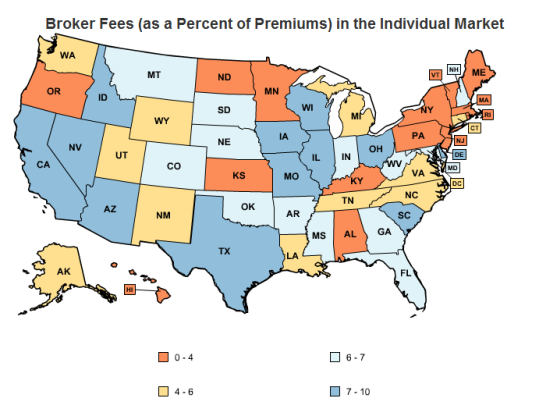
To put all this into perspective, we analyzed 2010 insurer filings to NAIC (compiled by Mark Farrah Associates). On average, broker compensation accounted for 6% of insurance premiums in the individual market and 5% of premiums in the small group market. On a per person basis, this works out to an average of about $12 per month going to commissions in the individual market and $15 in the small group market. (Note that these amounts are averages. Not all insurance is sold through brokers, and commissions are generally higher for an initial sale than for a renewal.)
Interestingly, the amount insurers spend on brokers compensation varies quite a bit from state to state. In the individual market, commissions range from less than 1% of premiums on average in Hawaii and Vermont to nearly 10% of premiums in South Carolina and Delaware. In the small group market, broker compensation accounts for less than 1% of premiums in Alabama and North Dakota, compared to about 7% of premiums in Utah and California.
The state-by-state variation may be due to a variety of factors, including: How competitive the insurance market is, how insurance is sold in different states, how often individuals and consumers change insurance carriers, and the level of commissions paid by insurers. In some states, insurers rely more heavily on direct sales than commissions. Direct sales are also counted as administrative expenses under the MLR rule, but on average account for a much lower share of premium revenue than commissions (about 1% on average in both the small group and individual markets).
How much pressure the MLR requirement will put on broker commissions – or, how much exempting them would affect rebates to consumers – will vary from state to state, but also from insurer to insurer. Some plans appear to already be meeting the MLR thresholds, so exempting commissions in those cases would have little effect. But for the market overall, removing sales commissions from the equation would lead to smaller rebates for consumers and higher premiums over time.
Starting in 2011, the fellowship program provides in-depth briefings and week-long site visits focused on complex health policy issues. These are for invited health and health policy journalists, with invitations tailored to the topics and issues addressed.
California: The first site visit of 2011 focused on the implementation of the Affordable Care Act (ACA) in California. In May 2011, journalists with a strong focus on health policy, state health reform, and/or California-specific policy issues were invited to participate in a week-long program. Based initially in San Francisco and later in Sacramento, the program offered journalists the opportunity to meet with a variety of stakeholders concerned with the implementation of health reform, including officials from the California Health and Human Services Agency, health policy experts, physicians, community clinic staff members and legislative staff. The program focused on a range of issues including the establishment of the California health benefit exchange, the state’s “Bridge to Reform” 1115 Medicaid Demonstration Waiver, Healthy San Francisco, initiatives to improve the delivery of health care and reduce medical costs, and projects addressing physician shortages in the Medicaid program.
Texas: Based in Austin and Dallas, the site visits offered journalists the opportunity to meet with a variety of experts and stakeholders. Journalists met with state health officials, health policy analysts, academics, community clinic staff members and legislative staff. The program focused on a range of issues including the demographics in Texas and their implication for health care, Medicaid in Texas and the 1115 Waiver, and access to health care and the performance of health care safety net systems in Texas.
With the passage of health reform, the Money Follows the Person (MFP) demonstration grant program was extended through 2016 giving states further options to transition Medicaid beneficiaries living in institutions back to the community. Enacted into law in 2006 as part of the Deficit Reduction Act (DRA), the MFP demonstration provides states with enhanced federal matching funds for twelve months for each Medicaid beneficiary transitioned from an institutional setting to a community-based setting.
A total of 43 states and the District of Columbia have received federal grant money under the program to transition Medicaid individuals living n institutions back into their homes or the community. As of August 2011, nearly 17,000 individuals nationally had been transitioned since the program’s inception, up from 8,902 individuals by 2010. These findings and others in the report are derived from a Kaiser Commission on Medicaid and the Uninsured survey of state MFP programs conducted in August 2011. The latest survey is a follow-up to surveys conducted in 2010 and 2008.
As the country struggles to recover from the impact of the Great Recession, one much discussed and analyzed economic measure has been the number of Americans who are unemployed. NPR News and the Kaiser Family Foundation partnered on the Long-Term Unemployed Survey to better describe the experiences and views of two groups of individuals: the long-term unemployed (those who have been out of work for a year or more and would prefer to be working) and the long-term underemployed (those who are working part-time and have been without full-time work for over one year, but are interested in full-time employment).
NPR reported the findings in the series, “Still No Job: Over A Year Without Enough Work,” which aired across all NPR newsmagazines and at NPR.org. The survey is part of a series of polling projects about health-related issues by NPR and the Henry J. Kaiser Family Foundation.
This fact sheet summarizes the Texas health care landscape, including data on demographics, population health, the uninsured and the state Medicaid program.