KFF Tracking Poll on Health Information and Trust: Health Information and Advice on Social Media
Findings
Key Takeaways
- Just over half (55%) of adults, including larger shares of young adults and Black and Hispanic adults, say they use social media to find health information and advice at least occasionally and most adults report seeing health-related content in the past month on social media, with the largest shares saying they’ve seen content about weight loss, diet, or nutrition (72%) and mental health (58%). Overall, fewer adults report seeing content related to vaccines (38%), abortion (30%), and birth control (22%). Even people who say they never use social media for health information and advice report being exposed to health information in the past month – with weight loss, nutrition, and diet information being the most common.
- Most adults are skeptical of the health information and advice they see across social media platforms. When asked to assess the health information and advice on various social media platforms, fewer than half say they find “most” or “some” of the information they see on each platform trustworthy, and less than one in ten say “most” of the information is trustworthy. There is some variance across platforms, with at least three in ten users of YouTube, TikTok, and Reddit saying they trust “some” of the health content they see, compared to about a quarter of Facebook, Instagram, and X users, and smaller shares of users of WhatsApp, Snapchat, and Bluesky who say this.
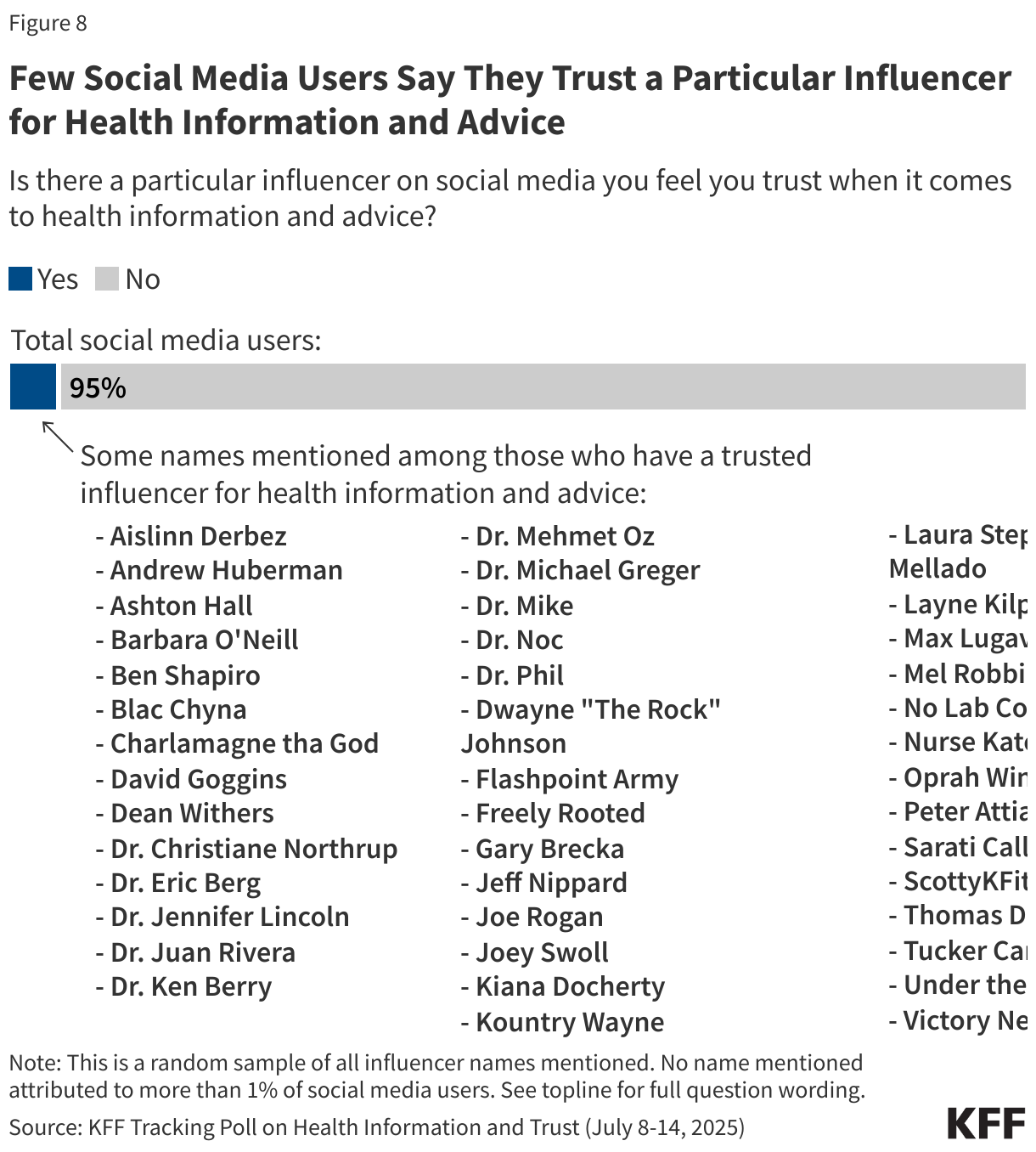
- About one in six (15%) social media users (14% of the public overall) say they regularly get health information and advice from social media influencers. Among those who report regularly getting health information and advice from influencers on social media, six in ten (61%) say health influencers are mostly motivated by their own financial interests, while about four in ten (39%) say health influencers are mostly motivated by serving the public interest. Among those who use social media for health information and advice, more than one-third (36%) say there is a particular influencer whom they trust when it comes to health information and advice (5% of total social media users), with a variety of individuals named, including conservative influencers, as well as doctors and other health care providers mentioned by name.
The Public’s Use of Social Media for Health Information and Advice
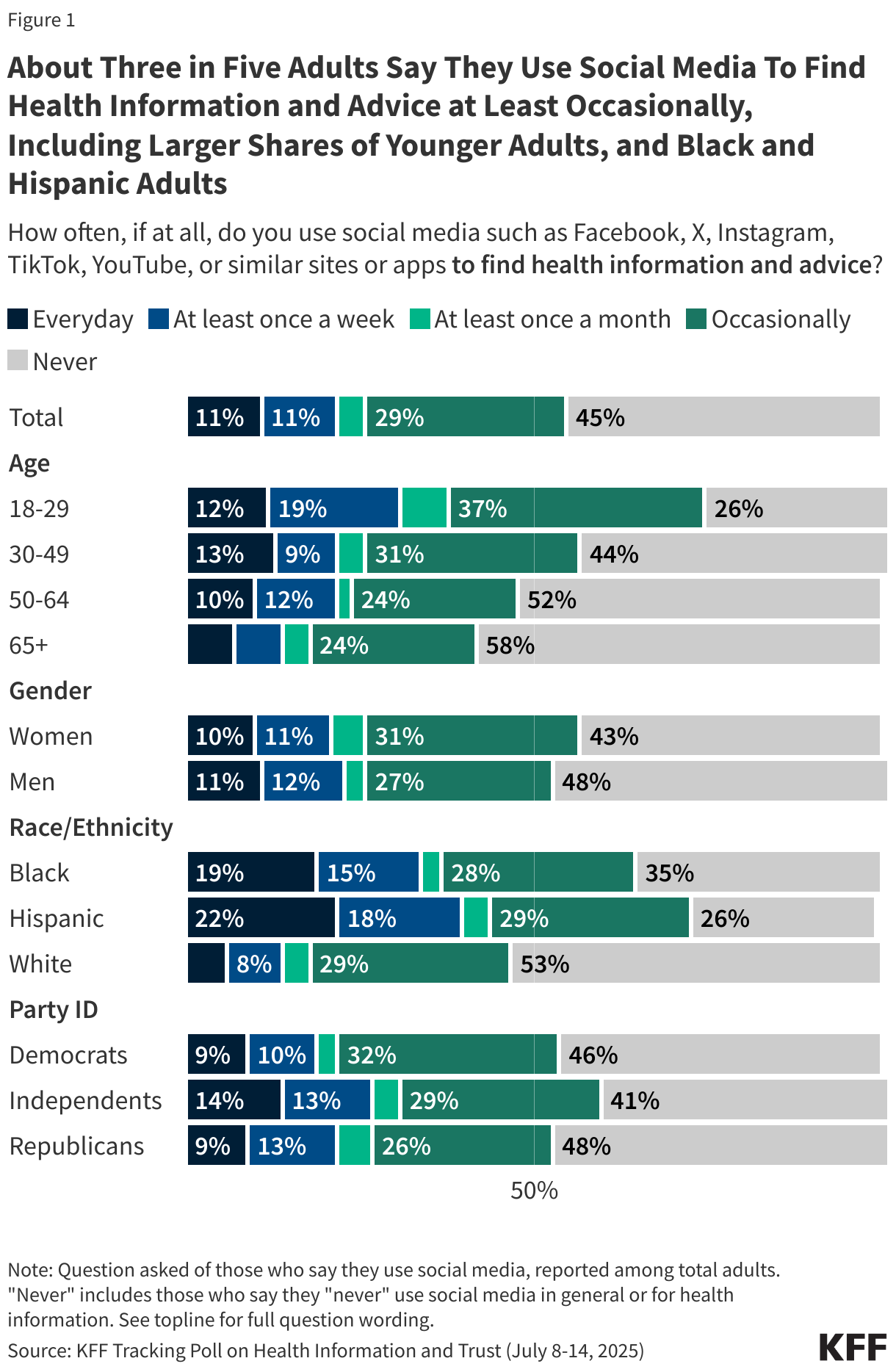
Just over half (55%) of adults say they use social media to find health information and advice “at least occasionally,” with larger shares of younger adults, and Black and Hispanic adults reporting this. Overall, about one in ten adults say they use these sites or apps to find health information and advice “everyday” (11%) or “at least once a week” (11%), 4% say they use it “at least once a month,” and about three in ten (29%) say they use it “occasionally” for this purpose. About four in ten (45%) adults say they never use social media to look up health information and advice. Younger adults and Black and Hispanic adults are more likely to report using social media to find health information and advice, while similar shares of social media users by gender and partisanship say they do this.
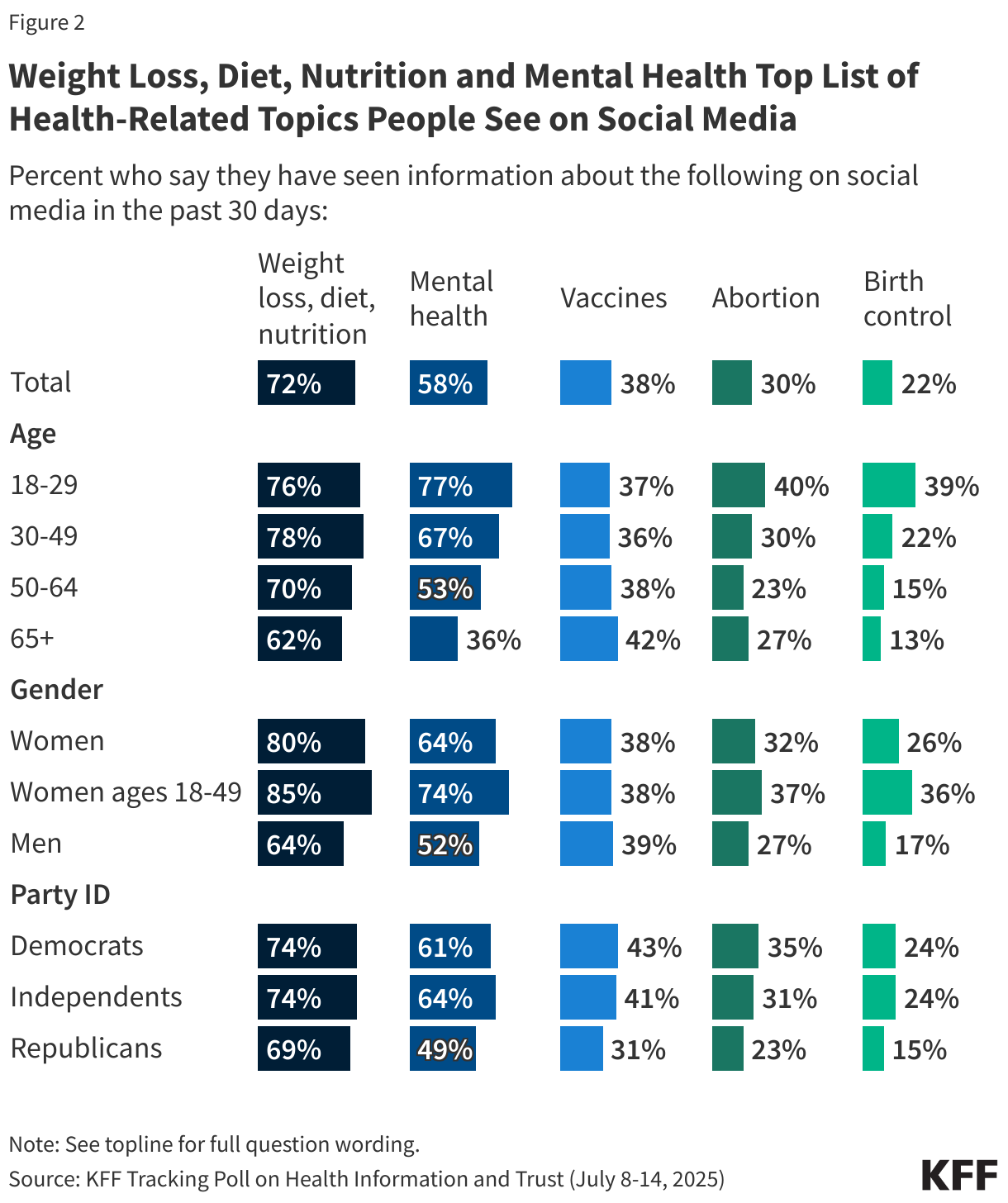
Majorities of the public report being exposed to health information and advice about weight loss, diet, and nutrition (72%) as well as mental health (58%) on social media in the past 30 days, with younger adults, women, and Democrats most likely to report seeing these topics. Overall, fewer adults report seeing other content related to vaccines (38%), abortion (30%), and birth control (22%) on social media in the past month. Democrats are more likely than their Republican counterparts to report seeing social media content in the past month related to mental health (61% vs. 49%), vaccines (43% vs. 31%), abortion (35% vs. 23%), and birth control (24% vs. 15%). Similar shares of adults by race and ethnicity report seeing most of these topics on social media, though White adults (41%) are more likely to report seeing content about vaccines compared with Black (34%) and Hispanic (29%) adults. Notably, sizeable shares of adults who say they “never” use social media to find health information and advice nonetheless report seeing these topics, including seven in ten who say they have seen weight loss, diet, and nutrition information on social media in the past month.
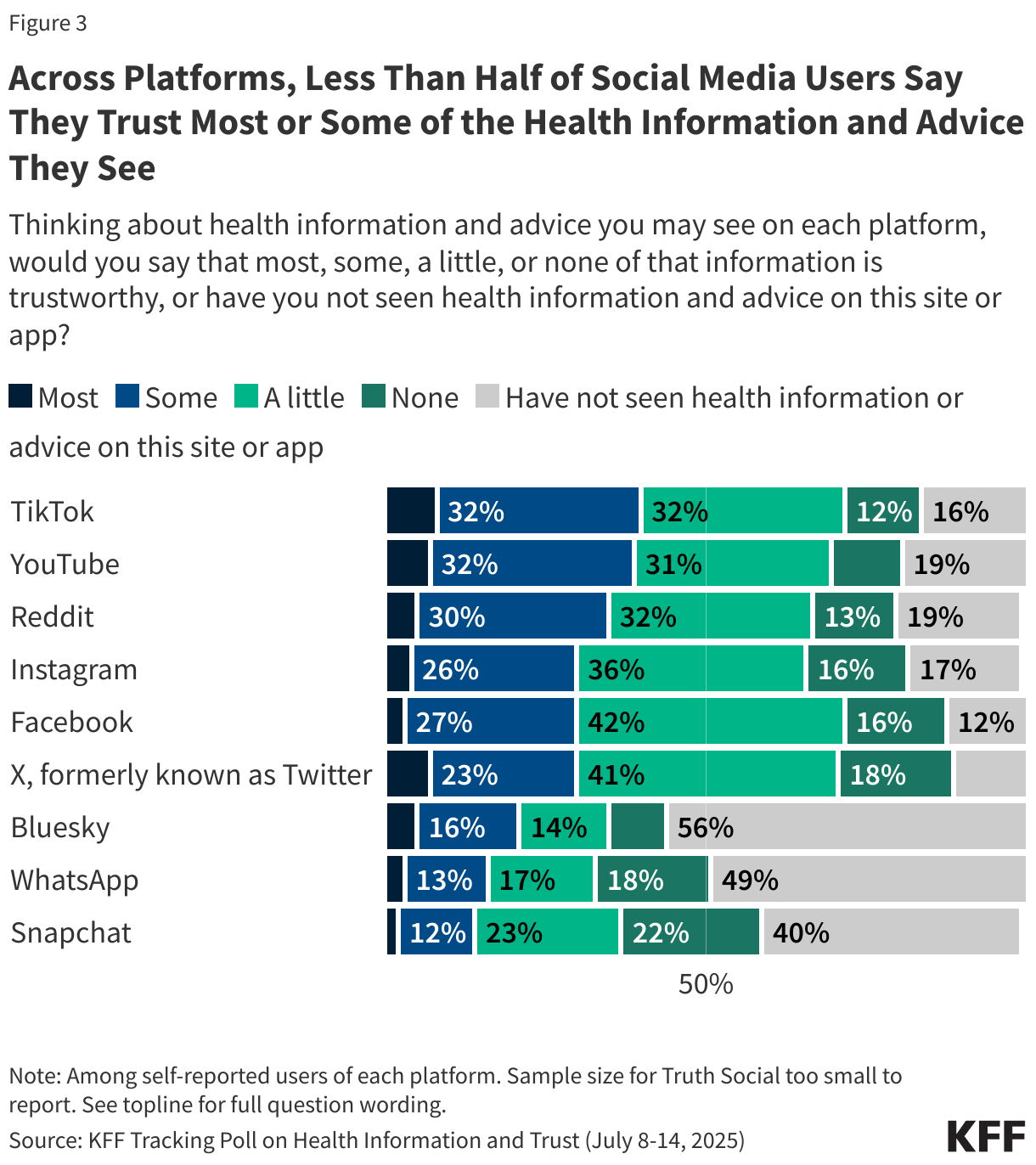
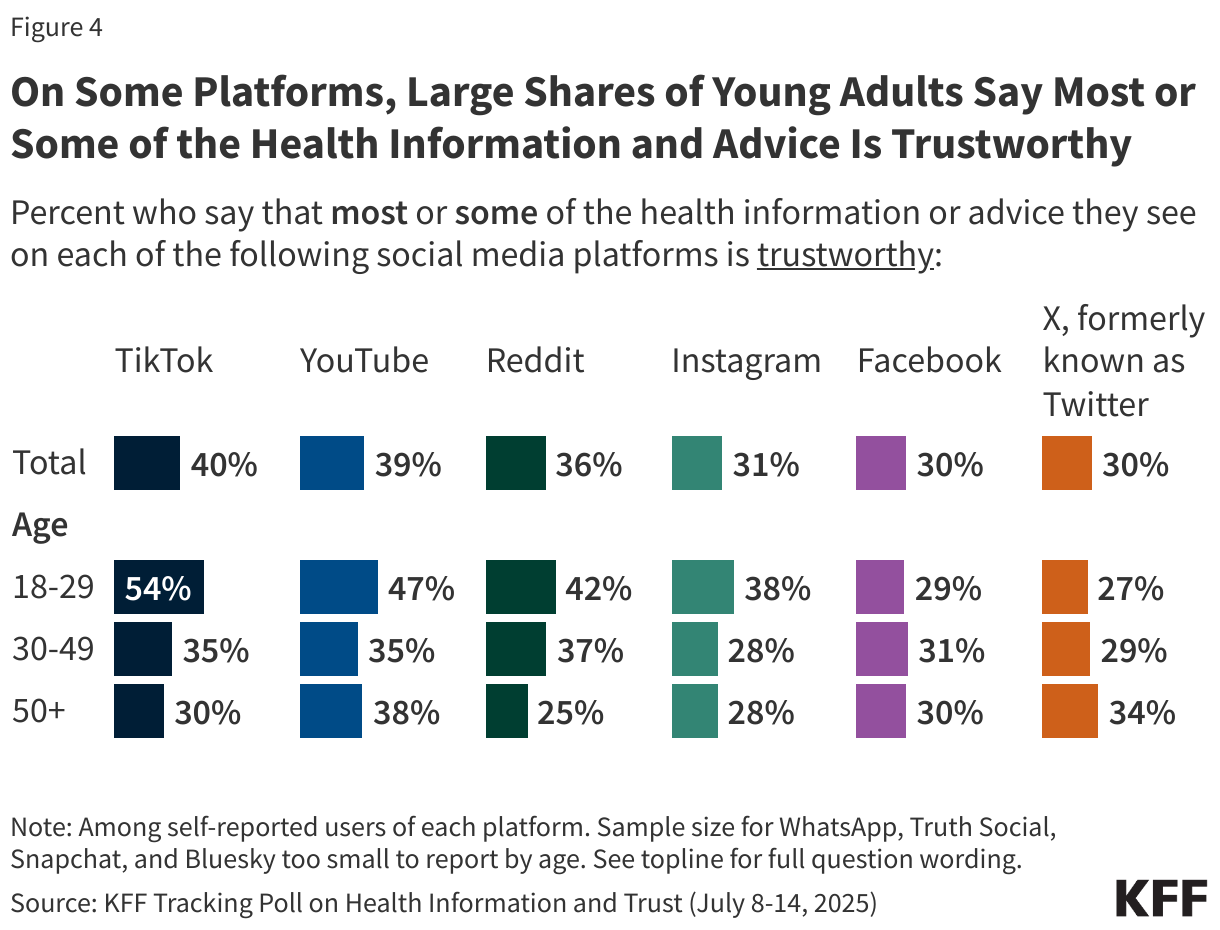
Less than one in ten social media users say they trust most of the health information and advice they see on social media platforms. At least three in ten users of YouTube, TikTok, and Reddit say “some” of the health content they see is trustworthy, as do about a quarter of those who use Facebook, Instagram, and X. Smaller shares of users of WhatsApp, Snapchat, and Bluesky say the same. Importantly, across all social media platforms, a majority of users say they trust the health information they see on the app either “a little” or say that none of the information is trustworthy.
On some of the most widely used social media apps or sites, large shares of younger adults trust the health information and advice they see. For example, just over half (54%) of TikTok users ages 18-29 say “most” or “some” of the health information and advice they see on the app is trustworthy, as do about half (47%) of young YouTube users, and about four in ten young Reddit (42%) and Instagram (38%) users. On lesser used sites by young adults like Facebook and X, younger adults are as trusting of the health information they see as older adults.
The Role of Social Media Health Influencers
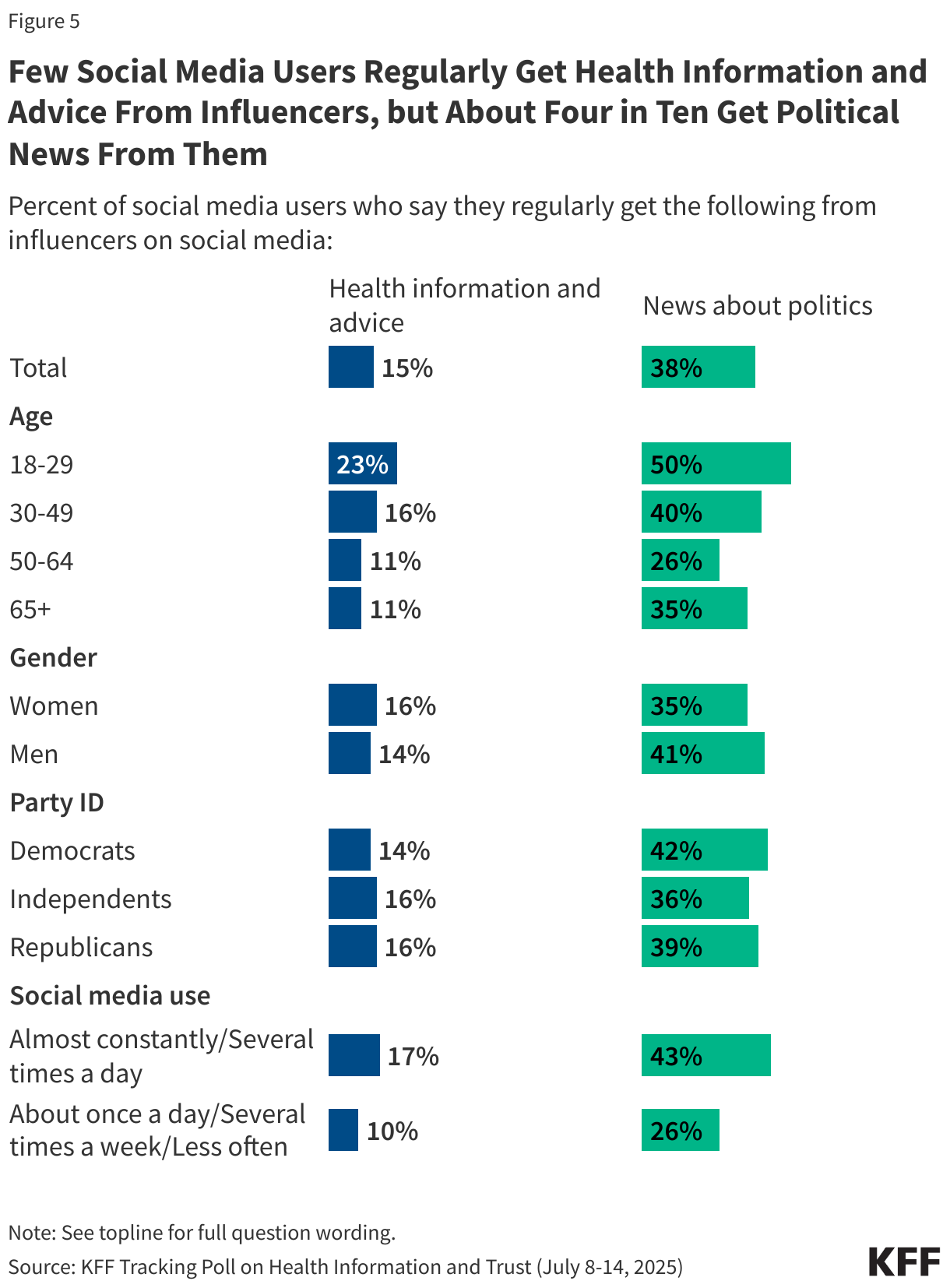
About one in six (15%) adults who use social media (14% of the public overall) say they regularly get health information and advice from influencers on social media. Notably, the share who say they get health information and advice from social media influencers is much smaller than the share who say they get news about politics from social media influencers (38% say so). Certain groups are more likely to report relying on social media influencers for health information and advice including about one in five 18–29-year-olds (23%) and Black adults who use social media (21%). Perhaps unsurprisingly, more frequent social media users are more likely to say they get health information and advice from influencers than less frequent social media users. Similar shares of social media users by gender and partisanship say they get health information and advice from influencers. About one in five users of each social media platform say they regularly get health information and advice, ranging from 15% of YouTube users to 21% of TikTok users.
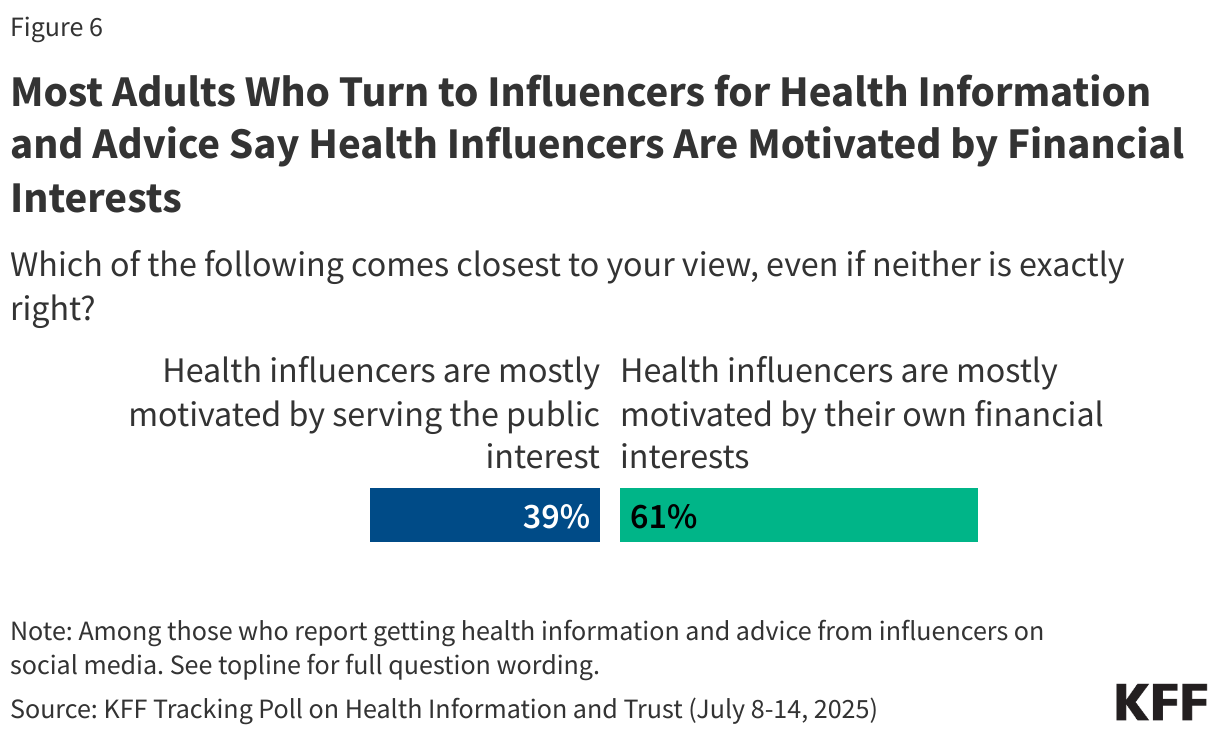
Among those who report regularly getting health information and advice from influencers on social media, six in ten (61%) say health influencers are mostly motivated by their own financial interests, while about four in ten (39%) say health influencers are mostly motivated by serving the public interest.
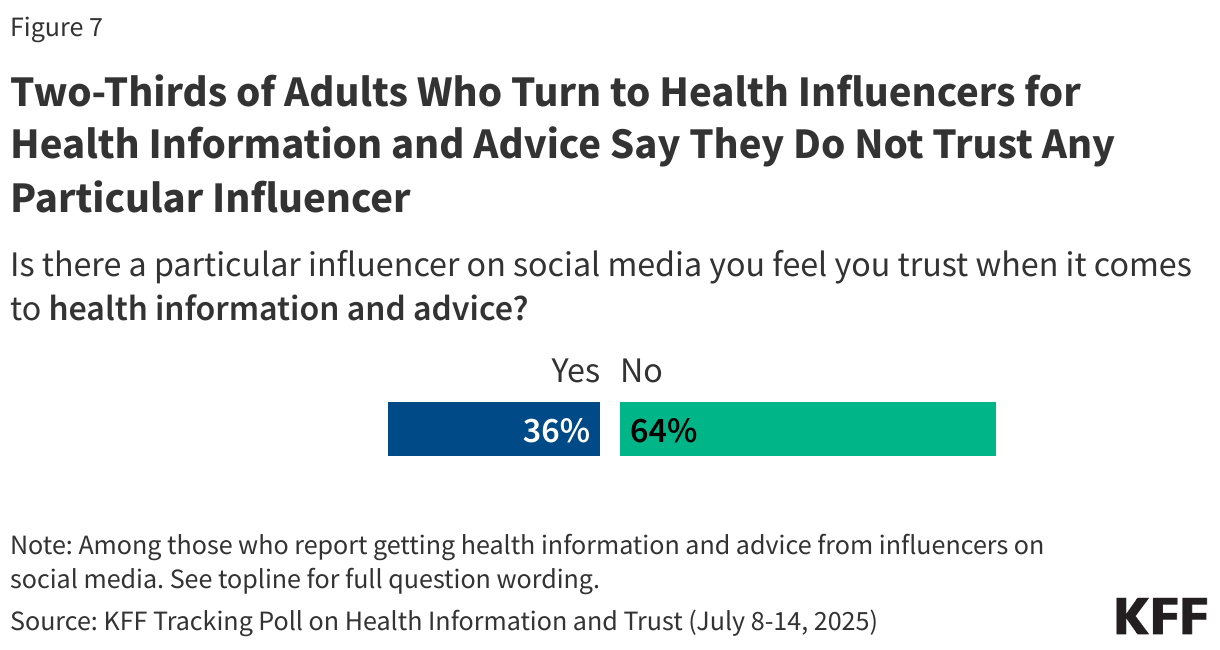
One-third (36%) of those who use social media for health information and advice say they trust a particular influencer for this (5% of total social media users). When asked to give the name or handle of the person whom they trust for health information and advice, a variety of individuals are mentioned, including Barbara O’Neill and Nurse Kate, conservative influencers like Ben Shapiro, Joe Rogan, as well as doctors and other health care providers who were mentioned by name.
Methodology
This KFF Health Tracking Poll/KFF Tracking Poll on Health Information and Trust was designed and analyzed by public opinion researchers at KFF. The survey was conducted July 8-14, 2025, online and by telephone among a nationally representative sample of 1,283 U.S. adults in English (n=1,212) and in Spanish (n=71). The sample includes 1,004 adults (n=58 in Spanish) reached through the SSRS Opinion Panel either online (n=979) or over the phone (n=25). The SSRS Opinion Panel is a nationally representative probability-based panel where panel members are recruited randomly in one of two ways: (a) Through invitations mailed to respondents randomly sampled from an Address-Based Sample (ABS) provided by Marketing Systems Groups (MSG) through the U.S. Postal Service’s Computerized Delivery Sequence (CDS); (b) from a dual-frame random digit dial (RDD) sample provided by MSG. For the online panel component, invitations were sent to panel members by email followed by up to three reminder emails.
Another 279 (n=13 in Spanish) adults were reached through random digit dial telephone sample of prepaid cell phone numbers obtained through MSG. Phone numbers used for the prepaid cell phone component were randomly generated from a cell phone sampling frame with disproportionate stratification aimed at reaching Hispanic and non-Hispanic Black respondents. Stratification was based on incidence of the race/ethnicity groups within each frame. Among this prepaid cell phone component, 135 were interviewed by phone and 144 were invited to the web survey via short message service (SMS).
Respondents in the prepaid cell phone sample who were interviewed by phone received a $15 incentive via a check received by mail. Respondents in the prepaid cell phone sample reached via SMS received a $10 electronic gift card incentive. SSRS Opinion Panel respondents received a $5 electronic gift card incentive (some harder-to-reach groups received a $10 electronic gift card). In order to ensure data quality, cases were removed if they failed two or more quality checks: (1) attention check questions in the online version of the questionnaire, (2) had over 30% item non-response, or (3) had a length less than one quarter of the mean length by mode. Based on this criterion, 1 case was removed.
The combined cell phone and panel samples were weighted to match the sample’s demographics to the national U.S. adult population using data from the Census Bureau’s 2024 Current Population Survey (CPS), September 2023 Volunteering and Civic Life Supplement data from the CPS, and the 2025 KFF Benchmarking Survey with ABS and prepaid cell phone samples. The demographic variables included in weighting for the general population sample are gender, age, education, race/ethnicity, region, civic engagement, frequency of internet use, political party identification by race/ethnicity, and education. The weights account for differences in the probability of selection for each sample type (prepaid cell phone and panel). This includes adjustment for the sample design and geographic stratification of the cell phone sample, within household probability of selection, and the design of the panel-recruitment procedure.
The margin of sampling error including the design effect for the full sample is plus or minus 3 percentage points. Numbers of respondents and margins of sampling error for key subgroups are shown in the table below. For results based on other subgroups, the margin of sampling error may be higher. Sample sizes and margins of sampling error for other subgroups are available on request. Sampling error is only one of many potential sources of error and there may be other unmeasured error in this or any other public opinion poll. KFF public opinion and survey research is a charter member of the Transparency Initiative of the American Association for Public Opinion Research.
| Group | N (unweighted) | M.O.S.E. |
| Total | 1,283 | ± 3 percentage points |
| Party ID | ||
| Democrats | 439 | ± 6 percentage points |
| Independents | 387 | ± 6 percentage points |
| Republicans | 344 | ± 6 percentage points |
| MAGA Republicans | 308 | ± 7 percentage points |